
There’s not much I can say, folks. Just check these videos out — and tell me what you think…
Countdown to Comedy: 3 Weeks Before Emilia, Maggie & Daniel at iO West!
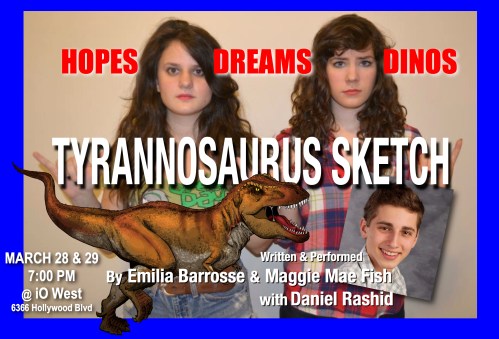 Hopes. Dreams. Dinos. Get Your Tickets Now for “Tyrannosaurus Sketch”
Just three short weeks from now, On March 28th and 29th, my daughter Emilia Barrosse and her Snickerdoodlin’ comedy partner and fellow Northwestern alum, Maggie Mae Fish, will perform their original comedy revue, Tyrannosaurus Sketch at iO West on Hollywood Blvd. Joining the cast will be USC’s Daniel Rashid, the son of fellow Northwestern University alums and Practical Theatre Company members, Steve and Bea Rashid.
I saw Emilia and Maggie perform this show in December at Studio Be on North Sheffield in Chicago. (It was a nostalgic night for me because Studio Be is across the street from the Vic Theatre, where Vic and I performed in two Practical Theatre comedy revues in the mid 1980s.) Though the temperature outside Studio Be was 1 degree below zero — the comedy inside was hot. After the show I said they should do it again in Los Angeles: where theatre audiences don’t have to brave life-threatening temperatures to attend a spirited night of improvisational sketch comedy. I eagerly volunteered to direct.
In “Tyrannosaurus Sketch”, Emilia and Maggie, two recent college graduates, are ready to strike out on their own and make their dreams come true – but it’s not going to be easy. The madness of everyday life and their own overheated imaginations create hilarious obstacles along their path to self-realization and personal fulfillment. Plus some dinosaurs. And Daniel.
It’s going to be a very entertaining night, folks.
Both shows are at 7:00 pm. Tickets can be ordered here.
Come join the fun!
Filed under Art, Comedy, Improvisation
A Dry Season: Malibu Creek State Park & Sycamore Canyon

 Last month, as California experienced its driest year on record, Governor Jerry Brown declared a drought emergency in our glorious Golden State. (Which is currently more burnt umber than gold.)
 At a news conference held to make his case for the severity of the drought, Governor Brown used charts to show that this drought is historic — and that it’s time for Californians to conserve our precious water.
But most of us Californians didn’t need Jerry Brown’s earnest show and tell to inform us that we’re going through a shockingly dry season.
We have the clear evidence of our own experience.
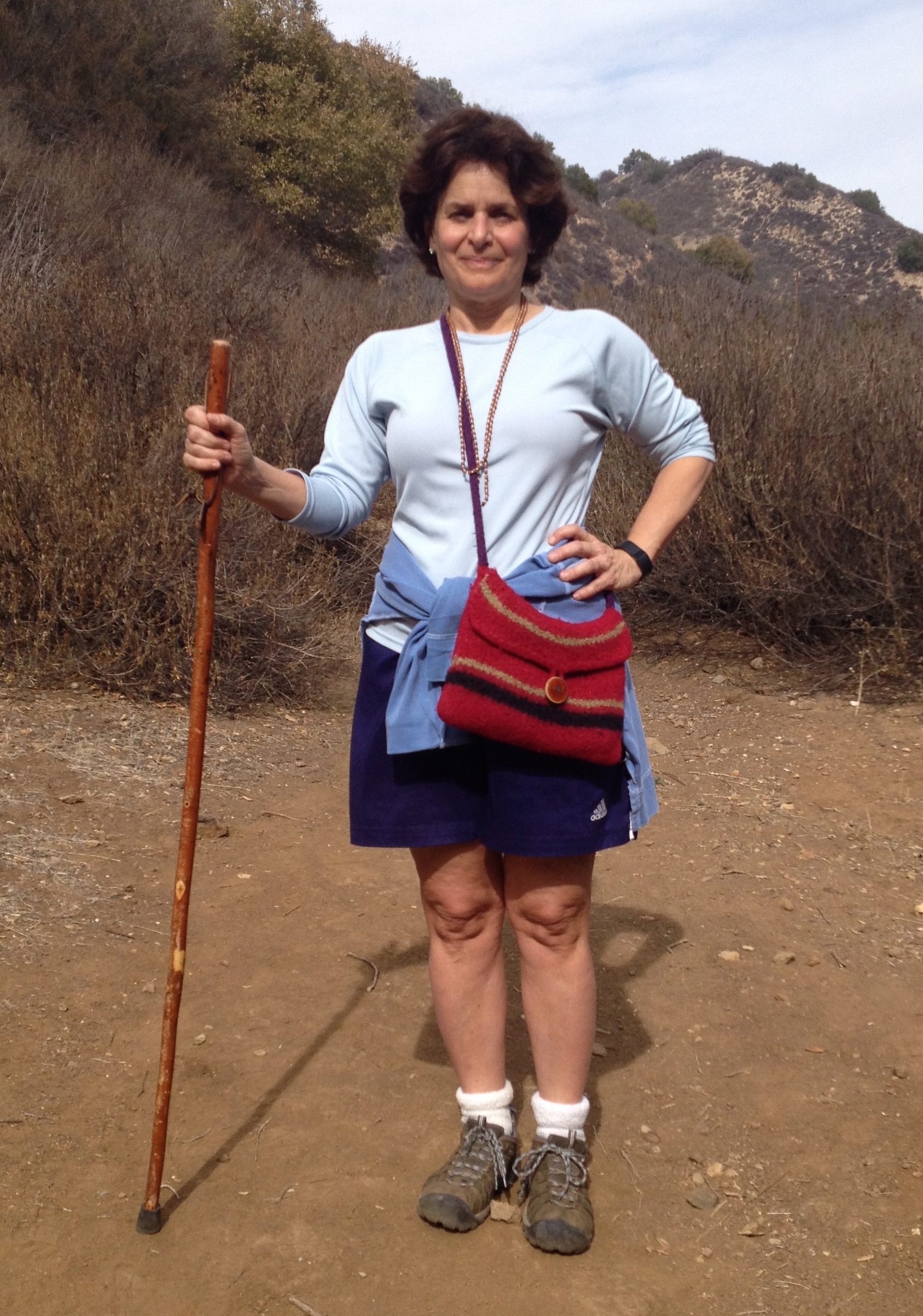 My wife and I took two hikes in the Los Angeles area this past weekend – and our state’s dire drought conditions were dramatically evident on both hikes.
On Saturday we went, as we often do, to nearby Malibu Creek State Park. However, right now there’s no creek.
Here’s a photo of the creek from one of our hikes in the spring of last year.
Here’s a photo of the creek as it appears now. All that’s missing is the creek.
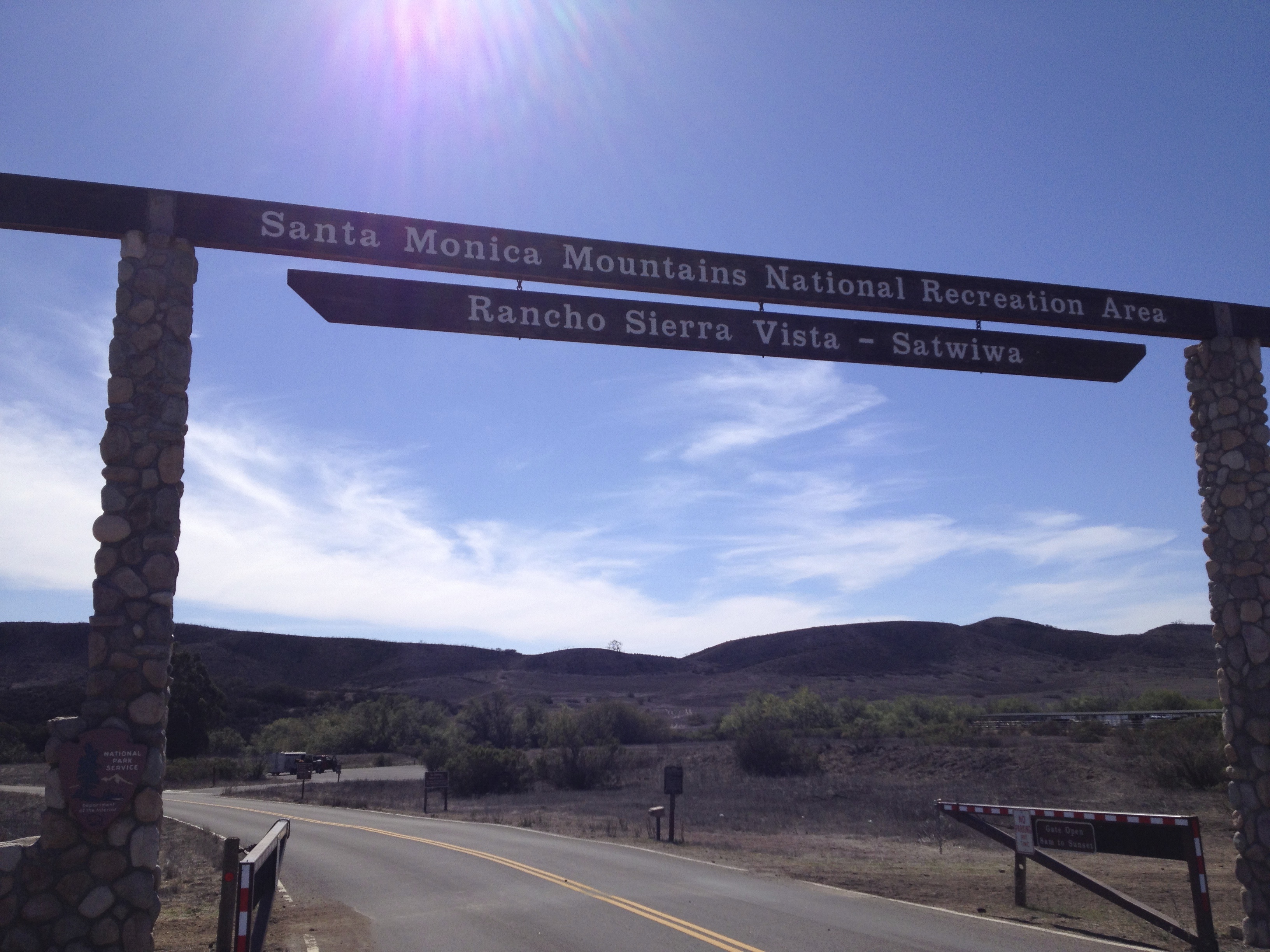 On Sunday, we took our second trip to The Santa Monica Mountains National Recreation Area, Rancho Sierra Vista – Satwiwa — just south of the 101 Freeway on the eastern edge of Ventura County.
This wonderful park encompasses the area where the old Chumash Indian village Satwiwa once stood, as well as 8 miles of winding trail through Sycamore Canyon that the Chumash used as a path to the Pacific Ocean shore.

Victoria explores a Chumash dwelling at the Satwiwa Native American Indian Culture Center.
 Last year, in May 2013, a wildfire raged across much of this parkland – and the devastation from that conflagration is evident in the charred, blackened landscape.
Wildfires can happen in any season, in any year in Southern California, but drought conditions increase the danger of fire exponentially.
Fire is a natural part of the cycle of life in the Santa Monica Mountains. For ages, coastal Southern California chaparral land like that in the Santa Monicas has experienced infrequent but intense wild fires. These fires usually blaze in the fall, driven by dry conditions and hot Santa Ana winds. Unfortunately, the frequency of fires has increased due to human activity. And the drought doesn’t help.
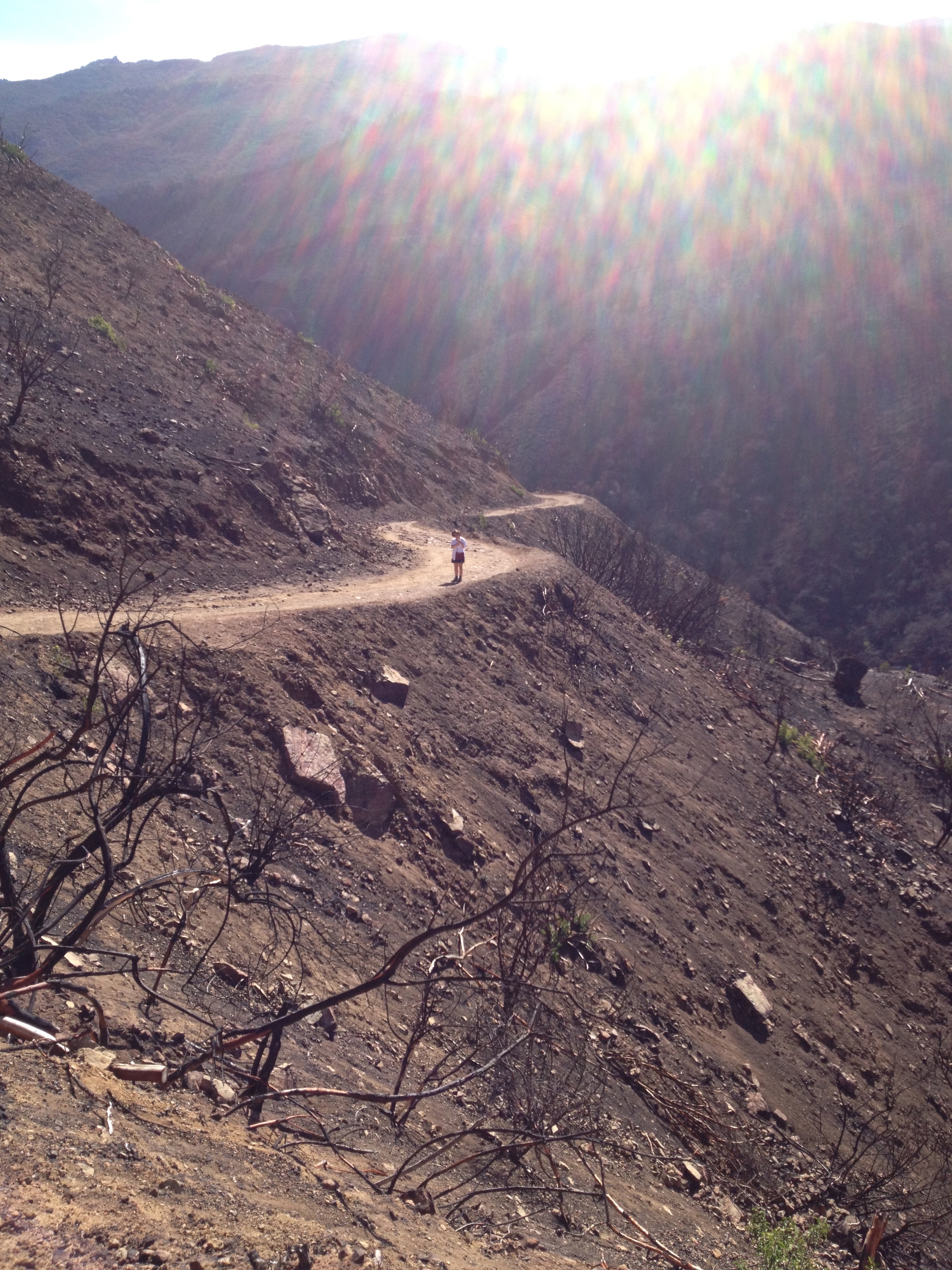 But, while the ravages of the fire can seem almost apocalyptic as you gaze in awe at the darkened, denuded hillsides – you can also see signs of bright green life creeping back into view.
Within a few years, these hills surrounding Sycamore Canyon will be covered in greenery once again. Of course, a little rain would help that process of regeneration along.
Here we are at the fire line: the place where the fire stopped. On one side, you can see Victoria walking under a canopy of live oaks: a sylvan heaven.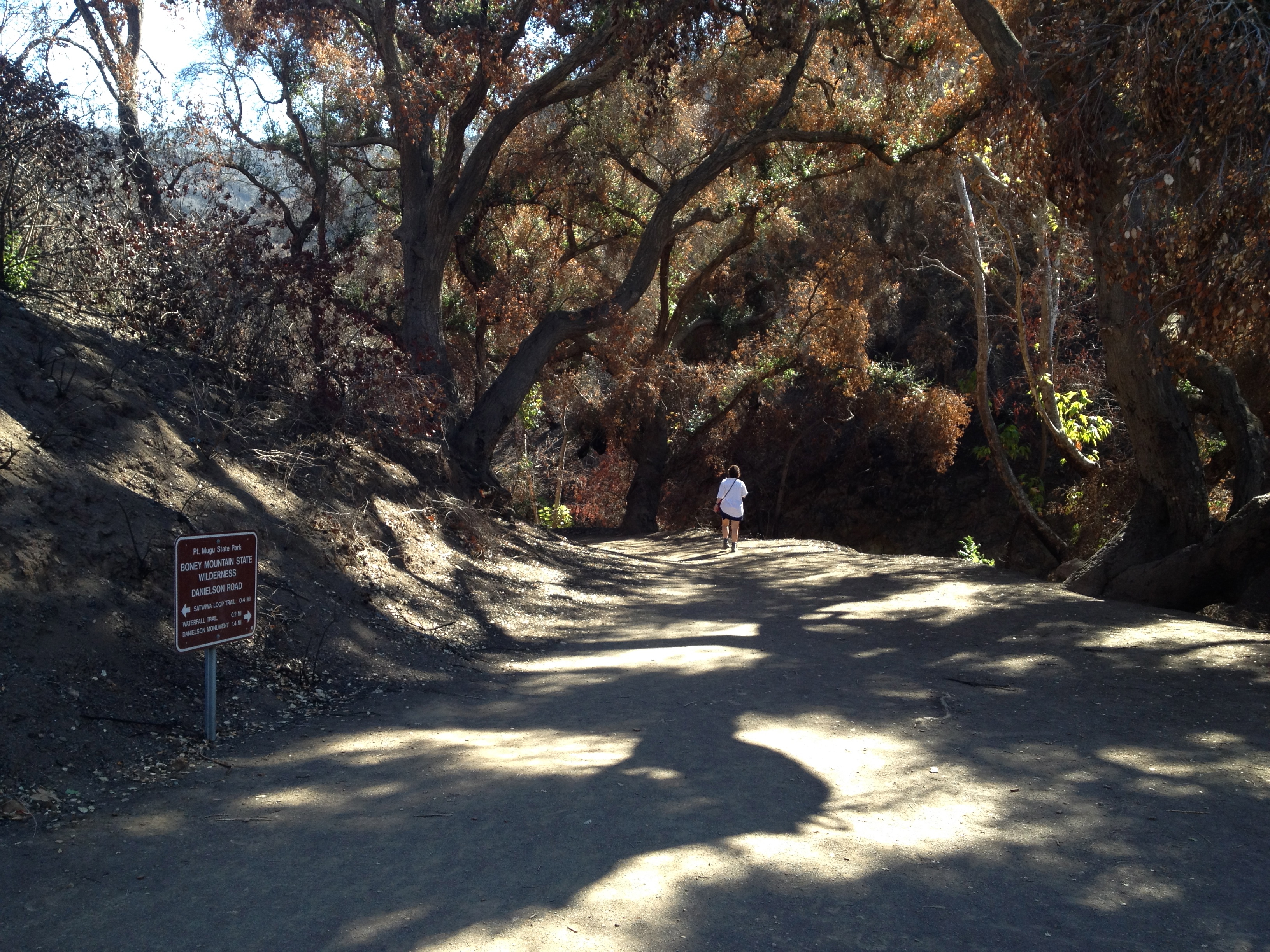
But when you turn around 180 degrees – there’s no canopy of trees anymore: just a charred hillside.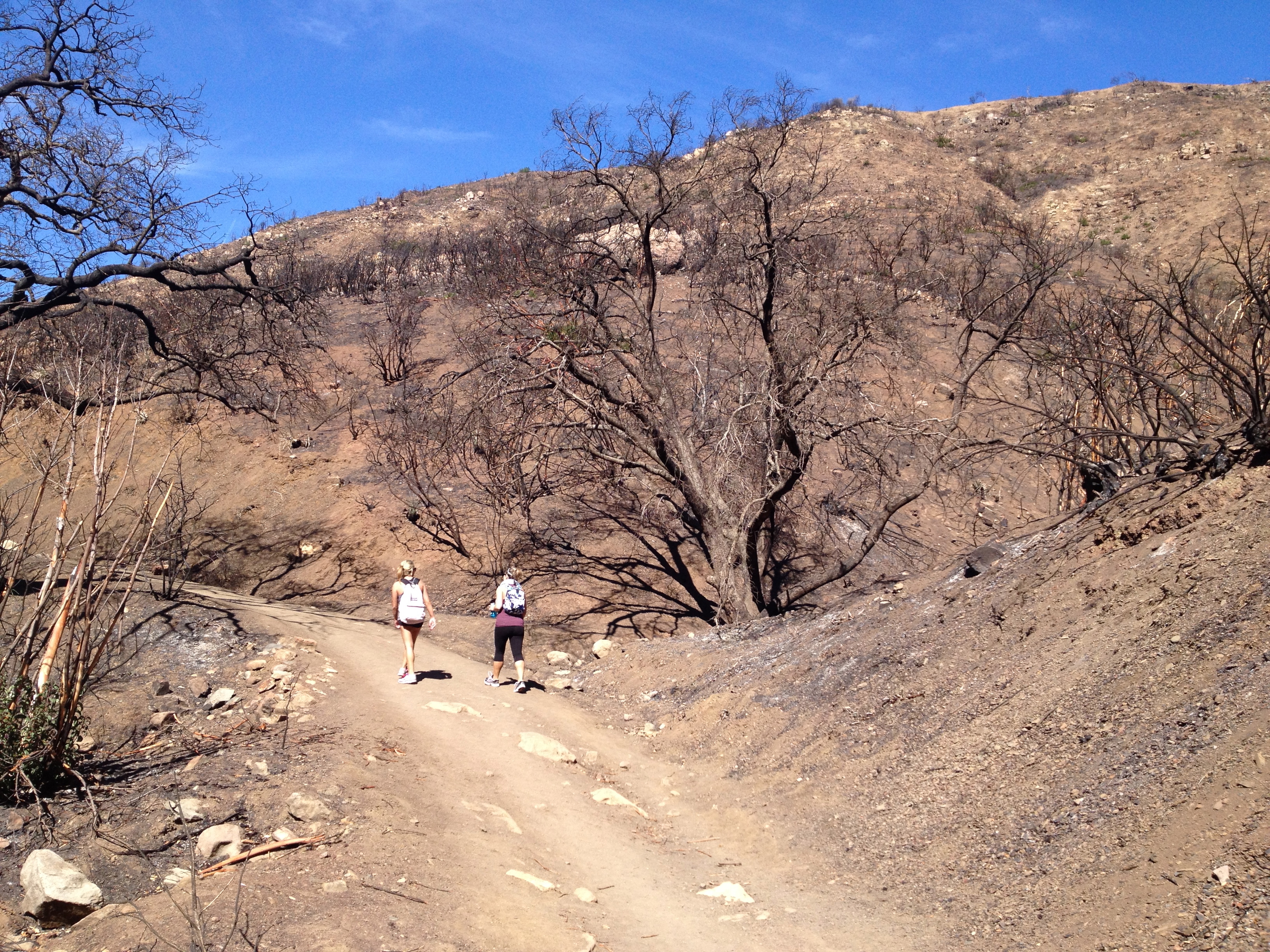
 Victoria and I hiked the trail that leads to what, in a normal, rainy winter, is a dramatic waterfall. But our hike along the waterfall trail brought home the deadly dry nature of this year’s drought. What follows are shots of the small pools of water that linger below the tiny trickle that, at this time of year, should be a dramatic cascade.



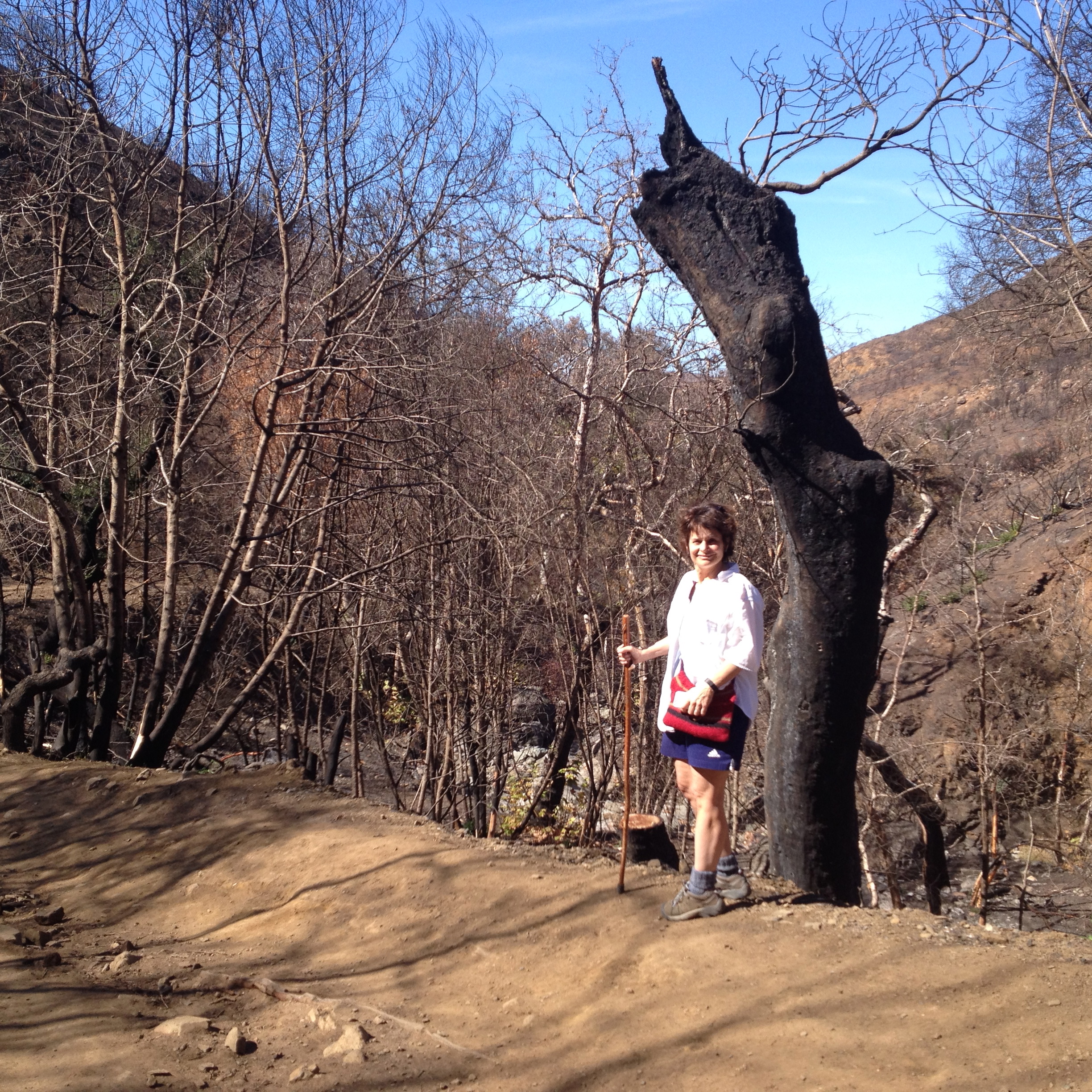
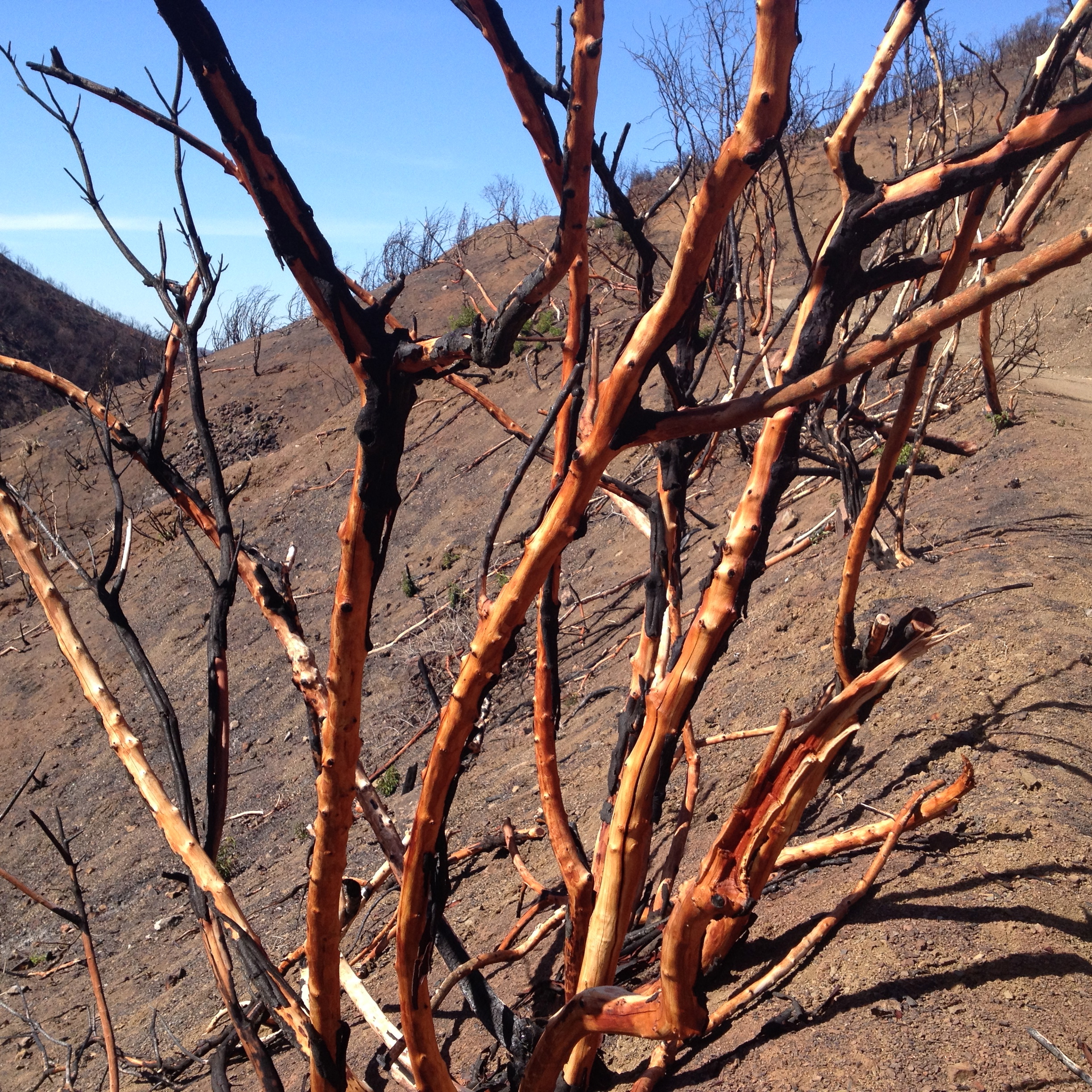

Second Generation Comedy

 I don’t know if a sense of humor is hereditary. I don’t know whether jokes are in your genes. But it appears that funny runs in our family.
 Later this month — on February 20 and 22 — my daughter Emilia will make her West Coast debut as a standup comic at two clubs in Hollywood. If you’re in the Los Angeles area, you may want to check her out.
I have no idea what Emilia’s going to do onstage. She hasn’t run her material by me. She’s 22 years old — and if you’re old enough to vote, fight in the Army, sign a contract and drink legally – you’re old enough not to clear your jokes with dad. So, I can’t wait to hear her routine.
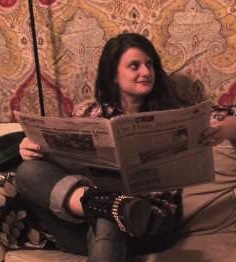 Emilia graduated from Northwestern University (her parents’ alma mater) last June with a hard-earned degree in journalism and a passion for writing comedy. Jokes and Journalism both require a keen, insightful and objective view of the world. But if Emilia’s currently more interested in a punchline than a newspaper byline – what can I say?
After all, what was I doing as a 22-year old fresh out of Northwestern?
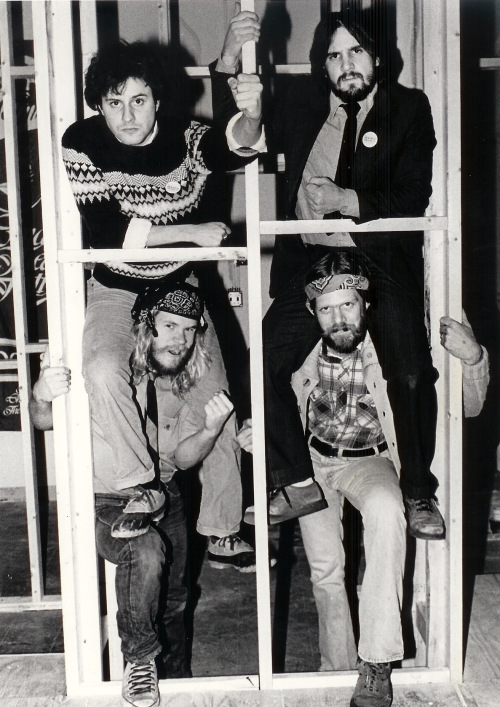 33 years ago, in February 1981 during the winter after my graduation, my comic comrades at The Practical Theatre and I were banging the last bent nails into our newly built storefront theatre at 703 Howard Street in Evanston, Illinois – getting ready to stage our second improvisational comedy revue, Thrills & Glory.
It was the PTC’s third season: our first at the magical 42-seat venue we dubbed The John Lennon Auditorium. Thrills & Glory opened on March 21, 1981 with Rush Pearson, Gary Kroeger, Reid Branson and Emilia’s dad (me) in the cast. We didn’t run our material by our parents, either.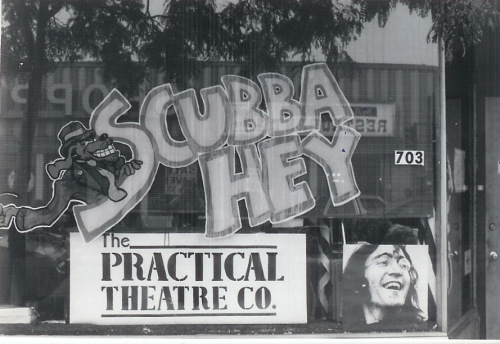
 A few months later, we opened our third comedy revue, Scubba Hey! — featuring Brad Hall (my fellow PTC artistic director), Rush Pearson, me and a (very) funny (very) young girl named Julia Louis Dreyfus, whom Rush and I met when we performed together in the 1980 Mee-Ow Show at Northwestern.
This month, The Mee-Ow Show will celebrate its 40th anniversary. Of course, I cannot possibly be that old.
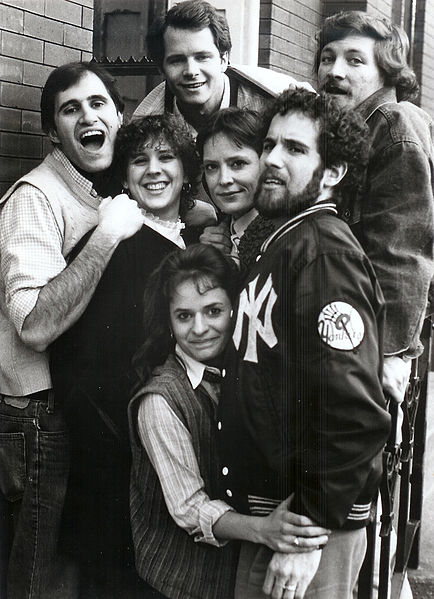 But, evidently, the comedy gene is not solely paternal. Around this same time, as I was earning my last college credits and The Practical Theatre was getting underway, Emilia’s future mom (and my future, fabulous, funny wife) was also doing her own improvisational comedy thing. Victoria Zielinski played the Chicago comedy clubs as a member of a group called Laugh Track: another gathering of Northwestern funny people and Mee-Ow Show veterans.
Vic was in law school in 1981 so she couldn’t be part of the early fun on the tiny stage of The John Lennon Auditorium – but in 1983, she finally joined the cast of the Practical Theatre’s hit comedy revue, Megafun at our Piper’s Alley cabaret space behind Second City.
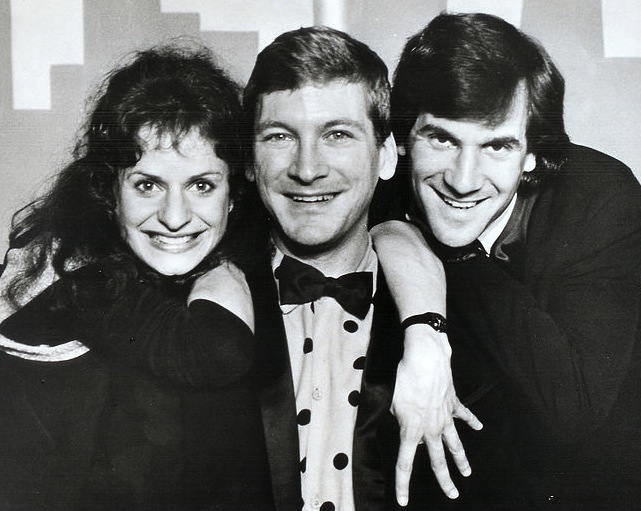 Three years later, Victoria and I (along with Jamie Baron) joined forces in Art, Ruth & Trudy. We got married in 1990. 20 years later, we wrote and performed The Vic & Paul Show — and we’ve been having fun onstage together ever since.
So, I have to admit, our daughter Emilia comes by the comedy thing honestly.
 Emilia’s will perform her first standup set as part of the Miniature Stand-Up Comedy Festival on February 20th in the Leche Lounge at Malo, located at 4326 Sunset Blvd in Los Angeles.
The show starts at 7:30. I’m told that folks should “please be on time as the show will start at 7:45 sharp and seats are limited.”
Emilia will be on a bill with a series of comediennes, including Carmen Faulkner, Christie Campagna, Katie Robinson and Raluca Sanders.
 Two days later, on Saturday February 22 at 7:30 PM, Emilia will be doing a set at the famous Comedy Store at 8433 Sunset Boulevard. Tickets are $10.00, plus a two-drink minimum. But, really, if you’re going all the way down to Hollywood on a Saturday night – two drinks is the minimum, right? (Doors open at 7:00.)
Emilia’s two standup shows are the entertaining preliminaries leading up to the main event.
 On March 28th and 29th, Emilia and her Snickerdoodlin’ comedy partner and fellow Northwestern alum, Maggie Mae Fish, will perform their original comedy revue, Tyrannosaurus Sketch at iO West on Hollywood Blvd. Joining the cast will be USC’s Daniel Rashid, the son of our fellow NU alums and PTC members, Steve and Bea Rashid. (There’s that damn Northwestern/PTC thing again!)
Both shows are at 7:00 pm. Tickets can be ordered here.
 When Emilia, Maggie and Daniel take the stage at iO West on March 28, they’ll do so more than three decades after my Practical Theatre friends and I staged our first comedy revue at the John Lennon Auditorium.
 May Emilia and her friends have as much fun as we did back in the day.
And — as it has been for us — may that be just the beginning.
Filed under Art, Comedy, Improvisation
The State of the Union Speech President Obama Can’t Give. Alas.
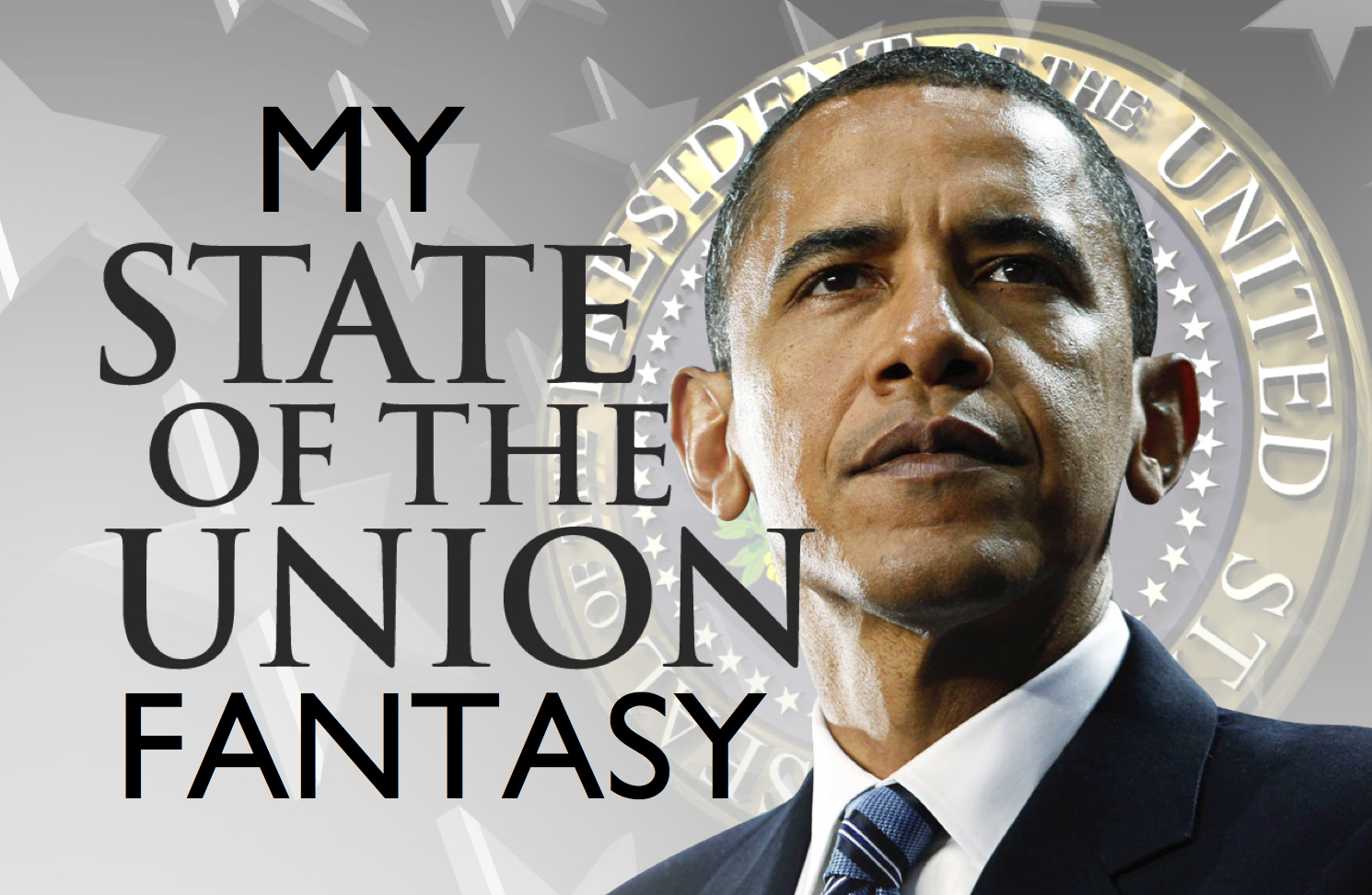
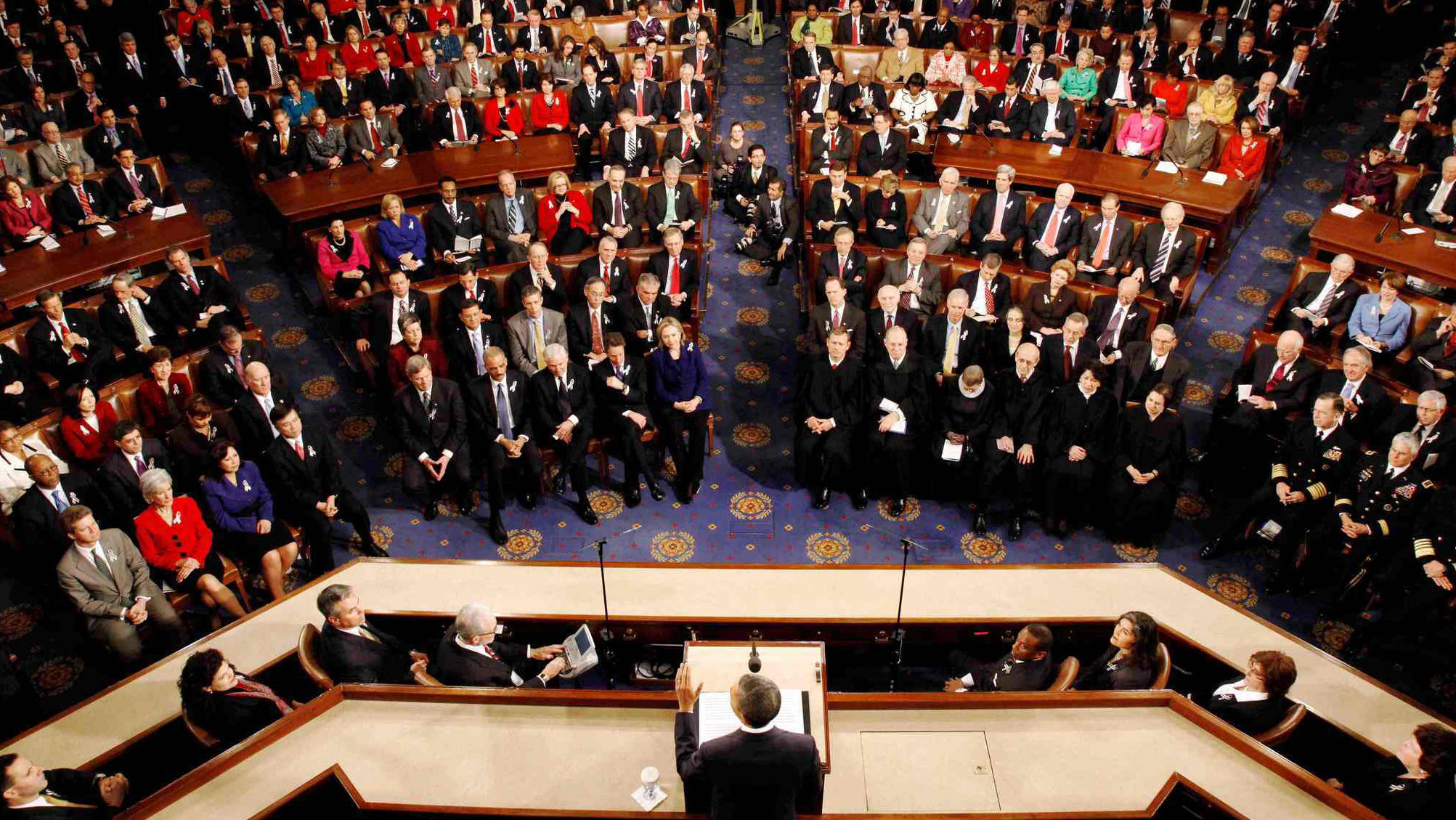 Tomorrow evening, January 28, 2014, President Barack Obama will stand before a special joint session of Congress to present the Constitutionally mandated State of the Union Address. As President Obama is a wise and circumspect orator, a skilled politician and a naturally conciliatory person, he will probably not give the kind of speech millions of progressives, liberals and Democrats would love to hear him give.
 We will certainly hear a speech that will thrill us at times with ardent, engaging calls for tolerance, cooperation, hope and determination in confronting the many daunting challenges our nation faces in this turbulent age of promise and peril.
According to all the pre-speech hype from the TV talking heads, we are led to expect a “feisty” President to lay out an agenda that relies more on executive action than Congressional legislation. Confronted by historic levels of obstruction and inaction by the opposition party, particularly by the Republican majority in the House, Obama has little choice than to try to make progress on his own this year. Yet, I don’t expect him to be completely candid about why he has encountered so much Republican resistance.
In fact, there will be some large elephants in the room that will likely go unaddressed.
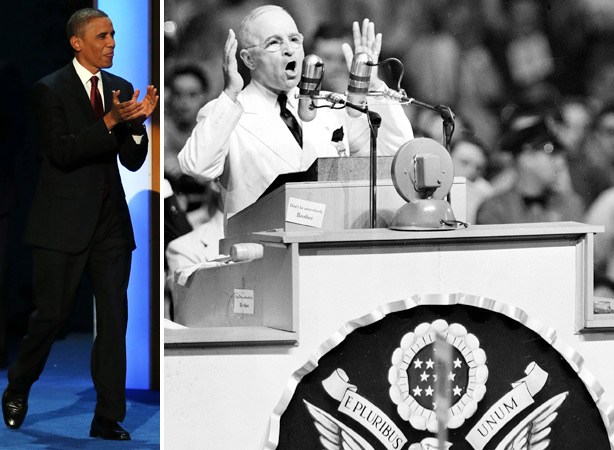 That’s because, as our country’s first black President, while Obama may be allowed to strike a “feisty” note, he can’t afford to appear angry or defiant – though his opponents will surely label him such (and worse) regardless of his actual demeanor. There’s too large, vocal and virulent a sector of the U.S. electorate (and political class) that can’t tolerate the mixed-race son of a black African father and a white American mother bluntly lashing out against a “do-nothing Congress” as President “Give ‘Em Hell” Harry Truman famously did.
Southern blacks were forced to appear humble and deferential in the presence of whites in the Jim Crow South. And now, despite all the progress we’ve made since the Civil Rights Movement of the 50’s and 60’s, a black Leader of the Free World is still not free to get righteously indignant and tell it like it is.
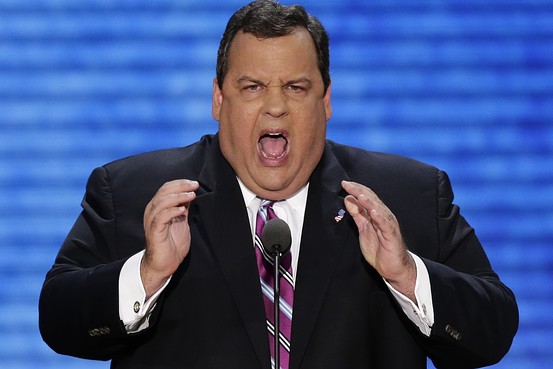 Everyone – even many liberal wise men – agree that President Obama can’t appear to be an angry black man. (Of course, you can’t be an angry woman, either.) But the same politicos and pundits admire tough-talking, shoot-from-the-hip, white public officials from Governor Chris Christie to Sheriff Joe Arpaio. It’s a clear, shameful double standard.
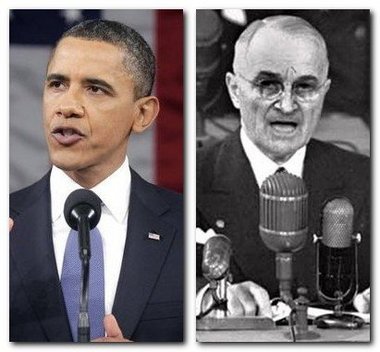 Now, let me be clear. Racial animus isn’t the only reason I don’t expect President Obama to give ‘em hell in his State of the Union speech. It’s clear by now that he’s a natural bridge-builder and consensus-seeker. Obama’s not the kind of populist firebrand that some on the left hoped he might be in 2008 when they heard the soaring rhetoric of his inspirational Hope and Change campaign. I believe he’s sincere about trying to encourage a less divisive political atmosphere.
But Obama can’t clap with one hand — and the GOP refuses to extend theirs.
 So, mindful of the complex reasons that President Obama can’t give the speech I’d love to hear, please indulge me in a bit of political fantasy.
Just imagine that an impassioned Barack Obama wrote the following words in an off-the-top-of-his-head, get-it-off-his-chest first draft. Then, after reading it back to himself, the calm and cautious peacemaker President was about to get out his red pen and start to temper his words – when I got someone to distract him so I could steal this draft off his desk…
TEXT OF PRESIDENT BARACK OBAMA’S 2014 STATE OF THE UNION ADDRESS
FIRST DRAFT
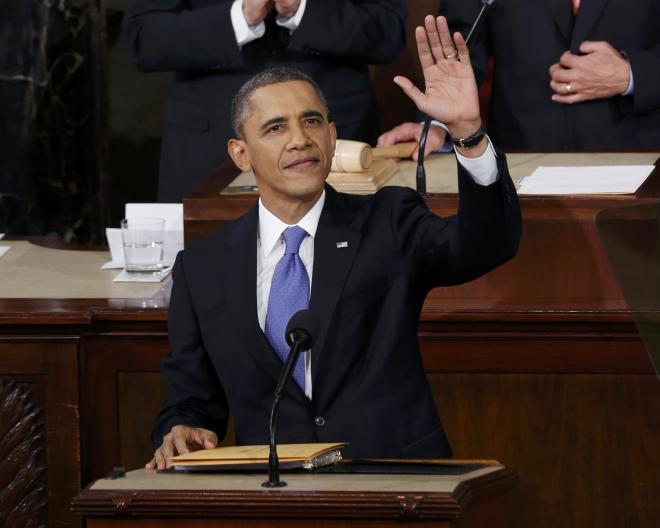 Mr. Speaker, Mr. Vice President, members of Congress, distinguished guests, and my fellow Americans – including all you assault rifle-toting, Bible thumping, intolerant, government-hating folks and those of you who are still unable to get over the fact that I’m only half as white as the 43 Presidents who preceded me.
The state of our nation is nowhere near as good as it would be if my Republican opposition in Congress would actually do their job and work for the benefit of all Americans – instead of misleading their less educated, bigoted and utterly confused “low information” supporters into voting against their own economic interests by flogging hot button social issues like abortion and gay marriage while pursuing economic policies that favor corporations and the wealthiest one percent over the interests of the vast majority of middle class and working class Americans – let alone the neediest among us.
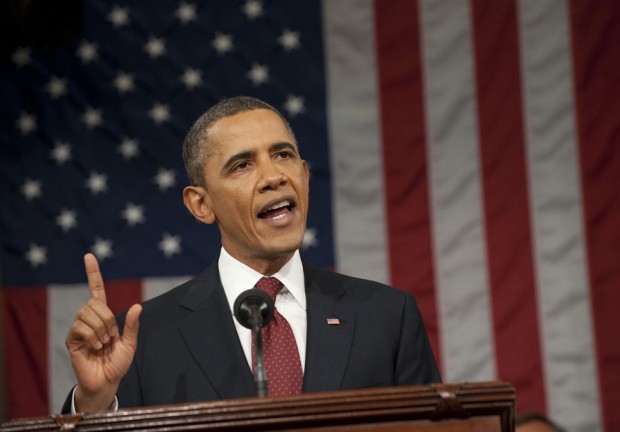 In the Gospels, Jesus talked a lot about how “it’s easier for a camel to pass through the eye of needle than for a rich man to enter the Kingdom of Heaven” And he was always trying to help the poor and the sick and those oppressed. Somehow, I don’t think that Jesus would be trying to balance the budget by kicking needy families with children off food stamps – or denying unemployment insurance to working families during a hard, cold winter. Yet that’s what these supposedly Jesus-loving conservatives in the GOP – especially that wacko Tea Party bunch – are always pushing us to do.
In order to avoid a second, economy-damaging government shutdown, Democrats in Congress – and this President – were forced to ignore the explicit teachings of Jesus and take food out of the mouths of babies and deny much-needed help to workers who find themselves out of a job through no fault of their own. (And folks, these unemployed workers PAID into the system for years to make sure they were insured against an economic downturn.)
 I want to particularly acknowledge the hard, flinty heart of Republican Congressman Paul Ryan of Wisconsin. If there’s a working man or woman in Kenosha, Racine or Walworth Counties who is still supporting Paul Ryan, I have no idea why. Wake up, folks! Look at the guy’s record. He’s all about corporations getting all the breaks, the rich getting richer, the poor getting poorer – and the middle class footing the bill.
And what’s with that hair? Is he an Eddie Munster fan or what?
Sorry, Paul, just kidding — about the hair. The rest is, as Sergeant Joe Friday used to say, “just the facts.” You don’t remember Dragnet, Paul? It was on TV around the same time as The Munsters.
Now, I wish I didn’t have to talk like this. I’m a nice guy by nature. I encourage people to get along, and I think we can best solve our problems and meet the challenges we face through consensus building and common effort.
 But I’ve tried bipartisanship and compromise – and Republicans just won’t take “yes” for an answer. Let’s take Health Reform, for instance. Many in my party are in favor of the type of government-run, single-payer health care system that’s been successful throughout Europe and Canada. Barring that, many progressives hoped for at least a so-called “public option” – but what did I do?
What did the President that conservatives and Tea Baggers openly excoriate as everything from Stalin to Hitler to Mao — and as both a communist and a fascist do? Did I propose the Big Government system that the majority of my party wanted? No, I didn’t. Instead, I compromised by adopting an idea that was the brainchild of conservatives: the individual mandate. I took a huge political hit within my progressive base to seek a deal that would extend affordable health care to millions of uninsured Americans. And I did it by promoting a Republican idea.
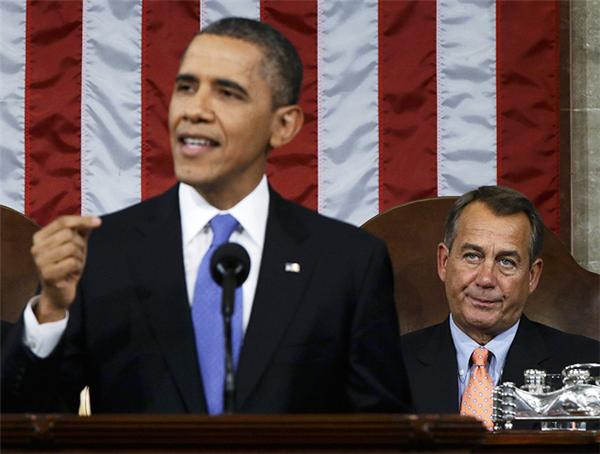 So, how did Republicans respond to my bipartisan approach? Did they appreciate the political courage it took to disappoint so many Democrats and progressive independents in the pursuit of the greater good?
In the words of House Speaker John Boehner — “Hell no!”
My reward from the opposition party – that’s you, you Republicans and Tea Baggers — has been nothing but a constant shit storm of misinformation, vilification and obstruction – including that needless government shutdown.
And please don’t tell me that Democrats and Republicans play the game the same way — because the level of obstruction I’ve endured at the hands of the right wing in Congress is historic.
The truth is that there’s no historical precedent for the number of cabinet-level nominees that have been blocked or delayed by Republicans during my administration. Let me emphasize, my fellow Americans: this has never happened before.
 Republicans in the Senate even filibustered my nomination of a Republican Vietnam War hero and former Senator, Chuck Hagel. In fact, Chuck was the first Defense Secretary candidate ever filibustered. Again, I reached out in a nonpartisan way – and got smacked in the face for doing it. But it’s not that I was hurt – it’s that America suffered from a needlessly slow and combative process in filling a job that’s vital to our national security.
Lately, Republicans have filibustered nearly every one of my Cabinet appointments. Guys, this is my team we’re taking about. A President gets to name his own team. Advise and consent. That’s your job, Senators. And, frankly, I’ve had enough of the “advise” and not enough “consent”.
 My judicial nominees are also getting the shaft. They’re waiting exceptionally long periods to be confirmed. The average wait for circuit and district judges while I’ve been in the White House has been 227 days, compared with 175 days under President Bush. I’ve got one appellate judge who waited a year for her nomination to be voted on.
There have always been filibusters in the U.S. Senate, but they were rare. Before 1960, there were only four times in U.S. history when Senators of one party had to muster a 60-vote super majority to end a filibuster. My so-called “loyal opposition” has used the tactic far more than ever before. Since 2007, the Senate Historical Office has recorded that Democrats have had to end Republican filibusters more than 360 times — an all-time record of which nobody should be proud.
This is not business as usual, my fellow Americans.
 During the legislative fights to pass the landmark Civil Rights bills of the early 1960′s, the filibuster became a weapon used by the bigots opposed to ending segregation. Still, even in those charged and turbulent times, filibusters were rare — and the Senators had to take the floor and keep the floor by talking hour after hour. Today, Mitch McConnell (that turtle-looking guy with the grumpy face sitting on the Republican side of the aisle) just tells the Democratic Majority Leader that no GOP Senators are willing to allow a vote – or even a debate – on an issue. It’s filibuster by default.
Lately, Majority Leader Harry Reid has implemented some reforms that have unclogged the Congressional constipation regarding my nominees. Thanks, Harry. What the hell took you so long?
 I know you were trying to be collegial. I understand. I’ve tried to be that guy, too. But enough’s enough, right? Glad you finally gave ’em hell, Harry.
So, why is it that Republicans aren’t willing to cooperate at all with my administration? Why did Majority Leader McConnell, the senior Senator from Kentucky, announce early in my tenure that his number one priority was to make me a one-term President?
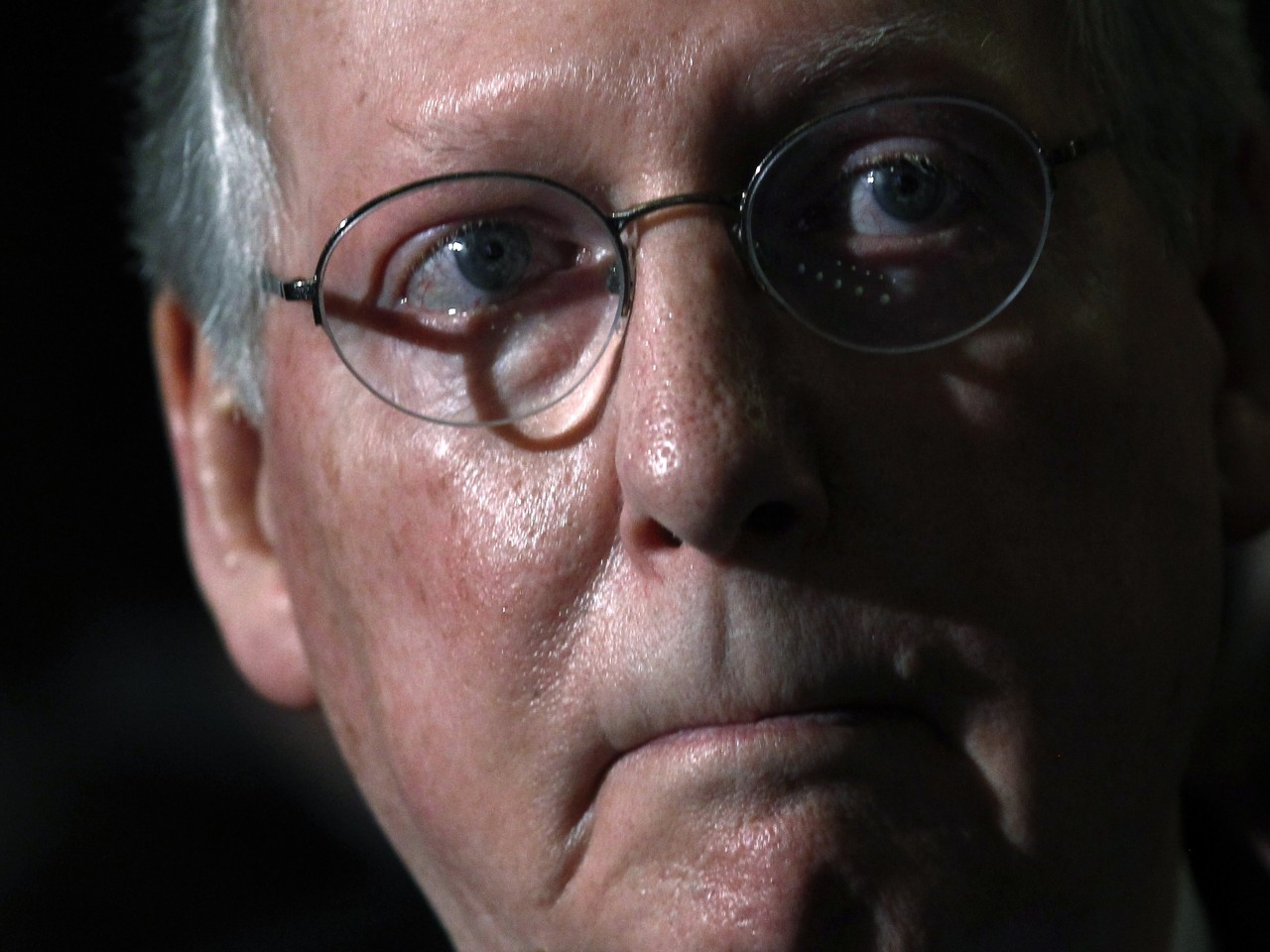 Why wasn’t this eminent Republican leader’s first priority to improve the economy, repair our nation’s failing, outdated infrastructure and improve the lives of working Americans? Why was I his target?
I know I’m not supposed to say it – but sometimes I’ve got to wonder if that good old Southern boy just can’t allow himself to work side by side with a black President. Is that the problem, Mitch?
I’m just sayin’…
 Look, America. This nation is not going backward. And I’m not going to give up. The arc of history bends toward freedom and tolerance – and the GOP must get on board and help us move forward into this new century – dealing with the problems of poverty and the obscene disparity of wealth in our nation, our global environmental crisis, the scourge of gun violence, malfeasance and amorality on Wall Street, and all the other issues that must be dealt with in order for America – and the world – to survive and grow in peace and prosperity.
But if my Republican friends continue to be the party of obstruction, intolerance and willful ignorance, they will eventually be consigned to the dustbin of history.
Starting with the mid-term elections later this year.
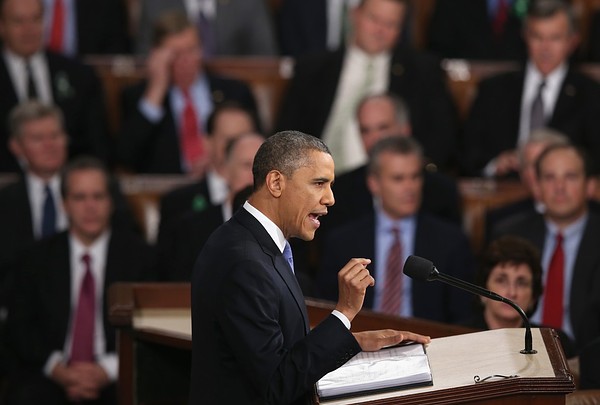 I’m angry, America. I’m pissed. I’ve lost faith in the possibility of my Republican friends putting aside partisanship and idealogical extremism in favor of the general welfare. But I haven’t lost faith in you, my fellow Americans. I believe in the wisdom and goodness and tolerance of the vast majority of the American people who truly embrace the ideals our nation was founded on: freedom, equality and justice for all.
As President Abraham Lincoln said in his first Inaugural Address, at one of the gravest moments in our nation’s history:
“We are not enemies, but friends. We must not be enemies. Though passion may have strained it must not break our bonds of affection. The mystic chords of memory, stretching from every battlefield and patriot grave to every living heart and hearthstone all over this broad land, will yet swell the chorus of the Union, when again touched, as surely they will be, by the better angels of our nature.”
Thank you, God bless you, and God bless the United States of America.
Even you, Mitch.
The Backbone Trail: A View To A Thrill
 One of the great joys of life in Southern California – and especially here in Woodland Hills, situated in the foothills of the Santa Monica Mountains at the southwestern end of the San Fernando Valley — is our proximity to some of the best day hiking opportunities in the entire world.
No kidding.
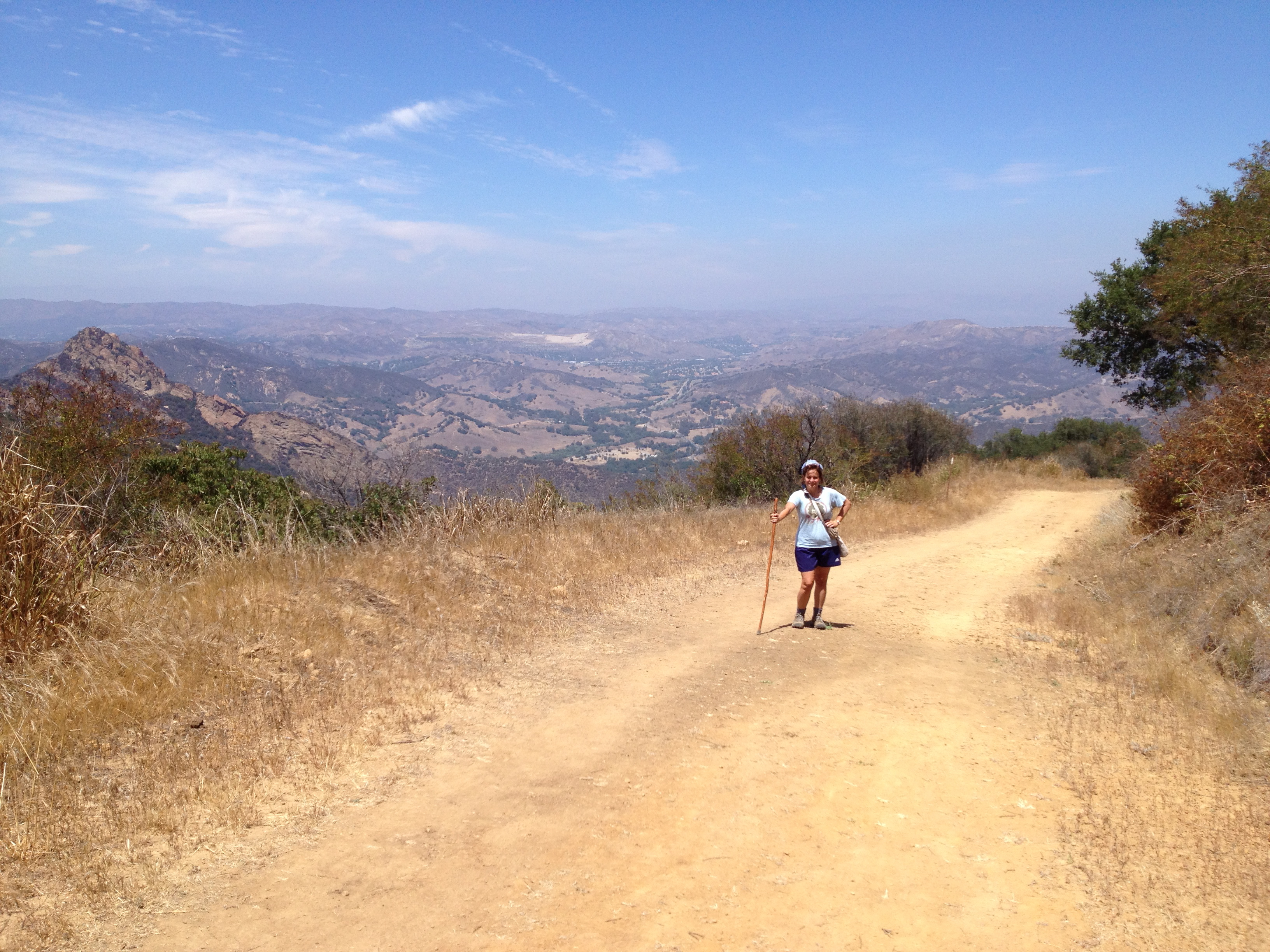 Where else could you leave your house, drive for 20 minutes – and wind up at a dusty trailhead that will soon take you up to a chaparral covered mountain ridge overlooking the Pacific Ocean to the south and, to the north, the entire San Fernando Valley, the Santa Susana Mountains and beyond.
My hearty, vivacious wife Victoria and I have dedicated ourselves to hiking every weekend that we possibly can – and we were delighted to make our first ascent of the Backbone Trail late last year.
We returned to the Backbone Trail after the New Year with our daughter Emilia.
We’ll be returning throughout 2014 to hike as many miles of this wonderful trail as our legs and lungs will allow.
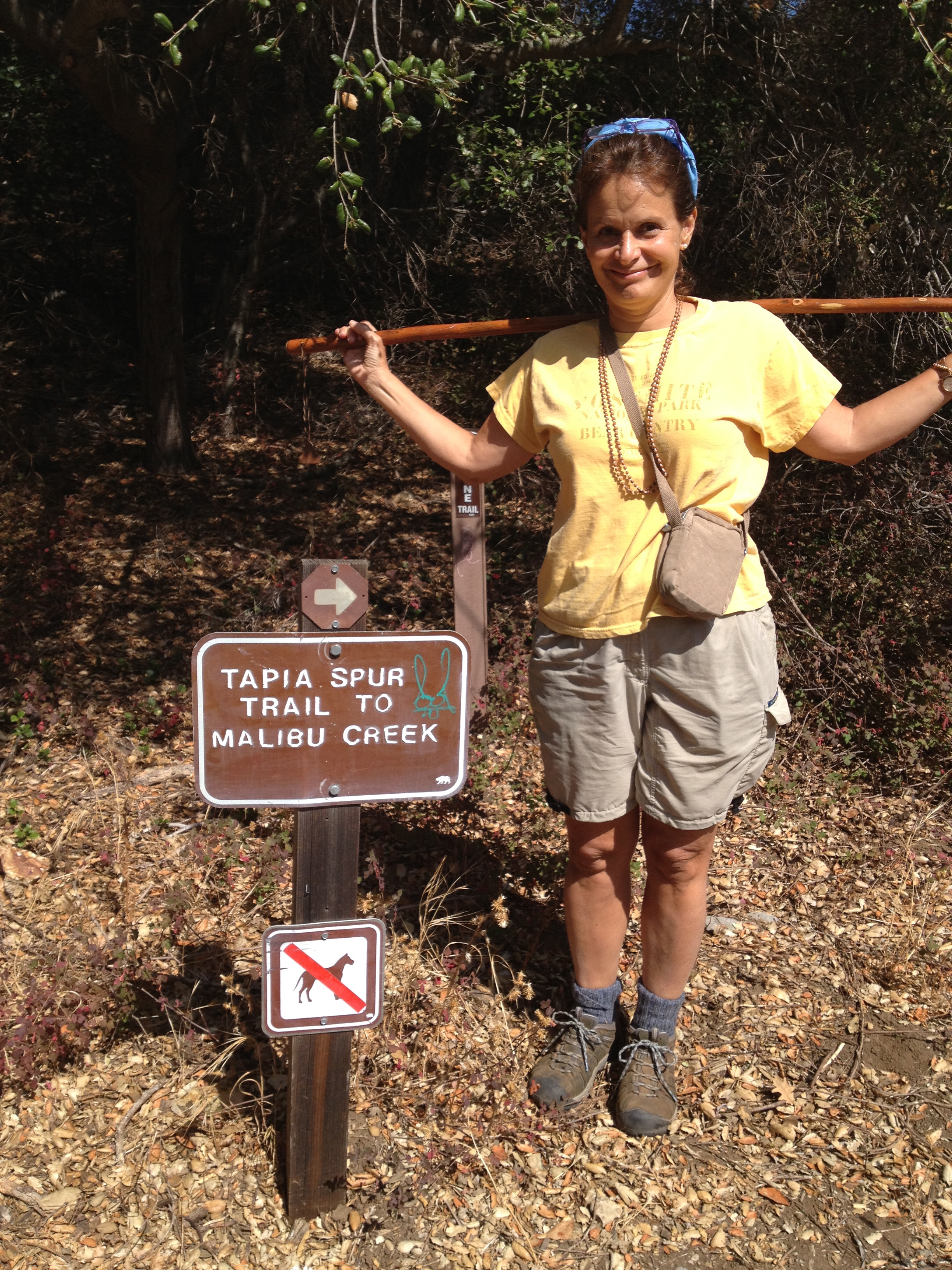 You can access the Backbone Trail from Malibu Creek State Park and several other locations along Pacific Coast Highway – but Victoria and I made our first ascent from the trailhead at Tapia Park off Las Virgenes Road.
We started our trek with a daunting uphill slog – but the payoff was well worth the effort: the brilliant Pacific Ocean to our left and the familiar but still impressive San Fernando Valley and beyond to our right.
It was exhilarating to walk a path astride the western edge of the North American continent.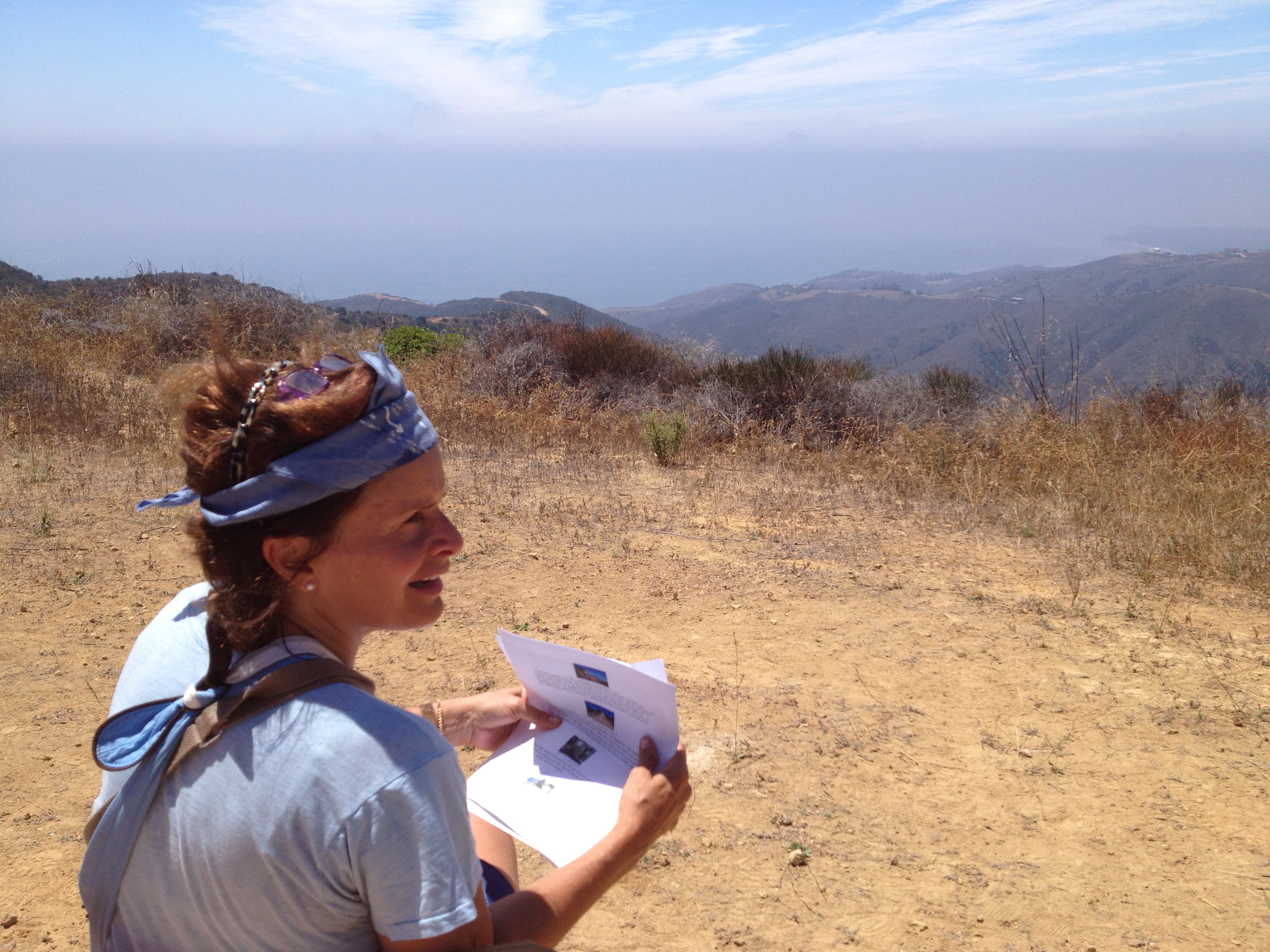
The Backbone Trail is considered the holy grail of trails in the Santa Monica Mountains – and Victoria and I wholeheartedly concur.
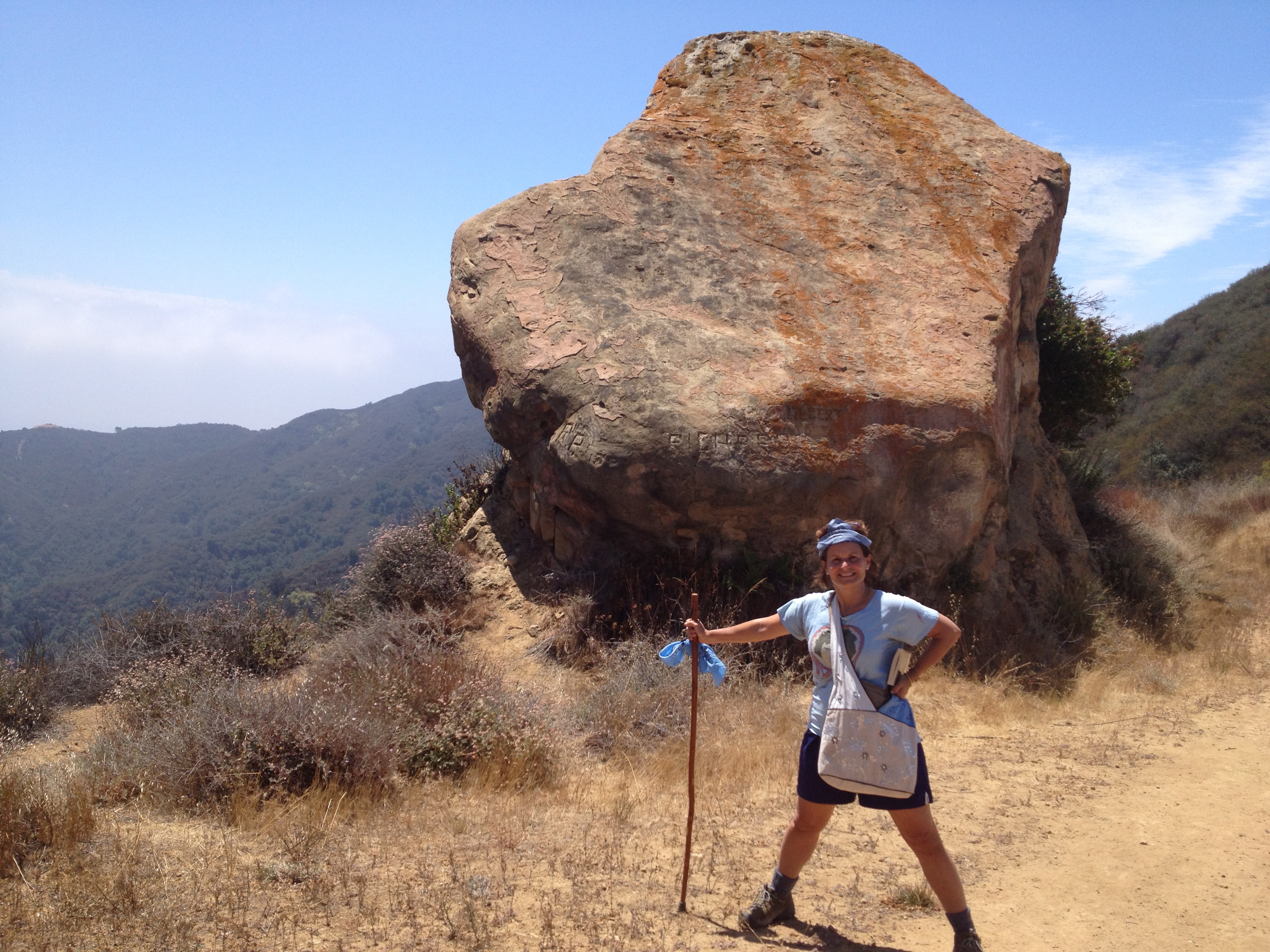 Vic and I have hiked Topanga State Park, Malibu Creek State Park, Solstice Canyon, the Hollyridge Trail and others in the Santa Monicas – but, while each of those hikes have a great deal to recommend them, the view from the Backbone Trail is unique, stunning and thought-provoking.
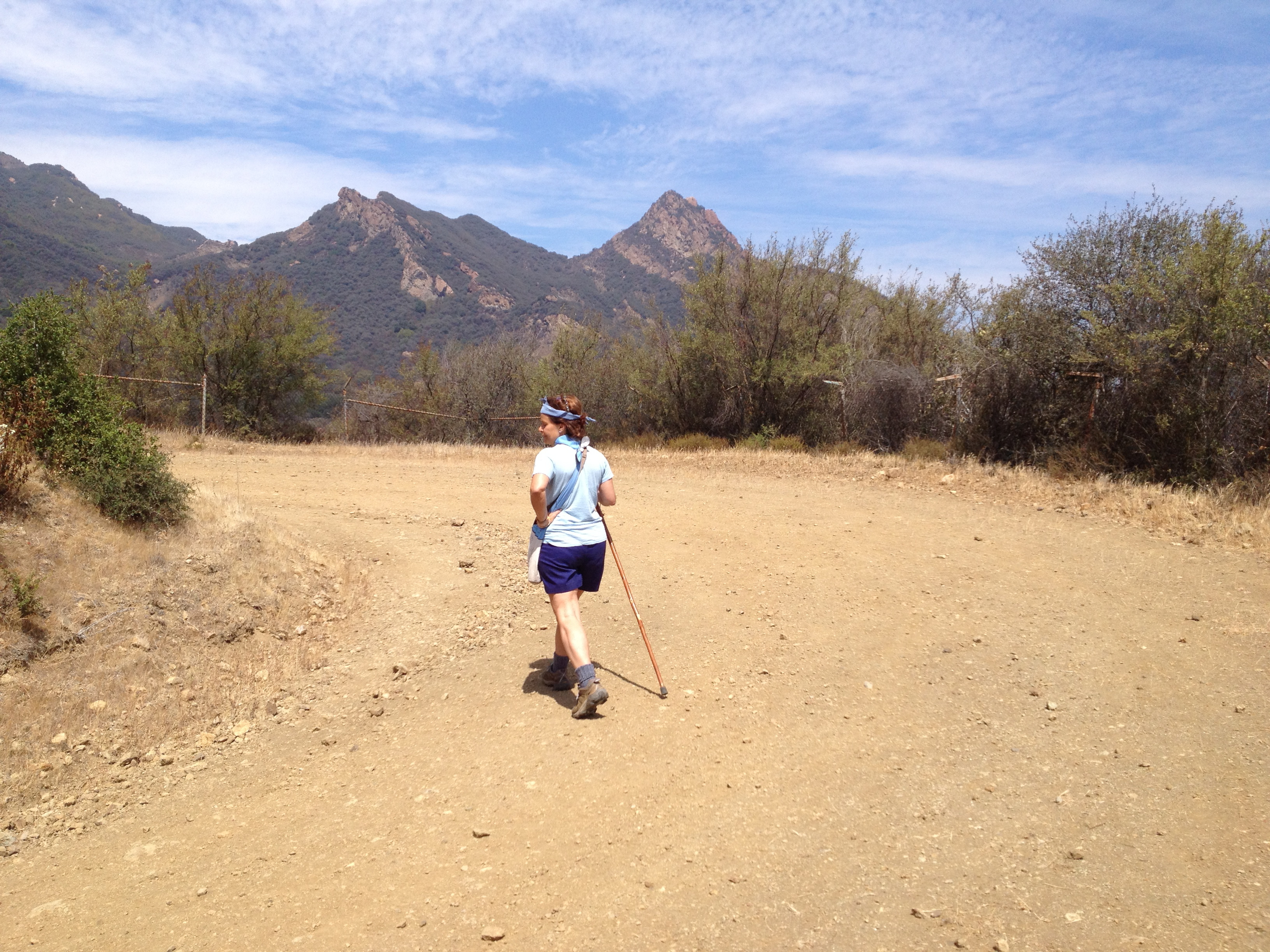 Hikers on the Backbone Trail experience the wonders of the Mediterranean eco-system, found only in five places in the world, with its unique plant and animal species — traveling through coastal sage scrub, chaparral, oak woodlands, meadows, and streamside areas. (Though we’ll need a hell of a lot more rain – in fact, any rain — before we can experience “streamside areas”.)
So, jump in your car and head to Malibu this weekend to ascend the Backbone Trail.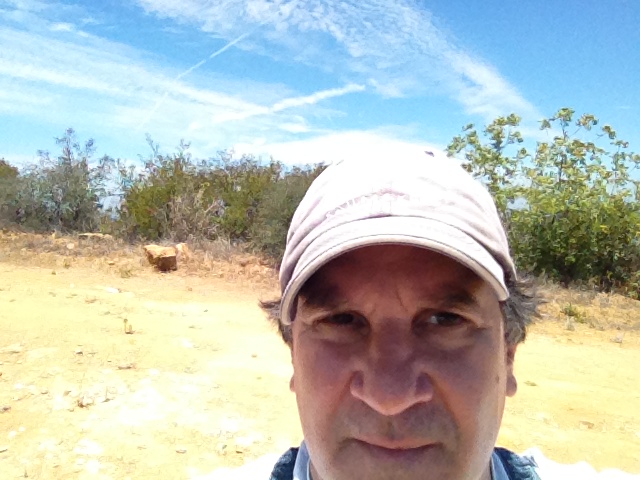
And, as you enjoy the incredible views on both sides of the mountain ridge, when you encounter other hearty hikers along the way – tell them Vic and Paul sent you. They won’t have any idea what you’re talking about, but you may spark a conversation. And our conversations with hikers on the Backbone Trail have all been interesting and inspirational.
 After all, everyone we talked to on the Backbone Trail had the good sense, creativity and imagination to climb up to a path from which they could gaze upon the expanse of the Pacific Ocean on one side — and the magnificent San Fernando, Simi and Antelope Valleys on the other side.
I just love living in this corner of Southern California.
Backbone Trail, Ho!
Otto Graham: The Greatest Pro Football Quarterback Ever

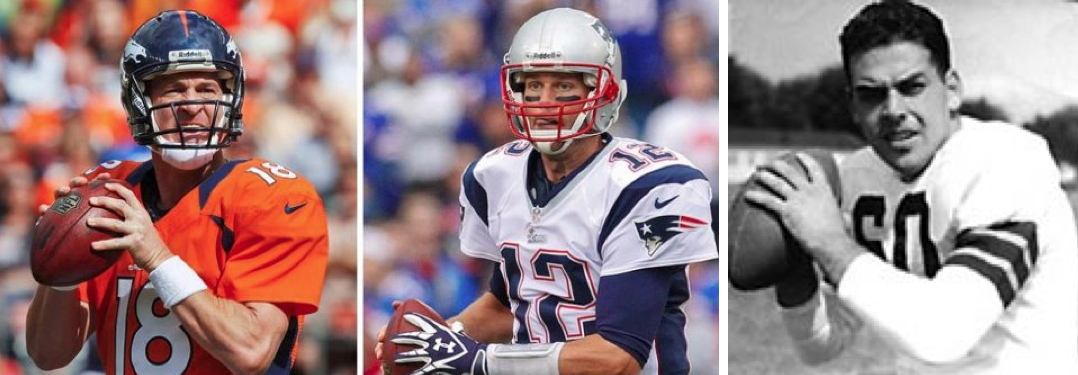
 The NFL conference championship games that were played today were as thrilling and satisfying a pair of gridiron contests as a football fan could desire. It was great to watch two veteran quarterbacks like Tom Brady and Peyton Manning face off for the AFC title – and then enjoy the next generation of star quarterbacks, Russell Wilson and Colin Kaepernick, do battle for the NFC crown.
 However, in the lead-up to these games – and undoubtedly in the two-week media hype extravaganza that will precede the Super Bowl, there’s one thing that will bug the hell out of me.
In all the talk about Manning and Brady and Wilson and Kaepernick and the great quarterbacks of all time – there’s one name that won’t be mentioned.
It’s the one name that should always be mentioned.
Otto Graham.
A couple of months ago I was listening to sports talk radio host Colin Cowherd hosting a discussion of the greatest NFL quarterbacks on his morning radio show. Cowherd had the nerve to say he didn’t want to hear about guys like Otto Grahama who played in the “no face mask era”.
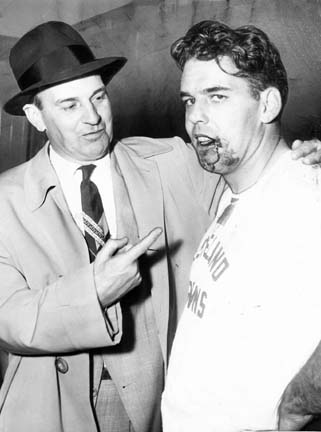
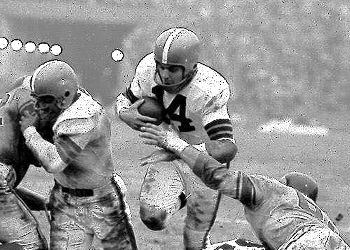 Well, Colin, here’s proof that Otto Graham wore a face mask in the NFL.
(Later in this post, I’ll show why Cowherd’s comment proves there’s an even deeper gash in his NFL football knowledge regarding Graham and face masks.)
 Then, last month, The Los Angeles Times ran an article by Mike DiGiovanna ranking the top 10 sports records that’ll never be broken. Candidates were chosen from professional sports, the Olympics and major college sports programs – and the writer limited his choices to records set from 1940 on.
 But DiGiovanna did not find a spot on his list for the most unbreakable professional sports record of all post-1940. It’s a record that will always be held by Otto Graham.
After his brilliant college career at Northwestern University was interrupted – and his professional career was delayed — by his service in the Navy during World War Two, the great Hall of Famer Otto Everett Graham, Jr. played 10 seasons of professional football for the Cleveland Browns – and took his team to the championship game all ten years!
 That’s right, ten out of ten.
Let me say that again.
Otto Graham played 10 seasons of pro football for the Cleveland Browns – and took his team to the championship game all ten years!
And he won 7 of those 10 championship games.
Can you imagine a more unbreakable sports record?
 From 1946 to 1949, Graham and The Browns dominated the All-America Football Conference. Then, they joined the NFL in 1950. Did Otto and his Browns struggle as an NFL expansion team? Hardly. They simply ran off an unprecedented and unequaled string of 6 straight NFL title game appearances from 1950 to 1955.
After that, the legendary Otto Graham retired as a player at the top of his game. (Just like another Browns legend, Jim Brown, would do in the following decade.)
 It drives me crazy to hear otherwise intelligent and knowledgeable football pundits talk about Tom Brady and Coach Bill Belichick as perhaps the most successful quarterback and coach combo in NFL history.
Really?
Brady & Belichick? Oh, please…
 Paul Brown was coach of the Cleveland Browns during Graham’s entire career. Did Brady and Belichick get to the title game 10 seasons in row?
Okay, let’s throw out the AAFC years and stick to Brown and Graham’s NFL years. Have Brady & Belichick gotten to 6 NFL championship games in a row? And Brown & Graham won three of those title games, including Graham’s last game, the 1955 championship. Like I said, Otto Graham went out on top.
And, for all you stats geeks, consider this:
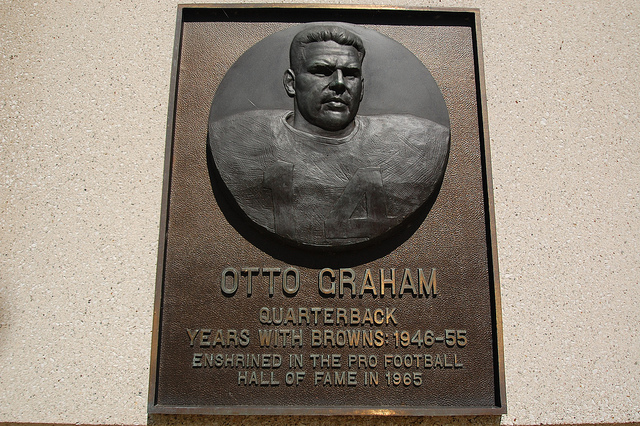 With Graham at QB, the Browns posted a record of 114 wins, 20 losses and four ties, including a 9–3 playoff record. And while many of Graham’s records have been surpassed in the modern era — he still holds the NFL record for career average yards gained per pass attempt with 9 yards per attempt. That’s not 9 yards per pass completion – that’s 9 yards per pass attempt.
Basically, Otto Graham was good for a first down every time he threw the damn football.
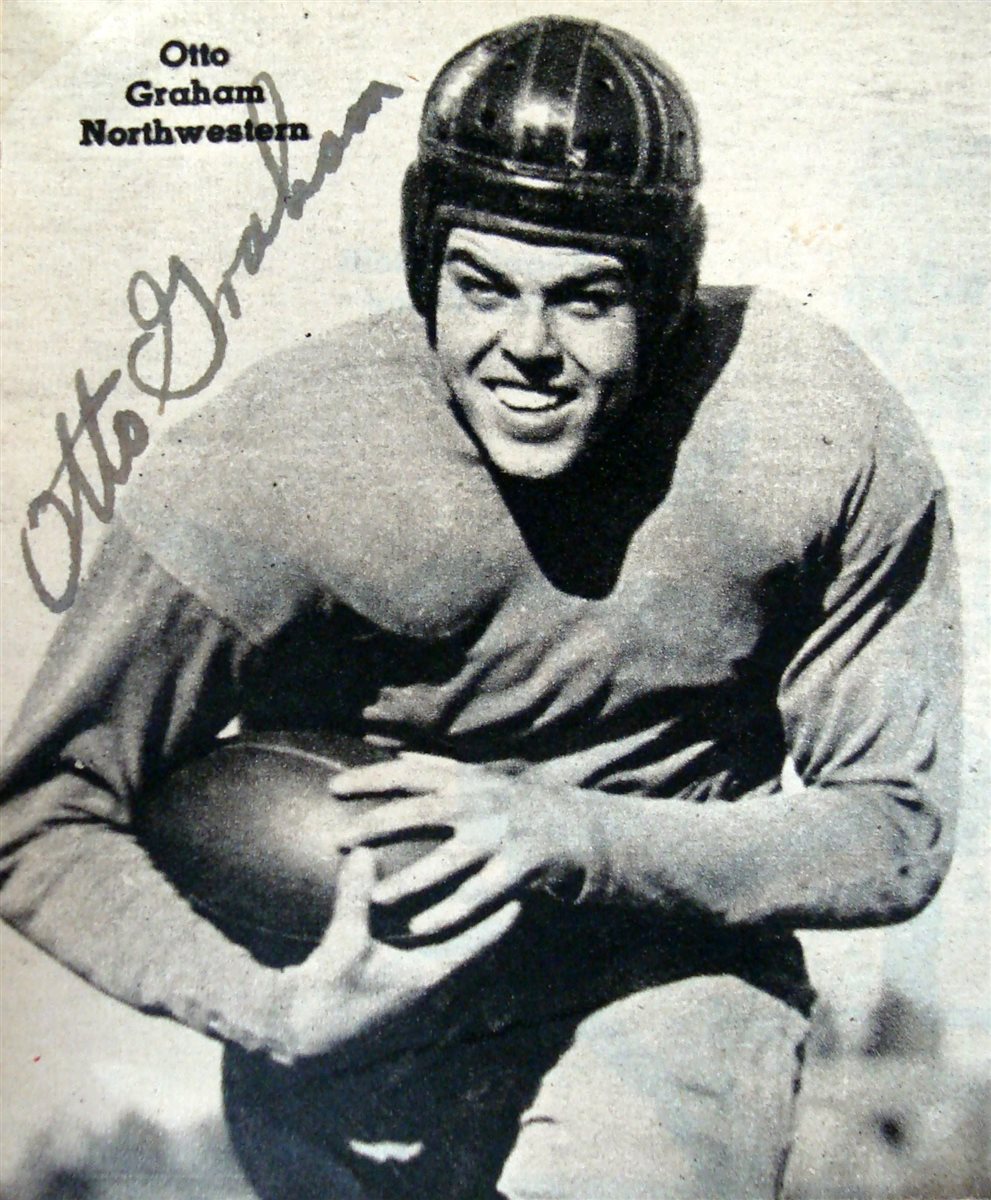 Graham also holds the record for the highest career winning percentage for an NFL starting quarterback, at 0.814. If winning is the greatest measure of a pro quarterback – Otto Graham was better than Johnny Unitas, Joe Montana, Dan Marino, Terry Bradshaw, Tom Brady and all the others.
And he was tough as nails, Colin Cowherd.
In fact, Mr. Cowherd, for your information — Otto Graham played a role in ushering in the face mask era in pro football.
 Otto Graham led the Browns to 11 straight wins to start the 1953 season. (Their lone loss came in the season’s final game against the Philadelphia Eagles.) Late that season, in a game against the 49ers, Graham took a forearm to the face that opened a nasty, bloody gash it took 15 stitches to close. Was he done for the game?
No way. This was Otto Graham.
His helmet was fitted with a clear plastic face mask and he came back into the game — which The Browns won. Graham’s injury helped inspire the development of the modern face mask.
 All right, I’ve had my say. Look it all up yourself. I’m tired of getting pissed off and wanting to throw things at the radio and TV when I hear all this yakking about the best NFL quarterbacks ever – and never any love for Otto Graham.
Now, onto the Super Bowl.
Peyton Manning is amazing. Russell Wilson is exciting. But Otto Graham was the best ever.
And I’d say that even if he weren’t a fellow Northwestern alumnus.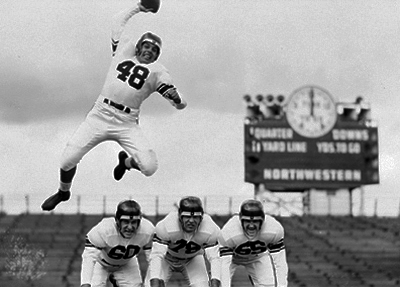
ObamaCare & Italy & Everything Else — Blog 2013: The Fourth Year In Review.
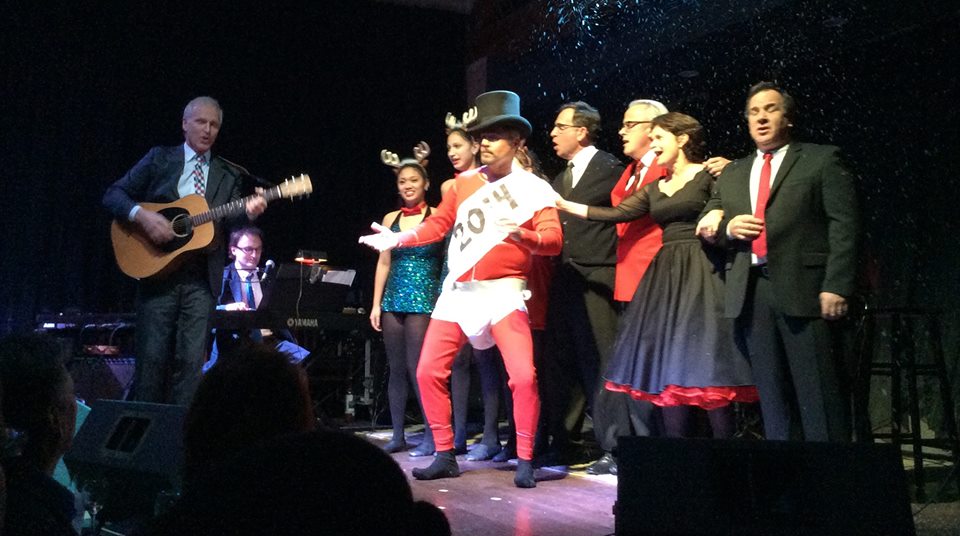
 For my family and me, 2013 ended on an upbeat note with “Mr. Olsen’s New Year’s Rockin’ Neighborhood” — a raucous, sold-out celebration of comedy and rock & roll at 27 Live in Evanston, Illinois. The weather was bitterly cold but there was a delightful, enveloping warmth in our comic camaraderie with longtime friends, bandmates, fellow Northwestern University alums and members of The Practical Theatre Company.
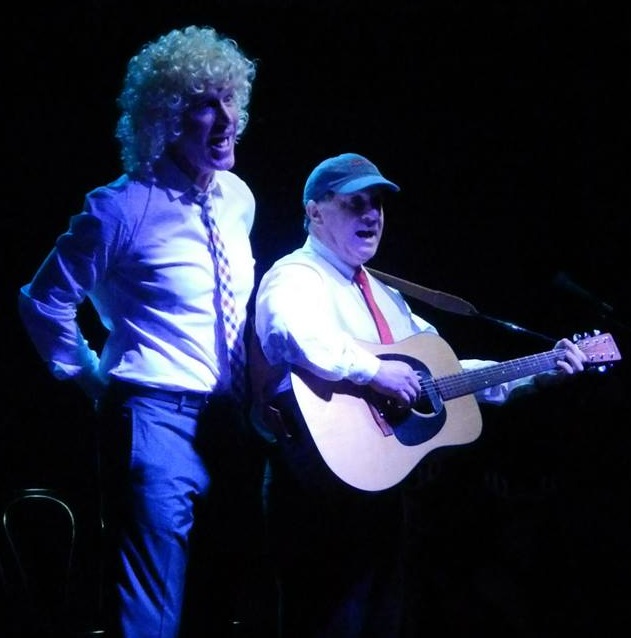
 I even got to sing duets with my college roommate and fellow Practical Theatre founder, Brad Hall (as Simon & Garfunkel, above) — and with my daughter, Eva.
We closed the evening with two spirited sets by Riffmaster & The Rockme Foundation, the band I’ve been playing with since the early 1980’s. There’s no better way to ring in the New Year than by rocking with your best buddies. All in all, it was a wonderful way to say goodbye to 2013 and hello to 2014.
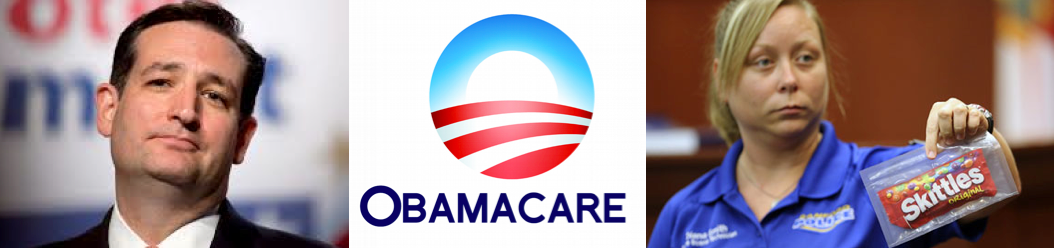
 I’ll be candid. For some reason, 2013 was not a very prolific year for this blog. I don’t know whether it was the fact that the excitement of the 2012 Presidential election gave way to Congressional constipation courtesy of the recalcitrant, reactionary Tea Party bloc in the House of Reps — or that the rollout of the Affordable Care Act led to the dispiriting madness of the government shutdown. I managed to get off a few broadsides skewering the likes of Senator Ted Cruz (Tea Party, TX) — but the I should have written more in defense of President Obama and progressive politics. (Though my most commented-on post in 2013 was President Obama Goes to War.) Still, I resolve to do a better job of blogging on politics in 2014.
 The highlight of 2013 was our family’s two-week trip to Italy and the provinces of Tuscany and Umbria in August. I tried to sum up the experience in an article entitled, Our Italian Adventure. I could easily have written a series of blog posts on each of the beautiful cities and towns we visited, the artwork we saw, the food we ate, and the people we met — but I stuffed the whole, glorious journey into one account. To make amends to my readers I promise that, before too long, I will post a link to the movie we shot on the grounds of Camporsevoli. Stay tuned…
2013 was the fourth year for this blog — and here are the year’s vital signs:
Paul’s Voyage of Discovery & Etc. has attracted 164,472 views since it began four years ago. There were 34,572 visits in 2013. I’ve posted 299 articles since this blog began. This post is #3oo: certainly a notable milestone.
This is not the real subscription sign up box. The real one is further to the right. And up a little…
I am honored that 147 subscribers have now signed on to have my posts automatically delivered to them via e-mail. (And 43 more folks follow this blog on Twitter.) Are you a subscriber? If you’re not — then look to your right at the photo of the saluting Matey and follow the simple instructions to “Hop Aboard!”
The search terms that readers used most to find this blog were “Pearl Harbor”, “Occupy Wall Street”, “trial by jury”, “Bill of Rights” and “Pickett’s Charge”. And these are the posts that readers were most attracted to this year…
What follows is a list of The Top Ten Most Popular Posts of 2013.
Just click on the title of each post to access the original article.

Originally posted in 2010 on the anniversary of the “day that will live in infamy” – this post has become an annual event. A lot of military history fans visit this blog, but I think Pearl Harbor fascinates and resonates with Americans whether they have an interest in military history or not. The September 11, 2001 terrorist attacks took more American lives – but Pearl Harbor was the shocking opening act in a drama that ultimately made the United States the world’s preeminent superpower.
2. Happy Birthday Bill of Rights!
On December 15, 2010 – the 215th birthday of our Bill of Rights – I wrote this basic primer on the first ten amendments to the United States Constitution and it’s become one of the most-read posts in the history of this blog. I guess that’s because Americans still give a damn about their rights and are keen to understand their Constitutional foundation.
3. A Childhood Memory of Kent State, May 4. 1970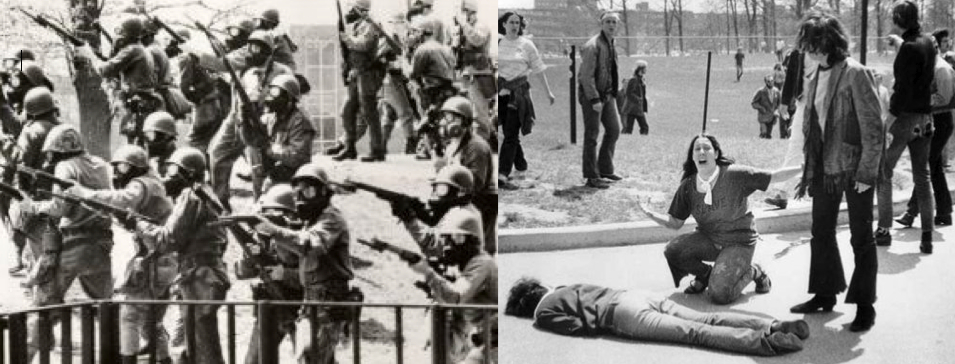
On the May 4, 2012 anniversary of this very dark day in America history, I posted this personal remembrance of a young Ohioan’s earliest memories of that terrible day. Unlike the Pearl Harbor post, I haven’t re-posted this article every year — but readers still find it. “Tin soldiers and Nixon coming.” The shootings at Kent State should never be forgotten.
4. The Top Ten Rock & Roll Singers of All Time

There’s nothing like a Top 10 list to promote discussion on a blog – and this December 5, 2011 post did just that. Check it out – and then weigh in with your own opinion. Just realize that your opinion on rock & roll singing cannot possibly be as informed as my own.
5. The Occupy Wall Street Movement Doesn’t Need Black Bloc Buffoonery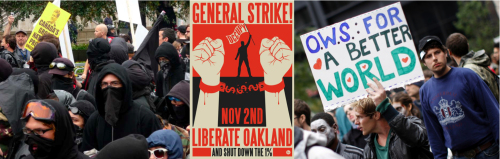
Though we didn’t hear much about it in 2013, the Occupy Wall Street movement has inspired a lot of posts on this blog since 2011. This post, written on November 2, 2011, has proven to be the most popular. Maybe that’s because people agree that we don’t need a bunch of foolish, immature anarchists screwing up a noble movement that ultimately helped to put Barrack Obama back in office. Without Occupy Wall Street, would Romney’s attack on the 47% have evoked such a profound and spirited response? Without Occupy Wall Street, would the concept of the 99% and 1% have ever entered the Zeitgeist?
6. My Book Report: “The Battle of Midway”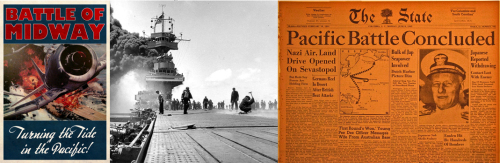
What a great book! What an amazing chapter of world history! On January 23, 2012, I wrote this review of a book that captures all the incredible heroism, good luck, and turns of fate that made this epic World War Two naval battle an overwhelming victory that turned the tide of the war against Imperial Japan. In 2013, I write another book report on an excellent World War Two account, The Day of Battle, about the campaign to liberate Italy. A few weeks after I wrote that post, my family visited the American cemetery in Tuscany and paid our respects to the soldiers whose valor, sacrifice and victory are recounted in Rick Atkinson’s fine book.

As a Cleveland native, I’ve often been asked my opinion of LeBron James leaving the Cavaliers several years ago — and my friends and co-workers are usually shocked that I’m not upset or indignant or jilted, etc. And while the blogosphere hardly needed one more commentary on LeBron James’ move to the Miami Heat, I wrote this post on July 9, 2010 to explain that LeBron James didn’t owe me anything. He’s a professional basketball player who wants to win and be remembered as the best to play the game. The two NBA championships he’s won in Miami since I wrote this post have given LeBron all the scoreboard he needs.
8. Growing Up in the Space Age
The last American space shuttle launch inspired this July 14, 2011 remembrance of my personal connection to the Space Age. This popular post salutes my fellow Ohioan, John Glenn, who served as both the first man to orbit the Earth and as a Senator from my home state. I wish that my three daughters had grown up experiencing something half as exciting and inspirational as The Race to the Moon.
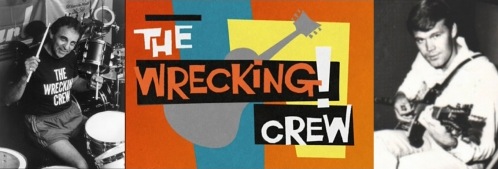
Glen Campbell, Hal Blaine, Carol Kay, Tommy Tedesco, Leon Russell, Earl Palmer: the cream of Los Angeles studio musicians in the late 50’s, 60’s and early 70’s became known as “The Wrecking Crew”. I’m thrilled that my March 21, 2011 blog article celebrating Tommy Tedesco’s son’s marvelous documentary film about these rock & roll legends has proven to be such a popular post. If you haven’t done it already, do a Google search on “The Wrecking Crew”. Until then, your rock & roll education is not complete.
10. The Matey’s Log: Sailing Season Begins 
This post recounted a sailboat race held on February 13, 2010. It was a good thing that the race was being run the day before Valentine’s Day. Like golf, sailing is a sport that takes men out of the house for long stretches of time on the weekend. But sailboat racing is worse than golf because it’s never certain when you’ll be done. 18 holes of golf always take about the same amount of time to complete. The duration of a sailboat race depends upon the vagaries of the wind and conditions on the water. I don’t sail as much as I used to to — but I still love it. And I’ll continue to report on my sailing adventures in the new year.
So, that’s the best of 2013. Stay connected. Subscribe. And please keep posting your comments!
Here’s to another fine voyage in 2014!
And here are the All-Time Top 10 Blog Posts from January 2010 up to today:
1. Happy Birthday Bill of Rights!
3. The Occupy Wall Street Movement Doesn’t Need Black Bloc Buffoonery
4. History & Honeymoon: Part Three
This post was the #3 post in 2010. 24 years ago, my wife Victoria and I went to Gettysburg and other Civil War battlefields on our honeymoon! I needed no other assurance that I had married the perfect woman. On our 20th anniversary, we returned to Gettysburg. Now both students of the battle, we walked the battlefield on July 1, 2 and 3, 2010 on the 147th anniversary of that critical conflict. My four-part account of our battlefield tramping became one of the most popular items on the blog. (Originally posted July 20, 2010)
5. A Childhood Memory of Kent State, May 4. 1970
I’ve always wondered where singular, epochal, “out of this world” geniuses like William Shakespeare, Leonardo da Vinci and Bob Dylan came from. So, on January 26, 2011, I wrote this speculation on the possible alien origin of such monumental minds. Evidently, my curiosity (if not my Erich Van Daniken “ancient astronaut” fantasy) is still shared by a lot of people who read my blog in the past year.
7. Growing Up in the Space Age
8. The Top Ten Rock & Roll Singers of All Time
9. Bazooka Joe, Jay Lynch & Me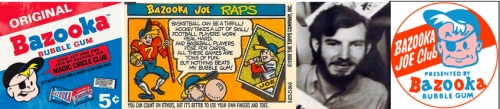
One of the first posts I wrote for this blog back on January 9, 2010 celebrated my brief but soul-satisfying collaboration with the legendary underground comix artist, Jay Lynch, who gave Vic and I the once-in-a-lifetime opportunity to write a series of Bazooka Joe comics. It was one of the great chapters in my creative career. The Practical Theatre Company, Saturday Night Live, Behind the Music, The Vic & Paul Show and Bazooka Joe. Classics all. Can I retire now?
10. History & Honeymoon: Part Four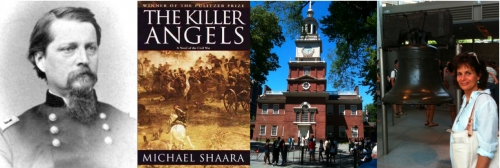
2011 was the 150th anniversary of the commencement of the American Civil War – and the Civil War Sesquicentennial is likely the reason that two of my “History & Honeymoon” posts are still among the most-read this past year, including this one, first posted on July 26, 2010. This post covers everything from my wife Victoria and I battle tramping Pickett’s Charge on the third day of Gettysburg –to our visit to Philadelphia and the eccentric, visionary artwork of Isaiah Zagar.
Just 4 Days Until The Funniest, Most Rocking New Year’s Party Ever!
 A splendid time is guaranteed for all this New Year’s Eve in Evanston, Illinois. (Which is, of course, just 5 minutes from anywhere by rocket car!)
 But why party in Evanston? Why not join the throngs in Times Square, on Bourbon Street in New Orleans – or at Monty’s Steakhouse in Woodland Hills? Because the big little town north of Chicago is where you can enjoy “Mr. Olsen’s New Year’s Rockin’ Neighborhood” at 27 Live — Evanston’s newest nightclub.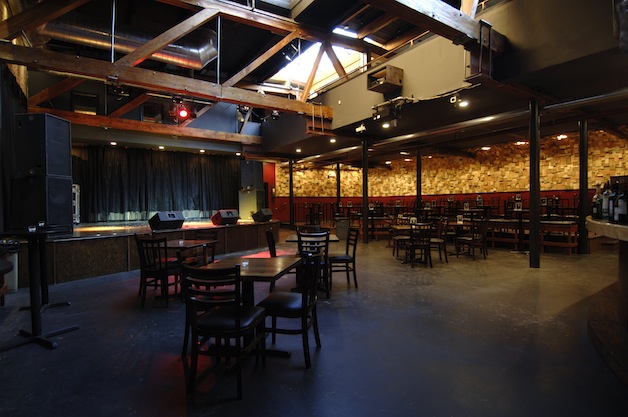
 The fun begins at 8:00 PM with a one-hour comedy variety revue for the middle ages — hosted by screenwriter/comedian Dana Olsen, and featuring yours truly and my wife Victoria Zielinski of “The Vic & Paul Show”; our tall, blonde friend and fellow Practical Theatre founder, Brad Hall; the great Steve Rashid tinkling the ivories; Rockin’ Ronny Crawford hitting the rim shots on drums; and narrated by Stewart Figa, who will also grace the show with his powerful singing voice.
If you were among the standing-room-only crowd that caught “Mr. Olsen’s Neighborhood” at the Wilmette Theatre last June, you’ll have some idea of the fun to be had when Mr. Olsen and his neighbors get together to sing, dance and look back on the craziness of 2013 with laughter and comic camaraderie.
 Then, at 10:00 PM, the kids (of all ages) will start jumpin’ when Riffmaster and The Rockme Foundation take the stage for two sets of classic rock & roll and original songs written by a bunch of guys who grew up listening to the best records ever made and played on the radio. Wit, harmony, the big backbeat — and passionate guitar playing that would make Chuck Berry proud of his children.
 After Riff and the Rockmes ring in the New Year, a DJ will keep the dance floor jumping until 2:00 AM.
It’s all happening at 27 Live, featuring a great stage, bar, whiskey lounge, and restaurant in a 14,000 square foot space that’s perfect for a New Year’s Eve crowd. 27 Live is located at 1012 Church Street, just steps away from both the CTA Purple line and Metra Davis stops.
Valet Parking is available.
 Tickets are $25 in advance and $30 at door – with a $100 Dinner Package available (includes a 5 course dinner).
Tickets are now on sale at www.27live.com
Or get them at this link.
See you on New Year’s Eve!
Filed under Art, Comedy, Improvisation, Music, Uncategorized
Remembering Lincoln at Gettysburg


 I was honored and delighted when my good friend Darroch Greer invited my wife Victoria and me to take part in another of his wonderful historical events at the Bedford Winery in Los Alamos, California, hosted by the great winemaker, history buff and raconteur Stephan Bedford.
Darroch is the Bedford Winery’s resident historian. (Does any other winery boast a resident historian?)
I’d been to several of Darroch and Stephan’s presentations staged in the courtyard of the Bedford Winery’s tasting room — and I’d always enjoyed the combination of fellowship, fine food and wine, and respect for history.
 So, on November 16, 2013, Vic and I took part in Lincoln at Gettysburg: The 150th Anniversary of the Dedication of the National Soldiers’ Cemetery and Abraham Lincoln’s Gettysburg Address on November 19, 1863, Celebrated Through Eyewitness Accounts, Music and Victuals of the Era.
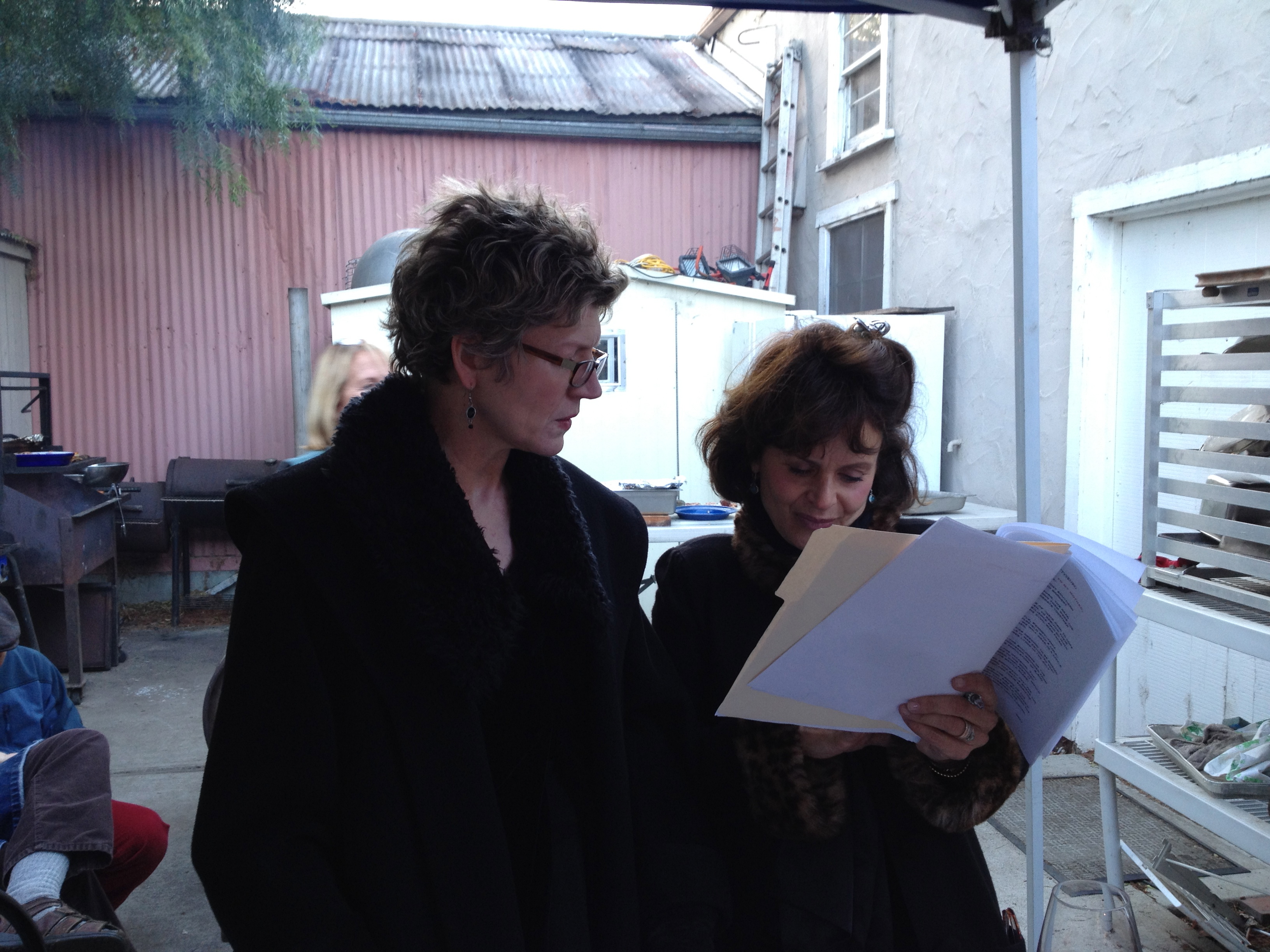
Darroch’s wife Stephanie goes over the script with Victoria before the reading.
The main event was a staged reading of Remembering Lincoln at Gettysburg, written by John Copeland: featuring the words of eyewitnesses to that famous event at Gettysburg, when 15,000 people gathered in the town four months after the great battle to dedicate a final resting place for thousands of fallen Union soldiers.

A rare photo of Lincoln at Gettysburg. November 19, 1863.
Darroch gave me the task of summing up the battle itself before we began the reading.
What follows is my attempt to capture the stakes, the major action, and the drama of those three epic days of combat in ten minutes.
Reflections on The Battle of Gettysburg
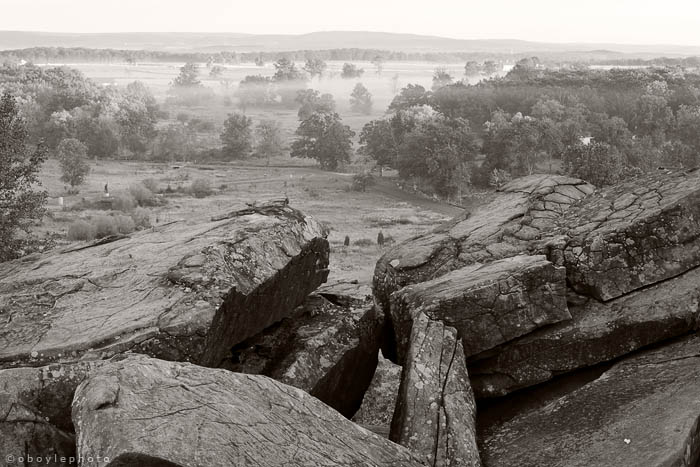 Seminary Ridge, Culp’s Hill, Cemetery Ridge, the Peach Orchard, the Wheat Field, Devil’s Den, Little Round Top…
On June 30th, 1863, these were not yet legendary place names: they were simply topographical features on the landscape surrounding the small crossroads town of Gettysburg, Pennsylvania.
 In the summer of ‘63, the war to preserve the union was not going well for President Lincoln and loyal Americans who wished to keep the United States intact.
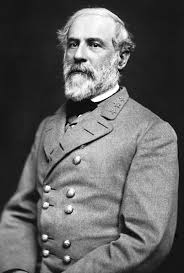
Crushing Confederate victories at Fredericksburg that winter and Chancellorsville that spring left Unionists anxious and dispirited. The Army of the Potomac staggered under the blows delivered by Robert E. Lee’s seemingly invincible Army of Northern Virginia.
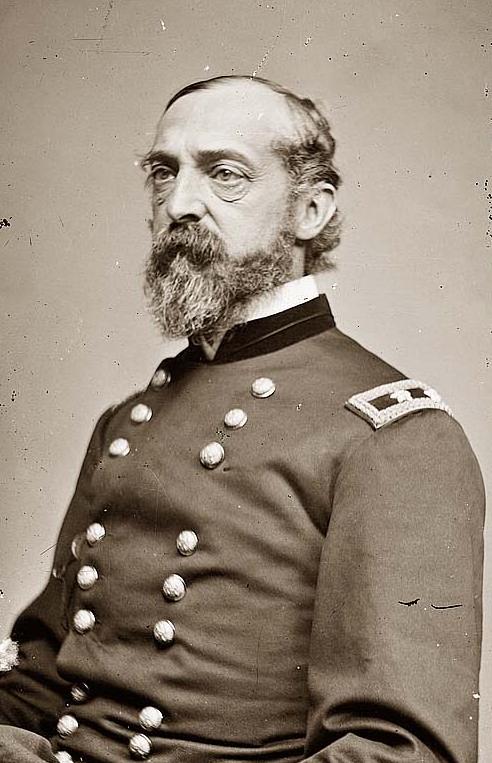 After the debacle at Chancellorsville, another in a series of unsuccessful Union commanders had been sacked – as General Joe Hooker was replaced by George Gordon Meade. Meade was a Pennsylvanian. That would prove provident. Just three days after taking command, General Meade would face Lee at Gettysburg.
Yet, as bad as the war was going for the North, the stakes for the Confederacy were existential. Two years of warfare fought almost exclusively on Southern soil took a terrible toll in battle casualties, civilian morale, economic viability and agricultural productivity. Rebel leaders knew they couldn’t win a war of attrition against the superior industrial strength and manpower of the North.
 Something had to be done to change what was ultimately a losing equation — and convince the European powers to recognize the Confederacy.
In the west, General Grant’s army was closing in on Vicksburg, the last rebel bastion on the Mississippi. If Vicksburg fell, the Confederacy would be split in two. Meanwhile, the Union naval blockade continued to strangle Southern ports and cripple its economy.
Lee decided to take the war to the North. The goal of his invasion was to relieve pressure on war-torn Virginia. And if Lee could beat the Federals on their home turf — his army could threaten, or even capture, Washington DC and force President Lincoln to seek peace.
 As Meade took command of his army, Lee’s 75,000 veterans were already in Pennsylvania. The opposing armies weren’t sure where each other were, but Meade knew Lee was somewhere west of the state capitol at Harrisburg. As Meade groped northward to find his foe, nobody thought the decisive battle of such a critical campaign would be fought at an insignificant dot on the map like Gettysburg.
Yet, when the battle came, both sides well understood what was at stake. Gettysburg lies just 86 miles from Washington DC: two days forced march to the nation’s Capitol. The battle for Gettysburg, therefore, would ultimately decide the outcome of the war.
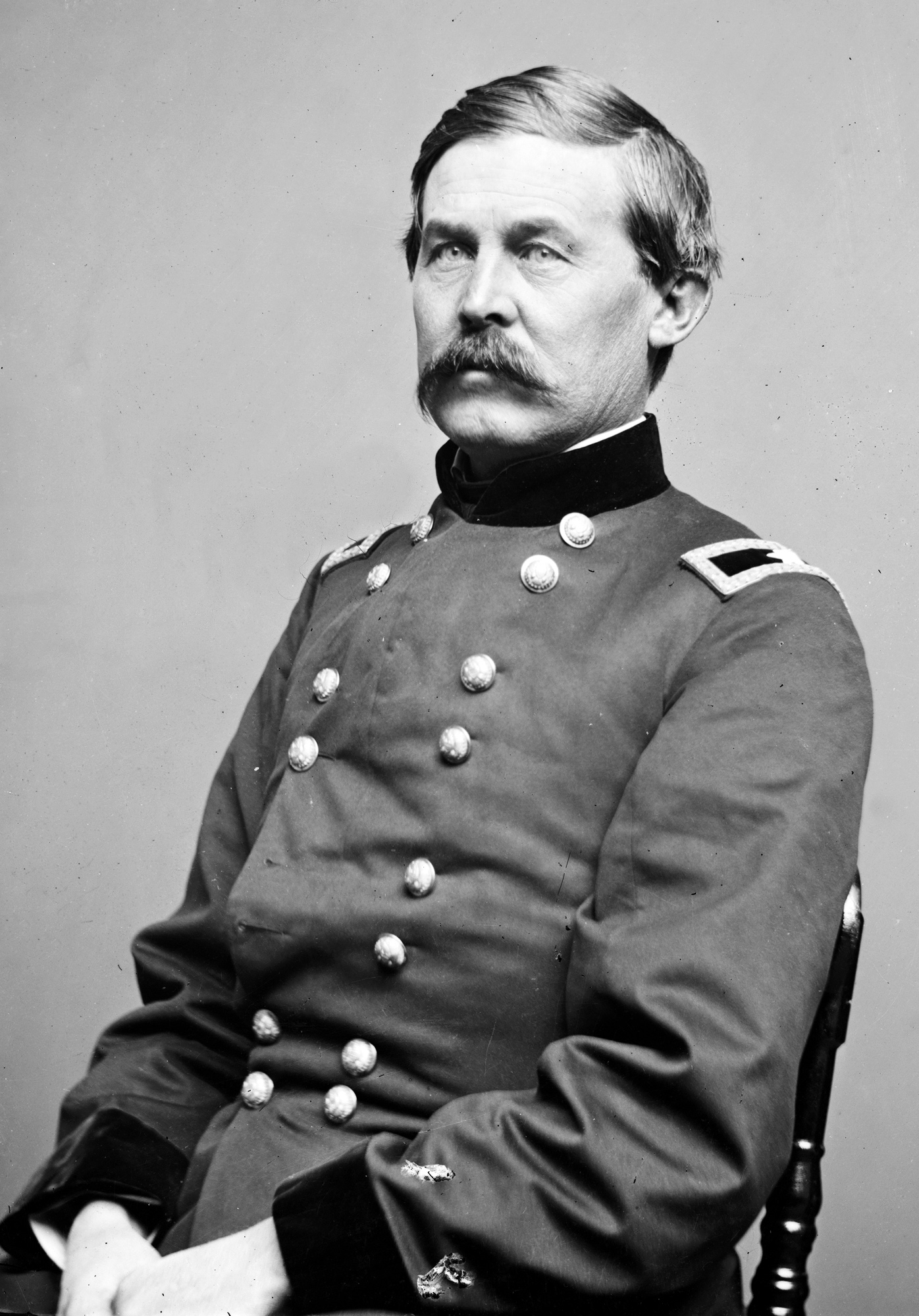 It was nearing 6:00 PM when General John Buford and his cavalry rode into Gettysburg on June 30th. Buford watched with concern as a brigade of Confederate infantry came down the Chambersburg Pike. When the rebels saw Buford’s troopers they withdrew — and informed their superiors that Union cavalry barred their way. But the Confederate generals refused to believe there was anything more than green Pennsylvania militia in Gettysburg.
In fact, Buford’s cavalry were the tip of the spear. The Army of the Potomac was on its way. The fighting would wait until morning.
 The next day, July 1st, the Rebs returned down the Chambersburg Pike determined to push Buford’s cavalry off the ridges north of Gettysburg. Fighting dismounted, Buford’s troopers put up a stiff resistance, buying time for reinforcement. In the cupola of the Lutheran Seminary overlooking the fight, Buford watched the progress of the battle raging to his front — and looked anxiously to his rear for the approach of General Reynold’s First Infantry Corps.
I would’ve loved to be there at the moment Reynolds rode up to the seminary and called out, “How goes it, John?” And Buford shouted back — “The devil’s to pay!”
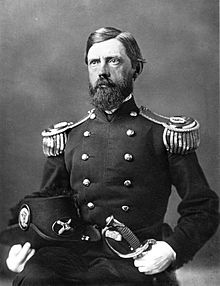 Buford was right. Before the day was done, Reynolds was dead and Union troops were driven off Seminary Ridge, through the town of Gettysburg, and into defensive lines on Culp’s Hill and Cemetery Ridge above the town and fields below. The Union First Corps lost two thirds of its men: dead, wounded, taken prisoner, and missing in action. But their sacrifice had kept the rebels from taking the high ground.
Lee wasn’t pleased that Union forces occupied the heights. But his army had once again driven their enemy from the field.
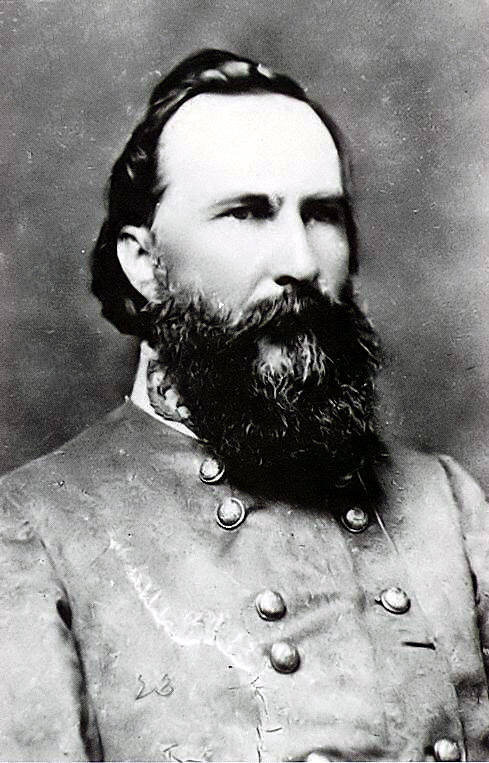 Day Two at Gettysburg was a violent, chaotic stage on which some of our favorite Civil War characters played their most memorable roles. For most of the day both armies consolidated their positions.
Ironically, Lee’s units arrived on the battlefield from the north and Mead’s army came up from the south.
It wasn’t until 4:00 pm that General Longstreet’s Corps began the Confederate attack on the Union’s left flank along Cemetery Ridge.
 But the Rebel advance ran into something unexpected: Union General Dan Sickles’ Corps, posted in a peach orchard – far in front of the main Union line.
Sickles was the only Union corps commander without a West Pointeducation. But while he was not a professional soldier, he was a born leader: a pugnacious New Yorker who never shied away from a fight.
And he was in for an epic one.
 There were innumerable peach orchards in America on July 2, 1863. But the stand of trees that Sickles’ troops defended from 4:00 to 6:30 PM that day would be known ever after as The Peach Orchard. It was here that Confederate General William Barksdale’s brigade of Mississippians made their famous charge. It was here that Sickles lost his leg to a cannonball. It was here that, after fierce fighting, Sickles’ men were forced to fall back under heavy fire.
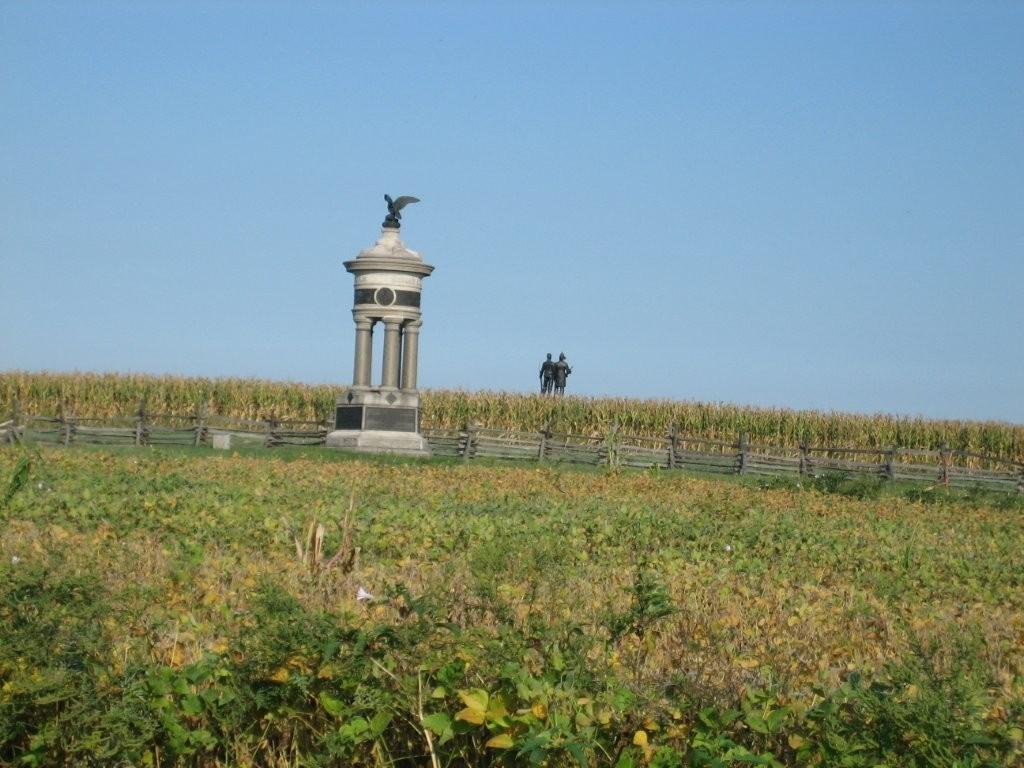 And it was here that New York’s Excelsior Brigade made their heroic stand.
But the bravery of the Excelsior Brigade could not stem the flood of Rebels charging through the peach orchard to exploit the gap in the Union line caused by the collapse of Sickles’ exposed position.
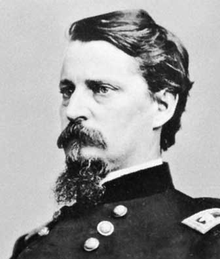 General Winfield Scott Hancock – in command of the Union center – and another Pennsylvanian — knew that, in just a few minutes, the Rebs would plow through that gap and penetrate his defensive line. The day, the battle, and the war, could be lost.
Hancock rode toward the crisis point and rallied Sickles’ retreating troops. But the few shell-shocked soldiers willing to reform their lines would not be enough. Hancock called for reserves, but they’d never arrive in time. He needed something to plug that fatal gap.
That something was the First Minnesota Volunteer Regiment.
 Hancock asked the unit’s officer, “What regiment is this?” “First Minnesota,” replied 23-year old Colonel William Colvill. With the clock ticking toward disaster second-by-second, Hancock pointed toward the oncoming Rebels and bellowed, “Charge those lines!”
Said a First Minnesota veteran, “Every man realized in an instant what that order meant — death or wounds to us all, the sacrifice of the regiment to gain a few minutes’ time and save the position. And every man saw and accepted the necessity for the sacrifice”.
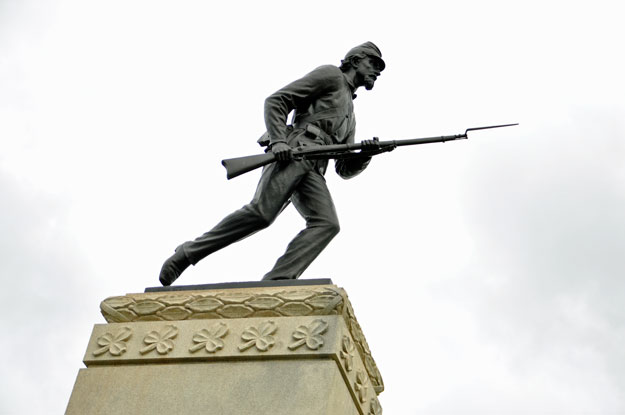 The 262 men of The First Minnesota advanced on the double quick, shouldering their muskets through a hail of lead, bearing down on the center of the enemy line. On Colvill’s order to charge, they raced forward with leveled bayonets. The lines collided with a shock, muskets blazed, and fighting raged hand-to hand. The First Minnesota’s flag fell five times, but it was taken up again each time.
The Southerners were stunned by the First Minnesota’s fury and tenacity, and for 15 precious minutes, paid for in blood, the Rebel advance was stalled. Of the 262 men who made that charge, only 47 survivors rallied back to General Hancock: an 83% casualty rate that remains the greatest loss by any American military unit in a single battle. But the men of The First Minnesota bought Hancock the time he needed to reinforce the gap in his defensive line.
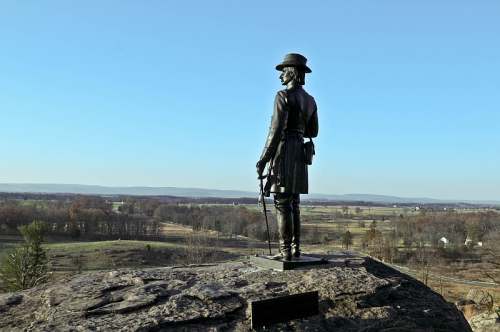 Longstreet renewed his relentless assault on the Union left in bloody engagements that made The Wheat Field and Devil’s Den synonymous with savagery, gallantry and wholesale sacrifice.
Before the fights in The Peach Orchard and Wheat Field, Union General Gouvernor Warren stood on Little Round Top and saw Longstreet’s battle line forming on the ridges beyond The Wheat Field.
 Realizing that Sickles’ advanced position left Little Round Top undefended, Warren sent couriers scrambling for units to help defend the hill. One of his couriers encountered 26-year old Colonel Strong Vincent.
Told that Warren needed troops “to occupy yonder hill,” Vincent declared, “I will do so and take the responsibility.”
Vincent rushed to Little Round Top and placed the four regiments of his brigade in line on the extreme left of the Union army, with the 385 men of Joshua Chamberlain’s 20th Maine anchoring the end of the line. Soon after that, the Confederate assault began.
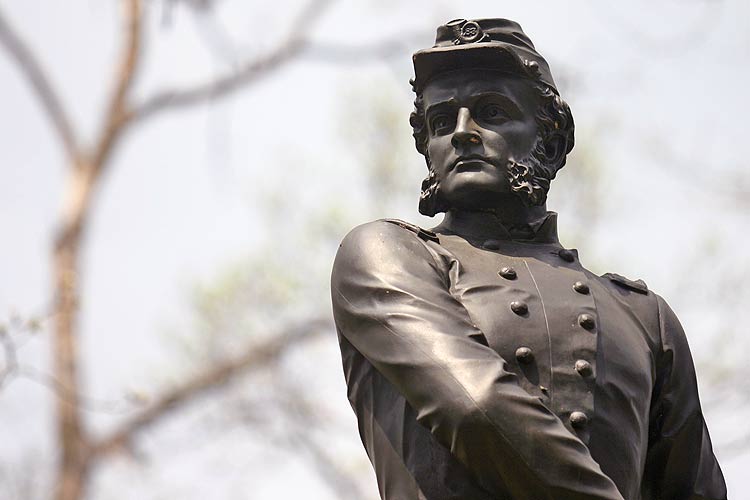 Vincent, brandishing his wife’s riding crop, urged his men, “Don’t give an inch!” It wasn’t long before Strong Vincent fell, mortally wounded. Like General Warren, Vincent had done his part to save the Union left flank. Now, it was up to Chamberlain’s 20th Maine to play their role in the deadly, decisive drama on Little Round Top.
 At 6:30 PM, after repulsing yet another rebel attack, Chamberlain’s troops were nearly out of ammunition — and running out of time. Ordered by Vincent to “Hold at all hazards,” Chamberlain knew he couldn’t retreat. He ordered his men to “fix bayonets.”
Said Chamberlain, “I ordered the bayonet. The word was enough. It ran like fire along the line, from man to man, and rose into a shout, with which they sprang forward on the enemy, now not 30 yards away. The effect was surprising; many of the enemy’s first line threw down their arms and surrendered… The enemy’s second line broke and fell back, fighting from tree to tree, many being captured, until we had swept the valley and cleared the front of nearly our entire brigade.”
Longstreet’s Corps had failed to take Little Round Top – and both sides regrouped for the fighting that would climax the next day.
 On July 3, 1863 the exhausted armies faced each other across a mile of open farmland — preparing to commence the final violence of their epic battle. Though Lee planned to strike the Union center early in the day, the thunderous cannonade preceding General Longstreet’s assault did not begin until 1:00 in the afternoon.
 Actually, the third day of the battle began at dawn as Union guns opened fire in defense of Culp’s Hill on the Federal right flank. By 11:00 am, Billy Yank was once again in possession of the earthworks they’d lost to Johnny Reb the day before. The fight on the Union right was over almost before it began.

Lee’s target: the legendary “copse of trees” that marked the center of the Union line on Cemetery Ridge.
Lee had attacked both Union flanks – and the Federals had paid dearly in their defense. Since General Meade must have had to draw troops from his center to reinforce his embattled flanks, Lee resolved to attack the Union center.
Lee’s “Old War Horse” Longstreet argued that the wiser course was to go around Big Round Top, get behind the Union army’s left flank and threaten the roads to Philadelphia and Washington D.C. – thereby forcing the Union army off the high ground on Cemetery Hill to give battle on ground of the South’s choosing.

The copse of trees (center right) seen from Confederate positions across the farm fields.
But Lee was resolved to strike – and break – the Union center. “The enemy is there, and I am going to attack him there.” After all, his army had never failed to break the Union lines in a frontal assault. But Gettysburg was a different: for the first time, Pennsylvanian Generals Meade and Hancock and the Army of the Potomac under their command were defending home turf. There was nowhere to run. As Hancock rode his lines that morning, he no doubt reminded his troops of the need to hold firm and give no ground.
 General Pickett’s division would lead the charge that became known forever after as “Pickett’s Charge.” The three brigades of General Pickett’s division were led by Generals Garnett, Kemper and Armistead. General Lo Armistead was a close friend of General Hancock, who waited for him across the open killing field.
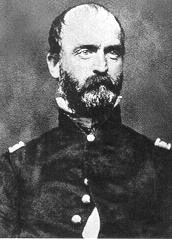 Pickett’s brigade commanders would pay a heavy price: Garnett and Armistead died in the charge. Kemper was severely wounded. The rebels managed to punch a hole in the Union center, led by Armistead, shot down as he placed his hand on a Federal cannon. But the Army of the Potomac sent the rebels in retreat across the farm fields over which they had so gallantly, but futilely, charged.
Of the more than 13,000 Confederates who made the assault, more than 7,000 lay dead or wounded on the field afterward.

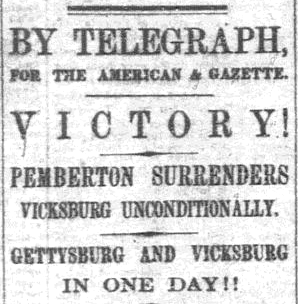 On July 4th, the day after General Meade’s Army won the Battle of Gettysburg, the Confederate stronghold at Vicksburg fell to Union troops under General Grant.
At great cost, the soldiers of the Union Army had given their war-weary nation two great birthday gifts. And while it would wear on for two more grinding years, the Civil War was essentially over.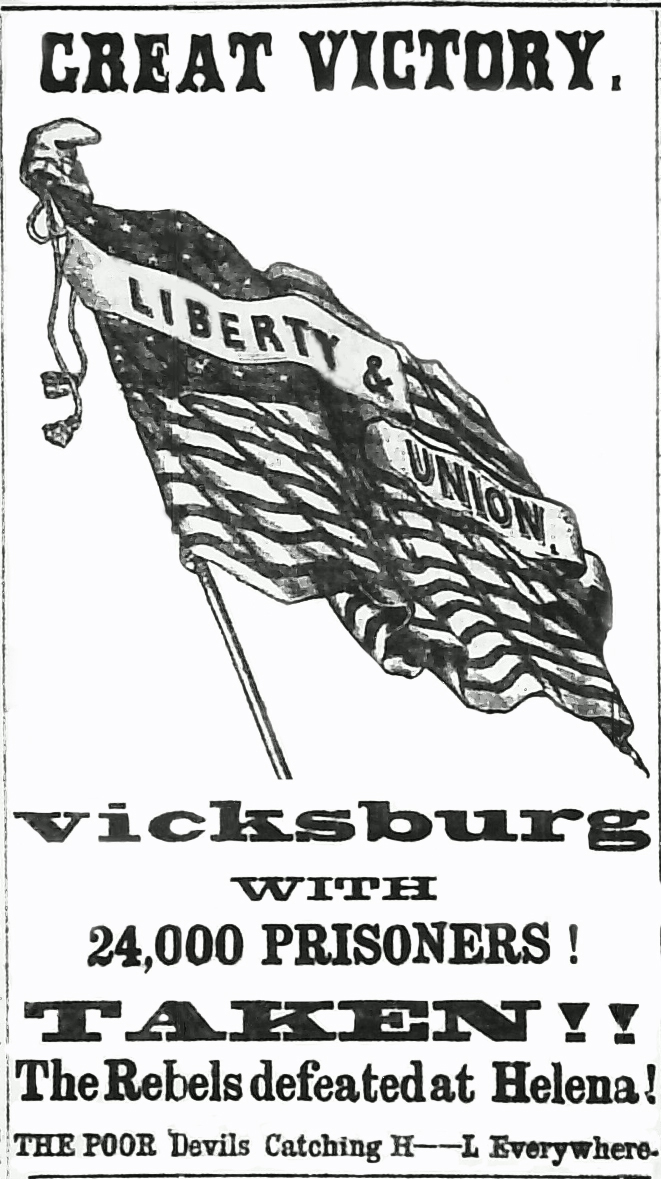


 Paul's Voyage of Discovery & Etc.