ICE Murders Arouse Heartland Backlash: ICE Out Now!
The temperature was well below zero, but the frigid weather didn’t stop hundreds of angry Evanston patriots from gathering at Fountain Square in the center of town to express their opposition to Trump’s ICE Brownshirts and their brutal occupation of cities led by Democratic politicians.
My wife Victoria and I were among the first to arrive minutes before the 4:00 PM start of the protest, but over the next ten minutes, the square was packed with progressive townsfolk, braving the cold to make their voices heard. (Victoria is holding our “Dump Trump” sign with flag: a veteran of many protests since the Mango Mussolini’s re-election.)
Here’s a sample of the many statements that our fellow Americans felt compelled to share despite the biting cold.
The next morning, Mike and Andy checked Huber’s email. The paramilitary RSVPs were already flooding in from Arizona, Oregon, Texas, Idaho — even as far as Michigan. There was a lot of excitement over seeing Goebbels’ and Himmler’s medals and decorations — and sheer ecstasy over what appeared to be Hitler’s own uniform! These right-wing freaks really knew their Nazi gear. There was no way they were going to miss the big show. It looked like Mike would have a full house, or a full barn, for the big bash he had planned.
With less than forty-eight hours to prepare for the party, Mike and Andy packed his van with the necessary supplies, including all the explosives, Mike’s TEC-9, and a fully loaded AR-15 from Andy’s arsenal with four additional 30-round magazines. “I got this baby when the assault weapons ban ended four years ago, like a lot of those militia nuts did. If things get out of hand, you’ll need the extra firepower.”
“Good idea, Andy. But drive extra careful. We can’t get stopped with all this stuff in your van.”
“Relax, pal. I’ve got handicapped plates. They always get me out of trouble. Cops don’t like to mess with an old guy in a wheelchair. What are they gonna say? ‘Step out of the car, mister?’ It’s too much of a hassle with the ramp and everything.”
“I get it, Andy, but stick to the speed limit and don’t run any red lights, okay?”
“Okay, dad.”
Andy observed all the traffic laws as they drove back up to the deserted farm north of Goleta. Just as Andy expected, there was nobody there. They parked near the closed gate and Mike used bolt cutters on the padlock so Andy could drive in and park behind his dead buddy’s abandoned farmhouse. Mike pocketed the broken lock, replaced it with a new one, then closed the gate and locked it. This farm didn’t need any surprise visitors today.
Mike went to work. He knew his way around explosives. Though not trained in the Marines as a sapper or combat engineer, he’d been pressed to help those guys blow up roads and bridges when they’d taken too many casualties to handle the job on their own. He knew where to place the charges for maximum effect, how to hide them, and how to wire them for detonation.
As he prepped the old barn to explode with a maximum loss of life, a nagging thought entered Mike’s mind. Was he any better than the Nazis with their death camps? Or the Japs in the Pacific, ruthlessly killing tens of thousands of civilians and prisoners of war?
Hell yes, he reassured himself. Hitler and Tojo’s armies murdered innocent people. They and their minions were guilty of war crimes. The assholes Mike was targeting were just as bad: racist killers who’d already started slaughtering blameless, unsuspecting Americans who weren’t like them. The other. Like the Jews, Gypsies, homosexuals, the mentally retarded, intellectuals, and everyone else who didn’t conform to the Nazi’s perverse Aryan ideal. Or the Chinese, Filipinos, and other Pacific islanders sacrificed on the bloody altar of Japanese imperialism.
But still, Mike wondered, should he just alert the cops to this gathering? Stage a police raid, and hand all these militia bastards over to the authorities? Leave them to justice?
No way.
As a cop, Mike had seen all too often how bad guys would lawyer-up and get away with their crimes. Even now, he was hearing right wingers on TV and radio making pathetic excuses for the rash of mass shootings. The killings were regrettable, but the shooters were aggrieved. “We’ve got to understand why these militia men feel the way they do. They’ve been ‘radicalized’ by changing demographics in what they feel has always been their country – ‘alienated’ by a loss of white privilege.” To the apologists it was all about economic anxiety and “cultural dislocation” among the white working class: too many immigrants from Africa and Central and South America taking away their jobs.
Mike was calling bullshit on all that claptrap. None of these jerks were ever going to spend a single day in the hot sun, bent over row upon row of lettuce or strawberries. Their teenage sons weren’t going to clean hotel bathrooms or wash dishes or mow anybody’s damned lawn but their own. These gun-loving militia yokels were just fascist stooges, easily led by soulless men who preyed on their hatreds, fears and insecurity. Mike and his GI pals had defeated creeps like these in the war – and he was ready to, once again, send them all back to hell.
Before the sun dropped below the Pacific Ocean’s western horizon, all the explosives were in place. Tomorrow, it was down to Mike to play his part.
He and Andy camped out overnight on the farm. Siting in Andy’s car, they watched as the excited email chatter continued to pour in on Huber’s iPhone. The top militia boys had clearly taken the bait. Mike figured there’d be at least forty to fifty of these bastards at the big event tomorrow night. The plan was for this secret shindig to end with a big bang. But before Mike could set it off, he had to start the show on the right note. He had to keep these lowbrows in suspense. They were expecting something spectacular.
Perhaps the inconceivable arrival of the Fuhrer himself!
The sun finally sank behind the ocean. Maybe it was the cool ocean breeze, or the exertion of playing sapper again after all these years, but Mike had no trouble drifting off to sleep. As he slept, there were no challenging thoughts of the day to come. Just blessed rest. Much needed rest. Not enough rest.
The next morning, Mike woke up to a crowing rooster. Abandoned as it was, this was still a farm. As he shook off the fog of sleep, he considered calling Gloria, but he couldn’t use Andy’s phone. That could put Andy and Gloria both in hot water. And there was no way he could use his phone – Huber’s phone. At this point, Mike knew he should only use it for official business. Militia business. He knew just enough about these damn iPhones to suspect that the militia nuts might be able to track down Gloria somehow through his phone activity.
However the day turned out, Mike was determined to protect Gloria. If he somehow got out of this crazy situation alive, he needed her to be there for him. There were a lot of big ideas on the line — democracy, equality, freedom from fascism, and defeating racist hate — but Gloria was foremost on his mind.
Despite the insanity of their years apart, and the difference in their ages, he was no less in love with Gloria than on that day in ’51 when he disappeared down the rabbit hole. She was his point of focus. Do the right thing, take the right steps, make the right moves, and he might get back to the girl he loved. He might survive. That’s why so many Marine pals carried photos of their sweethearts into battle — and kissed them just before the shells started flying.
It was 10:00 in the morning. The meeting would start at 9:00 PM — only eleven hours away. There were many things Mike still had to do, but Andy was useless at this point. In fact, he was a burden. You can’t tool around a farm in a wheelchair. Especially when the shit is hitting the fan.
Mike woke Andy up and told him to drive back home and wait for his call after the show over. “You kidding, Mike? I should be standing by. You don’t know what’s gonna happen! I might need to come to your rescue…”
Mike stopped him. “You can’t help me now, buddy. You’ve done all you can do. You’re the brains of this outfit. This whole setup is yours: the plan, the pyro, the farm, the barn. It’s all you, my friend – and it’s all wired to explode. But I’ve got to greet these assholes and dazzle them for a while before I blow them all to hell. If I manage to come out alive, I’ll call you to come and pick me up. Go home, pal. I’ll call you as soon as I can.”
Andy was crestfallen, but he was no fool. He knew he couldn’t be much help in the madhouse situation Mike was facing. Instead, he’d wind up being a burden. “Okay, Mike. I’m driving out of here. But I’m not going far. Maybe I’ll get a motel room in Santa Barbara. Hell, I might even go wine tasting over in Santa Ynez. Drown my sorrows in Chardonnay.”
“Sounds good, buddy. A fine idea.”
“Better yet, I’ll toast your impending victory. At two or three vineyards at least!”
“You do that, Andy. And bring back a bottle or two for me. We’ll share them with Gloria when we get back.”
“Okay. I’ll wait for you in Los Olivos. Love that little town. I’ll hang out at Mattei’s Tavern. That way I’ll be close when I get your call.”
“See, Andy? You are the brains of the operation.”
Andy blushed for a split second, then recovered. “If you need me, call me. And fuck you if you don’t.”
“If I don’t call you, Andy,” Mike replied, “You’ll know I’m truly fucked.”
Mike watched his old buddy drive away and turn right on the 101, heading north toward the Gaviota Pass. It was now less than ten hours before showtime.
Mike had already set the barn to blow. The explosives were connected to a switch that would set off the blast. He hid that switch in a chicken coop located forty yards from the barn. Gritting through the searing pangs in his hip, he practiced running from the barn to the switch. The world’s best athletes could run a forty-yard dash in around 4.25 seconds. Mike was no Olympic sprinter, but even with his old, aching war wound, he covered that distance in a little more than five. Hopefully, that would be enough.
The chicken coop was twenty yards from the front porch of the farmhouse. Mike stashed Andy’s four AR-15 magazines and his loaded TEC-9 under the front porch. From that concealed vantage point, he’d have a clear field of fire between the closest barn door from which anyone might escape and their parked cars.
He was rehearsing an ambush. If anyone survived the blast, he wasn’t taking prisoners.
Next, to be certain of where any blast survivors might emerge, Mike made sure there was just one working door in and out of the barn. He boarded up the door facing away from the farmhouse and closed up any gaps in the walls that might allow for escape. He made sure that the one exit that remained, the door that opened toward the farmhouse and chicken coop, could be bolted shut from the outside. He was glad to find that the large, rusty old iron latch bolt still worked. Mike latched it closed — and tugged mightily. It would hold. For a while at least.
Starting at that door, Mike stepped off about thirty yards behind the barn. This is where he’d direct his guests to park — hidden from the view of passing traffic on the 101. A bunch of cars, vans, and pickups parked on what looked like a vacant farm property might draw attention. The paranoid militia boys would no doubt appreciate yet another level of operational security.
Mike walked down the road past the farmhouse and out to the gate. There was almost no traffic on the 101. As he walked, he rehearsed the speech he’d give to his audience in German. Andy had helped him prepare it by using a translation “app” on his computer. Modern advances like this made Mike’s head spin, but German was, after all, his mother’s tongue. He’d spoken enough around the house as a kid that his accent was passable. He had to admit that, after several dozen rehearsals, he sounded pretty good.
“Gentleman. Es ist mir eine Ehre, heute Abend unter Helden zu sein. Sie haben bereits den großen Krieg für die Erlösung Ihrer Nation begonnen, aber jetzt biete ich Ihnen etwas mehr an als die Waffen, die Ihnen versprochen wurden. Heute Abend bringen wir Ihnen historische Führung. Heil Hitler!”
Translated, Mike would say to the gathered militiamen, “Gentleman. I am honored to be among heroes tonight. You have already begun the great war for the salvation of your nation, but now I offer you something more than the weapons you have been promised. Tonight, we bring you historic leadership. Heil Hitler!” That’s when Mike would walk out the barn door as if to usher in Hitler and his Nazi minions. Instead, that’s when he’d bolt the barn door shut, race to the chicken coop — and blow them all to bits!
Mike rehearsed his speech over and over as he made his final preparations. It soothed his nerves and focused his attention on the task at hand. Tonight, he’d strike a death blow against a movement that was already betraying the proud, democratic nation that his Marine comrades had given their all to defend from island to blasted, bloody island across the Pacific.
All Mike had to do was keep his shit together, stay calm, and pull off the plan. Eight hours from now, he’d know if he measured up to the task.
Chapter Twenty-Five
At 6:00 PM Pacific time, the sun was diving beneath the Pacific Ocean, sending long shadows across the neglected farm where Mike Delaney was preparing to launch a counter-offensive against the right-wing terror that was gripping his beloved country.
And there was still a lot to be done.
With three hours to go before D-Day in Goleta, Mike carried a table from the farmhouse and placed it in the center of the barn. He took the bin of Nazi gear he’d taken from Hitler, Goebbels, and Himmler and laid it on the table: an assortment of insignia, medals, and uniforms that any true Nazi fan would die for. That thought brought a hard-hearted grin to Mike’s face. “Die for,” he mused. That was, indeed, the plan.
Mike knew his audience. This vintage collection of Third Reich memorabilia would focus the attention of every white supremacist in the room. Mike placed Hitler’s Walther and Goebbels’ Luger on display. All unloaded, of course. Then he walked out of the barn, closed the door, and bolted it shut.
At 7:45 PM, he trotted down to the gate, unlocked it, and swung it open. Then he ran back up the road toward the barn. It was time for him to get dressed. He chose the Nazi uniform that fit him best. Heinrich Himmler was five-foot-nine inches. Mike was nearly six feet tall. It was close enough. As he admired his reflection in one of the farmhouse windows, Mike had to admit that — evil though they were — the Nazis turned out some sharp-looking duds.
Mike slung Andy’s AR-15 across his back and holstered one of the Walther pistols on his hip. The sight of a World War Two era Nazi officer armed with a modern automatic weapon and a classic Nazi sidearm would no doubt thrill the men who showed up for tonight’s event.
Mike wasn’t shooting fish in a barrel, but it was damned close.
At 8:00 PM, Mike stood next to the barn and brandished a flashlight. Over the next hour, he signaled the militia boys as they arrived via the 101 and turned into the deserted farm. In his role as a well-armed imperious Nazi officer, Mike said very little, and what he said in the way of direction was minimal – and spoken in broken English with a heavy German accent. There was no friendly chatter. He assumed an air of command and was met with obedience.
With few words, Mike showed the arrivals where to park – and they dutifully lined up thirty yards behind the barn in rows of five cars each. Stacked in that way, the vehicles could not be seen from the highway.
Most of the vehicles carried more than one man. Mike made a tally of all the occupants as they drove in. By the time the last vehicle was in place, he counted thirty-two cars, trucks, and vans containing a total of seventy-three men. This was more militiamen than Mike had seen at the Griffith Park Zoo and Murphy’s Ranch combined. Clearly, the spate of racist mass shootings across the country had energized the right-wing militia movement.
Any vestige of guilt that Mike felt about what he was about to do vanished.
The night grew chilly. Mike ordered the militiamen to stay in their vehicles until 9:00 PM sharp. The door to the barn wouldn’t be opened until then. This caused some grumbling among the more cantankerous guys. One guy in particular, a member of the Boogaloo Boyz, didn’t take kindly to Mike’s directions and let him know it. But most of the arriving guests followed orders without complaint.
Mike ran down the road to the gate, closed it, and locked it — then came back to patrol the rows of neatly parked cars, listening to what the men were saying among themselves: a lot of chest-beating about the mass shootings that were taking place and curiosity about the Nazi gear they saw on the internet. That led to speculation about which Nazi leaders might be showing up. Would they be contemporary neo-Nazis from Europe or South Africa? Or were they about to meet senior officials of the actual historic Third Reich? If time travel was possible, surely a certifiable genius like Dr. Huber would have mastered it.
They’d all know soon enough.
At 9:00 PM, Mike ordered the men to exit their vehicles and gather in front of the barn door. There was some muttering as they assembled. They’d been patient so far, but these guys weren’t used to taking orders. Mike had to maintain control if he was going to pull this thing off. He required strict obedience, whatever it took.
The same member of the Boogaloo Boyz that had chafed at Mike’s orders upon his arrival less than an hour ago pushed his way forward through the crowd. He stood two feet from Mike, looked him in the eye, and issued a direct challenge. “Who the fuck are you, pal? And why should we take orders from you?”
Mike instantly drew his Walther pistol and calmly put a bullet through the man’s forehead. As his dead body hit the ground, Mike glared at the assemblage, and without raising his voice or betraying any emotion, spoke with force in his convincing German accent.
“Do you think this is a game? I say to you all – we’ve not come so far to suffer fools who doubt our cause!Small men who put their own egos above our sacred mission. We have all devoted our lives to the master plan! Our brothers in arms are already in the field! This is no time for weak minds that don’t understand the need for total obedience to Nazi leadership. No time for small men without stout hearts and wills of solid steel! Forward now brothers, to our glorious future!”
Mike opened the barn door and motioned the militiamen to enter, filing past the man he’d just killed. They did so. Obediently. Most of them enthusiastically.
The table full of Nazi gear stood in the center of the barn. The sight of the uniforms, the medals, the insignia — especially all the SS emblems and weapons — had an electric effect on the assembly. They were like little boys on Christmas morning getting their first look at the delights that Santa stashed under the tree. Hitler’s uniform was not on the table. Mike wanted the militia boys to imagine that the great man himself might wear that uniform when he entered the barn to take personal control of their racist crusade.
Mike gave the men a moment to appreciate what this display represented before directing them to take up positions in the back half of the barn. Once they all fell into place, Mike addressed the group in his well-rehearsed German, as though the Fuhrer himself were listening.
“Gentleman. I am honored to be among heroes tonight. You have already begun the great war for the salvation of your nation, but now I offer you something more than the weapons you have been promised. Tonight, we bring you historic leadership. Heil Hitler!”
The crowd responded with a hearty, “Heil Hitler!” Mike continued, this time in his heavily accented English.
“My brothers in arms. I am Helmut Brinkmann. I wear the uniform of Reichsführer of the Schutzstaffel, the Nazi cadre you may know as the SS. I wear this uniform because the day will soon be upon us when we will all be proud to show the world who we are and what we stand for. The day is coming when white Christian men will regain supremacy in America and the world. I am, like all of you, a patriot in this battle for the soul of our nation: a battle in which God himself has ordained our victory. Seig Heil!”
Mike may have gotten carried away, but the lusty “Seig Heil” shouted back in reply assured him that he knew his audience all too well.
“Dr. Huber and Horst Mueller cannot be with us tonight. Their scientific breakthrough – which has led to the miracles you will witness tonight — has aroused the interest of those in the U.S, government that would oppose our noble goals. Concerned they might be under surveillance,” Mike gestured to the table of Nazi gear, “they have sent me in their stead with these tokens from the past – and this message.”
Mike’s mention of “tokens from the past” did not go unnoticed. When he repeated the part about giving them “something more than the weapons you have been promised. Tonight, I present you not just with arms – but with historic leadership,” the gathering was, to a man, nearly foaming at the mouth. Mike’s final “Heil Hitler!” was met with a thunderous response that would have made the Brownshirts of the Beer Hall Putsch proud.
Mike held his AR-15 aloft and told the whipped-up crowd that, after they met their new leaders, they would all head over to the farmhouse where hundreds of these weapons were waiting for them. That drew more cheers. But first, Mike redirected their attention to the display of Nazi paraphernalia, saying the items “are clues to the identities of the great men you are about to meet — leaders who will guide us to a glorious victory over the mud races who stain the blood of our proud white Christian nation!”
Summoning all the bravado he could muster; Mike ordered the militiamen to stand at attention while he brought in the Nazi leaders. Every man stood rigid, obeying his command. Mike had them right where he wanted them. He strode out the door, bolted it closed from the outside – then sprinted the 40 yards to the switch that would detonate the explosives. In the few seconds it took to reach the switch, Mike could hear some shouting inside the barn and men pounding on the locked door.
Mike flattened himself on the ground — and threw the switch.
The barn exploded in a rapid series of powerful blasts that shattered the wooden walls and engulfed what remained of the structure in a roiling maelstrom of fire.
Mike could hear the screams as he raced to his hideout under the farmhouse stairs and trained his AR-15 on anything that might emerge from the inferno. Within seconds, he was gunning down wounded men staggering from the blaze — many with their clothes and bodies on fire. The few that managed to escape the conflagration unharmed, some with weapons in hand, fell victim to Mike’s withering automatic fire. A handful of them managed to get off a shot at their unseen attacker before Mike dropped them.
Four minutes and four thirty-round magazines later, nothing was moving in Mike’s kill zone. Nobody had gotten as far as their vehicle.
The cops and the firemen would be on the scene before too long. The locked gate would make it harder for them to get to the burning barn, and the carnage behind it. It would also help Mike put more distance between him and this grisly scene. He went looking for any survivors, found just a few terribly wounded men – and with a few quick bursts from his TEC-9, he left no one alive.
Mike took off his Nazi uniform and tossed it along with his AR-15 into the back of a burning pickup truck before running to the farmhouse and putting on his old clothes.
Carrying his TEC-9 and trusty old .45 automatic, he disappeared into the woods on the northern edge of the farm. He paused for a moment, hidden, and looked back at the dreadful scene.
Nothing was moving except the devouring flames. No sirens could be heard yet.
It was time to get lost.
Chapter Twenty-Six
Mike hiked north, parallel to the highway, staying well off the road and out of sight. Fifteen minutes after he fled the farm, emergency vehicles started racing by on the 101, heading southwest from towns like Buellton and Solvang. There were probably more of them racing north from Goleta and Santa Barbara. Mike wondered whether Andy could hear all those screaming sirens up in Los Olivos.
Mike had made a hell of a mess back there. He’d done some grim, hard-hearted, cold-blooded things. But this was all-out war — and those bastards had started it. He’d never forget their full-throated shouts of “Seig Heil’ and “Heil Hitler!” There was only one way to deal with that kind of evil. And he’d done it. Just like he and his men had done with M1 rifles, flame throwers, and satchel charges on Iwo Jima and all those other places where the forces of hate and extremism had dug in for a fight to the bitter end.
When he finally got a chance to sleep — if he ever got that chance — he’d sleep just fine.
For the next three and a half hours, Mike trudged more than ten arduous miles through farmland, woods, and occasional streams and irrigations ditches. High and bright, the winter moon lit his way but kept him mindful of staying hidden. Then, that annoying shred of shrapnel in his hip insisted he stop soon for a rest.
It was past midnight when he gave in to the pain and settled on a secluded spot where he felt safe enough to take a breather and call Andy.
“How was the wine tasting, buddy?”
“Mike! Are you okay?”
“I’m fine, Andy. Listen. I’m about twelve miles or so south of Gaviota Pass. I’m gonna rest here for a while before pushing on. I figure I’ll reach the pass sometime before five or six in the morning, just before sunrise. Can you pick me up there?”
“No chance, pal. I’ve got another wine tasting.”
There was a brief, confused pause. Mike’s wits weren’t the sharpest at that moment.
“Of course, you asshole, I’ll pick you up. Jeez, Mike! Where’s your sense of humor?”
“Sorry, Andy. That was hilarious. You’re a regular George Burns.”
“You know he lived to be a hundred? He died just twelve years ago.”
“That’s amazing. Good for George. Listen, Andy. I’ll be waiting near the historical marker. You know, the one about Fremont in the Mexican War?”
“Sure. Sure. I know where that is.”
“Good. I’ll see you there by six o’clock.”
“I’ll be there, pal. You know, Gloria called me asking about you…”
“For Pete’s sake, Andy — don’t talk to Gloria or anyone else until you pick me up. Radio silence, buddy. Got that?”
“Roger.”
“Okay, my friend. Over and out.”
Mike hung up. What would he do without Andy?
Nearly five hours after he hung up with Andy, Mike arrived at Gaviota Pass and collapsed, totally exhausted, behind a large clump of chapparal. The sun had yet to rise over the steep Santa Ynez Mountains to the east — and there was almost no traffic moving through the pass.
Mike welcomed the relative peace of the small roadside park on the south side of the road that featured the Fremont-Foxen Memorial. Mike was around fifteen years old when the memorial was erected. His dad was the kind of guy who always stopped at roadside history markers, so no family trip to the Santa Ynez Valley was complete without a brief visit to California Historical Landmark No. 248.
Mike was too tired to get up and walk over to the metal plaque, plus he wanted to keep out of sight. But he knew what the memorial said. He’d once memorized the text for a high school history presentation on the Mexican American War. It was either that or build another sugar cube replica of the Santa Barbara, Santa Ines, or La Purisima Missions.
“Here on Christmas Day, 1846, natives and soldiers from the Presidio of Santa Barbara lay in ambush for Lt. Col. John C. Fremont, U.S.A. and his battalion. Advised of the plot, Fremont was guided over the San Marcos Pass by Benjamin Foxen and his son William, and captured Santa Barbara without bloodshed.”
Researching his presentation, Mike learned that the events inscribed on the memorial weren’t true. According to local lore, Mexican soldiers from the Presidio of Santa Barbara lay in ambush on the cliffs above Gaviota Pass, ready to rain an avalanche of boulders down on Fremont and his troops. But, in fact, those Mexican soldiers were way down south in Los Angeles at the time, and torrential rains had flooded the Gaviota Pass. So, there was no such plot. Fremont and his command actually marched out of the Santa Ynez valley for Santa Barbara through the San Marcos pass on the other end of the valley because it was the most direct way out.
Still, the local legend made a hero out of William Benjamin Foxen, a former merchant seaman who eventually became a wealthy rancher.
That’s how it is with events in war, Mike reflected. The dark truth gets confused over time. Deadly command mistakes, self-glorifying lies, and savage, brutal battles, butchery, and carnage become sanitized tales of victory and heroism as they’re told through the years.
Mike didn’t have to wonder about how his story would be told. Nobody would believe it anyway. There were only two people in the world who would know what happened. Only Gloria and Andy could judge whether what Mike had just done was a heroic act of national defense in a budding civil war or just evil piled upon evil. Only Gloria and Andy…
His mind was wandering. Where was Andy?
A short time later – was it seconds, minutes, or more? — Mike was awakened by the short blast of a car horn. He shook the cobwebs from his brain and poked his head over the bushes. It was Andy alright. Mike got up, waved to him, then trotted over to his van. “Six o-clock on the dot,” said Andy, as Mike climbed into the passenger seat.
“Thanks, pal. Let’s get out of here.”
Andy pulled out of the park, heading northeast toward the Gaviota Tunnel. “You know, this is a divided highway, buddy. I had to drive about 10 miles south before I could get in a northbound lane. I got within eight or so miles of the farm you torched last night.”
“Did you see any cops or fire trucks?”
“I heard some faint sirens in Los Olivos last night. Nothing unusual. But I didn’t hear anything this morning. Not even on the 101 near the farm.” Andy took a good look at Mike. “You look like shit.”
“I feel worse.”
“Want me to turn on the radio? Local news is blowing up with stories about last night.”
“Blowing up?’
“Sorry, Mike, I wasn’t trying to be funny.”
“Take the 154 through the San Marcos Pass into Santa Barbara.”
“Just like Fremont?”
“Yeah, Andy. Just like Fremont.”
Mike leaned back in his seat as Andy switched on the radio. KZSB was on the story big time. The broadcasters were saying it was the biggest new story in Santa Barbara County since the 1968 oil spill disaster — or that time in 1942 when a Jap submarine lobbed some shells at the oil installations on the Gaviota Coast.
Reporters close to scene weren’t getting a lot of information from local authorities, but from the number of ambulances and emergency vehicles arriving from both north and south, it appeared to be a mass casualty event.
“Why so many bodies and vehicles have been found on this abandoned farm is still a mystery,” a reporter informed his radio audience. “The absentee owners, who both live out of state, are the only children of the man who owned the farm before he passed away two years ago.” Mike was impressed with how soon they’d gathered so many details. But he knew they’d never know the full story.
The reporter went on. “Authorities will be holding a news conference at noon to update the public on the latest information. At this point, there is no reason to believe that residents of Santa Barbara County are in any immediate danger.”
“The local cops don’t know shit,” said Andy. “And what little they do know they aren’t about to talk about. Before long, the ATF and FBI are gonna come in and bigfoot the whole case. And then, nobody’s gonna get any information until the Feds are damn good and ready to release it.” He turned to Mike. “But you, my friend, know all the details. And you don’t exist. So, this shit could hardly be more nuts.”
As they briefly lost radio traffic in the Gaviota Tunnel, Mike took it all in for a moment. He hadn’t felt this physically and emotionally spent since the war. Emerging from the tunnel, the breathless radio reports resumed, but Mike wasn’t listening. Andy was right. Mike already knew what happened. And he knew that law enforcement, no matter how good they were — local, state, or federal — had any chance of figuring it all out.
Less than a half hour later, they were almost out of the valley. The Cold Spring Canyon Arch Bridge approaching the San Marcos Pass on Highway 154 rose four hundred feet above the canyon floor. One of the highest bridges in the nation, Mike had never seen it before. “Holy shit, Andy! When did they build this?”
“They cut the ribbon in ’64. Thirteen years before your dumb ass disappeared. Still scares me to drive over it. Dozens of folks have killed themselves jumping off this thing. It’s what they call an attractive nuisance. But it beats winding your way up these hills like we did back in the day, remember? Although, stopping for drinks and barbecued tri-tip at Cold Spring Tavern was well worth the trouble, wasn’t it, buddy?”
“Sure was, my friend,” Mike replied, happy to think for a moment about good old times.
“Cold Spring Tavern’s still going gangbusters, Mike. But they’re closed ‘til lunch time, or I’d take you there for breakfast right now.”
“I’m damned hungry, Andy. But I want to see Gloria as soon as I can. I gotta touch base with her before I can relax.”
“I get it, pal. You just get some rest. I’ll wake you up when we get to Malibu.”
A restful half-hour later, Mike woke up as Andy pulled off the 101 to park along the coast at County Line surf break — so named for being on the border between Ventura and Santa Barbara counties. “Sorry for stopping, Mike. But I just love this place. It’s like therapy, you know? We caught a lot of great waves here back in the day.”
“We sure did. But I caught a hell of a lot more than you.”
“So, what! You were younger.”
“Two years is nothing. Besides, I was riding those waves with Jap shrapnel in my hip.”
“Don’t give me that ‘shrapnel’ crap, pal. Sometimes I wonder if you were ever even wounded. Sometimes I think to myself, ‘He’s just making this shrapnel shit up.’”
“I don’t blame you, buddy. Fact is, the truth is only the stories we tell each other, right?”
“I guess so, Mike. But your story’s getting so fucking impossible to believe – and it’s true. That’s the crazy part. Among a fuck ton of totally crazy parts — it’s true.”
Mike fell silent for a moment. He hadn’t been through anything like what happened last night since Iwo Jima. Andy knew what he was thinking.
“You gonna tell Gloria everything?”
Mike gave Andy a solemn look. “No, Andy. And you won’t tell her either, okay?”
“Hell, I don’t even know all the details. I’ll back whatever story you want to tell her.”
“Thanks, buddy,” Mike replied, taking the phone out of his pocket. “I’ll give her a heads-up.”
Gloria came on the line, overtaken by waves of heart-rending relief at finally hearing from Mike. He told her he was with Andy and he’d be home soon, but that he didn’t want to stay on the line too long. They exchanged an emotional, tearful goodbye for now, then Mike hung up.
He held the phone in his hand: the black, mysterious object that had started this whole insane adventure. He realized that the time had come for this thing — Dr. Otto Huber’s iPhone – to disappear.
Andy agreed. “There’s too much information stored on that sucker, Mike. You have no idea. Too many ways to track you or Gloria – or me – down.”
“Okay,” said Mike, “Let’s give it a burial at sea.”
He ran down the beach, paused at the water’s edge – and threw the iPhone as far as he could. It sailed through the moist morning air for nearly one hundred feet until it finally splashed into the water and disappeared beneath the waves.
Chapter Twenty-Seven
Andy dropped Mike off at Gloria’s house. Mike looked like shit. And Gloria agreed.
“You look like hell, lover-boy. Is this what I waited for the past two days?”
Gloria’s jest landed for just a split second before she broke down and threw her arms around Mike. “I missed you, baby. I was so worried. Hell, I’m still worried,” she gushed. “Are you okay? I heard on the radio about that big farm fire in Goleta…”
“Yeah, I heard about it, too, baby.” Mike held on to her for life. He kissed her forehead, then her lips. “They don’t really know anything, babe. The reporters don’t know — and the cops won’t say. That’s usually how it goes.” He gave Gloria another kiss. “It’s crazy. But you know what I know?”
“What’s that?”
“I know that I love you, baby.”
“I know, Mike. And I love you, too. That’s just one more crazy thing, right?”
“Right, doll.”
Just then, Gloria caught a whiff of her returning hero. “First things first, boyfriend. Jump in the shower and do something about your sorry self.”
Gloria started making breakfast while Mike cleansed himself of his ordeal. As he washed away the filth of the past two days, he wondered what Gloria was thinking. How much did she know? How far did she think he went? He’d told her he could do things the cops couldn’t do: things she didn’t need to know. But could he be completely honest with her? Could he tell her the whole story? And if he did, would she be horrified? Not just by all the killing – but by him. By what he was capable of doing.
After Mike’s shower, he wrapped the towel around his waist. He could glimpse Gloria in the kitchen, and the smell of bacon was in the air. He never wanted to move from that spot, that moment, for the rest of his life. But he walked into the kitchen.
“Nice outfit, Mike.”
Gloria looked him over, his banged-up 29-year-old torso was nonetheless like a Roman statue. “It’s nice to see you’re finally trying to appeal to my intellect.”
She put a big plate of bacon and eggs, a steaming cup of coffee, and a stack of pancakes in front of him. “So, what’ve you been doing all night?”
“Andy and I were working a job.”
“Up in Santa Barbara County?”
Mike didn’t say a word.
“I’m not a mind reader, Mike. I know where you were. You called me from County Line.” Gloria showed him her phone. “See? It’s right there, Sherlock. Welcome to the modern world.”
Mike was happy to see Gloria in a joking mood. It might be best, he thought, not to burden her with too much darkness.
“Were you and Andy just riding some waves?”
Mike wanted to share as much as he could with Gloria, but he had to protect her. The militia nuts would be looking for revenge. And while he couldn’t imagine how they might track his 76-year-old girlfriend down – it wasn’t a zero percent chance. Nothing was. Not after everything he’d been through.
“Gloria, baby.” Mike looked her in the eyes and took her hands in his. “The less you know the better. It was a really bad night for the bad guys. And now I’m back home with you. Let’s just start there and go from here.”
“Start there and go from here?’ You’re so damned smooth, Detective Delaney,” she pretended to purr, “How can an old gal resist such witty repartee? You’re the most eloquent guy I’ve known since Abe Shatz and Ignatz Kalicky held up one end of my bar.” Their lips were about to meet when Gloria’s phone rang.
It was Andy. She gave Mike the phone. “You want me to leave? Is this some kind of Batman and Robin shit? Or can I finish my breakfast?”
Mike motioned for Gloria to stay. “What’ve you heard, buddy?”
Andy had been listening to local AM radio since he dropped Mike off at Gloria’s. Now, he told Mike, the story is getting covered on television. “You gotta tune in, Mike. They don’t know much, but it’s clear that the bodies are stacking up. Holy hell, man! You really bagged…”
“Andy!” Mike cut him off cold. “Don’t talk like that. Understand? And since your phone was talking to the good doctor’s phone, you better get yours replaced. Pronto.” He looked at Gloria. “Gloria needs a new phone, too.”
“Done,” said Andy. “It’s taken care of. But turn on the news. It’s a big deal.”
Mike handed the phone back to Gloria. “Don’t use this thing until Andy gets you a new one.”
“Don’t scare me, Mike.”
“You don’t have to be scared. You told me yourself. I’m an impossible person. I shouldn’t even exist. Look at me. I’m eighty-six years old. You’re seventy-seven. I’m almost ten years older than you – and look at us. It’s crazy. We’re in love, babe. Don’t worry about anything else.”
Gloria gave Mike a pointed look. “Gina’s been asking about you. ‘Where’s Mike? What happened to Mike?’ What am I supposed to tell her? I think she likes you. And who could blame her?”
Mike gave Gloria a squeeze and a deep seal-the-deal, kiss.
“We’ll figure it out, babe. Just tell her that I’m into older women.”
“You’re into her grandmother?”
“Well, you’re the cradle robber.”
They kissed again. It was a “get a room” kind of kiss.
“Okay, baby doll. Let’s see what the hell is going on this morning.”
Gloria turned on the television just as a reporter was saying that “as many as sixty or seventy bodies have been recovered from the scene of the fire. Many, we are being told, look like they’ve also been shot.”
Gloria and Mike settled into the couch. After a moment, she looked back at Mike, tears welling up in her eyes. He met her gaze and said simply, “We’re at war, baby.”
“And you’re America’s secret weapon. Is that it, Mike?”
They sat together, switching from channel to channel as “The Goleta Massacre” was fast becoming a national story.
Gloria hit the pause button and stared at Mike, seeing right through him. “So, you’re just gonna play house with me until Andy sends out the Bat Signal – and then you’ll go off into the unknown to battle the forces of evil. Is that it?”
Mike just stared at Gloria: the absolute magnificence of the woman.
“Because if that’s what you’re saying, Mike. If that’s what the future holds for us. Then all I can say is…”
She looked straight at him, “I guess it’s okay with me, my hero.”
“Now, give me your plate, lover-boy. I’ll toss it in the sink,” she said heading back to the kitchen. “But let’s switch channels. I need a break from all this heavy shit. Let’s watch ‘Celebrity Apprentice.’ I recorded it last night.”
“You recorded it last night?”
“Yes, on DVR.”
“What’s that?”
“I forgot. You’re an unfrozen caveman. It’s a digital video recorder. You can set your TV to record shows now.”
“Any TV?”
“No. Just the newer ones. This one’s brand new. Unlike you, my dear.”
“Wild. A couple weeks ago, TV was black and white…”
“I get it, babe. It’s a lot to deal with. But I think you’ll like “Celebrity Apprentice.’ It’s a reality game show on NBC.”
“A reality game show?”
“Well, it’s not ‘Your Show of Shows’, my dinosaur darling. It’s a contest hosted by this New York business mogul, Donald Trump. He’s a pompous ass, but it’s a lot of fun. Celebrities compete to win money for their charities. If they lose, Trump fires them.”
“Can we just take a nap instead?” Mike reached out to grab Gloria around the waist.
She sidestepped him.
“Save it for later, Batman,” she cooed. “Just get your rest so you can take me out to dinner later tonight. After dinner, I’ll think about it.”
Walking out of the room, she turned and blew him a kiss.
He followed Gloria’s every step as she disappeared into the kitchen.
After breakfast, Mike took a long, hot shower to soothe his aching body and go over the plan he was hatching. The key was to assemble as many of the militia honchos he’d seen gather at the Griffith Park Zoo and Murphy’s Ranch meetings as he could: the Bund Boys, Aryan Patriots, Boogaloo Boyz, Oath Takers, and the rest. The rank and file were shooting up the country right now, but their leaders might still be hoping that Horst and Huber will deliver more AR-15s and ammo. And maybe even that “cadre of great Nazi leaders” they’d been promised.
Mike’s plan was still evolving as Gloria drove him over to Andy’s house. They didn’t say much along the way. The less Gloria knew, the better it was for her. She already knew from Mike’s call with Andy that whatever the plan was it involved explosives. It all sounded dangerous as hell, but she knew her darling boy had to see this thing through. Horst Mueller had shot her in cold blood. Innocent people were being killed. They were up against evil itself.
Gloria pulled up to Andy’s place. Mike gave her a this might be the last time we see each other kiss, then got out and lingered at the open car window. He thought of things to say at this moment. Again, Bogart in Casablanca came to mind. “I’ve got a job to do. Where I’m going, you can’t follow. What I’ve got to do, you can’t be any part of.” But he didn’t say that. Instead, he said, “I’ll be back, babe.”
Gloria held back her tears. They wouldn’t help right now. “I love you, Mike. I just don’t want to lose you again.”
“I’ll be careful, baby. I love you, too.” He leaned through the window for one more kiss. When their lips parted, she smiled, doing her best to be brave — then drove away before her tears started falling. Mike wondered if he’d ever see her again. Then he shook himself. From now on he needed to focus on the mission.
Andy was impressed that Mike had arrived at 12:00 sharp. Back in the day, his old partner was rarely on time.
“So, Ace, what’s the plan? And how can I help?”
Mike handed Andy Huber’s old iPhone – the object that started this whole mad adventure in the first place.
“First, we need to get this thing working again.”
“That’s easy,” said Andy, plugging it into a charger. “It should only take a few minutes. That is, if it still works.”
Minutes later, the screen flashed that image of an apple with a bite taken out of it. “That’s a good sign, Mike. It’s booting up.”
“It’s what?”
“It’s booting up. That means it’s getting ready to work. So, what are we looking to do with this thing?”
“I’m hoping it still has the info I need. I want to get in touch with all the militia assholes I saw at the zoo and Murphy’s Ranch. Huber might have called them all on his phone.”
“More likely, he would have emailed them or messaged them. You may be in luck, because not long ago, Apple added an update that gave users the ability to send a text message to multiple recipients.”
“Jeez, Andy. How do you know all this shit?”
“I’m a nerd, Mike.”
“A nerd?”
“I keep forgetting what a square you are, pal.”
Soon, Dr. Huber’s phone sprang to life. “We’re in luck, Mikey! The doctor’s phone is still working. So, what do you need to know?”
“Find all his communications with the militia guys.”
“I’m on the case, pal!” Andy was getting excited. “We’ll start with his emails. I’m betting old Doc Huber didn’t know how to delete his emails and messages…and bingo! There it is — the whole email thread. Subject line: ‘Murphy’s Ranch’. For a couple of big scientific eggheads, this ain’t exactly top-flight secret agent stuff.”
For the next hour, Mike and Andy pored through the emails and text messages that passed between Huber, Horst, and the leaders of the various militias. Mike was amazed. It was all there: what Andy called their “email addresses” and whatever names they called themselves in the text “chats.” It all seemed too simple, too easy. Back when Mike was working cases after the war, a trove of information like this would have been impossible to gather so fast. It would’ve taken him days, weeks, maybe months to track it all down. Now, it was all literally at his fingertips. The question was how to use it.
“Here’s the deal, Mike. These militia guys haven’t heard from Horst or Huber in what, maybe two weeks? A lot’s happened since then. The killing has already started, but these nutjobs haven’t heard anything about their Nazi genius friends getting arrested, so they have no reason to think there’s a problem on Horst or Huber’s end. They may be hoping Horst and Huber will still deliver what they promised.”
“That’s what I’m counting on, Andy. But what about the two militia guys I killed at Cal Tech?”
“Those guys were burnt to a crisp. The cops will have to run dental records on ‘em. I doubt they were dumb enough to carry any ID – but even if they did, it would’ve been cinders after the blaze. Don’t worry about them. They were just foot soldiers anyway. You want the big boys.”
“I want a lot of them, Andy. All the bastards I can get in one room at the same time.”
“So, we compose a group email from Huber and Horst. Make it a big deal.”
“A group email?”
“That’s right, Mike. We can send the same email to all of them at once. If you want, we can hide the names of the other recipients and make it look like each of them are getting a personal invitation from Huber and Horst.”
“What do you think would be best?”
“Hide all the other names, Mike. Let each of these jerks-offs think they’re something special. If they tell any of their comrades about the email and learn that others are invited, they’ll probably appreciate the operational security.”
“Okay, Andy. We’ll them that the guns, ammo – and most of all, the great Nazi leaders – will be delivered at such a place, at such a time. I’d love to use some of the Nazi gear I’ve got as bait.”
“No problem, Mike. To really entice them, we can attach photos of some of Hitler, Goebbels, and Himmler’s personal Nazi regalia.”
“Attach?”
“Yeah. We can actually add photos of that shit to the email. Knowing these militia freaks, they’ll do their own online research and start foaming at the mouth when they find out what big time Nazi goodies they appear to be.”
“But let’s use a bit of code, Andy. One more level of operational security. Say something like, ‘At this glorious moment, you’re invited to a private showing of vintage Nazi memorabilia recently arrived from Berlin.’ What do you think?”
“That may be too cute. But it might also be perfect. You probably can’t go wrong appealing to their outsized egos and Nazi fetishism.”
“Fetishism?”
“Jesus, Mike. What did they teach you in your very brief time at UCLA?”
“Fuck you, Andy. I was a chemistry major.”
“Fine. So, where do you want to hold this clandestine militia shindig?”
“Somewhere no innocent people will get hurt when I touch things off.”
Andy and Mike gave this a lot of thought. Murphy’s Ranch was out of the question. It was still a crime scene, with police tape zigzagging across the landscape and investigators still poking around. The Griffith Park Zoo? Too public, even late at night. Besides, an outdoor location would be tough to booby trap. They needed an indoor space in a remote area. But where? After hours of brainstorming and frustration, Andy hit on a possible answer.
“There’s a big old barn north of Goleta, about twenty-two miles from Santa Barbara. I pass it all the time when I go up to the wine country in Santa Ynez. It’s south of the Gaviota Pass on the east side of the 101 freeway. I knew the old guy who owned the farm. We used to surf together at Hollister Ranch back in the day. He keeled over from a heart attack a couple years ago, right after his wife died. A broken heart can be a real thing, my friend.
“Anyway, the property’s in limbo now. His two kids are fighting over it. They both live out of state, and they’ve got families of their own. They’ve got zero interest in working the farm — but they can’t agree on a sale price. So, it’s been sitting there, off the market, since he died. Let’s drive up, scout it out, and see if it’ll do. The kids are never in town. And there’s not another property for a half mile.”
It took less than two hours for Andy to drive Mike up the 101 past Goleta. Sure enough, the farm was vacant, and the barn looked large enough, and remote enough, for Mike’s purpose. Andy parked on the shoulder of the road and Mike climbed over the chain link fence bearing a “No Trespassing” sign. The few cars that whizzed past on the 101 paid no attention to Mike as he walked the hundred yards up to the barn and made his reconnaissance.
Using Huber’s iPhone, he took photos of the scene. Mike saw where the militia guys would drive up and park behind the barn, where they’d enter the barn, and where he’d hide the explosives. That part of the plan was coming into focus. But how would he pull off his own role? He was no actor, but he was the one that would have to greet the hard-core paramilitary fanatics who showed up to his surprise party.
One step at a time, he reminded himself. One step at a time.
After completing his scout of the property, Mike jumped back over the fence and Andy drove him back to Malibu. He’d stay at Andy’s place until the job was done. His beloved Gloria would be too great a distraction from the hard-hearted work at hand. He and Andy had an important message to write and send to the militia leadership. They had explosives to pack. And Mike had a big old barn to prepare for demolition. Human demolition.
Back at Andy’s house, they had dinner. Strictly bachelor fare. Mike marveled as Andy used a device that he called a “microwave,” “zapping up” Velveeta cheese sandwiches and Vienna sausage. Did Andy only eat food that began with a V? It was the worst meal Mike had eaten since he choked down military rations on Iwo Jima. But he was basically on a combat mission, so he made peace with Andy’s meager fare. He longed for Gloria – and not just for her cooking.
After their miserable dinner, Mike wrote Dr. Huber’s invitation to the militia boys.
“Comrades! The time has come to share in the glorious bounty we have promised to those heroes faithful to our sacred cause. The great work has already begun. We must gather in two days at 9:00 PM Pacific at the attached location. At that time, the additional supplies we previously offered will be made available. And something far more valuable will also be provided: leadership of the highest rank. The attached photos featuring vintage items recently arrived from Berlin, will no doubt inform you of whom I speak.”
Andy wondered whether folks should RSVP to the email. Mike had no idea what an RSVP was. “It’s French, Mike. It means ‘let us know if you’re coming.’ Something like that.”
Mike sent the email, the location, the photos, and the RSVP request, via Huber’s email.
Leaving the fiery chaos that was Physics Lab #7 behind, Mike made his way to a dark street just a few blocks from the Cal Tech campus. San Pasqual was a quiet, lane in a tranquil, upscale part of town. Fire truck sirens wailed in the distance, but they aroused no evident concern in this peaceful neighborhood. Mike called Andy to pick him up — and within an hour he arrived on the spot.
Mike put the bin full of Nazi gear in the back of Andy’s van, then got in the passenger seat. The van was fixed so Andy could drive while still seated in his wheelchair. He noticed that Mike was staring at the modifications.
“Cool rig, right? It’s got a ramp that lets me roll up in my chair and get behind the wheel. And I can drive the damn thing using only my hands.”
Andy started driving away. “So, mind if I ask who got whacked back there?”
“You won’t believe it.”
“At this point, I’ll believe anything.”
“Huber, Horst – and Himmler and Goebbels and Adolph Hitler himself!’’
“No shit! That’s nuts.”
“Tell me about it. But ya gotta wonder, Andy. How’s this gonna change history? Does it change history?”
“Who knows? Think about it, Mike. All those big Nazi assholes killed themselves right around the time our troops reached Berlin. So, if Hitler and his boys went off the grid a few months earlier, does it really matter? They’d already lost the war. And none of those creeps were in the dock at Nuremberg anyway. So, there’s no point in wondering about it.”
As they turned right off San Pasqual onto Hill Avenue, bound for the 134 Freeway, Andy jerked a thumb toward the back of the van. “What’s in the bin, Mike? Souvenirs?”
“Nazi stuff. Their uniforms, medals, sidearms, and everything else.”
“No shit! That’s a goddamn treasure trove, buddy. Those right-wing militia freaks would pay beaucoup bucks for big time Nazi shit like that. You could make a mint.”
“It’s not for sale, Andy, but it could be bait. I’ve got some ideas brewing about next steps. But what I want to know right now is how’s Gloria? Is she okay? Can I see her?”
“She’s home, Mike. She’s fine. They discharged her two days ago. The bullet passed through her arm. No broken bones. She lost lots of blood, but she was using an improvised tourniquet when the paramedics found her. Was that you, Mike?’
“I used my tie.”
“Good call, buddy. You probably saved her life.”
“Take me to her, Andy.”
“Will do.”
Andy turned the van onto the northbound ramp of the 134 Freeway. They were passing through Glendale when Mike broke a period of anxious silence.
“So, Andy. What’s the latest on that footage I shot at Murphy’s Ranch? What do your guys at the FBI think? Are they taking any action?”
“I don’t know, Mike. They stopped talking to me.”
“They what…?
“They’re polite when I call, but they say they can’t talk. The higher-ups must’ve gotten spooked. Maybe they’re worried the video’s a fake. All that excitement and now? Nada.”
“Goddammit! I almost got killed shooting that stuff.”
“Yeah, and so did a cop.”
“What about that whole damn Rustic Canyon Shootout? The cops killed some of those militia bastards, right? Doesn’t that confirm what’s on the footage?”
“I don’t know what to tell you, Mike. They’re stonewalling me.”
“They’re fucking this up, Andy. That’s what they’re doing. They’ve got no idea what they’re dealing with. Our democracy is on the line. This is a neo-Nazi, fascist wet dream. I’m not shitting you, Andy, we’re looking at civil war!”
“Aw, c’mon, Mike…”
“Listen! This is no bullshit. Maybe I just cut off the head of the snake, but the rest of it is alive and growing — all across the country. And I’m the only asshole who knows exactly what’s going on. That means I’m probably the only one who might be able to stop it.”
“So,” Andy asked, “What’s your plan?”
“I’m working on it, pal. I’m working on it. But first, I gotta see Gloria.”
Nearly an hour later, Andy dropped Mike off at Gloria’s Malibu beach house. Dressed in Andy’s police uniform, Mike looked like shit, and smelled like gasoline. How would she receive him? He’d only been gone for a week or so – time being totally fucked up at this point. But it felt like ages to him. What had it been like for her? She took a bullet for him, and he left her behind, wounded, as he ran off after Horst. Was she still going to be okay with that?
Mike knocked on Gloria’s door like a nervous high school boy picking up his freshman prom date. It felt like forever before she spoke through the screen door.
“Is that you, Mike Delaney?”
“Yes, ma’am, it’s me.”
“Any reason why I should open this door and let you in?”
“I was the guy who gave you that tourniquet?”
“Weren’t you the asshole who got me shot?”
“Guilty as charged. But…”
“But what?”
“I love you, Gloria.”
“You do?”
“I just traveled sixty-three years to get back to you.”
“Big deal. Did you get shot?”
“No.”
“Good. I’m glad.”
Gloria opened the door, her arm in a sling. “Kiss me, asshole. And mind my wounded wing.”
Two hours later, after several drinks and the whole, mad story, Mike and Gloria lay in bed, sexually spent — and way too tired to think.
After Gloria fell asleep, her head resting on his shoulder, Mike turned on the television in time for a report on the latest racist mass murder — this time in the American heartland. Fifty-seven Hispanic farm workers and family members gunned down in rural southern Ohio. Masked men in combat gear attacked a local community center, run by a Catholic church, that provided support to immigrant farm laborers. They were having a fiesta to celebrate the upcoming Christmas holiday.
In the days since Mike had stalked Dr. Huber into the past, the race war had spread across the country. The news anchor ran down a list of mass shootings in the past week. There were dozens of them. The fifty-seven dead in Ohio was the highest toll, but more than five hundred innocent people had lost their lives so far. Most of the dead were minorities. The southern states were hit hardest. Texas was the worst.
So far, none of the shooters were in custody.
A former FBI profiler came on TV to emphasize that this wasn’t a series of “lone wolf” attacks. Unlike most mass shooters looking to go out in a blaze of glory, none of these perps killed themselves – or left any kind of manifesto. And they always worked in teams. Witnesses reported anywhere from three to five shooters at each scene: all masked and equipped for war. On the few occasions that police arrived in time to confront the attackers, the cops were outgunned by what appeared to be AR-15s. Fifteen responding lawmen had been killed so far.
Just as the anchor was reporting that the governors of California, Oregon and New Mexico were preparing to call up the National Guard, Mike switched off the television.
“I’m not done, Gloria. I’m not done.”
She heard him. She’d only appeared to be sleeping. Much as she wanted Mike to be safe – to be hers — she knew it was coming.
“I’ve got to take these guys down. And I think I know how to do it.”
“Why is this your job, Mike? You’ve already done enough. Give whatever information you’ve got to Andy, and he can feed it to the FBI or the CIA or whoever…”
“Look, babe,” Mike said, holding Gloria close and gazing into her eyes with all the longing a woman could ever dream of, “I want to be here with you more than anything. But I’m the only guy in the world who really knows what the hell is going on.”
“So, tell Andy everything you know – and he can pass it on to the cops!”
Mike squeezed Gloria harder, maybe too hard. “Baby. Think about it. They’d wonder where Andy got all that information. He’s just an old, retired desk jockey. They’d think he was nuts.”
“But Andy gave them the video you shot at Murphy’s Ranch, right? He said that when they saw that video their hair was on fire, remember? So, the FBI already knows about these militia guys and all the guns. Anybody who saw that video could connect the dots.”
“Maybe they did connect them, baby. Maybe my video is helping. I don’t know. But Andy says nobody at the Bureau is talking to him now. They might’ve gotten cold feet. It was an insane scene after all. Crazy Nazis talking about leading a race war in America.”
“But what can you do on your own? What can any one man do?’
“I can do things the cops can’t do. Things they’d never imagine. Things you don’t need to know.”
“You’re scaring me, Mike.”
“Baby, listen. If I can’t throw a wrench in this crazy militia shit, you and I can never truly be happy. We’d just be fucking our way through the apocalypse.”
“What a way to go, right?”
“Amen, baby.”
Mike kissed Gloria with all the passion he could muster in his weary, time-traveling state. She wiped away a tear. “Mike Delaney. You’re an impossible person. You shouldn’t even exist. But you know more than anyone else how all this craziness started. So, it’s just my luck that my long-lost lover boy is the only guy who can bring it to an end.”
Gloria was sending her beloved knight on a righteous crusade — and he’d prove himself worthy of her favor.
“Gina asks about you, Mike. She wonders who you are and what the deal is between us. I tell her you’re an old friend, but she asks how old. Should I tell her the truth? Can she deal with the fact that her grandmother’s boyfriend is really eighty-six years old? It’s weird as hell.”
“And getting weirder.” Mike kissed Gloria’s hand. “Weirder every damned day.”
“So, go solve this fascist Armageddon shit, Mike. Then we’ll sort out the personal stuff. Now, let’s get to sleep. You need some rest for whatever comes next.”
Mike woke up the next morning, still exhausted. Gloria teased that he was suffering from “time travel lag.” She thought it was funny, but Mike didn’t get the joke. “Time travel lag, honey,” she said, a bit miffed that he didn’t appreciate her wit. “You know, like jet lag.”
“Jet lag?”
“You never heard of jet lag?”
After a beat, Gloria realized. “Oh, that’s right. No passenger jets in 1951. Sorry. I keep forgetting you’re a dinosaur. Would you like some eggs?”
“About a hundred of ‘em. Us dinosaurs have to maintain our enormous weight.”
Mike wrapped his arms around Gloria’s waist while she fried up breakfast. She shook him off, pretending to be annoyed. He wished it could go on like this with her: cracking jokes around the house, sharing lost time, living in the moment, and loving each other for as long as it could possibly last. But not a chance.
The phone rang and Gloria picked it up. She handed it to Mike. “It’s Andy. He’s got news.”
“Hey, Mike. How’re you feeling this morning?”
“I’m okay, Andy. As okay as I can be right now. Just about to have some breakfast. So, what’ve you got?”
“Have you been watching the news?”
“I just woke up, buddy. I don’t know shit. I killed a bunch of Nazis and blew up Cal Tech yesterday. Did anybody notice?”
“Very funny, pal. Local TV is covering the fire at Cal Tech, but they don’t know much at all. They certainly haven’t connected it to all these shootings. The fire ran through most of the building. They say it appeared to have started somewhere on the first floor. No students were hurt. But they obviously don’t know what we know.”
“Don’t know or aren’t saying?”
“Who can tell?” Andy continued. “I talked to an old surfing pal in the Pasadena FD. Nobody’ll go on the record, but he says there were a bunch of bodies found at the scene. As many as seven. Burned to a crisp. Two looked like they were dressed in body armor. A pile of bodies in the lab didn’t look like they were wearing anything at all. My guy got the scoop from one of the first responders. Then word from the top came to shut the fuck up! So now, nobody’s talking. Either they don’t know what Physics Lab #7 was all about — or they’re covering up.”
“Have they ID’d any of the bodies?”
“Are you nuts, Mike? They were nothing but ashes.”
Mike knew they’d probably identify Horst – and maybe the militia guys — from dental records, but what about the other charred bodies? Will they search dental records all the way back to ‘45? From fucking Berlin? Mike suddenly felt very good about taking all their Nazi uniforms and shit.
“Don’t ask too many questions, Andy, but keep the lines of communication open.”
“Right, Mike. I’m just a curious old ex-cop, trying to stay ahead of the TV news.”
“That’s right, pal.”
Gloria chimed in. “They might think Horst was just a Nobel Prize winning genius who went crazy and destroyed his work.”
Mike smiled. Gloria was beautiful and brilliant. “True, my love. But what about the four Nazis who died with him?”
“Potential investors?” Gloria turned back to the stove. “You’re breakfast’s almost ready.”
Mike continued with Andy. “Do you have that box of Nazi stuff I left in your van?”
“No. I donated it to Goodwill. Are you kidding? I’ve been on eBay all morning. Nazi fan boys will pay big time money for vintage Third Reich uniforms and stuff. Even if that shit wasn’t worn by the actual real-life motherfuckers, it’s worth tens of thousands. Maybe millions. Mint condition Nazi paraphernalia really sells.”
“No doubt, Andy. That’s why I need it. It’s bait. Big-time bait.
“I’ve got ‘em whenever you need ‘em.”
“You still fixed for explosives?”
“Still got plenty of dynamite and C-4. Why? What’s the plan?”
“I’m still working on it. But I’ll see you later.”
“How much later?”
“After I’ve had my breakfast. I don’t want to disappoint my beautiful cook.”
“I swim at the gym until 10:00 – we can meet after that.”
“Okay. Noon. Your place.”
Mike hung up the phone. Gloria gave him a loving look — both sad and very, very proud.
“Eat your breakfast, Lancelot. Then go out and slay me some dragons.”
After the all-clear siren signaled the end of the air raid, Mike went back for another look at the time portal chamber. Had the portal survived? Dust filled the air in the long hallway, and cracks appeared in the concrete ceiling — but none of the bombs had punched through. How many more direct hits could this bunker withstand? Had Dr. Huber survived this latest Berlin bombing run? Was he safe in the Führerbunker? Did he make it that far?
Mike tried not to wonder too much about stuff he couldn’t possibly know. He focused on what he knew: where he was right now – and how to prepare for what might come. Whoever might come. But he had an edge. Nobody entering this bunker would have any idea that an enemy was waiting for them. He had to maximize that advantage. From what Mike could remember, the element of surprise worked wonders in his dream. Even though it was just a dream.
When he went back to the portal chamber, Mike saw that Dr. Huber had clearly anticipated the worst. The chamber was reinforced far more than the rest of the bunker. Huge iron girders framed the walls and held up the ceiling, which was made of thick sheets of steel. That’s why there was no concrete dust inside the chamber. The room housing the portal was an armored fortress. It was the best place to ride out the bombing runs, but way too far from the bunker door. When it opened, Mike needed to be as close to it as he could get. He had to know right away who he was up against.
Mike shined his flashlight across the room. There didn’t seem to be any damage to Dr. Huber’s equipment — or the time portal itself. But what did Mike know? He’d barely passed his high school algebra class. Sensitive scientific equipment like this could be broken in ways he couldn’t possibly see or understand. But everything appeared to be working yesterday.
Was it truly just yesterday? Mike was losing track of time. It didn’t help that the clocks in the bunker had stopped when Huber shut off the electricity. Mike looked at his watch — but it, too, had stopped. He couldn’t remember the last time he’d wound it. It was set to Pacific time, but he had no idea what time zone Berlin was located in. The time thing was getting more and more confusing.
Exploring the chamber, Mike was pleased to confirm there was, indeed, a long counter against the wall opposite the time portal equipment. But unlike in his dream, the counter was pushed directly up against the wall, leaving no space for Mike to hide behind it. Careful not to disturb any items on top of it, Mike slid the counter away from the wall, just enough so he could squeeze in behind it, giving him more room to operate. Would Huber notice his counter had been moved? It was a risk worth taking.
Mike practiced crouching down and moving quietly behind the counter, stopping within a few feet of the entrance to the portal. Remembering the shattered glass in his dream, he took a few fragile items off the countertop so they wouldn’t give him away when he popped up over the counter with his TEC-9. At the critical moment, he had to have a clear kill shot.
He also needed a distraction.
Mike went back to the supply cabinets and found two 12-ounce glass jars full of mixed nuts. He dumped their contents into the closest toilet, flushed them, and went back to the portal chamber with the empty jars. He placed them behind the far end of the counter. They’d be there if he needed them.
It felt good to be able to prepare, to do something positive — even if much of what was to come was unknown. Mike managed a smile. Things were looking up. It was time for breakfast. Or was it lunch time? It didn’t matter. Canned mystery meat was perfect for any meal.
For the next three days, Mike honed his routine. He rehearsed his moves in the portal chamber and built his nightly fire in the same place, extinguishing it after a few hours. Then he slept in his hiding place near the bunker door, prepared to be awakened by the sound of sliding and banging metal. He imagined the door opening — and everyone who might come through the door. Would it be all the Nazi brass he saw in his dream? Less? More? How many SS guards would protect them? And how would they be armed?
Mike was planning and practicing for an event that anyone but he, Andy, Gloria – and Huber and Horst — would consider insane: preventing Hitler and his elite Nazi cadre from traveling into the future.
Several times each day, starting at the bunker door, Mike tracked his imaginary prey from the door to the portal chamber, keeping in the shadows. He repeated his movements enough to be certain that he could remain hidden. He removed obstacles that could get in his way, things he might trip over. He rehearsed how to respond if he accidentally gave himself away along the route, practicing how to react in the firefight that would result. Who he’d kill first. And so on…
Once Mike got to the portal chamber, he repeated his routine, hiding behind the counter and rehearsing various gunplay scenarios. He visualized how he might use the glass nut jars to cause a distraction, covering his movements. But his fading dream may have made it look far too easy. When Huber and his Nazi big shots gathered in the portal chamber, Mike would be lucky to get behind the counter without being seen. The odds were stacked against him, despite his preparations.
Mike still hadn’t decided whether he should just kill all the Nazis right there in the bunker if he got the chance – or follow them into the portal and gun them down them after they arrived in the future. Either way, all they all deserved to die. But he also had to stop the militia violence. And he desperately wanted to get back to Gloria, to know if she survived.
All Mike could do in his impossible situation was to practice his moves and wait for Dr. Huber’s return. Of course, Huber could return any time of day or night. Mike had to be ready for that. A veteran detective, he understood the vagaries of a stakeout. You started with an educated guess – but you had to be ready for anything. At this point, Mike was ready for way beyond anything.
Six days and nights passed. Mike kept track of the time with a pen and paper from the supply cabinets. By now, he’d practiced his routine to the point of muscle memory. He’d been back and forth from the bunker door to the portal chamber maybe fifty or sixty times, tracking phantom Nazis and enacting every violent scenario he could think of. Twice during that time, Mike heard bombs falling in the distance, leveling other parts of Berlin. The tempo of the Allied bombing campaign was increasing. Mike wondered which day would be the one that Dr. Huber finally got Hitler to agree to his mad escape plan.
While Mike worked and waited, he was well fed. The food supply in the bunker would last for months. But every day he spent getting fat and training for his rendezvous with Huber and his Nazi cohort was another day that Gloria could be fighting for her life. Another day those racist militia morons were shooting up the American dream. He was sick and tired of waiting and preparing. Like his fellow Marines on those landing craft in the choppy Pacific surf, he was aching to finally hit the beach and charge the enemy.
Whoever came through that bunker door, Mike felt ready — to die or to kill. He wasn’t a very religious guy, but as the saying went, there are no atheists in foxholes. Still, Mike wondered. Did almighty God give a damn about American democracy? Did he side with the Bund Boys and Oath Takers? Many of them claimed to be god-fearing, Bible-thumping Christians. Mike was just a decorated war veteran with a blemished record as an LA cop — and an indifferent career as a private eye — but he knew for sure he was on the right side of history.
Whether God was on his side remained to be seen.
The next morning, Mike was in his accustomed hiding place in sight of the bunker door when he woke up to the unmistakable sounds of the door opening.
Mike shook off the fog of sleep and prepared for action. His TEC-9 and Luger were fully loaded, his knife strapped to his leg. He watched the door open, his TEC-9 drawn, aiming in the direction of whoever came through that door.
Just as he’d dreamed, Dr. Huber was the first to enter. He went to the console and turned on the lights in the bunker. Mike blinked: his eyes accustomed to days of darkness. But he was well prepared for the lights to go on. His dream had shown him that darkness and shadow were his friends. But who would follow Huber through that door?
Huber issued a command and a squad of four SS troops took up positions inside the bunker: two less than in Mike’s dream. They were armed not with MP 44s but with MG42 Mausers. Known as “Hitler’s buzzsaw,” the MG42 was a high-powered automatic rifle that had done deadly service in the Battle of Berlin: the very fight currently raging outside the bunker. The Mauser was fully automatic with a 50-round belt clipped to the side of the gun. These four guys could unload two hundred rounds within seconds.
Mike was certainly outgunned, but he liked his odds. These Nazi creeps were unaware he was just ten yards away, aiming right at them. He could drop them all before they had a chance to return fire. But they weren’t the big game. The Nazi honchos coming through the door next were his real targets.
Hitler was next through the door. This time it was no dream. Mike was truly in the presence of the devil himself. Hitler looked tired, Mike thought, and smaller than he imagined. Mike wished he could get closer and look right into Hitler’s eyes. Would he see fear? Desperation? What would he learn about this angry, hate-filled little Austrian corporal who’d managed to kill so many innocent souls and reduce Europe to rubble? Mike couldn’t let this demon flee into the future and make the same horrific mess of America.
Unlike in Mike’s dream, only three of the Fuhrer’s top henchmen followed behind him: Goebbels, Himmler, and Eichmann. Were the others left behind to oversee the final defense of the fatherland? Perhaps the time portal couldn’t transport a larger contingent? Or were these three chosen because they possessed the critical skills needed to inspire and direct the hate-filled American militias: racist zeal and a proficiency in organizing cold-blooded mass murder?
Hitler and his three hateful honchos were all carrying holstered handguns: Goebbels and Eichmann appeared to be packing Lugers. It looked like Hitler and Himmler had Walther pistols. If the SS men stayed behind to guard the door, Mike’s TEC-9 would have a big advantage in firepower when they got to the portal chamber. His hopes began to rise. Mike was ready to deal with a much larger group of Nazi brass. But, like any a combat veteran, he knew not to get overconfident. Shit could get FUBAR at any moment.
The four SS guards remained at the bunker door as Huber, Hitler, and the other three villains proceeded down the long hallway to the portal chamber. So far, so good, thought Mike. Those four 50-round Mausers were out of the immediate equation. He had only four 7-shot pistols too contend with. But, as he trailed Huber and company down the hallway, Mike wasn’t planning to trade gunfire with anyone. His plan was coming into focus. All he had to do was stay close to these five unsuspecting Nazis, stay out of sight, and make his move at the right moment.
Mike remained in the shadows as the Nazis finally reached the portal chamber. There was a charged moment when Hitler and his cadre entered the room and beheld the good doctor’s time machine — for what appeared to be the first time. Could it be that none of them had been in this bunker before? That might be another advantage for Mike, but every step he took next could also be his last.
As he’d practiced over and over, Mike slipped unnoticed into position behind the counter and did his best to keep up with the conversation as Herr Huber went over the workings of the portal. Mike wondered whether he was better prepared for what came next than the Nazis were. He noticed that Eichmann wasn’t doing any talking, wasn’t asking questions like the others. It seemed to Mike that Eichmann knew more about the portal than the Fuhrer and the others.
This time, unlike in Mike’s dream, Hitler wasn’t having anyone draw straws. It was clear that Otto Adolph Eichmann had been designated to operate the time machine controls while Hitler and the other two joined Huber in the portal to be sent into the future. It figured. If Hitler could trust Eichmann to pull of the systematic murder of millions of Jews and other undesirables, Huber could surely count on him to push the right buttons.
Dr. Huber threw a series of switches — and the complex machinery sprang to life. The whole, mad contraption hummed and sparked. Eichmann took his place at the controls. The time had come. Huber, Hitler, Goebbels, and Himmler walked into the time portal.
It was game time.
Once the Nazi time-travelers disappeared into the portal, Mike made his move. From his hiding place at the end of the counter, he took one of the glass jars he’d pre-placed just for this moment — and threw it against the doorway leading into the chamber. When it smashed against the wall, Eichmann’s head snapped in the direction of the sound, just long enough for Mike to slip unnoticed into the portal.
By the time Eichmann refocused on his task, Mike Delaney was time-traveling for the third time in less than two weeks.
Chapter Twenty-One
As in his previous trips through the time portal, Mike didn’t feel any strange sensations — and there were no science fiction movie effects — as he moved from the past into the future. Huber, Hitler and their two criminal comrades were somewhere ahead of him, though he couldn’t see or hear them.
Suddenly, Mike could see the Nazi foursome exit the portal and enter Horst’s brightly lit lab. He hung back in the portal for a moment, obscured by a welcome shadow. He made sure the silencer on his loaded TEC-9 was locked in place. He recalled that, for some odd reason, he hadn’t used the silencer in his dream. It was a useless thought. Mike had to focus clearly now. He moved toward the end of the portal with the stealth of a trained assassin.
As Horst Mueller greeted his time-traveling companions, exchanging stiff-arm salutes and triumphant shouts of “Heil Hitler!” their backs were turned to Mike. They had no idea they’d been followed. Horst’s view of the portal was blocked by his comrades. Intent on greeting his Fuhrer, he didn’t see Mike step out of the portal with his gun drawn.
Grimly resolved and cold as ice, Mike got as close as he could — and swiftly executed Huber, Hitler, Himmler, and Goebbels with kill shots to the back of their heads.
The four fell in a heap, and Mike raked their bodies one more time before taking aim directly at the head of the lone survivor: a stunned and quaking Horst Mueller.
“Hands up, Horst!” Mike barked, “Or you’ll die slowly and painfully.”
Just then, Himmler stirred — so Mike sprayed all the fallen bodies with another round of lead.
When Horst tried to take this opportunity to move, Mike fired a burst at his feet. “Stay put, Horst,” said Mike, seething with anger, “I’m not in a mood to dance with you.”
Mike kicked a chair in Horst’s direction. “Take a seat, professor. Let’s talk. And speak English. If I hear another word of German out of you, I’ll take my combat knife and carve you into little pieces. You won’t enjoy it. But I will.
Horst took a seat, soiling his pants.
“Go ahead, piss yourself, pal. That way you’ll know how all those brave men tortured by the Gestapo felt right before they died.”
“I was…not…Gestapo,” Horst stammered. “I didn’t even fight in the war. I was too young.”
“Save that bullshit for your trial, Horst. That is, if I let you live to see one.”
Mike searched Horst for a weapon but found none. “You got any poison, Horst? I know you Nazi bigwigs love your cyanide. Your pal Goebbels over here,” he said, giving that body a nudge with his foot, “He loved it so much he fed it to his six children. Himmler also liked his cyanide, right?”
Mike found nothing in Huber’s pockets but his wallet, a couple of pens, a pack of cigarettes, and a lighter. “Good,” Mike said with a strained smile, “Now we can talk.” Mike pulled up another chair and sat directly across from Huber.
“I know all the crazy shit that you and Huber were up to with those militia nuts. Plus, you shot my girlfriend. Did you know that? She’s that pretty, older lady you shot with your Luger. I’m the guy who shot you in the shoulder. Looks like you’ve been healing nicely over the past week.”
Mike gave Horst’s bandaged shoulder a squeeze. Horst winced. “Now, before I call the cops, you and I have some stuff to talk about. Your dreams of a new Reich are dead, pal. As dead as your buddies on the floor. But I’ve been chasing you creeps back and forth through time for a couple of weeks now, and there’s some things that the detective in me has just got to know.”
“There is nothing I can tell you,” Horst replied, attempting something like bravery. “I have no idea what you are talking about.”
“Aw, come on, professor. I came through your damned time portal, didn’t I? In fact, I went through it three times. From 1951 to 2008, then to 1945 and back again. That’s why I’m here – and all your Nazi pals are dead! Damn it, Horst, I’m telling you a lot more than you’re telling me – and it’s pissing me off!”
Mike placed his TEC-9 up against Horst’s forehead, his anger rising to a level he was struggling to control.
“What do you want me to tell you?” Horst pleaded. “I did my duty to my country. I did what I had to do.”
“You’re an American, Horst. This is an American university. Cal Tech paid for your time-travel experiments, right? But they had no idea what you were actually up to, did they? You got your Nobel Prize as an American. Yet you and Huber plotted to bring Hitler and these Nazi shitheads to America. For what? To lead a fucking race war?”
Mike pushed the muzzle of his gun harder against Horst’s skull.
“I was there, asshole! I was at Murphy’s Ranch when you and the good doctor riled up those militia wackos – and gave them all those AR-15s! You know what that makes you, Horst? A traitor. And do you know what happens to traitors? What would the Gestapo do in this situation? This conversation would be over, wouldn’t it Horst?”
“I told you. I was not Gestapo…”
“Cut the crap, Horst! Don’t make me any angrier than I am now!
“What do you want to know, Mr…”
“Screw my name. You don’t need to know it. Just answer my questions. How in the hell did you get away with it? After you sent Huber and me to 1945, why didn’t the Pasadena cops shut your crazy operation down? They were banging on your door, for chrissakes. My girlfriend was lying wounded outside! Two dead militia assholes were stinking up your hallway, and a trial of blood led right to your lab – because I shot you! And yet, they let you go right back to work. Why was that? How could that possibly happen?”
Realizing his situation was hopeless, and with more than a vestige of Aryan Nazi pride, Horst explained that Mike’s bullet had only grazed his shoulder. “There was some dripping of blood, but no serious damage. I bandaged it easily and cleaned what little blood fell on the laboratory floor. That was before you must have arrived. And so, when the campus police came to my door, I did not appear to have been shot. I assured them that I had been far too absorbed in my work to be aware of anything that might have been going on outside my laboratory.”
Horst went on. The Cal Tech cops called for backup, but his Nobel winning reputation convinced the Pasadena police that he truly had no idea who the dead men outside his door were. Nor did he know anything about a woman being shot near his building. “I told them that whatever those unfortunate men and that old woman were involved with, if indeed they were in league at all, it was a mystery to me. They gave me their cards and left me alone. I have not heard from the authorities since then.”
“So, there was no reason to resort to Plan B?”
“I don’t know what you’re talking about.”
Mike ground his gun barrel into Horst’s temple. “I heard you talk about a Plan B, pal. Don’t fuck with me. I’m exhausted and pissed. Huber told you that if the cops got into this lab, you were supposed to destroy the portal – and Hitler and his goons would travel through the Berlin portal and emerge in Berlin on today’s date.”
“Correct,” said Horst with an air of disdainful superiority. “Herr Huber’s Plan B called for them to be transported through the Berlin portal. The same one you came through. But I, myself, considered that a most unlikely scenario. For the bunker and portal to still exist in 2008, it would have had to survive the Allied bombing and the fall of Berlin undamaged and undiscovered. It was far more likely that the Americans or Soviets would have destroyed it — or stolen what equipment they could salvage to advance their own technological superiority. I never wasted any thought on Plan B.”
Dr. Huber warmed to the subject of his own brilliance. “Moments ago, when the Fuhrer stepped gloriously out of my portal, he was delighted to find himself in the United States. He was not trying to sneak his way through the Berlin of the future — then find a way to somehow get to America. Instead, he shook my hand and congratulated me. He called me a Hero of the Fatherland. So, Dr. Huber was in no position to chastise me for ignoring his mad Plan B.”
Even in Horst’s dire situation, he could manage to swell with pride. The pupil had outperformed his teacher. He’d proven himself to be a better scientist and tactician than Huber. He was the superior Nazi egghead in service of his Fuhrer.
“The cops may come back here with more questions,” Mike reminded him. “And when they do, they may want to know what a stinking pile of infamous dead Nazis from World War Two are doing in Physics Lab #7.”
Horst wasn’t concerned.
“The police have no idea about any plan for the Fuhrer to lead a race war in America. They would think it crazy. Far-fetched. It would only be your word against mine, yes? And who are you? Are you a Nobel Prize winning physicist? Are you anybody at all?”
“It doesn’t matter who I am!” Mike snapped, his patience wearing thin. He pointed to the dead Nazis. “It matters who these guys are.”
“True,” said Horst, with a triumphant smile. “If the authorities identify these men that you’ve just killed in cold blood as Adolph Hitler and his closest associates, it will prove that I’ve mastered the physics of time travel. I will no doubt win a second Nobel Prize.”
At that moment Mike realized that, as brilliant as he was, Horst was truly a madman.
Mike now knew what he needed to do. “Sorry, Horst,” he said flatly, “None of that’s gonna happen. You just sit tight while I call a friend.”
It wasn’t proper police procedure. It might have been against the rules of war. But nobody had ever been in Mike’s position before. He took out his iPhone – which now worked – and called Andy Pafko.
“Andy, buddy. It’s a long, crazy story, but I’m back in 2008…”
“No shit. How in the…?”
“Not now. Just tell me, is Gloria okay?”
“She’s out of the hospital, Mike. She lost a lot of blood, but she’s gonna be fine.”
Andy started in with more questions, but Mike cut him off. “Listen Andy, I’ll explain it all later, okay? I’m in Physics Lab #7 at Cal Tech. You can find out where I am on your phone, right?”
“Yeah. Don’t worry, Mike, I can locate you.”
“I need you to get here right away with at least three sticks of dynamite, some of that C-4 shit you were talking about, and a couple gallons of gas. Wear your old police uniform – but take your name tag off. And don’t let anyone see you.”
“But Mike…”
“No time for questions, Andy. Just get here with the pyro, okay? And come in uniform. With no name tag.”
“Uniform? I haven’t worn one in twenty-three years, Mike. I’m a geriatric fart in a fucking wheelchair!”
“Shit, that’s right.” Time travel was screwing with Mike’s head. “Is there anybody else we can trust to bring me that stuff?”
“I can drive, Mike, I just can’t walk.” Andy was eager to play his part. “I can take the explosives over to you in my van. I’ll bring you my old police uniform, too.”
“Yeah. I’ll need ‘em both: the pyro and the uniform. Drive up as close as you can, and I’ll come out and get them.”
“I’ll be there within the hour, Mike. Hang tight and stay out of trouble.”
“Trouble? You’re a funny guy Andy. Call me as soon as you get here.”
“Roger that. Over and out.”
Mike hung up. Horst looked crestfallen. He realized that Mike was going to destroy his greatest scientific achievement.
“Don’t try to be a hero, Horst. You’ve already told me all I need to know. Nobody but a handful of freaks think you Nazis are the heroes. Ever see ‘Hogan’s Heroes’? You goose-stepping freaks have been a joke for decades.”
While keeping his TEC-9 aimed at Horst’s head with his right hand, he took out Horst’s Luger with his left. “You remember this gun, Horst? You shot my girl with this Luger. I’ve had it for a while now. Haven’t even fired it. Looks like you even designed your own silencer. Those early silencers were real long and cumbersome, weren’t they? Hard to conceal. But yours is some real cloak and dagger stuff. Nice work, pal.”
“There are still seven rounds in your Luger’s clip. If you don’t mind, Horst, I’m gonna use up four of those bullets right now.”
Without waiting for Horst to object, Mike fired a silent round from Horst’s Luger directly into dead Hitler’s head. Then he did the same to Huber, Himmler, and Goebbels. “Now, there’s just two bullets left. What should I do with the last two shots, Horst? What would the SS, the Gestapo — or you do?”
His eyes wide with a rising fear, Horst pleaded, “You wouldn’t. Not in cold blood. I’m your prisoner. Let the police…”
“Let them do what?” Mike glared, grim and determined, as hard as he’d ever been in battle. “Accept your bullshit again? Get mesmerized by your shiny Nobel Prize? After all, who am I? Am I anybody at all?”
In this crucial moment, Mike set humanity aside. Or was he saving it?
He’d sort out the big questions later. Right now, he was wrapping up this case the best way he could. Keeping the Luger trained on Horst, Mike offered his TEC-9 to Horst.
“You ever watch old Western movies on TV? We can make this like a Wild West gunfight.”
“I have no time for old movies,” Horst replied with all the defiance he had left, “You are indulging in a kind of heroic fantasy, yes?”
“Fuck fantasy, professor,” Mike barked. “Take my gun or I’ll kill you right now. If you take it, you’ll still have an outside chance of getting out of this mess alive.”
Mike pressed the Luger to Horst’s right temple as the frightened Nazi scientist took Mike’s TEC-9, fumbling with it in his trembling hands. Before Horst could put his finger on the trigger, Mike shot the Nazi genius clear through the head with his own Luger at close, suicide-like range.
Mike wiped the Luger off with a cloth from a nearby table and placed it in Horst’s dead right hand. He found the keys to the lab in Horst’s coat pocket, then made sure the lab door was locked.
While waiting for Andy to arrive, Mike stripped the bodies of all the dead Nazis, except for Horst. He emptied a large bin of laboratory supplies and stuffed all their uniforms, IDs, weapons, shoes, medals — everything they carried or wore — into the bin. Then he dragged their bodies into a pile.
It was ugly work, but he’d done nasty stuff like this before: after a battle, when he helped prepare fallen comrades for burial. But unlike these Nazis, who’d all died neatly in one piece, he often had to gather the bloody fragments of his Marine buddies. This was easier. And for Mike, this grisly task was almost therapeutic. That’s what war does to a person.
And this had been war.
It was barely an hour before Andy finally called Mike and announced his arrival.
“Hey, Mike — I’m parked outside Horst’s building. Come and get this stuff before I get a visit from the campus rent-a-cops. I got it all packed in a duffel bag.”
“Be right there, Andy.”
Mike unlocked the lab door, then locked it behind him. Luckily, the hallway leading to the lab was empty. Horst was certainly not going to conduct any classes on the day the Fuhrer was supposed to arrive. Mike raced down the hallway and up to Andy’s van. “Stuff’s in the back, Mike. The doors are open. Grab it and go.” Mike took the duffel bag out of the van and closed the doors.
“Beat it, Andy! I’ll see you as soon as I can.”
“Good luck, pal,” Andy said as he drove away. “Light ‘em up!”
Mike returned to the lab, unlocked the door, locked it behind him — and got down to business. He dumped the gasoline on the dead bodies, then placed the dynamite and C-4 inside the portal and under all the machinery in the lab.
As Mike did this, he knew that he’d never return to 1951. He’d never get back to young Gloria. They’d never have a family. But fuck it. Gloria had survived Huber’s gunshot. He’d cherish every last moment they could have together. She was still the same girl. And he was still nuts about her.
Once all the pyro was in place, Mike got dressed in Andy’s LAPD uniform. It didn’t fit very well, but Andy remembered to remove his name tag. It wasn’t great, but it would have to do. Nightfall was approaching, so his costume didn’t have to be perfect.
Mike locked up the lab again, walked back down the hallway – and pulled the nearest fire alarm. He went outside the building and watched as students and teachers evacuated. It must be the weekend, he figured, as less than a dozen people exited the building. Dressed in Andy’s LAPD uniform, Mike was empowered to ask questions and determine that everybody was out of the building. He explained there was a dangerous gas leak in one of the labs and that the area should be cleared immediately.
Everyone complied. So far, so good.
Mike returned to Physics Lab #7, unlocked the door, and carried the bin full of Nazi uniforms and regalia into the hallway. Before he stepped out of the door, he lit a pack of matches and tossed them onto the gasoline that was pooling on the laboratory floor.
As he left the building, dragging his bin of Nazi regalia with him, the fire inside Horst’s lab raged. Explosions could be heard as Mike slipped into the shadows, leaving the scene as sirens signaled the approach of fire trucks.
Horst Mueller was not going to win his second Nobel Prize. But America just might be saved from a second Civil War.
Mike’s nagging hip complained bitterly as he settled into a reasonably comfortable corner within sight of the bunker door. He switched off his flashlight and stuffed it into a pocket bulging with batteries, then watched as the fading strip of sunlight over the door gave way to darkness. Night had come to his first day in Berlin. Tomorrow would be January 2, 1945. He had to be ready for anything. He sat down with his back against the wall, face toward the door — and allowed himself to drift off to sleep.
At some point after he lost consciousness, the loud metallic sounds of the bunker door opening woke Mike up with a start. He had no idea what time it was. The strip of sunlight above the door suggested early morning or an overcast day. Dr. Huber had come back sooner than he’d expected. The Nazi genius had evidently been persuasive.
As the door’s bolts and bars slid loudly into their unlocked positions, Mike made sure his two pistols were fully loaded. His knuckles whitened as he gripped his TEC-9, focusing on the door as it slowly swung open, spilling daylight into the chamber, and casting shadows that kept Mike hidden as he waited to see who came through the bunker door.
The first to enter the bunker was Dr. Huber. He went to the console next to the door, flicked some switches, and turned on the lights.
Mike blinked. His eyes had grown accustomed to the dark. A moment ago, darkness and shadow were his friends. Now, he had to avoid detection. He regretted that he hadn’t settled on a clear plan of action for when Dr. Huber returned. He thought he’d have more time to figure out what he would do. But that didn’t matter now. It was always going to come down to who walked through that door — and what happened after that.
Huber barked some commands in German and a squad of six SS troops took up positions in the chamber, three on each side of the doorway, standing stiffly at attention. They were armed with Sturmgewehr 44 submachine guns — what the GIs called MP 44s. That was a ton of firepower. Mike’s guns were no match for what those SS guards were packing.
Mike figured there may be at least as many Krauts stationed outside the bunker door. It was only a guess. There was so much he couldn’t possibly know. One thing he was certain of, however, was that the first bastard who walked through the bunker door after Dr. Huber was the Fuhrer himself.
Mike was staring at Adolf Hitler.
He was overwhelmed with emotion. Mike had a clear shot at the Fuhrer. He could kill the sonofabitch right now — five months before the war ended — and possibly save millions of lives. With Hitler dead, cooler German heads might sue for peace. Was that what he should do? Mike had barely finished that thought when seven more uniformed men arrived, all Nazi leaders, draped in medals and dressed as if on parade. Huber closed the door behind them.
From what Mike could make out from his hiding place, some of the seven were officers carrying holstered Lugers like the one he had stuffed in his pocket. The odds against Mike had just gotten longer. Though he had the drop on all of them, this was no time for a bold but foolhardy shootout.
Mike wished some Allied bomber would drop a 500-pound distraction on the bunker and shake things up. But the skies over Berlin sky were apparently clear today, as Huber led Hitler and his henchmen toward the chamber where his time portal waited to carry their Nazi evil fifty-seven years into the future.
The SS guards remained stationed at the door, concerned about threats from outside the bunker. They had no idea that Herr Huber had picked up a stowaway on his journey into the past. That gave Mike an advantage — at least for the moment. He kept out of sight, moving in the shadows, tracking this unholy crew as they followed behind Huber and their Fuhrer.
Mike recognized the faces of Hitler’s cadre: faces every veteran of the war knew. These were infamous men, featured in newsreels, newspapers, and magazines. Some of them sat in the dock at the Nuremberg trials, accused of hideous crimes against humanity. These were the twisted, ruthless Nazis who would lead gun-crazy, right-wing American militia nuts like the Bund Boys in a new civil war.
The seven trailed Hitler and Huber in a well-spaced column of twos, their eyes focused straight ahead. They knew where they were going. Some of them may have been in the bunker before. Perhaps they’d already seen the time portal.
Walking just behind Hitler’s right shoulder was Albert Speer, the man in charge of Nazi weapons production. Huber’s time portal would certainly qualify as a top-secret weapon. Speer was also the regime’s chief architect. He designed and built some of the Reich’s most important buildings, including the Nuremberg stadium where the big Nazi rallies were held. Nuremberg was also where Speer would be sentenced to life in prison for his use of slavery and forced labor. What a fucking asshole, Mike thought.
Some of other bastards were even worse.
The man off Hitler’s left shoulder was von Ribbentrop, Nazi Germany’s foreign minister and one of the Fuhrer’s closest confidantes. Mike couldn’t remember his first name – but his face was splashed across every front page in the world when he became the first Nuremberg defendant to be hanged for his crimes.
Behind Speer and von Ribbentrop were a couple of devils in the flesh: Martin Bormann and Joseph Goebbels.
Bormann became Hitler’s chief deputy after Rudolph Hess took off on his ill-fated solo flight to Scotland and wound up a POW. Bormann was the guy you had to go through to see the Fuhrer. He had the final say on legislation and total control of the German public. If Dr. Huber doesn’t send him into the future, four months from now he’ll kill himself here in Berlin.
Alongside Borman was the master of Nazi propaganda, Joseph Goebbels. He controlled every aspect of German media, selling fascist ideology, the fatherland, and the Aryan master race to the “good Germans” who believed his lies and looked the other way as the atrocities – and the bodies — piled up. He’s destined to kill his six children and commit suicide along with his wife the day after Hitler blows his brains out. Unless Dr. Huber’s time machine can save him.
The next pair were Göring and Himmler.
A bear of man, nearly six-foot tall, Hermann Göring was the founder of the Gestapo, the Nazi secret police. He also commanded the Luftwaffe. If Göring was looking to escape, it was a clear sign there was no longer an air force strong enough to defend Germany from Allied bombers. If Dr. Huber’s magic time portal is a bust, Göring will be sentenced to death at Nuremberg — and swallow cyanide before his execution.
To Göring’s right was Heinrich Himmler, the sadistic butcher who commanded the murderous Waffen SS — and ran the Gestapo, too. No job was too dirty for Himmler, a man without a soul. He, too, will kill himself after the fall of Berlin. Unless he can escape to the future – and carry the fight for fascism to America.
The last man in line was maybe the worst: Adolf Eichmann. All Mike needed to know about Eichmann was that he was a big shot in planning and carrying out the Final Solution: the mass murder of millions of Jews, Gypsies, political prisoners, and anyone else he and Hitler deemed undesirable. Mike knew guys in GI units that liberated Eichmann’s death camps. Their stories made him sick. Mike wished he could carve Eichmann up with his knife. Slowly. Dying just one death wouldn’t be enough for a monster like him.
Mike trailed this hateful bunch as they marched down the hallway to the time portal. He had no trouble staying with them while keeping out of sight. So far, it all seemed too easy. He still wasn’t entirely sure what he would do when they all reached the time portal. He yearned to get back to Gloria, but these Nazi creeps had to be stopped. He couldn’t let them join up with the militia nuts who were already shooting up his country. The stakes were as high as they could be. And Mike’ situation was as crazy as it could get.
As Huber and his cohort arrived at the time portal, Mike slid behind a chest-high countertop across from the portal, squeezing himself between the counter and the wall. On the other side of that counter, the Nazis stood marveling at Huber’s time machine. Huber began to give instructions. Mike followed what Huber was saying as best he could, but without Horst Mueller around, Huber had no reason to speak any English.
Mike snuck a peek from his hiding place. It seemed crazy, but it looked like Hitler was having his goons draw straws. From what Mike could make out, the guy who drew the short straw would stay back and operate the portal. Had they all been trained to do it? Was this the best way to choose? They’d need Huber to guide them into the future, and, of course, the Fuhrer wasn’t drawing a straw — but this part of Huber’s plan seemed oddly random.
Mike had to get closer to the portal if he wanted to follow them into the future. TEC-9 in hand, he worked his way silently toward the end of the counter, less than five feet from the entrance to the portal. But his silence was broken when Mike banged his knee against the counter, giving it a jolt – followed by the sound of glass smashing on the concrete floor!
Mike had given himself away.
The Nazis were alarmed by the crash, their voices rising. They’d soon whip their guns out and aim in the direction of the sound. There was only one thing Mike could do: shoot first and drop as many of those assholes as he could. He popped up over the countertop and sprayed them all with the full forty-eight-shot clip in his TEC-9. Five Nazis fell in the fusillade — but two others tried to return fire. Mike drew his Luger, got off two well-aimed shots, and killed them both.
Scanning the room, Mike saw Dr. Huber laying on top of Hitler to protect him. They were both unarmed.
Mike heard footsteps running hard toward him in the distance. The six heavily armed SS guards would be here soon. Mike had just five rounds left in his Luger. It was bad math for Mike. Before he engaged in a final gun battle, he had a grisly job to do. He drew his knife.
Huber helped Hitler up and started moving toward the SS men rushing to save them. Mike bounded from behind the counter – and with the same jungle-honed efficiency that cut down those Bund Boys at Cal Tech, he tackled both men, plunged his knife into Dr. Huber’s chest, then sliced Hitler’s hamstrings.
While Huber clutched his chest, gasping and bleeding out, Mike straddled the writhing Fuhrer. Hitler’s eyes were wide with fear as Mike sliced his throat from ear to ear. Sic semper tyrannis, he thought.
The jackbooted footsteps of the SS guards grew louder as Mike ran back behind the counter, ready to make his last five rounds count. He thought of Gloria. He’d never get back to her now. He loved her so much.
As the SS men arrived at the chamber, Mike peeked around the corner of the counter. Two of the guards, momentarily stunned at the carnage, ran to Hitler’s side. Two others looked for signs of life among the fallen officers. The remaining two swept the room, their 30-round MP 44s at the ready, looking to blow away the men who did this. Those two guys were the ones Mike needed to kill first. If they opened fire with their machine guns, he didn’t stand a chance. As it was, his chances were slim to none.
One of Mike’s SS targets moved along the counter toward where he was hiding. As he reached the end of the counter, Mike made his move. Gripping his Luger, his hand sweating, he put a bullet through the Kraut’s head, dropping him and his MP 44 to the floor. Before the other SS men could respond, Mike picked up the dead man’s rifle and blazed away, riddling the others as they tried to return fire. A few of them got off some wild shots, but Mike had the element of surprise, a lethal weapon, deadly aim – and a righteous fury.
The room grew quiet.
After a heavy moment, Mike stood up, surveyed the bloody scene, and taking no chances, sprayed the fallen bodies with every round left in his stolen MP 44’s magazine. Then he took Horst’s Luger out of his pocket and coolly put his final four bullets into the heads of Hitler, Huber, Himmler, and…
Suddenly, a massive explosion overhead shuddered the bunker and shook loose a downpour of dust and debris. Everything went dark.
Mike woke up with a start as another big Allied bomb shivered the bunker. His tired mind struggled to focus in the dark. He switched on his flashlight and saw that he was still camped near the bunker door, far from the time portal. There was just a hint of daylight above the closed door. The Allies were on an early morning bombing run over Berlin.
As the fog of sleep lifted, Mike realized he hadn’t killed anyone. His vivid images of killing Huber, Hitler, and his whole Nazi cadre were just a dream. His deadly heroics were an unconscious fantasy — satisfying in a way, but as useless as his iPhone.
Now that he was awake, he was back to square one, waiting to see who came through the bunker door. If anyone came through that door.
Mike wished he could remember every detail of his dream. It was, after all, sort of a practice run. Was there really a long countertop in the portal chamber that he could hide behind? He needed to go back and give that room a closer look. After the bombs stopped falling, of course.
If he didn’t get killed in this bombing run, he’d have plenty more chances to die in the hours and days to come. Mike smiled at this bit of gallows humor — until another bomb blast dropped a large chunk of concrete ceiling next to him. Just close enough to remind him that his death could come much sooner than later.
Mike walked about three hundred feet down the hallway, nearly out of matches, when he was lucky to find some shelves stocked with office supplies. The reams of typing paper would make good kindling, but he’d need something more substantial to build a decent campfire. Of course, the wooden shelves would serve that purpose. For as long as they’d last.
In the darkness, his spirits rising, Mike dismantled the shelves, stacking them in a pattern he’d perfected during his years in the Boy Scouts. Next, he crumpled up wads of typing paper and stuffed them between every gap in the stack. When Mike was finally satisfied that his campfire would pass muster with his old scoutmaster — he struck a match. The blaze lit up the bunker nearly a hundred feet in every direction.
Mike’s momentary joy in the firelight was tempered by the thought of Dr. Huber coming back to find a campfire raging in his bunker. Then again, when that big iron door opened it made a hell of a lot of noise. If Mike heard that racket, he’d put out the flames and make it look like Allied bomb damage. Or something like that.
What else could he do?
Now that he could catch his breath and relax for a moment, Mike allowed himself to feel how exhausted he was. He’d made the right decision. The odds were slim on chasing Huber through the streets of Berlin. Rather than trail his prey, Dr. Huber would have to come back to him. It was a good situation for a detective. Mike was certain he was right where he should be.
As he rested by the fire, he tried to imagine Huber’s frame of mind – and more importantly, Hitler’s. Mike knew that at this point in January of ‘45, Hitler and his regime were on the ropes. The Allies were driving east toward Germany. In four months, Berlin will finally fall to the Americans and Soviets. Nazi Germany will be defeated, and Hitler will die by suicide.
Unless something crazy happens to disrupt that history.
Competing thoughts ran through Mike’s mind. He could mark the passage of days by keeping track of that sliver of sunlight above the bunker door. He had to explore every inch of the bunker. He had to find the lights and turn them on — or at least the lights in the room where the portal was.
Where would he hide when the Nazis came back? Whatever Mike did — he had to sleep close to the bunker door or risk being surprised by Huber’s return.
He had to be ready. But ready to do what?
Mike wasn’t entirely sure what to do when Huber showed up with whatever top Nazis he might round up. He knew that Hitler had built his Fuhrerbunker beneath the streets of central Berlin. Probably not far from where Mike was hunkered down right now. That was likely where Hitler and his senior staff were housed at the moment, brainstorming ways to stop the Allied onslaught. With the Fuhrer still clinging to fantasies of victory, Dr. Huber would be walking into a desperate situation.
Mike wondered if Hitler was already aware of Huber’s time-travel plan. Did the Fatherland’s most brilliant scientist convince the Fuhrer that, if Berlin should fall, he could carry his mad dream of world conquest more than sixty years into the future? Would Hitler be willing to abandon his capital city beforethe Seigfried Line was broken? Would he run away before Berlin fell? And if the Fuhrer didagree to escape through the time portal, how many of his inner circle would join him? And how long would it take for Huber to round them all up?
Mike could only guess at the answers. He and his Marine buddies would have considered such questions to be way above their pay grade. But Mike had no superior officers calling the shots in this battle. There were no orders to follow other than his own.
He wouldn’t be able to settle on a plan of action until Huber returned. Not until he knew exactly who and what he was up against. But Mike was certain about one thing. He was hungry.
Mike had breakfast early that morning with Gloria, but it felt like days ago. Had it truly been just hours ago? Hopping back and forth through the decades was taking a toll on Mike’s sense of time and place. He was worn out, but he couldn’t afford to sleep. Not yet. There was too much to be done. And finding food was at the top of the list.
He threw a few more shelves on the fire and scanned both walls of the long hallway stretched out ahead of him. The hallway didn’t seem that long when he was chasing Huber and the bombs were bursting overhead. About forty feet from the fire, Mike could make out what looked like a row of floor-to-ceiling cabinets. Using a flaming shelf as a torch, he headed toward them. Four ten-foot-tall cabinets stood side by side. Together, they were about twenty feet in length.
Relax, Mike told himself. There might not be any food inside. Still, his heart sank when he found the first cabinet was filled with more office supplies: typing paper, file folders, envelopes. All perfectly combustible. If Mike was trapped in this goddamn bunker for weeks or months, he’d have plenty of fuel for his fires. But he wouldn’t last long enough to burn all that fuel if he didn’t have some fuel of his own.
The second cabinet held an ample supply of first aid kits and other emergency medical equipment. Again, very handy. If the next Allied bombing run dropped a 500-pounder through the roof, Mike might wind up in dire need of first aid. That is, if he survived the blast. A weary grin crept across his face. Being blown to smithereens would be better than slowly starving to death.
The third cabinet brought salvation.
Mike was delighted to find a healthy stockpile of food. The fourth cabinet was also a food pantry. Both cabinets were crammed with chow meant to stand the test of time: every kind of preserved and canned food, from vegetables to meats. Jars of pickled and dried fruits, cans of condensed milk, jugs of water, and bottles of wine, beer, and bourbon. This was clearly a bunker built to accommodate the needs and tastes of ranking officers and other high rollers. Mike wouldn’t starve. He could wait here for months. He hoped he wouldn’t have to.
Mike didn’t care how any of this stuff tasted. None of it could be any worse than the K rations and canned Spam he’d eaten for months while fighting on one blasted Pacific island after another. Or that damned chocolate brick known as D rations: chock full of calories, but hard as a goddamn rock. Everything in these cabinets was edible. That was all he needed. So, he feasted.
If it took Dr. Huber a while to gather his Nazi pals, Mike would grow fat waiting for them.
After eating his fill and allowing himself a warm beer, his thoughts turned to the next task at hand: finding out how to turn on the lights and get back to the time portal. If he couldn’t get the lights back on, he’d have to keep using improvised torches. That would be a real medieval pain in the ass, he thought, as he walked down the long hallway, burning shelf in hand.
Mike was delighted to find an open door leading to a small men’s room. The urinal and toilet didn’t need electricity. They both flushed perfectly. Mike took advantage of his discovery. It had been a while. Relieved, he retraced the steps he took after exiting the portal and chasing after Dr. Huber.
He’d been through a time portal twice now. Both times he’d lost track of where he was while inside the portal. It was an indescribable feeling. He had no sense of being transported anywhere until he found himself suddenly outside the portal. In both cases he became aware of his new surroundings only after he got smacked in the face with some branches at Murphy’s Ranch — and found himself under bombardment in this bunker. He never thought to look back and see where he came from. He was looking ahead, focused on following Huber as closely as he could.
Mike’s mind wandered. He couldn’t help thinking about what life would’ve been like if he didn’t follow Huber through the portal at Murphy’s Ranch. He and Gloria would’ve been married before too long. He’d have cleaned up his act, quit the private eye game, and become a solid citizen. A husband and father. Maybe he would’ve worked at Zack’s with Gloria and her mom. He could’ve tended bar and been the bouncer when needed. That way he and Gloria would always be together, and she wouldn’t have to worry about him working odd hours on dangerous cases.
The thought of working odd hours brought a wry smile. Now, Mike was working odd decades.
But what should he do when he found the portal? Should he destroy it before Huber got back? Should he leave Hitler to his eventual suicide four months from now? Or should he lie in wait and gun down all the lousy Nazis that showed up – then destroy the portal?
Of course, if Mike destroyed the time portal, he’d never get back to Gloria. He’d never know if she survived Horst’s bullet. He imagined traveling through the portal back to 1951 and marrying young Gloria. He fantasized about their wedding night – then shook himself. This wasn’t about him. It was about stopping a second American civil war.
Without an operational portal, he’d be just another lost soul trying to stay alive in war-torn Berlin. A guy whose German was piss poor, carrying an ID that made no sense in January of ‘45. He was in an impossible situation. And what about Huber’s “Plan B”? Did they have another portal somewhere in case the one in this bunker was destroyed? It seemed far-fetched. But what about this case wasn’t far-fetched?
It occurred to Mike that going back through this portal was his only shot to get out of this crazy mess. But how could he do it? How many passengers would Huber take into the portal with him? Would he have a new assistant to operate the damn thing? Would they station guards around it? And, if so, how many? Could he manage to secretly follow the Nazis into the portal — then kill them all after they came through at Cal Tech?
Given the two dead militia assholes Mike had left on Horst Mueller’s doorstep — and the trail of blood leading to Physics Lab #7 — what where the chances that Horst and his time portal were still in business? Was the lab now a crime scene, cordoned off and under police guard? Did Horst talk? Or did he kill himself like a loyal Nazi dead-ender before the cops busted through the door? Did he destroy his portal before it could fall into enemy hands? Would Horst have done that knowing it would leave Huber and Hitler with no way to escape the fall of Berlin – and inspire their glorious Nazi crusade in America?
Then again, Mike reminded himself that the Pasadena cops would have no way of knowing what Horst was up to in Physics Lab #7. After all, Horst was a local celebrity: a Nobel Prize winner. He was a big important man at Cal Tech. All those gizmos in his lab would be far beyond the comprehension of the cops arriving on the scene.
Horst might’ve explained his gunshot wound by pinning the blame on the same unknown assailant that had killed his two bodyguards. Hopefully, Mike’s bullet had passed through Horst’s shoulder and ballistics would be inconclusive. Maybe they hadn’t even found the bullet. In either case, the cops would ask Horst a lot of questions, but they’d have no reason to mess with Cal Tech’s expensive and obviously important laboratory equipment.
As Mike walked down the hallway in search of the time portal, he remembered a conversation he had with Gloria just a few days ago. That night at Zack’s she said she knew why he went through the portal at Murphy’s Ranch. She said he did it because he wanted to solve the mystery. She was right. And she was still right. Mike was working one of the craziest cases in history. And as impossible as it appeared to be right now, he wanted to wrap this case up. Somehow.
As for his darling Gloria, Mike recalled a favorite line of Bogey’s from Casablanca. “I’m no good at being noble,” he told Ingrid Bergman, “But it doesn’t take much to see that the problems of three little people don’t amount to a hill of beans in this crazy world.” He and Gloria were just two people — but the sentiment was the same. Thinking too much about her wasn’t going to help him make the best decisions right now. In this lousy bunker, Mike had to lead with his head – and not his heart.
He walked down the hallway at least fifty yards before he reached the chamber that housed the time portal. His flaming shelf had burned dangerously close to his hand, so he scanned for something else to ignite. He spotted a wastebasket full of discarded paper and other trash, set fire to it, and used the light of those flames to get a better look at the room. Where were the light switches? If he couldn’t get the lights on soon, he’d be plunged back into darkness – more than a hundred yards away from the bunker door.
He’d be in sad shape if Horst suddenly returned.
The fire in the waste basket was almost out as Mike groped along a wall in the gathering gloom. His hands arrived at a series of switches. Six of them. He toggled them all back and forth to no effect. Had Huber overridden all the electricity in the bunker when he closed the door and left? It was yet another sinking moment. The odds against Mike were getting longer.
The light from Mike’s basket fire grew dim as he moved through the room as though on a night patrol. He tied to keep calm and focus on the next step, feeling carefully along every surface, not wanting to upset anything. All this stuff might be needed to get back to 2008.
Just before the basket fire died out, Mike’s hand landed on his salvation: an angle-headed flashlight just like the one he’d carried in the Marines. The flashlight’s beam was still strong enough that Mike could search the portal chamber thoroughly. Further exploration confirmed that Dr. Huber had, indeed, shut down the bunker’s electrical system. Mike went back to the office supply cabinet and stuffed as many flashlight batteries as he could into his pockets. Then he headed back down the hallway toward the bunker door. He tucked himself into a hiding place for some much-needed shut-eye, less than twenty feet from the door through which Huber had left – and through which he might return at any time.
The Practical Theatre Company returns to Studio5 — Opening on December 26th!
Thomas Jefferson and Abigail & John Adams welcome you to an evening of sophisticated frolic, music, and more as The Practical Theatre Company presents their annual holiday revue — “Quick! Before We’re Cancelled!”
Among the subjects comedically explored is Chicago’s embrace of the first American Pope and his relationship to the Windy City’s baseball teams.
Studio5 is Evanston’s shining gem of a cabaret theatre performance space — with adult drinks available at the bar — and acres of free parking. Laughs, music & adult beverages! Holiday fun in classic Practical Theatre style. Featuring Paul Barrosse, Victoria Zielinski and Dana Olsen. With Steve Rashid & the Studio5 All-Stars, keyboard whiz Larry Schanker, Chicago’s finest jazz vocalist Paul Marinaro, Jim Cox on bass, and Robert Rashid on drums. Let’s all enjoy a laugh at the close of 2025. We could all use a good laugh, right?
Join us at Studio5 in Evanston for an evening of classic improvisational sketch comedy, laughter, and great music with Victoria Zielinski & Paul Barrosse & Dana Olsen of The Practical Theatre Company. We’ve been doing this sort of thing on the North Shore since the late 1970s — and this year’s show will close out 2025 with the cathartic comedic celebration we all need.
Featuring multi-instrumentalist and Studio5 impresario Steve Rashid, keyboard wizard Larry Schanker, and Chicago’s finest jazz vocalist, Paul Marinaro! Plus the Studio5 All-Stars, with bassist Jim Cox and drummer Robert Rasdhid.
Trying to enter the building Horst had just entered, Mike turned the door handle. It was locked. Of course, it was. Dr. Horst Mueller wasn’t an idiot.
Time was wasting. Mike looked to his right and saw a first story window about fifteen feet away. Beneath it was a large dumpster. It was a chance.
Climbing up onto the dumpster, Mike saw that the window was open a crack. If he could climb through that window without being detected, he could outflank anyone who might be guarding the front door. He needed some luck right now. America needed some luck.
He wedged his fingers into the space at the bottom of the window and pushed upward. The window moved, making a loud squeaking noise. If anyone but a fool was on guard, he’d surely come running toward that sound. But Mike had no choice but to shove the window open, crawl through it, draw his TEC-9 – and blast his way through to that goddamned portal if he must.
But nobody came into the room.
Mike glanced at his phone. The tracker showed Horst was somewhere to Mike’s left. At least that’s where his overcoat was. What floor Horst was on was impossible to know, but Mike knew which direction to go. He checked his TEC-9’s clip, just to be sure. Save for the one slug he put into Horst — Mike was loaded and ready for battle. But, if he got into a gunfight, he’d never be able to sneak up on Horst and Huber. The situation called for getting in close – and quiet.
With his gun in his right hand, Mike reached with his left and drew his Marine commando knife from the sheath strapped to his shin. He’d drawn lots of blood with it in the Pacific. It was his good luck charm. He’d never left home without it.
Mike could see about twenty feet down the hallway to what looked like it might be the door that Horst would have staggered through. But he didn’t see any guards. That was odd. He figured Horst and Huber would have employed some kind of armed security — and surely their paramilitary pals would be more than happy to provide some muscle.
He couldn’t just rush in like some gung-ho Marine and hope things went his way. He had to know what he was up against. Looking down the hallway, a shadow darkened the wall, followed closely by a second shadow. Both shadows looked to be armed with long guns. The bastards had guards after all.
Moving silently and surely down the hallway, Mike knew he had the drop on these guys. But gunshots would alert Horst and Huber. Mike had to keep the element of surprise — observing the rules he learned on night raids in the jungle. Go in quietly. Get it done quietly. Get out quietly.
Mike saw the guards just seconds before he and the two shadows converged at the front door. He was bigger than either of them, but they were wearing body armor and carrying long guns. They didn’t look like grad students. They looked more like the militia nuts he saw at Murphy’s Ranch.
Flying bullets were random and chaotic. This was a time for what hardened commandos like Mike called wet work. Close-up, physical combat.
He took his commando knife from its sheath.
As the two guards walked past him, Mike bolted from his hiding place, swept in low behind them with his knife — and hamstrung both men. Before they could cry out, he slit their throats. Butchering them without an ounce of remorse. This wasn’t a police matter, or some sordid little case for a private dick. This was war.
But where were Horst and Huber? And how close were they to bringing Hitler and his pals into the future?
Mike moved with purpose in the direction from which the two unfortunate guards had come, his hip complaining loudly. Drops of blood on the white tile floor confirmed he was heading in the right direction. Luckily, the hallway led to just one windowless door. Horst and Huber were likely on the other side. As he got closer, he could hear the muffled sound of electrical buzzing and humming.
Mike’s plan was simple: open the door — surprise the two Nazi masterminds — and pump them both full of lead before they could cause any more misery. Then, he’d place an anonymous call to the cops and get back to Gloria.
Mike gripped the handle on the metal door, turning it as quietly as he could. Again, luck was with him. The door wasn’t locked. The wounded Horst must not be operating at one hundred percent. Whatever timetable he and Huber had for bringing Hitler and his regime into the future would’ve been moved up now that someone was hot on their trail. What if there were more guards on the other side of the door? No matter. Mike’s TEC-9 was on a hair trigger. More guards would only increase the body count.
Mike opened the door quietly and stepped inside — ready to blast away — but there were no armed militia boys to greet him. He crept into a small cloakroom outside a much larger room which bore the title “Physics Lab #7”. Mike could hear the agitated voices of Horst and Huber amid the hum of the time portal machinery.
He locked the door behind him, turning the knob and setting the deadbolt. He wasn’t going to let his prey escape. He crept up close to the laboratory door, listening in.
Speaking in their customary mix of German and English, Huber was telling Horst to shut up about the pain in his wounded shoulder and focus on the work at hand. He called Horst’s impulsive shooting of “some damned old woman” inexcusable. Mike didn’t like hearing anyone talk about Gloria like that, but Huber was right. Horst’s bloody trail would soon lead the cops to those two militia stiffs in the hallway – and right to Physics Lab #7. Mike figured they’d be here inside of a half hour at most.
Sure enough, Dr. Huber was rushing their ultimate plan into action right now.
Dr. Huber went over that plan one more time. Horst was to dial the portal back to January 1, 1945. Huber would emerge from the portal in Berlin and gather Hitler and his top henchmen. If the police started breaking into the lab after Huber is transported to the past, Horst was to destroy this Cal Tech portal. Huber and his Nazi cohort will then pass through the Berlin portal, emerge on today’s date in 2008, and implement plan B.
Mike understood most of what they were saying. But plan B?The Berlin portal? This was a lot to take in all at once. Could he be hearing this right?
While the two scientists had their backs turned, Huber manipulating dials and Horst taking notes, Mike slipped through the doorway into the lab, ducking out of sight behind some Frankenstein-looking machinery. Should he just kill these creeps now? Destroy their crazy time machine? But what about this Berlin portal? Did Horst and Huber have associates in Germany ready to carry out their plan if for some reason they couldn’t? Plan C perhaps?
As he crouched down, hidden, TEC-9 at the ready, Mike wondered whether it would be a mistake to bump these guys off without truly wrapping up the case: without making sure there’s no way a time-traveling Hitler could escape the fate that history had already recorded? What effect would his miraculous survival and emergence in 2008 have on everything that’s happened in the world since he was supposed to have killed himself in the Fuhrerbunker?
Mike shook his head. These were big thoughts for a guy with less than two years of college.
Just as he did back at Murphy’s Ranch on December 12, 1951 – somehow only six days ago – Mike made a bold decision. He’d follow Huber into the portal. This time into the past. He’d do his best to make damn sure Hitler and his henchmen stayed dead. He wasn’t going to let Gloria take a bullet for nothing. He wasn’t going to let all those gun-toting, racist militia morons rally around the second coming of Hitler. Hell no.
Huber barked final instructions to Horst, who flipped a couple of switches in response. The portal’s machinery hummed at a higher pitch. Raising their hands in salute, the two conspirators exchanged an emotional “Seig Heil!”
Then, Dr. Huber strode into the portal for his trip back to January 1, 1945.
While Horst focused on his time machine’s control panel, Mike crawled unseen toward the portal. Just then, there was a loud banging and shouting at the door. The cops had already arrived! Horst turned his head toward the commotion, freezing for a moment as urgent voices demanded immediate entrance. With Horst momentarily distracted, Mike slipped into the portal.
Ignoring the clamor at the door, Horst turned his attention back to the portal’s controls. He threw one last switch, sending the portal’s occupants back 63 years in time.
As before, there were no sci-fi pyrotechnics inside the portal. Mike experienced no distinct line between present and past. He couldn’t see anything ahead of him. It was as though he was in a cloud. It was surreal. A waking dream.
Mike tried to push away thoughts of Gloria and whether she was going to be okay. He had to focus on staying alive long enough to stop unspeakable horrors from happening. Dr. Huber was somewhere up ahead of him, passing through the portal, moving toward a hideous rendezvous. An appointment with evil.
Suddenly, Mike could see clearly as he emerged from the portal, his adrenaline pumping. He was in the hallway of what appeared to be an underground bunker. Overhead he heard the high-pitched scream of a falling bomb – followed by a blast that shook the ceiling and nearly knock him off his feet. Concrete dust showered him. The smell of cordite was in the air.
Mike was back in the war.
Through the dusty haze and flickering electric light, he saw Huber just five yards ahead of him, getting up slowly from the floor, shaken by the blast. Huber gripped his knee, then began limping down the long hallway. The old scientist never looked back to see if he was being followed. Why would he? He had every reason to think he was alone. And even if he did look back, he wouldn’t see Mike in pursuit. Mike was good at this game.
Upon reaching the bunker’s large, heavy, cast-iron door, Huber sat down and rubbed his injured knee. Outside, the sounds of the air raid continued: the whistling of the falling bombs, the explosions, and the wailing of sirens. It looked like Huber was going to wait until the “all clear” signal sounded before leaving the bunker. It was a good call. It also gave Mike, hidden in the shadows about twenty feet away, a chance to catch his breath and assess the situation.
He had Huber in sight – and the game was on! But Mike had no tracking device on Huber, so he’d have to keep track of his target the normal way. Stalking Huber through the bombed-out streets of Berlin wasn’t going to be easy. For one thing Mike couldn’t trail anybody while dressed in clothes from 2008. He’d have to find something else to wear, perhaps from someone killed in the bombing. Civilian clothes? A uniform? Civies might give him more freedom of movement. If Mike was spotted on the street in uniform, some officer might give him orders he’d have to obey. Orders he wouldn’t completely understand.
Again, Mike wished he’d learned more German growing up.
Identification was another problem. His California driver’s license, issued in 1948, was worse than useless. It was an absurdity. He’d need to steal an identity. Perhaps from the same corpse who provided his clothes?
Mike’s thoughts were interrupted when another bomb came whistling down, exploding somewhere above the bunker and showering him with another layer of concrete dust. The lights flickered. He was in wartime Berlin alright.
The Allies had been bombing Berlin since ‘43. Mike had read all about those daring daylight raids in The Stars & Stripes when he was at Pearl Harbor, ready to ship out to the South Pacific. It was good news at the time. By ‘45, the tempo of the raids picked up, and large parts of Berlin were reduced to rubble. That’s what was going on up above.
Mike also knew that four hundred miles away in Belgium’s Ardennes Forest, the Nazis’ last big offensive of the war was about to fail. By January 25th – a little more than three weeks away — the Germans will lose the Battle of the Bulge, and retreat to fortifications along Germany’s western border. By April, the Allies will break through the Siegfried Line and close in on Berlin. Russian troops will be marching on the city from the east.
Time was running out for Hitler and his godawful regime. Dr. Huber hoped to throw them a lifeline that stretched into the future. But how did Huber and Horst manage to build a time portal in a Berlin bunker? And does that question even matter now?
Mike thought back to when he was eavesdropping on Horst and Huber at Murphy’s Ranch less than a week ago — back in ’51. Huber had given his protégé fifty-seven years to refine their time portal and build another one in Berlin. As nuts as that sounded to Mike at the time, it now made sense. Horst must have eventually advanced their Cal Tech portal to the point that he could travel back in time months or maybe even years before January of ‘45, ferrying the equipment he needed to build this secret portal in Berlin.
The “all clear” signal had yet to sound. Clearly, old Dr. Huber wasn’t going anywhere for a while, so Mike had a bit more time to think.
It’s possible Huber might’ve gotten permission to build his time portal from the Fuhrer himself. Why not? Hitler always tried to be ahead of the technological curve. He had a secret program to develop Wunderwaffe – high-tech wonder weapons like the supersonic V2 rocket, radio-controlled missiles, and an atomic bomb. If a certified scientific genius like Dr. Otto Huber presented an ambitious plan to build a time machine that would allow the Fuhrer and his top lieutenants to escape the fall of Germany, why not give him a shot?
At this point, Mike was ready to believe anything was possible.
But what would Mike do when the bunker door opened? This wasn’t like storming the beach with a platoon of Marines. Young as they were, Mike and his Leatherneck pals knew what they were going up against on those islands. They’d drilled and trained for it as a unit. They were supported by the navy’s big guns, blasting away at the enemy hidden in the tree line. They didn’t need any ID other than their dog tags — and they didn’t need to find new clothes…
The “all clear” siren began to wail.
For Mike, that siren was not an entirely welcome sound. He would soon be outside, facing lots of unknowns as he tried to stay close to Huber. He wondered if he was in the wrong place at the wrong time. Maybe he should have stayed with Gloria and made certain she was okay. But how could he and Gloria live happily ever after knowing that he’d allowed the worst person in history to travel through time and lead an army of gun-crazy, racist nuts in a new American civil war? The mass killings were already underway. The Bund Boys, Oath Takers, Aryan Patriots and the rest had started slaughtering those who weren’t like them: innocent folk who didn’t think, worship, or vote like them.
Adding actual Third Reich Nazis to that madhouse mix was unthinkable.
Mike watched from the shadows as Dr. Huber got up slowly, still favoring his gimpy knee. He punched a few buttons on a console next to the door, which was held closed by a series of bars, bolts, and locks. He heard metal grinding against concrete as the massive door slowly opened. A widening shaft of sunlight came through the doorway, revealing a flight of stairs — and chilling blast of wintry air reminded Mike that he wasn’t in southern California anymore.
Suddenly, he had an epiphany. Dr. Huber didn’t know he was being followed. Had no idea who Mike was or what he looked like. That was Mike’s edge. He had to think and move fast. Race to the door, brush past Huber, sprint up the stairs, hide somewhere on the street — and wait for Huber to emerge from the bunker. Then again, wouldn’t that spook Huber? He didn’t even know whether Huber was armed. Mike had scant seconds to act.
Then, a thought flashed in his weary mind — and he caught himself. What the hell was he thinking? The time portal is in this bunker! Why would Mike ever leave it? That would be the dumbest thing he could possibly do. There was no need to track Huber back and forth on his rendezvous with Hitler and company. They’d all have to come back to this bunker – or there’d be no trip to the future. All Mike had to do was stay here and wait for Horst to return with them.
Mike stayed put as Huber stepped through the doorway into the sunlight — and the door closed behind him with a slam that echoed down the long halls of the bunker. The door’s closing turned out all the lights and triggered a mechanism by which the locks, bolts, and bars all slid back into place, sealing the door again.
Now, Mike had no choice. He was stuck in the bunker for the duration. He’d use the time to plan his reception party for the Nazi honchos. He felt for his good-luck knife strapped to his leg. Still there if he needed it. He checked the ammo in his TEC-9 and Horst’s Luger. There were forty-eight rounds left in the TEC-9 and seven in Horst’s Luger. The only bullet missing from the Luger was now in Gloria’s arm. His thoughts returned to Gloria. Was she okay? Was she alive?
Of course, she was alive. He couldn’t entertain any other thought.
Dog tired, Mike sat in the now-quiet darkness. He thought about the bombing raid: a moving blanket of destruction and death. It sounded like the bombers had made two runs over the area. Those flyboys, he figured, must not be all that threatened by what was left of Jerry’s air defenses. Goering’s vaunted Luftwaffe was short on fuel and losing planes and pilots it couldn’t replace. It was no longer capable of shielding the Fatherland. So, the U.S. Eighth Air Force was piling it on.
One month from now, fifteen-hundred American bombers would hit the center of Berlin in one of the largest bombing raids of the war. Mike didn’t want to be in town on that deadly day.
His stomach grumbled. It was way past lunch time.
An awful question chilled Mike’s blood. What if there wasn’t any food in here? If Huber didn’t come back for days – or weeks — how would he survive? Mike took a deep breath. Panic wasn’t going to help. He had to keep positive. Rather than stalking desperate Nazis through the smoldering ruins of Berlin, he’d hunt for food in the bunker.
He had reason to be optimistic. Bunkers like these were built for survival, right? What bomb shelter wouldn’t be stocked with lots of stuff to eat? But it was nearly pitch-black inside. There was now no light in the bunker aside from a thin line of sunlight above its closed iron door. That thin shaft of light didn’t travel very far into the interior. Mike had hundreds of feet of blackness to explore.
He reached into his pocket and found a matchbook. Knowing he had to use this limited resource wisely, he struck a match — which flared, shedding a faint light down a long hallway. The time portal was somewhere back there in the deepest, darkest shadows. But right now, time travel wasn’t top of mind. Mike needed light and warmth. He had to build a fire, then search for food. Starvation wouldn’t help him complete his mission.
With no idea when Herr Huber might return with the Nazi hierarchy in tow, Mike had to stay alive long enough to prevent the insanity of a Third Reich restoration in America. And hopefully, somehow, he could return to Gloria. All he needed was some light in the darkness — and as much good luck as he could possibly get.
Mike walked slowly down the hallway, lighting a new match every twenty-five feet until it burned his fingertips. Once he got a good look inside the bunker — he’d have a better grip on his situation.
Okay, readers. Things are getting complicated. Are you with me? Let me know. Are you following Mike Delaney’s descent into the unknown? Likes and comments are appreciated. (Criticisms, too.) This is my first novel, after all…
Chapter Sixteen
As Gloria drove Mike to Cal Tech, it was decided that she would be the one to place the tracker on one of the old Nazis. She’d be the bait to draw either Horst or Huber into a trap. Mike wasn’t comfortable with Gloria taking on such a dangerous role, but it made a lot of sense. A very sexy senior citizen, Gloria’s charms were manifest. If she could somehow nuzzle up to one of the bad guys and plant the tracking device on him, Mike could gain an edge.
The tracker was connected to Mike’s iPhone. Wherever Gloria went, whoever she planted the device on, could be tracked on his phone. He hated to put his lover in such a tight spot – but Gloria was more than game. “Get me next to one of those old Nazi rats and I’ll charm the pants off him,” she said with the assurance of a woman who knows how attractive she is. “That is, if he’s truly a man.”
Mike winced. He knew how far Gloria was willing to go to trap these assholes. The fate of western democracy was at stake – and his girlfriend was ready to take the point with him.
Mike didn’t like being chauffeured by a woman, even Gloria, as fabulous as she was. It just didn’t feel right. He felt humiliated by the loss of control. But it had to be. If they were stopped by the cops for any reason and Mike was at the steering wheel — they’d lose valuable time while the cops tried to sort out the unsortable. The fact was they’d never sort it out.
Mike gazed at Gloria as she drove to Pasadena. She was cool. Magnificent. He could only imagine what she’d gone through in the years after he went missing. What had made her so capable, so fearless? If Gloria had been a Navy officer, barking out orders as her landing craft pounded through surging waves and hellish incoming fire toward a bloody island beachhead, he would’ve followed her without question. Straight into hell.
He’d abandoned Gloria for over half a century, yet she’d forgiven his inexplicable disappearance and still loved him. It was a fucking miracle. But he’d need many more miracles to defeat this time-traveling Nazi plot and save his country. And maybe the whole goddamned world.
The next miracle would be finding those mad scientists. Another would be if Andy’s tracking device actually worked as advertised.
“Turn on the radio, babe,” Mike said, as they drove into Pasadena and were nearing Cal Tech. “Let’s see if this shit’s gotten any worse.” Gloria tuned in the news. It wasn’t good.
A mass shooting was now being reported in northeast California. One of the shooters was wounded and captured by police. He proclaimed himself to be a citizen of the independent State of Jefferson. The killers used automatic rifles, and the victims were all Hispanic farmworkers gathered at a Catholic church. The reporter said the killings might be a hate crime.
“That’s an understatement,” Mike muttered. Horst and Huber had ignited a race war. And if he didn’t track those guys down before they made their next move, things were going to get a whole hell of a lot worse.
Time was wasting. The portal had to be somewhere on or near the Cal Tech campus. The school would have placed every resource at the disposal of their Nobel Prize winning physicist so Horst could continue his groundbreaking research in astrophysics. They wouldn’t question what he was doing. They’d eagerly await the results of his latest Nobel-worthy breakthrough.
Mike and Gloria drove onto the campus and parked on the street near Horst’s campus office. Mike had been on hundreds of stakeouts, but none with such high stakes. They watched for any movement that Horst and Huber might make — running over what they’d do if, and when, they saw the old Nazis. Gloria would engage with one or both of them, plant the tracking device, and Mike would follow their trail.
Andy had run a list of Horst’s graduate students over the last few years and settled on a student named Bill Martens. Martens had graduated from Cal Tech with a Masters in Nuclear Physics and was now in a doctoral program at the University of Chicago. Gloria would play the role of Marten’s grandmother, a sweet old woman with a favor to ask of Dr. Mueller. Mike would listen in at a distance — and move in fast if there was trouble.
If they saw Dr. Huber first, Gloria would simply ask him if he knew where Dr. Mueller’s office was, using the same story about being the grandmother of a gifted ex-student with a favor to ask of the esteemed physicist.
It wasn’t much of a plan, and there was plenty that could go wrong in a hurry, but it was all they had. Mike wasn’t thrilled about Gloria being in harm’s way, but Andy’s tracking device was far better than the old wiretap crap they’d used back in Mike’s day. But Gloria to had to get close to her target. And stay close.
Gloria’s charms would be crucial. Nazi rat bastards as they were, Horst and Huber were just a couple of old men after all. Gloria had a far better chance than Mike did of engaging one of them and planting the tracking device on him before Mike could make his next move. Maybe, once he knew where the portal was located, he could call the cops. But what would he tell the police? “Hey, come arrest a couple of old Nazis who are about to fire up their time machine at Cal Tech and bring back Adolph Hitler? And please hurry up!”
By the time the cops were done asking him questions that would be damned hard to answer – including who the hell he was – it would probably be too late. It was all a goddamn crap shoot. Mike was betting on his beloved Gloria — and letting it all ride.
Before long, they saw Horst Mueller walking with purpose toward his office. This was a first bit of luck. Dr. Huber never had a student named Bill Martens.
Gloria jumped out of the car and ran up to Horst as though she was a young co-ed bumping into him between classes. In English, she gushed, “Forgive me, Dr. Mueller, but I have a question if you have a moment. I know you’re busy, and I hate to disturb a brilliant man like yourself, but I’m desperate. It’s about my grandson, Bill Martens. He’s the only reason I’d dare to contact you in this way.”
Taken aback, yet charmed by Gloria, Horst asked what her question was.
Gloria poured on the charm. “My Billy was a graduate student of yours, Dr. Mueller. He told me that you’re the sole reason he was able to get his Masters. Now, he’s a PhD candidate at the University of Chicago, pursuing his doctorate in Nuclear Physics.”
“That’s admirable, my dear,” said Horst. “Bill is a bright and promising young man. You should be very proud.”
“Of course, Dr. Mueller,” said Gloria, “We both have good reason to be proud of Bill. You far more than me. But I wonder if you might answer his question.”
“And what question is that my dear lady?”
“You must know, Herr Mueller, that my grandson has made quite a study of your brilliant career. He hopes to write his doctoral thesis on your phenomenal life’s work. Surely you agree that it’s a worthy subject.”
“You flatter me, ma’am…”
“Please, call me Gloria.”
“Of course. Gloria.”
Mueller blushed, but he was an agitated man in a hurry — torn between attraction, ego, and an appointment for which he was clearly late. He gave Gloria a warm but nervous smile. “Your grandson honors me – but he should make such a request himself. Directly. This is highly unusual. Forgive me, madam, but your grandson must contact me through proper channels.”
“Please, Dr. Mueller, surely you can answer just one question. It would mean so much to my grandson, Bill. He needs to know if he’s headed in the right direction.”
Listening in, Mike’s blood grew cold. Gloria was pushing hard. Maybe too hard. Horst Mueller was an old man, but he was also a devoted Nazi. Mike fingered the trigger of the TEC-9 in his hand, ready to open fire at a moment’s notice
Gloria stepped up close to Horst, enough for her perfume and pheromones to come into play. Watching from forty feet away, Mike saw Gloria lean into Horst, her chest to his chest.
In a sultry whisper, Gloria asked, “Whatever happened to your mentor, Dr. Otto Huber?” As she said this, she attached Andy’s tracking device to Horst’s jacket.
Unaware he’d been tagged, Horst turned pale, caught between attraction and a growing suspicion. Gloria pressed her case as though she’d said nothing remarkable.
“My grandson has questions about Dr. Huber for his dissertation. You and Herr Huber made history in the study of Physics. Your concepts are so advanced that nobody appreciates them to this day. I’d be grateful if you’d talk to my grandson.”
Intoxicated by Gloria, Horst kept his cool. “I’m sorry, but I don’t know anyone by the name of Dr. Huber. Good day to you, Mrs. Martens…”
“Please, call me Gloria.”
“Please, Mrs. Martens. Excuse me. I must be on my way.”
Gloria stepped in front of Huber, facing him down. “I’m no longer a married woman, Dr. Mueller. You needn’t be so formal. Is my grandson correct that you and Dr. Huber were associates in some very important work?”
Listening in, Mike worried that Gloria was pushing Huber too far, too fast.
“I’m sorry, madam,” Horst said, as if to end the conversation.
“But my grandson,” she replied, looking Horst straight in the eye.…
“I really must go…”
“Please, Herr Mueller. Is there nothing you can tell my grandson about your work with Dr. Huber? It would mean so much to his dissertation on time travel.”
At that moment, Horst’s voice turned ice cold — and Mike’s heart nearly stopped.
“Our conversation is at an end, Madam.”
Horst drew a Luger pistol from his coat pocket and pointed it at Gloria’s heart. “You will ask no more questions.”
From Mike’s vantage point, it looked as though Horst’s Luger had a suppressor attached to its barrel. He could gun Gloria down in the street and nobody would hear a thing.
Horst leaned in close and pushed his Luger into Gloria’s breast. “I’m so sorry, Mrs. Martens. But I’ve no information about this Dr. Huber you speak of. Our conversation is over,” he said, as he shifted his gun to Gloria’s back. “Follow me, please, and ask no more questions.”
Mike wanted to draw his gun and drop that fascist prick right where he stood — but he couldn’t. He might save the woman he loved, but he’d lose track of this Nazi mastermind and his whole evil plot. The fate of the free world was at stake.
Still, if he lost Gloria again, was the goddamned free world worth it?
Mike got out of the car. He followed at a distance as Horst directed Gloria into an alley between two nondescript university buildings. The love of his life was in mortal danger, keeping her cool, against an evil she couldn’t truly comprehend. He followed with all the skill he’d gained on a hundred deadly patrols in the Pacific. He paused just outside the alley and poked his head around the corner of a building to get a bead on Gloria and Horst. They were close enough for Mike to hear what they were saying.
“I don’t know who you are, madam,” Horst said. “But I cannot allow you to live.”
Mike took aim at Horst as Gloria pleaded in a loud voice.
“Please, Dr. Mueller!”
Mike squeezed off a shot just as Horst fired point-blank at Gloria. Their silent shots were simultaneous. Gloria fell to the ground, clutching her arm as Horst spun around, gripping his shoulder, and dropping his Luger on the ground.
As Horst staggered away from the scene, Mike was momentarily stunned. He gasped for air, his legs buckling. But, as much as he loved Gloria – as much as he ached for her — he had to keep his mind on the mission. He’d lost so many Marine buddies, slaughtered on the beaches, torn to pieces, and bleeding out. Like the platoon leader he’d been, he had to focus on the job at hand. He knew what the mission was. Stop the Nazis.
But Gloria!
Mike raced to her side as Horst’s footsteps trailed away. He knew gunshot wounds all too well. Gloria was badly wounded, but she was breathing, and alert. The bullet had gone clear through her arm and she was bleeding bad. Mike ripped off his tie and improvised a tourniquet. Gloria fixed her eyes on Mike. She grabbed his wrist with her good arm.
“Get him, Mike,” she gasped. “Don’t let the bastard get away!”
“But Gloria…”
“Damn it, Mike. Track down that Nazi prick,” she whispered in pain. “Follow him to hell if you have to.”
Mike kissed Gloria’s still warm lips as though his love alone might save her life. She looked him in the eye and told him to go – now! “Follow that bastard, Mike. Follow him straight to hell!”
Mike pulled himself away from Gloria – then paused. “I’ll call Andy. He’ll send help. Tighten the tourniquet if you have to…”
“Go, Mike!
Mike stuffed Horst’s Luger into his pocket and ran off to run down his wounded prey. The signal from the tracking device was strong – and Horst was trailing blood, so he wasn’t hard to follow.
At that point, the hour changed, and the class bell rang. Cal Tech students would soon emerge from their classrooms and the sidewalks would fill up. Hopefully, a student would find Gloria and alert campus security. An investigation would soon be underway. But the campus cops weren’t going to help Mike. They’d only get in the way.
This was Mike’s war. And only he could bring it to an end.
As Mike followed Horst’s bloody trail, he called Andy Pafko, who answered on the first ring. “Hey, Mike. The mass shootings are spreading. Reporters still don’t know what’s going on. A black church just got shot up in Vegas…”
“Shut up and listen, Andy. I just traded shots with Horst. Gloria’s wounded at Cal Tech. Campus security will find her soon – but stay on it, will you?”
“Of course, Mike. But what about Horst and Huber?”
“I winged Horst. He’s wounded. I’m on his trail now. No time to talk. Just take care of Gloria, okay?”
“I will, buddy…”
“Make sure she’s okay, Andy. I can’t lose that girl. She’s all I’ve got. I’ll take care of these fucking Nazi bastards.”
Mike stuffed the phone into his pocket next to Horst’s Luger. He knew if that if these right-wing nuts joined with Hitler and his Nazi henchmen, the American experiment could be over in a spasm of uncontrollable violence not seen since the Civil War. Bullets were already flying. Gloria was already a casualty.
Mike had no time to lose. He followed Horst’s blood-dripping trail for two hundred yards to the back door of a three-story brick building, then paused. Would the door be guarded by fanatic Nazi dead-enders — or Cal Tech grad students with no clue that their illustrious old professor was ushering in a new Third Reich?
Either way, Mike was going in with lethal intent, ready to kill the asshole who’d gunned down his one true love: the guy who was about to lead Hitler and his Nazi cadre through some crazy time machine — and turn America into a fascist hellscape.
Mike paused before following Horst through that door. He texted Andy.
Early the next morning, Mike woke up next to Gloria, delighted to be in her bed – but worried sick about everything else. The “Rustic Canyon Shootout” had been on the news all night — and Mike had no idea what his next move should be. Gloria rolled over, stunning in the morning light, and kissed him in a way that crossed all his weary wires. “Let’s talk over breakfast, baby,” she said, soothing him amid the madness.
The television was off as Gloria cooked up French toast, eggs, and bacon while Mike scanned the Los Angeles Times. The headlines screamed that Rustic Canyon had been the scene of deadly mayhem the night before. Two cops and a dozen militiamen had been killed — but nobody was certain what the shooting was all about. Nobody but Mike and Gloria and Andy.
Mike shoveled scrambled eggs into his mouth as Gloria filled his cup with coffee. Mike wished it could just stay this way: he and Gloria waking up together, having breakfast and enjoying each other’s company. It was a pipe dream, of course. Their destiny was anything but clear – and none of this would ever be normal. Normal disappeared back in ‘51. Now, the best they could do was take things one day at a time. Love each other one day at a time.
After breakfast, at 9:00 AM, Gloria drove Mike to Andy’s place.
“You really stirred up a hornets’ nest last night, pal. ‘The Rustic Canyon Shootout!’ Nice, stealthy work, my friend.”
Andy Pafko looked around to see it any of his neighbors were paying attention, then he ushered Mike and Gloria into his house. “Did you get the goods on video?”
“I got the whole meeting,” said Mike, somewhat defensively. “At least I got what they were saying. It was hard as hell to see anything without giving myself away.”
“Looks like you absolutely gave yourself away, partner,” said Andy with a pained smile. “Who shot first? You or the bad guys?”
“The bad guys. I tripped over a bush. They heard the sound and started shooting at me. Luckily, they couldn’t see me.”
“Hope you dropped ‘em all, buddy.”
“I’m not sure I hit anybody, Andy. I was firing blind. I got out of there before the bullets really started flying.”
“Gotta tell ya, pal — the shit truly hit the fan last night. In spades. Have some coffee and I’ll fill you in on what my pals on the force are telling me.”
Mike and Gloria took a seat at Andy’s small Formica kitchen table as Andy poured three cups of steaming hot coffee and launched into a description of the violent events of the night before – just as his police contacts relayed it to him.
“They found a bunch of dead bodies, Mike. Some by the side of Sullivan Ridge Road, some on and around the stairs leading down into that crazy old Nazi compound. And at least four near some cinder block building with a lot of crazy graffiti.”
“Graffiti?” Mike didn’t know the word.
“That wild spray painting the kids do nowadays.”
“That stuff that looks like Picasso?”
“If you say so, Mike. It’s just vandalism.”
Mike knew he was probably the guy responsible for the bodies near the blockhouse. They were lucky shots. He couldn’t see who he was shooting at. All he did was return fire in the direction of the muzzle flashes. Combat instinct took over.
Gloria kept silent until now. She looked at Mike, her eyes narrowing with concern. “How many guys do you think you killed, Mike? And how many were killed by the cops?” She sounded more like his lawyer than his lover.
Mike knew he likely dropped the guys near the blockhouse, and maybe he shot two or three on the concrete stairs – but nobody on Sullivan Ridge Road. The bad guys hadn’t gotten that far before Mike made his escape. The assholes gunned down on the road must’ve been courtesy of the cops.
“Relax, Gloria,” said Andy. “Your time-traveling fiancé isn’t a suspect.”
Andy turned to Mike, hard as stone.
“You’ve got nothing to worry about, Mike. You, my friend, don’t exist. And even if they could trace some bullets back to my TEC-9 – and odds are they can’t — how could an old guy in a wheelchair get into a gun battle, late at night, hundreds of steps down into a canyon? In that case, my gun must’ve been stolen, right? You’re home free, pal. You’re a freaking impossibility.”
Andy was right. Mike didn’t really exist. He was here — but his presence was impossible. That was his one great advantage. Horst and Huber were the only other people on Earth who could possibly understand the insanity of Mike’s situation. And they had no clue that he was on their trail.
Andy tuned in the TV to catch up on the latest updates. The “Rustic Canyon Shootout” was still big news. Reports revealed that at least ten members of various right-wing paramilitary militia groups had been killed — and that several cases of high-powered assault rifles were seized in a concrete building on the site of a ruined compound that once belonged to Nazi sympathizers in the years before Pearl Harbor.
“They’re doing their research,” grinned Andy. “Accent on ‘Nazi.’ Let that sink in.”
When Mike heard the reference to “several cases” of assault rifles, he had two thoughts. He had seen at least a dozen cases stacked in the blockhouse. One thought was that the authorities were covering up the scope of the situation. The other was that the militia boys had made off with the rest before the cops shot their way down into the canyon. Mike’s second thought was far worse than his first.
Reporters and experts were speculating that a fight between militia groups may have broken out over possession of all those assault weapons. Mike knew that was bullshit — but he kept the thought to himself. There were lots of questions about where the weapons came from. Mike knew all the answers. But who would believe him?
Andy looked Mike in the eye — serious as a heart attack. “Mike,” he said. “We’re on the verge of civil war.”
Mike was way ahead of him. He gave Gloria a look that was grim, determined, and honestly scared: the kind of look he gave to his Marine pals just before they jumped off the landing craft and waded ashore under fire. She tightened her grip on his arm.
“I hate to tell you, Mike” said Andy, “but this country is seriously FUBAR. And you know what that means. You’ve got millions of self-professed American patriots in rural pockets of this country who get hard thinking about an armed insurrection against the U.S. government. That’s coming from the FBI, the CIA, and the military. All these nuts own guns and, what’s worse, a lot of these douche bags have served in the U.S. military. They took a sacred oath to defend our country – and now they’re all jacked up about overthrowing the government.”
“I know, Andy. I’ve seen them. I’ve heard them. I watched them listening to those old Nazi bastards. They ate up every crazy, racist, fascist thing that Horst and Huber told them. It was all I could do not to open fire and mow them all down on the spot!”
Gloria squeezed Mike’s arm harder than before, grateful her man had kept his cool.
Andy went on. “These nut jobs believe in what they call ‘The Great Replacement’. They say that billionaire Jews are flooding the country with black and Hispanic immigrants who will take their jobs for less pay. They’re scared shitless that colored folk will wind up with the same rights they’ve got. They’ll burn the whole country down before they let white folks become the minority. And they’re dead serious. It’s not a game, Mike. They’re pumped up to where it’s existential for them. A lot of them are ready to go out in a blaze of glory.”
“No shit, Andy. I saw that for myself.”
“So, what did you get on video that’ll help us take these bastards down?”
Mike handed his iPhone to Gloria. She played the recorded video for Andy.
The old cop was stunned by what he saw and heard. It was insane, of course. For a start, the inexplicable presence of Dr. Otto Huber: ageless after fifty-seven years. Even if the authorities could somehow identify Huber, what would they make of his apparent visit to the fountain of youth? And how would they react to seeing a highly regarded Nobel Prize-winning Cal Tech physics professor on the scene?
But, strange as the appearance of the two German scientists was, the incendiary things that they said, the militia yahoos that were gathered, the open threats of violence — and all those automatic rifles waved around — might give Andy just what he needed to get one of his friends at the FBI to dip a cautious toe or two into all this craziness. Especially now that shots had been fired and it was now a big news story. Andy said he’d get the video to a friend in the FBI that very day. He warned Mike to be careful. Mike didn’t need to be warned.
On their way back to Gloria’s, Mike turned on the radio. Suddenly, the madness was horribly worse. The news was reporting that three mass shootings had occurred that morning in towns between Los Angeles and San Diego — Long Beach, Carlsbad, and La Jolla. High-powered automatic rifles were used in each case. The victims were in Hispanic, black, and Asian neighborhoods. The cops who responded were outgunned. Casualty counts were high among victims, responding cops, and assailants. The gunmen appeared to be targeting law enforcement as much as minority communities.
Mike’s heart sank. His clumsy stumble outside the blockhouse had prematurely set all this violence in motion. He saw right away that the militia boys weren’t waiting for Huber and Horst to call the next move. The old Nazi brain trust’s big plans were now out the window. The militia yahoos were getting their Helter-Skelter on without direction from anybody. A lot of pent-up white resentment and fury was exploding with no grand coordination.
But, Mike feared, if those two old Nazis scientists could put their time-travel plans into effect and add Hitler and his cohort to the mix, it might inspire these militia nuts to rally around the Fuhrer — and make things infinitely worse. Mike couldn’t believe he had to think about loony crap like this. Even crazier, he knew he might be the only guy in the world who could keep a lid on all this madness. That old shrapnel pain flared in his hip.
Old wounds meet new wounds.
By the time Mike and Gloria got home cable news was reporting that a black nightclub in Long Beach was attacked, killing fifty people. A security guard gunned down one of the three assailants: a thirty-something white man, dressed in full body armor and armed with an AR-15 and several clips of ammunition. “The motive for the attack is unknown,” said the reporter. But Mike knew the motive all too well.
In Carlsbad, a popular Mexican restaurant was shot up by as many as three masked men armed with semi-automatic rifles. Twenty Hispanic diners were dead. The gunmen were on the loose. Mike’s stomach was in knots.
But there was more.
In La Jolla, two heavily armed men shot up a marketplace in an Asian neighborhood. Twelve people were dead. Dozens wounded. Witnesses said the gunmen sprayed the crowd with automatic rifle fire. The shooters could not be identified — but Mike knew who they were — and it ate at him. Was this the world that he and his Marine brothers fought their bloody way through the Pacific to save?
As a cop, Mike dealt with lots of murders — nasty and brutal as they were. But those killings were mostly drunken rage, domestic violence, and gangsters fighting their deadly wars over territory. Now, he had to wrap his head around something far worse. Violence on a vast scale. Racist mass murder by white nationalists. He’d fought this kind of crap back when it was called “fascism” and “Nazism.”
His stomach churned. How could he stop the madness?
Mike knew he had to get back on Huber and Horst’s trail as soon as he could. He trusted that Andy would give his contact at the FBI the video from Murphy’s Ranch, but Mike also knew the Feds were usually slow to move, especially where politics were involved. Besides, what he recorded at Murphy’s Ranch was totally nuts. If the Feds ran down the details on Dr. Otto Huber, how could that old Nazi’s presence possibly be explained? They’d want to ask the guy behind the camera a lot of questions. And that guy was not available for questioning.
Mike’s head was spinning. He couldn’t control what the Feds would do or wouldn’t do. But he had to do something – and quick. He couldn’t wait for any official blessing to make his next move. And why should he?
After all, he didn’t exist, did he?
What stung Mike most was that LA cops had died at Murphy’s Ranch because of his stumble. And too many people had already been killed by those murderous militia nutcases. He couldn’t just sit on his hands. But where to start? He couldn’t go back to Murphy’s Ranch. It was crawling with crime scene investigators.
Where would Horst and Huber go?
Gloria sat at her kitchen table, glued to the TV. A reporter confirmed that three crates of automatic rifles had been seized at the scene of the Rustic Canyon Shootout. Mike’s ears perked up. Just three cases? Where the hell did the rest of those guns go? A lot of deadly firepower was missing.
Mike knew the shooting – and the dying – had only just begun.
Four hours after they left Andy’s house, Gloria’s phone rang. It was Andy. She handed it to Mike. Andy was blunt.
“Mike. Your Murphy’s Ranch video is already stirring up a shitstorm in official circles. They want to know who was behind the camera, but I told them the guy’s operating in deep cover to infiltrate the militias. I don’t know what the FBI’s next move is gonna be — but everybody’s hair is on fire! We’ve got dead cops, right-wing nut jobs, mass shootings across Southern California, and a cache of high-powered rifles. The Feds know there’s a lot more guns out there, and they’re trying to track them down. They’re jumping on it, Mike, but they don’t know what you know.”
Andy made it clear. “They have no clue about this whole time-travel insanity. They’ll never figure it out. How the hell could they? That’s why you’ve got to take the point.”
“Take the point.”
Mike knew what that meant. Take the lead. Walk down a deadly trail into the unknown. Walking point is how that damned shrapnel got lodged in his hip.
“Stick with Huber and Mueller,” Andy implored. “Dog their every step. I can’t believe I’m fucking saying this, but after the gunfight at Murphy’s Ranch, they’ll be stepping up their time-travel plans, right? They’ll be trying to bring their Nazi pals into the future as soon as possible: Hitler, Himmler, Goehring — the whole unholy bunch! We can’t have those Nazi shit-bags coming back. We kicked their asses back in ‘45. No way we want to fight them again on our home turf.”
Andy went on. “You’re gonna get a delivery in the next hour or so. It’s a tracking device. You don’t know shit about this kind of thing, Mike, ‘cuz you’re just a 50’s private dick – but if you can pin a tracker on one of those Nazi bastards, it’ll lead you to their time machine or whatever the fuck it is. It’s down to you now, pal. The Feds are putting out fires everywhere – but they can’t comprehend how the fires started. The video you shot is a clue, but they’ll never wrap their heads around it in time.”
Andy’s words rang in Mike’s ears. The time-travel madness was all too real. Mike was the only guy who had a chance to do something about it. He had to stay on Huber and Horst’s trail. The old Nazi scientists might be momentarily stunned by the undisciplined, random violence of the last twenty-four hours –and that might give him a slim advantage.
It was nearing 2:30 PM when Andy’s tracking gizmo arrived. There was just enough time for Gloria to drive Mike to Pasadena, where he could tag Horst or Huber with the tracker, and follow one of those Nazi bastards to their time machine. He would need more than a little luck.
But that was always the case when a guy took the point.
And now, once again, we present the further adventures of private eye Mike Delaney. Let me know who’s reading!
Chapter Fourteen
By the time Mike reached Zack’s it was almost 11:00 pm. Exhausted, he sat on the rocks below the bar’s back deck, as the swells crashed against the shore. He was nearly frozen, but he paused before going inside to see Gloria. The waves had calmed down. But Mike was anything but calm.
He’d made his escape from Murphy’s Ranch, but he’d made a hash of what was supposed to be a surveillance mission. Because of his clumsiness, it turned into a gun battle. Luckily, he wasn’t wounded. But he wondered if he’d hit anyone. If he’d killed anyone. And what happened when the cops finally arrived? Did Horst and Huber get away? And, if they did — what would be their next move?
One thing was sure. Mike had just thrown a wrench into their plans.
His uneasy thoughts somewhat eased, Mike went inside. Gina was behind the bar, serving a half dozen guys. She looked up, saw Mike, and gestured to where Gloria was waiting for him in her booth. Mike nodded and smiled at Gina. He was still struggling with the fact that she was Gloria’s granddaughter. Had Gloria told her anything about him yet? About Gloria and him? That would be some crazy conversation.
“Took you a while, Mike,” said Gloria, as Mike slid into the booth across from her. “Take your coat off and relax. You look like you need a drink or two.”
In an instant, Gina appeared with a bourbon on the rocks, set it down in front of Mike, and went back to the bar. Maybe Gloria had told her something about him. He took a long sip of his drink. He’d need several more after all he’d been through.
“So, are you going to tell me what happened? Or do we play twenty questions again?”
Mike took another sip and leaned back with a wince. He ached in more places than his hip. “Tonight, baby…” He paused to collect himself, “…was wild. Totally nuts. I’ll try to explain it when we get back to your place.”
“Back to my place? You’re pretty sure of yourself, aren’t you?”
Mike blushed. She was teasing him. Or was she?
“I’m sorry, baby. I just don’t think this is the best place to talk.”
Gloria smiled. Her face betrayed concern, but she knew Mike needed a break.
“Fine. So, let’s just enjoy our drinks and talk about the weather. And how cute you are in your brand-new clothes.” Mike blushed again. “Which you seem to have gotten awful dirty tonight.”
They exchanged a knowing look, then sipped their drinks in silence for a time, until that silence was broken by a loud voice at the bar.
“Holy shit! That’s just down the road! Turn up the TV, Gina!”
Mike and Gloria looked toward the bar. All the guys had put their drinks down and were staring at the three televisions over the bar. All three TV stations appeared to be covering the same story. Gina turned up the volume on one set so loud that Mike and Gloria could hear the news anchor clearly from their booth.
“Around 9:00 pm this evening, police responded to reports of gunshots heard in Rustic Canyon below Sullivan Ridge Road in the Pacific Palisades…”
Gloria reached for Mike’s hand and squeezed it. Mike gave her a quick glance, rolled his eyes, and turned back to the TV.
“We go now to our reporter on the scene, Jeff Calderone, for more details. Jeff? We know that neighbors heard gunshots and called the police. What more can you tell us?”
“LAPD is being tight-lipped at this point, but we can report that several police units responded to the scene – an area known to locals as Murphy’s Ranch. The first units to arrive were met with gunfire coming from the woods on the canyon side of the road, and at least one officer was seriously wounded…”
Mike winced. It was his worst nightmare. That some poor cop might pay for his mistake. The reporter went on.
“Police on the scene returned fire but report being seriously outgunned. SWAT teams were called in, and helicopters trained their searchlights on Rustic Canyon. The copters were fired upon, too. Once the SWAT teams arrived, the police used loudspeakers to call upon the shooters to surrender. Eventually the gunfire stopped, and an armored SWAT vehicle knocked down the fence so a SWAT team in full combat gear could move down into the canyon. Cops I’ve talked to compare it to a war zone.”
Mike wondered what kind of arrests had been made. And how many.
“Two pickup trucks were pulled over about a mile or so from here on Pacific Coast Highway, and several men were taken into custody. It appears that more shots were exchanged before the arrests were made. No word on casualties…”
Gloria was squeezing Mike’s hand so hard it hurt. He turned back to look at her. She looked scared. If she only knew how scared he was. Not for his own safety, but for the cops who came up against those gun-crazy militia nuts. And he feared for his country. It began by accident when he tripped over that stupid bush — but the first shots of a possible civil war had been fired.
The first blood had been shed.
Back at Gloria’s beach house, a half-empty bottle of bourbon sat on the coffee table – and the Rustic Canyon shootout was still all over the TV news. Mike and Gloria sat side by side on the couch, stunned by the breathless reporting of what was fast becoming a national news story. Mike was amazed that every channel soon had its own custom-made “Rustic Canyon Shootout” graphics.
Mike couldn’t believe it. He expected a story in the morning papers. That is, if the writer could get it to his editor fast enough and the type could be set before the presses ran. Back in Mike’s day, which was, incredibly, only several days ago for him — there were only fifteen minutes of TV news a day. And the four TV channels went off the air at 11:00 pm. Now, television never went to sleep. And some channels appeared to be covering the news twenty-four hours a day.
All night long, more details of the mass shooting at Murphy’s Ranch emerged.
At 2:00 in the morning a reporter gave the latest update. At least three police officers were shot in the crossfire. One in critical condition. Sources said that more than a half-dozen armed gunmen were shot in the exchange of fire with SWAT team members along Sullivan Ridge Road and down in Rustic Canyon. Unofficial reports from those on the scene suggest that some of the gunmen were wearing body armor, and that at least four or five were found dead…”
Mike put his arm around Gloria and held her tight. Too tight.
“Relax, honey,” she said, “Let’s turn it off and go to bed. You’ll need your rest for whatever the hell is coming next.”
“I had to defendmyself, baby. Those crazy bastards. You should’ve heard ‘em — eating up everything those sick old Nazis were saying. I wanted to kill them all right then and there. Maybe I should’ve…”
Gloria dialed Mike down. “There’s nothing more you can do about any of this tonight,” she said. “We’ll go see Andy first thing tomorrow. He might know more than the TV people do.”
After a few more drinks, Mike and Gloria went to bed. She gave her exhausted lover a kiss — and Mike responded with unexpected enthusiasm. Escaping a deadly gun battle hadn’t cooled his ardor.
“Get some sleep, baby,” Gloria advised, in a voice that made it hard for Mike to do what he was told. “You’ve got a long day ahead of you.”
She turned out the light.
After a few more drinks, Mike and Gloria went to bed. She gave her exhausted lover a kiss — and Mike responded with unexpected enthusiasm. Escaping a deadly gun battle hadn’t cooled his ardor.
“Get some sleep, baby,” Gloria advised, in a voice that made it hard for Mike to do what he was told. “You’ve got a long day ahead of you.”
She turned out the light.
Gloria was right. Mike needed a rest. He hugged her close. Despite the violent insanity he was dealing with, Mike was thrilled to be spending another blessed night with Gloria. The difference in years meant nothing. Being with her was wholly, soulfully satisfying — if only this time-traveling Nazi crap wasn’t part of the bargain. He ached for the years they’d lost.
Aided by the bourbon, he allowed his troubled mind to surrender to momentary oblivion.
Please enjoy the further adventures of private detective Mike Delaney. And let me know you’re reading!
Chapter Thirteen
Gloria drove Mike south down Pacific Coast Highway and turned left on Sullivan Ridge toward the rendezvous at Murphy’s Ranch. All Gloria knew is that she wanted her Mike to nail these sickos and come back safe. After that, they’d figure out the future. When the smoke cleared, and Mike was still standing, they’d sort the crazy age thing out.
Or not. It was way too early to know for sure.
Gloria dropped Mike off near the overgrown gate to Murphy’s Ranch. He was early and there was still some waning sunlight.
“I’ll phone you after the meeting, baby.” Mike took Gloria by her shoulders. Maybe his grip was too strong. “Pick me up on PCH. I’ll let you know.”
“Be careful, Mike. I couldn’t bear losing you again.”
To lighten the mood a little, Mike gave her his best Bogie.
“Here’s looking at you kid.”
Her smile betrayed her concern. “You’re a real jerk. You know that?”
Mike leaned in and kissed Gloria goodbye for the second, and perhaps, the last time. He watched as she drove off. He knew he was nuts to risk losing her again. But, just like Bogie said, this thing was bigger than the problems of two little people.
Mike made his quiet way over the gate and down the crazy concrete steps to the site where Horst and Huber’s rendezvous was set to occur. Andy’s TEC-9 felt heavy in Mike’s overcoat pocket. It wasn’t his weapon of choice. In fact, he’d never even fired it. If he had to pull the trigger, he hoped the damned thing would work. He had his trusty .45 in his jacket, which eased his mind. And his old combat knife was strapped to his shin. Still, he’d rather avoid trading bullets or a blade with these militia guys.
Mike re-traced his way toward the cinder block building where he first encountered Horst and Huber and their time portal. He wasn’t entirely sure how far he was from it, but he knew it had to be close. He wished he was as certain about his mission. Get the goods tonight on Huber and Horst and their militia pals. Sure. And then what?
He reminded himself to focus on the task at hand.
Mike’s job was to get what folks in law enforcement and the military call actionable intelligence: something that would convince the authorities to act. If he could film Horst and Huber handing out weapons to a bunch of militia crazies, it might convince Andy’s friends at the Bureau to move on these creeps.
It was another frigid night, but this time he was wearing a nice warm winter coat and a black ski mask. Gloria had dressed him perfectly. Gloria. It was too easy to let his mind wander to Gloria — and a wandering mind could get him killed tonight.
Mike was surprised to see that there was just a single armed militia guy guarding the building. He was even more shocked when, after a few minutes, that lone guard took a last look around and went inside. Now there was nobody standing guard.
These guys seemed pretty sure that their meeting was a secret. Of course, Mike was early, so maybe the security boys had yet to arrive. For the next thirty minutes, Mike watched from his hiding place as Huber and Horst waited for their conspirators to gather.
The rising moon shed just enough light on the groups as they arrived: young and middle-aged men, all but a few of them lily white. There were lots of beards and camouflage. Some wore more tactical gear and body armor than Mike had been issued in the Pacific. It was like Halloween for grown boys who never stopped playing army. He wondered how many of these dopes had actually served their country in uniform. He knew he’d be disappointed in the answer.
Mike tried to film the arrivals, but the moonlight wasn’t bright enough to see anything but silhouettes on camera. He kept his iPhone camera rolling anyway. Maybe the FBI lab could blow the footage up or something? They probably had some newfangled process he knew nothing about. There was so much that he knew nothing about.
Finally, the meeting got underway.
Mike could hear Horst and Huber greeting the men as they gathered inside. Careful not to be seen, he worked his way to the back of the building, on the opposite side from the door, and crept up close to a window. He could hear most of what was being said, though he couldn’t see who was speaking. The leaders of various militia groups introduced themselves to their Nazi hosts: Bund Boys, Oath Takers, Aryan Patriots, Boogaloo Boyz, and more.
The assembled expressed their allegiance to the sacred task of purging the country of leftists, Godless socialism, Jews, non-whites, and homosexuals. Their goal was to make the United States a white Christian nation – and to do it by force, if necessary. And now, evidently, they thought it was necessary.
While the militia guys were spouting their claptrap, Mike stole a peek through the window and saw that Horst and Huber’s time portal was no longer in the room. Horst must have rebuilt it somewhere else. Maybe at Cal Tech? Not likely. He’d need a more private, remote spot to secretly modify a large machine like that. But that was a problem for another time. Right now, Mike had to learn how the Nazis planned to advance their plot – and use these gun-loving yahoos as pawns in their game.
Horst brought up “Helter-Skelter” again. That got the guys all hot and bothered. “It’s true that Manson failed to ignite a race war in ‘69. But his followers were willing to shed blood to carry out his vision. They were just kids, drug addicts and perverts. If true, clean-living patriots like you men gathered here tonight dedicate yourselves to purging America of the communists, elite intellectuals, and ethnic scum who debase the white Christian foundations of this nation – how can we not achieve a glorious victory!”
It was a speech designed for a Munich beer hall, and more than one man, aroused with a violent passion, began to cheer. But Dr. Huber, his eyes flaring with anger, raised his arms to quiet them.
“Gentlemen!” Huber hissed, in a steely tone that silenced the room, “We must be disciplined. We must work silently. We must move in the shadows. In the great war, the Allies had a slogan, ‘Loose lips sink ships.’ They were correct. Our U-boats feasted on their shipping because of fools who talked too much.”
Dr. Huber eyeballed each man, stalking through the room like a Gestapo officer sniffing out a traitor in his midst. “We are here to help you, gentlemen. But you must maintain strict order. This is not a cowboy movie. It’s not a sporting event. This is war. We are defending our people against the destruction of all we hold dear — and the righteous anger of almighty God.”
From Mike’s point of view below the window, he could barely see as Huber, with dramatic flair, parted the crowd, revealing dozens of long wooden boxes stacked in the back of the building.
Dr. Huber opened one of the boxes, revealing a cache of weapons unlike any Mike had ever seen before. Horst piped in to say, with pride, that they were “AR-15 semi-automatic assault rifles.” The crowd murmured with excitement. Many of the militia men said they’d seen AR-15s before. Some even owned one. But nobody had seen this many in once place. Again, Huber silenced them.
“Some of you may already know of such a weapon. But I assure you, you’ll soon be armed with many more than you see here. And through the genius of my colleague, Dr. Mueller, all these guns have been rendered fully automatic.”
That brought the crowd to rapt attention. Fully automatic. A gun fetishist’s dream.
Horst beamed at Dr. Huber’s praise. Despite his arrogance, his scientific achievements, and his Nobel Prize, Horst was — on a fundamental level — still Huber’s fawning protégé.
Now, Horst took the floor.
“These fully automatic rifles will be difference makers in our battles to come. A semi-automatic AR-15, like those many of you patriots already have, can fire four hundred rounds a minute. But a fully automatic AR-15 can fire eight to nine hundred rounds per minute: more than double the firepower of the guns you currently possess.”
“These lethal weapons will help us trigger a great civil war between the white man and the racial and ethnic trash — a battle in which the thin layer of weak, feminized, liberal society in America must confront the holy power of a stout, patriotic, white Christian manhood.”
Horst held an AR-15 aloft and declared, “If only the Wehrmacht and the SS had such a killing machine, we’d have won the war!”
Mike was just a kid when machine guns were outlawed in America. But what Horst held was nothing like the old Tommy guns. A fully automatic AR-15 had firepower Mike couldn’t even imagine. He wondered how it was possible that the bad guys could get their hands on a rifle with more firepower than anything he and his platoon carried on Iwo Jima?
As Mike listened to the back and forth, he was sickened to hear this mob eat up so much Nazi insanity. They’d be happy to storm the White House, guns blazing, and overthrow the nation’s democratic government in order to install a white nationalist regime.
How could such men call themselves patriots?
Mike resisted the urge to whip out his TEC-9 – mow down dozens of these creeps — and make the rest of them hit the deck. He had the drop on all of them. But he held his fire. He was outnumbered. And there was a whole lot more that he needed to know.
Mike kept recording as Dr. Huber announced that, “very soon, the time will come when you’ll be joined by a cadre of great Nazi leaders who will summon you to rise like the brave, resolute Minutemen at Lexington and Concord – to strike a mighty blow against the forces of decadence and moral rot in your beloved nation.”
Mike couldn’t believe that anyone bought this pseudo-patriotic bullshit.
But what was the timeline for touching off this impending race war? How many militias across the country were involved? At what point did Horst and Huber intend to bring back Hitler and his inner circle? And where the hell was the time portal now? Was it ready to go?
It all felt way beyond the scope of a solitary private eye.
Mike listened in as Horst told the militiamen that their AR-15s would soon be delivered to them with lots of ammunition. They were to stand by for the call to action. At that point, Mike decided that he’d recorded enough. It was time for him to get up those hundreds of steps before the goon squad started leaving. But, as he turned to walk away, he tripped over a knee-high bush and collapsed in a heap.
The sound of snapping branches was clearly audible in the still night air – and Mike hugged the ground, laying still, hoping nobody had heard it. He reached into his pocket. Andy’s TEC-9 was ready and waiting.
Mike’s heart raced. Then, voices!
The first guys out of the door had clearly heard something and were headed in Mike’s direction. He couldn’t stay on the ground much longer or he’d soon be surrounded by paranoid gun nuts with itchy trigger fingers. Crawling into the underbrush wouldn’t help. He’d be too slow and too loud. His only option was to get up and move as fast as he could before the approaching voices reached him where he fell.
As soon as Mike got to his feet, three shots rang out. He saw the muzzle flashes. Combat instincts kicked in as Mike drew his Tec-9 and sprayed a silent burst of bullets toward those flashes, then sprinted toward the steps. More gunshots followed him, and Mike returned fire as he ran.
He could hear Horst yelling to cease firing, furious that these idiots were making such a racket. The gunfire stopped after that.
As Mike reached the base of the steps, he could hear agitated voices, perhaps twenty to thirty yards away. Going up the steps would leave him visible in the rising moonlight, so he went up the hill, parallel to the steps, moving fast through the overgrowth. It was slower, but it was safer. Plus, he had the high ground on his pursuers. And lots of ammo in his clip. “Light ‘em up if you have to,” Gloria had said, “I want you back in one piece.” Mike did not intend to let her down.
When he reached the top of the steps, Mike fired one last, sustained volley down the hill. A burst of return fire from his pursuers told him that Huber and Horst were no longer in control. It also told Mike that the enemy wasn’t even halfway up the steps. He still had a chance.
Mike got over the fence and onto Sullivan Ridge Road — and then it hit him: he didn’t have a car! He’d told Gloria to pick him up on Pacific Coast Highway. There was no way he could run down to PCH without being overtaken by the militia boys, frothing at the mouth, eager to run him down with their pickup trucks.
He had to do the opposite of what was expected. After running twenty yards or so down the road, he climbed over the chain link fence and back onto Murphy’s Ranch. He rolled a short distance down the hill and hugged the ground, eyes toward the road on the other side of the fence — his blood pounding in his ears. He watched as a series of pickup trucks raced toward PCH with flashlights scanning the sides of the road. Mike kept his head down. He was 20 feet beneath the shoulder of the road. Headlights played in the bare trees, well above where he lay hidden.
Then, Mike heard sirens in the distance coming up from the coast. Lots of them. The gunshots had aroused the neighbors and the cops had been summoned. Mike felt like he’d blown it. One little stumble over a bush — and the shit had hit the fan.
Mike slithered downhill and began walking in the direction of PCH. The police sirens were approaching — and the militia trucks making U-turns and hauling ass in the opposite direction were no longer on his trail. Nobody had even gotten a look at him. He was just a sudden noise in night. A snapping of twigs. A snapping of twigs that could fire eighteen rounds in two and a half seconds. There were advantages to being a ghost.
Mike had hiked about a mile down the canyon when he heard distant gunshots coming from the direction of the concrete steps. Was that the cops trading fire with the wackos?
Safe now from the chaos on Sullivan Ridge Road, he stopped to call Gloria.
“Are you okay, Mike. I’ve been waiting for your call. Did something go wrong?”
“Don’t worry, baby, you’ll read all about in the papers.”
“Are those police sirens? Are you in trouble?’
“No, honey, I’m perfectly safe. I just wanted to tell you not to pick me up.”
“Just tell me what happened, Mike. I’m worried about you…”
There was a tremble in her voice, as though she might cry. Mike ached. He wished he could hold her in his arms and assure her that everything was alright.
“Meet me at Zack’s, baby. I’ll get there as soon as I can.”
“I swear, Mike. If you’re hurt, I’ll kill you.”
“Just have a scotch on the rocks waiting for me. It’s been a busy night.”
Mike told Gloria he loved her, kissed the phone, and hung up. It was a long hike to Zack’s, and that old Jap shrapnel was shooting pain through his hip again. But he’d made tougher marches after a firefight — and under far worse conditions. The temperature was falling, but he was warm enough to make the long walk to Malibu. Gloria had dressed him better than Uncle Sam ever did.
Moving on to Chapter Twelve. As always, let me know you’re reading. Thanks!
Chapter Twelve
Mike expected Andy to be stunned by seeing a ghost in the flesh, and he was to some extent – but he was also oddly ahead of the game. “Mike Delaney, as I live and breathe,” he said. “Wild as it seems, I was half expecting you.”
Andy held the door open and ushered them in. “Got a call from an old contact on the force. A guy we both used to know. He said they ran the fingerprints on a couple of stolen cars in the past couple days. Seems there’s some 85-year-old guy named Mike Delaney with a jones for boosting vintage cars. This Delaney guy used to be an L.A. cop. Hasn’t been seen since December of ‘51. They’re looking all over for him – but they sure as hell don’t expect him to look like you.”
Andy rolled up to his dining room table and motioned Mike and Gloria to sit. Gloria went into the kitchen instead to make a pot of coffee. She knew Mike and Andy had some catching up to do.
Andy looked straight into Mike’s face. He was a dead ringer for the man he knew all those years ago. With Gloria and those fingerprints vouching for the guy — and seeing his Marine tattoo right where it should be, Andy had to yield to the wild notion that Mike Delaney was an actual, real-life time traveler.
“Okay. It shouldn’t be possible – but somehow, here you are. Mike fucking Delaney. With his old fiancé Gloria, no less. It’s completely nuts.”
“It sure is,” Mike agreed. “And it’s keeps getting crazier.”
For years after Mike went missing, Andy was frustrated with Gloria’s devotion to a ghost – and he was always curious about how and why his old partner had suddenly disappeared. He leaned in closer to Mike as though someone else might be listening. “The last time we were together, bobbing between waves, you were asking me about some Nazi fugitive named Dr. Otto Huber. Does this have anything to do with him?”
“Sure does. I know this sounds incredible, but I followed him through some crazy time portal at this place called Murphy’s Ranch, just a few miles south of here off Sullivan Ridge Road.”
“That Nazi sympathizer joint they rolled up right after Pearl Harbor?”
“That’s the place. Huber and another guy named Horst Mueller built a time portal there.”
“You keep saying ‘time portal.’ Do you mean to tell me…?”
“Andy. I’m dead serious. Look at me. How the hell do you think I got here? They built a fucking time portal. And it works! They’ve got some wild plot to bring the old Nazi regime into the future to start a race war. Hitler, too!”
“You’re shitting me.”
“Andy, I’m here, right? This is no joke. They’re serious about this shit. I tracked them to a meeting last night with some guys calling themselves The Bund Boys.”
“The Bund Boys,” Andy said, looking Mike dead in the eye. “They’re for real. A bunch of gun-loving white supremacists — and they’re not alone. I kept tabs on a lot of these right-wing whack jobs when I was at the Bureau. Eastern Oregon, Idaho, northeastern California, across the rural south and Midwest — there’s lots of paramilitary groups full of radicalized white boys who don’t get laid enough, full of rage and grievance. They hate Blacks, Jews, the government, gays, liberals – anyone who doesn’t think white men are God’s chosen. Mostly they’re a bunch of big-talking, beer-swilling good ol’ boys playing army in the woods. But sometimes they do some real damage.”
Andy sat back in his chair. “Back in ’95 two of these assholes blew up the federal building in Oklahoma City. They packed a truck with more than five thousand pounds of ammonium nitrate fertilizer and a thousand pounds of liquid nitromethane. It was like the equivalent of five thousand pounds of TNT. They parked their little gift in front of the building and set it off right as the workday was beginning. They killed at least one hundred and sixty-eight people and wounded nearly seven hundred others. Nineteen of them were just little kids in a day care center. The shitheads planned it as payback for the Feds taking down some armed messianic lunatic’s compound in Waco, Texas.
“I figured the government would start rolling up all these militia nuts after that, but they didn’t. At least not with true gusto. Too many conservative politicians wailing about gun rights and talking that “Don’t Tread on Me” anti-government bullshit. I quit the Bureau not long after that.”
Mike listened intently. A lot had happened since ‘51. There was so much more he wanted to know. So much more he needed to know. But what Andy said next was all he needed to know at that moment.
“You’re onto a dangerous situation, buddy. Don’t underestimate these freaks. The militia movement slowed down after Oklahoma City. It peaked at more than eight hundred groups in ’96 and they haven’t pulled off another big attack since then. But when Barrack Obama was elected the first black President last month, that added new fuel to their fire. Now, there’s lots of incendiary chatter on the internet.”
Mike was still trying to wrap his head around the idea of a black President – when Andy’s last word landed. “The internet?”
“Oh, that’s right. You’re from the way back machine. Today, just about everybody’s got a computer or a smartphone,” Andy explained, holding up an iPhone similar to Mike’s. “They’re all connected by a system called the internet. Gloria can show you how it works when you have a chance.”
“I learned a little bit about it from an Apple Genius the other day. I thought it was just on my iPhone.”
“You can access the internet from any computer. Thanks to the internet, what were isolated, mostly rural groups of right-wing nut jobs are now able to connect with each other easily. They can spread their propaganda, recruit new members, and share big talk about a coming race war, or a new civil war – various violent fantasies.”
“Fantasies like ‘Helter-Skelter’?”
“Bingo. That’s one of the names for it. So is ‘The Boogaloo.’ Right now, these groups aren’t well organized across the country. They’re fractious and clannish — paranoid about infiltration by the cops and federal agents. But all it would take to make their white nationalist wet dreams come true is charismatic leadership with the ability to pull them all together. Or some kind of triggering event that galvanizes them. Sounds like your Nazi friends plan to provide just the kind of catalyst they need.”
“That’s what I’m afraid of. Huber and Horst are thinking big. It seems far-fetched that they can time-travel the leaders of the Third Reich – but here I am, Andy. The fact that I’m here talking to you right now makes all kinds of crazy shit possible. That’s why I’ve got to stop them somehow.”
Gloria came back from the kitchen with a pot of coffee and took a seat.
“So, Andy,” she said, filling his mug, “Should Mike take this to the police?”
“Take what? A crazy story about time-traveling Nazis? They’re gonna ask a lot of questions that are damned hard to answer without sounding like a lunatic. How can our 29-year-old hero explain that he’s also an 86-year-old car thief? And what evidence does he have on these guys?”
Andy locked eyes on Mike. “I believe you, pal, but the cops won’t. Not without hard evidence. You get me something solid, something provable – and maybe I can get an old friend or two at the Bureau to dip his little toe into this thing.”
Mike told Andy that Horst and Huber were meeting with some militia guys at Murphy’s Ranch that night and that he was going to stake them out.
“What if Mike got tonight’s meeting on video?” Gloria got Andy’s attention. “He could shoot it on his iPhone.”
“I could do what?”
“You can shoot video on your phone. I can show you how.”
“What’s video?”
“It’s like television, Mike,” explained Andy, “It’s so simple even kids do it nowadays.” He turned to Gloria. “Show our boy what to do. Make sure his phone is fully charged. The trick will be getting close enough to get good audio.”
All of this was over Mike’s head, but he knew Gloria would fill him in. “Sounds good, Andy. Seeing is believing.”
“And hearing, Mike. Get as close as you can. We gotta hear what these rat bastards are saying. Get me the goods, pal. I’ll say I got it from a confidential source. Somebody who infiltrated the Bund Boys.” Andy scratched his head, a wry smile on his face. “Gotta wonder what the Feds will make of seeing Otto Huber? I mean, that guy should be 107 years old at this point.”
Then, Andy’s expression darkened. He looked at Mike, dead serious. “What’re you packing?”
Mike pulled his .45 out of his pocket. “My old standby.”
Andy took one look at Mike’s World War Two museum piece and told Gloria, “Your man can’t go to war with that old pea shooter.”
Andy went to a drawer in his living room and pulled out a more modern weapon. He handed it to Mike. “This is a TEC-9 semi-automatic pistol, fully loaded with a 50-round magazine. It’ll spray eighteen rounds in two and a half seconds. And it’s equipped with a silencer – so it won’t make much noise. Plus, it’s been scrubbed of any ID. Its serial number is filed off. It can’t be traced. It’s what we call a ghost gun.”
Mike took the TEC-9 in his hand. It was lighter than he thought. He wished he’d had something like it in the Pacific.
“I’ve got some explosives, too, if you need them,” added Andy, like a corner grocer peddling his wares. “Dynamite, C-4…”
“C-4?”
“Yeah. A plastic explosive. It was called Composition C-2 when the U.S. military got it from the Brits around ‘43. C-3 came out in ‘44. Now, we’ve got C-4. Each version gave a bigger bang for the buck. Easy to carry. Easy to conceal.”
“Don’t think I’ll need it, Andy. This is a surveillance mission, right? I want to get in and out quietly.”
“Sure, you do. I’d just love to blow up a big bunch of these assholes, Mike. Get some real revenge for Oklahoma City.”
“I understand, buddy. But let’s take it one step at a time.”
“Okay, Mike, but if any of those militia dirtbags take a shot at you,” Andy said with a devious smile, “open up with that TEC-9 and take ‘em all out.”
Gloria smiled at Andy, then fixed her beautiful, haunting eyes on Mike. She stared at him hard, then whispered in his ear.
“Light ‘em up if you have to, Mike. I want you back in one piece.”
Nothing goes better with Thanksgiving dinner than a heaping helping of Practical Theatre comedy at Studio5. Bring the entire extended family! https://buytickets.at/practicaltheatre
Okay, Chapter 11. No, it’s not about a bankruptcy. It’s the latest installment in the adventures of 50’s detective Mike Delaney. I’m not counting “likes” anymore — but I appreciate it when you let me know you’re reading. Enjoy!
Chapter Eleven
Gloria lit a burner on the stove and poured Mike a bourbon on the rocks. She knew he had to be hungry, so she fried him two hamburgers. He sat in her beach house kitchen, dumbstruck and smitten, barely able to put two coherent words together.
“You know, your old apartment building on PCH got torn down years ago,” Gloria said, doing her best to make casual conversation in an insane situation. “That whole stretch is now a bunch of luxury beach houses for the Hollywood high rollers. This whole area, from Sunset and PCH all the way up through Malibu, is now a high-rent district. The working folks like your parents and my parents have been priced out. The good thing is, I can charge more at Zack’s. We’re getting a more upscale clientele. Not just beach bums and seedy private eyes who kiss girls and run off on some crazy adventure.”
Mike knew Gloria was trying to lighten the mood, but he felt the pain beneath the casual banter. He’d only been gone for a couple days — for Gloria it had been a lifetime.
“When I saw you chatting with Gina yesterday,” she said as his burger sizzled, “I could’ve sworn you looked just like my long-lost fiancé. But I couldn’t believe it. It was impossible. Yet here you are. My old boyfriend, Mike Delaney. The man who vanished.”
Gloria slid one of the burgers onto a bun and put ketchup on it, not mustard. She hadn’t forgotten how Mike liked his burgers. She remembered everything. Gloria set the burger down in front of Mike and leaned in close. “Give me a kiss,” she said, “and then let’s figure out just what the hell we’re gonna do.”
Their lips came together in a kiss that bridged nearly six decades. Mike loved this woman and she loved him. All those lost years didn’t matter. Soul mates were soul mates. That fervent kiss sealed the deal.
Besotted by Gloria, Mike wolfed down both burgers without tasting them. He knocked back a last shot of bourbon and followed a beckoning Gloria into her bedroom.
After fifty-seven years, as she stripped down to her underwear, she was still a vision of loveliness. Mike yearned for her touch — her everything. He took off his dirty clothes. Was this really happening?
Thirty indescribable minutes later, Mike and Gloria lay spent and satisfied, studying each other’s eyes. They’d just made love for the first time. They were still in love. It was inconceivable — but it was true. They were time-travelling lovers on a mad voyage no one else had ever known. Gloria’s naked body was bathed in moonlight as she sat up and lit a cigarette. She lit another for him. If this was all a dream, Mike didn’t want to wake up. She laid back alongside him.
It was heaven.
Gloria told Mike the sad story of her daughter, Gina’s mom. Camille was a good girl who married a bad man. Angelo was a handsome, charming scoundrel. A talented trumpet player — and a lousy drunk. He left his pregnant wife and ran off to New Orleans a few weeks before Gina was born. Camille died in childbirth and Angelo was never seen again. Months later, Gloria heard he’d died of a heroin overdose in the French Quarter. She raised Gina as her own daughter until the girl was old enough to know the truth.
The truth, Mike thought. The truth was elusive. He’d spent so much of his life trying to discover the truth: figuring out who killed who, who stole what and how – and now, what the hell were Horst and Huber going to do next?
With those thoughts, and Gloria’s warm body nuzzled alongside him, he fell asleep feeling as good as he could possibly feel.
By morning, the surf had calmed, rolling sluggishly to shore after a turbulent night. It was 7:00 am, and Gloria was up frying bacon and eggs while Mike was still in bed. The smell of breakfast on the stove roused him, his mind still fogged by the booze and passion of the night before. What, he wondered, after all he’d seen and done in the past forty-eight hours, could today possibly hold?
Mike was accustomed to danger — but he knew he had to cling to Gloria now. He stood no chance without her. And he didn’t want one. For her part, Gloria didn’t intend to be a bystander. Her long-lost fiancé had shown up at her bar fifty-seven years after he proposed marriage and disappeared. She wanted a measure of control over what happened next.
Gloria had been up all night thinking about the situation while Mike was sawing logs. Last night was thrilling, but as gratifying as it was, her happiness was now tied to a fugitive from the 50’s. Mike tried to explain everything, but there were only two things Gloria knew for sure. Mike was truly her long-lost love. And he needed a lot of help. As they ate breakfast, Gloria began taking charge. She told Mike that she would do the driving from now on — and they’d use her car.
“You can’t keep stealing cars,” she said.
“Why not?” Mike countered. “They can dust those cars for prints – but even if they manage to make a match, they’ll be looking to track down an 85-year-old man with a taste for classic cars. A guy who disappeared in 1951.”
“True,” said Gloria, dead serious. “But what kind of ID do you have, lover boy? A driver’s license from the Truman administration? You can’t afford to make a single mistake, Mike. You’re a freaking curiosity. If you run a red light or get in a fender-bender, they’ll hold you for days just to figure out who the hell you are and what to do with you.”
“You’re right, honey,” Mike said, acknowledging the obvious. “But I don’t want you in the middle of this thing. It’s dangerous. It’s insane. These folks are violent as hell – and crazier than you can possibly imagine.”
“Please, Mike. I’m a 76-year-old woman who just fucked my 29-year-old time-traveling fiancé. So, tell me again what I can’t possibly imagine.”
Game. Set. Match.
How could Mike argue with her? Stung by the knowledge he’d lost so many years with this brilliant, sexy, and courageous woman, he regretted the great life he’d missed. But if he and Gloria could work together now, what kind of life might they salvage? Mike recalled a song he’d heard toward the end of the war.
“You’ve got to accentuate the positive Eliminate the negative Latch on to the affirmative Don’t mess with Mister In-Between”
Against all odds, he and Gloria were still in love. Everything else was a question mark. He needed to start finding answers.
Mike told Gloria he had to be at Murphy’s Ranch in Pacific Palisades that night at 8:00 pm. The Nazi scientists were going to meet with some racist militia guys, and he’d learn more about their plot. Gloria’s response was entirely practical. “Shower up and shave, Mike. Then, we’ll get you some new clothes. You look like hell, baby — and you certainly aren’t dressed for winter.”
An hour later, Mike and Gloria walked out of her Malibu beach house. Gloria’s was the kind of place that Mike dreamed of back in the ‘50s — a hip, expensive pad close to the waves. She must be in the chips. Zack’s had been a lucrative enterprise over the years, and Gloria was clearly doing okay. Now, he was complicating her life – possibly putting everything she’d worked for in jeopardy. The last thing he wanted was for her to get hurt in this whole mad enterprise.
Gloria led Mike to the parking lot, and they climbed into her 2007 Toyota Prius. She explained it was a hybrid: one of the first readily available cars that was part gas-powered and part electric. Mike was floored. A semi-electric automobile? What other leaps of science and technology would he confront? Did she have to plug her Prius in? How far could she drive without a charge? Mike felt like an ancient relic. A time portal was one thing. But electric cars?
Gloria drove Mike down to Santa Monica and bought him some new clothes at a boutique on Wilshire Boulevard. “You can’t go around looking like Sterling Hayden on a week-long bender,” she said. She paid the bill with what she called a “credit card.” No cash was exchanged. She gave them a card about the size of a driver’s license – and they accepted it. What the hell was a credit card? He knew a guy back in ‘51 who had a Diner’s Club card. But that was it. In Mike’s world, cash was king. Clearly, he had to play catch up. The best he could do was take things moment to moment.
Mike changed into his new duds, no longer looking like a fugitive from the past. Thank heavens Mike had Gloria now. She was an absolute miracle — with no real idea what she was getting herself into.
Then she brought up a name Mike knew well.
“You should talk to Andy Pafko,” she said. “Believe it or not, your old surfing buddy’s still alive and kicking in Malibu.”
“No shit? Pafko’s still around?”
“Comes into Zack’s now and then. Used to be your best friend, right? A pal from the force?”
“Yeah. I didn’t have too many friends. I was a suspect character.”
“Maybe he can help. He might freak out a bit — but if I can handle it, so can that old bird.”
Andy was the guy who put Mike on Dr. Huber’s trail more than half a century ago. But, after all these years, was there still a connection between them? Andy was already leery of getting too involved with Mike back in the day. How would he react to Mike’s fantastical story about tracking a time-traveling Nazi scientist into the future?
Andy didn’t respond to Gloria’s call at first – but when he finally got back to her, he agreed to meet with her and her unnamed “old friend.”
Andy was now 83 years-old, still sharp, but troubled. He left the FBI after the Oklahoma City bombing in ‘95, depressed by the rise of right-wing, home-grown terrorism and frustrated by the lack of bipartisan political resistance to that threat. Thirteen years later, he was getting sloshed on the sidelines, in no mood to right the wrongs of the world. Gloria knew these things and more about Andy, but she didn’t tell Mike. She figured Andy could fill him in if he felt like it.
Gloria drove Mike to Andy’s place — another Malibu beach house, but not as classy as hers. Andy’s police and FBI pensions helped pay the mortgage on a dowdy, surf-friendly beachfront pad. Andy had always been crazy about Gloria, and not long after Mike disappeared, he made his move. She let him down easy.
Gloria walked Mike up to Andy’s door and rang the bell. As weird as the situation was, she was cool — while Mike’s heart was racing. Was this the right move? Would Andy think they were both crazy? He had to trust Gloria. She was all he had.
A few tense minutes later, Andy Pafko came to the door. Mike was shocked to see his old pal rolling up in a wheelchair. For Mike, it had only been a few days since he and Andy were riding the waves on this very beach. Now, Andy was an 88-year-old guy in a wheelchair.
Thanks, folks! Glad to know you’re following Mike’s story. It’s always nice to hear from readers!As pharmacist David says in the Prevagen commercials, “That makes my day.”
Chapter Ten
Mike walked along the road out of Griffith Park toward Los Feliz Boulevard looking for his next mount. He felt guilty about stealing another car, but what choice did he have? He couldn’t hitchhike all the way to Malibu. Odds were slim to none that anyone would pick up a ratty-looking guy like him and give him a thirty-five-mile ride to the coast.
The intersection with Los Feliz Boulevard was in sight when Mike spotted his prey: a beat-up Cadillac Coupe DeVille with a license plate reading “CADDY63.” He’d hotwired a few Cadillacs back in the day. Skillfully using his tools, it was a cinch to pinch. He switched plates with the car parked next to the Caddy and was soon on the road.
Moments later, Mike was cruising west on the Ventura Freeway, a road that didn’t exist back in his day. After twenty miles, he took the Las Virgenes exit and drove south for ten miles until he hit Pacific Coast Highway. From there, he was home free. Mike had concerns about driving around in another automotive museum piece, but from the looks of the modern cars that whizzed by, he’d never be able to boost one of them. Once he got this car close to Zack’s, he’d leave it somewhere as a gift to the cops, who would soon be looking for a missing ‘63 Cadillac Coupe DeVille.
A few minutes later, Mike pulled onto the shoulder of PCH a quarter of a mile from Zack’s and left the Caddy for the police. He walked the rest of the way, dog tired, and reached Zack’s more in need of a drink than he’d ever been in his life. Problem was, he had no cash. As he staggered through the door, he wasn’t firing on all cylinders — but he was glad to see Gina behind the bar. Maybe she’d pour him a beer on credit. He was more than willing to swallow his pride for a swig tonight. He looked like hell. And he smelled bad, too. He’d have to rely on what was left of his minimal charms.
Mike had only a puncher’s chance of guessing what would happen next. It was all way too much. He told himself to focus on the here and now. Walk up to the bar, take a seat, and hope for the best. Flag down the lovely Gina and hope she’s in a giving mood. He felt three sheets to the wind – and he hadn’t even had a drink yet.
Mike settled onto a barstool and waved to Gina. How could be possibly tell her what he’d seen and heard and done this evening? He couldn’t. He couldn’t tell the cops, either. The whole thing was insane. All he could do was get hammered and steel his nerves for tomorrow night’s meeting at Murphy’s Ranch.
It was a busy Saturday night at Zack’s. Gina caught his eye and signaled she’d be right with him. Exhausted as he was, her attention thrilled him. And made him feel guilty, too. His thoughts turned to Gloria.
After serving another customer, Gina greeted Mike and asked what she could get him. Mike blushed and stammered, knowing full well how bad he looked. He needed a beer, he confessed, but he was out of cash. Tapping the dregs of his pride, he asked if he could possibly get a beer or two on credit. Gina smiled sweetly, without an ounce of pity. “Let me talk to my grandma, Mike. She’s the boss. If it was up to me, I’d give you a six-pack on the house.”
Mike watched as Gina disappeared behind the bar. Soon after, her grandmother came out, stared at Mike in a meaningful, penetrating way, and walked over to the jukebox. She punched in some numbers, and after a beat, some guy was singing…
Won’t you wear my ring — up around your neck? To tell the world I’m yours, by heck Let them know I love you so…
Gina’s grandma strode from the jukebox over to Mike. She had to be in her seventies, but she’d clearly been a real looker in her day. In fact, take away the years and she looked an awful lot like his Gloria. She fingered a chain around her neck as she sidled up to him. Like she’d known him all her life.
“Gina says your name is Mike,” she said.
“That’s right…” Mike stammered.
“Call me crazy, Mike,” she said, leaning in close. “Haven’t we met before?”
Mike realized he was staring at her open-mouthed like the village idiot. He lowered his gaze – and saw his ring on the chain around her neck! There was no mistaking it: a little diamond between two blue sapphires. Then he caught the scent of her perfume. Jasmine. Of course! His head and heart were about to explode.
“You know who’s singing this song?”
Mike had no idea.
“Of course, you don’t, Mike. You have no idea who Elvis Presley is, do you?”
He had to admit he didn’t.
“Who won the World Series this year? And don’t look it up on your smart phone.”
It was a standard spy-catching trick during the war. Many a Kraut in a G.I. uniform had been stumped by that question while trying to infiltrate the American lines. Mike didn’t even venture a guess.
“The drinks are on the house, Mike. I don’t know what in this crazy world is going on,” she said, fondling his ring, “but you’re not leaving my bar until you tell me all about it.”
How could he tell her? What could he tell her?
Then again, who else could he tell?
“Gina! Get this young man a beer – and keep ‘em coming. I’ll have the top shelf bourbon myself.” She turned back to Mike. “Join me at my private table.”
Mike followed her to the last booth along the wall that faced the sea. Through the windows, the moonlight caught the whitecaps as choppy waves rose and fell. Mike’s heart was churning like the surf. He was in a drunken stupor and had yet to touch a drop. As she slid into the booth, he knew who this woman was. Who she had to be.
“My name’s Gloria, she said, looking straight through him. “Ring a bell?”
Mike searched his tumbling thoughts for something to say at this impossible moment – but he couldn’t take his eyes off Gloria’s face. As he looked at her, the years melted away. He beheld the girl she’d been all those years ago — though, for him, it had only been a couple of days. How could be possibly make sense of that?
Luckily, Gina arrived with their drinks, granting him a brief reprieve.
Gloria told Mike to take off his jacket, and he did as he was told. “Roll up your sleeves and get comfortable. We’re gonna be here awhile.” Mike obeyed, revealing the Marine Corps tattoo on his right forearm. It was just what Gloria was looking for. She raised her glass.
“Here’s looking at you, Mike. I believe we both could use a stiff drink right now.”
Mike took a long chug of his beer, hoping to steel his nerves. He still hadn’t said anything, but Gloria took control. Hadn’t she always taken control? “We can play twenty questions, Mike. But just a couple will do. Let’s start with this ring. When do you think I got it?”
There was nothing he could do but tell the truth – and hope for the best. “Well, for me, it was — just a few days ago. But for you, it’s been fifty-seven years.”
He searched her face for a response. “Fifty-seven years — and three days.”
Her eyes flickered for a moment, but she went on, calmly and directly. “Four days, Mike. And where was I when you gave it to me?”
“You were behind the bar. But you didn’t wear it until the next day — when you wore it on that chain around your neck.”
She smiled. “You told me not to dip it in somebody’s chili.” She remembered it all.
At that point, there was no holding back. This 76-year-old woman was the girl he’d asked to marry him — and then he vanished. As incredible as the story was, she had a right to know what the hell was going on. She had to know that he didn’t just run out on her.
“I had to break our movie date that night because I was on a new case.”
“You said you had to go to a meeting at 7:00.”
“I did. It’s the truth. But before I left, you went out to the parking lot with me and gave me a great big kiss. It was the greatest feeling I ever had in my life.”
“And after I kissed you — what did I say?”
“You said you’d marry me.”
“And what did you say?”
“I promised we’d get married as soon as I closed the case”
“So, Mike Delaney,” she said with the same warmth she’d bathed him in when she accepted his proposal all those years ago, “Have you closed the case?” She finished her bourbon with a longing, pained smile. “A girl can’t wait forever.”
Gina interrupted with another round of drinks and left as fast as she came. She’d never seen that look on her grandmother’s face.
The look of a young girl in love.
Mike’s weary mind wandered for a moment. If he hadn’t followed Huber through that time portal, he would be eighty-five years old right now, enjoying his golden years with Gloria. Probably sitting in this very same booth…
Gloria patted his hand, snapping him out of his reverie. “Drink up, Mike.” She sipped her second bourbon. “What the hell happened after you drove off that day?”
Mike took a long slug from his beer mug, heaved an exhausted sigh, looked deep into Gloria’s eyes — and summoned the strength to tell her the whole unbelievable story.
He must have talked for an hour straight, leaving out no detail, however small: how he found the strange black brick, traced it to Murphy’s Ranch, and discovered the mad Nazi time-travel plot. How he tracked down Dr. Huber and followed him through the time portal and into the future.
He told her about the meeting with the Bund Boys in Griffith Park and the dangerous plans they had for igniting a race war. He paused; worried that Gloria might think him insane — but she wasn’t judgmental. It was almost as though he was convincing himself that it all actually happened.
He paused only when Gina came by with another round.
Gloria said nothing. Her eyes flared when he recounted moments of danger and teared up when he said how desperate he was to return to her. When he was finished, when he had taken her up to the point where he parked the stolen Caddy and walked into Zack’s that night, Gloria finally asked him a question.
“Why did you do it, Mike? Why did you go through the time portal?”
She was near tears now, struggling under the weight of all the lost years. “Why did you take that risk?”
“Because I had to, baby. I’m a detective.”
He continued in his defense, “I’m not a great one, I’ll admit, but I’m a detective. Maybe I could’ve gotten the drop on Horst and bagged Huber that night. But would that have stopped their plan? I didn’t know, Gloria. I still don’t know.”
“But if you gave Huber to the FBI, you would’ve collected the reward money, Horst would go to prison for harboring a wanted fugitive, and you and I would have spent all these years together.” It sounded like a rebuke, but there was no bitterness in it. Gloria gazed right through him.
“I know why you did it, Mike. You wanted to solve the mystery. Busting Huber before he went through that portal would’ve closed the case – but it wouldn’t have solved the mystery.”
Gloria was right, of course. Mike’s eyes grew wet. It had been a selfish thing to do. He’d gambled their happiness on the unknown: on an inconceivable adventure. “I’m sorry, baby,” he said as the tears came, “I should’ve been thinking about you. About us.” Mike was nearly overcome.
Gina approached the table with another round, but Gloria waved her granddaughter off.
She leaned into Mike, close enough to kiss him. “So, what are we gonna do about it, lover? Cry in your beer? Or work our way through this crazy maze?” She sniffed. Then smiled. “First thing we’ve gotta do is get you a bath — and tomorrow, a new suit. You need a jacket, too. It’s winter, for godsakes.”
“I can’t have my man looking like a homeless bum, no matter what century he came from.”
Mike was amazed. Gloria’s love for him had endured for decades. She told him about the guy she married ten years after Mike went missing: a poor, unhappy fella who soon learned that she’d always be carrying a torch for the detective that disappeared. They gave birth to Gina’s mother, but he couldn’t play second fiddle to a phantom. So, he took a powder and Gloria never saw him again.
Mike had ruined Gloria’s second chance for happiness all those years ago. What could he offer her now?
The situation was impossible, but Gloria didn’t see it that way. She wasn’t shocked by the notion of time travel. She’d seen a lot in her long life. Anything seemed possible. Technology was out of this world. She told Mike that the iPhone he was carrying had more computing power than NASA had when they put men on the moon.
Mike had no idea what NASA was. He wasn’t even sure what “computing” was. “They put a man on the moon?” His bloodshot eyes were wide in amazement.
“When in the hell did that happen?”
Gloria saw that Mike had way too much to learn. She’d have to take the lead.
“I’ll fill you in on the space race later,” she said. “Right now, you’re coming home with me.”
Okay, folks. So, we never quite got to 160 “likes”. We’re stuck in the 150’s. But some readers have reached out to ask when I’ll post Chapter Nine — so here it is! If you are reading these chapters please let me know by “liking” these posts, either on this blog or on my Facebook page. Thanks for reading!
Chapter Nine
Shivering in the falling cold, Mike was relieved to see Horst walk out to the waiting Mercedes. But as the driver opened the door for Horst to join Huber in the backseat, Mike’s momentary relief turned to alarm.
How could he follow Huber’s car when his stolen Impala was hidden several blocks away? By the time he’d retrieve it, Horst and Huber would be long gone. And he had no idea where the two old Nazis were going.
His next thoughts came fast.
Were they going back to Murphy’s Ranch? Then again, the portal might not be there anymore. They may not even be headed to a time portal. They could be meeting with more conspirators, maybe at another time portal. Mike had no idea. He wished he could call the cops for backup – but it was hopeless. What he’d seen and done in the past few days was too nuts to be believed.
Mike knew he was on his own.
He took out his notebook and, driven by training, wrote down the plate number of Huber’s Mercedes. As Huber’s driver started the car, Mike’s iPhone vibrated. The screen lit up with a message: “Old Griffith Park Zoo.” Mike knew nothing about old Griffith Park Zoo, but he knew where Griffith Park Zoo was back in ‘51.
Mike figured maybe Horst and Huber didn’t know their messages were going to the phone that Horst had lost — and he had found!
It was a lucky break. One Mike desperately needed.
As Huber’s car drove away, Mike ran to where he’d stashed his Impala, hot-wired it again, and made the half-hour drive to Griffith Park — taking side streets and staying off the highway. He knew this part of town like the back of his hand. That was another lucky break.
He could use several more.
A little after 5:30 PM, Mike parked his stolen Impala behind the Griffith Park Merry-Go-Round, which was deserted at this late hour. Mike had last seen it more than six decades ago, and it now looked worn and dilapidated.
Mike felt a lot like that vintage carousel.
The small corral for the pony rides looked almost like it did when he was a boy, but the lights in the parking lot weren’t there when he was a kid. At least not these lights. They were brighter than he’d like them to be right now. Trailing his two Nazi targets, Mike preferred the concealing darkness. He moved as fast as he could, walking uphill toward where he knew the zoo should be. Would he find Horst and Huber there? Was he too late?
Mike reached into his jacket for his .45. He didn’t know what to expect.
Cresting the ridge, the rising moon illuminated an eerie scene. The concrete, cave-like, animal enclosures Mike remembered as a child were still there — but all the bars were gone. The animals were gone, too. It was a familiar scene – and it was also very new. Another stark reminder that he was a time traveler.
Mike moved toward the ruined enclosures, careful to stay out of sight. Their concrete walls were covered with a lot of the same crazy, avant-garde paintings he’d seen at Murphy’s Ranch after he passed through the time portal. Was this some wild, city-wide art project? The cold night breeze carried the sound of voices ahead — stopping him in his tracks.
The voices were coming from the other side of a low wall, about five feet high. In the moonlight, Mike could make out silhouettes on the other side of the wall. He crept up behind it — and took out his .45 for insurance.
He could hear Dr. Huber speaking in German. Horst was doing most of the talking, but he was doing it in English. Mike couldn’t tell how many people were in this clandestine meeting but, besides Horst, he heard the voices of at least a half dozen others. He got out his notebook and, in the rising moonlight, started taking notes on what they were saying.
Of course, they were all talking crazy.
Compared to Horst and Huber, the other voices sounded much younger. They were all male, though that didn’t mean no women were present. There was just enough light that Mike could see who they were, but he’d have to expose himself to get a better look – and he didn’t dare do that. He was likely outnumbered. Apparently, these guys were members of a paramilitary group calling themselves “The Bund Boys”. They were armed and ready to be part of whatever plot the two old Nazis had cooked up.
The Bund Boys. Mike was well-aware of who “The Bund” were. In the years leading up to the war, The German American Bund backed the Nazis and resisted American intervention against Hitler’s regime — even after the antisemitic horrors of Kristallnacht in ‘38 and the Blitzkrieg invasion of Poland the following year.
The Bund held big rallies in American major cities with Nazi flags flying and stiff-arm salutes. Twenty thousand of these fanatics gathered in New York City for a rally at Madison Square Garden in ‘39. The Nazi followers at Murphy’s Ranch were cozy with The Bund. But after Pearl Harbor, The Bund lost its mojo in America – and the Murphy’s Ranch cabal was rolled up by Hoover’s G-men.
Now, Horst and Huber were conspiring with 21st century American Nazis. The very thought disgusted Mike. Hadn’t he, and millions of Americans, fought to bury Nazism and Fascism once and for all? Yet, the toxic ideology of white supremacy and fascist rule represented by the swastika was still alive in this abandoned corner of Griffith Park – sixty-three years after The Fuhrer blew his brains out in his Berlin bunker.
In the company of these avid young Nazis, neither Horst nor Huber said anything about time travel or their plan to transport the leaders of the Third Reich into the future. Instead, they were talking about something The Bund Boys were calling “Helter-Skelter”.
“Charlie Manson had the right idea,” said one of the Bund Boys. “But he was a nutcase relying on a bunch of strung-out hippies to put his vision into action. That don’t mean he wasn’t right about Helter-Skelter. It you do it right, you can start the race war. There’s a hell of a lot more of us than the coloreds and the foreigners and the faggots. And we’ve got a shit ton more guns. We’re just prepping for the moment when we can touch it off.”
“We’re all in with you two on the white man getting back on top in this country,” said another Bund Boy. “We know old Horst here is a good man – and he told us you can help us. He says you’re some kind of bad ass Nazi genius. That’s why we’re here. We just wanna know how you can help us.”
The guy was obviously addressing Dr. Huber. Huber’s English wasn’t good, so he spoke in German as Horst translated. Truth be told, the Bund Boys probably loved getting the straight dope in Hitler’s mother tongue.
Through Horst, Huber said he’d spent a lifetime preparing for this great moment, and if they all worked together, the day was coming soon when white Christian men would once again rule America and ultimately the world. Democracy had shown itself to be too weak to oppose godless Communism in Russia and China, and too soft on so-called “civil rights” and “equal opportunity” here in America. The laws of nature don’t recognize equal opportunity. Natural law is the survival of the fittest. “We,” declared Huber, “are white men. God made us supreme among the human races. It is our divine right to reclaim our preeminent place in the world.” Mike was sure he’d have heard a lusty “Sieg Heil!” if this meeting wasn’t on the down low.
Dr. Huber pressed on. Decadent western women now dared to consider themselves equal to men. But once America was re-established as a white Christian nationalist state, the natural order would be restored in the family, in the church, and in the government. The Bund Boys were eating it up. Still, they pressed Dr. Huber. How could he help them make all this come to pass?
Dr. Huber played his cards close to the vest. Mike could tell that the old scientist knew these guys were just useful idiots. The Bund Boys had stockpiled an arsenal of weapons and explosives and they’d developed a loose alliance of like-minded militia groups across the country. They dreamed of igniting a race war, but they had no strategic plan beyond their sick “Helter-Skelter” pipe dreams.
Mike listened as Huber assured the assembled wackos that he had contacts with a powerful group of wealthy, well-connected Nazi leaders who were waiting for the critical moment to make common cause with the right-wing American militia movement. But these great leaders needed to know that men like the Bund Boys had the stomach for a real fight. They needed a sign. They needed to see action. What were the Bund Boys willing to do to demonstrate they were prepared to go to war for the future of the white race?
The Bund Boys asserted their willingness to die for the glorious cause, but they needed more direction. Horst took over, telling them they had to make sure they struck the right targets, and that they did so in coordination with militias across the country – and with overwhelming numbers and firepower. Horst and Huber could help them procure that firepower. The Bund Boys liked the sound of that.
“You’re talking about launching our own Tet Offensive,” said a Bund Boy who seemed to be the lead voice in the group. “Hit the enemy hard in dozens of places all at once.” Mike had no clue what a “Tet Offensive” was — but it sounded ominous.
Horst told the Bund Boys that their next meeting would be at Murphy’s Ranch tomorrow night at 8:00 pm. Operational security required that they each bring just one member of a fellow militia group to attend. “Any man you bring to this meeting must be someone you know and trust more than your own family. A man who would die alongside you. A man you can trust with your life. Write their names on this paper and I will let you know tomorrow morning if they are cleared to attend. There can be no leaks, no stupid mistakes, or it will not end well for you – and for our cause. Great and powerful men are relying on a loyal army. You and your allies can be that army.”
There was a pause as the men wrote down names. Or at least Mike figured that’s what the pause was all about. A minute later, Horst continued. More information would be revealed at the meeting tomorrow night. Powerful weapons would be made available. Until then, they’d communicate through the normal channels. Horst would be their contact. Sure enough, the meeting concluded with a hushed “Sieg Heil!”
Mike hung back in the shadows as the conspirators dispersed. He saw no point in trailing Horst and Huber. The two old Nazis surely needed their rest. Besides, he knew when and where their next move would take place.
Mike returned to his stolen Impala and got behind the wheel. But before he hotwired the ignition again, he took out his iPhone, opened the Google app just like the Apple Genius had showed him, and typed “Tet Offensive” into the search bar. He wasn’t sure he’d spelled “Tet” correctly, but the results came up instantly. He read how the Tet Offensive was a turning point in the Vietnam War. The Vietnam War? Mike had scant time to learn why the U.S. was fighting in Vietnam in 1968. He wasn’t even sure where Vietnam was. The article said that it was another battle against Communism, like the war going on in Korea when Mike stepped through that damned time portal.
But what Mike read next gave him the shakes. The Tet Offensive was a series of surprise attacks launched simultaneously by the North Vietnamese in 100 towns and cities across South Vietnam. Holy shit! If Horst and Huber and their fanatical militia pals were planning something on that scale, it wasn’t something Mike could tackle on his own. He had to bring in local, state, and federal authorities – and fast!
But how could he do that? What would he tell them? What tangible evidence did he have? What would law enforcement think when he rolled out this crazy story? Mike couldn’t even rationally explain who he was or how he got here. His current ID was more than a half-century old. The cops would likely hold him for psychiatric observation. He’d lose any chance to disrupt this insane Nazi scheme. And he’d never be to get back to 1951.
He’d never again see his beloved Gloria.
It was now 7:00 pm, and while a lot had gone down that evening, the night was still young. After a long, bewildering day, Mike yearned to touch home base at Zack’s. He’d have a couple beers, pull himself together and come up with a plan – that is if the cops didn’t collar him in his hot Impala before he got to Malibu. If that happened, all bets were off. Mike decided he’d have to leave the Impala behind and commandeer a new ride.
Mike pulled a blank page out of his notebook, scribbled a message, and left it on the dashboard before getting out of the car with his bag of tools. “Dear cops,” it read, “I stole this from a car lot in Santa Monica. Please see that it gets returned. And don’t bother dusting it for prints.”
And now, my friends, Chapter Eight! When we get to 160 “likes” — I’ll drop Chapter Nine. You can read the whole novel-to-date in sequence by clicking on “My Novel” in the “Landmarks” menu at right. Enjoy!
Chapter Eight
Late the next morning, as the sun rose over the still-agitated Pacific, Mike woke up in his cave with a brutal hangover. He’d have to do a lot better than he did last night if he wanted to solve this case and return to 1951 and Gloria. Mike looked like a fall-down drunk on a week-long bender. If he didn’t find some clean clothes soon, he’d be mistaken for a homeless bum. Of course, he was currently homeless. He’d figure out what to do about that later.
Right now, Mike had to find Dr. Huber – and fast. Huber would be looking to connect with his old protégé, Horst Mueller, who was, according to their plan, likely at Cal Tech in Pasadena.
Last night at Zack’s, Gina told him that his iPhone just needed a charge. So, that was the next step. He’d charge up the crazy black brick and see what else it could tell him. There was no time to lose. He staggered out to the highway and walked into a corner store.
“Sorry, buddy,” the old man behind the counter said. “You can just turn around and get out. I can smell you from here. You look like you slept on the damn beach.”
“I did. But don’t worry, I’m not staying long…”
“You sure as hell ain’t!”
Mike held up his iPhone. “Do you know where I can charge this thing?”
“I don’t know nothin’ about those newfangled phones. I have a flip-phone myself. My daughter got it for me. Don’t need all those bells and whistles.”
“I get it, pal. But do you know where I can charge this thing?”
“You don’t have a charger?”
“No, I don’t.”
“Then you gotta get one.”
“Any idea where?”
“What am I? The Answer Man? Try the Apple Store in Santa Monica. It’s on the Third Street promenade. My daughter took me there once. They got everything. It’s all too goddamned expensive. Me? I’ll keep my flip-phone, thank you.”
The Apple Store. So, that’s what that apple on the back of his iPhone meant. It was a trademark. “Thanks for the tip,” he said to the cantankerous proprietor.
“You’re welcome. And here’s another tip. Take a goddamn shower. You’re stinkin’ up the joint.”
Mike walked out onto the street. The guy was right. Mike was smelling awfully ripe. He ran down to the beach, took off everything but his boxer shorts, and plunged into the ocean. The cold water was cleansing — and invigorating. After a few moments, he got out of the surf, ditched his soggy boxers, and put his clothes and shoes back on. It wasn’t the hot, soapy shower he needed, but it would have to do for now.
Mike walked back to PCH and spent some of his precious cash on a cab ride to Santa Monica. Fifteen minutes later, the cabbie pulled up in front of the Apple Store, which clearly had nothing to do with fruit.
It was like no store Mike had ever seen before: the hushed, polite voices, the unnatural pleasantness, and all those futuristic devices. The overhead light was way too bright, and the ridiculously young staff was way too upbeat, intelligent, and eager to help. Mike felt awkward admitting that he didn’t know how to use his iPhone — but there was no problem. He was directed to the “genius bar”, where a 20-something “Apple Genius” quickly powered-up Mike’s phone and showed him the basics, like how to retrieve old messages, click on “links” and “Google” things he wanted to know. The damn thing was also a camera. He could take pictures with his phone! How crazy is that?
It was mind-bending how much information Mike now had at his fingertips. He spent more of his dwindling cash on a charger, left the Apple Store, and sat down on a bench to do his first “online” research.
Whatever Mike “Googled” came up on his iPhone with lightning speed. Mike typed “Horst Mueller” into Google and the screen soon displayed a series of “links” to articles about Horst, including the recent announcement of his Nobel Prize in Astrophysics. He also learned that Dr. Horst Mueller was now 79 years old and a Professor Emeritus at Cal Tech.
Dr. Huber’s old protégé had stuck to the script and played his part to the letter.
Another link led Mike to the vital information that Horst kept office hours at Cal Tech on Tuesday and Thursday evenings between 4:00 and 6:00 pm. And today was Thursday. Mike marveled, at the speed with which he could gather information. It was a detective’s dream! But it was already 11:30 am, so Mike had to move fast. Horst would surely lead him to Dr. Huber. But first, he had to solve his transportation problem.
With the scant cash he had left, Mike couldn’t afford cab fare from Santa Monica to Pasadena, and he didn’t have a valid driver’s license. The one in his wallet expired on March 31, 1952. He hated to do it, but Mike would have to steal a car. He found a hardware store and spent his last few dollars on a thin metal ruler, flat head and Phillips screwdrivers, a hammer, and wire cutters – all tools of the car stealing trade. Plus, a box of matches and a new pocket notebook.
Mike walked down Santa Monica Boulevard and came upon an upscale vintage car lot, where he picked out a 1962 Chevy Impala Sport Coupe in cherry condition. The Impala’s technology was old enough that Mike, employing his low-tech private eye skills, would have no trouble getting it started. He set a fire in a dumpster on the opposite end of the car lot, and while everybody was reacting to the raging dumpster fire, Mike jimmied the driver’s side door open and hotwired the ignition. The Impala’s 283 V-8 engine roared to life — and Mike drove it off the lot without anyone noticing.
Despite his surface cool, Mike was a desperate man. He turned the Impala into an alley, took out a screwdriver, and switched license plates with a parked car. He wasn’t proud of his theft, but the situation was dire. He was trying to save America from an evil Nazi plot. He couldn’t possibly go to the police for help. At least not yet. They’d figure he was nuts.
Mike never trained for a mission like this in the Marines – and they didn’t cover stuff like this at the police academy. As he steered his hot Impala out of the alley, his mind was racing. He was going to have to make it up as he went along. Go with his gut.
Rather than driving directly to Pasadena and staking out Professor Mueller at Cal Tech, Mike took the risk of going back to Zack’s in his stolen car. Why take such a chance? The only explanation was his magnetic attraction to the lovely Gina. He had a few hours to spare before who-knows-what might happen, and he wanted to spend that time at Zack’s with her. He wasn’t sure why, but Gina reminded him of Gloria.
Mike pulled into Zack’s parking lot. No sirens pursued him. So far, so good. Ten minutes later, Gina was serving him lunch at the bar. As he gazed at her, Mike felt guilty. Was he really that fickle? Was the memory of his beloved Gloria so easily replaced by this new vision of female perfection? What was he doing here anyway? He was wasting time. He should be in Pasadena, waiting for Horst and Huber to make contact.
The nation’s future might be in the balance. But here he was, sitting on his old barstool.
Gina asked Mike if he wanted dessert. He ordered a slice of pecan pie and told her he had to go to Cal Tech. She showed him how to “MapQuest” the quickest route from Zack’s to Cal Tech. Factoring traffic, he was about 90 minutes away. Mike had to get going, but it was hard to tear himself away from Gina. They were still huddled over Mike’s iPhone when Gina’s grandmother came out from the back room.
She saw Mike and froze.
She was stunned to see the spitting image of her old flame, Mike Delaney, sitting at her bar, chatting up her granddaughter.
It was impossible. Was this the same guy who ran out on her fifty-seven years ago — on the day she accepted his marriage proposal? Was he the faithless fiancé who disappeared without a trace? Had he been here before and she didn’t notice? How long had Gina known him? Her heart was beating fast. Could this guy be her long-lost Mike? Or did he just look like Mike? Hell, he was wearing the same suit Mike always wore. The only suit he owned.
77-year-old Gloria fingered the vintage ring around her neck and wondered whether she was losing her mind.
It was 1:30 pm. Mike had to go, or he’d be cutting it way too close. He devoured his pecan pie and went out the door in a hurry. Gloria watched him from the window as he fired up an old Impala and drove out of the parking lot.
“Who is that guy, Gina?”
“Which guy?”
“The one you were just talking with at the bar. The one in the dirty suit.”
“Oh, him. That’s Mike. He’s new. Came in here last night for the first time.”
“Did you catch his last name?”
“No, just Mike. He’s kind of funny. He’s got an iPhone and he barely knows how to use it. I was just showing him how to use MapQuest. He’s worse than you with technology.”
“You sure he came in here for the first time last night?”
“Yeah. First time I ever saw him here.”
Gloria glanced at the calendar hanging over the bar. It was December 13th. Last night was the 12th – fifty-seven years to the day since Mike Delaney vanished. She’d worn his ring ever since. The memory of him haunted her to this day.
Ten years after Mike disappeared, Gloria married — but the guy wound up being a jerk, and their brief, unhappy union produced nothing more than Gina’s mother.
For more than five decades, Gloria carried a torch for the man that went away. Could this young guy somehow be that man? It was a crazy thought, she told herself. But, as she cleaned up after the lunch crowd, it was a thought she couldn’t put away.
Mike was making good time as he exited the 210 Freeway at Hill Street, headed for the Cal Tech campus in Pasadena. He drove down Hill Street and approached the intersection with Colorado Boulevard. He held the iPhone close to his face. It was hard to see the directions with the glare from the sunlight hitting the glass face of the phone.
As he went through the intersection, Mike heard what sounded like a short blast of a police siren. Looking in his rearview mirror, he saw he was being pulled over by Pasadena’s finest. Damn. This was going to be a problem for a whole host of reasons. How could he save American democracy while in prison for grand theft auto?
As a cop, Mike had made a lot of traffic stops in his time. He knew the drill. And he knew he’d be screwed as soon as they asked for his driver’s license — the one with an expiration date in 1952! He pulled over and weighed his options. They were all bad. The cops got out of their squad car and started walking toward him with their hands on their holsters. Were they worried he was a violent felon? Of course, they were. He was driving a stolen car.
The cop on the driver’s side tapped the window. Mike rolled it down. He knew the best thing to do was to be polite and comply with the officer’s directions.
“Hey, buddy,” the cop said with the same false friendliness Mike always employed in such stops when he was a cop. “You are aware that, since July of this year, it’s been illegal to use a hand-held cell phone while driving in California?”
“Yeah,” Mike lied. “I’m sorry, I couldn’t see the directions.”
“Distracted driving can get you killed, buddy – and others along with you. I’m going to have to write you a ticket.”
For a split second, Mike felt a wave of relief. They weren’t aware he’d stolen the car. Yet he knew all hell would break loose with the officer’s next question.
“Can I see your driver’s license?”
With that, Mike gunned his engine, burning rubber, and accelerating as fast as a 1962 Impala could go. The cops were caught flat-footed. Why would anyone in his right mind flee a traffic ticket? They ran back to their squad car, hit the siren, lights flashing, and followed in pursuit. Mike was already out of sight, but he knew exactly what they’d be saying as they radioed for backup. “Be on the lookout for a red, early-60’s Chevy Impala sedan. Driver is wanted for using a hand-held cell phone while driving. Suspect he may be guilty of something worse…”
Mike’s adrenaline was racing as fast as his stolen car. When the cops ran his plates, they’d be thrown off course. That gave him some comfort. And some more time. He could no longer hear any sirens as he took a winding course through side streets before pulling into an alley behind one of the more nondescript buildings on the Cal Tech campus. He parked the car out of sight behind a large trash bin. There was no one around. According to MapQuest, he was within blocks of Horst Mueller’s office in the Applied Physics and Materials Science Department.
It was now 3:00 — an hour before Horst was scheduled to be in his office.
Mike proceeded on foot to Horst’s office building, taking care to use a less-traveled path through alleys, behind buildings, dumpsters, and bushes. He strode calmly and casually to attract as little attention as possible. It appeared that most of the students were indoors now. It figured, Mike thought. It’s cold outside, and most of these Cal Tech eggheads were probably in the library, in class, or in their dorm rooms studying. That’s not how Mike approached his studies at UCLA. Rare were the days when he didn’t swap his homework for a game of pickup basketball or a movie at The Fox in Westwood.
Mike found a safe spot in the shadows directly across from the Applied Physics and Materials Science building. It was 3:20. Horst could be arriving anytime. So, too, might his old mentor, Dr. Huber. Mike settled in for the stakeout. The sun was sinking. He wished he had his overcoat. He really needed to do something about his clothes. He was, he had to admit, a mess. He needed a shave. And he smelled awful again.
A short time later, Mike watched as a black Mercedes Benz sedan pulled up in front of Horst’s building. A uniformed driver got out and opened the rear passenger door facing the curb. He helped an elderly man out of the car and up onto the sidewalk. The old guy walked with a cane, but he was nimble enough to manage the fifty or so feet to the front door of the building. Mike wished he had a pair of binoculars. He was doing a lot of wishing lately.
The sun had dropped behind the building at this point, casting a shadow on the sidewalk, so Mike moved up behind a tree to get a closer look at the old man before he went inside. He was Horst Mueller alright. A half-century older, but definitely Mike’s man.
Horst’s driver waited in the car out front. Mike concluded the old man wasn’t planning to stay in his office very long. Hopefully he was waiting for Dr. Huber to arrive and then they’d both travel to the time portal – or wherever else they planned to go. As long as Horst’s car was parked right where Mike could see it, he figured it was best to stay put and see what developed. But Jesus, it was getting cold.
It was a few degrees colder by 4:45. The sun was setting when Mike caught sight of Dr. Otto Huber in the glow of a streetlight, headed toward Horst’s office. Mike watched Dr. Huber walk in and out of the darkness as he passed under several streetlights before reaching Horst’s car. The driver came out to greet him, opened the door to the back seat, and helped the old Nazi inside. Huber was surely waiting for Horst to come out of his office. Then Mike would trail the two conspirators as they proceeded to do whatever they planned to do next.
It was weird, thought Mike, that Dr. Huber was now at least twenty years younger than his protégé.
Then again, what about this situation wasn’t weird?
We’re over 120 “likes” now, so without further ado — here’s Chapter Seven. As always, all the acts can be read in sequence by clicking on “My Novel” in the “Landmarks” menu to your right. 150 “likes” will release Chapter Eight. Thanks for reading, folks!
Chapter Seven
Quietly and single-mindedly, Mike trailed Dr. Huber through the time portal with no clue what to expect. He might’ve thought about Gloria — about the ring he gave her and the proposal she’d pretty much accepted just a few hours ago.
But he didn’t.
Into the future he went.
He didn’t feel anything other than a slight bit of nausea as he advanced decades into the future. It was dark inside the portal. There wasn’t any Frankenstein’s laboratory-like zapping and pyrotechnics. It was a smooth transition, as if there was no discernable border between the present and future.
Seconds passed — or was it less? Dr. Huber was somewhere ahead of him, perhaps only a few feet away. Mike couldn’t tell. He walked forward slowly, deliberately, stalking Huber through the darkness of the portal, trying to keep pace with his unseen target. His adrenaline was flowing. He was on a mission — and he loved it.
Suddenly, Mike got whacked across the face! Where did all these crazy tree branches come from?
It was clear that Mike was no longer in the portal.
The moon lit his way as Mike struggled through the overgrown chaparral, feeling his way through burrs, thorns, and cobwebs with his .45 in hand. Hearing a rustling up ahead, he caught a glimpse of Dr. Huber, who didn’t appear to know he was being followed.
Mike tracked Huber for several hundred feet, from just outside the building housing the portal to the foot of the steps leading up and out of the compound. Dense foliage blocked the entire passage as he pursued the unsuspecting Huber into December 12, 2008.
Mike paused as Huber stopped at the bottom of the steps to catch his breath. The moonlight revealed a dilapidated building at the base of the steps. Mike remembered passing the same building on both of his trips to the compound, but now it appeared as though some mad artist had covered the derelict structure with bizarre, Picasso-like paintings. It was Mike’s first solid evidence that he’d travelled in time.
He was chasing Dr. Huber, but Mike was the one who was lost. Huber knew where he was going. The mad Nazi scientist was following a grand plan, more than five decades in the making. Mike was just a lone hunter trying to keep up with his prey.
Huber was surprisingly nimble for an older man. He moved briskly up the five hundred concrete steps and unlocked the compound’s now-ruined gate. He closed the gate and padlocked the chain before stepping out onto Sullivan Ridge Road, unaware that Mike was on his heels. Behind the gate, Mike watched from the bushes as a souped-up car of a make he’d never seen before skidded to a sudden stop along the shoulder of the road, picked Huber up, and raced off down the street.
Mike watched as Huber’s wild-looking hot rod sped down the road toward Pacific Coast Highway. He saw the situation clearly. Huber’s getaway was no coincidence. He’d planned it all perfectly. His next step would be to link up with Horstand check out their new and improved time portal. That could lead to a rebirth of Hitler’s Third Reich right here in America – and unimaginable horrors.
Mike had a hard time wrapping his head around the idea that he was now fifty-seven years in the future. He would have to get his mind right – and fast – to keep up with Dr. Huber. Mike had little of value in his pockets, other than fifty-six dollars in cash, his trusty .45, and the iPhone he’d found. He figured Huber would be meeting up with Horst at Cal Tech. He just didn’t know exactly when.
It was likely very soon.
Besides trying to save the future from the return of Nazism, Mike had another big reason to wrap up this case. It wasn’t patriotism, the thrill of the hunt, or the reward money. Mike had to track down Huber as soon as possible so he could get back to 1951 and Gloria. What’ll she think when the guy she just agreed to marry suddenly disappears? And, if he does manage to get back to her, how will he ever explain where he went? Mike tried hard to push such thoughts aside. He needed to focus on the here and now — whatever that meant anymore. He looked at his watch. It was 8:00 pm. Despite all he’d been through, the night was young.
Mike knew it was probably hopeless, but he looked for his car where he parked it on the side of Sullivan Ridge Road. Of course, it was no longer there. He was less than a mile from Pacific Coast Highway, so he could always walk down to PCH and thumb a ride north to Malibu. Back in his old neighborhood, he could get his bearings and maybe find someone who could help him figure out what to do with his iPhone. Maybe it had more secrets to reveal?
Mike jogged down to PCH, which was lit much brighter than back in his day, though the moonlight on the ocean looked just the same as it always did. Mike walked north, thumbing a ride along the way. The cars that passed him didn’t look like anything he’d ever seen. They were smaller and had a lot less chrome. No fins, big fenders or running boards to be seen. They looked like something out of Popular Mechanics. And the people in them weren’t dressed like he was. None of the guys wore hats. Self-consciously, Mike reached for his fedora. It wasn’t on his head. He must have lost it while trailing Huber through the overgrown brush on Murphy’s Ranch.
Mike looked for a pay phone to see if any of his old phone numbers still worked, but he couldn’t find one. There was a phone booth every other block back in ‘51. He finally found one at Will Rogers State Beach — but it had been vandalized. The phone cord was cut and there was no receiver. No phone book, either. Jerks, Mike muttered. Why mess with a damn phone book?
A couple of twenty-something surfers and their girls were looking for their car in the parking lot. Mike wondered what they’d think of a guy who looked like he might be from half a century in the past. He needn’t have worried. They passed him without a word. They were dressed different than beachgoers in his day, the girls were wearing a whole lot less, but to them Mike must have appeared to be just another black and white square.
Mike was in a whole new world. From now on, he’d have to tread carefully with every step he made. Right now, all he could do was keep moving northward and hope to find Zack’s — if it was still there. But why would it be? How could he be sure that anything from 1951 was still where it used to be?
Hitchhiking didn’t seem too popular anymore, so Mike walked the last few miles to Zack’s Oceanside Dive.
Fortunately, Zack’s was right where Mike hoped it would be. He picked up his step when he saw the newspaper racks on Zack’s front porch. He could finally confirm the date! The Los Angeles Times and The Daily News mastheads made it clear that both editions were published on Friday, December 12, 2008.
So, it was true. He’d just travelled fifty-seven years into the future.
Suddenly, a pang for Gloria stung him worse than the pain in his hip. How the hell was he going to get back to her? Mike’s mind swarmed with questions for which he had no answers. He reminded himself to focus. Take it moment to moment. Moment to moment.
Mike opened Zack’s familiar front door. A crude, monotonous, percussion-heavy music played on the jukebox, which was nothing like Zack’s old jukebox. Above the bar, there were three large television sets – all tuned to a different station. And in color! The sound was off on all the TVs. The pounding music dominated.
The joint was jumping. Mike was glad that Zack’s appeared to be doing a decent business after all these years. Taking in the patrons, he saw that none of the men were wearing suit jackets. Not a necktie in the place. Some of the ladies wore pants. Many of them stared into the same kind of iPhone he had in his pocket. These iPhones clearly weren’t a rare commodity.
Besides the clientele, the music, and the televisions, Zack’s hadn’t changed all that much. It looked like the same dowdy seaside dive Mike always knew, except that Gloria was no longer behind the bar. Then again, if the newspapers in the boxes out front were correct, Gloria would now be 77-years old.
Mike’s mind wandered for a moment. There was something oddly familiar about the gal behind the bar. Was he nuts? Damn, Mike thought, as he settled onto his usual stool at the bar. She looks just like Gloria.
The young woman took Mike’s drink order. Did her voice sound a bit like Gloria’s? He dismissed the thought and enjoyed his first bourbon. He’d catch up with crazy Dr. Huber tomorrow. All he had to do was track down Horst Mueller, who’d likely be found at Cal Tech. He’d get a car in the morning and drive out to Pasadena. Right now, he needed to relax and get a grip on his bizarre situation. He called for another shot. Then another. No beer tonight for Mike. The stress of time travel had him back on the hard stuff.
There was a Daily News sports section sitting on the bar and Mike paged through it. An article on the pro baseball offseason made no mention of his beloved Hollywood Stars. Mike read that there were now two major league teams in town, the Angels and the Dodgers. Were these the same Dodgers that played in Brooklyn? Did the Stars still exist? Was Gilmore Field still standing? Mike shoved the sports page down the bar. He was in deep shit. If he didn’t stay focused, madness could be just around the corner.
Several rounds later, Mike had focused enough to learn the barmaid’s name was Gina but little else. He told her his name was Mike, feeling slightly more comfortable — and more than a little guilty. After all, he was engaged to Gloria. But the all-too-familiar-looking Gina was a pleasure to talk to – and as long as she set up the drinks, Mike would knock ‘em down.
By now, Gloria would have started pouring him coffee.
Way too many bourbons later, Mike was still looking for the right moment to confess to Gina that he was a traveler from the distant past. Of course, that would be stupid — but he had lots of questions that needed answers. First, he wanted to know more about his iPhone. So, he took a chance. Pulling it out of his pocket, he complained to Gina that it didn’t work. Gina knew what it was right away.
“Cool. An iPhone! Wish I had one. How much did it cost?”
Mike had no idea what it cost. He assumed it was probably expensive. “Way too much,” he said with a feeble smile. Gina laughed. “I know,” she said, “but they’re worth it.”
Mike handed the iPhone to her. “Looks like your battery’s dead. You just need to re-charge it,” she said, handing it back to him. She was sorry she didn’t have a charger. “You must be a high roller, Mike. You’re on the cutting edge of technology.” Mike smiled. If she thinks an iPhone is cutting edge, he mused to himself, how about a damn time portal? His head was swimming. There was something about Gina. Something familiar. She told Mike he could get an iPhone charger just about anywhere.
While Gina served her other customers, Mike listened to the conversations at the bar. He couldn’t keep up. The sports scores and current events were beyond him. He was fifty-seven years behind the times. He knocked back his last shot, bid Gina a too-flirtatious goodbye, and made his stumbling exit.
Weaving his way out of Zack’s, Mike made his way to a secluded spot on the beach that he knew well: a surfer’s cove where he’d camped overnight many times. There was a small cave at low tide, carved out by decades of pounding surf. He’d crash there. In the morning he’d get a car, charge up his iPhone and track down Horst – and Huber.
It was bizarre being stuck in the future, but he was determined to stop this mad Nazi plot and get back to Gloria, marry her, baby her up, and live happily ever after. That is, if he could make it back to 1951.
He was very drunk. And tired. So very, very tired. Soon, the crashing waves lulled him to a blessed, boozy sleep.
Cool. The 100 “likes” goal having been reached, please enjoy Chapter Six. Of course, you can read the whole novel to-date by clicking on “My Novel” in the “Landmarks” menu to the right. Once we get to 120 “likes” — I’ll deliver Chapter Seven. As always, thanks for reading!
Chapter Six
Mike got dressed and drove over to the Malibu post office. Sure enough, there was Dr. Otto Huber’s mug on the FBI’s Ten Most Wanted list, with a ten-thousand-dollar reward for information leading to his capture. Mike didn’t know whether to be impressed or not. Sure, ten grand was a lot of money – but if this guy was really a scientific genius that could keep Uncle Sam ahead of the Kremlin in the bomb and missile game, ten grand seemed like chump change. Then again, he and Gloria could afford a nice house with that kind of dough.
It was just about lunchtime, so Mike left the post office and headed straight to Zack’s. He’d get a bite to eat and, unfortunately, he had to let Gloria know that he couldn’t take her to An American in Paris that night. He hated to break their first official date, but he had to be at Murphy’s Ranch before 7:00 to witness Horst and Huber make their next move. Of course, he couldn’t tell Gloria that. He’d just say he was starting work on a new case. Mike didn’t like holding out on his intended, but it wasn’t a lie. Not really. He was a detective. Everyone was on a need-to-know basis. Especially, the girl he loved.
Mike’s blood was up. He’d grown cynical since the end of the war and his battles with the police department brass. He was having an increasingly hard time with everything and everybody — except Gloria. But Mike’s detective juices were flowing again. This was one hell of a mystery to be solved. Plus, the reward money for nabbing Huber would pay for a Hawaiian honeymoon — and a big downpayment on that house. They could start their life together in style.
Andy had warned Mike about trying to take down Huber on his own, but he couldn’t go to the authorities. Not with his reputation as a renegade. There was no way he could approach the LAPD or the FBI with a kooky-sounding story about one of their most wanted fugitives traveling back and forth from the present to the future — through a fucking time portal in the ruins of a hidden Nazi hideout just off Pacific Coast Highway.
Hearing such nutty stuff, they’d probably lock him up.
Mike needed to follow up on what he heard at Murphy’s Ranch last night. If he got there by 7:00 pm, he might learn whether Huber and Horst were just two nutcases — or whether they were truly capable of doing the incredible things they were talking about.
When Mike got to Zack’s, his favorite spot at the bar was open. But Gloria was nowhere in sight. Her mother, Barbara, was behind the bar. When she saw Mike take his stool, she put down the mug she was washing and made her way over to have a chat with the guy who just gave her twenty-year-old daughter an expensive engagement ring.
“Hi, Mike. You want something for lunch?”
“Sure do, Barbara. I’ll have a bowl of chili and a side of fries.”
Barbara kept her eyes on Mike as she turned her head slightly in the direction of the kitchen window and called out, “Chili and fries!”
“Something to drink?”
“I’ll have a Coke.”
She kept her gaze on Mike while reaching below the bar and pulling a Coke bottle out of the cooler. She was still looking at him as she popped open the bottle and put it in front of him.
“Gloria’s working in the kitchen right now. You wanna talk to her?”
“I’d love to.”
“I’ll have her bring out your chili and fries.”
“Thanks, ma’am.”
There was a beat as Barbara stared Mike down.
“So, Mike… Is there anything you want to talk to me about?”
Mike was caught flat-footed. But before he could reply, Gloria glided in with Mike’s food and saved his ass. “I’ve got it, Ma,” she said. “The man’s hungry. He’s not looking for conversation.”
“Who knows what he’s looking for?” said Barbara, throwing up her hands. “Enjoy your lunch, Mike. We’ll talk when you have an opening in your busy schedule.”
Barbara went into the kitchen. Mike didn’t mean to hold out on Gloria’s mom, but he didn’t know what to say.
Gloria came out and set Mike’s chili down in front of him, her smile a luminous beam. She wore his ring on a chain around her neck. “Look what I got from my steady,” she said. “Isn’t it beautiful?”
“Careful you don’t dip it in my chili.”
Mike knew it wasn’t a very funny line – but Gloria laughed anyway. He was thrilled that Gloria accepted his ring — but how long would she make him wait? She said they had time. But how much time? She said it wasn’t like he was going off to war. But in a way, maybe he was. If she only knew the truth. And if she knew, would she approve of what he was doing? Or would she think he was a hopeless case – a loser chasing windmills, like that old Spanish guy he read about in college.
Mike took charge of the conversation. He pretended to blush. Well, maybe he wasn’t pretending.
“Your mom had me cornered for a moment there.”
“She may not show it, but she likes you, Mike.”
“And you?”
Gloria placed her hand over Mike’s. “Like I said. You’re my steady guy, you goof.” She gave him an air kiss then spun around to attend to customers at the other end of the bar. He watched his ring fly around her neck, as her perfume lingered in the air. She always wore the same perfume. Jasmine. It was winter, but Gloria always smelled like spring.
Mike wolfed down his lunch, ordered a dessert, and ate that in a hurry, too. When Gloria came to take his plate, Mike was flummoxed. He didn’t expect this part to be so hard. In one way, it was just a last-minute change of plans. On another level, it was a sneak peek into the lousy, last-minute life of a detective.
He confessed to Gloria that he couldn’t take her out because he was working a new case and had an important meeting at 7:00. To Mike’s surprise, she understood right away. Or at least she pretended that she did. “Go do your job,” she purred. “We can see the movies another night.”
Damn, Mike realized, she just might be the perfect girl for him.
Mike paid his bill and Gloria motioned him to follow her out the back door. Once outside, she gave him a passionate, no-mistake kiss, wrapping her leg tightly around his waist. “Of course, I’m gonna marry you, Mike,” she said, staring into his tired eyes. “See you tomorrow, baby.” She kissed him again – and, big as he was, he almost dropped to his knees, his heart racing.
Mike promised Gloria they’d be married as soon as he closed this new case, but she had no clue how crazy this case was. Mike didn’t know either. Gloria didn’t know how his detective business worked. Sometimes Mike didn’t know either.
Luckily, Gloria didn’t ask Mike anything about his new case – so he didn’t have to make up a lie. What would she think if her brand new fiancé was investigating a dangerous, time-traveling Nazi genius?
That evening, Mike was trying not to dream about Gloria as he shivered in the moonlit shadows on Sullivan Ridge Road, waiting for Dr. Huber to show up at Murphy’s Ranch. He needed to focus on the job at hand. A pair of headlights drove up and parked on the shoulder, just about where Mike had parked the night before. Mike watched as Huber emerged and headed for the gate to the hidden compound.
Huber unlocked the chain, opened the gate, the locked it again. Mike waited a beat, then climbed over the fence as quietly as he could. In the moonlight, he could see Huber making his way down that long flight of steps. He trailed the Nazi fugitive down those five hundred steps and along the creek to the door of the cinder block building that housed the time portal. The Zeitportal. Mike shook his head and exhaled. Was that old Nazi scientist truly traveling through time? He might find out tonight.
Mike hid behind the foliage about twenty yards from the door of the blockhouse, as a nervous, shotgun-toting Horst greeted Huber, prepared to gun down any interloper. Mike took out his .45 and assessed the situation. He could get off more shots than Horst, but Horst only needed one reasonably accurate blast to win the battle. So, Mike hung back and watched from beyond the range of Horst’s shotgun. When Horst followed Huber into the building and closed the door, Mike combat-crawled up to the nearest window to hear what the conspirators were saying. He was sorry that he was wearing his best suit — and pissed that he’d forgotten his pocket notebook. Gloria was too much on his mind. He couldn’t afford any more mistakes.
As Mike listened below the window, it occurred to him that these two guys didn’t have much in the way of security. Just jittery young Horst and his shotgun. But, of course, Mike figured, they’re scientific eggheads, not trained espionage agents. And maybe they’re afraid to trust anyone else with their plans. After all, Huber’s a wanted fugitive with a hefty price on his head. That’s a lonely spot to be in.
The two men were in a heated conversation. Horst, with more than a little attitude, stridently reminded his elder that he was no mere flunky, content to be spoon-fed the great doctor’s plan bit-by-bit. Horst Mueller demanded to know Huber’s entire plan in advance. He had every right to be fully informed or he couldn’t be of maximum service to the glorious cause. Horst reminded his esteemed elder partner that his parents were founding members of the original Murphy’s Ranch enclave, and they’d spent millions on Huber’s time-travel project. It was clear to Mike that Horst was an arrogant, privileged rich boy. And a true-believing Nazi zealot to boot.
For a moment, Mike considered how satisfying it would be to take this prick down with one clean shot from his .45.
Horst was on a roll now — a wealthy, pampered heir having an indignant tantrum. Dr. Huber did not interrupt as his agitated acolyte reminded him how he’d practically grown up in this hidden compound. When Horst’s parents were arrested in the raid after Pearl Harbor, betrayed no doubt by the ignorant laborers who worked on the property, he wanted to travel to Germany and enlist in Hitler’s army, but he was only twelve years old. Instead, he stayed in school, enrolled in Cal Tech at the age of seventeen, and became a pioneering computer science prodigy. Horst pointedly stated that he wasn’t just a security guard. He wasn’t just Huber’s secretary. He was a genius in his own right, the good doctor’s equal: a fellow fighter for the great Aryan cause.
Huber endured the young man’s rant. 22-year-old Horst was his most devoted protégé, so despite his instinct to scold the intemperate youth, the old physicist put his arm around Horst and spoke to him with the warmth of a father figure. As Mike listened, Huber assured Horst that their plan would succeed, that Nazism would survive far into the future. He, Huber, would literally carry the Fuhrer’s vision through the time portal that he and Horst had built. Nazism would travel through their time portal and into a distant tomorrow. And Horst would play a central role in the glorious campaign to follow.
Mike couldn’t believe what he was hearing. Was Huber running some elaborate con job? Was he bilking this fascist rich boy? Getting him to bankroll his research into time travel? Mike strained to keep up with their conversation and the helter-skelter mix of German and English. But it seemed clear that tonight was D-Day for this far-fetched operation.
Dr. Huber started walking Horst through each step of their plan for the last time. It was the wildest thing Mike had ever heard. As he crouched beneath the window, Mike’s legs began to cramp and the pain in his hip returned with a vengeance, but he stayed focused on the plot being laid out by Dr. Huber. It sounded like total madness. Was Huber serious? Or a high-stakes Nazi grifter?
Huber told Horst that when he crosses through the portal, the date will be December 12, 2008 – fifty-seven years into the future. Just as it has been on his previous two trips through the portal. Huber’s first priority upon arriving in the future will be to link up with Horst. By that time, Dr. Horst Mueller should be a 79-year-old Nobel Prize-winning astrophysicist and professor emeritus at Cal Tech in Pasadena.
Of course, young Horst was pleased to hear this. It played to his enormous ego. But, Dr. Huber emphasized, it will take nearly six decades of hard work and fanatical devotion to their plan for Horst to become the right man at the right time in 2008. By then, Horst will have spent a lifetime secretly improving their time portal – and building another hidden portal in an old Berlin bomb shelter.
Dr. Huber gave his iPhone to Horst and warned him not to tell anyone about its existence. He explained that reverse engineering this device will allow Horst to make huge technological leaps over his colleagues in computer science, assuring his advancement at Cal Tech – and a likely Nobel Prize. Meanwhile, Huber explained, it will be Horst’s task to improve their portal’s passenger capacity and date range.
As Mike understood it, the big problem seemed to be that the portal could currently only take one or two people back and forth from the present day and time to the same day and time in 2008. And that wouldn’t suffice if their scheme was to be successful. They must be able to go further back into the past — before Hitler retreated to the Fuhrerbunkerin Berlin on January 16, 1945. Huber pointed to a large calendar in the wall. Huber had settled on a target date of January 1, 1945. It would be a great new year for the Third Reich after all.
The plan was to gather the cream of the Nazi hierarchy, including Hitler himself, and bring them all into the future. “Just think of it, Horst — Speer, Goebbels, Goering, and Himmler – all of them traveling through our portal and arriving here in the United States. We’ll gather a well-armed underground army from all the American militia groups and conquer The United States from the inside!”
Mike wondered who these “American militia groups” were that Dr. Huber was talking about. The German American Bund had been a big deal before Pearl Harbor and the FBI had busted quite a few cells of Nazi spies and saboteurs during the war. And sure, those white-hooded, racist Ku Klux Klan creeps were also up to no good. But Mike didn’t have to wonder for too long, as Dr. Huber continued to enlighten his protégé.
“The spirit of Nazism is very much alive in America in 2008. Their national leaders talk of unity and racial equality – but white supremacy is still embraced by millions. Many groups have armed themselves, especially in the rural areas. They dream of a new civil war. And we, Horst, we will provide them with the leadership they need to win that war.”
He clapped Horst on the back. “Now, to work!”
Mike’s head hurt. So did his legs. That old piece of Jap shrapnel was calling out from his hip. It was hard for Mike to believe that Dr. Huber’s crazy plan wasn’t just some kind of elaborate scam, cooked up to swindle Horst into bankrolling his mad experiments. But if Huber was a con artist, he was a damned good one.
Huber went about tweaking dials, turning knobs and calling out numbers to Horst, who dutifully wrote them down. It appeared that Huber was minutes away from stepping through the time portal.
At that point, Mike had a crazy thought. Why not follow Huber through the portal and see what the hell was actually going on? If Huber was just running a con job on a gullible rich kid, Mike would soon find out. And if Huber was telling the truth…holy shit.
Mike felt again how much he loved the thrill of solving a mystery. That’s what he enjoyed about detective work. Sure, Huber was a valuable fugitive. There was the reward money to consider. Mike could easily get the drop on both men and bag Huber right now. Horst was busy preparing the portal and his shotgun was resting against the wall, too far away to do him any good if Mike made his move.
As Huber stepped toward the portal, Mike tossed a large rock on the roof. Horst looked up at the ceiling, grabbed his shotgun, and ran out the door, allowing Mike just enough time to slip inside unnoticed, just as Dr. Huber was passing through the time portal.
Without pausing to reconsider, without thinking of his beloved Gloria, Mike Delaney drew his .45 and followed the Nazi genius into the unknown.
Okay. We’ve reached 90 likes. So, here’s Chapter Five! Thanks for reading, folks. Keep those comments coming. Our boy Mike is getting deeper into the unknown. Of course, you can read the whole novel in sequence at right in “Landmarks” by clicking on “My Novel”.100 “likes” and I’ll drop Chapter Six.
Chapter Five
The sun was setting as Mike drove slowly up Sullivan Ridge Road above Rustic Canyon. After a while, the road wasn’t paved. A half-mile in, it got bumpy, and he knew he was close to Murphy’s Ranch. The road wasn’t well travelled, but it wasn’t forgotten. For decades, Hollywood big shots had made their homes in the hills high above the hidden Nazi compound. It was dark when Mike parked his car, tucking it out of sight behind the roadside chaparral.
Mike had no reason to think anybody was following him, but he moved like he was being tracked. As on any dangerous case, he had his old Marine combat knife strapped to his right shin. He was also packing the 45-caliber automatic pistol he’d found on a shell-torn Pacific battlefield and smuggled stateside as a souvenir. Both had saved his life more than once. If things got as crazy as he imagined they might, he could need them tonight.
Mike had only walked about a few dozen yards when he managed to find the overgrown gate to Murphy’s Ranch. He climbed over the chained and locked gate and made his way down the five hundred vertigo-inducing concrete steps into what remained of the secret fascist enclave. He couldn’t see much in what little moonlight there was, but he didn’t dare use his flashlight. He advanced as if he was walking point on a night patrol. He had to find the meeting place, wherever it was, by 8:00. And he only had twenty minutes to get there.
Mike followed the shallow creek at the bottom of the canyon and with ten minutes to spare, he came upon a cinder block pillbox with lights ablaze in the one small window he could see. Voices could be heard inside.
The meeting was already underway.
Mike looked at his watch. 7:56. “Holy crap,” he whispered, it was really happening. He felt for the .45 under his jacket and crept up beside the window, careful to stay out of sight.
Keeping in the shadows, Mike peered through the window. It was a twenty-five-foot square chamber. Sophisticated machinery was in evidence everywhere: lots of wires and pipes and dials and buttons, but nothing Mike recognized. Two men were speaking what sounded like a mix of English and German. The young man didn’t seem to be as fluent in German as the older man, whose vocabulary and accent were superb. Mike listened for a moment. The younger man, who appeared to be in his early twenties, addressed the older man as “Doctor Huber.”
Mike understood the dynamics of rank and could tell that the younger guy was clearly subordinate to Huber, who looked more than thirty years older than his obvious assistant. Extremely agitated, Huber told the young man, whom he called “Horst,” that he was angry with himself for losing something. Some wondrous piece of advanced technology. At that moment, Mike wished his mom had spoken a lot more German around the house, and that he’d been more attentive in class at UCLA. But since Horst spoke less German than Huber, it wasn’t hard for Mike to get the gist of what they were saying. He was pleased with how well he was keeping up with their conversation — though what Dr. Huber said next made Mike wonder if he truly understood what they were saying at all.
If Mike heard him right, Dr. Huber was complaining to Horst that he’d intended to bring this incredible object “Zurück aus der Zukunft.” Mike took out his pocket notebook and wrote it down. “Zurück aus der Zukunft.” He had to make sure he remembered the words right – because they meant “back from the future.”
Did Huber really say, “back from the future”? What could that mean? Horst mentioned the word “future” several times. But Mike still couldn’t make out what exactly Dr. Huber had lost.
Huber told Horst that the device he’d just lost had far more computing power than anything current science had produced. Huber was adamant that he had to go back through the “Zeitportal” to find another such device. Mike jotted “Zeitportal” in his notebook. It wasn’t a difficult word to understand. “Ziet” meant “time”. And “portal” was the same word in English. Were these guys talking about a time portal?
Mike was listening very closely now, keen to understand every word of this crazy conversation. He took notes as the two scientists discussed how Huber’s lost piece of technology could advance their master plan. “Time portal?” “Master plan?” Mike didn’t like the sound of Germans talking about a master plan.
Mike couldn’t believe what he was hearing and seeing. This might turn out to be the wildest case he’d ever stumbled into.
And he was stone cold sober.
As Mike eavesdropped, he gathered that Horst was living in the hidden, forgotten compound, guarding the time portal that he and Dr. Huber had built. The portal was comprised of a large ring of wires and steel about thirty feet in circumference, with electronics and lights that meant nothing at all to Mike. Dr. Huber stepped toward that otherworldly contraption and declared he’d be back within the hour with another device like the one he lost. Mike watched in amazement as Horst fiddled with various controls and fired up the time portal, which hummed to life. Then, Dr. Huber entered the time portal and disappeared.
Mike was slack-jawed at what he was witnessing, but he steeled himself to calm down and focus. Did Huber really just disappear? This was when Mike was always at his best. When the crap was about to hit the fan, whether on Tarawa or in a dark alley in Long Beach, he knew how to shift into low gear and keep his mind on the mission.
With Huber gone, Mike turned his attention to Huber’s protégé, who was furiously writing up his notes. He couldn’t quite make out the situation between the two men. Dr. Huber was clearly in charge, but what organization were they working for? Was this a continuation of the Nazi fantasy embraced by Herr Schmidt and the founders of Murphy’s Ranch? Or was this something else?
Mike knew he had to stay put until Dr. Huber got back. That is if he got back.From the future?
It was all totally nuts.
The night was getting colder, and Mike regretted not wearing an overcoat. Of course, only in Los Angeles would forty degrees on a December night be considered cold. He’d been shivering in the dark for nearly an hour when Dr. Huber reappeared.
Mike watched as Huber emerged from the Zeitportal, triumphantly holding a small rectangular thing in his hand. Mike rubbed his eyes and stared at the object that Huber proudly showed to his protégé. It looked just like the same strange black device Mike had in his pants pocket!
Huber told Horst that the people of the future call it a “smart phone” or an “eye phone.” There was no mistaking those two names as Huber apparently didn’t know a German language equivalent. Mike took the device out of his pocket and looked at the writing on the back. “iPhone 3G.”
Mike realized his “iPhone” must be the very same “eye-phone” that Huber had lost, since the message on its screen led Mike directly to this meeting. He knew he had to hold on tightly to his mystery gizmo. There was no telling how it might help him as he tried to figure out just what the hell was going on.
In a commanding tone, Dr. Huber ordered Horst to make sure the portal’s systems were fully recharged by 7:00 pm tomorrow night. That’s when he’d go back to the future and start to put their plan into action. The two men ended their meeting with a crisp Nazi salute and a hearty “Heil Hitler!”
Mike could see that, just like those fanatic Japanese soldiers still hiding in caves, unwilling to surrender six years after the war, Horst and Huber were devoted dead-enders. Only they weren’t at a dead end. They’d apparently cooked up some wild, nefarious time-traveling plan. And that made them more dangerous than those Jap holdouts, hiding from their victorious enemies.
Then again, their whole time-traveling master plan might turn out to be a lot of kooky sci-fi bullshit, like that crazy flying-saucer flick he’d seen last month, The Day the Earth Stood Still.
Mike followed Dr. Huber as the older man left his cinder block laboratory and labored up the long flight of concrete steps out of the canyon.
Huber was nimble for man his age. Mike drew on his stalking talents, which he credited to his time as a Boy Scout and improved upon as a Marine. He kept up with Huber undetected, tracking the old scientist until he got into his car and drove off. To where, Mike wondered? He didn’t try to follow. By the time he’d get to where his own car was parked, Huber would be long gone.
Besides, Mike knew exactly where Dr. Huber would be tomorrow – and when. He thought of going back down all those crazy stairs to see what young Horst was going to do next, but he was exhausted. He’d pulled off his surveillance mission so far and there was no good reason to take chances with a return visit to Murphy’s Ranch. He’s already gotten more information than he knew what to do with.
More than he could fathom.
It had been an incredible day. Did he really propose to Gloria and then watch a guy go back and forth through a time portal in the same evening? Mike had seen a lot in this world — an awful lot. But these last twenty-four hours had been like no other. He went back to his car, his thoughts swirling.
Did Dr. Huber really make a round trip to the future and back? Who was this Horst guy? What kind of plot were they cooking up? Should he alert any of his pals from the police force? And what the hell does an “iPhone” do?
At least he now had a couple of names to work with: Dr. Huber and Horst. Was Horst the guy’s first name or last?
Sleep didn’t come easy that night.
Early the next morning, as he often did, Mike went surfing at Paradise Cove before it got too crowded. As he paddled out, large swells were still being pushed onshore by yesterday’s storm. It wouldn’t be hard to catch a big wave in these conditions. Riding that wave would be the challenge.
From the time Mike was a teenager, surfing was a way to keep his body toned and his mind sharp. He surfed through high school, college, and right up to the war. Not long after his war wounds were healed, he got back on top of the waves. It was therapy. It was his religion. It was the closest thing to great sex. Conjuring the ecstasy of making love to Gloria, Mike missed his first big wave.
Despite the crazy scene Mike had witnessed at Murphy’s Ranch the night before, his proposal to Gloria was top of mind. Did he really just pop the question? Of course, he did. He was crazy about that girl. If she honored him with a “yes” he’d be the happiest jerk in the world. Lost in that thought, he missed another big wave. He wasn’t paying attention. It was Gloria. And the weird time travel thing. But it was mostly Gloria. Get your head in the game, he told himself.
These waves were too big to trifle with.
Before long Mike saw his buddy paddling out to meet him. Sergeant Andy Pafko was two years older than Mike, with over a decade of service in the LAPD. Andy tried to enlist in the Army right after the attack on Pearl, but since he was already a police officer, he was turned down by the draft board, which gave him a Class II-A deferment as he was deemed “essential.” Andy could never let that go. He wanted to be part of the big fight overseas. He hated spending his war years stateside, patrolling the seedy streets of L.A. So, of course, he drank a lot. The war took a toll even on the guys who couldn’t go.
Andy and Mike were detectives and partners a few years ago, until they both got demoted for leaning on some crooks with connections in City Hall. Mike lost his detective rank and was busted back to walk a beat. Andy got reassigned to a shitty desk job. The police chief at the time, Clemence Brooks Horrall, wound up resigning from the department a year later in ’49, when a grand jury started investigating police corruption. But Mike had quit the force before that shit went down. Meanwhile, Andy stayed as his desk doing research: looking through case files for the hot shot detectives — kept out of the main action again.
Mike understood that, for a while, Andy was wary of association with his hot-headed, hard-charging ex-partner. He knew Andy blamed him for their demotion, though they both knew the jerks they busted were mobbed up, with city officials in their pockets. But ultimately, he and Andy remained friends. And they both loved to surf. After riding a satisfying set of waves, Mike asked Andy to run down a name for him: some German-speaking guy named Dr. Huber.
Andy laughed. He didn’t have to work hard on that one.
“If we’re talking about the same Dr. Huber, then he’s on the FBI’s Most Wanted list. Dr. Otto Huber. Fifty-something years old. He’s a former Nazi physicist. Some kind of uber-genius. There’s a price on his head. We want him to work for our side. The Russians want him, too.”
Andy explained that in these six years after the war, Dr. Huber managed to elude the Soviet and American governments, both hungry for his technological expertise, as they ramped up production of atomic weapons and advanced their rocket programs. “If both sides can’t get Huber to come in from the cold and join them,” said Andy, “they’d all rather see him dead.”
Andy looked Mike straight in the eyes. He knew when his old partner’s wheels were turning. “Why the interest in Huber? You hear anything about his whereabouts?”
Mike played dumb. “Nothing solid, Andy. Just heard the name and was wondering who he was. I haven’t been to the post office lately, so I didn’t see his mug on the poster.”
“You’re full of shit,” said Andy. He knew Mike wasn’t asking about some random guy just because his name came up in conversation. Mike was a UCLA college boy, but Andy still couldn’t see his surf bum pal getting into a casual chat about nuclear physics.
As they lugged their longboards off the beach, Andy warned Mike. “If you know anything about this Huber fella, you should go to the Feds. Don’t try to bust him on your own, Mike. He’s a dangerous, fanatical bastard. A real Nazi dead-ender. Taking him down is a job for the G-men.”
Mike asked, “Is there a reward?”
“Yeah,” Andy replied, his concern growing evident. “There’s a big one. Ten grand. But you can’t spend it when you’re dead.”
“Thanks, buddy,” replied Mike with a grin. “I love you, too.”
Andy slugged him in the arm. “See you next week, my friend,” he said, walking away. “That is, if you’re still alive.”
Thanks, folks. Having reached 70 “likes” — I now present Chapter Four of my serialized first novel. You can read all four chapters at once by going to “Landmarks” on the right side of the blog and clicking on “My Novel.” When we get to 90 “likes”, I’ll post Chapter Five.
Chapter Four
Mike found the nearest phone booth and called The Los Angeles Times. He tracked down the reporter who wrote the article on the Murphy’s Ranch bust. Luckily, Burt Abernathy was still on staff and thrilled to get Mike’s call. It was one of the oddest stories he’d ever covered, and he hadn’t spoken to anyone about it for nearly a decade.
“Why the sudden interest in Murphy’s Ranch?”
Mike was slow to answer. How could he tell this newspaper hack about seeing a message light up on the screen of a weird, glass and metal device straight out of science fiction?
“My dad was in the landscaping business in Malibu. He knew some guys that did gardening at this compound deep in Rustic Canyon. He said they were always tight-lipped about it.” Mike was lying, of course, but it was a plausible lie. “I was at the library today and I came across your article. I thought, maybe this could be the same Murphy’s Ranch my dad told me about.”
“Sounds like it,” said Burt. “That little Nazi cabal loved their gardening – both for raising food and for the aesthetics. They built raised gardens, planted fruit trees, and hired guys like your dad’s buddies to do the work. Winona and Norman Stephens were very wealthy. I’ve seen the blueprints for the huge mansion they were planning to build there.”
“The Stephens were convinced by a Nazi buddy named Herr Schmidt that when Hitler’s Germany conquered Europe, America would descend into anarchy. So, the Nazi true believers needed a hideout from which to plot the ultimate Nazi takeover of America. Sounds crazy, right? But so did a Japanese surprise attack on Hawaii.”
Mike thanked Burt for the info and got the site’s precise address on Sullivan Ridge Road in the Palisades. Hanging up, he glanced at his watch. He now had about seven and a half hours before 8:00 pm. It crossed his mind to ask his few remaining pals on the police force for some help. But help with what? Given how nuts this whole thing was, Mike knew he had to go it alone. At least for the time being. But first, he headed to Zack’s for lunch — and a date with his romantic destiny.
The ring he’d just bought was burning a hole in Mike’s pocket and his heart was racing as he walked into Zack’s. Gloria was right where he hoped she’d be, behind the bar, keeping things tidy. There was an open barstool right next to where she was working. Mike took it as a good omen.
“They’re finally gonna give it to Bogie!”
“They should give it to Fredric March. Bogie should’ve gotten it for Casablanca.”
Abe and Iggy were also where they belonged, their ongoing argument now focused on the Academy Award nominations.
Mike was glad Bogie might finally win Best Actor. He didn’t see many movies, but he never missed one with Humphrey Bogart. It wasn’t just a private eye thing. Bogie was great with women. He played the kind of bold, confident lover Mike wished he could be. Bogie would’ve asked Gloria out a long time ago. He’d walk right up to her, give her the ring, and pop the question without a lot of hemming and hawing.
Taking his stool, Mike felt for the small box in his pocket and found it. Finding his courage was another matter. Gloria smiled warmly as she leaned in to take his order.
“Some lunch today, Mike?”
“Yes. Anything special today?”
“Well, you’re kind of special.”
Mike’s heart leapt. Did his goddess just call him special? Was this the moment to pull out the ring? Should he wait a beat? Maybe eat first — then propose?
Gloria let him off the hook. “Take your time, honey,” she said, walking away. “By now, you know the menu better than I do.”
What followed was the longest ninety minutes of Mike’s life. He ordered a burger and ate it without tasting anything. Gloria had just flirted with him, so why couldn’t he follow up with some playful remark of his own? His mind was on the ring in his pocket, all the things he hadn’t told Gloria, and everything he wanted to say now. He ached for her. Was he moving too fast? Maybe. But is there ever a perfect time to declare your love? He was truly bad at romance. Where’s Bogie when you need him?
Mike glanced at the clock above the bar. It was getting close to 3:00. This late in the year, the sun would be setting by 5:00. It was already an orange orb hovering just above the horizon, getting ready to sink below the Pacific Ocean. It would be hard enough to find Murphy’s Ranch in the light of day, let alone in the dark. Mike had to get moving if he was gonna be there on time. On time for what? Who knew?
When Gloria came to pick up the check, Mike did the most impulsive thing he’d ever done in his life outside of a battlefield. Taking hold of Gloria’s hand, he looked her square in the eye.
“Hang on a minute, gorgeous.”
He took out the ring box and placed it on the check. “This isn’t a tip. It’s just a little something I want you to have.”
Gloria’s eyes widened. Mike wasn’t sure she fully grasped the meaning of the moment, but rather than say anything more, he waited for what she’d do or say next.
“Oh, Mike. Is that what it looks like?”
Mike blushed like a schoolboy giving his first Valentine. “Open it and see.”
Gloria opened the box, saw the ring, and – to Mike’s joy – her eyes sparkled like the gems she beheld. “Mike! It’s beautiful. I…I don’t know what to say…”
Mike hung on her next words, but they didn’t come. Was it his turn to speak? Of course it was. There was a question he needed to ask. He spoke in what he thought was a hush – but he might have been broadcasting to the entire bar.
“Gloria, darling. You must know I love you…”
“What’s going on over there?” Iggy wanted to know. Abe told him to pipe down.
“Mike’s got some business with Gloria. It doesn’t concern you.”
“I wondered when he’d grow some balls,” said Iggy. “Looks like tonight’s the night!”
Abe slugged Iggy in the arm.
It was just background noise to Mike and Gloria. They looked at each other with months of unspoken thoughts and feelings — pent up and ready to flow. Mike still hadn’t asked the big question. The Marines had been a cakewalk compared to this. Then he said it.
“Gloria. Will you marry me?”
She didn’t seem surprised by the question. She held his gaze. “Oh, Mike. You’re a darling. And I’m flattered. I truly am. But shouldn’t we go on a few dates first? My mom’s been saying you like me, but you’ve never really made a move. And now this…”
Mike’s embarrassment was growing — and Gloria must have known it. She put her hand to his face, gently brushing the hair out of his eyes. “I really like you a lot, Mike. A whole lot. But let’s do this like normal people, okay? You’re not going off to war. I’m not going anywhere, either. We have time.”
Then she leaned over the bar and kissed him. Not on the cheek, but square on the lips. Tenderly. With no hesitation. It was like an electric charge. Mike’s heart nearly sprang from his chest.
“Keep the ring, baby,” he managed to say.
“I’ll give it to my mom for safe keeping,” Gloria replied with a smile, blushing and more beautiful than ever. “Until I’m sure I’m as crazy about you as I think I am.”
With his heart in his throat, Mike managed to ask. “Want to go to a movie tomorrow night?”
“That’d be a good start,” Gloria said, beaming. “A totally normal date.”
“Is there anything you want to see?”
“Gene Kelly’s in An American in Paris at the Aero in Santa Monica. I hear it’s really good.”
“That’s a musical, right?”
“It’s Gene Kelly, silly. Of course, it’s a musical. Honestly, Mike, you’re so damned cute. You’re my mystery man. I’ve still got a lot to learn about you.”
Mike didn’t know how to respond to that. Gloria had just said a lot of stuff at once. It all sounded encouraging. Maybe. It was his turn to say something, but Gloria let him off the hook.
“I get off work at 6:00.”
“I’ll see you then, doll.”
Mike wanted to seal the deal with a kiss – but not with Abe and Iggy watching. He thought of channeling his best Bogart and saying, “Here’s looking at you, kid” — but that would’ve made a mockery of this sacred moment. Instead, he smiled at his intended like the cat that ate the canary, tipped his hat to Gloria, turned on his heel with what he hoped was the grace of Gene Kelly, and sailed out the door to Abe and Iggy’s applause.
In the parking lot, Mike struggled to focus on what he was going to do next. “Murphy’s Ranch. 8:00”. He got into his car and caught one more glimpse of Gloria, talking to her mom, showing her the ring.
Mike was on the verge of being the luckiest guy in the world. He hadn’t felt this good since before the war. But now, he was headed to a meeting that might not even happen. A meeting to which he wasn’t invited. In a place he’d never been before. A secret Nazi hideout at that.
He felt for the strange metallic object in his pocket. Should he just forget about the whole thing? Just go home and plan for his first date with Gloria?
Conflicting thoughts banged around Mike’s head as he drove out of Zack’s parking lot onto PCH — and headed up into the Palisades toward the ruins of Murphy’s Ranch.
Thanks, folks. Between my Facebook page and Blog we’re at a combined total of 50 “likes”, so here’s Chapter Three. Please note that on the right hand side of my Blog there’s a menu called “Landmarks”. There you’ll find a listing for “My Novel”. Click on that and you’ll see all three chapters in sequence. It’s easier to read that way. I’ll update “My Novel” as we go until the whole book is in there. Now, when we reach 70 likes, I’ll drop Chapter Four. Thanks for reading!
Chapter Three
Mike woke up in his parked car the next morning with a hangover from all his birthday beers. The storm had arrived just before sunrise and the rain was pounding on the roof of the car, running hard off the Spanish tile roof of his beachfront apartment building, streaming along the gutters and down the spouts, spilling over the drains, and flooding the courtyard. That’s southern California. No rain for months. Then you get clobbered.
Mike pulled his jacket over his head and ran up the steps to his apartment, getting drenched before he finally managed to open his door and collapse on the couch — soggy and sore-necked from snoozing behind the wheel. He hadn’t slept well. Drunken dreams of Gloria contended all night with nagging questions about the strange device he’d found and the meaning of “Murphy’s Ranch Thursday night 8:00.”
He took the mystery object out of his pocket and examined it. It was now Thursday morning, so if today was the Thursday in the message, maybe he still had time to learn something about this mystery before 8:00 that night. Nobody was paying him to work a case at the moment, so why not look into this weird device and its cryptic message?
But first, he was determined to buy that engagement ring.
He got himself cleaned up, put on one of his better suits, and got back on the road. The storm had died down, and the light rain falling over the bay in the morning sun created a rainbow, as Mike drove down to Santa Monica where he knew a jeweler he could trust.
Mike didn’t know a damn thing about jewelry or gems. He didn’t own anything more precious than a fifty-dollar Longines wristwatch. But he’d gotten to know Albert Borroni a few years ago when his store on Wilshire and Third Street was robbed. Mike and his partner nabbed the burglars trying to fence a dozen diamond rings. An accomplice they cut out of the deal ratted them out. Albert was grateful for the swift justice – and he and Mike had been pals ever since. At least as much of a pal as antisocial Mike had.
Mike stepped out of the drizzle and into Al’s jewelry store. He caught the proprietor’s attention, they exchanged greetings, and Mike got down to business. Al was thunderstruck.
“You’re looking for an engagement ring? You? Amazing! You mean to tell me the lone wolf has formed an actual attachment to another human being?”
Albert’s surprise and sarcasm were justified. He’d never talked to Al about having so much as a date. Fact is, Mike didn’t date much at all. There was nothing wrong with his sex drive, but Mike couldn’t make small talk to save his life. He didn’t want to talk about the war, his life as a cop, or his career as a private dick. That didn’t leave much to chat about over dinner and drinks. Professional girls didn’t require conversation. But with Gloria it was different. He wanted to tell her everything.
“You got a budget for this ring, Mike?”
“A hundred fifty bucks.”
“Wow. Big spender!”
“Too cheap?”
“Don’t be an ass! I can show you some nice rings at that price.”
Albert showed him a variety of rings, some with diamonds, some with rubies and other stones. “Look at this one,” he said, “It’s one of the rings those bastards stole, and you guys got back.” Mike took the ring and examined it — not that he had any idea what to be looking for. “It was made in the early 1920’s,” Al explained. “It has a nice little diamond, flanked by two blue sapphires. And the setting is classic Art Deco. She’ll love it.”
Mike didn’t know Art Deco from Art Carney. “I’ll take it,” he said.
“An excellent choice, my gumshoe goombah.” Albert rang up the sale. “Is there a date for this wedding?”
“Tell you the truth, Al. I don’t even know if there’s gonna be a wedding. But I’ve got the ring – so that’s a start.”
Albert put the ring in a box and handed it to Mike. “She must be a special girl. You, my friend, are not for all markets.”
“I’ll let you know how it works out,” said Mike, pocketing the ring as he strode to the door. “Wish me luck.”
“My wife and I will pray a rosary. Hell – we many even sponsor a novena!”
Al Borroni was chuckling to himself as Mike hit the pavement, pleased with his purchase. If his courage didn’t fail, Mike would pop the question to Gloria tonight. He wondered how she’d react. Would she be charmed — or spooked? Maybe it was too much, too soon. He wasn’t sure where he stood with Gloria, but he just wanted to ante up. To place his bet. He’d fallen in love with her, and he wanted her to know it.
But first, he wanted to settle the other matter weighing on his mind: the mystery of “Murphy’s Ranch Thursday night 8:00”.
The Santa Monica Public Library was just a couple blocks away. The rain was only a mist as Mike made his way down the street, into the library, and straight to the card catalog. He couldn’t find a listing for “Murphy’s Ranch”. The librarian sensed Mike’s frustration. An older woman in her early 50’s, maybe she knew something the card catalog didn’t.
“Can I help you, sir?”
“Maybe. You have anything here about Murphy’s Ranch?”
“Murphy’s Ranch?”
“That’s right, Murphy’s Ranch. Ring a bell?”
An odd look passed across the librarian’s face. “Murphy’s Ranch. You must be a local, right?”
“I grew up in Malibu. Why?”
She walked to her desk, motioning for Mike to follow. “It was a local story, about ten years ago.” She opened the bottom drawer of her desk and pulled out a stack of folders. “It happened right after Pearl Harbor.”
The librarian found the folder she was looking for, opened it, and picked through a stash of old newspaper articles. “Here it is.” She handed the article to Mike. “Crazy as it sounds,” she said, “Murphy’s Ranch was a Nazi hideout up in the Santa Monica mountains. In Pacific Palisades not far up the coast from here.”
“A Nazi hideout? No kidding.” Mike scanned the yellowing Los Angeles Times article covering the arrest of some Nazi sympathizers on December 8, 1941.
“Most people around here have forgotten all about it, but it caused quite a stir at the time. Of course, it’s not exactly a source of local pride. But I’m Jewish, so it made an impression on me and my family. You don’t forget finding out you had some secret Nazi neighbors lurking deep in a canyon, close to where you live, plotting who knows what.”
The librarian told Mike everything she knew. After Pearl Harbor, the cops arrested some American Nazis in a hidden compound they’d built in Rustic Canyon. They were members of an anti-Semitic, white supremacist group called the Silver Legion of America. They built their hideaway at Murphy’s Ranch before the war as a base for Nazi plots in America.
“They were hoping that after Hitler conquered Europe, he’d invade America – and they’d be waiting to support him. They planned their compound to be self-sustaining,” she explained, “with a water storage tank, a fuel tank, a concrete bomb shelter, cinder block storeroom — the works. Ironically, the main gate was designed by the great Negro architect Paul Williams.”
“He couldn’t have known too much about his clients,” Mike mused.
“It was known as Murphy’s Ranch because the owner of record was a guy named Murphy,” the librarian went on, “The real owners were Winona and Norman Stephens. Some say the Murphy thing was just an alias. The place is still there. Or what remains of it. You’ve got to go down hundreds of concrete stairs to get to it.”
Wow. This was far more than Mike expected. American Nazis living and plotting in a hidden compound in the Pacific Palisades? Hell, Mike was living in Malibu and attending UCLA in Westwood in ‘41 when the cops broke up this crazy fascist fantasy. He’d driven past a secret Nazi camp every day — and he had no idea. But now that he knew a little something about Murphy’s Ranch, “Thursday night 8:00” became a lot more intriguing.
It was 11:15 am. Mike had less than nine hours to learn more about Murphy’s Ranch and find out what, if anything, might be going on in that old Nazi hideout.
Okay. 15 likes is more than enough to trigger Chapter Two. Thank you all very much! I hope you enjoy it. It will take a total of 30 likes to release Chapter Three. This process is a bit like one of those old-time movie serials like “Buck Rogers” or “The Perils of Pauline.” You’ve gotta wait for that next installment.
Chapter Two
Cruising north through Malibu on his way home, Mike glanced to his left at the ocean. Through the rain, the moon was bright enough to see the white caps of the storm-driven surf as it surged toward the beach. This coastline was where he was born and raised. He’d conquered an early fear of the water to become a damn good surfer. His dad owned a small landscaping business: trimming, planting, and raking the lush yards of the high rollers who lived in the low hills to his right, overlooking the ocean. His parents didn’t want their only son pushing a wheelbarrow for a living – or worse, becoming a surf bum — so they saved up to send their golden boy to college.
Mike’s thoughts went back nine years to the months after Pearl Harbor. At the time, he was in his second year at UCLA. He remembered how his parents reacted when he enlisted in the Marines. They weren’t thrilled that he was delaying his education, but his dad had survived the trenches in The Great War and was proud to see his son do his bit. Hi mother could only cry and pray. Cry and pray. So, instead of getting his diploma and moving on to grad school, he got basic training at Camp Pendleton, dog tags, an M1 rifle, and the opportunity of a lifetime to go island hopping in the Pacific. The term “island hopping” always pissed him off. It was too cute. Like it was game.
Mike remembered “island hopping” all too well: that series of savage battles waged to capture strategic islands from the desperate, dug-in Japanese. Mike was lucky enough to escape the carnage on Tarawa with no more than a gunshot wound in his right arm. The bullet missed anything vital, so the medics patched him up and threw him back into the meat grinder. Mike figured he must have done something good on Tarawa before he got wounded because the Marines gave him a Bronze Star to go along with his Purple Heart.
He healed up in time to join the bloodbaths on the Marshall Islands: shell-torn strips of coral, sand, and jungle fever with crazy names like Kwajalein and Peleliu. He was always wet, always on edge, always exhausted — always a stroke of luck away from death. While managing to stay alive, he was promoted to sergeant and command of a rifle platoon. The lieutenant who had the job before him was blown to bits by a Jap artillery shell. That’s how advancement works on the battlefield: next man up.
He was leading his platoon on Iwo Jima when a Jap grenade ended his military career. He had no memory of what happened before and after that blast, but he evidently led his platoon well during the battle because the Marines sent him stateside with a Silver Star to go with his Bronze Star and two Purple Hearts. His parents were proud to see their son come home a decorated war hero. But Mike didn’t feel heroic. He was just glad to make it out alive.
After recovering from his wounds at a San Diego military hospital, 22-year-old Mike went back to Los Angeles. On his first day home in Malibu, he got the Marine Corps logo tattooed on his strong right forearm in honor of his lost comrades — and looked ahead to the peacetime future.
All the beers he’d just downed at Zack’s made Mike woozier than he expected. Gloria had cut him off just in time. He prided himself on holding his liquor, but he wasn’t great behind the wheel right now, especially on the wet road. He sure as hell didn’t want to get stopped by the cops. That’d be a real pain in his ass. So, he pulled off PCH, parked on a bluff overlooking one of his favorite surf breaks, and continued to think about the past.
For a while, he worked with his dad in the landscaping business, but his parents urged him to go back to school, finish his education, and become a doctor. Planting some movie star’s palm trees was no job for a war hero. Mike agreed with his parents, but he couldn’t wrap his head around going back to college. Not after Tarawa. Not after Iwo Jima. Plus, he’d seen enough doctors, hospitals, awful wounds, and deadly diseases to last a lifetime. Medical school was not for him. He needed to do something else. But what?
One night, Mike was drinking at Zack’s with a Marine pal he met while convalescing in San Diego. Eddie had been an MP in the service, policing the waterfronts on hellholes in the Solomon Islands. Eddie had lost some of his hearing when an enemy shell blew up a nearby ammo dump on Guadalcanal. But Eddie’s MP experience helped land him a job as a Los Angeles cop. Eddie assured him that, given Mike’s impressive war record and his time at UCLA, he was a shoo-in for the force.
Eddie was right. Mike made it through the police academy with the ease of a veteran who’d been through basic at Pendleton and commanded men under fire. Mike went at the job of being a policeman like he was hitting some Jap-held beach. Bold and fearless. Some would say reckless. Within a few years, he rose from beat cop to detective. Very few guys rose in rank that quickly. It ruffled some feathers — but promoting a bona fide war hero made for a nice article in all the papers. It was good press for the LAPD brass.
Some guys on the force thought Mike was too aggressive, too inclined to act on his own, blind to department politics, and quarrelsome with his superiors. Mike knew they were right. But the only guys on the force he truly respected were the ones who fought and bled in the war. Guys like Eddie. To Mike, everybody else was play-acting. Hollywood cops. It wasn’t fair, maybe, but that’s how he felt. At least most days he felt that way. Most nights he drank.
And on this night, he’d guzzled down a few too many beers. Mike stuck his head out the car window and took a deep breath. The chill air and rain on his face had the right effect. His head was beginning to clear, but not enough to drive home safely. Not yet.
Beer – and before that, bourbon — helped to dull the pain in his hip, but that’s not why he boozed so much. He started drinking hard during his first year as a cop. It helped him deal with the fact that he’d traded one war for another. He was just wearing a different uniform. But this time, the killing served no higher purpose, and the end of the war was never in sight. Fighting crime in L.A. was like trying to root out the last of the Japanese dead-enders still holding out in caves on those bloody islands. Mike took another deep breath of ocean air.
God, he loved the water. The surf. The peace.
When Mike was feeling particularly unsettled, angry, or weary of seeing the worst side of postwar Los Angeles, he would head to Malibu to visit his parents and surf. But after his dad dropped dead of a heart attack while lugging a bag of peat moss up to some rich asshole’s hillside garden, Mike checked in with his mom less frequently. Her sorrow bugged him. What could he say to her? He’d seen thousands of young men in the prime of their lives die miserably on blasted specks of jungle in the middle of nowhere. He’d seen far too many innocent young people murdered on the streets of L.A. His dad was a 65-year-old man who died doing the job he loved: an Irish immigrant running his own business in America. Where was the grief in that?
Feeling like he was now just two sheets to the wind, Mike started his car and drove back out onto Pacific Coast Highway. After a few uneasy minutes driving in what was now a pelting rain, he managed to make it safely into one of the parking spaces below his apartment. Not a cop in sight. He’d gotten away with it tonight, but the last thing he wanted was to give his old colleagues on the police force the pleasure of the putting the big hotshot war hero in the drunk tank.
The rain drummed on the car roof as Mike leaned back in the driver’s seat and closed his eyes, his head swimming with beer and memories.
He’d been a cop for only four years when, after far too many run-ins with the department brass, his standing as a rising star gave way to a well-earned reputation as a hard-headed know-it-all with a stubborn streak and an unhealthy disregard for danger. When he got demoted from detective back to beat cop, he read the writing on the wall. He saw that, like his dad, it was better for him to run his own business. So, he quit the force in ‘49 and hung out his shingle as a private investigator. He swore off the bourbon and switched to beer. It was time to clean up his act. At least a little.
Young as he was for a private eye, Mike’s chest full of wartime medals and his detective experience kept him in paying customers among the Hollywood elite. But he soon found that tracking down missing rich kids, staking out cheating spouses, and fixing indelicate problems for folks with scads of money was even more soul crushing than battling domestic battery in Encino, gang warfare in Boyle Heights, and unsolved murders in Burbank.
He started taking fewer cases, avoiding the ugliest ones. He spent more time riding waves.
Two years after leaving the police force, disillusioned 29-year-old Mike was living in Malibu, more surf bum than private investigator. When he wasn’t working the occasional case that didn’t offend his increasingly prickly sensibilities, he was sitting on a stool at Zack’s Oceanside Dive, knocking back beers and mooning over a barmaid named Gloria: the one shining, unsullied light in his life.
I’ve written in a variety of formats over the years: plays, comedy revues, poems, songs, sitcoms, documentaries, screenplays – even Bazooka Joe comics. But never a novel. Until now. I recently finished my first novel. It’s unlike anything I’ve written to date. I don’t intend to shop this novel. I’d just like folks to read it. So, I’m presenting the first chapter here. If, and when, ten people “like” this post – I’ll post Chapter Two. And so on. Enjoy.
MALIBU NOIR
A Novel by Paul Barrosse
Copyright 2024All Rights Reserved
Dedicated to my darling Victoria
And to Peter Barrosse
My Dad & Veteran of the Korean War
Chapter One
From where Mike Delaney sat on his stool at Zack’s Oceanside Dive in Malibu, the Pacific Ocean looked anything but pacific. A storm was building, howling hard across the Santa Barbara Channel.
The surf slammed into the jagged rocks and wooden pilings below Zack’s waterfront deck, yet the gal working the bar wasn’t concerned. The crashing waves shivered Zack’s timbers, but 20-year-old Gloria polished her beer and shot glasses with no hint of concern. She was cool. And she was hot.
Gloria and Mike had been flirting for a few months now. At least Mike thought she was flirting with him. He normally did pretty well with girls. He was tall and good looking. Ever since The Asphalt Jungle came out the year before, he sometimes got compared to the movie star Sterling Hayden. Guys would call him “Dix” just to needle him. Yeah, he did okay with the ladies — but Gloria wasn’t just another chick he was looking to score.
Gloria was nice to Mike, but it was hard to tell how much she liked him because she was so damn nice to everybody. Still, he sensed she was extra nice to him. Gloria was the best thing Mike had found since he got back from the war six years ago. Since he survived the war. Swiveling on his bar stool to better track Gloria’s movements, a sharp, painful twinge in his hip reminded Mike how narrowly he survived.
Gloria’s mother, Barbara, owned the joint. Her late husband Zack was an abalone diver who cashed out, sold his boat, and bought the bar from the original owner who moved back East after a Malibu wildfire swept down the hillside and nearly torched the place. Gloria planned to go to college, but when her dad suddenly died of a brain aneurysm, she began helping her mom out at the bar.
Gloria was no typical barmaid. She was special. And Mike Delaney was falling hard for her. He wished he could tell her how crazy he was about her.
He wished he felt better about himself.
Johnnie Ray was crying on the jukebox as Mike tried to get his mind off Gloria by paging through a leftover Los Angeles Times. There wasn’t much news out of Korea lately. The war had ground to a stalemate after Heartbreak Ridge. That was the Army’s show. And a bloody show it was. Mike had found out just a week ago that he knew a couple guys who bought it in that useless battle. He knocked back the rest of his second beer, then waved to Gloria for another.He turned to the sports section to get his mind off war and death.
Mike was a baseball fan, and a pretty good player himself. He started in center field for his high school team and played some ball in the Marines before he was wounded. But a makeshift diamond on a shell-blasted island in the Marshalls was nothing like well-groomed Gilmore Field, where his favorite team played. The Hollywood Stars had ended the ‘51 Pacific Coast League season with a record of 93 wins and 74 losses, but they only finished in second place. Mike soon tossed the paper aside. Winter was the worst for baseball news. There was nothing new on the Stars.
By now, Mike was into his fourth beer — with more to come. Nothing specific drove him to drink. He came out of the war better than a lot of his buddies. He was alive after all. But he didn’t feel settled. He wasn’t over it. Any of it, really. Zack’s was the one place where, gazing at Gloria, he began to feel he was in the right place at the right time. He was dealing with a lot of stuff. It was about Gloria, sure. But it was about a lot more.
By the time Patti Page was singing “The Tennessee Waltz”, Mike was two more beers into his evening. It was his birthday, December 10, 1951. When you’re born between Thanksgiving and Christmas, you learn life doesn’t revolve around you. You get lost in the holiday hubbub. From as early as Mike could remember, he tried to let things roll off his back. He tried not to sweat the small stuff. He practiced being easygoing.
It wasn’t always easy. And he didn’t always succeed.
Most private dicks were anything but easygoing — but the hardboiled thing wasn’t Mike’s bag. Not that his 29 years of life experience didn’t justify cynicism. Hell, total nihilism was an appropriate reaction to what he’d seen and done. But Mike wasn’t wired that way. He signaled Gloria for another beer. He wasn’t into the hard stuff anymore. Mike and strong booze didn’t get along.
Not very long ago, they got along too well.
Gloria handed Mike a new bottle of beer. “That’s number five,” she noted with a smile, before whisking away his empty and moving on to her other customers. Mike felt she served him with an attention she didn’t pay to anyone else. She was even counting his drinks. That proved Gloria cared about him. The goddess Gloria.
For Mike, it was just he and Gloria at the bar that night. Everyone else was a bit player — like extras in the movies being shot all over town, like some rookie on the far end of the Hollywood Stars bench. When the right time came, Mike would be up to bat, he’d knock it out of the park, and Gloria would be his!
With these thoughts in mind, Mike fumbled in his pocket.
It was still there.
He’d found a strange object earlier that day and didn’t know what to make of it.
Mike had been surfing the storm-driven swell off Point Dume and was walking back to his car when he saw something odd lying on the shoulder of Pacific Coast Highway. It was a black rectangular thing about five inches long, three inches wide, and maybe a half-inch thick — heavy for its size. One side of it was metal and the other side was glass. On the metal side it had an image that looked like an apple with a bite taken out of it and “iPhone 3G” written in small letters. On the right side was a button. There were smaller buttons on the left side. Mike tried pressing all the buttons – and must have hit the right one because the object suddenly lit up!
A message appeared on what looked like a tiny television screen. The message was written against a light blue background in German. “Murphy’s Ranch Donnerstagabend 20:00.”
Then the screen went dark.
Mike tried to turn it on again — but no luck. Maybe its battery died. Did the thing even have a battery? What the hell was it? Mike tucked the thing back into his pocket and with an instinct born of detective work, he took out his small reporter’s notebook and wrote, “Murphy’s Ranch Thursday night 8:00.”
Lucky for Mike, German was basically a second language to him. His mother’s family left Hanover just before the First World War, and growing up, German was spoken quite a bit in his home. At UCLA, he majored in chemistry, but took some German classes for an easy ‘A’. When he enlisted, he played down his fluency, afraid he’d be sent to the European front as a translator. A surfer boy from Southern California, he preferred to serve with the Marines in the Pacific. Not that he ever got a chance to surf on Tarawa.
As Mike sat at the bar, mooning at Gloria, he ran over in his mind whether he should show the strange object in his pocket to her – whatever the hell it was. Would she think he was nuts? It mattered a lot to Mike what Gloria thought of him, if she ever did think of him. He decided it was best to keep the damn thing to himself and not mention it. At least not yet.
Mike was just getting to know Gloria. Weeks ago, he dared to ask how old she was — and was stunned to learn she was only nineteen. That she was so much younger than him, — and so innocent — made him nervous. She was just nine years old when the Japs hit Pearl Harbor! What could they possibly have in common? Was she too young for him? Are six bottles of beer too much? Was he too drunk to woo her? His vision of Gloria puttering behind the bar was getting blurry. It was time to go home.
Mike got up, trying not to appear drunk. He didn’t want Gloria to think he was a lightweight. As he got up off his barstool, the old pain shot through his hip, sharp and searing: a too-frequent reminder that the Marine medics didn’t get all the shrapnel out. But six years after a Jap grenade almost cost him his leg, Mike wasn’t feeling sorry for himself. The shrapnel lodged in his hip was a pain in the ass – but it was also a reminder of the injury that punched his ticket off Iwo Jima. Lots of guys didn’t make it off those eight square miles of hell. Sometimes Mike wondered if maybe some vital part of him got left on that volcanic slagheap.
“Hey, Mike!”
He turned to see Gloria advancing with a pot of coffee. “How about a cup of Joe for the road, cowboy?” She was playfully implying he’d had too much to drink — but Mike was thrilled to think she even cared. He drained the cup his goddess offered. Was she sweet on him, too?
Mike set his cup down and Gloria picked it up saying, “Happy birthday.”
“How did you know?”
She smiled. “You told me after beer number one.”
Mike was hoping she didn’t see him blushing as she pirouetted with the coffee pot and put it back on the burner. She glanced back at him for a moment. “Drive safe, Mike. See you tomorrow?”
Mike managed an unsteady, “For sure” and imagined himself blowing Gloria a gallant kiss as he floated out of the bar. The pain in his hip was dulled by the beer — and the pounding of his heart.
“Bobby Thompson got lucky!”
Abe and Iggy sat at the end of the bar, getting into it again. Abe Shatz was a Yankees fan. Ignatz Kalicky bled for the Giants. Ever since the World Series, they had the same argument at varying volumes. They were zealots. If Abe and Iggy weren’t arguing about baseball, they were arguing politics and the Korean War. Peace talks were underway in Panmunjom — but not at their end of the bar. Peace was impossible with those two. Mike was a big fan of peace. The brutal battles to liberate all those islands in the Pacific convinced him that peace was the only answer.
As he walked to his car, Mike could hear the ominous pounding of the surf. His mind wandered to the day, coming soon, when he would summon the nerve and declare his love for Gloria. He’d ask her to marry him — crazy as that might seem. In fact, he’d buy an engagement ring the very next day. He’d do the whole thing first class. She was, after all, the classiest girl he’d ever known.
But should he talk to Gloria’s mother first? Or was that old fashioned? Was he being an idiot? Did Gloria even share his affection? Wasn’t she sending all the right signals? Or did she see him as just another barfly? Should he ask her out on a date before declaring his love? A clap of distant thunder punctuated that thought.
His reverie broken, the shooting pain in his hip returned.
By the time he reached his car, he’d almost forgotten about the odd black object in his pocket. He climbed in behind the wheel and took the thing out to examine it again. The screen was still dark, but he remembered: “Murphy’s Ranch Thursday night 8:00.”
He took a last look through Zack’s window and caught a glimpse of Gloria shutting the place down for the night. Tomorrow, he’d get that ring and find his courage.
Mike’s apartment was less than a mile north of Zack’s, one of three small units in a rundown beach house along Pacific Coast Highway. As he drove home in his beer-fogged state, he pondered how he’d gotten to his 29th birthday in such an unsettled state. He wasn’t always this way. He used to be more certain of himself: certain about what he wanted and how to get it.
He felt like he was at the beginning of a turning point in his life. It wasn’t just about whether he’d ever marry his glorious Gloria. It was the mysterious thing he’d stumbled on. The strange black brick in his pocket. It was “Murphy’s Ranch Thursday night 8:00.”
Drunk as he was, he was more excited about tomorrow than he’d been in years.
In these distressing times, it’s important to show up, to bear witness to injustice, to blend your voice with others in protest. Fascism has come to Chicago, wearing a mask, showing no badge, carrying no warrant, riding in an unmarked car, hidden behind smoked glass.
Yesterday, Saturday October 26th, my wife Victoria and I made our second trip to the Broadview ICE Facility, 12 miles west of downtown Chicago and a 45-minute drive from our home in Evanston. After the elation of being among the 250,000 American patriots at the “No Kings” rally in Grant Park the week before, we felt the need to return to the place where Kristie Noem’s brownshirts were committing their ongoing crimes against our Constitution.
These are the buses in which our unfortunate neighbors will be transported — to where?
On the drive to Broadview, we talked about the ton of money that Trump and his sadistic sidekick Stephen Miller have poured into their mass deportation regime. We wondered how many pardoned January 6th felons, Proud Boys, Oath Keepers, Three Percenters and other right-wing militia thugs jumped at the chance to reap a $50,000 bonus and get paid to brutalize and terrorize marginalized, powerless immigrants – especially black and brown folk.
The ICE goons are in the distance, wearing masks. The County and Broadview officers are in the foreground. It’s an uneasy, forced partnership.
The ICE yahoos get to wear masks, carry guns, use tear gas, hit people with batons, break down doors, and do things no real cop can do. Due process? Not for our American Gestapo. Probable cause? How about just the color of a person’s skin? Show us your papers? I could go on…
When we got to the Broadview ICE facility, the protest location had been changed. The last time we were there, protestors lined one side of the driveway where the masked ICE thugs drove their unmarked cars into the detention center. We were able to confront the ICE goons as they came and went.
We couldn’t see into the various vans, sedans, mini-buses, and all the other smoked-glass vehicles to see who they’d snatched off our neighborhood streets. Transparency? That’s just something Republicans talk about when investigating Democrats. But when Trump, Miller and Noem want to make thousands of people disappear without a warrant? Move on. There’s nothing to see here.
This time, the protest zone had been moved to a spot about a hundred yards from another facility entrance. We could see the ICE vehicles enter and leave – but they didn’t have to drive past us. They didn’t have to look at us. They didn’t have to hear us. They didn’t have to feel our rage. But we expressed ourselves anyway.
Some of our fellow protestors expressed themselves in creative ways. There was the guy with the bald eagle head who wore only his red-white-and-blue underwear and a pair of boots on this cold, autumn day. Three handmaidens stood silent witness. There were lots of funny costumes. How threatening could a man in a pink conical cap riding a unicorn be?
The folks in the middle were the County sheriffs and the Broadview cops. They were there to maintain order – especially the Broadview mayor’s 6:00 pm protest curfew. We tried to remind them that our First Amendment rights to assemble and engage in free speech do not have an expiration date – or hour. We asked them why they don’t wear masks, but the ICE goons do. We asked them if they knew what was going on in the detention center. We asked them, as professional policemen, if they were comfortable protecting guys who were arresting people without a warrant and affording them no due process.
The cops that stood between us and ICE answered none of our questions. But, boy, did they look uncomfortable. They could hear the constant honking as car after car passed nearby, blaring their support of our protest. The people in those cars are their constituents, their fellow citizens — the people they are sworn to serve and protect. Small wonder those cops looked uneasy.
It was well past 6:00 pm when Victoria and I left the protest and went home. I’m not sure how long the stalemate lasted. There were still hundreds of protestors in no mood to leave quietly. Next time, we’ll stay to the bitter end.
Produced, written, and performed by students, The Mee-Ow Show was established at Northwestern University in 1974, two years before my arrival on campus. In those two years, Mee-Ow underwent a swift transition from a wide-ranging, multi-media variety show to a sketch comedy show in The Second City tradition.
I went to McCormick Auditorium at Norris Center in the fall of my sophomore year to see the 1977 Mee-Ow Highlights Show: a collection of the best sketches from the previous two years’ worth of Mee-Ow revues, Spirit My Ass and North by Northwestern. Among the cast were Stew Figa, Jeff Lupetin, Betsy Fink, Suzie Plakson, Tom Virtue, Kyle Hefner, and Dana Olsen. It was the coolest, funniest live performance I’d seen since I hit campus.
The buzz at Norris Center’s McCormick Auditorium that night was electric — and response to the highlights show was wildly enthusiastic. Mee-Ow was the hippest scene on campus – fast-eclipsing the popularity of The Waa-Mu Show: the traditional Northwestern student musical comedy revue first staged in 1929. Waa-Mu seemed crafted to entertain an older audience – something your parents could comfortably enjoy. But Mee-Ow felt more edgy, more subversive, made by-and-for the student body. It struck a resounding chord in me.
Maybe the popularity of The Mee-Ow Show had something to do with the fact that it shared the fresh, irreverent spontaneity of NBC’s new late-night hit Saturday Night Live(then known as NBC’s Saturday Night) – which premiered in 1975, just a year after Mee-Ow made its debut. But I didn’t make that connection at the time because I wasn’t watching much TV. And I had yet to see a show at Second City.
All I knew was that these people, these fellow Northwestern students, were very funny. And polished. And cool. And I was wanted to be a part of that scene. So, I auditioned for the 1978 Mee-Ow Show, directed by North by Northwestern cast member, Kyle Heffner.
I arrived for the audition at the Norris Center student union and met an incoming sophomore, Rush Pearson. Rush, for some reason lost to memory, was walking with a cane — but we vibed right away. He was damned funny. Kinetic. Offbeat. And short like me. We were both full of what our parents would have called “piss and vinegar.” We didn’t know it then, but after the auditions were over and the cast was announced, Rush and I and a taller guy from the Chicago suburbs with one year of Mee-Ow under his belt, Dana Olsen, would form the core of the next three Mee-Ow Shows.
The 1978 Mee-Ow Show: “In Search of the Ungnome.”
L to R: Jerry Franklin (hidden), Jane Muller, Dana Olsen, Shelly Goldstein, Bill Wronski, Ken Marks, Tina Rosenberg, Rush Pearson (obscured) & the author.
Directed by Kyle Heffner, the 1978 Mee-Ow Show was the very best thing about my sophomore year – and established the template for much of what I would do for the next decade – and beyond. Kyle set the standard for how an improvisational sketch revue should be created. We’d brainstorm comic premises, then improvise scenes based on those premises, record those improvisations – and then script our sketches based on what we recorded.
There was total freedom as we brainstormed the premises. No idea — no matter how absurd or esoteric or tasteless — was rejected out of hand. Then, Kyle would send us out of the room in groups for a few minutes to work out a rudimentary idea of how to structure a scene from one of these premises.
In our groups, we’d hastily assign characters, devise a basic framework for the scene — and maybe even come up with a button to end it (which was rare). Then, we’d come back into the rehearsal room after ten minutes or so to improvise our scene for the rest of the cast and production crew. Those semi-structured improvisations were recorded and formed the basis for the first-draft scripts of each sketch – which would go through several revisions as we refined each sketch throughout the rehearsal process.
Sketches were living things: always growing, always progressing, getting tighter, more focused in their intent, more streamlined, leading up to a punchier, more trenchant, laughter/shock/surprise-inducing ending.
If a sketch doesn’t end well, then the next sketch starts from a deficit. It must win back the audience after an awkward moment — and that can kill a running order. That’s why, from those days forward, The Practical Theatre Company has never rested until we’ve done our best to satisfactorily “button” a sketch. (Alas, we don’t always succeed.)
But let’s get back to 1978.
Improvisation is where it starts. And where it ends. But there’s lots of disciplined work between the beginning and end.
We’d commit our scripts to memory, so we had the confidence to overcome mistakes. In fact, reacting to mistakes was always an opportunity for a moment of unexpected, improvised fun with the audience. Confident in the through-line of the sketch and the final button, we could have some improvisational fun when the moment called for it.
Kyle also had his Golden Rules. Knowing that too many improvisations ended with a knee-jerk reliance on violence and death, he declared that violence had to happen offstage. That edict, alone, would set our work apart from so many improv groups that would follow. Death and violence were no quick and easy way out.
Kyle also encouraged us to seek laughs above the belt – and not play to the lowest common denominator. Cursing and vulgarity were employed at a minimum. These were lessons I took to heart. And have tried to observe ever since.
That year, we were also blessed to have a genuine musical genius in our cast: piano virtuoso, Larry Schanker. Larry was just a freshman – but his talent was otherworldly. When Rush and I knocked out some chords and lyrics – Larry turned them into a Broadway anthem. And his pre-show overtures were worth the price of admission. Okay, so tickets were only two bucks. Larry’s talent made the show a hit before the cast came onstage. And he’s still doing it today.
Rush and I shocked the crowd with a sketch called “Biafran Restaurant”. It was a moment in time. We were clad in our underwear, performing a sketch that juxtaposed a terrible African famine with a middle class American dining experience: balancing precariously on the comedic edge as we reminded the audience of an ongoing tragedy. These weren’t easy laughs. And it was glorious. We felt like we were pushing the envelope. And maybe we were. We were college sophomores – just starting to explore our comedic horizons.
I loved everything about the Mee-Ow Show process: the music, the comedy, the late nights scripting sketches at Rush or Dana’s apartments after rehearsals. And when we performed the shows and the packed crowds laughed every night, I was hooked. I was home.
The Practical Theatre Company Presents its Annual Year-End Revueat Studio5 in Evanston, Shows December 26, 27, 28 and January 1, 2, 3
The Practical Theater, the Evanston-based sketch comedy group that launched the careers of “Saturday Night Live” veterans Julia Louis Dreyfus, Paul Barrosse, Brad Hall, and Gary Kroeger in the 1980’s, is still hard at work in the Chicago comedy vineyards. This holiday season, The PTC will be staging their latest comedy revue in their inimitable style at Studio5 for 6 shows only: Dec. 26, 27, 28 and January 1, 2, 3.
Their new revue, entitled “Quick! Before We’re Cancelled” satirizes a wild and volatile 2025 with razor-sharp sketch comedy ripped from today’s headlines, as well as a fun-filled, satiric look at various aspects of contemporary life, love, and the pursuit of happiness in an increasingly crazy world. Their new revue is infused with an improvisational spirit and backed by a stellar combo of talented musicians who support cast members Paul Barrosse, Victoria Zielinski, and Dana Olsen for a night of smart laughs — and a cocktail or two. (Did we mention there’s acres of free parking?) Tickets range from $40 to $55.
“Quick! Before We’re Cancelled” is a merry mix of sketches and original songs touching on everything from wacko conspiracy theories, the bittersweet romance of Don & Elon, artificial intelligence, Tarzan & Jane, the new Chicago-born Pope, ICE raiders, and a musical salute to the late, great Tom Lehrer.
Multi-instrumentalist Steve Rashid leads the Studio5 All-Stars, featuring guest keyboard virtuoso and PTC veteran Larry Schanker and the popular Chicago jazz vocalist Paul Marinaro, who will put his own soulful spin on some holiday classics while also serving as the show’s announcer.
“We’re all in need of some good laughs after this crazy, maddening year,” says PTC co-founder and Artistic Director Paul Barrosse. “Going through a year like this, we’ve got a lot to work with comedically. Reality itself feels like satire. It’s also great to have Paul Marinaro and Larry Schanker back onstage with us. They added so much last year. And Steve Rashid and the band make every revue we do as much a great jazz concert as a comedy show.”
The Studio5 All-Stars include the great Jim Cox on bass and passionate Robert Rashid on drums.
Alcoholic beverages are available for purchase at all shows.
The Practical Theatre Company was founded in 1979 while its founders were students at Northwestern University. Three years later, after producing a string of new plays and comedy revues in their 42-seat storefront theatre on Howard Street in Evanston, they joined with Second City owner Bernie Sahlins to open The Piper’s Alley Theatre (now The Second City E.T.C. space) — where the entire cast of their first comedy revue in that venue, “The Golden 50th Anniversary Jubilee” was hired by “Saturday Night Live.”
In the years that followed, The PTC followed up with the long-running “Megafun” at the Piper’s Alley Theatre and their longest-running show, “Art, Ruth & Trudy” at the Briar Street and Vic Theatres — which teamed Barrosse and Zielinski for the first time. Four years later, Paul and Victoria were married.
After a two-decade hiatus from the stage while Barrosse and Zielinski produced television, and a family, in Los Angeles, The PTC was revived in 2010 when Vic and Paul joined with fellow Northwestern alum Steve Rashid to stage comedy revues in Los Angeles, Cleveland, and Chicago. The trio then joined in 2015 with veteran PTC drummer Ronny Crawford and comedian Dana Olsen, a Northwestern pal, fellow Mee-Ow Show veteran, and screenwriter known for writing comedy films like “The Burbs,” “George of the Jungle,”and the current hit Nickelodeon series, “Henry Danger.”
When I wrote a brief history of The Practical Theatre Company for this blog some time ago, I finished by saying, “The Practical Theatre in Chicago in the 1980’s — that was Brigadoon: a magical place that existed for a brief time and vanished. And I got the girl.”
That was true. I did get the girl.
And because I emerged from that life-changing experience with Victoria Zielinski as my wife and collaborator, the Practical Theatre was ultimately due for a renaissance.
But, alas, the PTC revival would take more than two decades.
The PTC had to wait as Victoria and I tended to our three wonderful daughters. But by 2010, the year of our 20th wedding anniversary, with the girls old enough to spare their parents for a few hours a day, Vic and I began to wonder if we were still comedians with something to say.
We decided it was time to write and perform sketch comedy again — and bring back The Practical Theatre Co.
Thus, was born The Vic & Paul Show.
But that was a rebirth built on a comedic foundation 35 years in the making…
Note:The following autobiographical material is offered to those for whom it may be of interest. But even if you’ve just stumbled upon it — and don’t know anyone involved – you might learn, within this narrative, something about the art of improvisational comedy and the sketch revue format.
Or not.
I was born and raised in Cleveland, Ohio. A lot of funny folks came from there. My father always said that the reason “Cleveland” was so often a punch line in TV and film was because a lot of comedy writers moved to Hollywood from Cleveland. (I eventually proved Dad’s explanation true by doing that very thing.)
I owe my love of comedy and music to my father, who was born and raised in New Orleans. Dad was a jazz and vaudeville fan. He loved old movies, too – especially the comedies. He’d tell me all about how Bob Hope, Red Skelton, Jack Benny, and other comics worked in vaudeville before the movies started talking — and stage stars gravitated to Hollywood.
Dad also explained how some of the biggest comics in early TV were vaudeville stars: headliners like Milton Berle, George Burns, and Gracie Allen.
Dad was a big Sid Caesar fan and spoke with reverence about Your Show of Shows and Sid’s writers, among them Mel Brooks and a young Woody Allen.
Note: Victoria saw Sid and Imogene Coca (pictured left) perform in 1990 at the Briar Street Theatre in Chicago. 68-year old Sid was still doing his sketch comedy thing. Imogene Coca was 82. She wore a bow in her hair that she tossed to Victoria. I like to think Imogene was passing the comedic torch.
Later, when dad worked the night shift at Reliable Springs, my mom would stay up to write down all the best jokes on That Was The Week That Wasso she could fill him in after work. I was only 5 or 6 at the time, but something about that show thrilled me: the sketches, the funny songs, the topical satire – most of which flew right over my head. I was lucky my mom let me stay up late to watch it. A few years later, Laugh In had the same effect on me. Only this time, I understood more of the jokes.
I owe my love of theatre to my mom. An elementary school teacher, she made sure her family were regulars at The Cleveland Playhouse, one of the oldest repertory theatres in America, founded in 1915.
She also made sure I saw my cousin star as Helen Keller in her high school production of The Miracle Worker, and my big brother play leads in our high school’s productions of Oliver! and Anastasia. Mom had a teaching colleague who made a keen impression on me as a leading man in summer playhouse productions of Man of La Mancha and The Fantasticks.
For me, live theatre was magical. And live comedy was even better. The give and take with the audience, the emotion, the surprise, the laughter. The stage was calling me – and I answered as best I could.
But my first sketch comedy revue was not a high school production.
Juggling high school football, wrestling, and the stage, I played roles in classic musicals like Finian’s Rainbow, Li’l Abner, The Music Man, and George M!
In the summer of my Junior year, I was lucky to have my drama teacher and our Li’l Abner musical director cast me in Good Times! — a cabaret comedy revue with original songs and sketches staged in a space at a local Catholic church as a benefit. Good Times! was my first sketch revue — with music! I would embrace that format for the rest of my life
Note: There I am, first row right, wearing the white tux jacket I’ll wear in comedy revues for the next five decades. (Though I can’t really button it now.)
I was the only teenager in a cast of talented and experienced adults. They were pros and I was honored to be among them: rehearsing, performing – and enjoying the laughs. It was an eye-opening experience. I loved it. It was the greatest experience of my life up to that moment.
But I didn’t yet see sketch comedy as my future. My plan was to be a serious actor on the regional theatre stage. To paraphrase John Lennon, “Life is what happens to you while you’re busy making other plans.”
Like many theatre hopefuls before me, I headed to Northwestern University to hone my acting chops. In my freshman year, I was fortunate to be cast in a musical, 110 In the Shade, a comedy, Catch-22 (pictured as Doc Daneeka, with Stew Figa as Yossarian), and a dramedy, Moonchildren.
That summer, buoyed by semi-success in my first year of college, I summoned the nerve (ignorance and/or naïveté) as a 19-year-old to audition at the Cleveland Playhouse. For some reason, the artistic director honored me with his presence at my tryout. At the time, I took it for granted. In retrospect, I’m shocked. Was it because I was a hometown boy?
I never considered how few parts there were for 19-year-olds in a Cleveland Playhouse season. Or how many 20-something actors fresh from Yale, Juilliard and The Actor’s Studio were up for those few roles. I knew nothing – and ignorance was my strength. I did my best and the Playhouse director let me down gently with a practiced, professional promise that my theatrical future was ahead of me.
But, within a year, I would find that my theatrical future was not as a “serious” dramatic actor. The comedy muse would soon be calling me.
In my sophomore year at Northwestern, I auditioned for the campus improvisational sketch comedy revue, The Mee-Ow Show. And serious regional theatre’s loss would be improvisational comedy’s gain.
How could The Cleveland Playhouse possibly compete with free beer and a one-hour slot on Thursday nights at Sylvester’s Comedy Club?
H.W.A.T (Humorous Weapons and Tactics). L to R: Jeff Lupetin, Me, Rush Pearson, Dana Olsen, Bill Wronski and Shelly Goldstein. Free beer and funny business in the early 1980’s Chicago comedy club scene.
Due to popular demand, The PTC is bringing back its “Ho-Ho-Holiday Revue” for one night only, with a performance on Sunday, February 4th at 7:00 pm. This event will also be available for remote viewing via Livestream. Tickets range from $25 to $35 for theatre and tables seats, with Livestream available for $10.
The “Ho-Ho-Holiday Revue” is staged in a classic variety show format in the PTC’s inimitable style: a throwback to the TV variety shows of the 1960s and early ’70s, featuring sketch comedy, improvisation, stand-up comedy, and music in an evening of sophisticated adult fun. The show touches on everything from the current political scene to mother-daughter relationships, the Greek gods, the Titan submersible disaster, the Supreme Court, Judge Judy vs. Donald Trump, and some classic PTC sketches. Plus, lots of upbeat, soulful, music from Steve Rashid & the Studio5 All-Stars.
Alcoholic beverages are available for purchase at the show.
The show stars Barrosse, Victoria Zielinski, and Dana Olsen — backed by a jazz quartet led by the PTC’s longtime musical director Steve Rashid. Adding to the fun are vocalist Ms. Maura and veteran stand-up comedian Emilia Barrosse, whose TV writing credits include HBO’s “VEEP” and TruTV’s “Tacoma F.D.”
The Practical Theatre’s Musical director Steve Rashid, Emilia Barrosse, Dana Olsen, Victoria Zielinski and PTC Artistic Director Paul Barrosse can’t wait to entertain you at Studio5 in Evanston for the holidays!
Want to know how Charlie Brown is feeling nearly 60 years after “A Charlie Brown Christmas” first aired on television — back when there were only 3 networks? Here’s a hint. He’s worried about the state of American democracy. (In a funny way, of course.)
Speaking about the state of American democracy — how about the state of the U.S. Supreme Court? The PTC’s “Ho-Ho-Holiday Revue” features the court’s all-female liberal minority singing a classic Motown melody about their resolve to be a check on the conservative majority. (Don’t mess with these ladies!)
Of course, the gods must weigh in over the holidays — and Zeus, the supreme master of the universe, is in a holiday funk. Why should the almighty Olympian Zeus be depressed during the Christmas holidays? Come to Studio5 to find out!
Tickets are now on sale for The Practical Theatre Company’s latest comedy revue — another in a series of nearly-annual holiday presentations. For tickets, click here. Performances at Studio5 run from Dec. 28 to 31 and Jan. 4 to 6.
The Practical Theatre’s “Ho-Ho-Holiday Revue” is a throwback to the TV variety shows of the 1960s and early ’70s, featuring sketch comedy, improvisation, stand-up comedy, and music in an evening of sophisticated adult fun. Tickets range from $30 to $45, and seats for the New Year’s Eve show range from $45 to $55.
The show features a mix of comedy sketches, original satirical songs, and holiday standards presented like you’ve never heard them before – and will touch on everything from pickle-ball mania and the current political scene to mother-daughter relationships, the Greek gods, the Titan submersible disaster, the Supreme Court, “thoughts and prayers,” Judge Judy vs. Donald Trump, and select, classic PTC sketches. Plus, lots and lots of upbeat, soulful, holiday music that will make it hard to resist dancing in the aisles.
Alcoholic beverages are available for purchase at all shows.
The show stars Barrosse, his wife and fellow PTC member Victoria Zielinski, and screenwriter and fellow Northwestern alum Dana Olsen. The cast will be backed by the jazz quintet, The Studio5 All-Stars, led by the PTC’s longtime musical director Steve Rashid. Adding to the fun are blues and soul vocalist Ms. Maura and veteran stand-up comedian Emilia Barrosse, whose TV writing credits include HBO’s “VEEP” and TruTV’s “Tacoma F.D.”
“Vic & Paul & Dana’s Funny Summer Show” is midway through its run at Studio5 in Evanston. There’s one more show tonight, June 25 at 7:30 — then four more shows next week, Thursday through Sunday.
As always, Studio5 features adult beverages and acres of free parking. The PTC provides the laughs.
This Practical Theatre comedy revue includes new sketches, a jazz quartet and a groovy dance troupe.
Here’s what the Evanston Roundtable had to say…
Three talented performers, dare I say senior citizens, who are proven comedians have returned to Evanston from successful careers in Hollywood.
As part of Practical Theatre Company, they have put together a comedy revue, Vic & Paul & Dana’s Funny Summer Show: an hour and a half of clever sketches with professionals who know how to deliver a line.
Victoria Zielinski, Paul Barrosse and Dana Olsen have a long history together, and it shows in how they interact on stage, always in sync and milking laughs from each other.
Barrosse and a group of fellow Northwestern University students originally founded the Practical Theatre Company in 1979. After some success in Chicago, members of the group were hired by Saturday Night Live for the 1982 season. They were young and their humor was edgy and about having fun with current events and politics.
Their material is still about having fun, but the topics they focus on are now geared to older audiences: computer confusion, pickleball, health conversations, community fights and subjects that might seem mundane but are actually fodder for comedy.
Their sketch about ChatBot artificial intelligence taking over their jobs as comedy writers, starts the evening. The side effect polka sketch, song and all, is a hilarious medical commentary. And a pickleball sketch, complete with older guys proving their masculinity over a challenge competition, is a witty take on today’s pickleball craze.Meanwhile, another conversation centered on complaints about potholes leads to a more savvy political satire.
Comedy takes energy, and the performers need some breaks in-between sketches. Their creative solution is to have three young women provide dance interludes, and also serve as stage hands as they move pieces of the set around during their dance moves.
It’s nice to know ahead of time that the entertainment is going to be an evening of good humor with skilled performers and plenty of laughs. I recommend going to “Vic & Paul & Dana’s Funny Summer Show” with friends and leaving together in good spirits!
Welcome back to Evanston, Practical Theatre Company, and welcome back Zielinski, Barrosse and Olsen.
Evanston comedian Emilia Barrosse to perform in her hometown this weekend
By Myrna Petlicki
Pioneer Press
May 08, 2023, at 5:05 pm
There were lots of laughs around the table at mealtimes when Emilia Barrosse was growing up in Evanston and then Woodland Hills, California. That’s to be expected when your parents are comics Paul Barrosse and Victoria Zielinski, Northwestern graduates and founders of The Practical Theatre Company, a Chicago comedy troupe that flourished in the 1980′s and whose members are currently enjoying a residency at Studio5 in Evanston.
“They were so funny at home but I never knew that they were comedians because they put that all on the shelf when they became parents,” Barrosse said. “My dad coached my soccer team. My mom was always there to help me with homework. They never told stories about the old days.”
Barrosse noted that her parents were pleased when she decided to study journalism at Northwestern University.
“I don’t think my parents wanted me to go into comedy,” Barrosse said.
But those family roots were too strong to be ignored. Barrosse has become a successful comic, touring the country to share her humorous reflections. She will be doing that at “Standup Comedy Night,” in Studio5 at 1934 Dempster St. in Evanston at 8 p.m. on May 13 and 6 p.m. on May 14. Tickets are $15; $20 for cabaret seating. For tickets, visit tickettailor.com/events/practicaltheatre.
Barrosse’s comedy career began when she was working as an assistant on the TV show “Veep.”
“It was really kind of like a Cinderella story,” Barrosse related. “The joke submission process for ‘Veep’ was blind. A bunch of writers would punch up the scenes with extra jokes. On the sixth season, I decided to start submitting jokes. Immediately they all started getting used but no one knew it was me. For a few weeks, I’d be standing on set holding everyone’s coffee during the show while they read out my jokes.”
Eventually, Barrosse got the courage to tell several of the writers that she had written those jokes. That’s how she became the youngest staff writer on the hit show for “Veep’s” seventh and final season in 2019.
Barrosse began sharing her humor long before that, though.
“Starting in high school, I knew that I had to be funny,” she recalled. “I went to an all-girls Catholic school and I didn’t really connect with the girls there on an interpersonal level but I realized that I could get people to like me if I made them laugh.”
It was when Barrosse was attending Northwestern, where she was surrounded by people who did comedy, that she realized it could be a career.
Standup has turned out to be a successful career for Barrosse who performs all over the country.
“I want to share my ideas with people,” she explained. “I’m constantly coming up with thoughts that I feel I want to tell people. Some of the topics that people like that are my favorites are Trix Cereals, Mount Rushmore and Go-Gurt and the Grand Canyon. Really random topics that you probably haven’t heard standup about before.”
Barrosse has moved back to Chicago, as did her parents. She said that she decided, “Why not live in my favorite city and be a part of this next revival of The Practical Theatre Company that I missed originally.”
It helps that Barrosse is really close with her family. In fact, her comedy performances are part of The Practical Theatre Company’s residency. Her dad, Paul Barrosse, will host the May 13 show; another Practical Theatre Company member, Dana Olsen, will be the host on May 14.
Two other comics will open for Barrosse: Carla Collins, Sothern California Motion Picture Council’s “Comedian of the Year,” and Josh di Donato, who has opened for Sarah Silverman, Dave Chappelle, Margaret Cho, and many other top comics.
In addition to her busy performing schedule, Barrosse is continuing to write.
“I’m working on two scripts — one with a writing partner and one that’s about the last three years of my life since the pandemic, which is the most personal script that I’ve ever written,” she said.
And she is very involved with her parents’ work at Studio5. Barrosse is “on book” to help her parents with lines when they are rehearsing, she attends rehearsals and offers them notes, and she goes to all of their performances.
“My parents are my best friends and most people are like, ‘How?,’” Barrosse said. She explains to them, “You don’t have comedians for parents.”
Myrna Petlicki is a freelance reporter for Pioneer Press.
It will be a happy homecoming on May 13 & 14 for my daughter, Emilia. She’s an Evanston-born writer and comedian who recently moved back to Chicago — and she’s returning to Evanston and the Studio5 stage for a special two-night stand-up comedy event — joined by two of her very, very funny friends, Carla Collins and Josh Di Donato. (More on them later in this article.)
Emilia was born in Evanston but spent the bulk of her life in Los Angeles because that’s where my television career took our family. Like her mom and dad, she went to Northwestern University, spending her college years in the town of her birth attending the Medill School of Journalism. After college, she spent some years as a journalist before turning to stand-up and comedy writing. She worked her way up from writer’s PA to a seat at the table as the youngest staff writer on the final season of the HBO show “VEEP” and then TruTv’s “Tacoma FD”.
Now, Emilia brings her decidedly Millennial perspective to everything from professional baseball’s demise to miracles, revolution, and the miracle of flight. “I have a really optimistic, positive perspective,” she says. “Some stand-up is about insulting everyone and everything around you, but I like it when people say they feel good after my set.”
Emilia will be joined at Studio5 by award-winning and multi-talented comedian Carla Collins and veteran comedy festival performer Josh di Donato, an unsung pioneer of the alternative comedy movement in Los Angeles.
Named “Comedian of the Year” by the Southern California Motion Picture Council, Carla Collins is an award-winning comedian, actress, television and radio host. In December 2022, she won an LA Film Award for Best Supporting Actress and has appeared in numerous movies and television shows in both the US and Canada. She performs comedy in clubs, theaters and festivals all over North America.
Collins is the bestselling author of Angels, Vampires and Douche Bags, a comedic motivational tome and she is currently writing her second inspirational book The Huahua Way, an homage to her beloved Chihuahua Dr. Zira who recently passed away.
Josh Di Donato produced a series of comedy shows in the 1990s at Largo, which became one of the essential places in Los Angeles to see comedy. He has opened for Sarah Silverman, Mitch Hedberg, Zach Galifianakis, Dave Chappelle, Maria Bamford, Janeane Garofalo, Marc Maron, David Cross, Margaret Cho, Patton Oswalt and many more.
I’ll be hosting the Saturday May 13th show which runs from 8 to 10 p.m.
The Sunday May 14th show will be hosted by Dana Olsen and runs from 6 to 8 pm.
Both shows are at Studio5, 1938 Dempster Street in Evanston.
Alcoholic beverages are available for purchase at all shows. And there is plenty of free parking.
Tickets are on sale now at tickettailor.com/events/practicaltheatre.
If you live, more specifically, on the North Side of Chicago.
And if you live, to be exact, on the North Shore – and you have any appreciation for great musicianship, classic film comedy, and an adult cocktail — then there is only one place to be with your loved one this weekend.
On Sunday at 6:00 PM, you must be at Studio5 in Evanston to hear Maestro Larry Schanker play live scores to 3 film shorts by the great silent comedians Charlie Chaplin, Buster Keaton and Harold Lloyd.
Larry Schanker, the pianist for every “Mee-Ow Show” I performed in at Northwestern University in the late 1970s — and The Practical Theatre Company’s first musical director — is back in Evanston on April 30th. Larry’s an even better improvisational musician than he was back in the day.
And folks, back then, he was the best.
For Silent Comedy Night, Larry harkens back to the time before films had their own soundtracks, as Maestro Schanker will play Studio5’s 1927 Steinway grand piano LIVE to accompany three silent shorts by the great silent film comedians, Charlie Chaplin, Buster Keaton and Harold Lloyd.
Larry Schanker has received multiple Jefferson Award nominations for a variety of Chicago theatrical productions, including A Christmas Carol at The Goodman Theatre. Studio5 audiences will remember his work accompanying Tom Mula at Studio5 in Jacob Marley’s Christmas Carol.
I’ll be joined by my fellow Practical Theatre ensemble members Dana Olsen and Victoria Zielinski as hosts for the evening. We’ll tell you some things about these three legendary silent films stars — and our brilliant friend Larry — that you may not know.
The music, and the fun, will be worth the trip to Evanston!

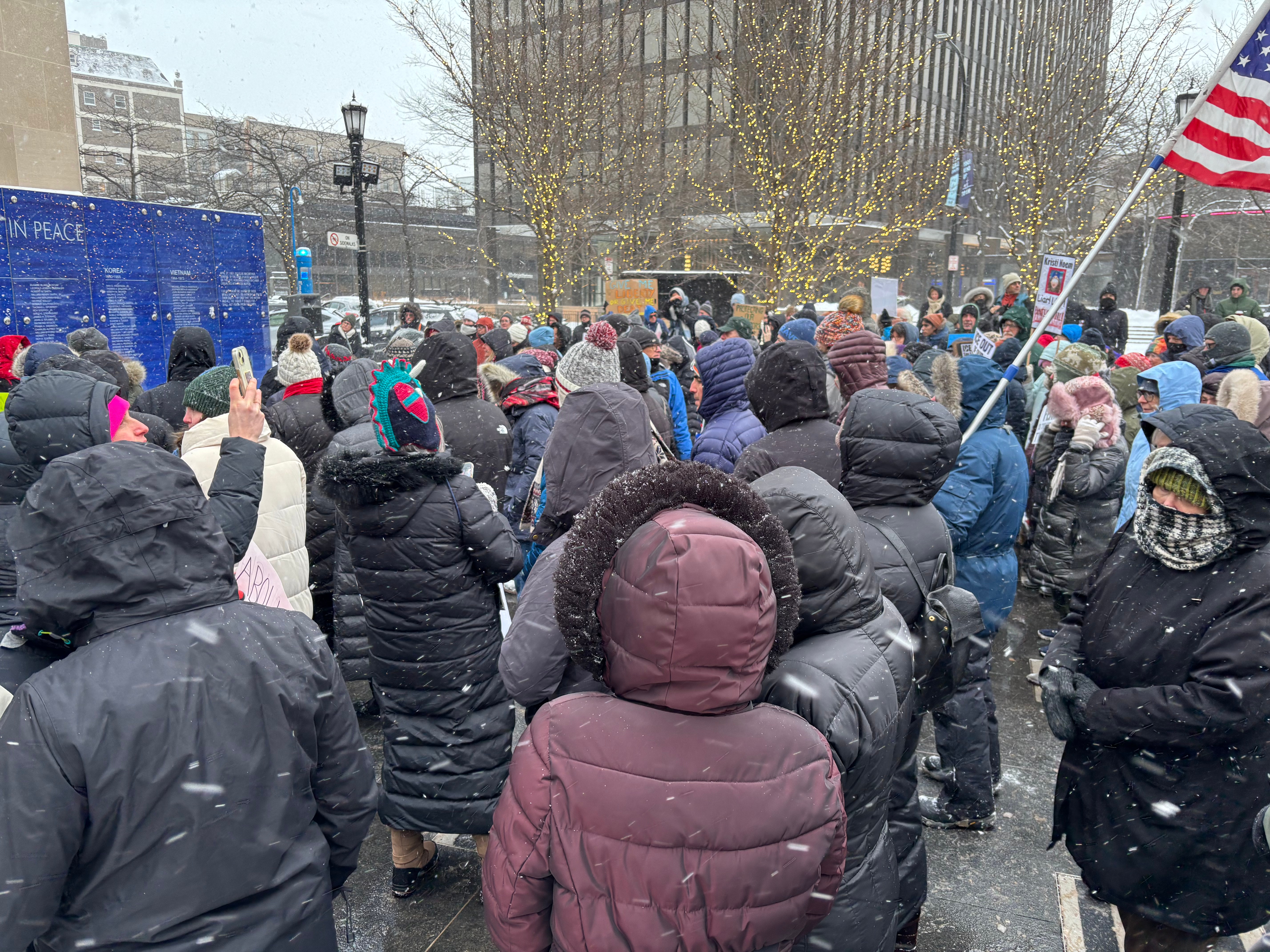
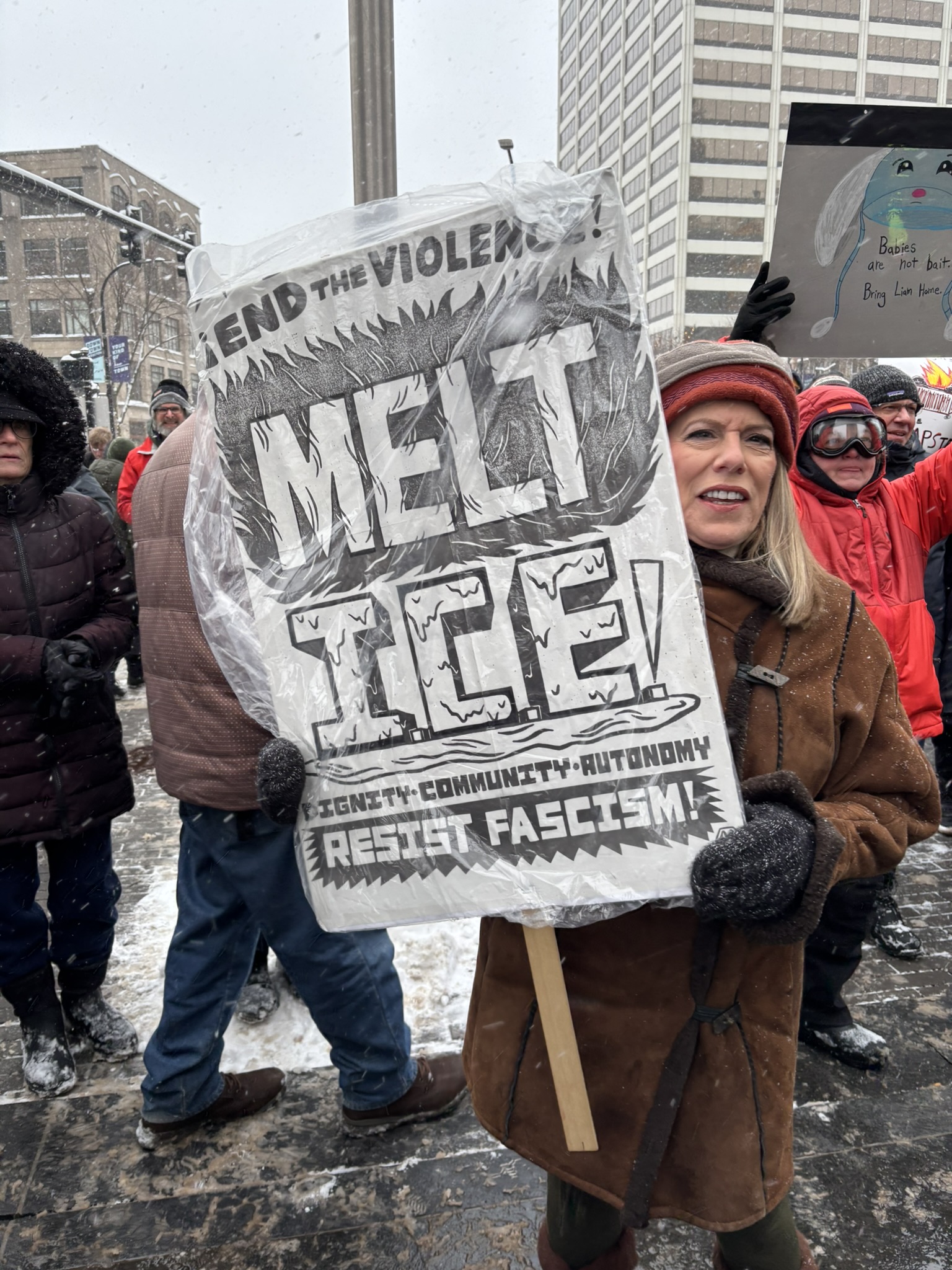
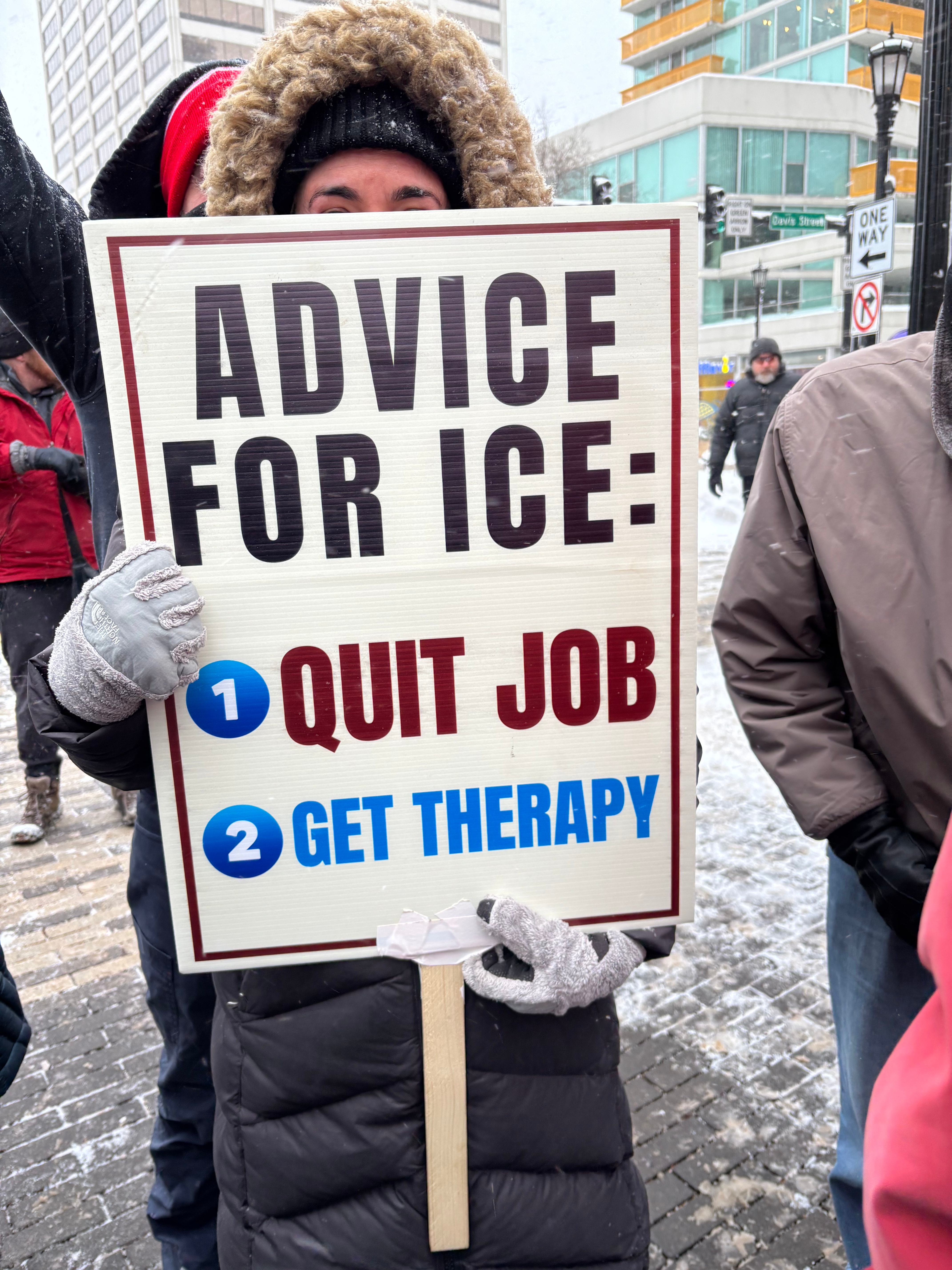
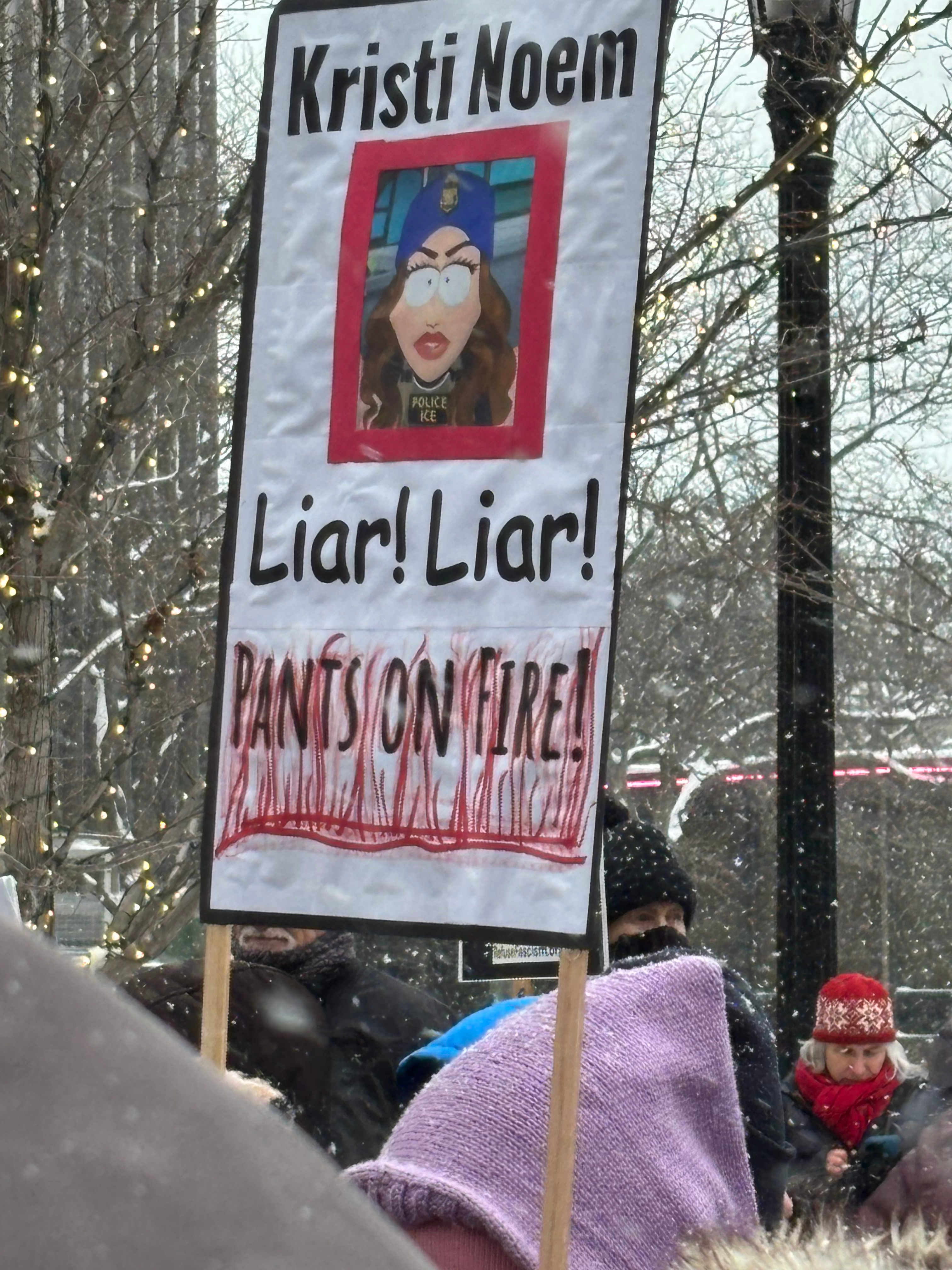
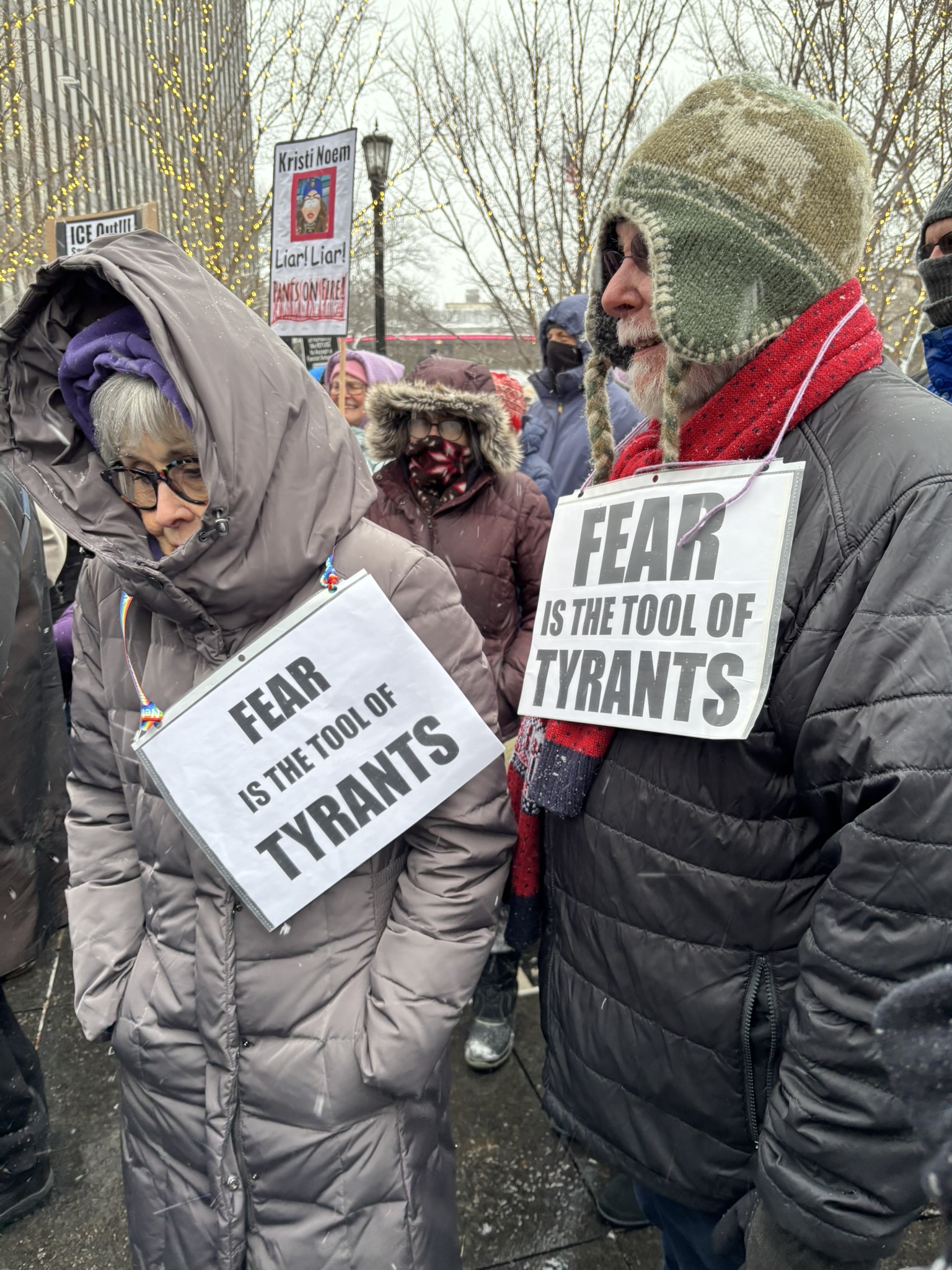
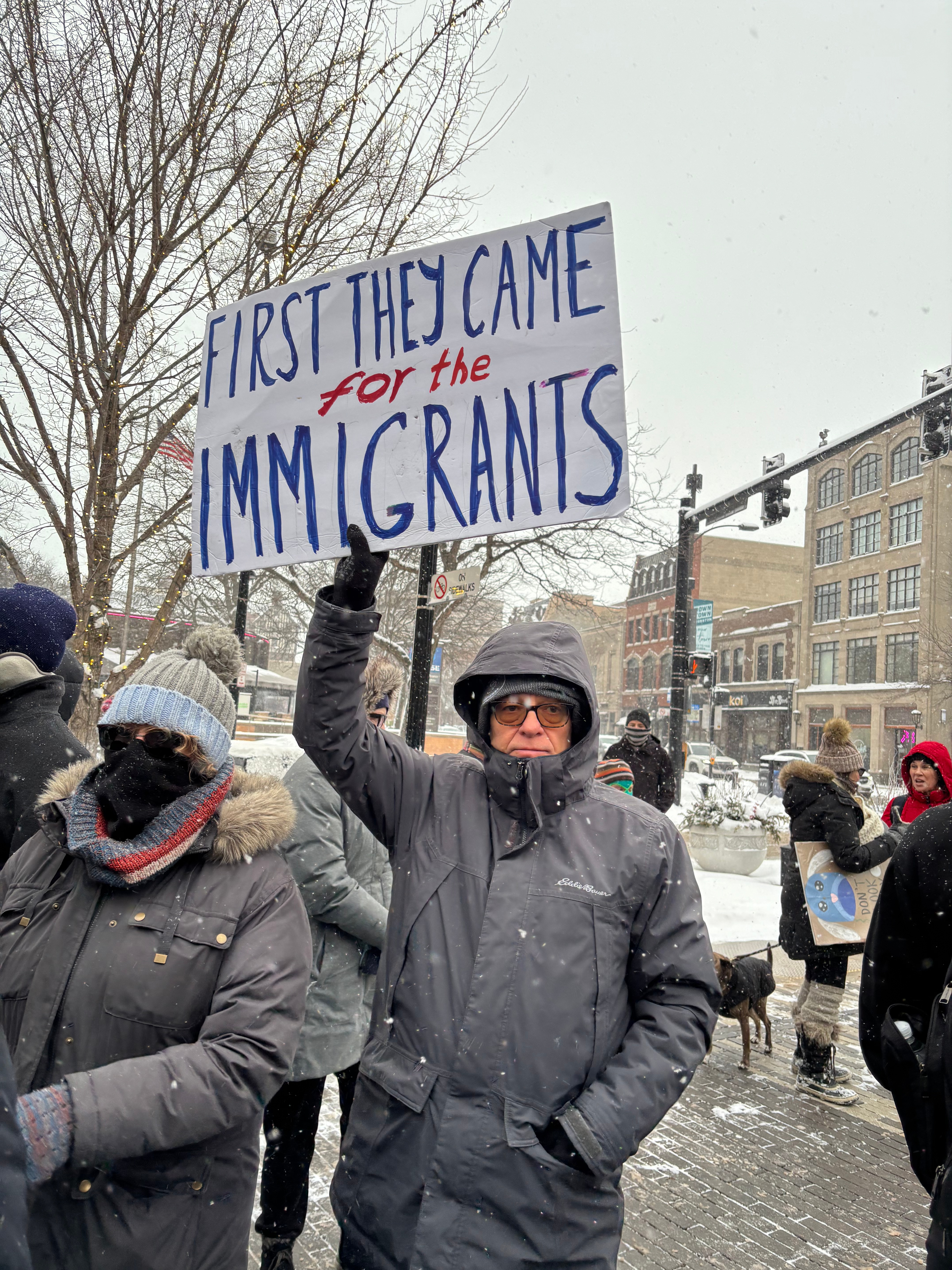
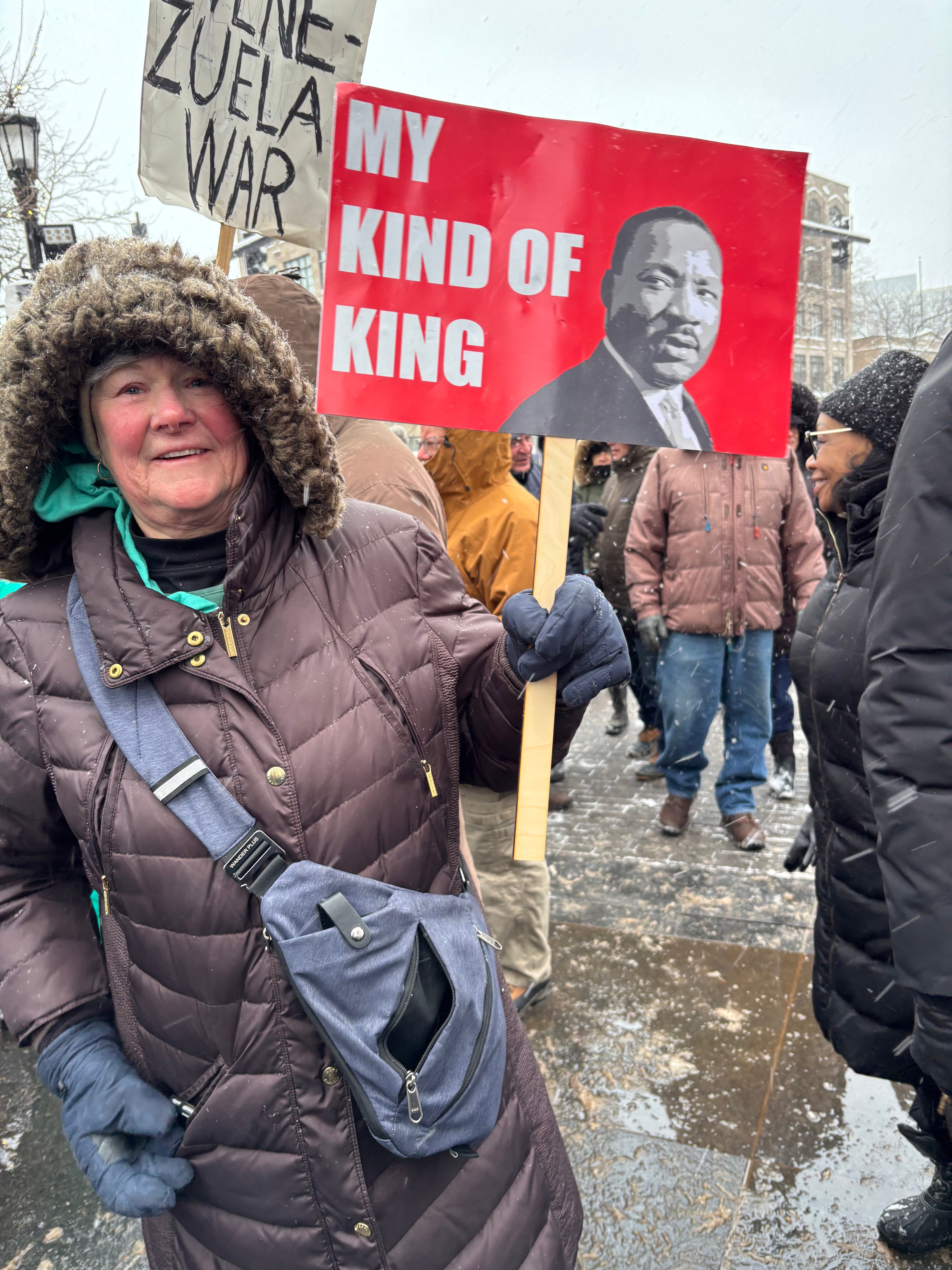
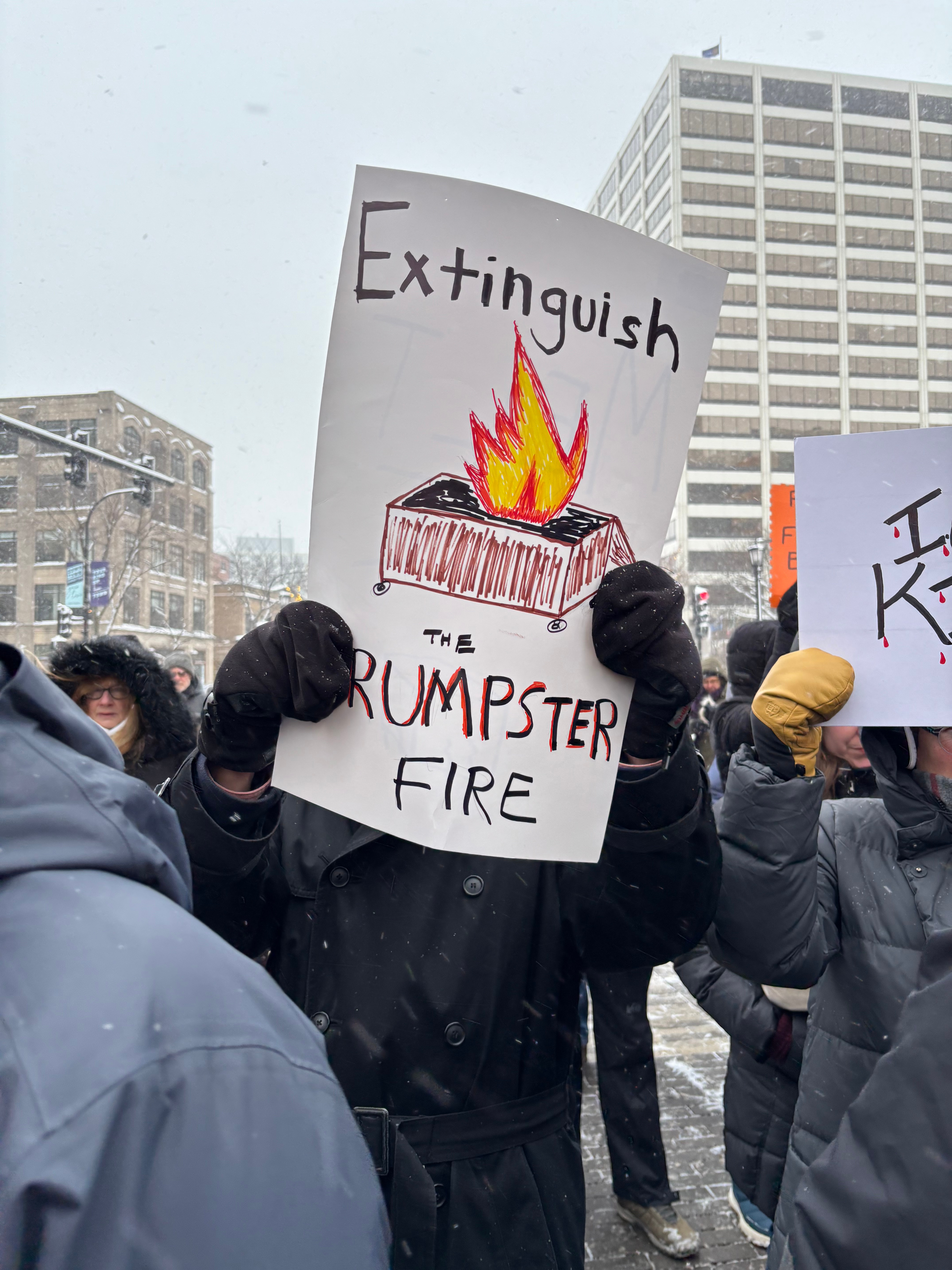
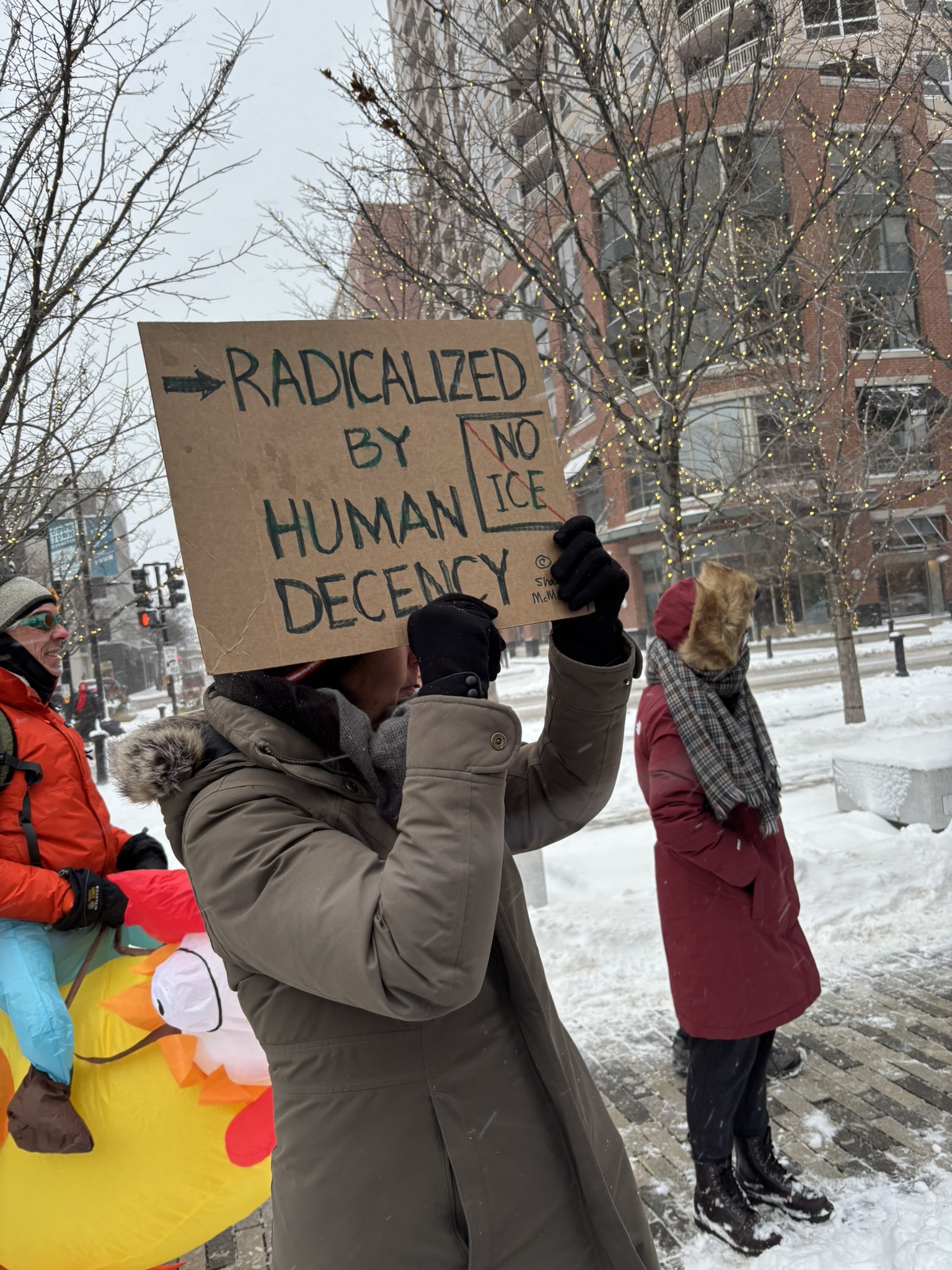
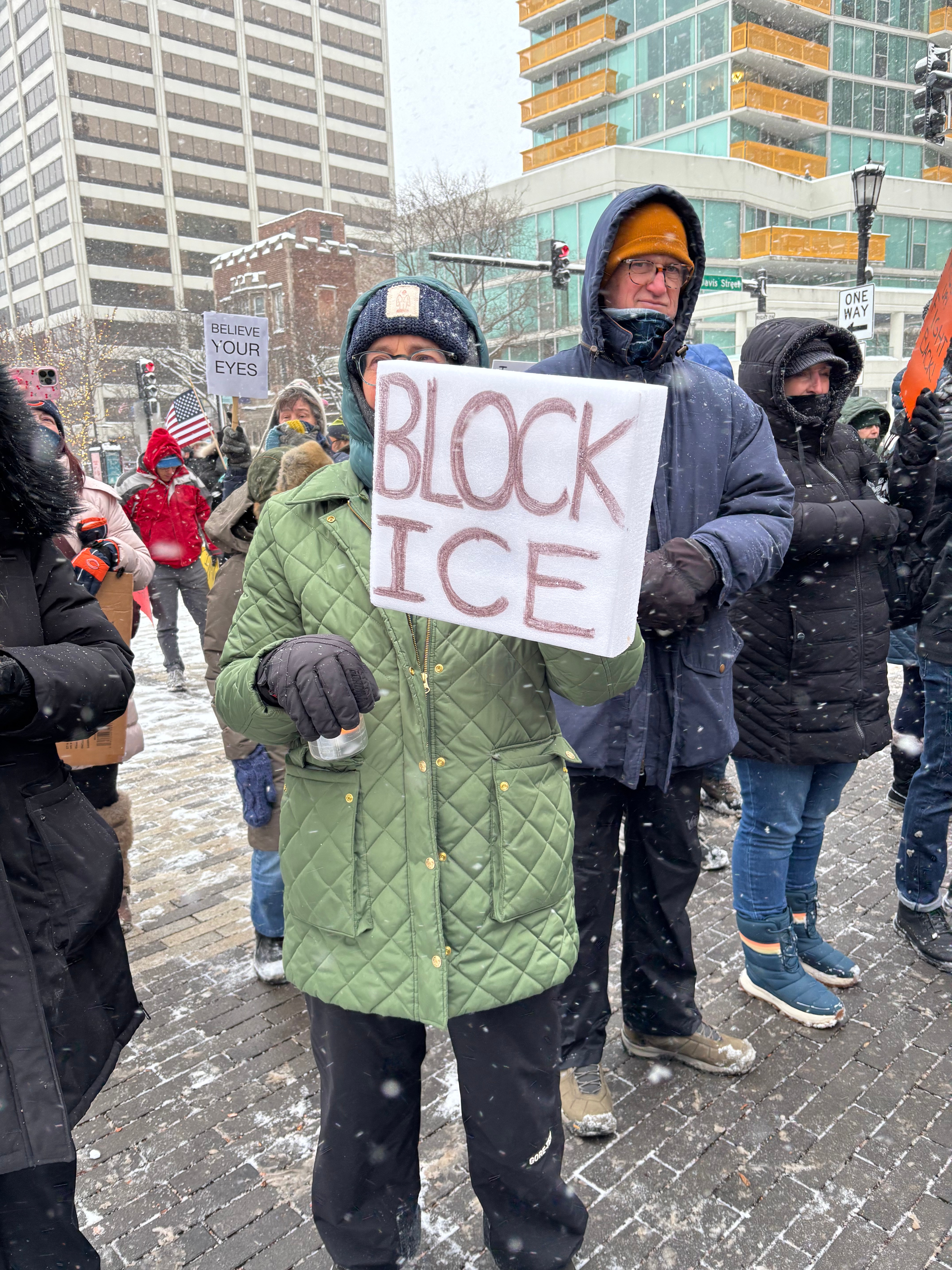
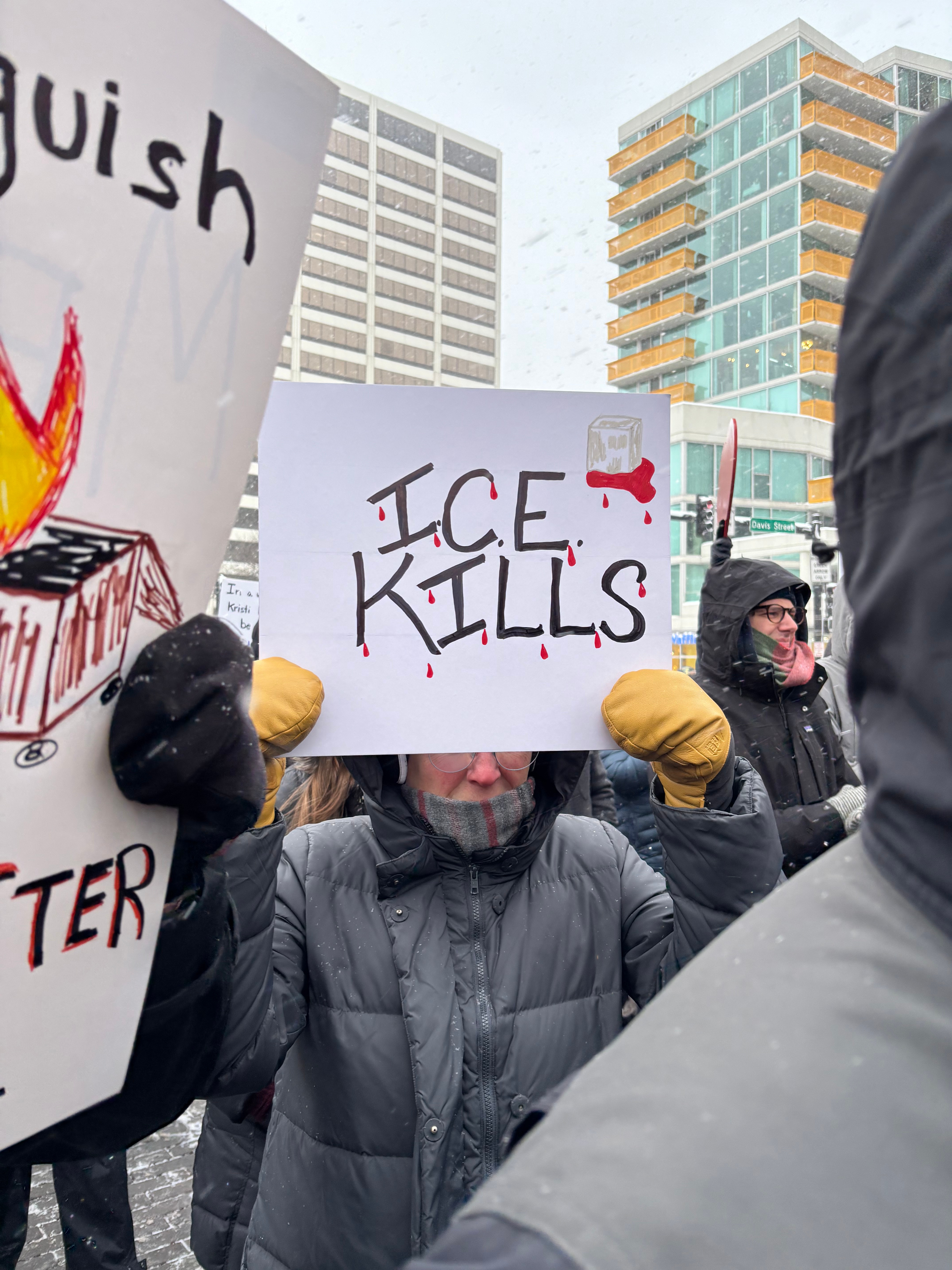
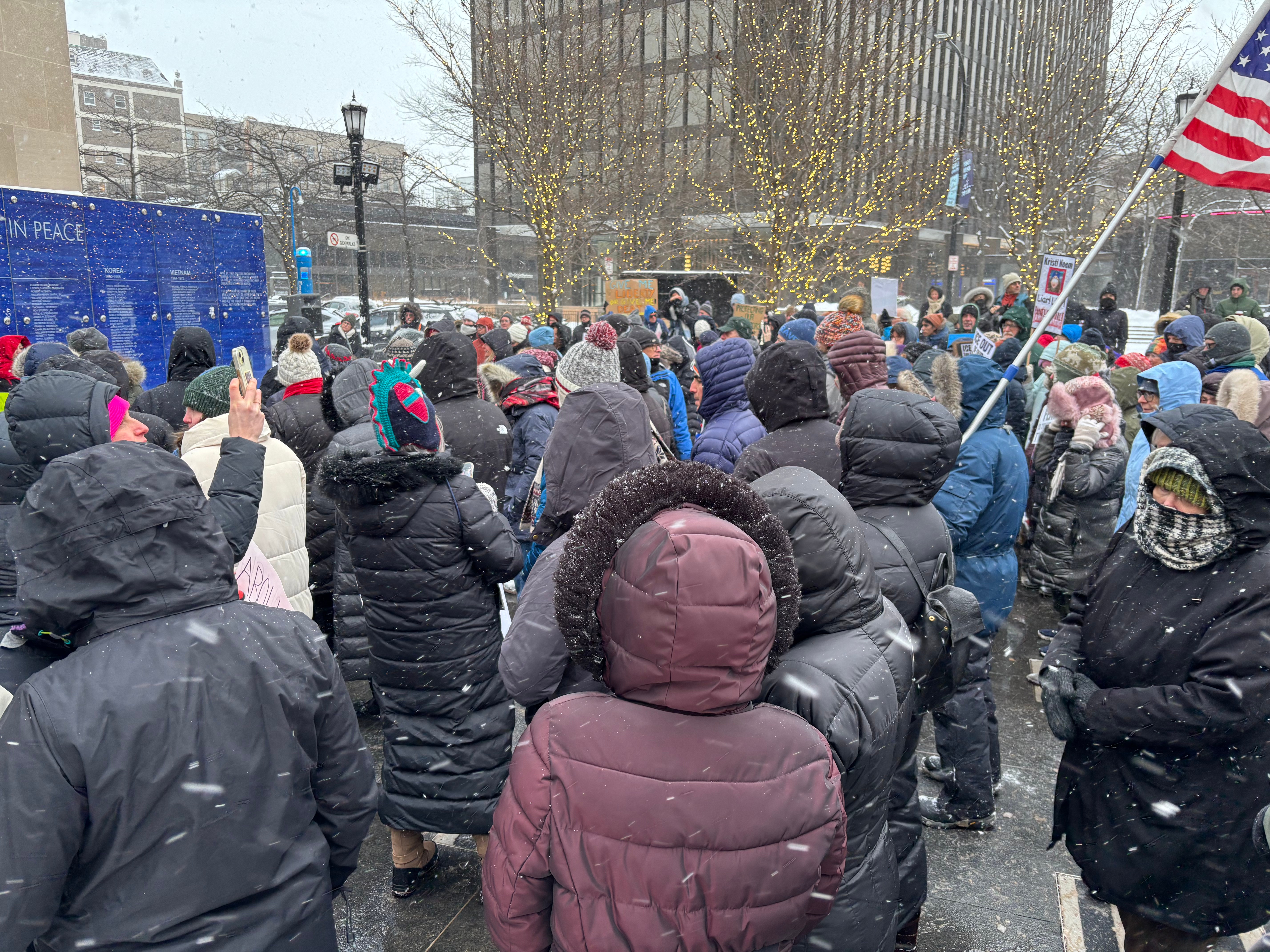














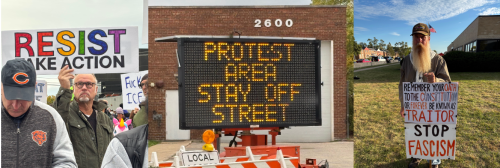

 When we got to the Broadview ICE facility, the protest location had been changed. The last time we were there, protestors lined one side of the driveway where the masked ICE thugs drove their unmarked cars into the detention center. We were able to confront the ICE goons as they came and went.
 another facility entrance. We could see the ICE vehicles enter and leave – but they didn’t have to drive past us. They didn’t have to look at us. They didn’t have to hear us. They didn’t have to feel our rage. But we expressed ourselves anyway.
 Some of our fellow protestors expressed themselves in creative ways. There was the guy with the bald eagle head who wore only his red-white-and-blue underwear and a pair of boots on this cold, autumn day. Three handmaidens stood silent witness. There were lots of funny costumes. How threatening could a man in a pink conical cap riding a unicorn be?
 The folks in the middle were the County sheriffs and the Broadview cops. They were there to maintain order – especially the Broadview mayor’s 6:00 pm protest curfew. We tried to remind them that our First Amendment rights to assemble and engage in free speech do not have an expiration date – or hour. We asked them why they don’t wear masks, but the ICE goons do. We asked them if they knew what was going on in the detention center. We asked them, as professional policemen, if they were comfortable protecting guys who were arresting people without a warrant and affording them no due process.
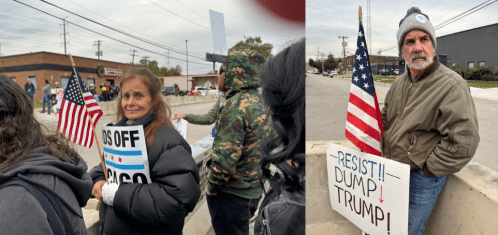
 It was well past 6:00 pm when Victoria and I left the protest and went home. I’m not sure how long the stalemate lasted. There were still hundreds of protestors in no mood to leave quietly. Next time, we’ll stay to the bitter end.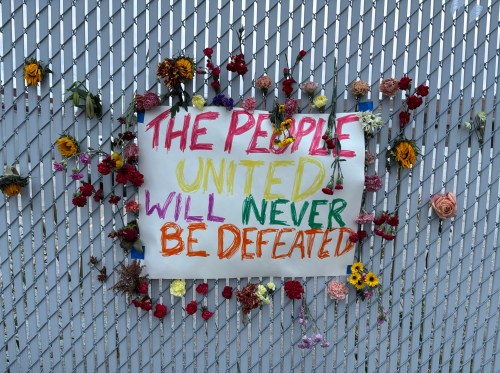
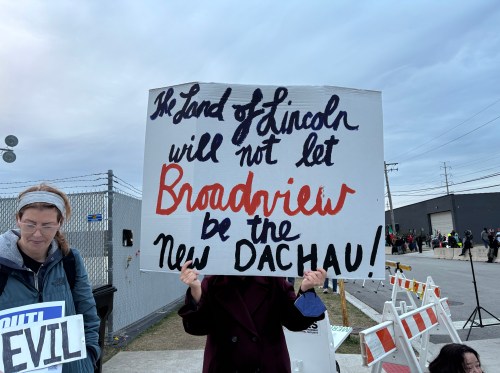


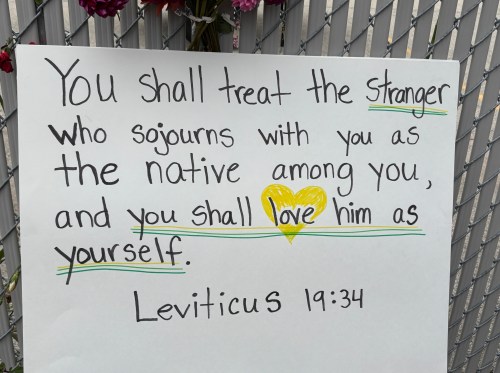
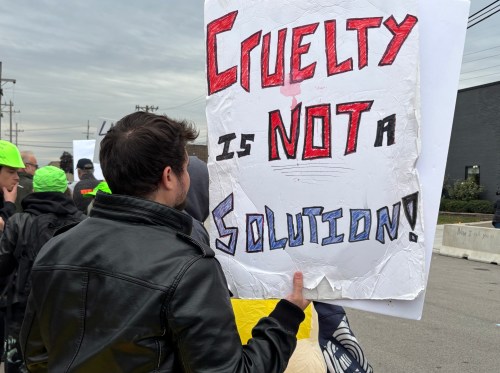
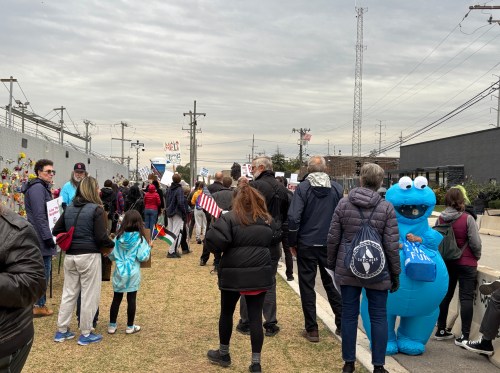
 Produced, written, and performed by students,
  Ass and North by Northwestern. Among the cast were Stew Figa, Jeff Lupetin, Betsy Fink, Suzie Plakson, Tom Virtue, Kyle Hefner, and Dana Olsen. It was the coolest, funniest live performance I’d seen since I hit campus.
 enthusiastic. Mee-Ow was the hippest scene on campus – fast-eclipsing the popularity of
 out of hand. Then, Kyle would send us out of the room in groups for a few minutes to work out a rudimentary idea of how to structure a scene from one of these premises.
 If a sketch doesn’t end well, then the next sketch starts from a deficit. It must win back the audience after an awkward moment — and that can kill a running order. That’s why, from those days forward, The Practical Theatre Company has never rested until we’ve done our best to satisfactorily “button” a sketch. (Alas, we don’t always succeed.)
 opportunity for a moment of unexpected, improvised fun with the audience. Confident in the through-line of the sketch and the final button, we could have some improvisational fun when the moment called for it.
 Rush and I shocked the crowd with a sketch called “Biafran Restaurant”. It was a moment in time. We were clad in our underwear, performing a sketch that juxtaposed a terrible African famine with a middle class American dining experience: balancing precariously on the comedic edge as we reminded the audience of an ongoing tragedy. These weren’t easy laughs. And it was glorious. We felt like we were pushing the envelope. And maybe we were. We were college sophomores – just starting to explore our comedic horizons.
 I loved everything about the Mee-Ow Show process: the music, the comedy, the late nights scripting sketches at Rush or Dana’s apartments after rehearsals. And when we performed the shows and the packed crowds laughed every night, I was hooked. I was home.























 Paul's Voyage of Discovery & Etc.
Coming Soon! “Quick! Before We’re Cancelled!”
The Practical Theatre Company returns to Studio5 — Opening on December 26th!
Thomas Jefferson and Abigail & John Adams welcome you to an evening of sophisticated frolic, music, and more as The Practical Theatre Company presents their annual holiday revue — “Quick! Before We’re Cancelled!”
For tickets: https://buytickets.at/practicaltheatre
Among the subjects comedically explored is Chicago’s embrace of the first American Pope and his relationship to the Windy City’s baseball teams.
Studio5 is Evanston’s shining gem of a cabaret theatre performance space — with adult drinks available at the bar — and acres of free parking. Laughs, music & adult beverages! Holiday fun in classic Practical Theatre style. Featuring Paul Barrosse, Victoria Zielinski and Dana Olsen. With Steve Rashid & the Studio5 All-Stars, keyboard whiz Larry Schanker, Chicago’s finest jazz vocalist Paul Marinaro, Jim Cox on bass, and Robert Rashid on drums. Let’s all enjoy a laugh at the close of 2025. We could all use a good laugh, right?
Share this post:
1 Comment
Filed under Art, Comedy, Improvisation, literature, Music, Politics, Random Commentary, Sports, Truth
Tagged as cabaret, comedy, Dana Olsen, Evanston, improvisational comedy, Jim Cox, Paul Barrosse, Paul Marinaro, Robert Rashid, Steve Rashid, The Practical Theatre, Victoria Zielinski