Here is the 5th and final installment of my daughter Emilia’s series of blog posts on her recent trip to Brazil to cover the story of how the government is dealing with the slums of Rio in advance of the Olympics. (It’s also about the need for sunscreen.)
“Inside every adult lurks a graduation speaker dying to get out, some world-weary pundit eager to pontificate on life to young people who’d rather be Rollerblading. Most of us, alas, will never be invited to sow our words of wisdom among an audience of caps and gowns, but there’s no reason we can’t entertain ourselves by composing a Guide to Life for Graduates.
I encourage anyone over 26 to try this and thank you for indulging my attempt.Ladies and gentlemen of the class of ’97:
Wear sunscreen.”
I would like to take this moment to inform my e-audience that, before I went to Brazil, I’d read that speech. Several times. I thought it was funny. Now I know it was serious.
After 5 whole days in Brazil, and only three left, Roshan and I finally made it to the beach—we made a day of it. We’d go to both…
Won’t you come with me?Down the Mississippi?We’ll take a trip to the land of dreamsGoing down the river, down to New Orleans
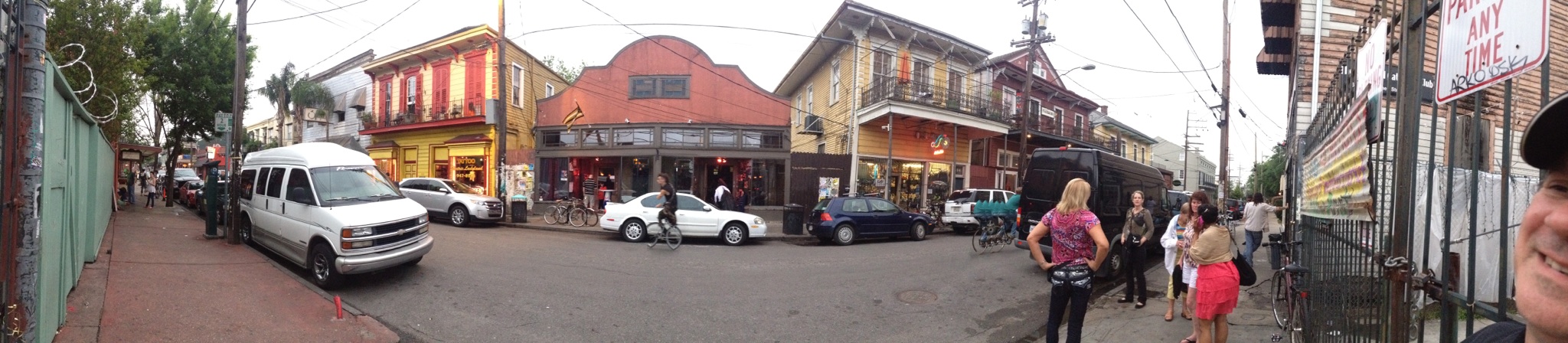
From the time that I was old enough to understand it was my father’s birthplace, New Orleans has always held a special place in my heart and my imagination.
Before I ever set foot in the Crescent City – or even knew it was called “the Crescent City” — my grandmother’s annual Mardi Gras packages aroused a fascination with my dad’s exotic hometown. Grandma’s annual package included three essential items: her homemade fudge (maple and chocolate), Mardi Gras beads and doubloons, and a couple weeks worth of Times Picayune front pages.
Incredibly, I still haven’t been to New Orleans during Mardi Gras.
I was somewhere around 6 or 8-years old when we made our first family pilgrimage from Cleveland to New Orleans to visit Grandma Barrosse and the rest of my dad’s family. We went by train. It was the biggest adventure of my young life – and the moist summer evening heat, the scent of magnolia and honeysuckle, the little Confederate flag some relative gave me, and my terror of voodoo queen Marie Laveau are still among my most cherished childhood memories.
I was around 12-years old when we returned to New Orleans – this time by car. I remember that trip in sharper focus because I was old enough to appreciate taking in the wonders of the French Quarter, City Park and the Chalmette Battlefield, site of the 1815 Battle of New Orleans.
That second trip was also memorable because of my determination to capture green anole lizards (the dime store chameleons of my youth) in my Grandma’s backyard. I captured more than a dozen of them among the honeysuckle vines before my grasping hand, plunging into the vines after my prey — got stung by three wasps at once. Though they laid me low for a full day, I survived those stings – and most of my lizards survived the drive home to Cleveland.
Ross Salinger, the author, and John Goodrich at the Renn Faire in Metairie (1984)
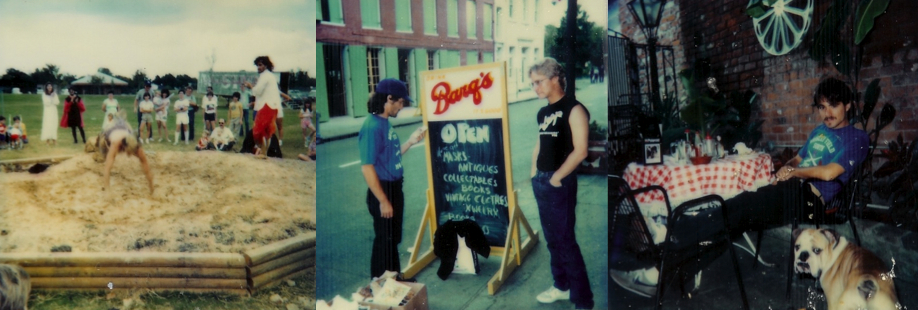
A couple decades later, I returned to New Orleans for two years in a row to perform at a Renaissance faire in the suburb of Metairie.
Those two working trips to the Big Easy were a chance to reconnect with my nonagenarian grandmother, my aunts and uncles, and my father’s amazing hometown with its unique history, music, food and culture.
(Left) Doing the Sturdy Beggars Mud Show. (Center) The author and Ross Salinger in the French Quarter. (Right) John Goodrich relaxes in the courtyard of Napoleon House. (1984)
With Victoria at Napoleon House waiting for a Pimms Cup.
On the second trip, in 1985, Victoria (now my wife) joined me to work at the Renaissance Faire, meet the Barrosse clan, and enjoy the pleasures of the French Quarter.
But, until this year, I’d never taken any of my three daughters to New Orleans.
Well, I wish I was in New Orleans,I can see it in my dreamsArm-in-arm down Burgundy,a bottle and my friends and me
Tom Waits
My youngest daughter, Evangeline (a good Louisiana name) applied to Tulane University in New Orleans – and this spring, we were delighted when she was accepted with an academic scholarship. So, a 3-day father-daughter trip to my dad’s hometown was in order. The choice was between UCLA and Tulane – and this trip would help her decide.
Eva is a songwriter – and New Orleans is a musical melting pot unlike any other, where jazz, blues, big band, marching band, rock and roll, Zydeco, and all the rhythms of the Caribbean and Mississippi Delta come together in the streets, restaurants and bars.
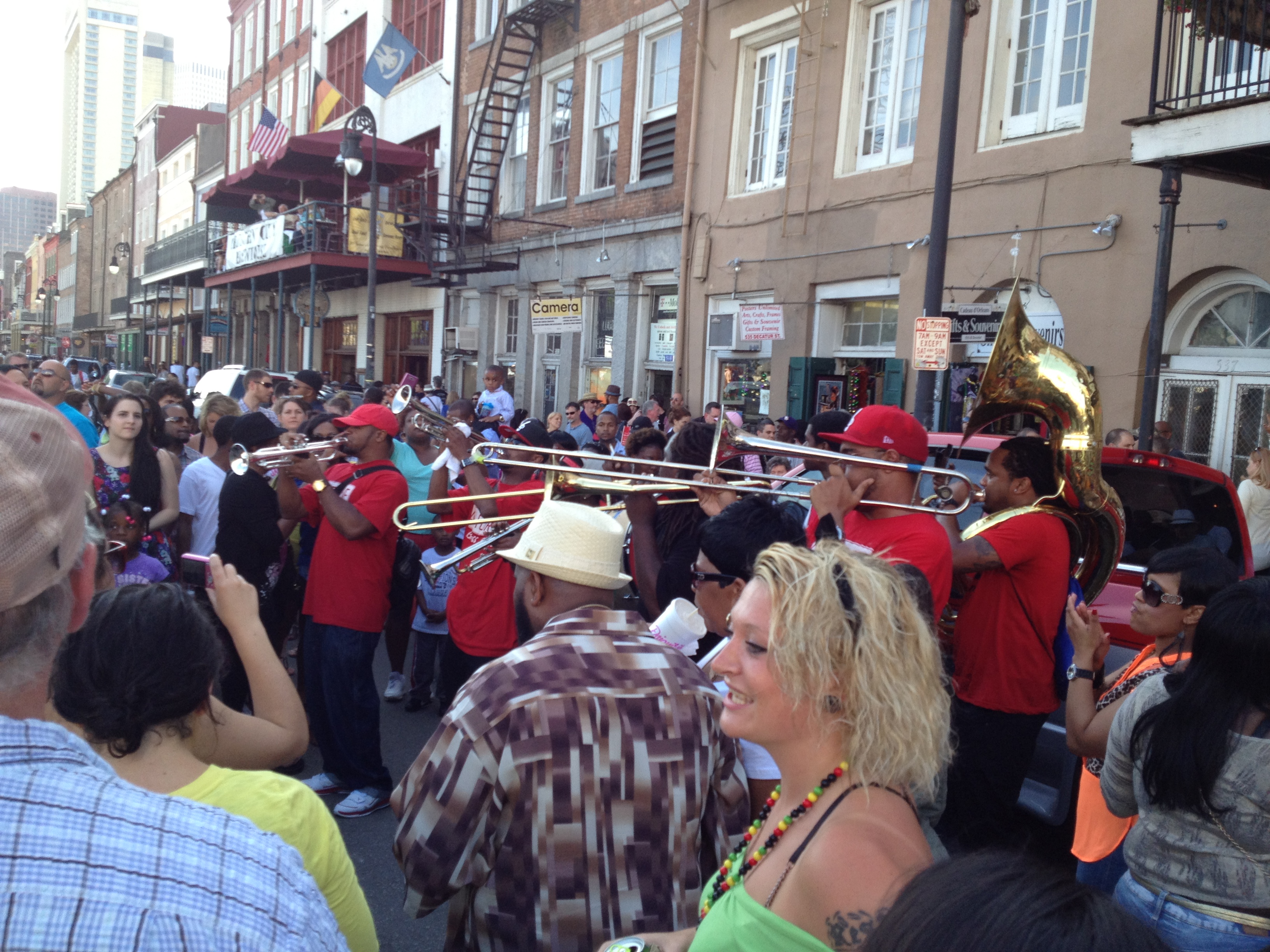
On the day we arrived in town, we were delighted to discover that the last day of the French Quarter Festival was still underway and the Quarter was jammed with musicians and bands on nearly every corner — including this dynamic face-off between brass bands on Decatur Street.
We also went to Preservation Hall. My daughters had seen the Preservation Hall Jazz Band in concert at The Gainey Vineyard in Southern California’s Santa Ynez Valley – but to see these wonderful musicians playing their hearts out as we sat on the worn wooden floor of that modest, intimate musical temple in the French Quarter is a whole different experience.
There’s music on just about every block of the Vieux Carre.
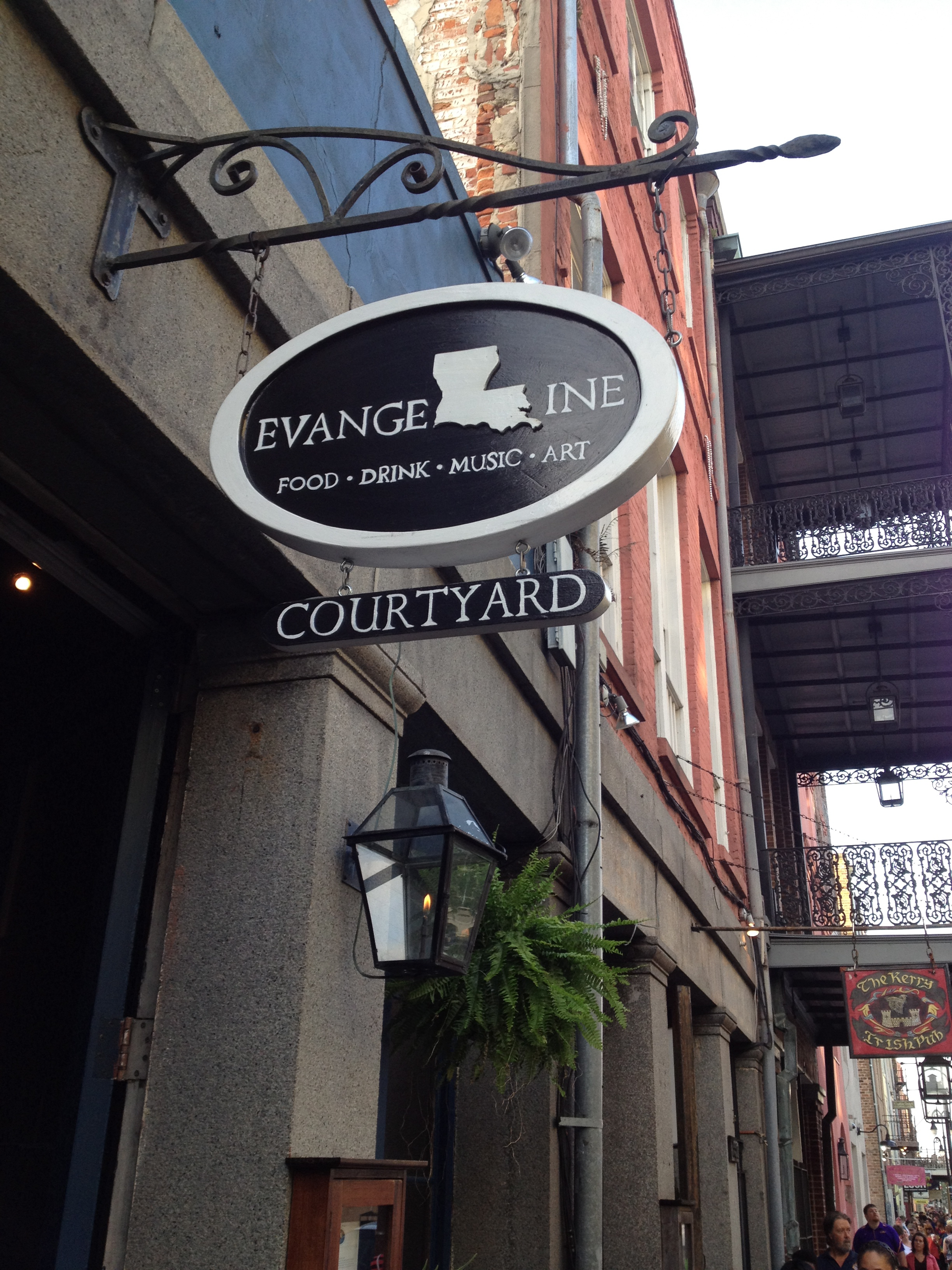
And then there’s the food. Nobody should visit New Orleans on a diet. Our first restaurant experience called out to us from its sign: Evangeline.
The food at Evangeline was superb.
Here’s just a sample of the many spicy and tasty delights we consumed at Evangeline and at other French Quarter eateries, including The Gumbo Shop, during our visit…
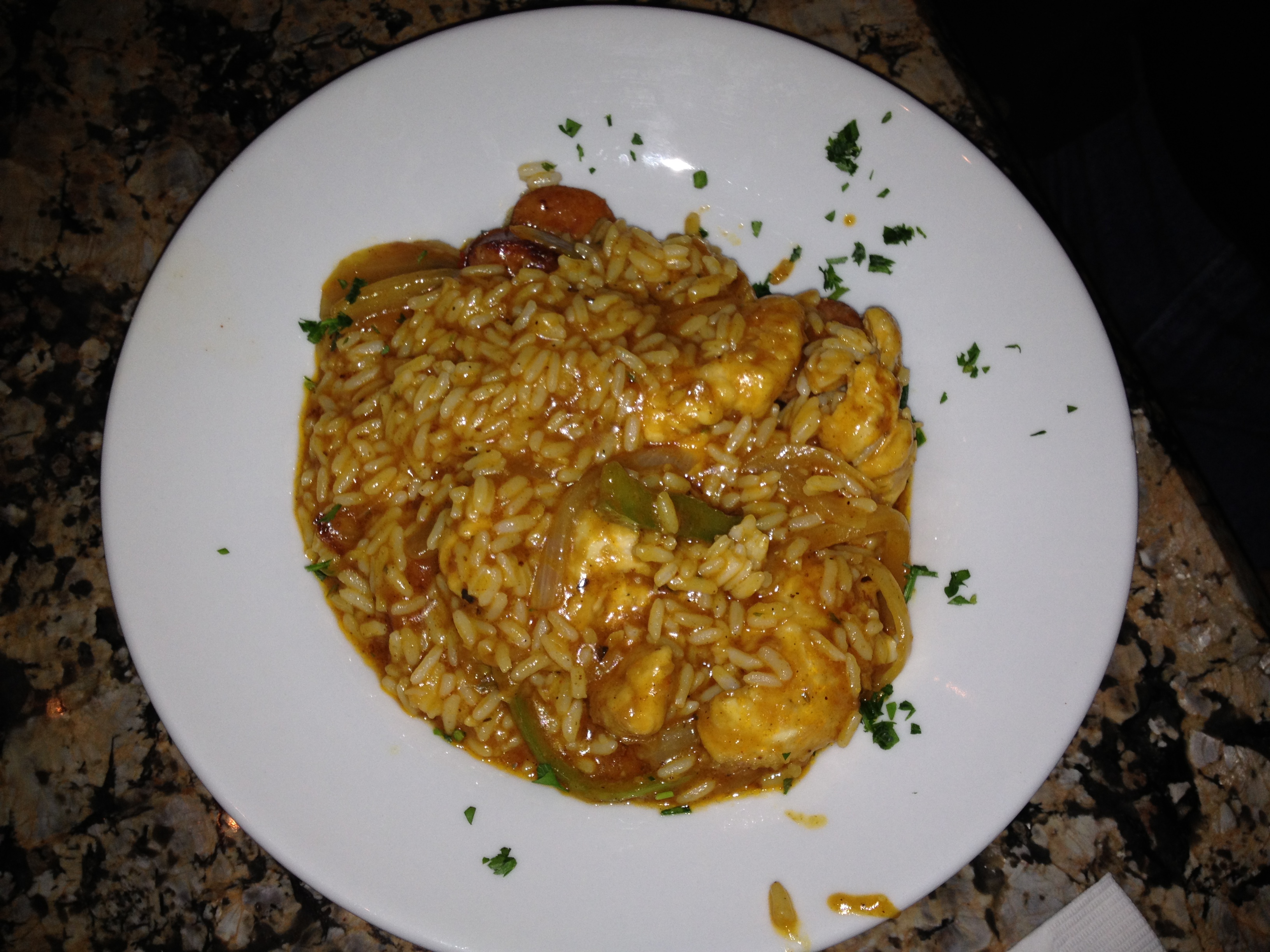
Jambalaya at Evangeline. Perfectly wonderful.
Gumbo at — where else? — The Gumbo Shop.
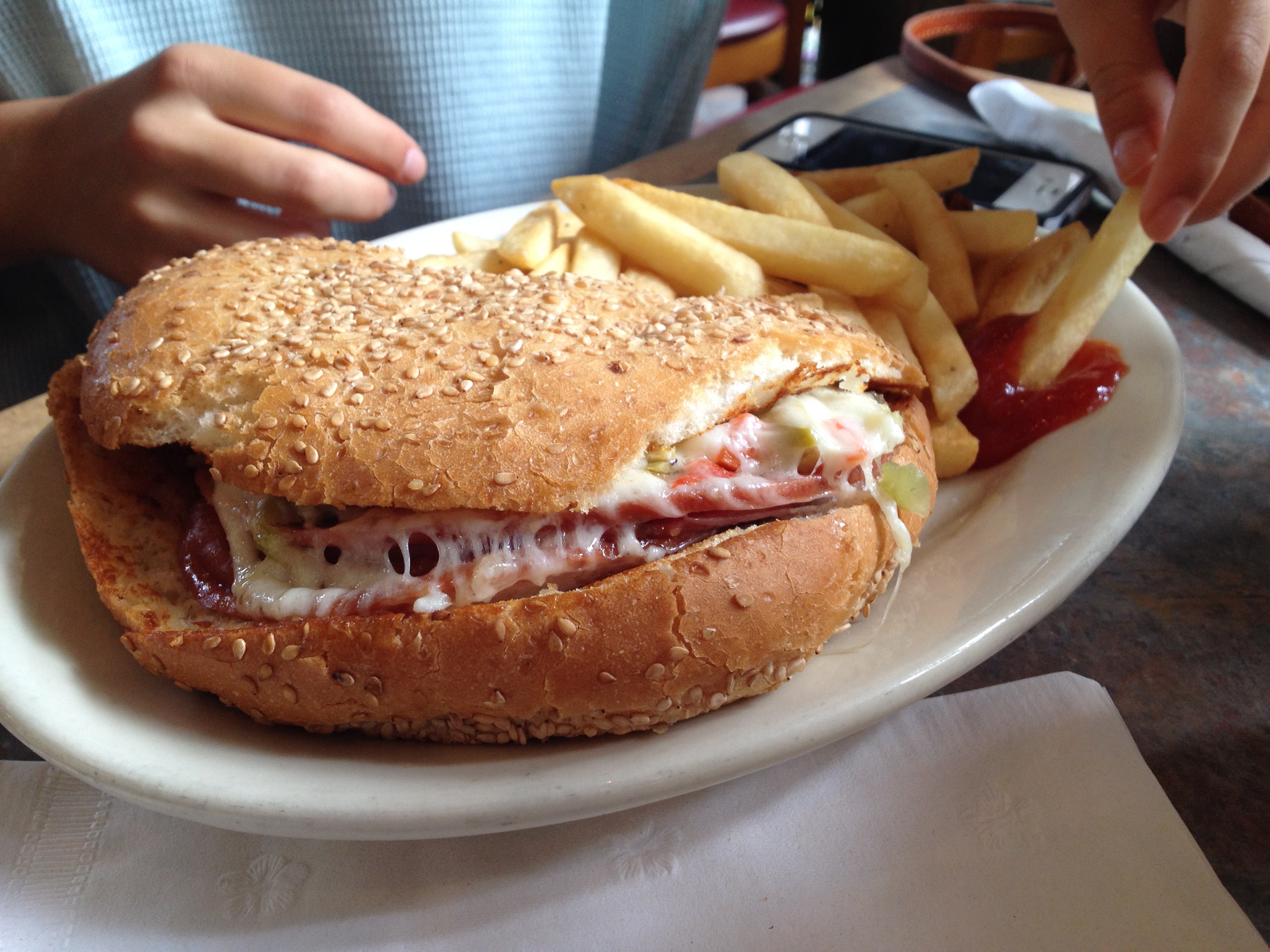
Eva enjoyed her muffaletta on Decatur Street.
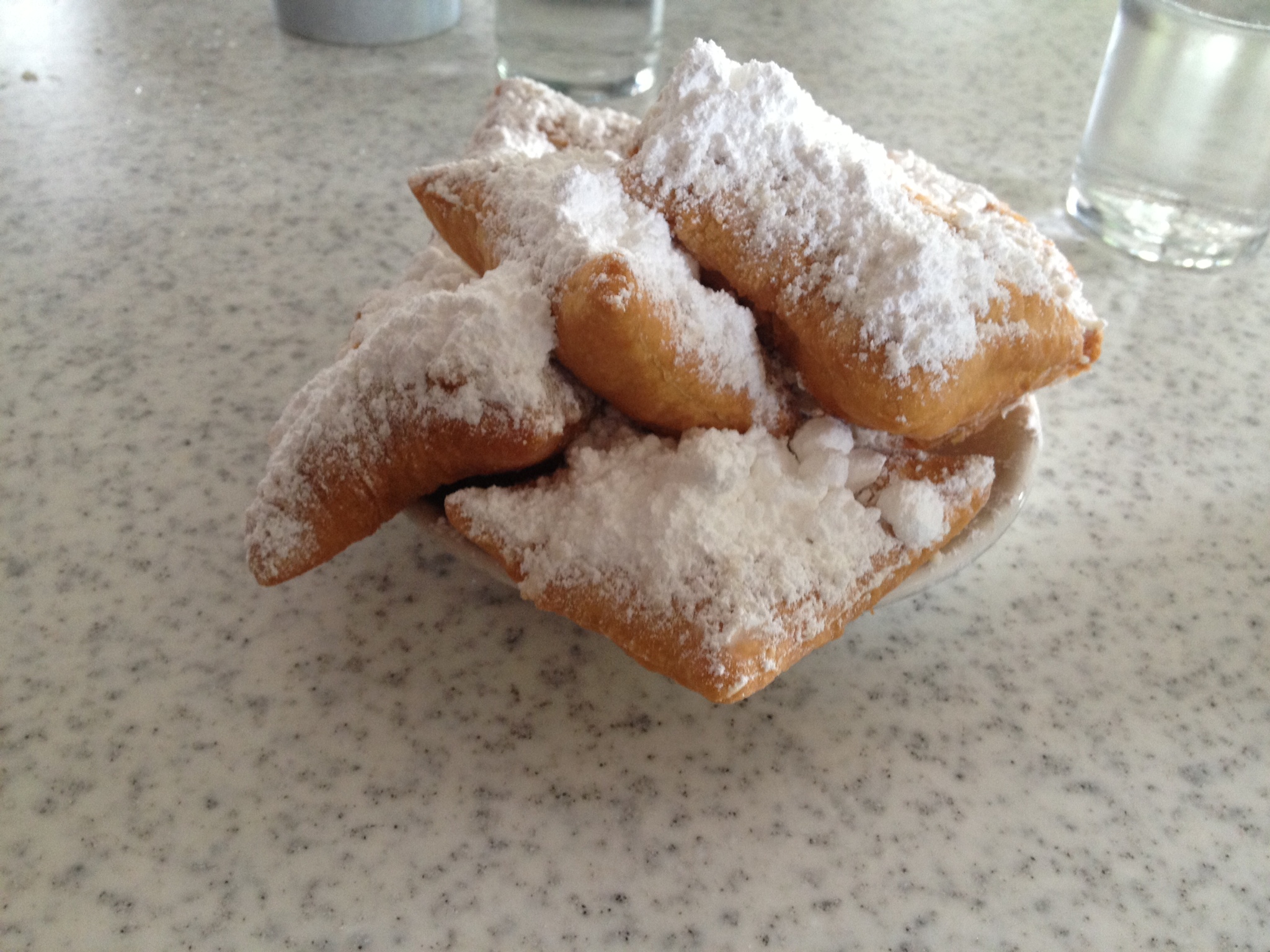
And, of course, we had to have our beignets at Cafe Du Monde.
So long mom.So long pop.I’m goin’ to New Orleans or elseI’ll drop deadDown in New OrleansYou know I love it thereAnd I ain’t been there yet.
The Rockme Foundation
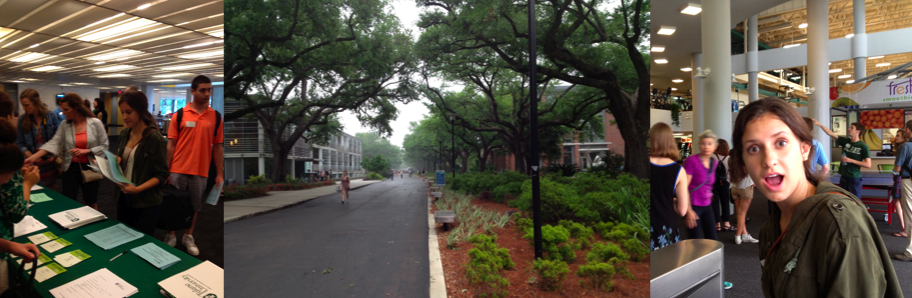
The second day of our trip was the reason we were in New Orleans in the first place: my daughter’s visit to Tulane University.
Tulane is a beautiful place.
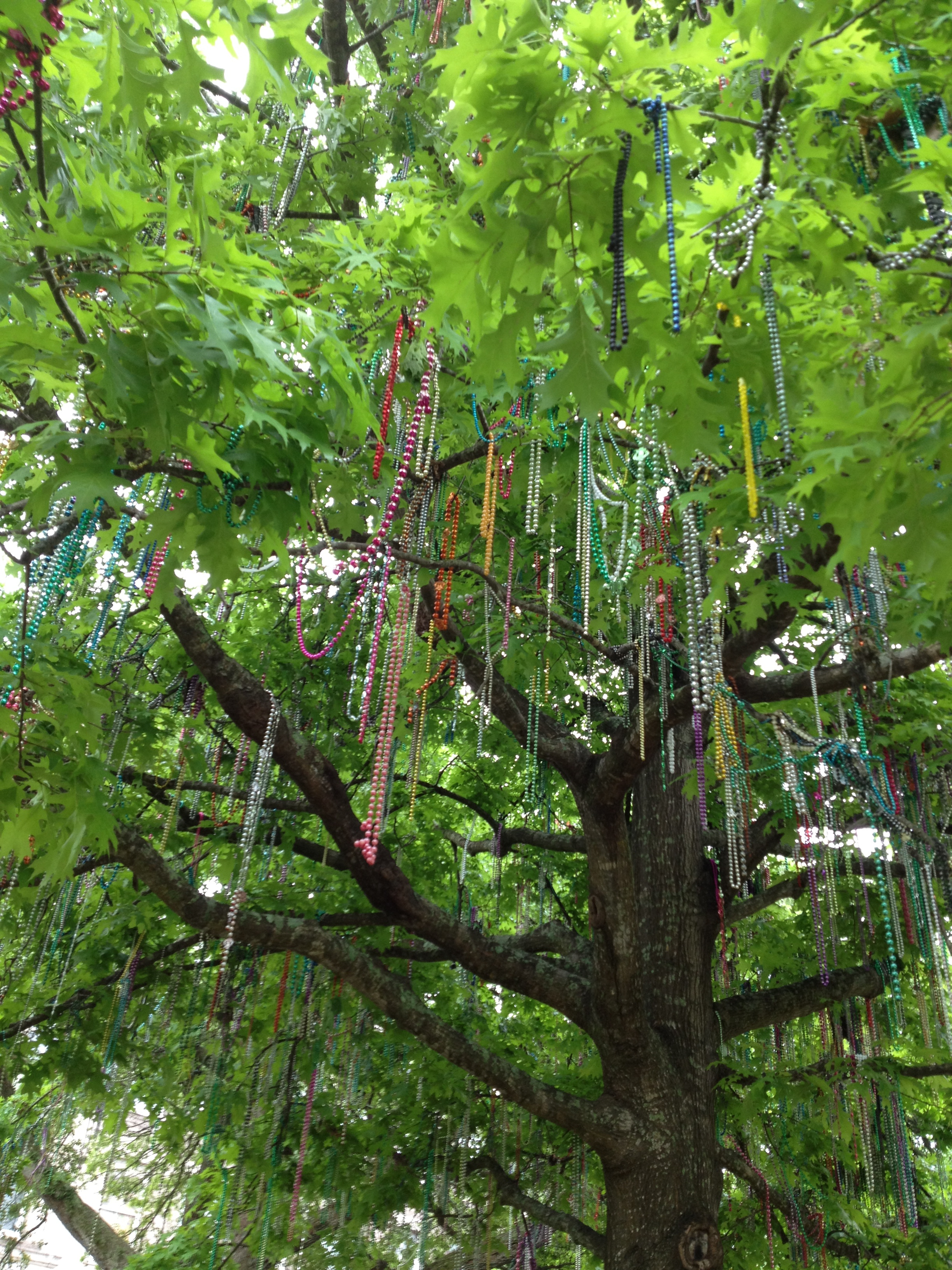
I could imagine Eva attending class among the spreading trees, draped with Mardi Gras beads.
Perhaps she could even take James Carville’s political science class someday.
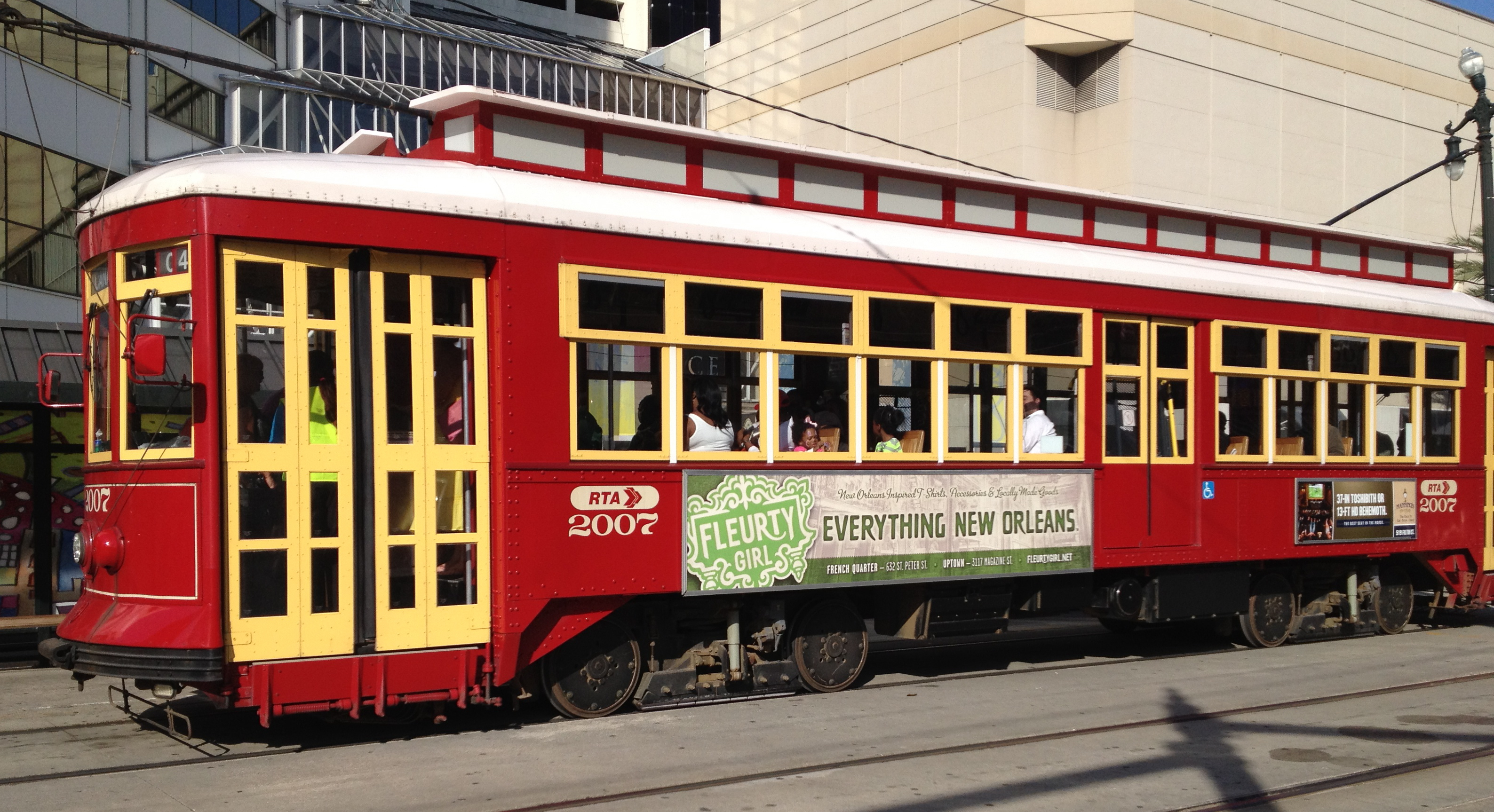
On weekends, she could take the St. Charles street car to the French Quarter and soak in music and culture that would inform her songs.
After our visit to Tulane we hopped that street car and returned to the French Quarter. The streets weren’t as crowded as they’d been the day before for the French Quarter Festival — but the the mood was still celebratory and the music was still playing.
Here, Eva is caught up in the New Orleans blues and the fancy steps of a veteran swing dancing devotee.
Dad and daughter at UCLA.
Ultimately, my daughter Eva chose to attend UCLA instead of Tulane. (Go, Bruins!) She’s a California girl — and we’re perfectly happy with her choice.
But on our father-daughter trip she fell in love with New Orleans.
And my love affair with my dad’s city was renewed.
We’ll be back in the Big Easy, the Crescent City, the Land of Dreams.
And New Orleans – as it has for centuries – will be waiting to fascinate and delight.
What follows is a photo essay to further celebrate the wonders of my father’s wondrous, historic, culturally resplendent hometown…
Dad poses across the street from our temporary home, The St. James Hotel on Magazine Street.
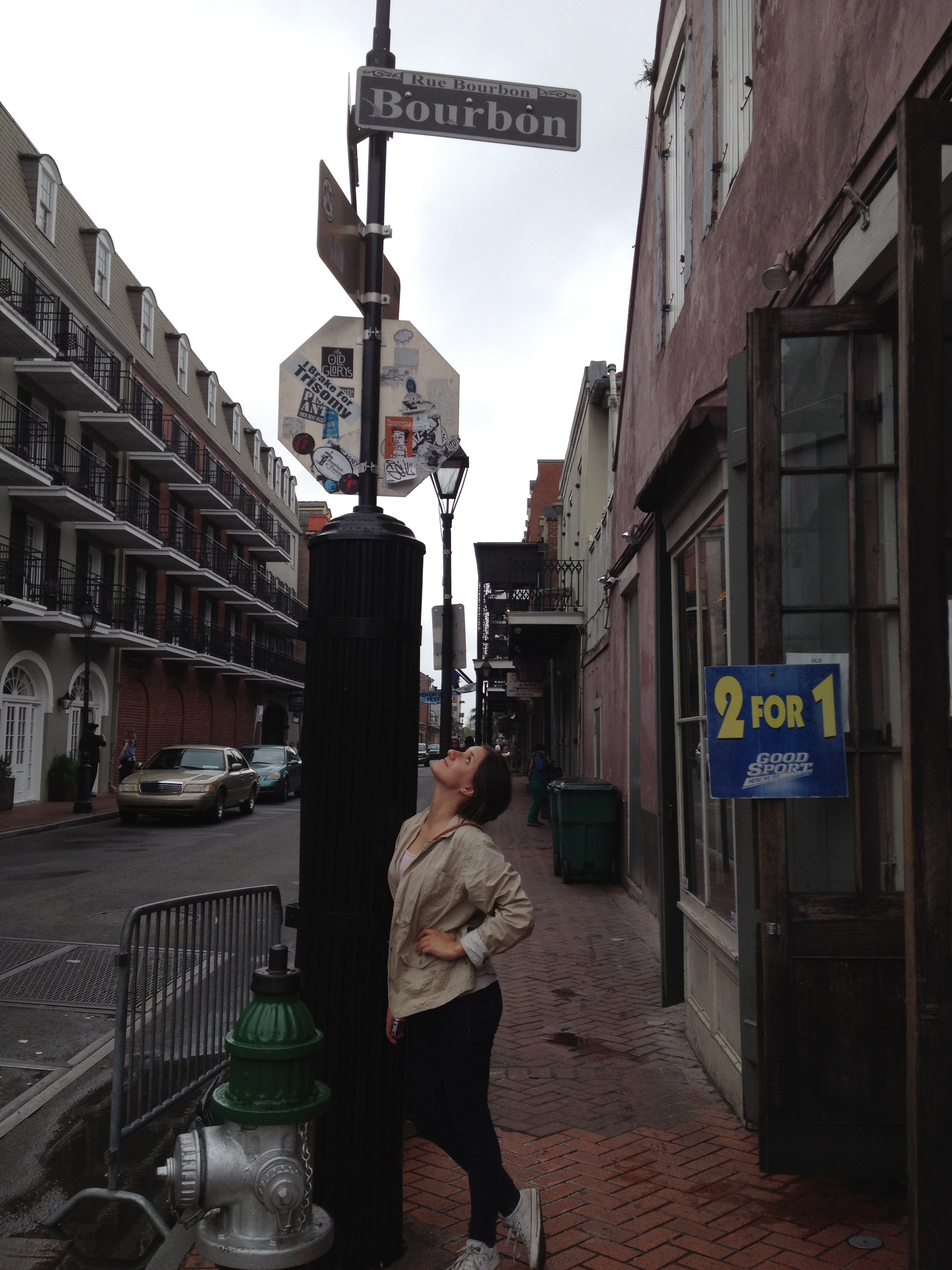
Dad gazes upward toward Jackson Square in the French Quarter.
Magnificent trees rise above the artwork hanging on the Jackson Square fence.
The street scene on the east side of Jackson Square.
Local legend has it that Napoleon Bonaparte’s friends provided this house for his exile.
Eva in the courtyard of Napoleon House. Her dad’s Pimm’s Cup is on the way.
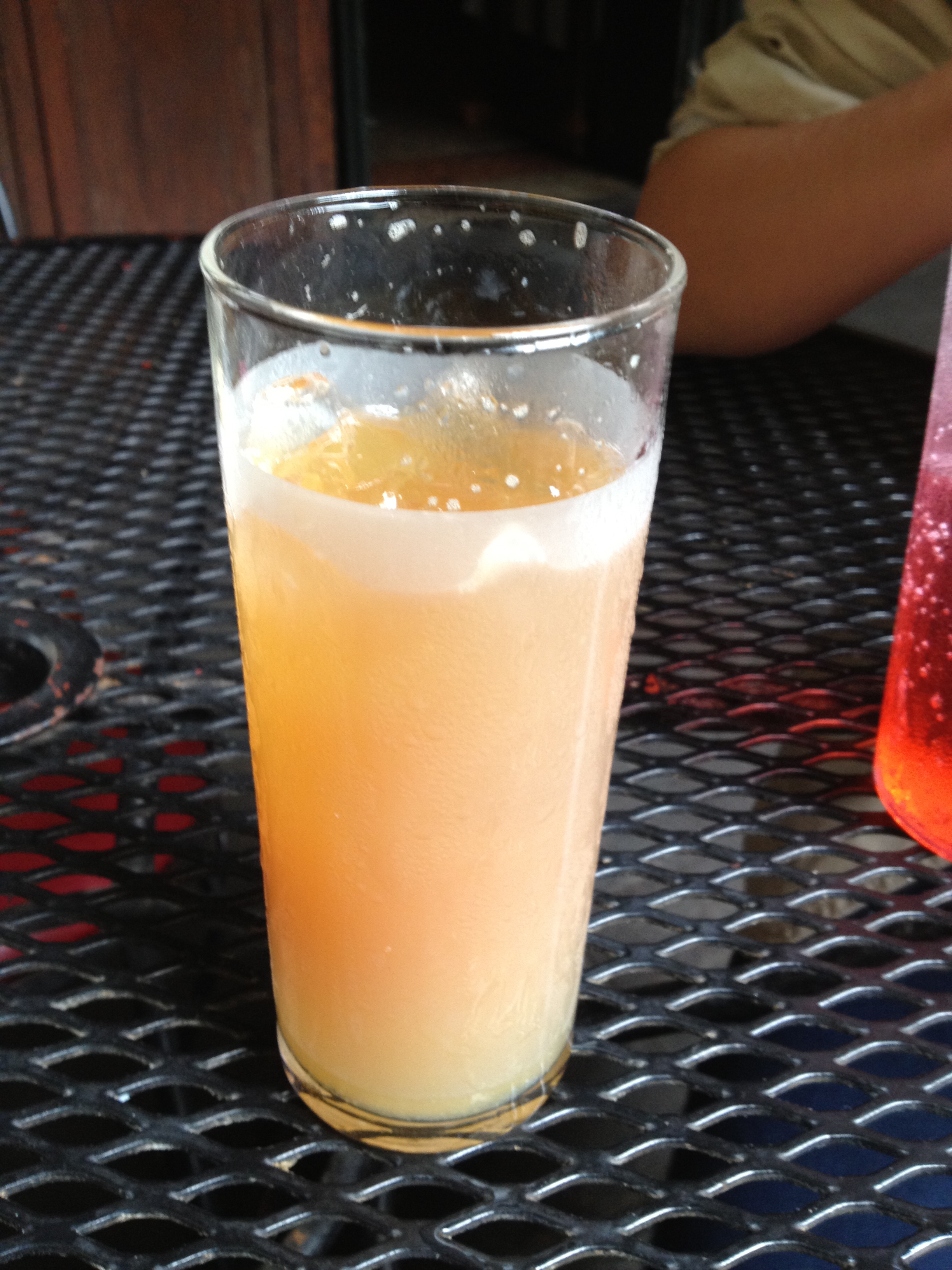
The aforementioned Pimm’s Cup. I already ate the traditional cucumber slice.
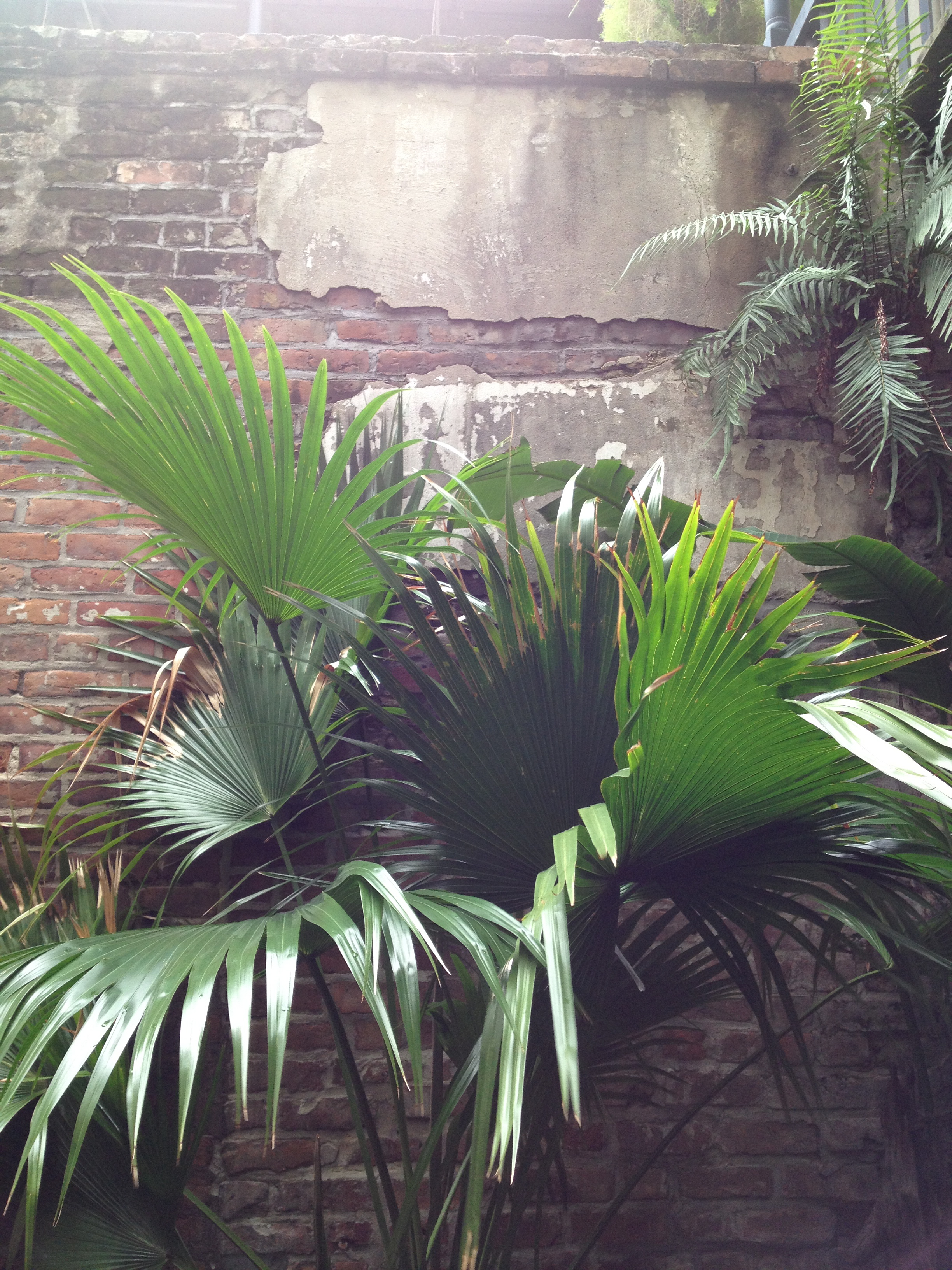
Classic, lovely New Orleans decay in the Napoleon House courtyard.
Eva in front of the house where William Faulkner lived and wrote while in New Orleans.
You’re not allowed to take photos at Preservation Hall. So, I don’t know what this is…
Eva poses in the gaudy costume of a Mardi Gras Indian.
The French Quarter House with the famous cornstalk gate.
The cornstalk gate.
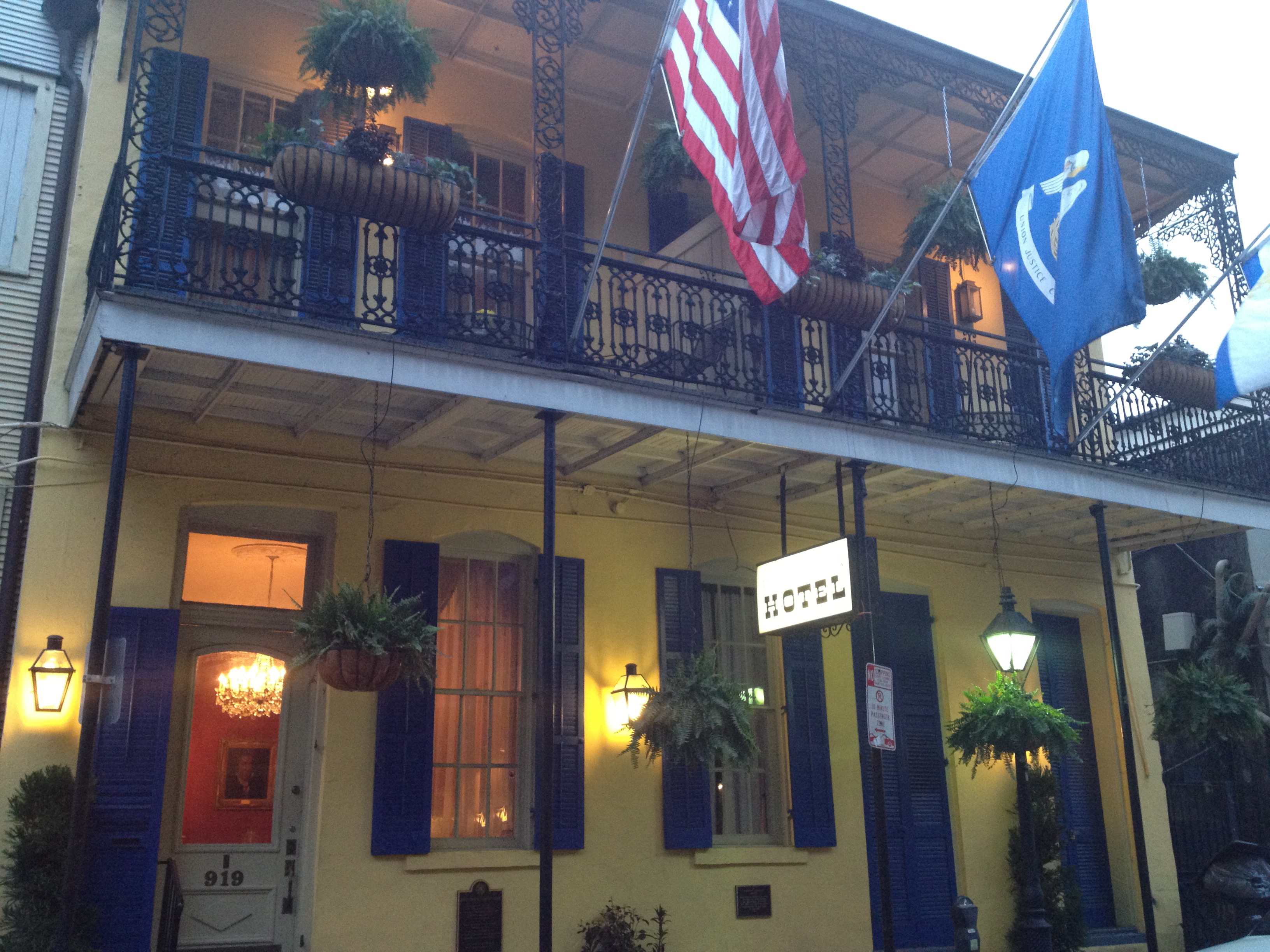
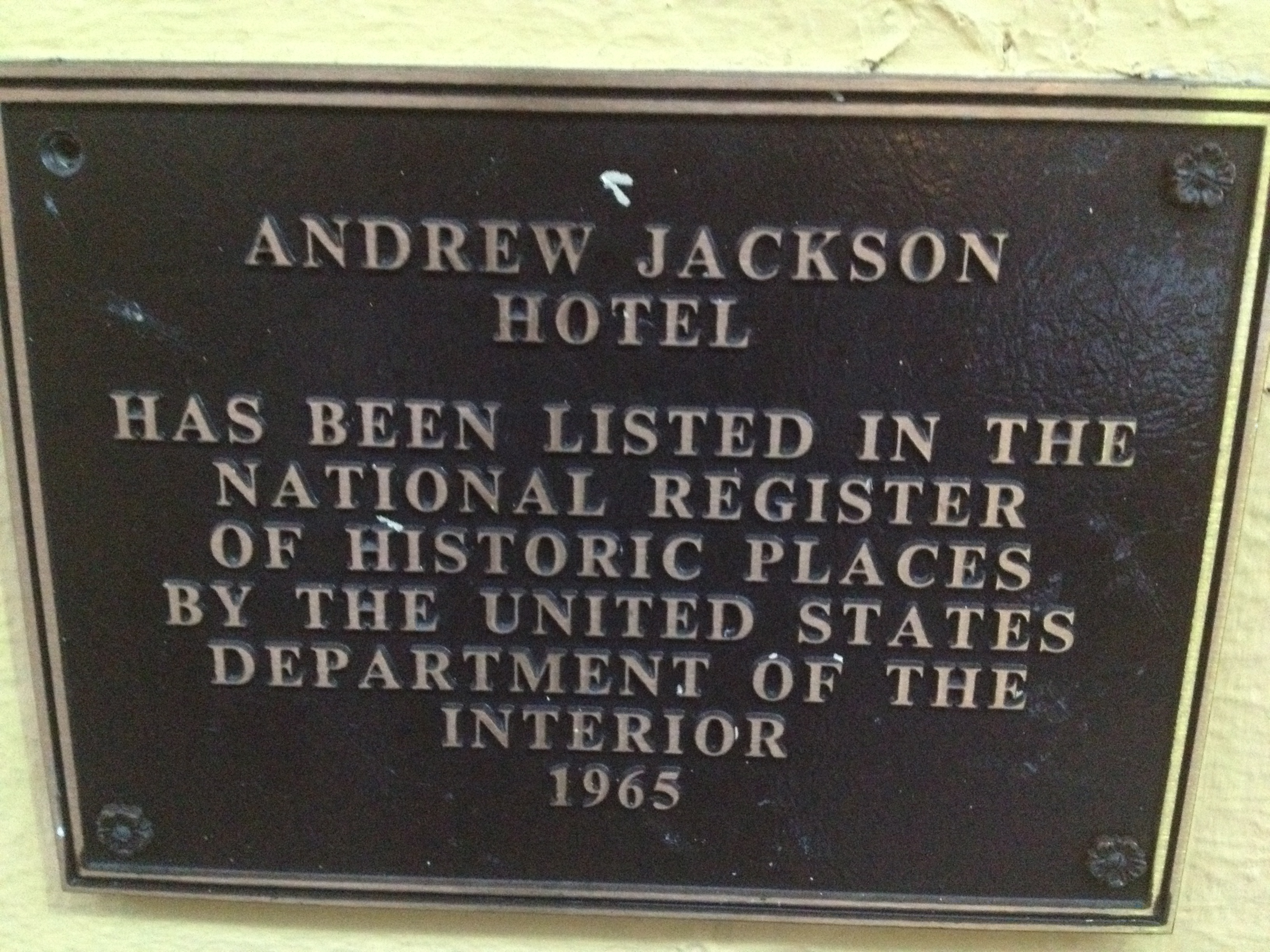
The Andrew Jackson Hotel — where Victoria and I stayed in 1985.
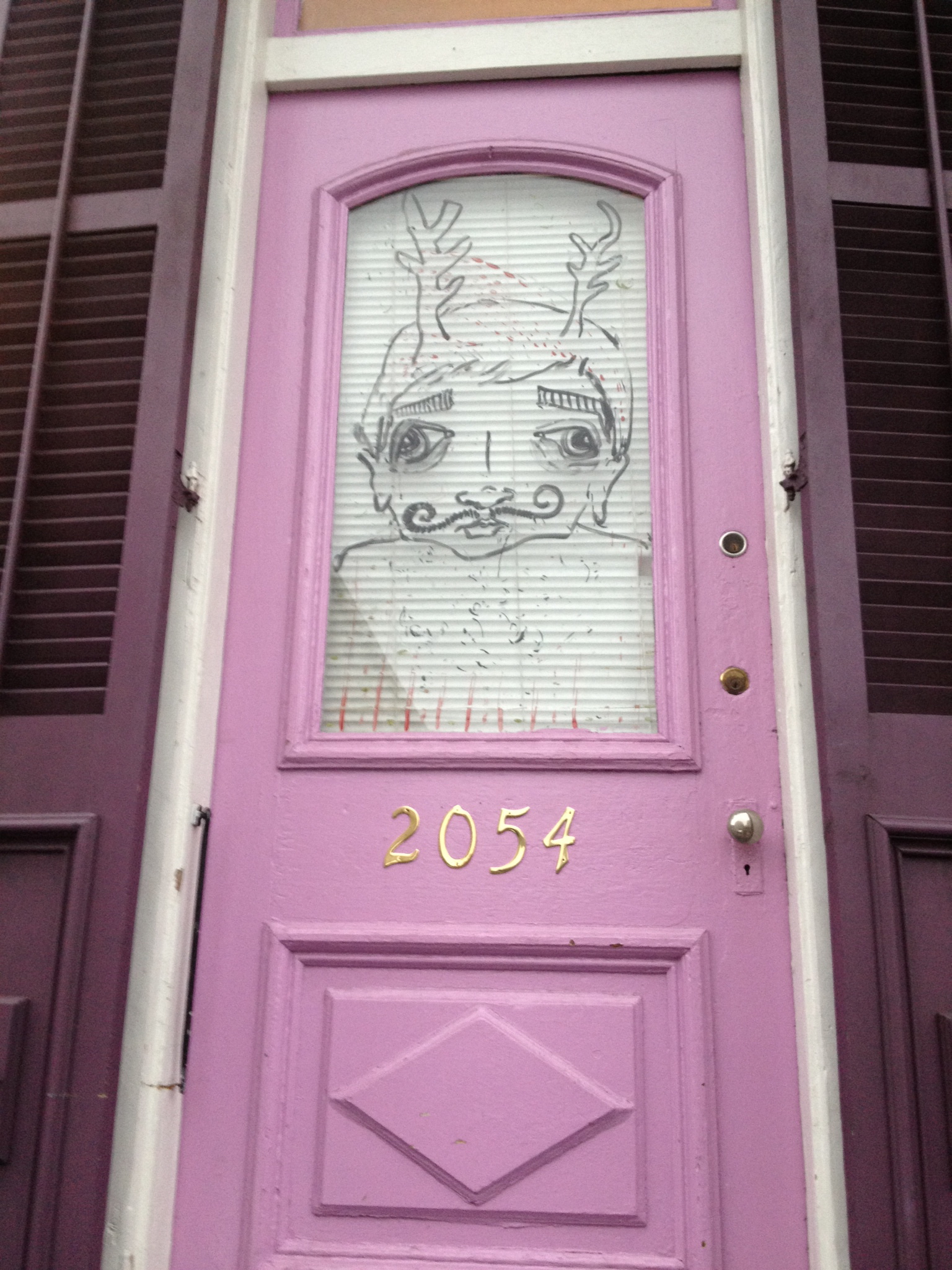
A French Quarter door.
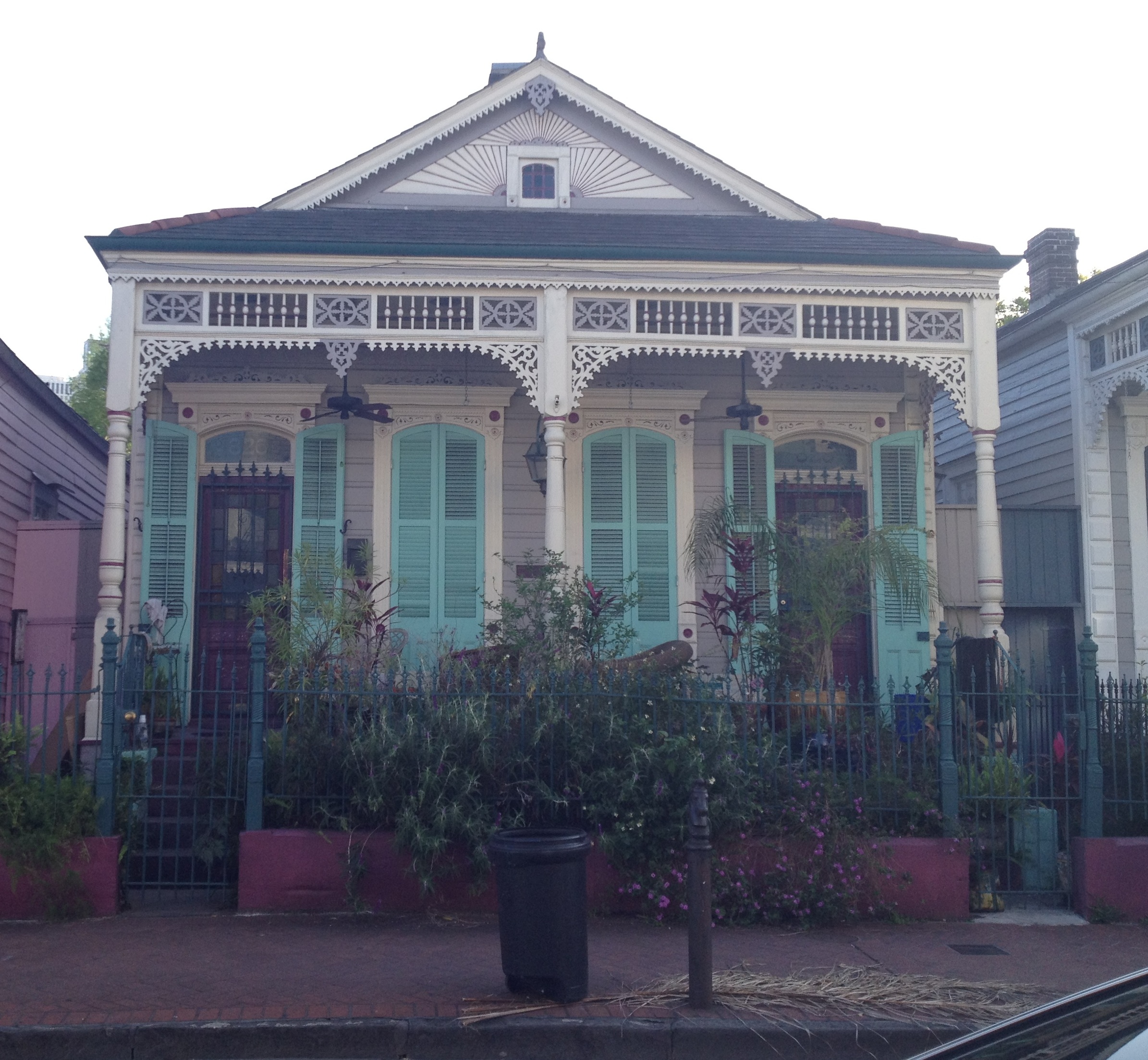
Typical French Quarter architecture and porch gardening.
Evangeline looks at home in the Vieux Carre.
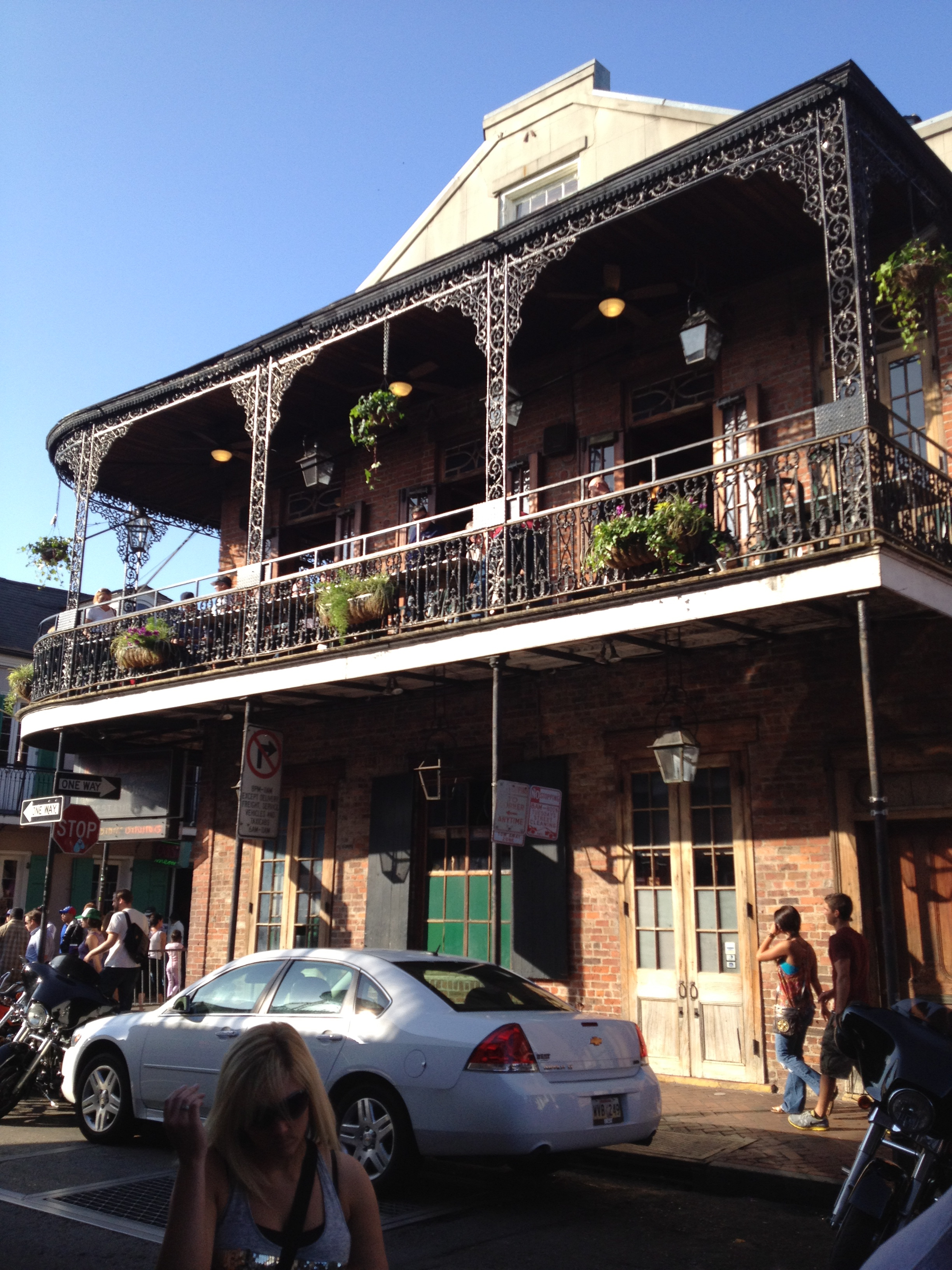
One gorgeous building after another…
New Orleans is a taste of Old Europe in the New World.
Once again, if you take anything with you from this blog, it should be this: When traveling in a place you’ve never been before, ALWAYS. HANG. WITH. LOCALS. Seeing a city with alongside a person who understands it and has lived in it opens the city for you in a way it never would if you’d stayed behind the plexiglass barrier that is being only a tourist. Because we made a point to run with as many Brazilians as possible, Roshan and I understood more truly than ever, what a Brazilian life means.
As it turns out, what does it mean to be a Brazilian?: To enjoy yourself.
Rio de Janeiro is a throbbing city—and when I say throbbing, I mean it in all the senses of the word. Rio is like a throbbing, open wound, a throbbing heart, a throbbing headache, a throbbing longing, a throbbing reverberation of music…
My daughter Emilia will graduate from Northwestern University”s Medill School of Journalism this June. She spent her spring break in Rio, getting the story on how the government is clearing slums in advance of the Olympic Games.
Because we were in Brazil for the express purpose of reporting, that is what we did. Without giving ourselves more than a moment to adjust, we grabbed our cameras and tripod and met up with our translator, Thiago.
Thiago is awesome. It is because of him Roshan and my trip was one of the best weeks of our lives. It is because of him I now understand more than ever that being in a new place with a local is a must. I will detail the adventures we had more thoroughly in a different post, but if I have one word of advice for the hopeful traveler, it is this: spend as much time with locals as possible. They open the city for you like it’s an oyster, revealing a pearl you’d never have been able to find on your own.
One of the glories of life in Southern California is the ability to quickly escape to the wilderness – whether it’s the ocean, the desert, or the mountains.
From our home at the southwestern end of the San Fernando Valley, we can reach the beach in less than a half hour, the high desert in a little more than that. And in about fifteen minutes, my family and I can be exploring the Santa Monica Mountains at Malibu Creek State Park.
We’ve been coming to Malibu Creek since we moved to Woodland Hills twenty years ago. We go several times a year, and we’ve enjoyed it in all seasons. Each season has its own beauty — but of all the seasons, Malibu Creek shows itself best in the spring.
Located just south of the junction of Las Virgenes Road and Mulholland Highway, the place is a nearby paradise. After you paid the $12 vehicle fee and parked the car — within minutes you can hike to vistas where it’s impossible to tell whether you’re anywhere near civilization. You can almost imagine what the Chumash saw when they settled among these live oaks and sycamores 5,000 to 10,000 years ago.
When we first brought our daughters to Malibu Creek State Park, the length of our family hikes were largely determined by our little girls’ enthusiasm for the expedition. We had to carry them along the trail sometimes, but eventually they became just as excited as their parents about spending some quality time at Malibu Creek.
The chaparral-covered mountains that dominate the park are green in the spring and golden by fall – and have been coveted by Hollywood for decades: 4,000 acres of beautiful scenery within an hour of downtown Los Angeles.
They’ve been shooting movies at Malibu Creek since the silent film era — and in 1946, 20th Century Fox bought 2,000 acres of what’s now the park to shoot movies like How Green Was My Valley, Love Me Tender, Viva Zapata, and Planet of the Apes.
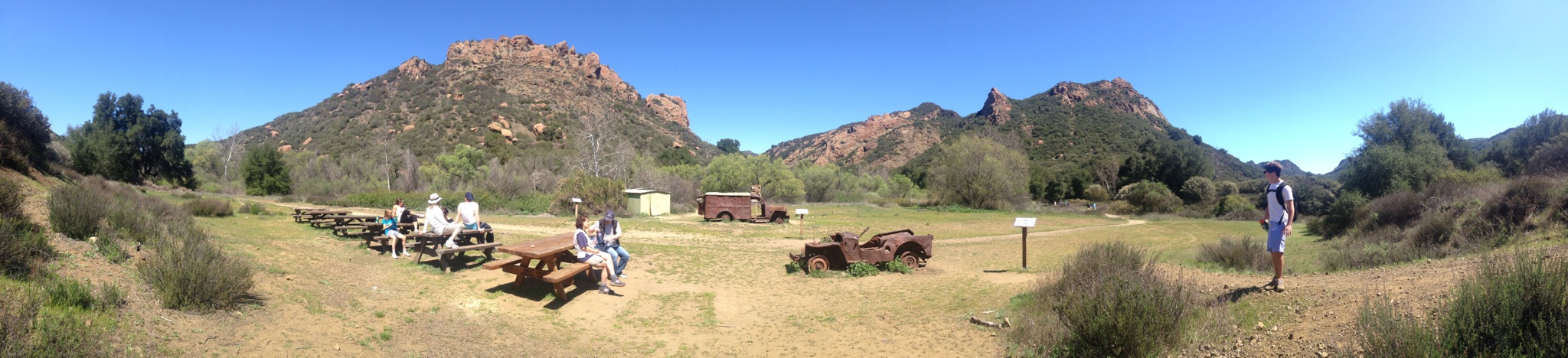
But the production for which the park is most famous was shot for the small screen. And that is why, the Barrosse family sets off along the trail to the M*A*S*H site: where from 1972 to 1983, the Santa Monica Mountains stood in for Korea on the classic sitcom, starring Alan Alda. When the girls were young, a couple of rusting Army vehicles were all that indicated you’d reached your destination.
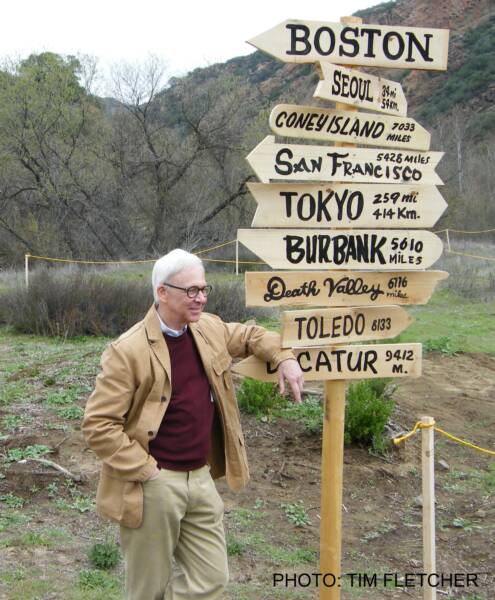
Father Mulcahy at the reunion.
But once you arrived at the M*A*S*H site, if of a certain age, you could easily recognize the jagged hills through which the helicopters passed and the plateau where they landed. You could even see the path that Captain Hawkeye Pierce climbed to meet the incoming wounded.
Since former cast and crew celebrated the 25th anniversary of the series’ last episode in 2008, the M*A*S*H site has gotten a facelift.
There are now signs that explain various features of the site, markers that lay out where the tents and buildings stood – and a freshly painted vintage ambulance offered up to the ravages of nature.
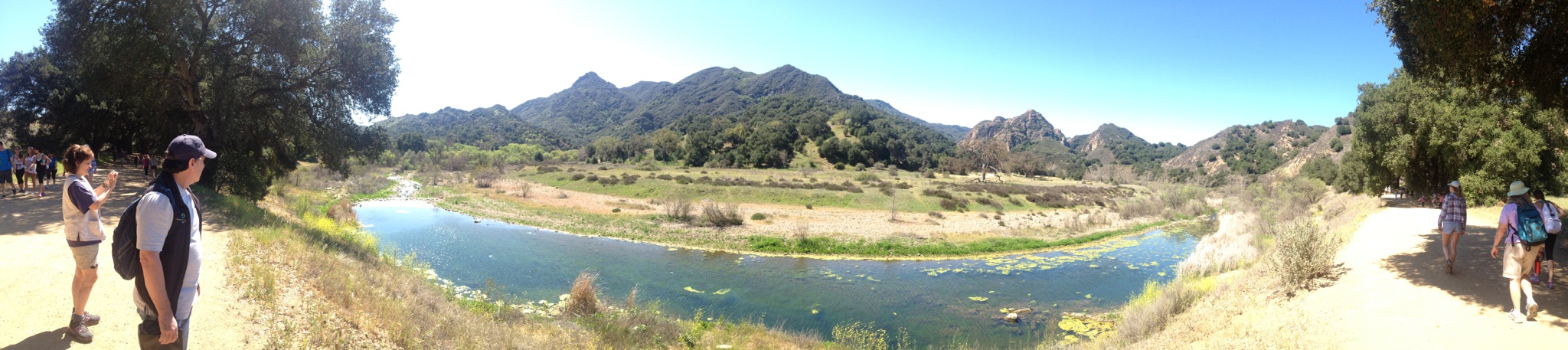
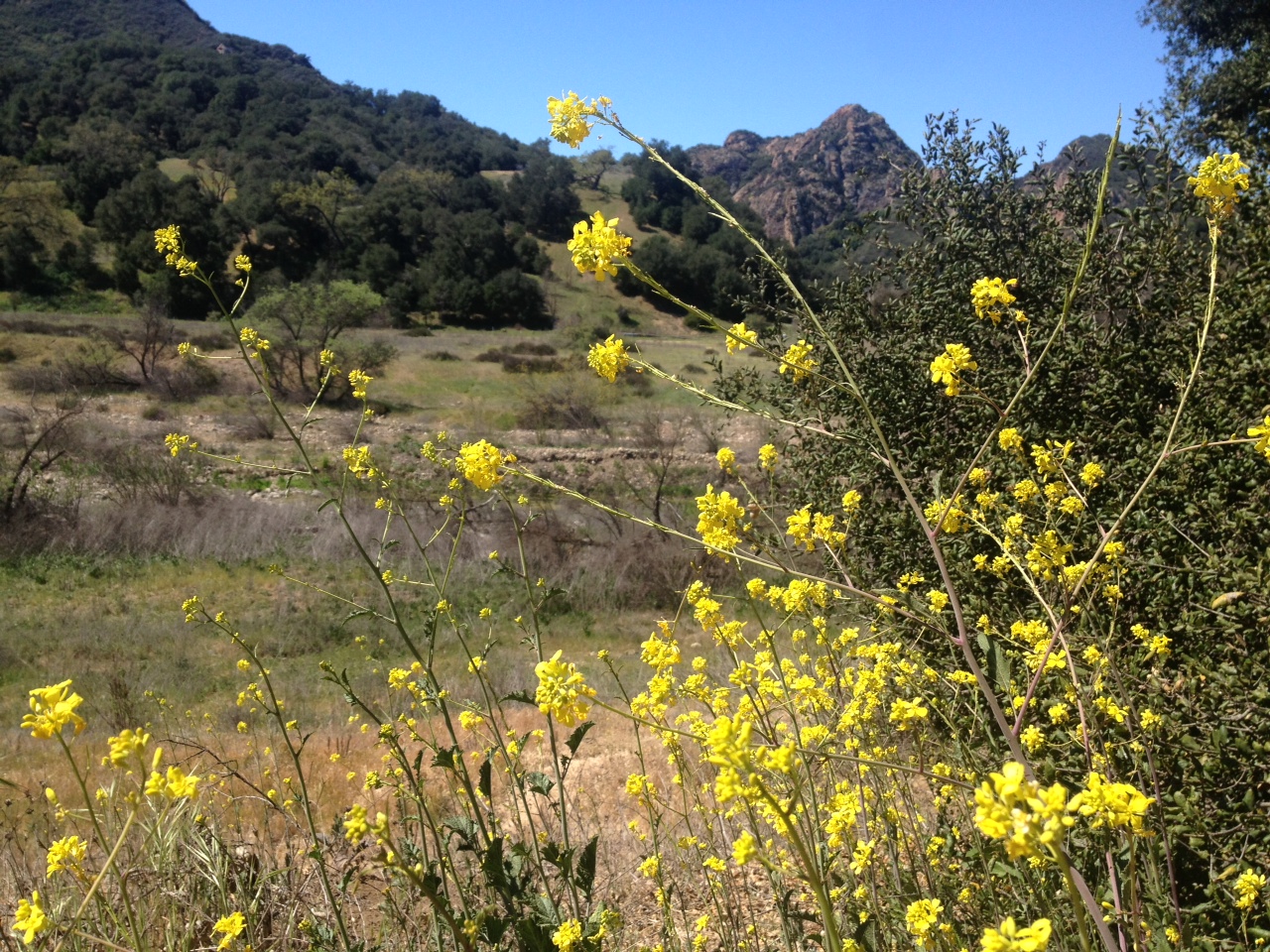
Along the trail to and from the M*A*S*H site, my wife Victoria, daughter and I were delighted to see the wildflowers starting to bloom. And we kept our eyes and ears alert for wildlife.
These geese weren’t that hard to track down. In fact, they just swam right up to Eva as though they were expecting her.
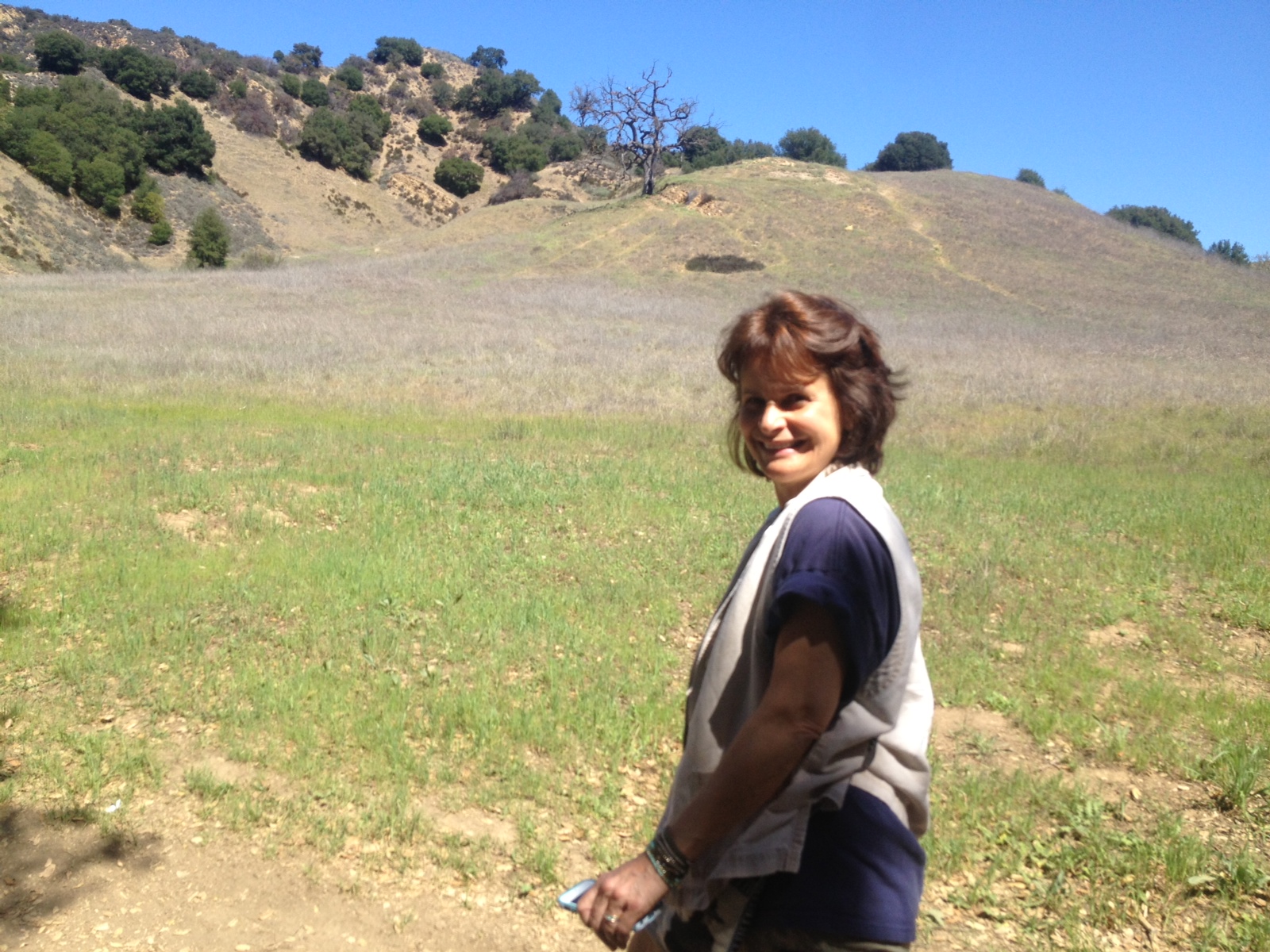
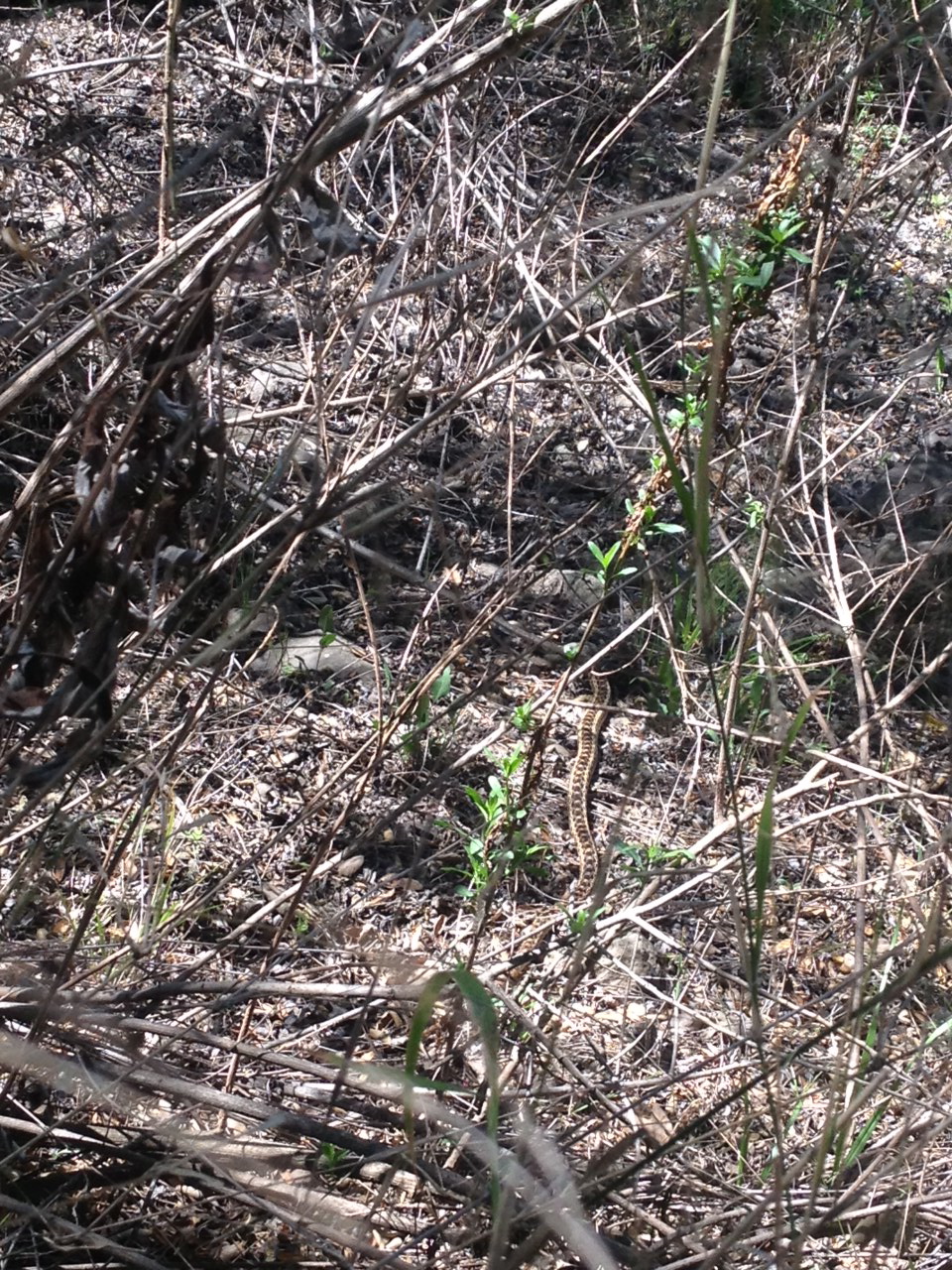
Can you see the well-camouflaged critter in the photo below?
And do you know what this nasty-looking insect is?
It’s a Jerusalem cricket. They’re not really crickets, and they’re not from the Holy Land, but you might find one at Malibu Creek State Park.
Yuck.
Quick. Let’s have another pretty picture.
And another. Love those wildflowers. (That reminds me: I’ve got make sure to get out to Lancaster to see the poppies this spring.)
Malibu Creek State Park is a large slice of heaven waiting just next door. I’m already looking forward to my next visit.
On Sunday, September 16th, my wife and I took a quick day trip to a whole new world: from our suburban home in Woodland Hills to the island of Santa Cruz – the largest of the Channel Islands off the coast of Southern California. Santa Cruz lies in the Santa Barbara Channel a mere 67 miles from our home in the western end of the San Fernando Valley.
The 42-mile drive to the harbor in Ventura took us less than an hour. We arrived at the Island Packers dock where our boat was waiting to carry us to Santa Cruz.
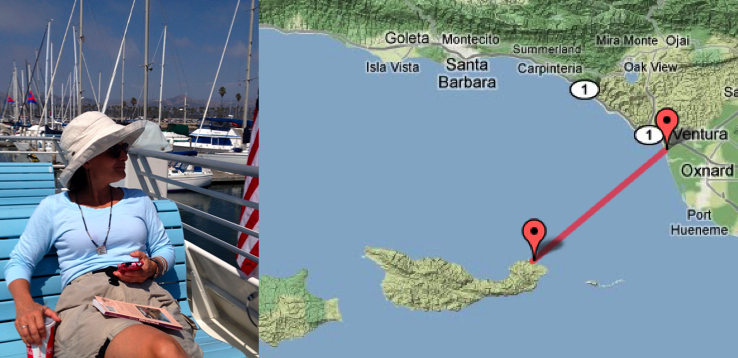
Victoria took a seat on the upper deck of the Island Packers boat, gazing out at the collection of vessels in Ventura Harbor.
We headed out of the harbor shortly after 2:00 PM. I’ve sailed out of Ventura Harbor many times, but not often aboard a boat of this size.
The pilothouse on the upper deck of the boat with the captain at the controls.
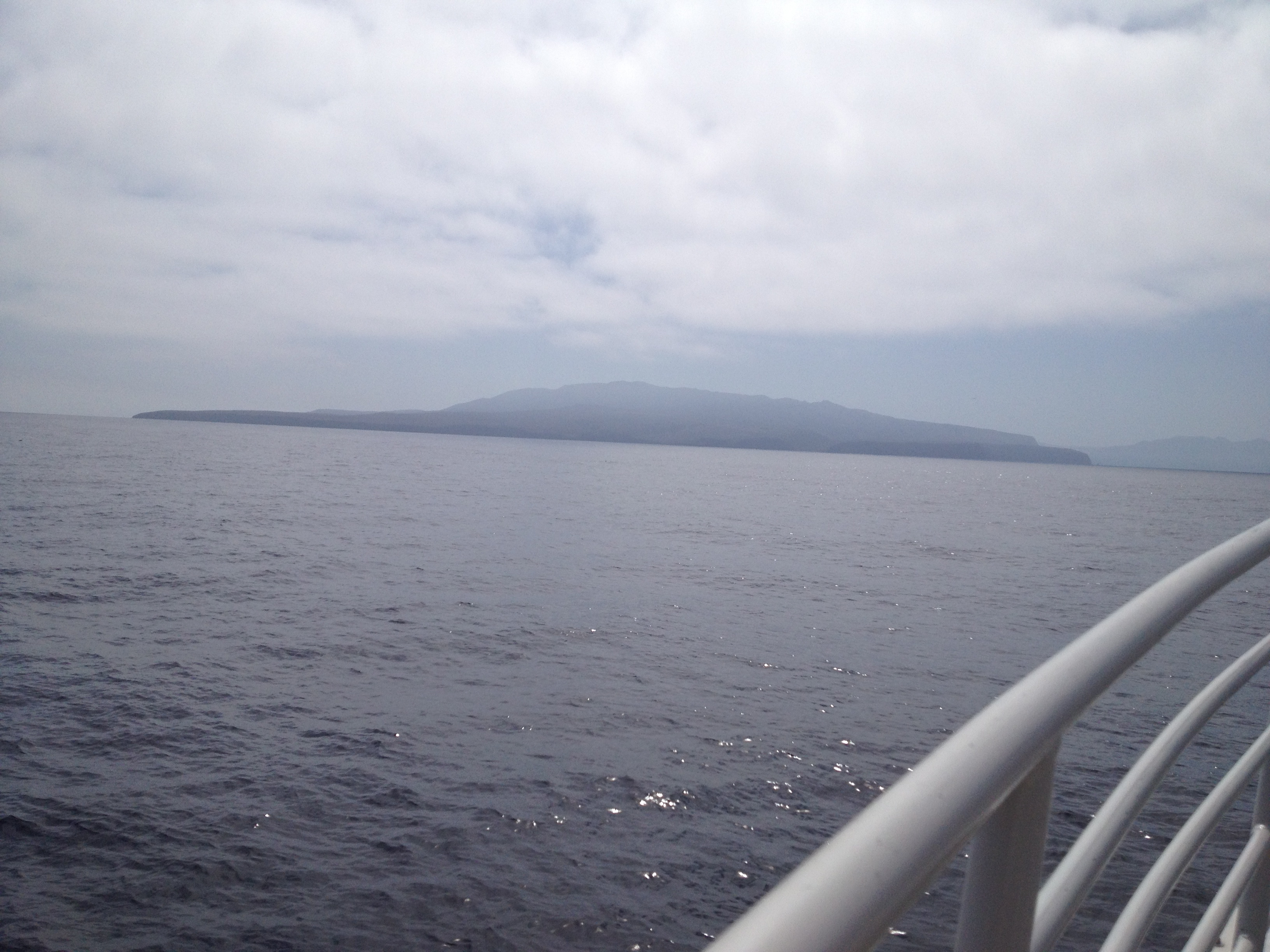
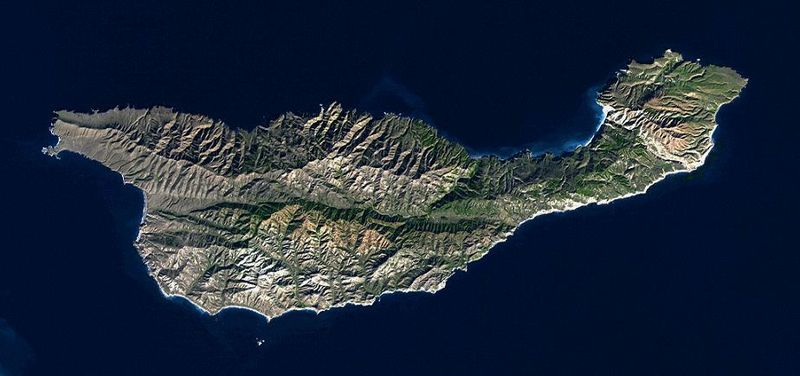
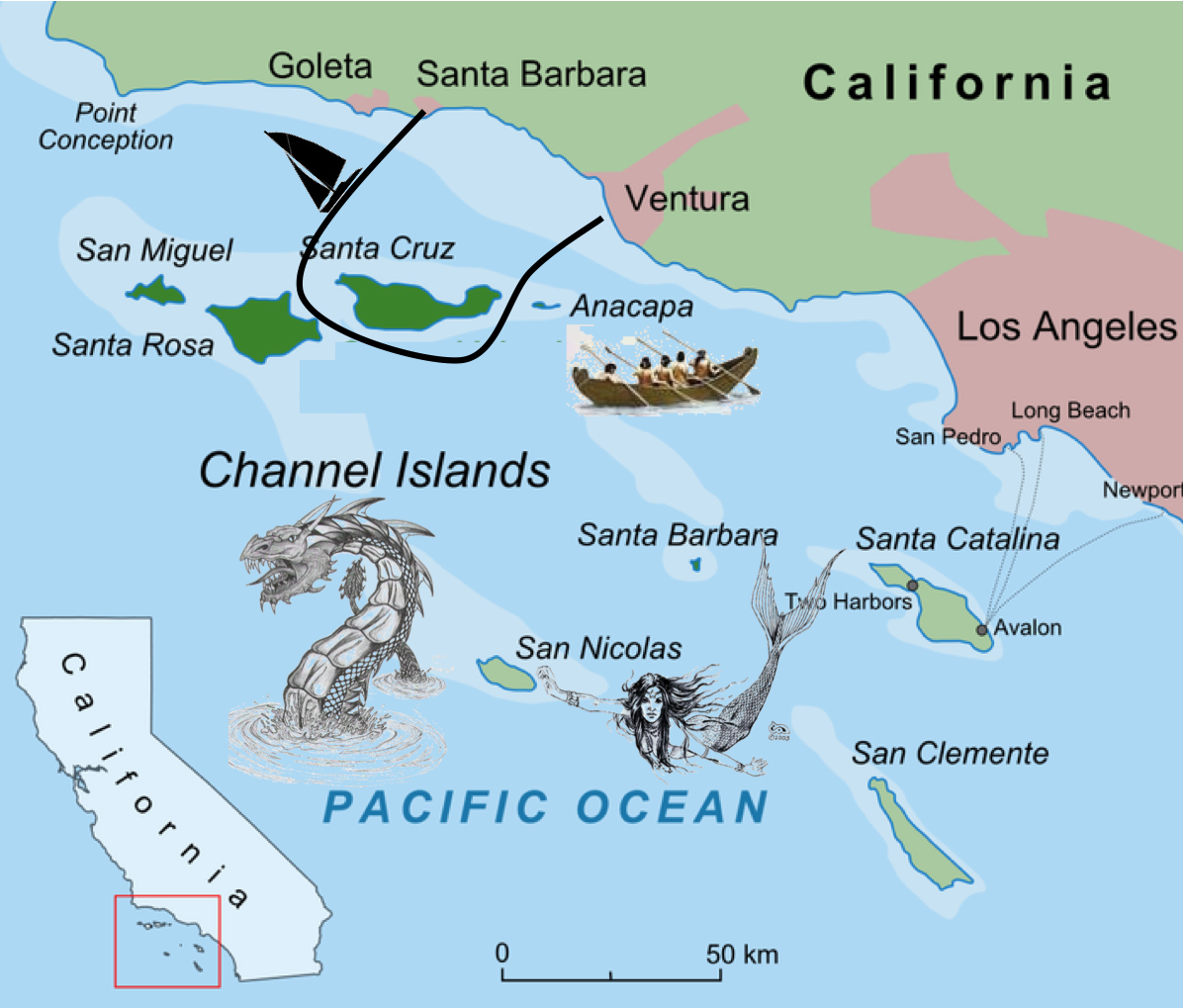
As we raced across the Santa Barbara Channel, a thick marine layer cast a hazy shroud over the islands in the distance. Santa Cruz is 25 miles off the California coast, and we covered that distance across a flat, grey ocean in less than an hour. (See map above.)
As we neared Santa Cruz, the foggy marine layer was burning off…
…and the island was finally revealed in brilliant sunshine.
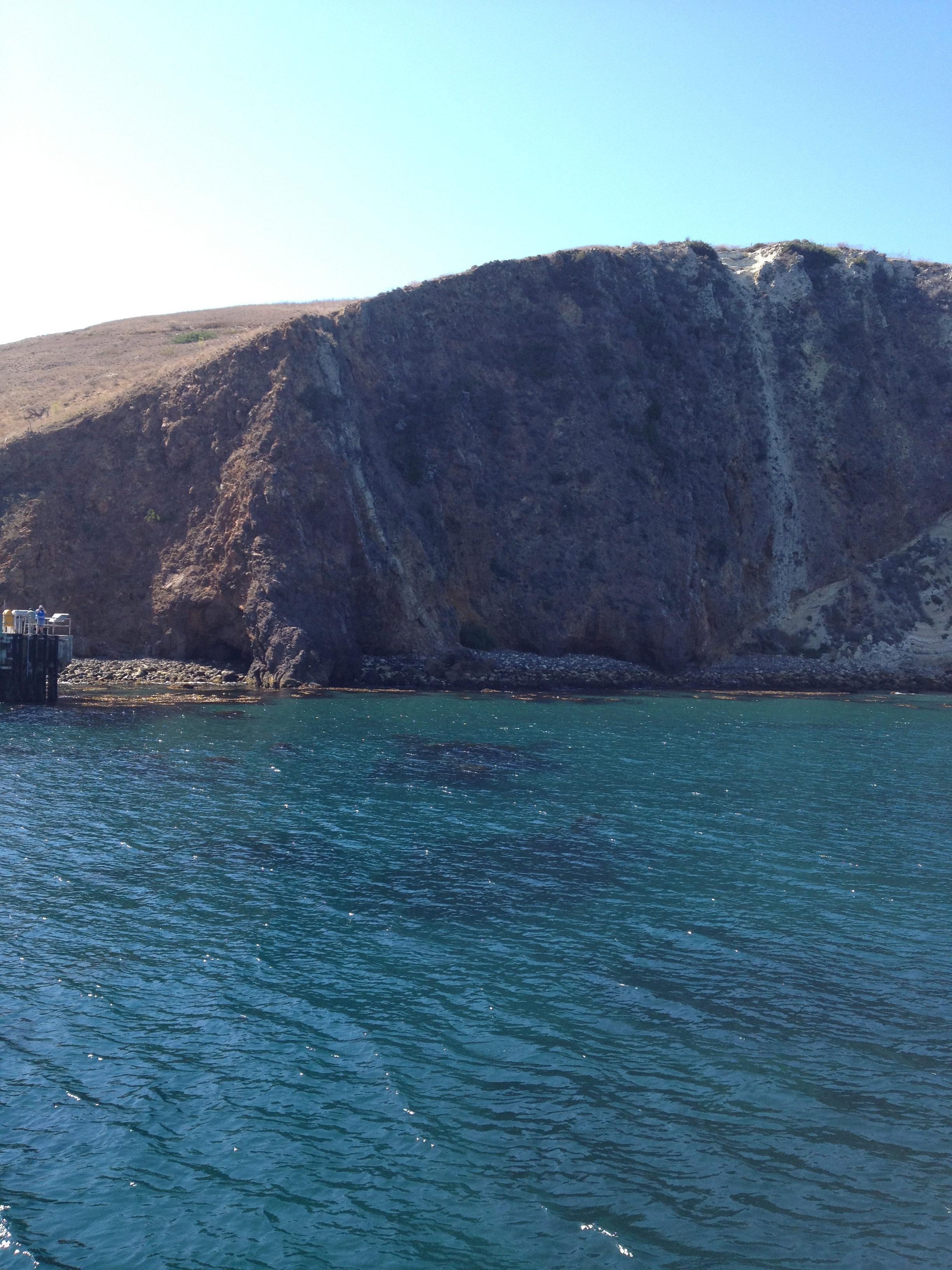
The closer we got to the island, the more the colors came out. The water became more blue and the island more golden and inviting as we approached the cliffs near the Scorpion anchorage on the eastern end of the island. (See map above.)
The Island Packers crew prepares to dock at the Scorpion anchorage.
The approached the dock at the Scorpion anchorage, where a pair of metal ladders stood ready for us to disembark.
A short dirt path leads from the anchorage to the former sheep ranch buildings that now serve as the visitor’s center and headquarters for this unit of the National Park Service. (Yep, the 5 westernmost Channel Islands are a National Park!)
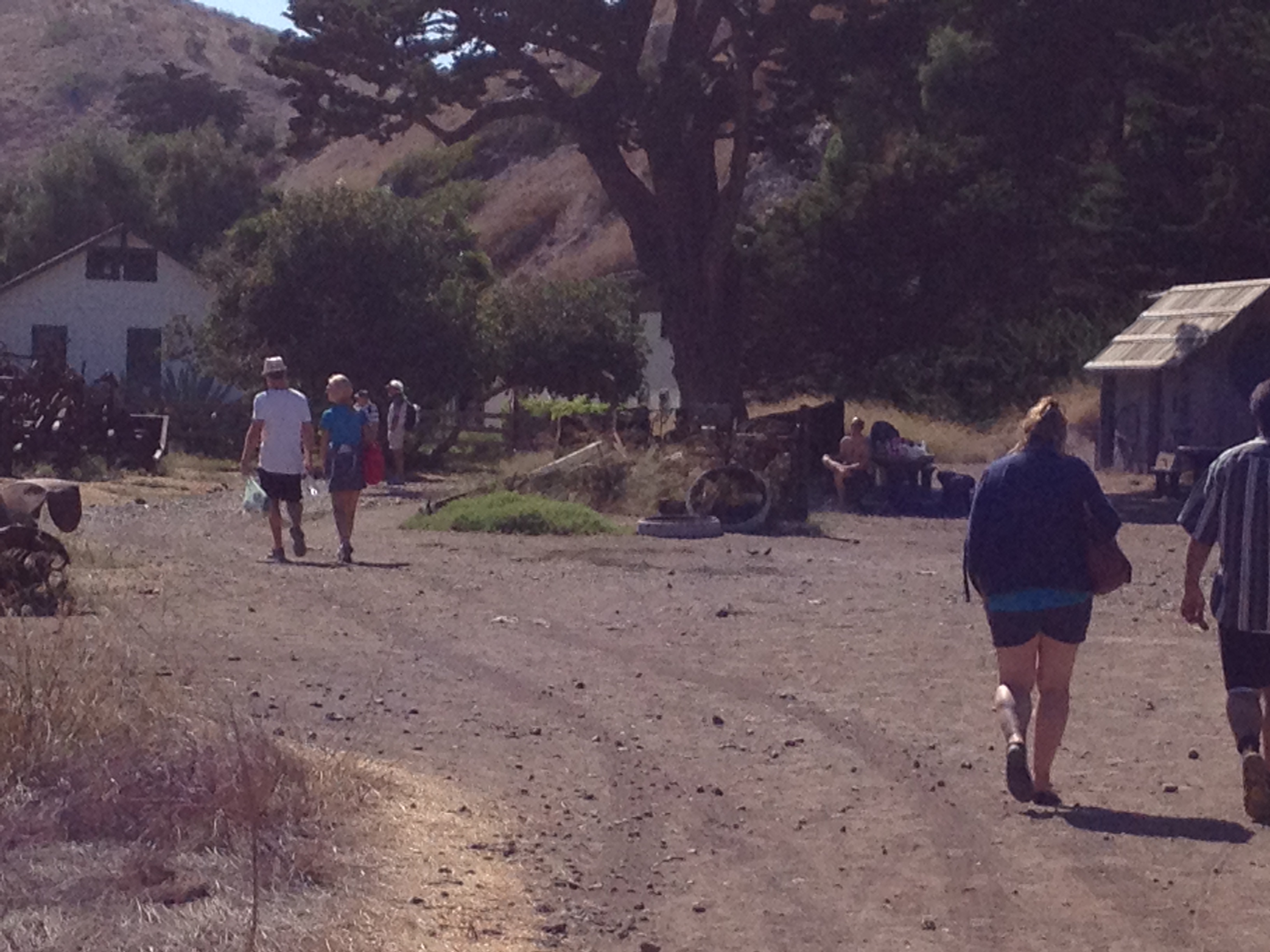
A couple hundred yards from the anchorage, the building of the former sheep ranch came into view.
Old rusted farm equipment provides mute testimony to the brief agricultural history of the island. For about 150 years from the 1830’s through the 1980’s, sheep ranching was the dominant industry on the island.
Victoria stands next to the old farm building that is now the National Park visitor center.
Victoria and I pause along the trail that rises above the visitor center. We only had about 40 minutes to explore before the boat was scheduled to return to Ventura. (We could have taken a much earlier voyage out of Ventura, but inspiration hit us too late in the morning.)
The trail rose quickly and the view was stunning. You can see our boat waiting at anchor below the cliff.
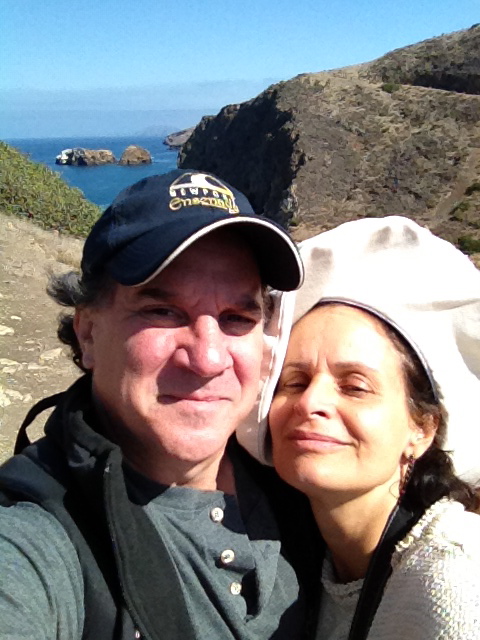
Victoria marches up the trail. Behind Vic, the mountains give a sense of low large the island is: 22 miles long and from 2 to 6 miles wide.
Victoria pauses at a particularly picturesque overlook to – what else? – take a picture.
Here’s another view from Victoria’s perch looking east above the Scorpion anchorage.
Heading back to the boat, Victoria spotted an island fox: a species that is native to six of the eight Channel Islands. (Vic earned her merit badge for the day.) I managed to shoot some footage of this cute, red-hued predator as it made its way through the chaparral.
We lined up on the dock to board the boat for our return trip – along with dozens of campers and day-trippers. It would be a far more crowded ride back to Ventura.
As I waited on the dock for everyone to climb down the two ladders onto the boat, I had plenty of time to study the gorgeous coastline.
Take a moment to enjoy the gentle lapping of the waves on the pebbled beach.
Now, take another moment to enjoy the hypnotic swaying of the kelp and other ocean vegetation along the coast.
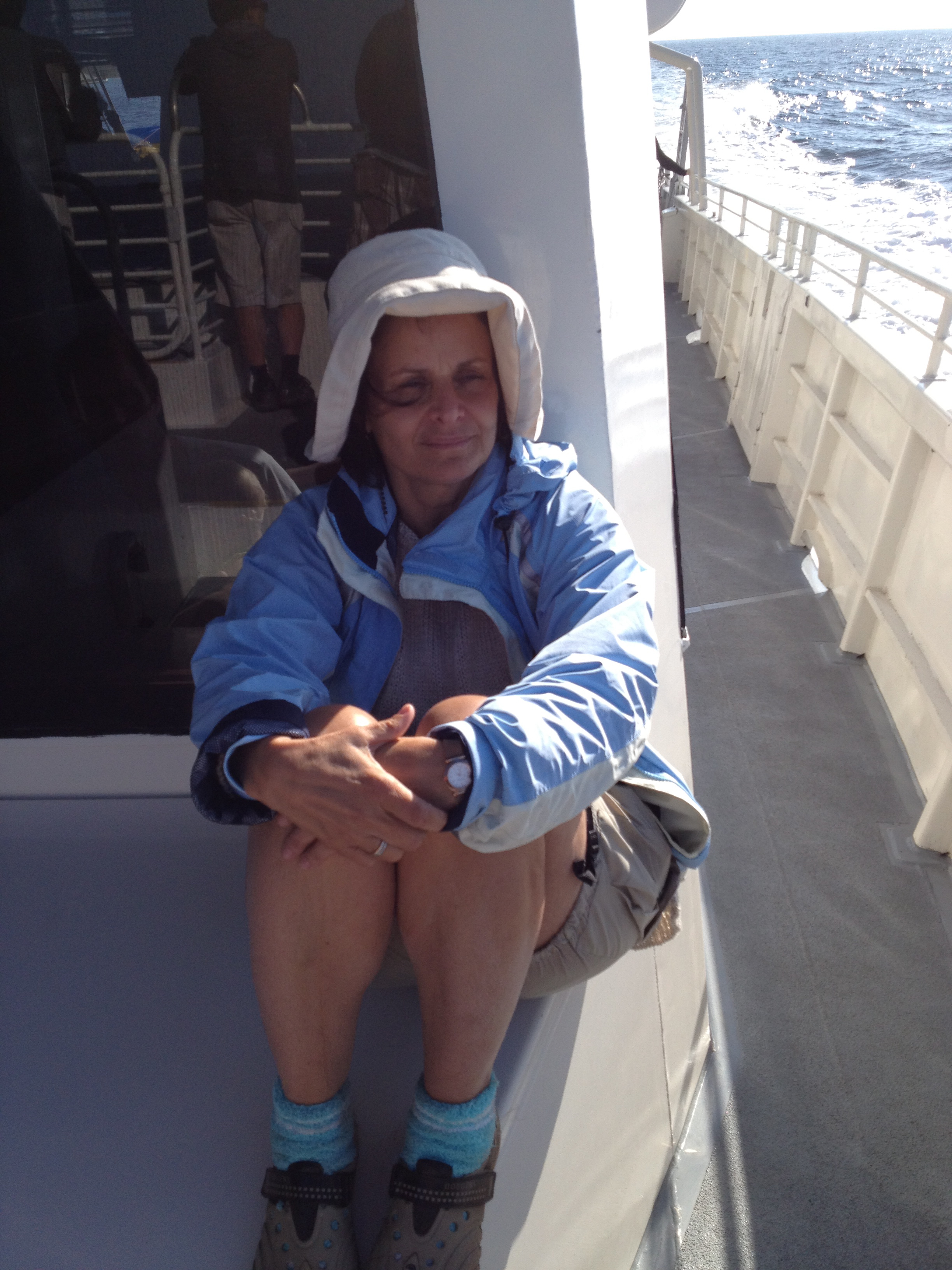
With the boat’s cabin crowded with returning campers, hikers, snorkelers and kayakers – Victoria takes windy refuge on the bow of the boat.
It was a great trip to Santa Cruz Island: a brief excursion to a whole ‘nother world that’s not too far away.
From the time that man first fashioned craft to ply the deep waters, hardy folk have braved the dangers of the sea for sustenance – risking the roiling waves for the bounty the oceans provide.
Others have taken to the sea for exploration and conquest, striking out for unknown shores to discover new lands and plant their flags upon them.
Others go down to the sea in ships for sport, to test themselves against the fickle and ferocious elements of wind and water, to ride the exhilarating edge of speed and danger in a fast boat, sails full of howling wind, the taut rigging straining, cracking on, bow waves drenching the gunnels as they race through the swell.
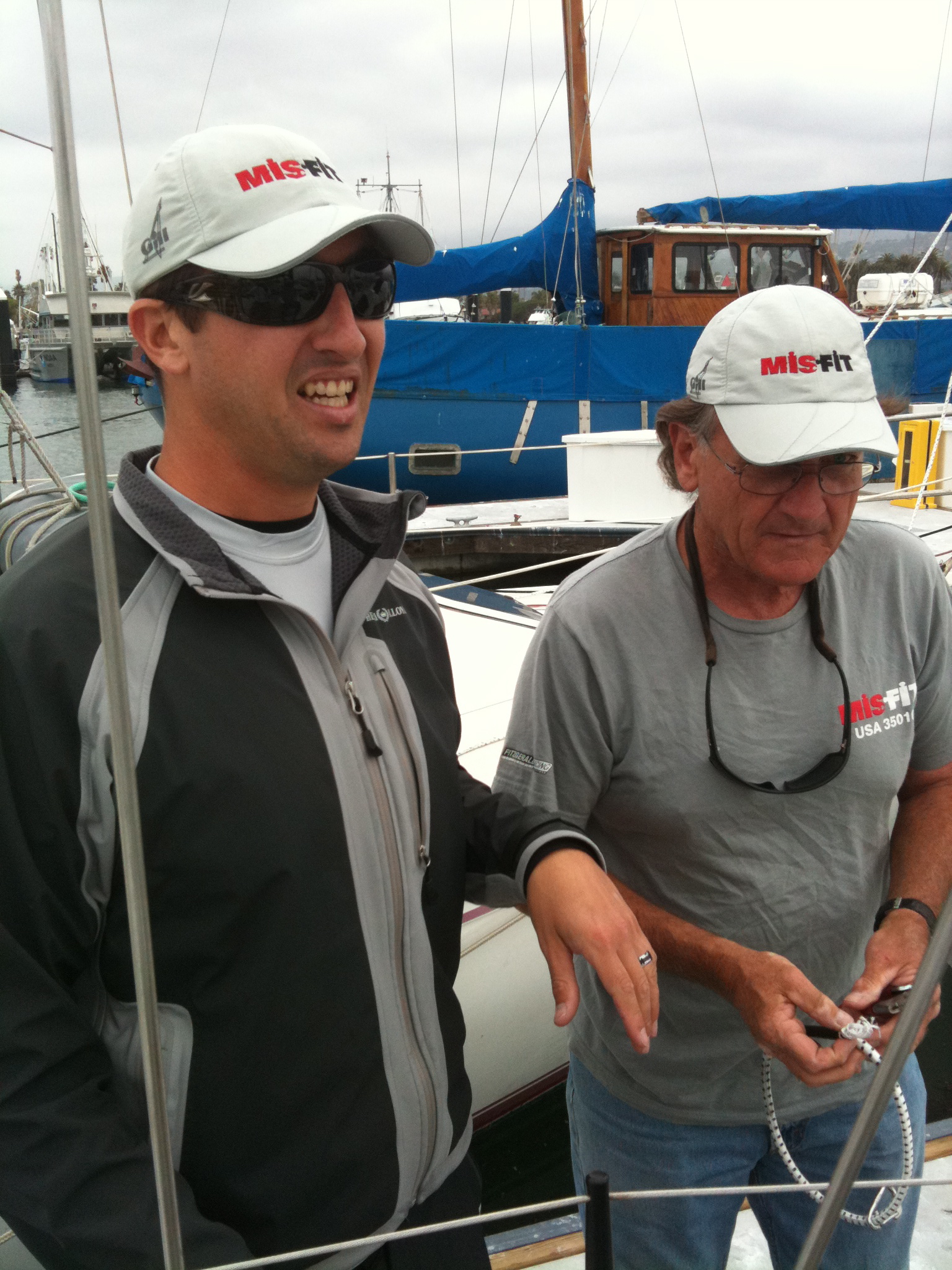
Master Eric and his father Joe the Ancient Mariner in Santa Barbara Harbor.
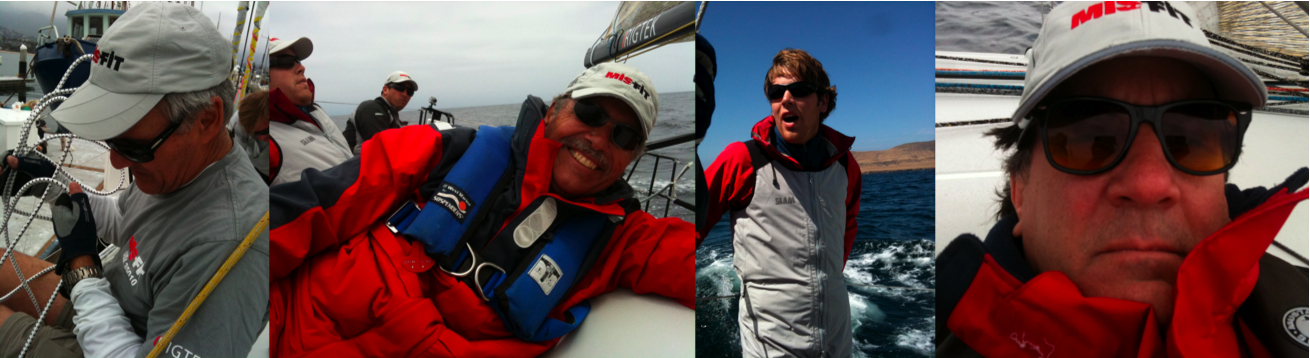
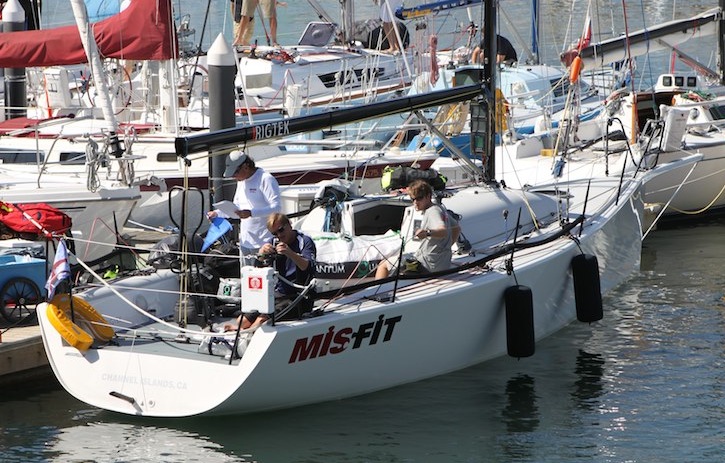
The men of Misfit number themselves among the latter category of sailors. And that is why Captain George Moll, Master Eric Schlageter and a crew of six intrepid adventurers gathered on the dock at the harbor in Santa Barbara, California on the morning of Saturday, May 14, 2011: to take part in The 31st Annual Hardway Race, sponsored by the Pierpont Bay Yacht Club.
The Hardway Race is the first installment of the 12th annual Island Series, a set of three races that feature voyages to the nearby Channel Islands.
To go “The Hardway” means to race from Santa Barbara to Ventura Harbor by going around Santa Cruz Island – a journey of 67 nautical miles.
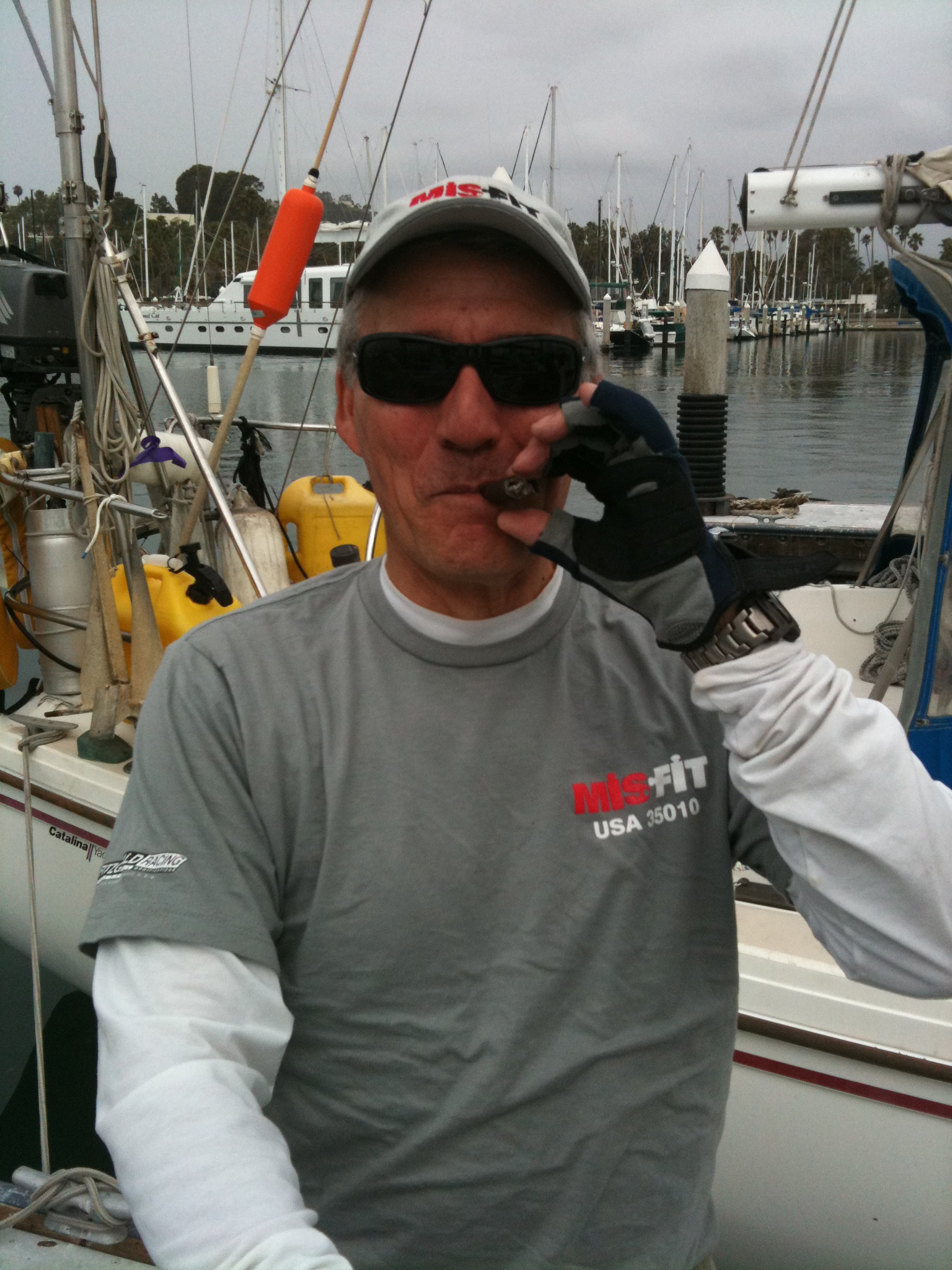
Master foc'sl'man Claude enjoys a celebratory cigar before we shove off.
I’ve been living in the Los Angeles area for two decades, and I’ve raced with Captain George in the Santa Barbara Channel for several years now – but I’d never sailed around the backside of Santa Cruz – so I was excited to be in this race. It’s wonderful to be able to explore exotic, unseen lands so close to home. I’ve sailed around Santa Cruz’s nearest island neighbor, Anacapa, many times. Anacapa is always a stunning sensory treat with its jagged shoreline, steep, rugged cliffs and zillions of seabirds. But going around Santa Cruz was going to be something special. Somewhere I’d never been before.
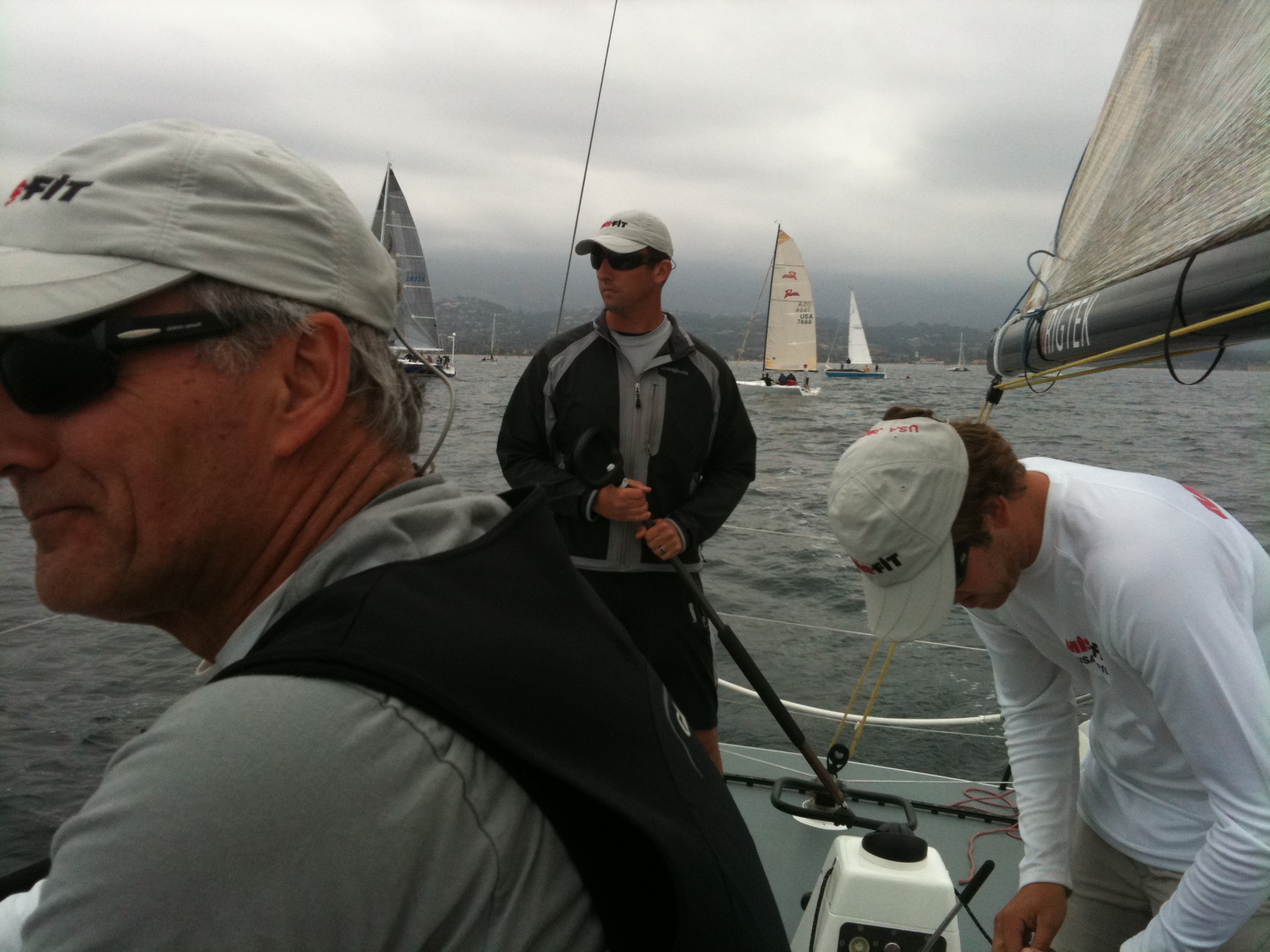
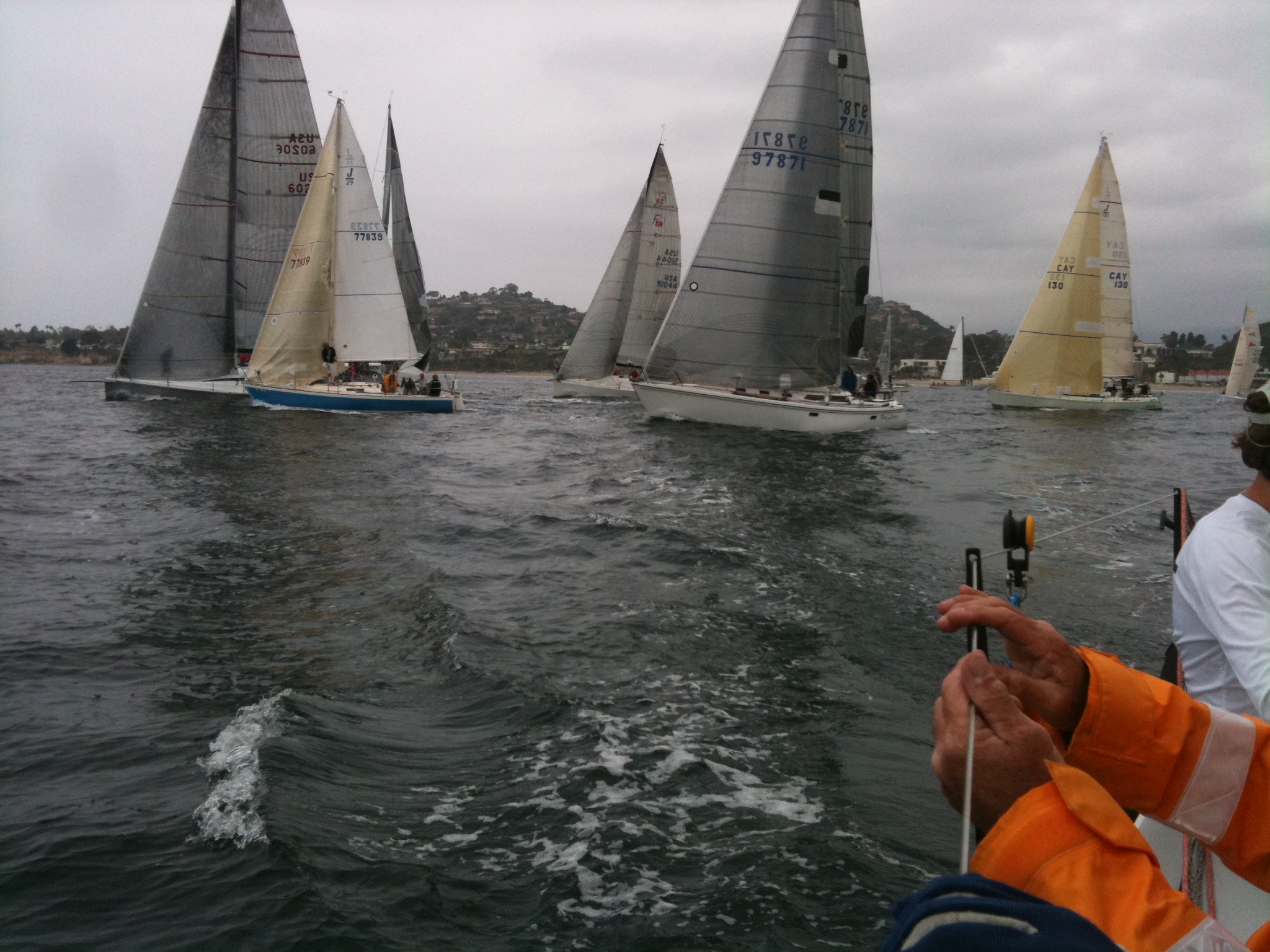
We motored toward the starting line, where the other boats in our class were jockeying for position prior to our 11:00 am start time. At 35-feet long, Misfit was among the smallest of the boats contending in the spinnaker class that had chosen to go “The Hardway” around Santa Cruz. Indications were that the wind would be up, so the Captain ordered us into our foul weather gear from the jump. When you see Eric’s dad, Joe the Ancient Mariner, donning his foulies, you’d best follow his veteran example. If Joe thinks we’re gonna get wet – we’re in for soaking.
Master Eric steered us to a great start and we got off the line, neck and neck with “Dr. Laura” Schlessinger’s magnificent racing vessel, Katana. With her much longer waterline, Katana soon began to pull ahead, as did another larger racing yacht, Prevail. But we could tell by the pace we kept with those longer boats that we had a chance to win this race if the wind – and our luck – held. (Wind and luck being the two biggest critical variables in sailboat racing.)
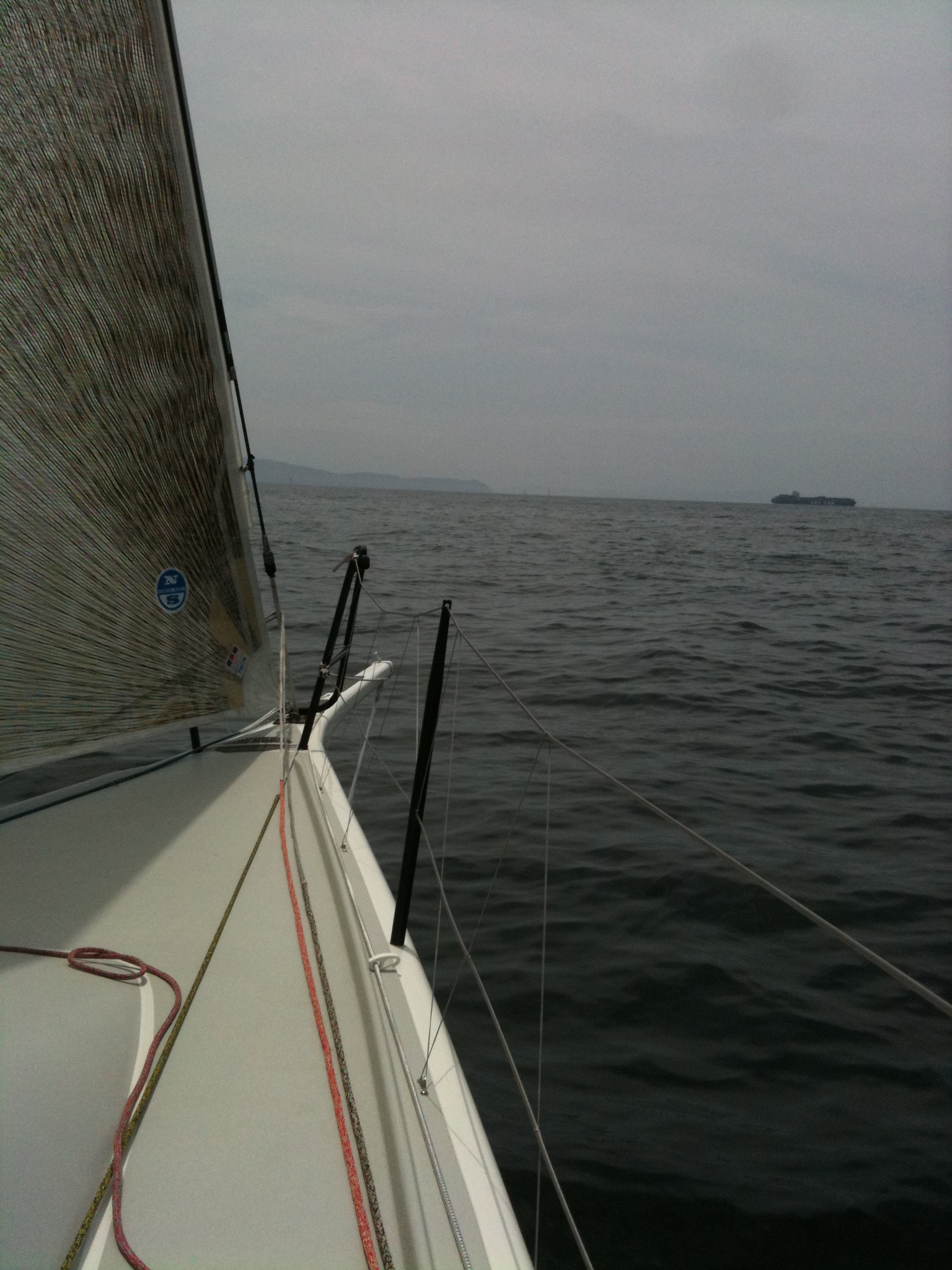
Within two hours sailing, we neared the western point of Santa Cruz Island at a speed of 8-10 knots. Luckily, a huge container ship crossed our bow about a half-mile ahead of us. At least one of the leading boats was not as lucky — and had to diminish speed to steer around the container ship.
We had a similar experience with an oceangoing barge approaching Anacapa on my first Hardway Race two years ago, so I was glad to see that container ship pass safely in the distance.
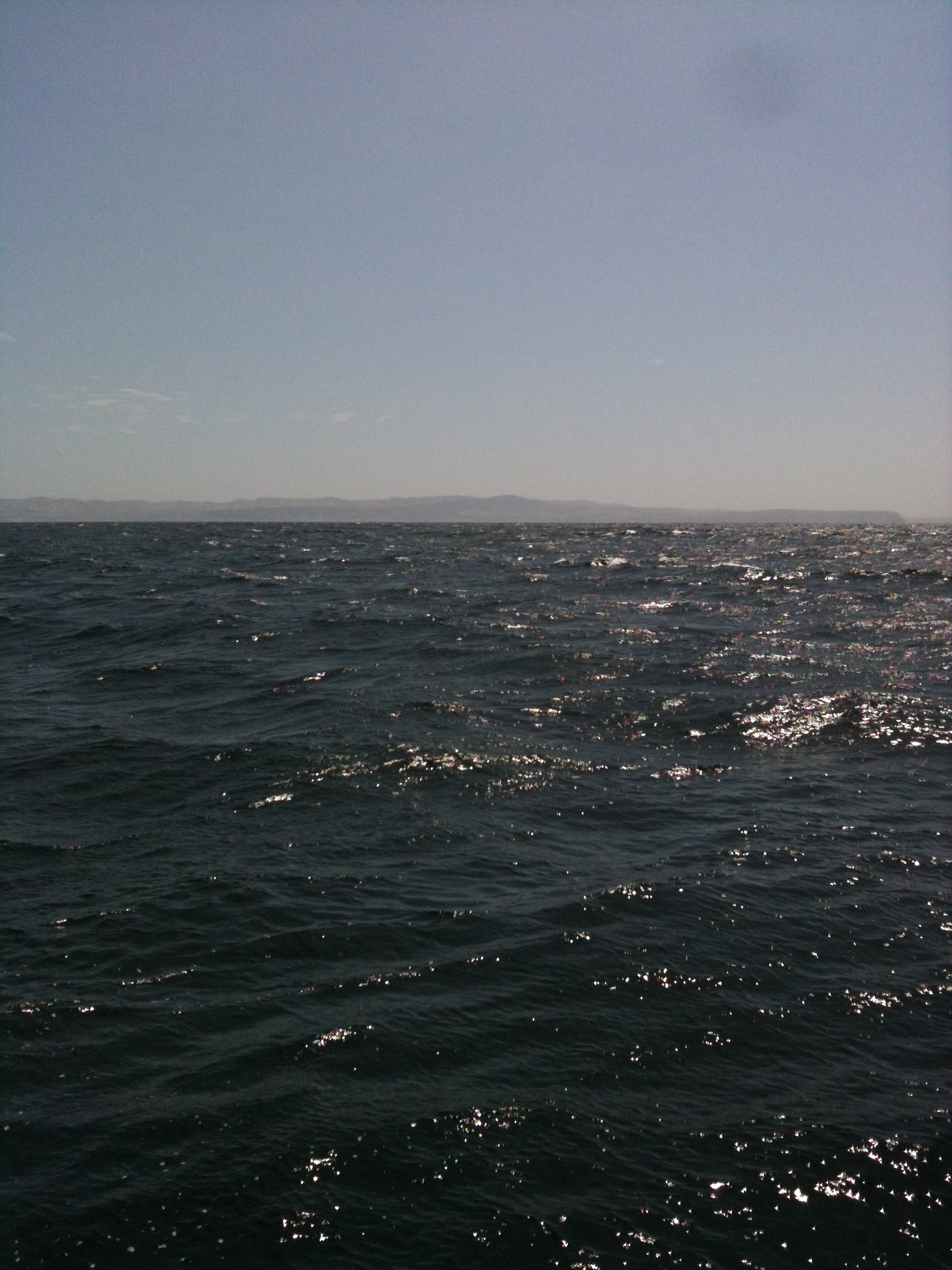
As we made the Santa Cruz headland, I was greeted with a sight I had not expected: there were two more islands in the distance beyond Santa Cruz: Santa Rose and San Miguel. I’d never seen either of these westernmost Channel Islands before, and it was a thrilling discovery.
I had not realized that the western end of Santa Cruz’s backside was actually a channel between two islands, and the choppy and confused currents that bounced and swelled between the two islands is known to local sailors and fishermen as “The Potato Patch.”
Once out of The Potato Patch, the northerly winds died a little as we passed under the lee of the imposing cliffs and mountains of Santa Cruz.
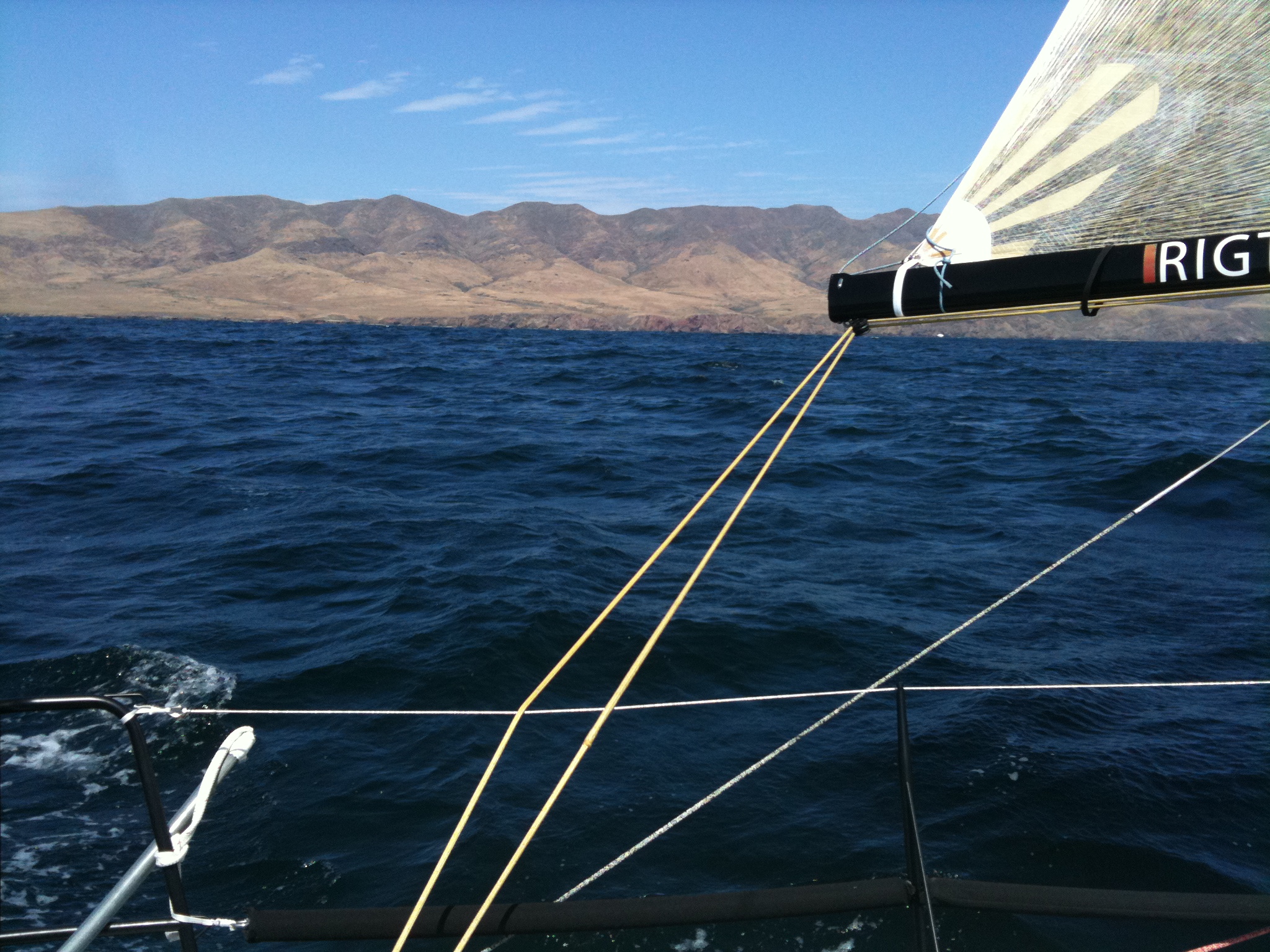
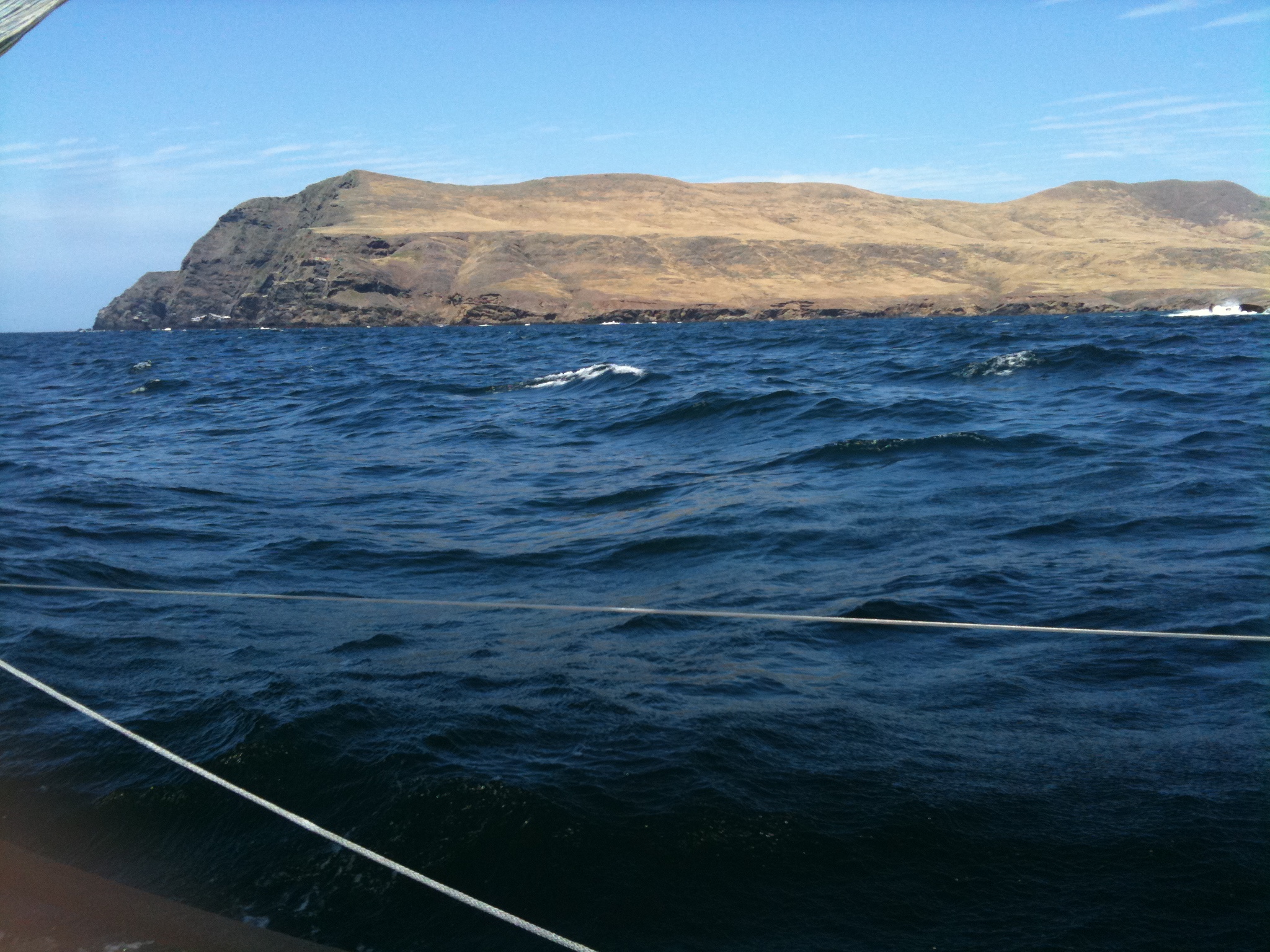
Between jibes, as we sought the shifting winds, I got a good look at the magnificence of Santa Cruz.
Santa Cruz was once the largest privately owned island in the nation, but now its jointly owned by the National Park service (which owns 24%) and the Nature Conservancy (which owns 76%). 22 miles long and from 2 to 6 miles wide, it’s the largest of the eight islands in the Channel Islands chain.
Steep, sea-battered cliffs, surf-filled caves, and a few sandy beaches make the coastline of Santa Cruz well worth the voyage.
Rising above it all is the high ground known as Devils Peak, the highest prominence on the island at 2,450 feet.
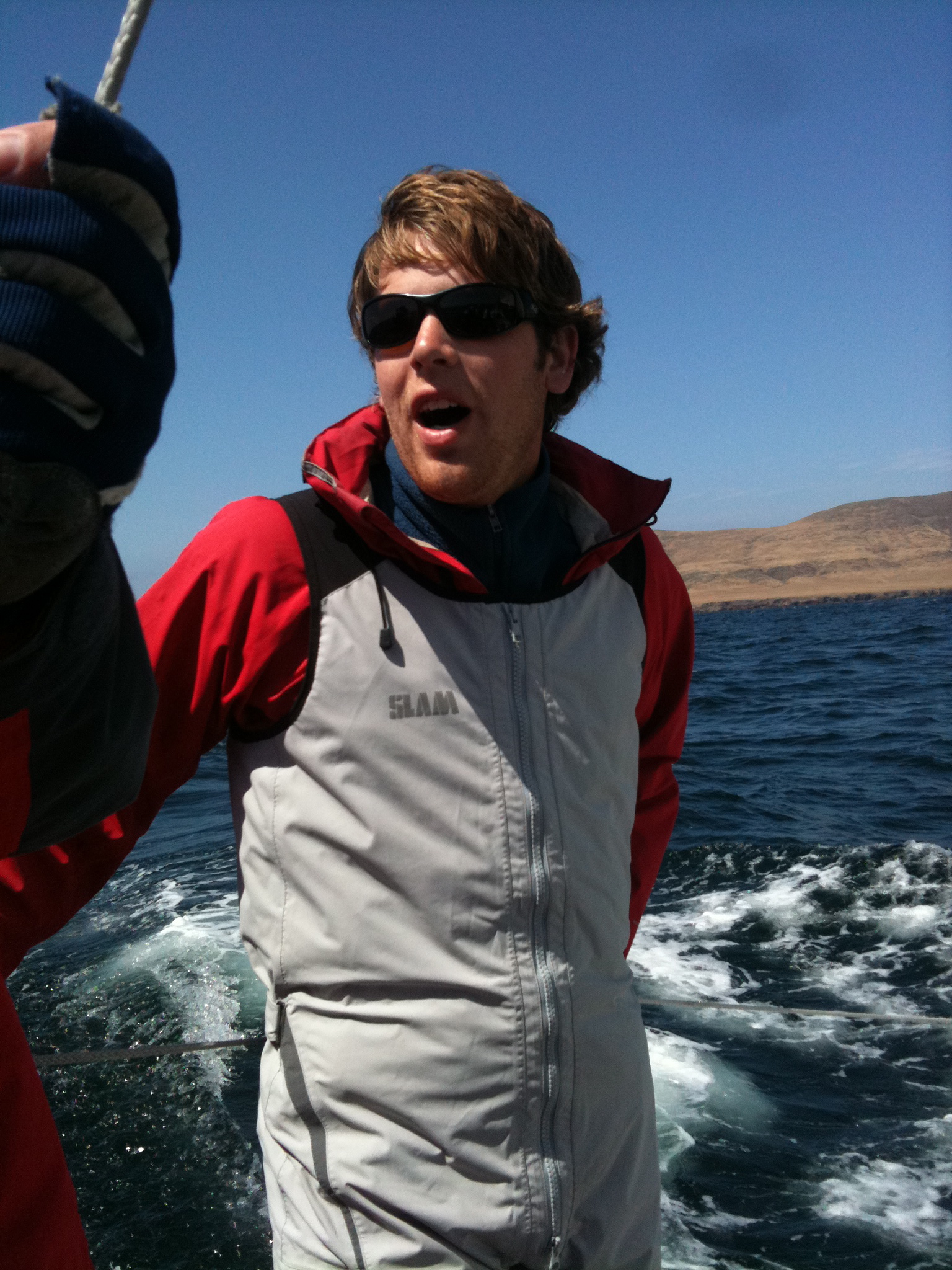
Geno in the cockpit with the sea cliffs of Santa Cruz rising behind him.
Archaeologists tells us that humans have been visiting (and living on) Santa Cruz Island for at least 9,000 years – most notably the ChumashIndian tribe, who lived on the island and traded with the mainland Chumash population.
The Chumash had it to themselves until Juan Rodríguez Cabrillo showed up in the Channel Islands in 1542, planted the Spanish flag, lost his leg, and died. Cabrillo and his crew did not come ashore on Santa Cruz, though he named the island San Lucas.
Sebastián Vizcaíno led the last Spanish expedition to check out the Channel Islands in 1602. Vizcaino’s map named Santa Cruz the Isla de Gente Barbuda (“island of the bearded people”), and in 1822, the last of those “bearded people”, the Chumash, left Santa Cruz Island for the Catholic missions on the mainland.
We were just about to leave the vicinity of Santa Cruz ourselves at about 4:00 pm, flying a spinnaker and ripping along at 12 knots with the Eastern headland of Santa Cruz in sight – when nautical hubris got the best of us, and we were overpowered, rounded up – and knocked down!
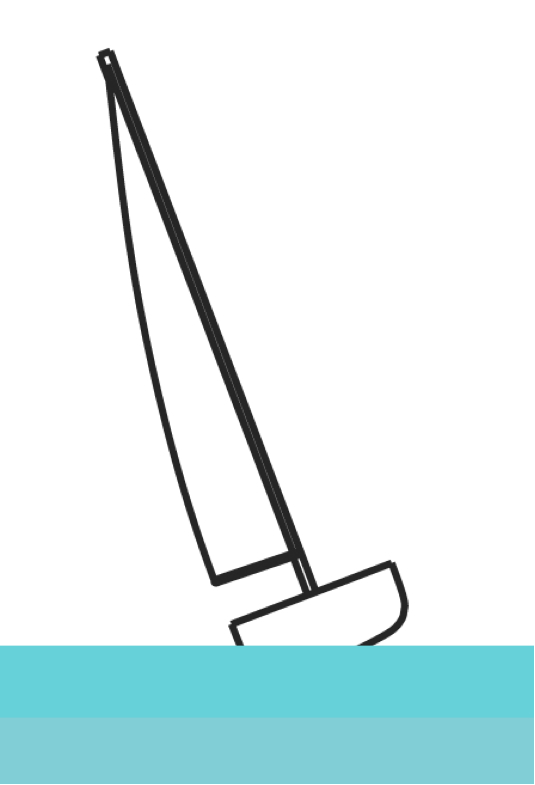
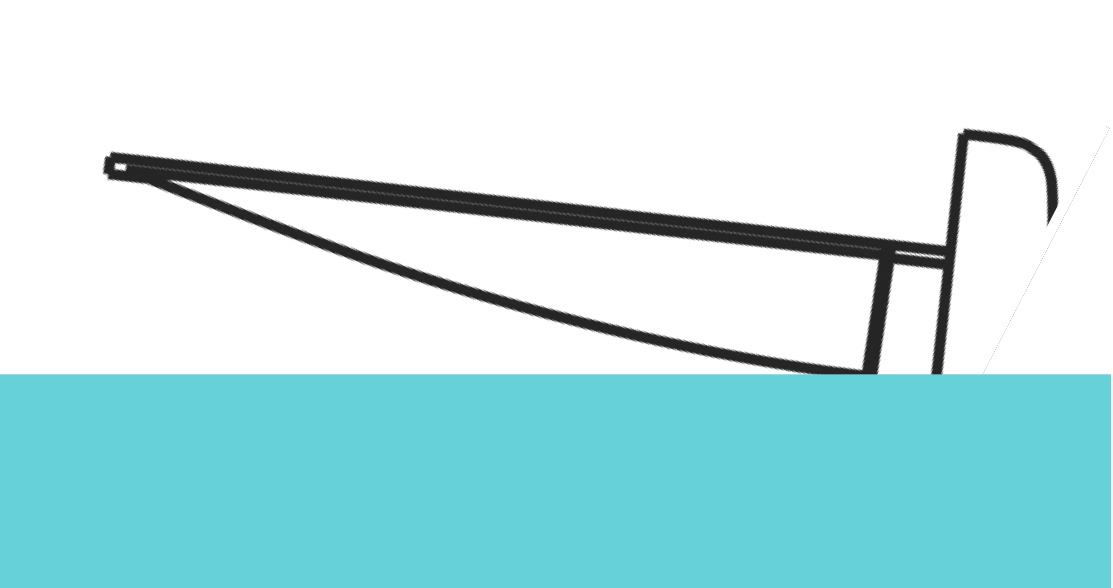
For those who are not salty enough to appreciate what it means to be “knocked down” — here’s a simple illustration.
This is the normal profile of a sailboat, heeled over in the wind, at a slight tilt relative to the waterline. This is what you want to achieve when you’re racing a sailboat.
This is the profile of a sailboat that has been “knocked down”. If it gets any worse than this, the keel will come out of the water and the boat will capsize.
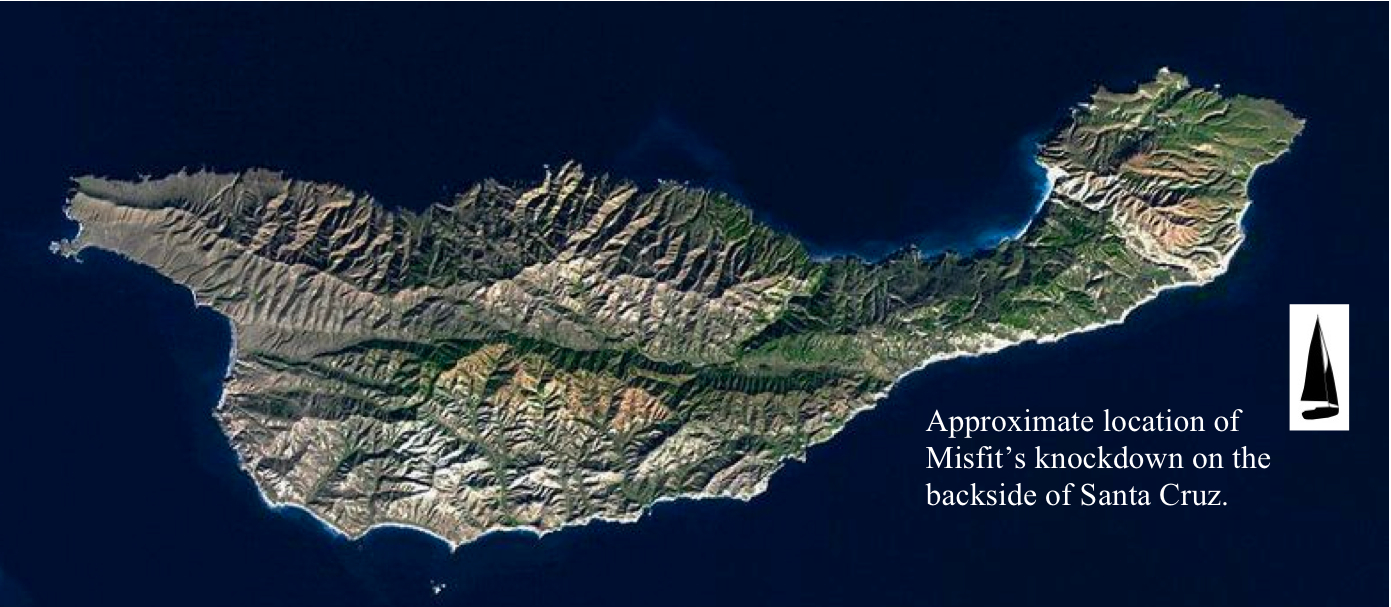
Here’s approximately where we were on the backside of Santa Cruz when we were knocked down.
What was I doing in the moments before we got knocked down? I was trying my best to capture the thrills and glory of our 12-knot surge through the swells with my iPhone. Here’s the footage I took in the moments before the knockdown.
Seconds after I stopped filming, we were overpowered and knocked down. The dramatic moment was captured on Captain George’s GoPro camera affixed to the end of the starboard stern rail. (You’ll note The Matey in the foreground – at the stern of Misfit – filming with my iPhone just before the critical moment. You can also see that, despite the calamity unfolding around me, I take great care to get that iPhone back in the pocket of my foulies.) The craziest thing was that when the starboard rail first disappeared into the sea, and the bottom of the boat suddenly became a wall rising on my left, as I clung to the stern lifelines, I was still trying to get a good shot of the ultimate dramatic moment. Damn my clumsy hands and the iPhone’s tiny controls…
Moments later, at Tom’s authoritative urging, I tucked away my iPhone and clambered over him to get hold of a portside stanchion. The fact that I was lying on top of Tom for a period of time before Misfit was righted led to the sort of off-color jokes that one comes to expect in the company of sailormen. I’ll say no more.
Here’s what Captain George’s GoPro saw…
Once the boat was righted – and kudos to Eric, Geno and Reed for their seamanlike reflexes in a crisis – we made for Ventura Harbor on the last leg of the race. As dangerous as the knockdown was, it was also an undeniable thrill. An adrenaline junkie’s fix, for sure. Our spirits were aroused and our senses engaged, as we sank Santa Cruz behind us and raced the setting sun into Ventura Harbor.
Hours before we rounded the Eastern end of Santa Cruz, our master of the fordeck, Claude, had expertly gauged the wind and waves and predicted that we’d finish just as the sun set at 7:45 pm. As we splashed our way toward Ventura, Claude’s assessment would prove to be dead on.
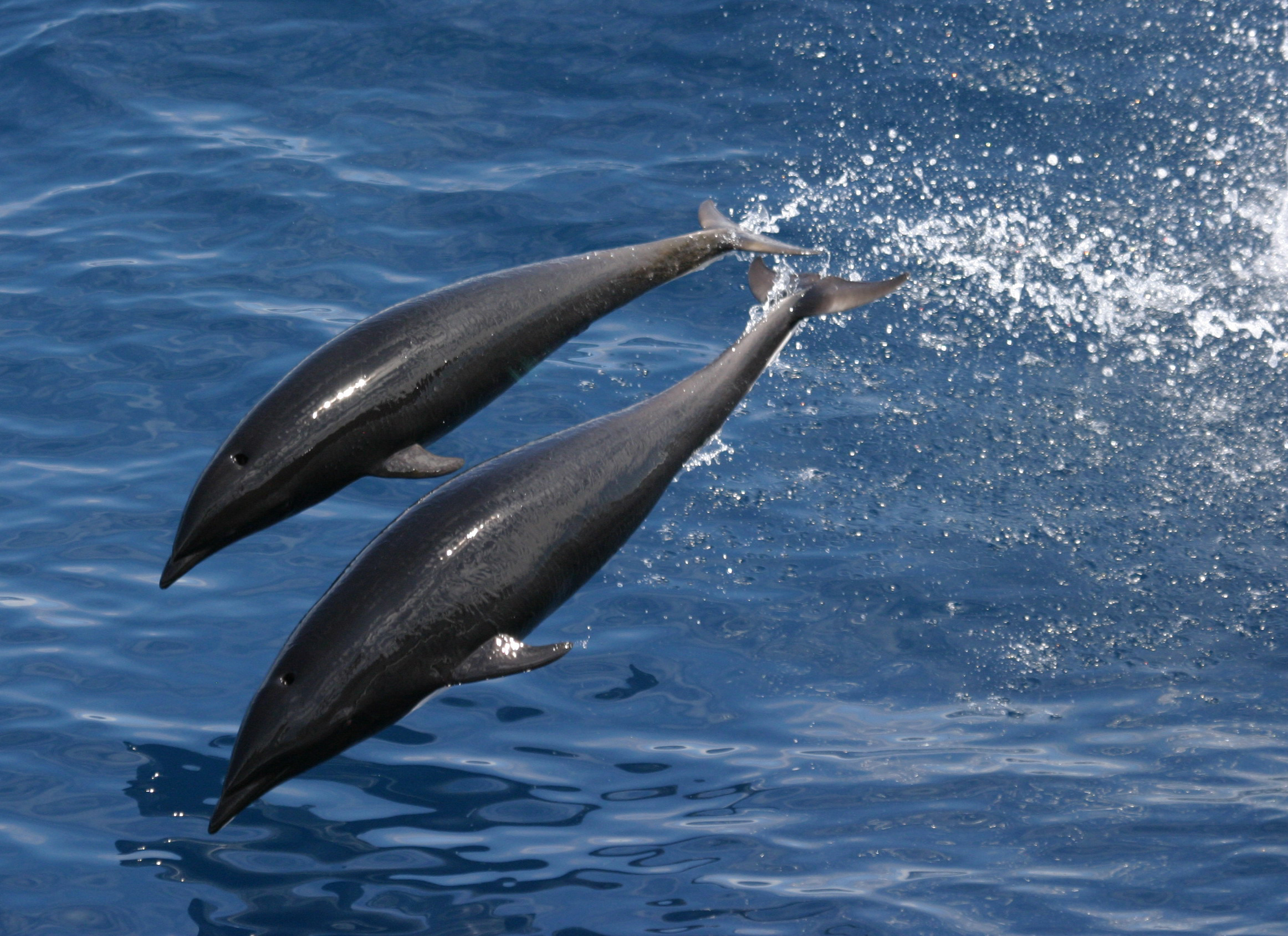
His assessment of the cetaceans that cavorted in our path along the way was not as correct. Seeing a pod of dorsal fin-less dolphins frolicking alongside our boat, Claude declared them to be porpoises. Just hours after the race, ever the conscientious oceanic naturalist, Claude would correctly identify them as northern rightwhale dolphins.
Despite the screaming winds, Captain George and Master Eric desired more boat speed as we flew toward Ventura, and they called for us to fly the larger Code Zero headsail. But while Claude and Geno and I did our best to fly the Code Zero, conditions got the better of us, and precious time was lost. Still, we hurtled through the channel, pointed toward the red whistle buoy that marks the entrance to Ventura Harbor.
The last hour of the race saw a constant drenching of the rail meat, as the geometry of boat speed and the direction of the swells added up to lots and lots of salt spray showering the benumbed human ballast — as Misfit tore through the waves like a trail horse smelling the feed bag.
We crossed the line moments after 8:00 pm, completing our voyage from Santa Barbara to Ventura by way of the backside of Santa Cruz in a little more than nine hours. The sun was down as we eased into an open slip, tied off at the dock, and got our nautical thoroughbred Misfit squared away for the night.
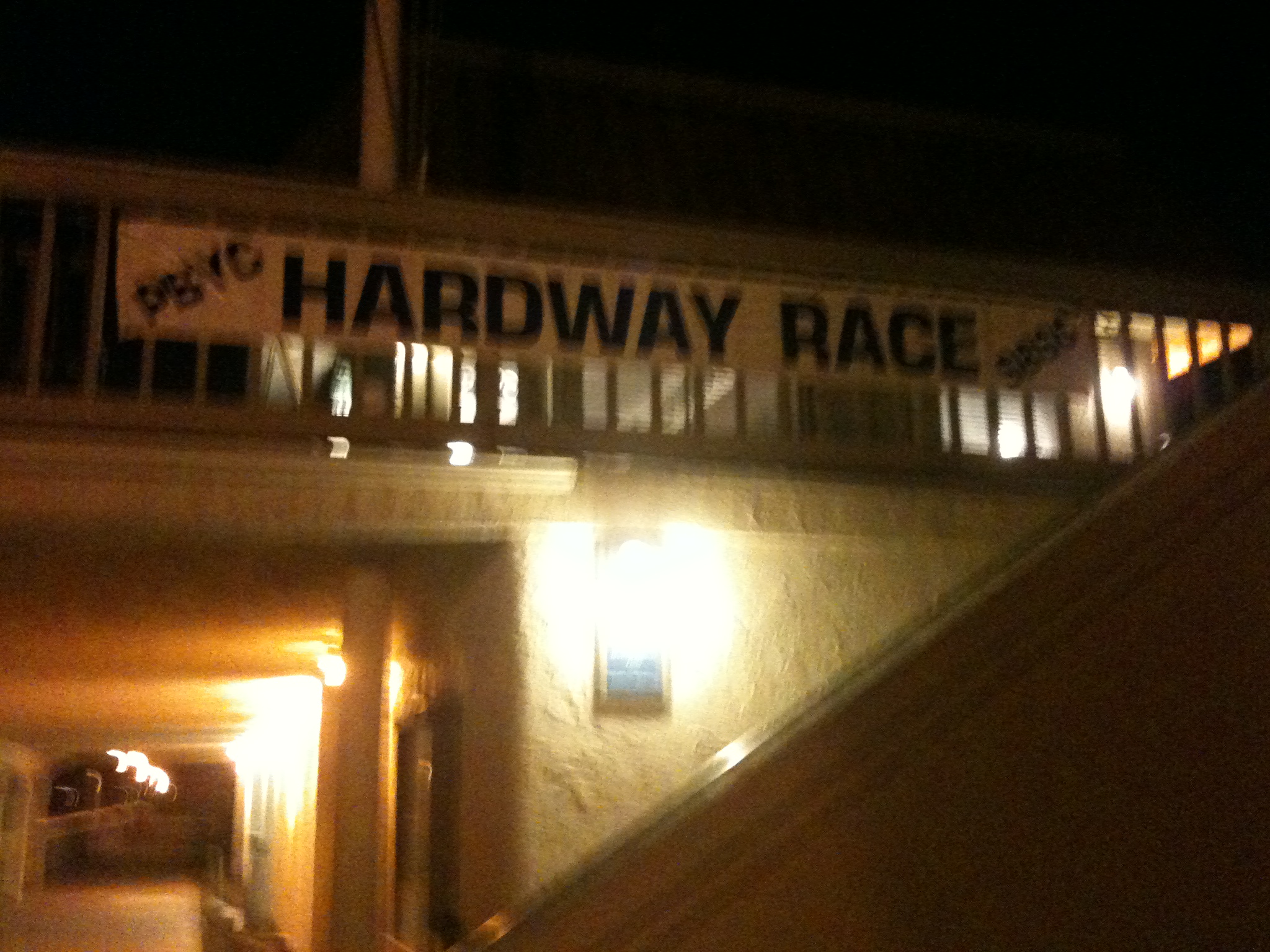
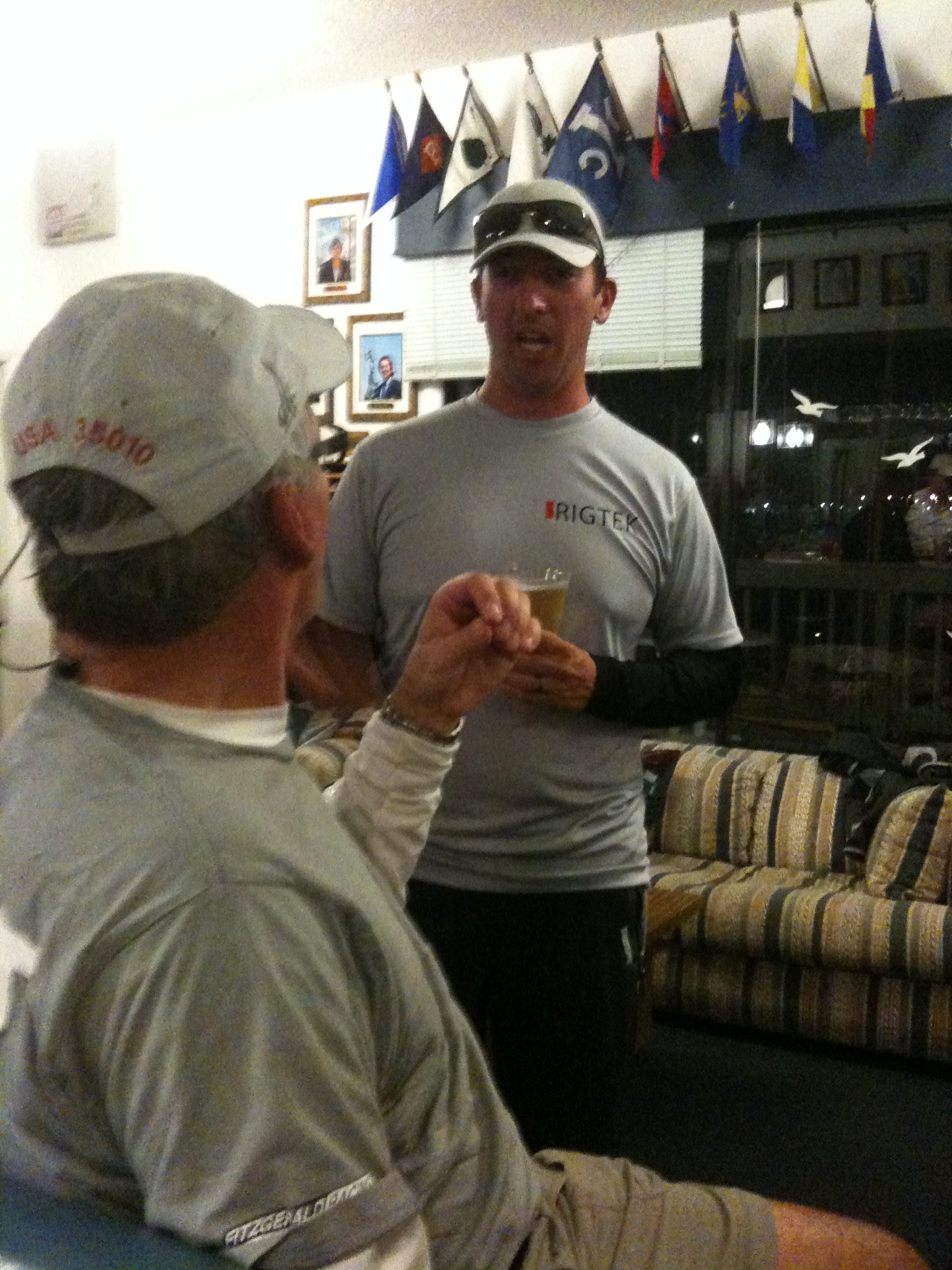
Finally, Captain George and his crew gathered at the PBYC clubhouse for a beverage and the last of the lasagna.
There we learned that Misfit had finished a mere 4 minutes out of first place — and just 20 seconds out of second place. Clearly, the knockdown off Santa Cruz and our struggle with the Code Zero on the homeward-bound leg may have cost us the race.
But, all in all, it felt like victory.
The boat performed gloriously. The Misfit crew did, too.
The Island Series is within our grasp.
Next up: The Milt Ingram Trophy Race, July 16, 2011.
Get your foulies on, mates — and unfurl as much canvass as we can!
I spent my birthday this year sailing southward along the Pacific coastline to Mexico in the annual Newport to Ensenada Race. It was the third time I’d been honored to be a part of this grand 125-mile overnight adventure – and what follows is a photo essay of the experience. The photos were taken by my good friend and fellow crewman, Brad Hall. Somehow, Brad managed to snap great shots at all angles and stay on board the boat.
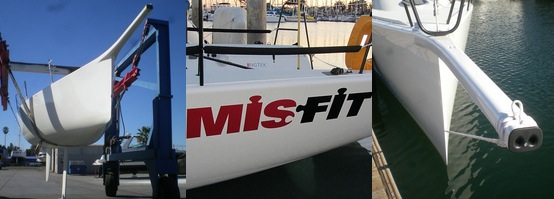
Brad and I drove down to Newport on Thursday, April 14, to meet the rest of the crew and get another good look at our boat, Misfit – a sleek 1D35 Racing Sailboat. Brad and I had yet to sail aboard Misfit, which had only recently been acquired and modified by our Captain George Moll and the ship’s Master, Eric Schlageter. I’m no shipwright (I’m barely a sailorman) and I cannot describe everything that George and Eric did to re-build and re-design Misft (which is all really cool if you understand these things)– but you can find out by clicking here.
Misfit under construction. It was like the Manhattan Project, only more expensive.
By 4:00 pm, the Misfits (as we would be known in Royal Navy parlance) had gathered at Newport’s Bahia Corinthian Yacht Club for the “Send-Off Fiesta” – a bayside Bacchanal at which…
Then again, you had to be there.
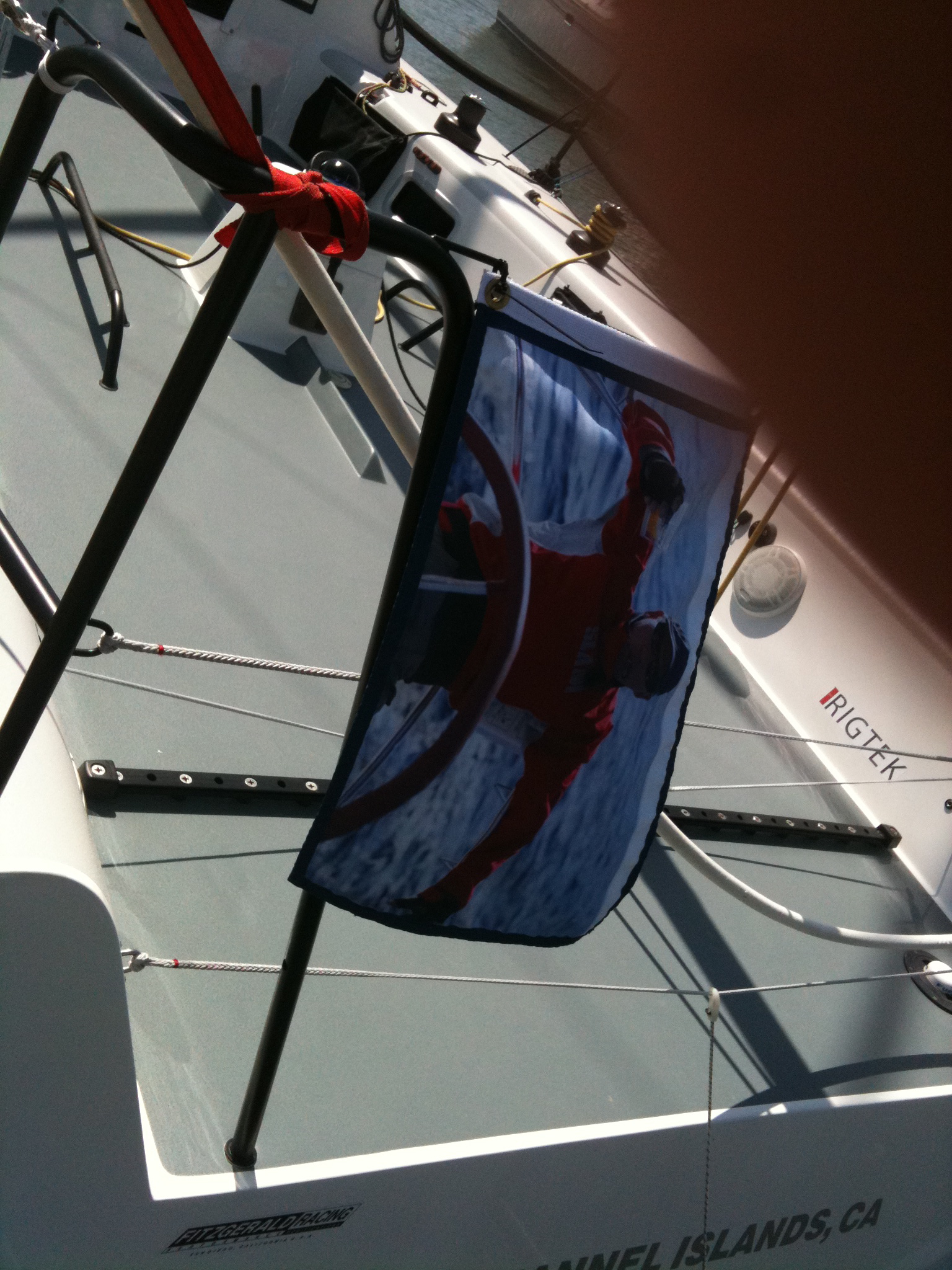
Next morning, we were all at the dock to prepare Misfit for the race to Mexico. Off the back rail, we flew “The Jolly Claude” flag in tribute to our mighty master of the foc’s’le, Claude Dubreuil, who could not voyage with us that weekend. With Claude in our hearts though not on deck, our sturdy crew of eight was a foursome of matched pairs. (It was easier for me to group us this way while counting heads over the next 24 hours: kind of an unofficial buddy system. You don’t want to find out too late that someone went overboard. Especially at night.)
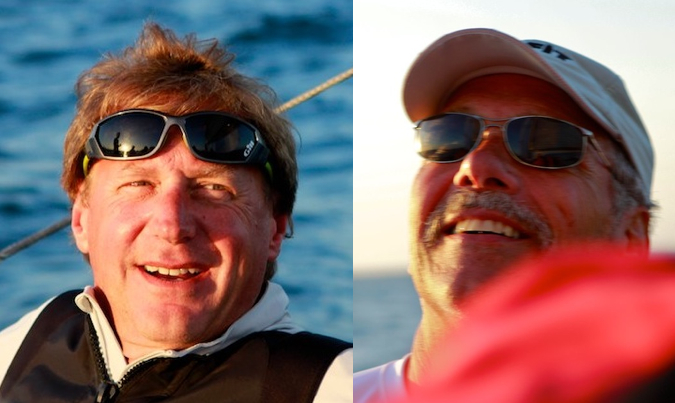
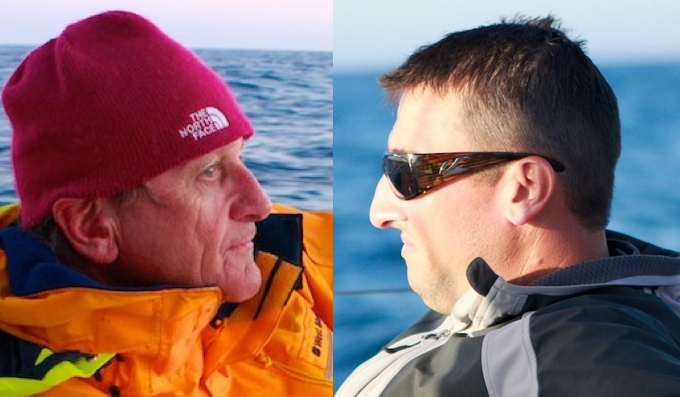
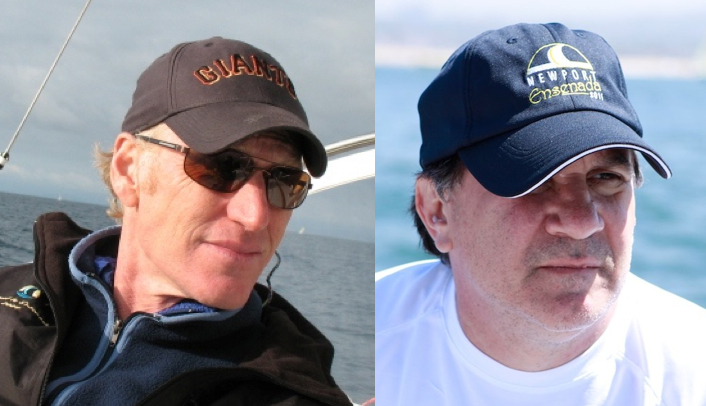
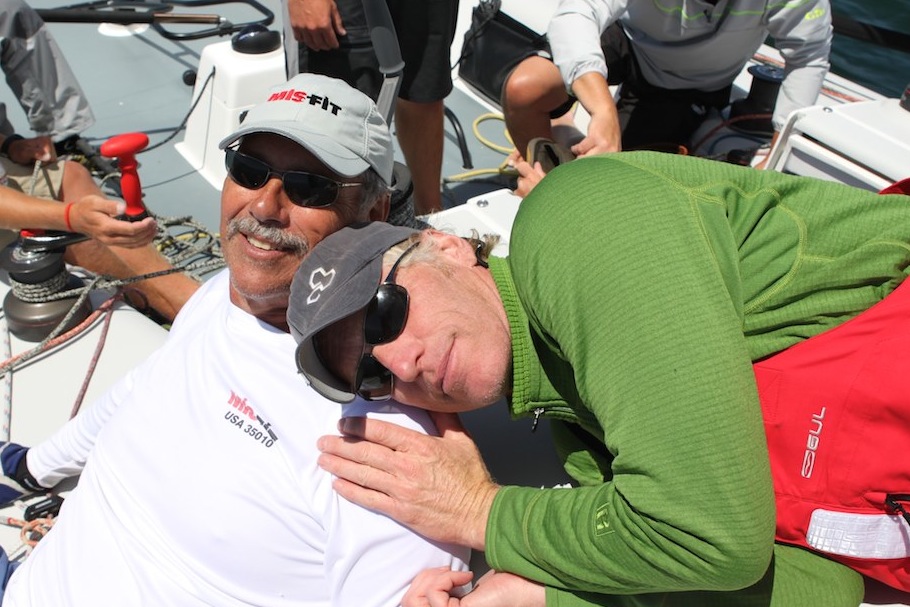
Captain George Moll and Tom Webber. Misfit is George’s boat, but I’m used to George and Tom being co-Captains. These guys are a classic odd couple. From the moment we hit the water, George is giving Tom grief and Tom is looking for a sandwich. But don’t let their Laurel & Hardy act fool you. These guys are real sailormen.
Joe and Eric Schlageter. Joe is Eric’s dad. They are two of the saltiest guys you’ll ever meet. I’d sailed with Eric many times, but I’d never met Joe until this race. Eric has forgotten more about sailing than I’ll ever know – and Joe knows even more. This is why I love sailing: the opportunity to get to know great characters like Joe and Eric.
Shaun Plomteaux and Geno Beville. The youngsters. The hotshots. They were born in water, of course, but appear to have slid right out of their mothers’ wombs into the Pacific Ocean. Watching them on this race would be a revelation. As hard as they worked, I think Captain George should move them up from midshipmen. Provided their sextant readings were correct.
Brad and Paul. A surfing Santa Barbara boy, Brad’s at home on the ocean, and has been sailing since his youth. As for me, I was born on the west side of Cleveland, and as a kid I built some model boats. We’ve shared many adventures together – and this would be another great one.
As Misfit pulls out of its berth at the Bahia Corinthian Yacht Club and sails out of Newport Harbor, Eric checks in with the race committee boat. “Sail number 35010 checking in!”
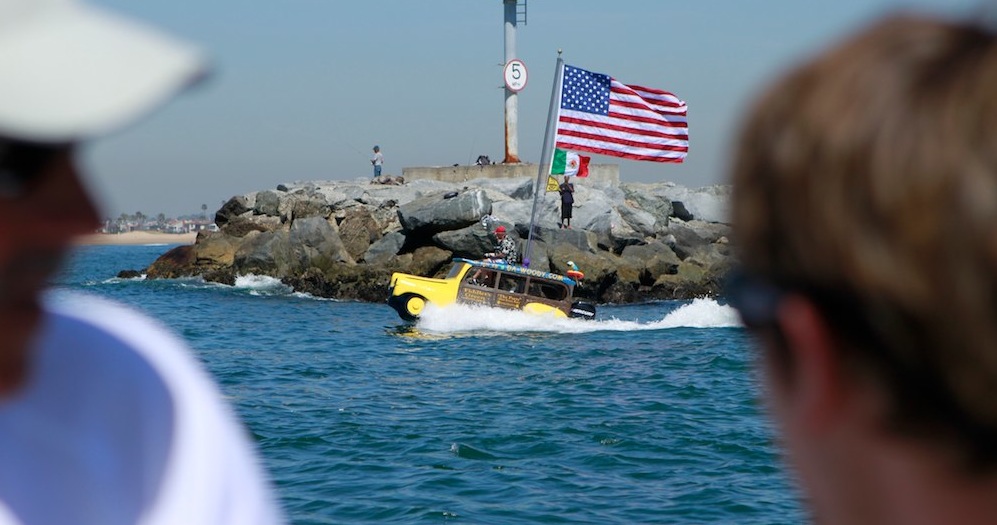
As we motored past the harbor breakwater, we caught our first sighting of that wacky photographer in his crazy taxi boat — the most unseaworthy-looking craft I’ve ever seen on the water.
Eric at the tiller negotiates our course at the start of the race. We got off to a very good start. Only one boat in our class got off to a better start. But there was a long race ahead.
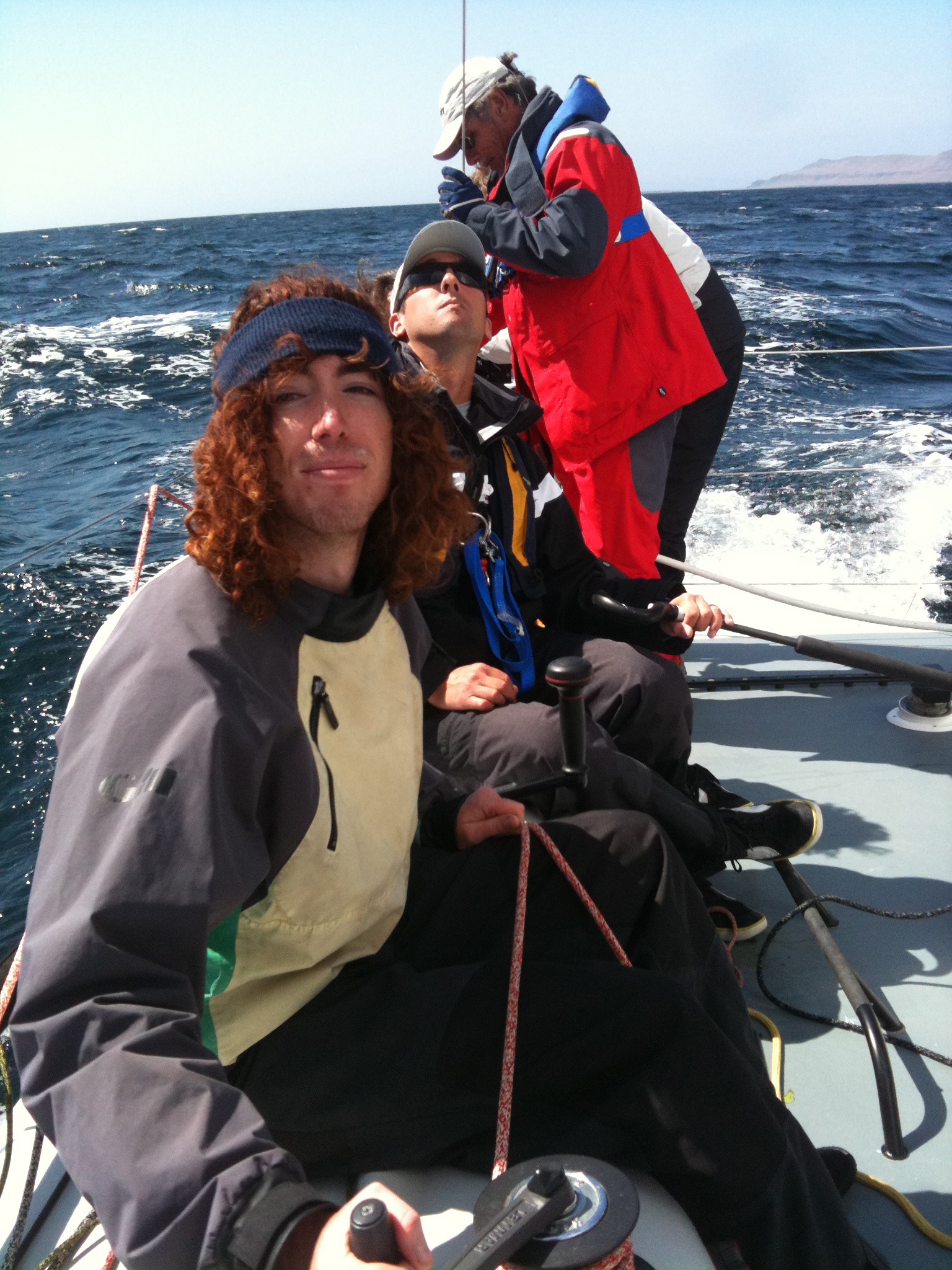
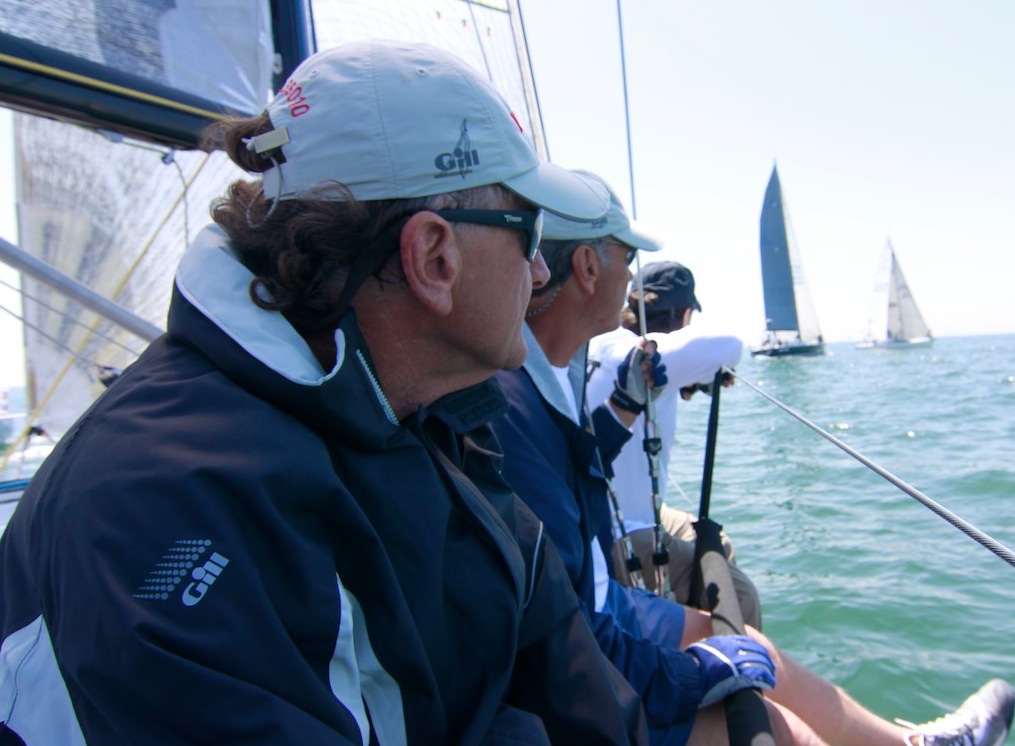
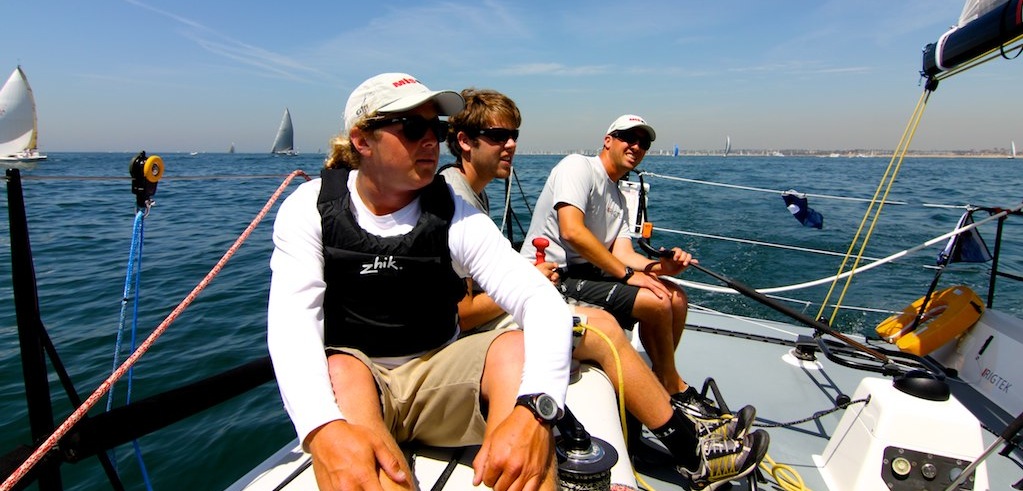
The boys and me are on the rail early in the race. A sailboat like Misfit needs a lot of human ballast to keep her balanced as she slices through the water. I, for one, am especially suited to the “rail meat” role.
Shaun, Geno and Eric are in control in the cockpit early in race. Eric is steering with the tiller. At this point, you can clearly see that most of our competition is behind us.
Captain George relaxes against the lifelines as the sun starts to set. We were making a steady 6-8 knots in light wind – and our hearts were full of hope. Misfit was proving to be very nimble boat.
As the sun continues to drop down toward the horizon, the Matey shows off his brand new Newport to Ensenada hat. We’ve been sailing for about 7 hours, and we’re less than a third of the way to our destination.
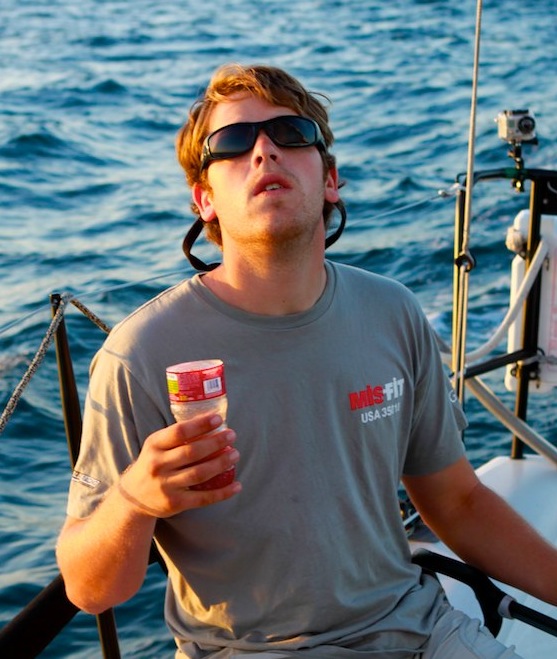
Young Geno takes a turn at the tiller, steering the boat while sipping a Bloody Mary in an improvised cup. Oh yeah, the cups. Tom forgot the cups. Actually, I was one of the guys who made the run for sandwiches, vodka and Bloody Mary mix before the race. But nobody told me about cups. (George insisted that he reminded Tom about the cups.) Finally, someone got the idea to make cups out of empty water bottles. It would not be the last instance of MacGyver-like ingenuity on this voyage.
Several Bloody Marys later, Geno is still at the tiller as sun has just about set.
In the waning moments of sunlight, Shaun trims the headsail. At this point we were flying a spinnaker, still averaging 6 knots in light winds. As far as we knew, we were among the leaders.
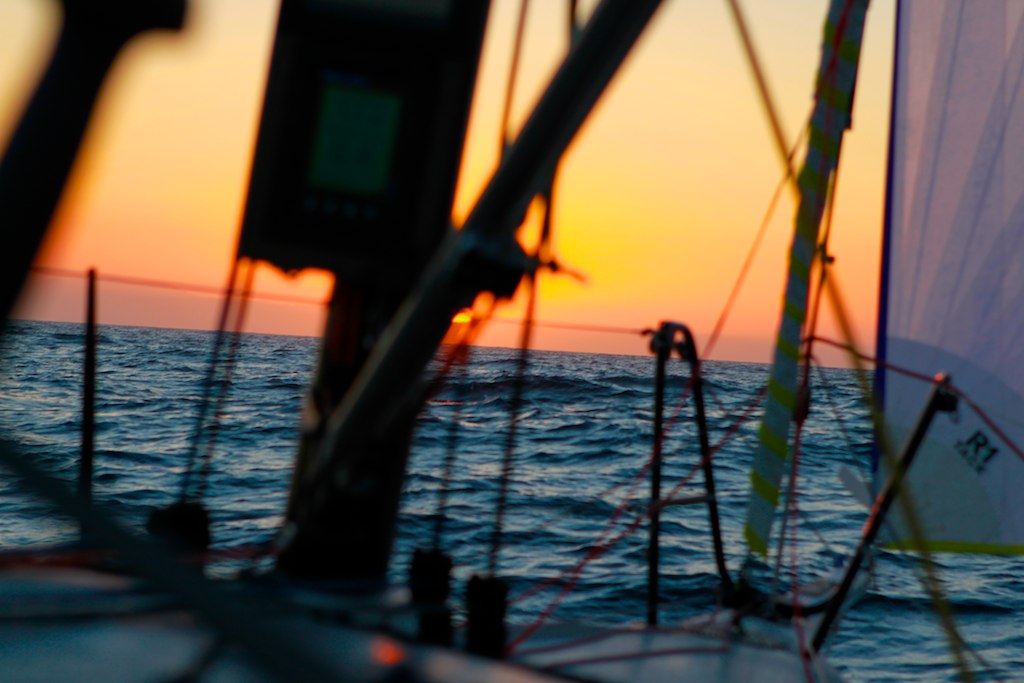
Gorgeous colors paint the water as the sun starts to dip below the horizon. This is the kind of scene that makes sailing so addictive. The beauty and the constantly changing color and character of the water are indescribable.
As the sun comes up next morning, it’s clear what gets some sailors through the night: Red Bull and energy drinks.
Joe, “The Ancient Mariner”, greets the morning light, still snug in his foul weather gear. It was a cold, damp night – and once you get cold, you’ll never warm up again. So, foul weather gear at night is a must. You don’t take your “foulies” off until the sun comes up — and you start to sweat.
It’s clear that Tom got some sleep during the night, since he looks about as good as Tom can look.
Taking a nap on the deck, it’s clear that Captain George didn’t get much sleep during the night. But George’s nap posture is nowhere near as uncomfortable-looking as Geno’s was at one point during the night when he was out cold, face down, lying in front of the companiomway. (Red Bull can only get you so far.)
The Matey celebrates the morning of his birthday, April 16th, dressed in his groovy hippy hoodie. The hoodie went on sometime during the night as another layer under my foul weather gear, At that point, I was wearing two t-shirts, the hoodie, and my foulies. I was still a bit cold.
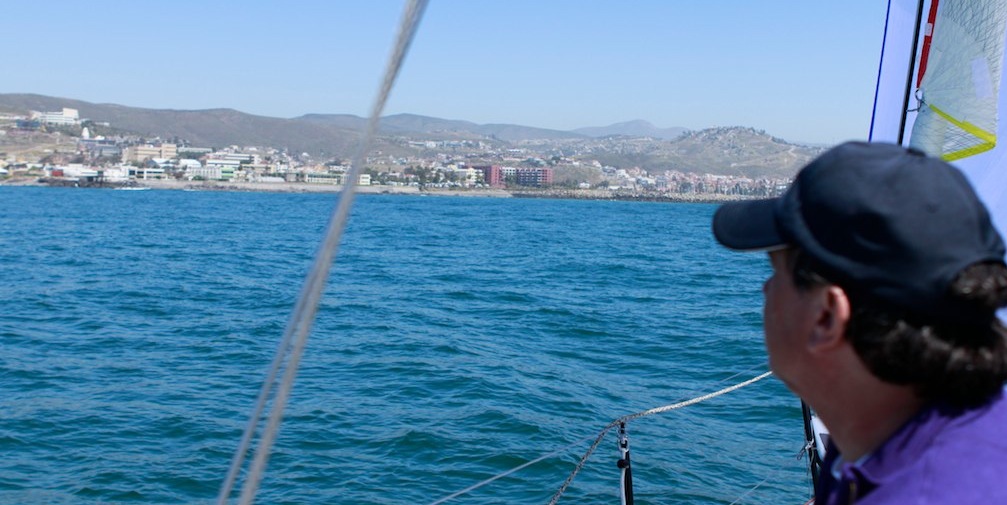
The Matey scans the Mexican shoreline as Misfit sails toward the finish line, coming into Ensenada.
Eric is at the helm as we approach the finish line. At this point, it was hard to tell how we’d finished. There weren’t many boats ahead of us – and a half-dozen could be seen behind us. Hope springs eternal.
Brad and Tom celebrate surviving the long, cold night and arriving at the finish line in fine, seamanlike style. A hot shower was now just an hour or so away!
At this point, a marlinspike was all that held the boom vang to the boom. Sometime in the wee hours of the morning, as the winds died and our boat speed slowed to 2 knots and less, the fluttering of the mainsail caused the boom to bang back and forth – and the bolt that held the boom vang in place was lost. This was the second MacGyver-like bit of ingenuity. (Claude would have been proud.)
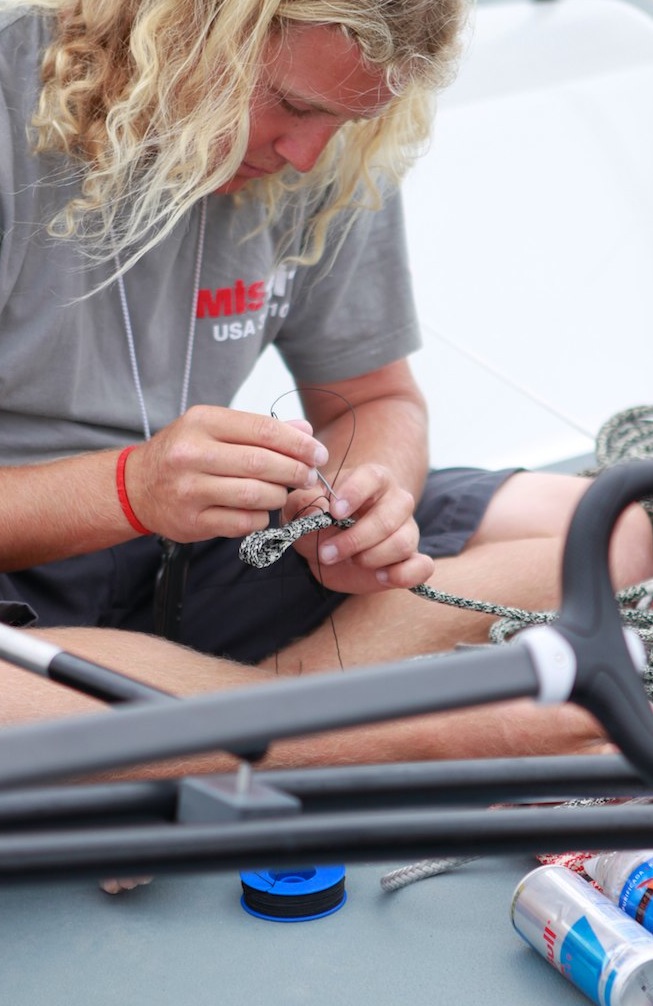
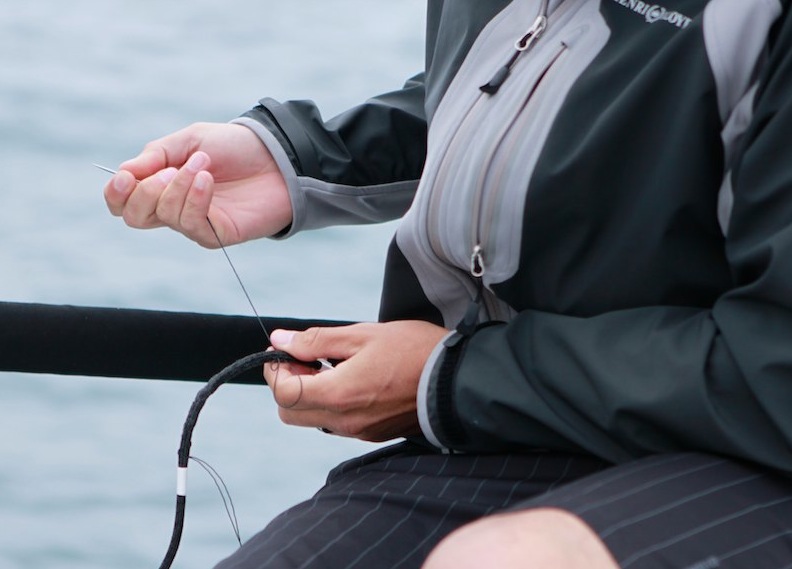
On the Sunday return trip, as we motored north to San Diego, Shaun was all about tending to the cordage. It was like something out of a Patrick O’Brian seafaring novel to see Shaun fixing, splicing and braiding the frayed ends of every bit of rope on board.
Eric caught the cordage bug from Shaun and started splicing and sewing, too. I was too busy enjoying the ride to San Diego. Besides, as rail meat, such refined maritime skills are way above my pay grade.
Shaun’s handiwork. I didn’t think anybody did this kind of work since the days of the Royal Navy in the Napoleonic wars. Someone should introduce Shaun to scrimshaw. Then again, better to save the whales.
Captain George relaxes as we arrive in U.S. waters. Misfit can motor at between 6-7 knots – and we were lucky enough to have a “following sea” the whole way. (That means we were moving in the direction of the swell.) If we’d been motoring into the waves, it would have been a very wet and bumpy ride.
Joe also relaxes, enjoying our smooth ride home. Note Joe’s bare feet. He and Tom rarely wear shoes on board. I find that amazing. These guys are really salty.
Since U.S. Customs won’t allow us to bring fruit back into the country from Mexico, George helps out by eating his share of the contraband apples.
The Matey looks a bit weathered and grizzled as Misfit makes her way into San Diego Harbor. It’s been a wonderful weekend of adventure: my first birthday on the Pacific Ocean.
Eric deals with the Customs agents at the U.S. Customs dock. I guess everything was okay because they let us all go. Luckily, the drug-sniffing dog didn’t give a damn about Red Bull.
The Misfits pose before a celebratory meal at the Southwestern Yacht Club in San Diego. (My wife Victoria snapped this photo.) We look none the worse for the wear. Next year, we want to see our shipmate Claude in this photo with us!
And now, here’s a little film that Brad edited from footage he shot during the race – with the same camera he used to shoot those photos! It’ll give you a better idea of what it’s like to be on the water aboard Misfit. Ahoy!
BTW — We didn’t win the race. But I doubt anybody had more fun — or more laughs.
Brad Hall and I flew into Chicago on Thursday, February 3rd, to work on “Rock Me!” — our rock musical set to be performed by a Northwestern student theatre group on March 7 and 8. The fact that Chicago had just been blasted by an epic snowstorm, the third largest on record, did not deter us. Harrowing tales of “thundersnow” and dozens of cars being abandoned on Lake Shore Drive could not keep us from our appointment with the brilliant musician, Steve Rashid, my daughter Emilia (an NU sophomore) and the other students involved in the production that we were hoping to meet despite the havoc caused by the tons of white stuff dumped on the shores of Lake Michigan.
The blizzard had stuck on Tuesday, February 1st, and by the time we flew into Chicago late on Thursday night, the skies were clear. So clear in fact that, as we made our final approach into O’Hare Airport, we were greeted with as spectacular a view of the city as we had ever seen. The city lights reflected off the snow blanketing every surface to create a stunning golden glow.
These pictures don’t quite capture the wondrous sight we beheld – but they’ll have to do.
Once we were on the ground, we drove northeast to Evanston, where we were Steve’s houseguests. As we arrived in his neighborhood near Central and Green Bay Road, the city street crews were hard at work clearing tons of snow from the main street. Clearly, every city employee that could drive a snowplow or a Bobcat was being pressed into service for every overtime hour they could stand to work.
This video was taken at the corner of Central Street and Central Park.
And here’s where they dumped all that snow: Lovelace Park. (No, it’s not named for Linda.)
And BTW – these are not rolling hills dusted with snow. This is a flat parking lot on which they just dumped these man-made mountains of snow. The Evanston kids were loving it! King of the hill!
Over the weekend, our meetings with Emilia and the musical director and director of “Rock Me!’ took us to the Northwestern University campus on the frigid lakefront in Evanston, which had been transformed into a winter wonderland.
Brad and I had been on campus for the great Blizzard of ’79, so this fabulous frosting brought back many snowed-under undergraduate memories.
We left Chicago on Monday, February 7th – and it was snowing again. Here’s Steve’s neighborhood on Hartzell, just before the flakes began to fall…
In this video, shot in front of Steve’s house, you can see the big flakes falling. It was time for Steve’s industrious neighbor to get his snow blower out again – and time for Brad and me to get out of town while we still could.
Getting back to the relative warmth of a February night in Los Angeles, I hurried to the Terminal 4 parking garage and found that my car battery was dead. As I waited for AAA to arrive, I was comforted by the thought that at least I wasn’t waiting while stuck in a three-foot drift on a slushy road in Chicago. And that I didn’t end up like one of those unfortunates snowbound on Lake Shore Drive.
“The enemy is there, and I am going to attack him there.”
On July 3, 1863 the exhausted armies of the North and South faced each other across a mile of undulating farmland in Gettysburg, Pennsylvania — preparing to commence the final violence of their epic battle. Though Confederate General Robert E. Lee planned to strike the Union center early in the day, the thunderous cannonade preceding General Longstreet’s assault did not begin until 1:00 in the afternoon. If Lee had placed my wife, Victoria Zielinski, in command of the attack, things would have gotten started much sooner. Indeed, Victoria and I were up and ready to go by 9:00 AM.
Our third day at Gettysburg would be a brief affair as we were due in Philadelphia later that same day. Victoria had planned a reunion in the City of Brotherly Love with a group of her closest college sisters (Northwestern University alums, of course). Therefore, we’d have to leave the Gettysburg battlefield before the climactic action — legendary “Pickett’s Charge” — began 147 years ago. But we’d still be leaving long after the day’s fighting began.
Few remember that the third day of the Battle of Gettysburg started at dawn as Union guns opened fire in the defense of Culp’s Hill on the Federal right flank. Soon afterward, Union troops drove the Rebels off the hill, and by 11 o’clock, Billy Yank was once again in possession of the earthworks they’d lost to Johnny Reb the day before. The third day’s battle on the Union right was over almost before it began. Undaunted, Lee was determined to attack the Union center.
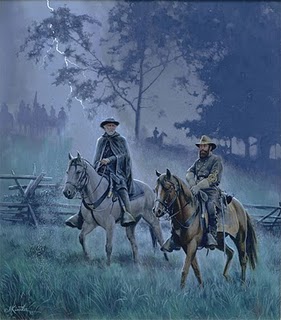
"Storm Over Gettysburg" by Mort Kuntsler. Lee and Longstreet confer before the third day's fighting.
Much has been made of the dispute between Lee and his “Old War Horse” General James Longstreet on the third day at Gettysburg. Longstreet argued that the wiser course was to get behind the Union army’s left flank and threaten the roads to Philadelphia and Washington D.C. – thereby forcing the Union army off the high ground on Cemetery Hill to give battle on ground of the South’s choosing.
Lee, however, was determined to strike – and break – the Union center. “The enemy is there, and I am going to attack him there.” After all, Lee’s army had never failed to break the Federal lines in an all-out assault. But at Gettysburg, there was a critical difference: for the first time, Pennsylvanian Generals George Meade and Winfield Scott Hancock and the Army of the Potomac under their command were defending home turf. There was nowhere to run. As Hancock rode his lines that morning, he no doubt reminded every subordinate officer of the need to hold firm and give no ground to the enemy.
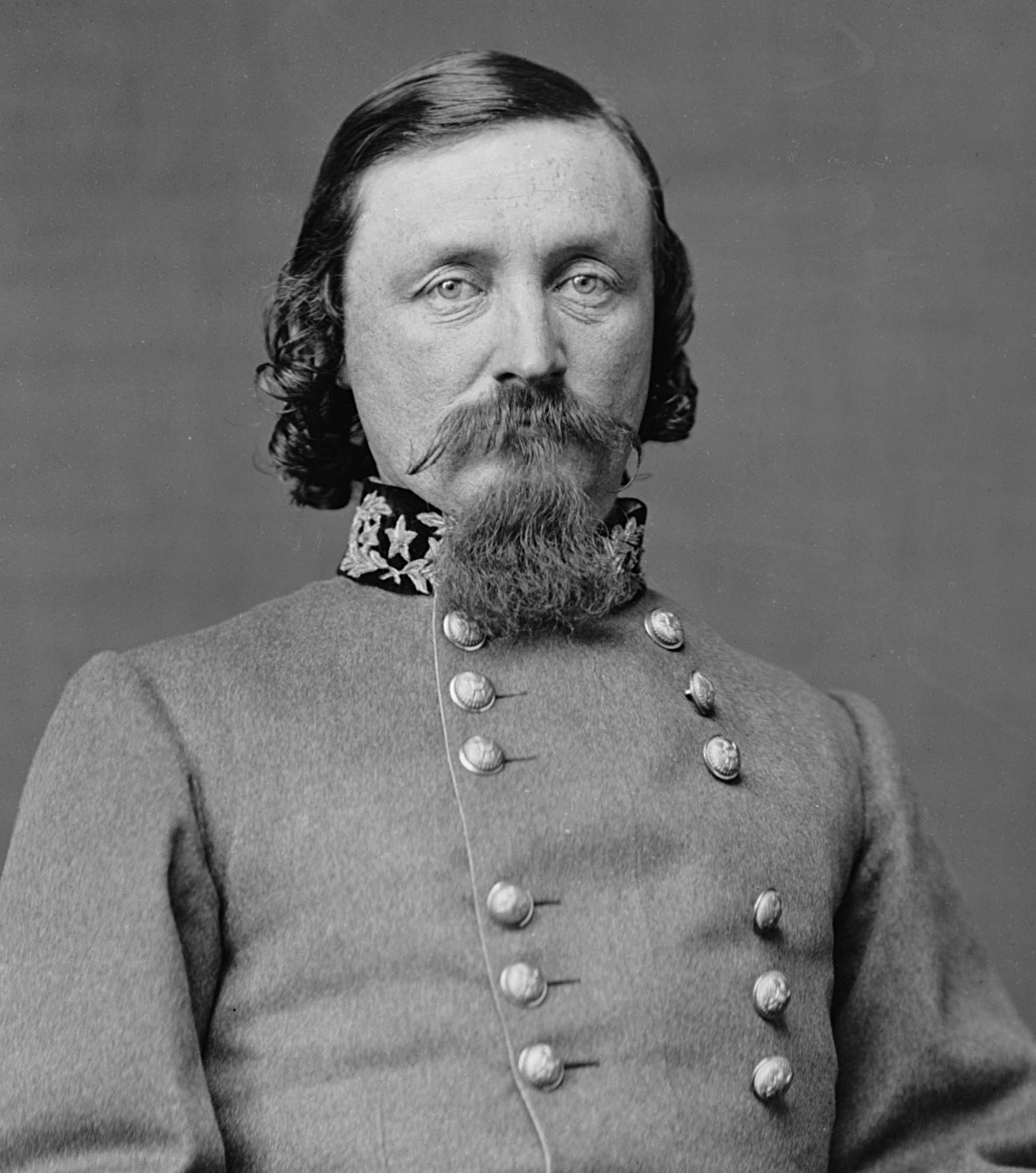
With the fight on Culp’s Hill essentially over, Lee ordered Longstreet to attack the Union center – to drive toward the infamous “copse of trees” at the heart of the Federal line on Cemetery Hill. Longstreet attacked with three powerful divisions, led by Generals Trimble, Pettigrew, and Pickett. The three brigades of Pickett’s division were led by Generals Garnett, Kemper and Armistead. Armistead was a close friend of General Hancock, who waited for him across the open killing field.
General Pickett
Pickett’s brigade commanders would pay a heavy price that afternoon: Garnett and Armistead died in Pickett’s Charge, and Kemper was severely wounded. Once again, it’s good to be reminded that general officers in those days of close combat led from the front.
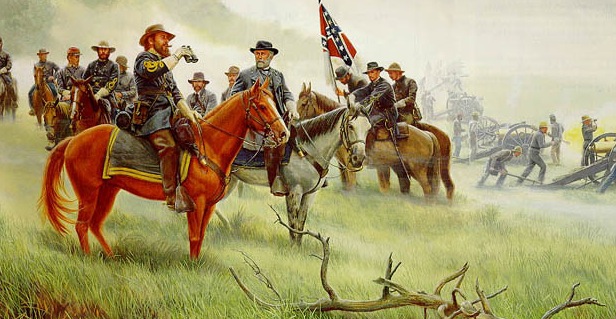
"Lee's Old War Horse" by Mort Kuntsler. Longstreet and Lee prepare for Pickett's Charge.
"Hell for Glory" Pickett's Charge by Keith Rocco
Shaara does a great job of bringing the conflict between Lee and Longstreet to life – and his account of Pickett’s Charge is well worth the read. I won’t give anything away to say that Pickett’s Charge failed and that of the more than 13,000 Confederate soldiers who made the assault, more than 7,000 lay dead or wounded on the field afterward. The Union won the day – and the Battle of Gettysburg.
Presudent Lincoln (center, without his hat) shortly before his Gettysburg Address.
A little more than four months later on Thursday, November 19, 1863, President Lincoln came to the battlefield to dedicate the military cemetery — and the “few appropriate remarks” he uttered that day would cement the worldwide fame of Gettysburg for generations to come.
Secure in the knowledge that the Union would ultimately be saved, we drove east to Philadelphia to meet up with Victoria’s college mates. I left Gettysburg knowing that I would certainly be back again, perhaps in 2013 – the 150th anniversary of the battle. (Come to think of it, I’d better book our hotel room now.)
It was a glorious, sunny drive through rural Pennsylvania and we arrived in Philly with plenty of daylight left. (General Zielinski drove us hard for good reason.) We rendezvoused with our hosts in South Philly, Mary Bartlett and Roy Backes, and began the second stage of our honeymoon adventure.
Vic’s friend Mary’s husband Roy is the Production Manager of the Walnut Street Theatre – the oldest operating theatre in America. So, while Vic joined Mary, Roy, and her college roommates at the Walnut Street Theatre’s production of “Fiddler on the Roof”, I met up with my own dear NU friend, Jim McCutchen – now one of those damn Philadelphia lawyers you hear so much about. (Actually, Jim clerks for an appellate court judge. His work entails more life and death responsibility than I’d want to deal with.)
Jim McCutchen, Esq. & Me
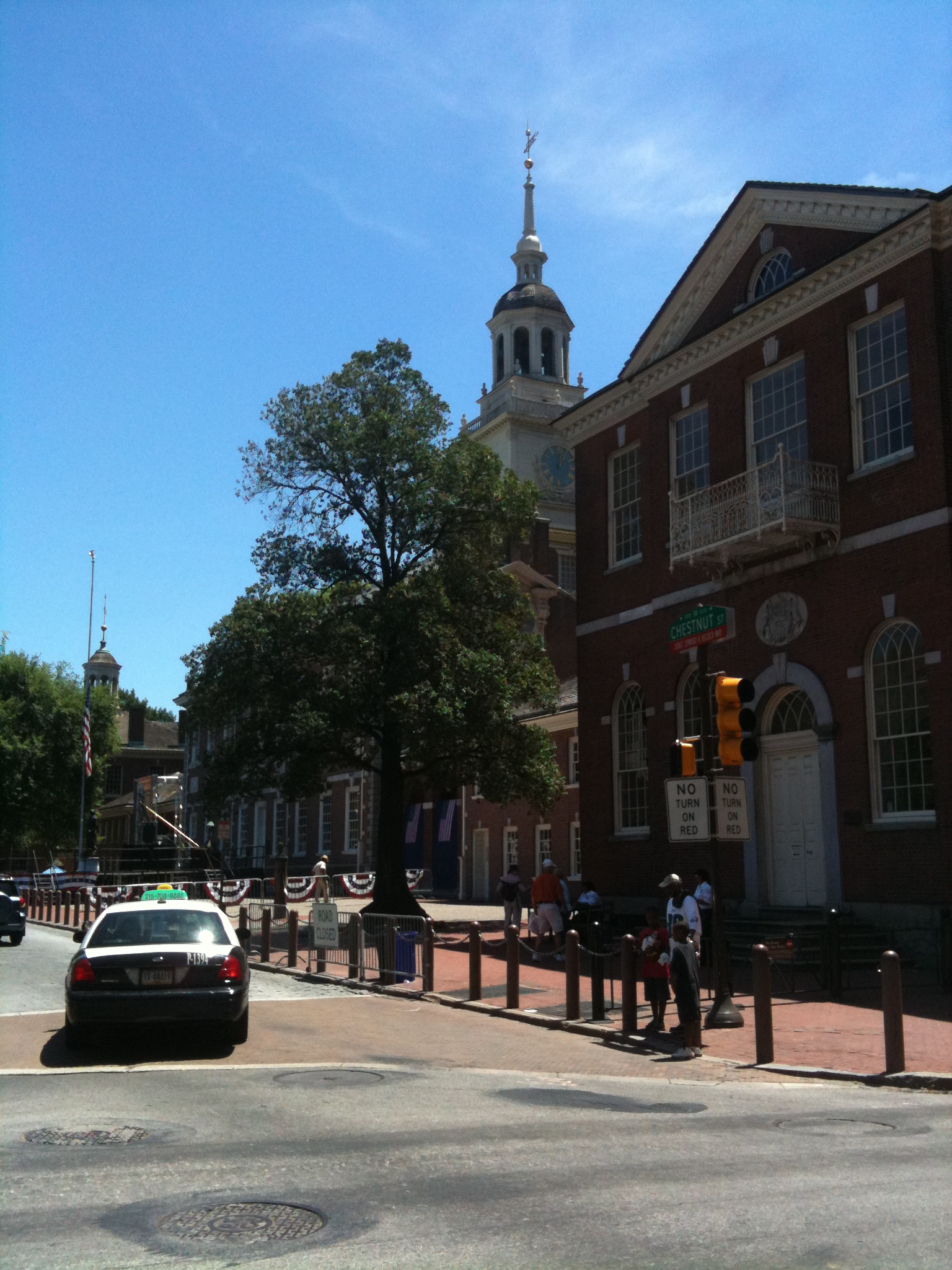
Jim showed me around the historic heart of the city, especially Independence Square, the site of Independence Hall, on Chestnut Street between 5th and 6th Streets. Every school child should know (though, alas, they probably don’t) that Independence Hall is the place where both the Declaration of Independence and the United States Constitution were born. Completed in 1753 as the Pennsylvania State House, it became the home of the Second Continental Congress from 1775 to 1783 and the site of the 1787 Constitutional Convention. It’s one thing to read about this place – it’s another thing to actually be there. It’s a pilgrimage every American should make.
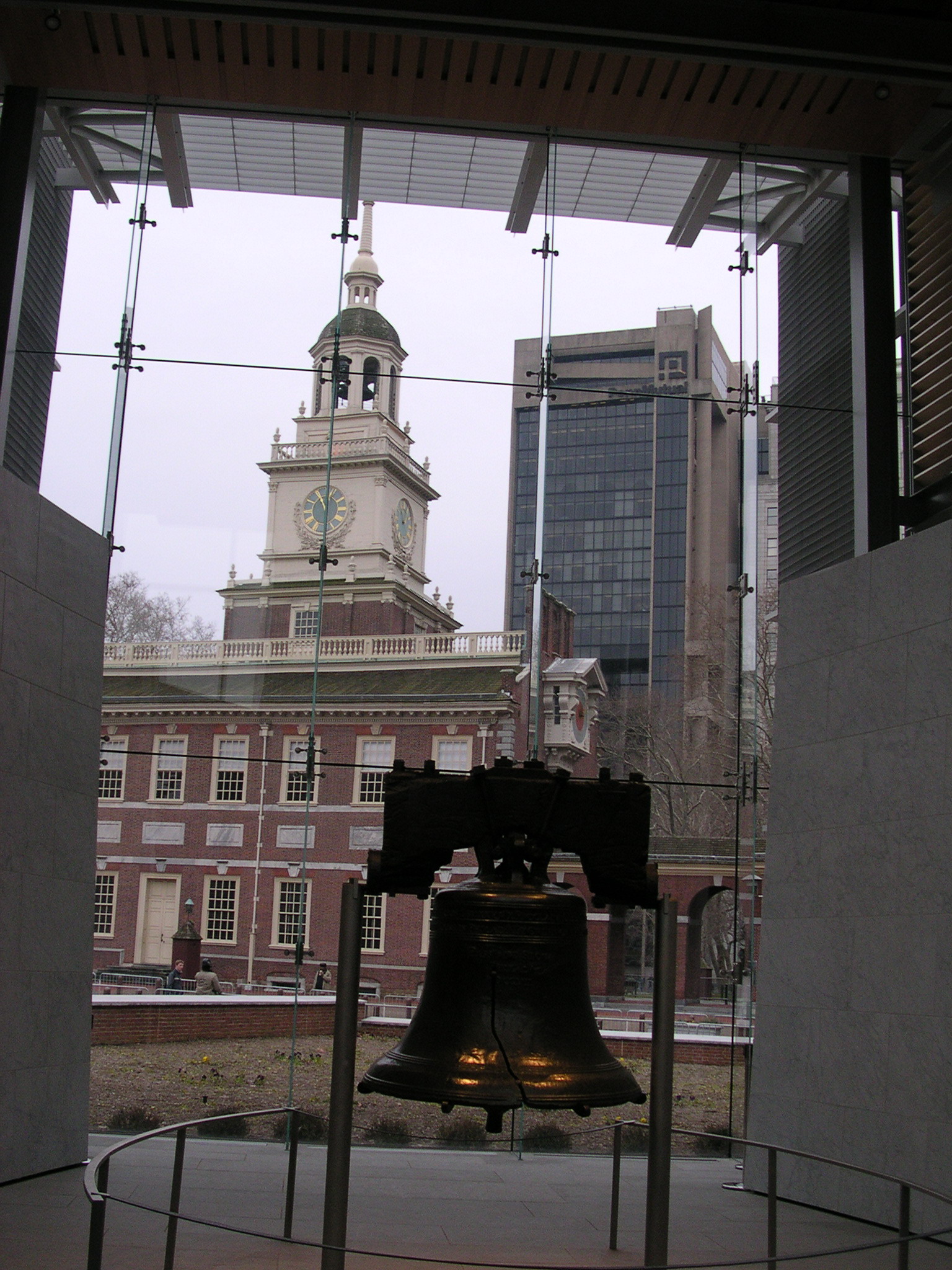
The Liberty Bell is housed in a groovy new glass and steel building across the street. I don’t care for the setting. Somehow, that proud, historic bit of brass doesn’t fit its modern surroundings. The bell looks out of place, out of time, an anachronism. I’m sure that’s not the message that the Park Service intends. But while the Park Service has housed the Gettysburg Cyclorama in a setting that adds to it’s dignity and power – The Liberty Bell is diminished by the manner in which it’s exhibited. Alas. Where’s Davy Crockett when you need him?
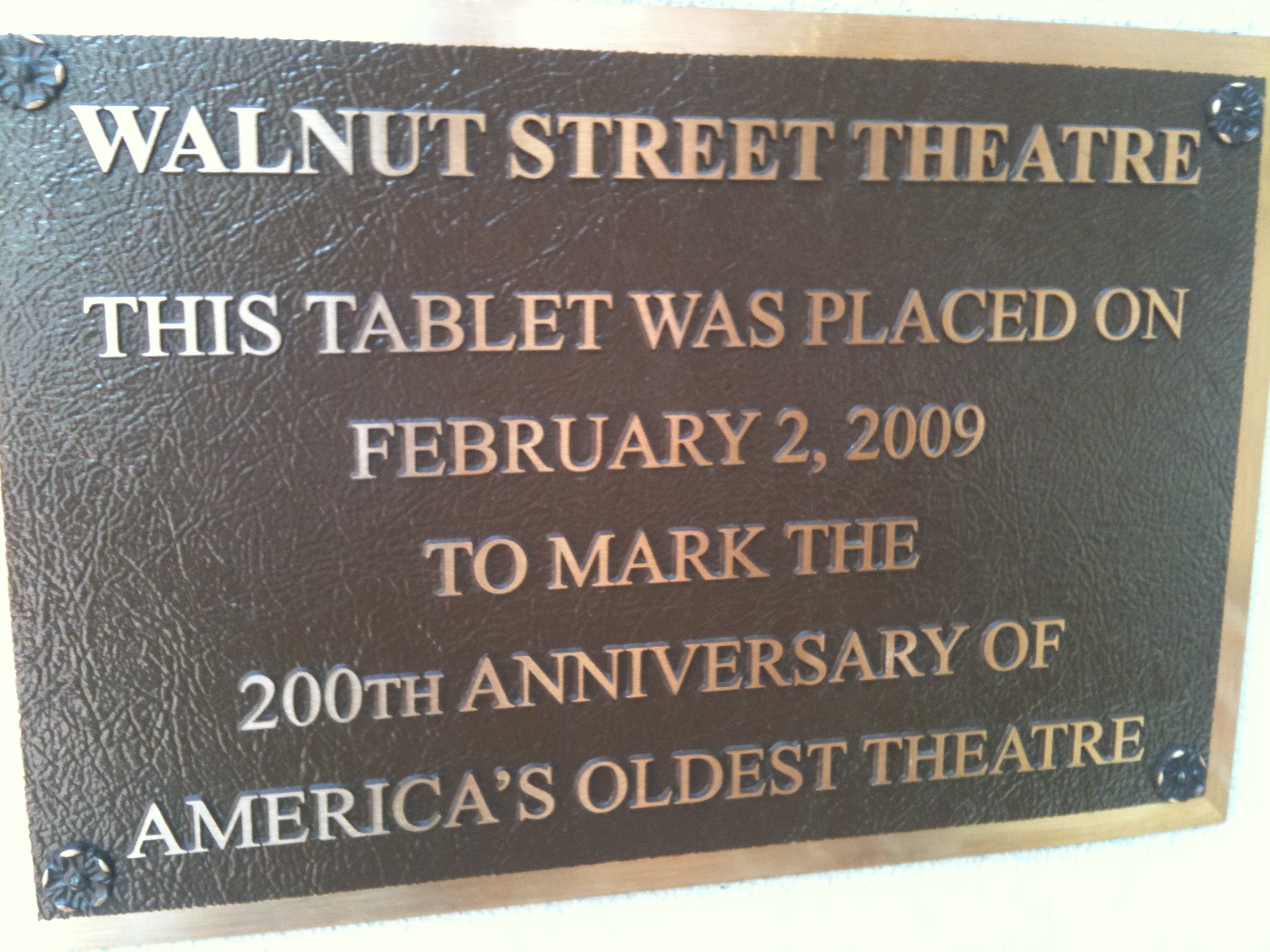
Jim and I hoisted a few cold ones and caught up with each other (after a quarter of a century) before meeting Victoria and her NU pals at the Walnut Street Theater, where Mary’s husband Roy gave us a private backstage tour of his historic domain. The Walnut Street Theater, which has stood at the corner of Ninth and Walnut Streets for two hundred years, bills itself as the nation’s oldest theatre. If so, there must be a lot of eminent theatrical ghosts haunting the place. Roy took us all around the stage and backstage – and into a room filled with fabulous old handbills and theatrical notices.
NU friends and goddesses Bea Rashid, Mary Bartlett, Betsy Dowd, Jean Marie Pla and Vic in front of the Walnut Street Theatre.
The Walnut Street stage has seen the likes of Edwin Booth, Edmund Kean, the Barrymores, George M. Cohan, Will Rogers, The Marx Brothers, Helen Hayes, Henry Fonda, Katharine Hepburn, Marlon Brando, Jane Fonda, Robert Redford, Jack Lemon, William Shatner – and the Practical Theatre’s own Louis DiCrescenzo in a long-running production of “Do Black Patent Leather Shoes Really Reflect Up?” There’s even a picture of Louis in the balcony lobby – right up there with all the other theatrical luminaries.
The next day, was July 4th – and there’s no better place to be on the Fourth than Philly. That’s what made this whole trip so special. Vic and I were at Gettysburg on the exact dates of the battle in 1863, and now, on the Fourth of July, we were headed out to the spot where the newly signed Declaration of Independence was first read aloud to the crowds outside Independence Hall in 1776.
As a group, we walked from Mary and Roy’s townhouse to Independence Square and enjoyed the sights and sounds of a Park Service July 4th ceremony complete with a male choir, a color guard, and what looked to be several dozen aged Sons and Daughters of the Americas Revolution. (A few looked to be no more than a couple years too young to have served at Lexington and Concord.)
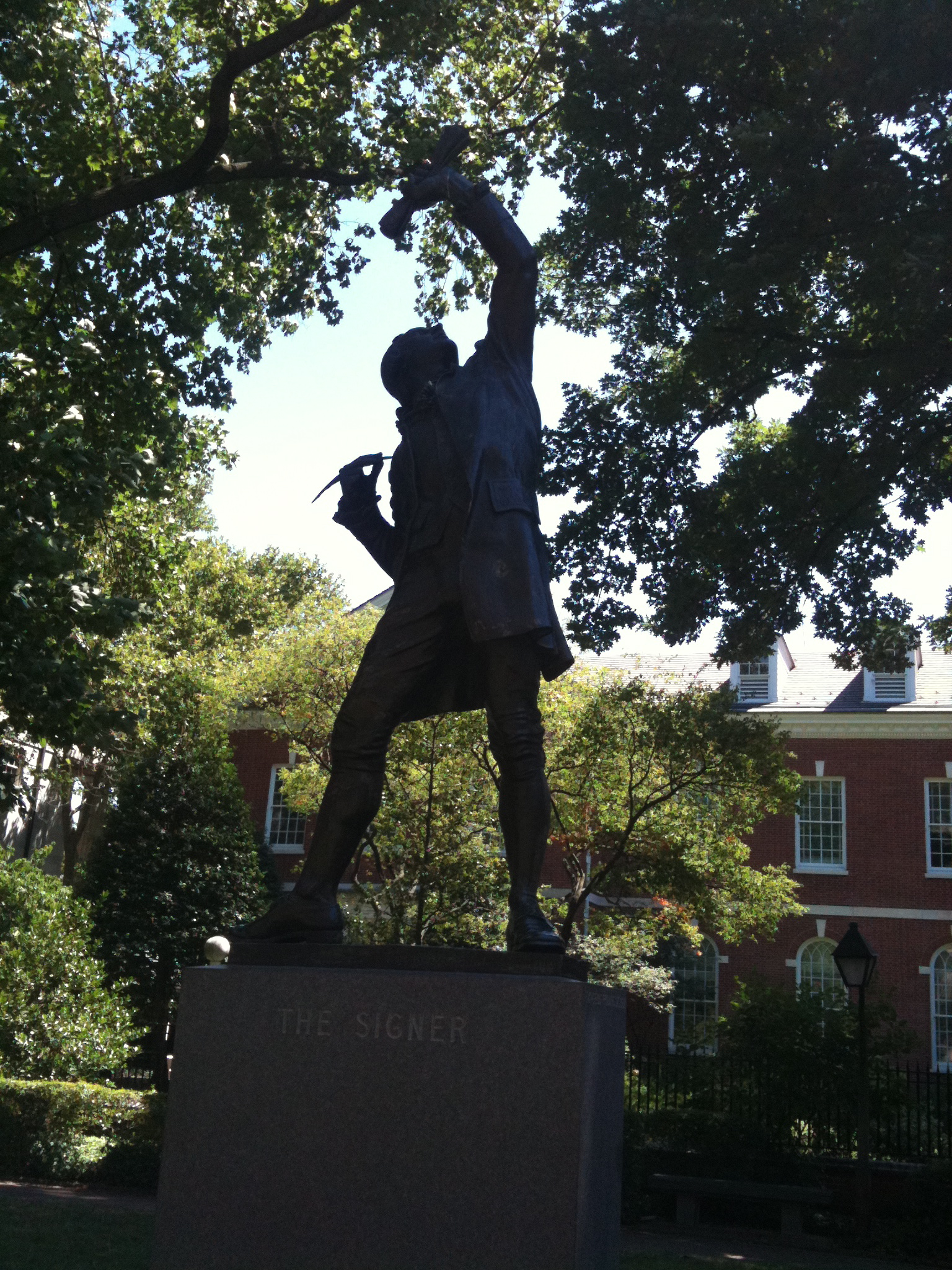
Not far off Independence Square stands a statue called “The Signer”, representing all those brave patriots who chose to hang together rather than hang separately. However, my personal interest in the statue was magnified when I read a plaque that revealed “The Signer” was modeled after signer George Clymer of Pennsylvania. Few but historians remember George Clymer – but if, like me, your mother hails from the tiny coal country borough of Clymer, Pennsylvania – that name is far more significant. I just love connections like that: discoveries that let you know you’re in the right place at the right time.
We headed back toward Mary and Roy’s house by way of South Street. Our hosts were eager for us to see something called Philadelphia’s Magic Gardens – which lay somewhere down South Street. I loved South Street right away. From the moment we started down this funky urban artery, its mix of Starbucks coffee culture, punk ethos, hippy vibes, and Rastafarian island groove captivated me. But wait, said our hosts, the best – and the grooviest – was yet to come.
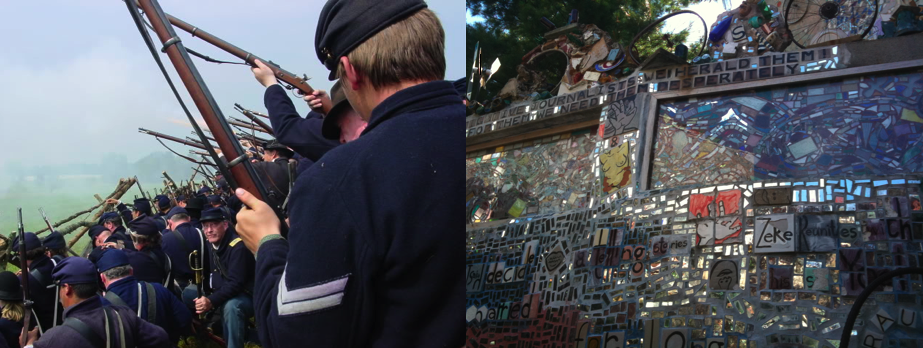
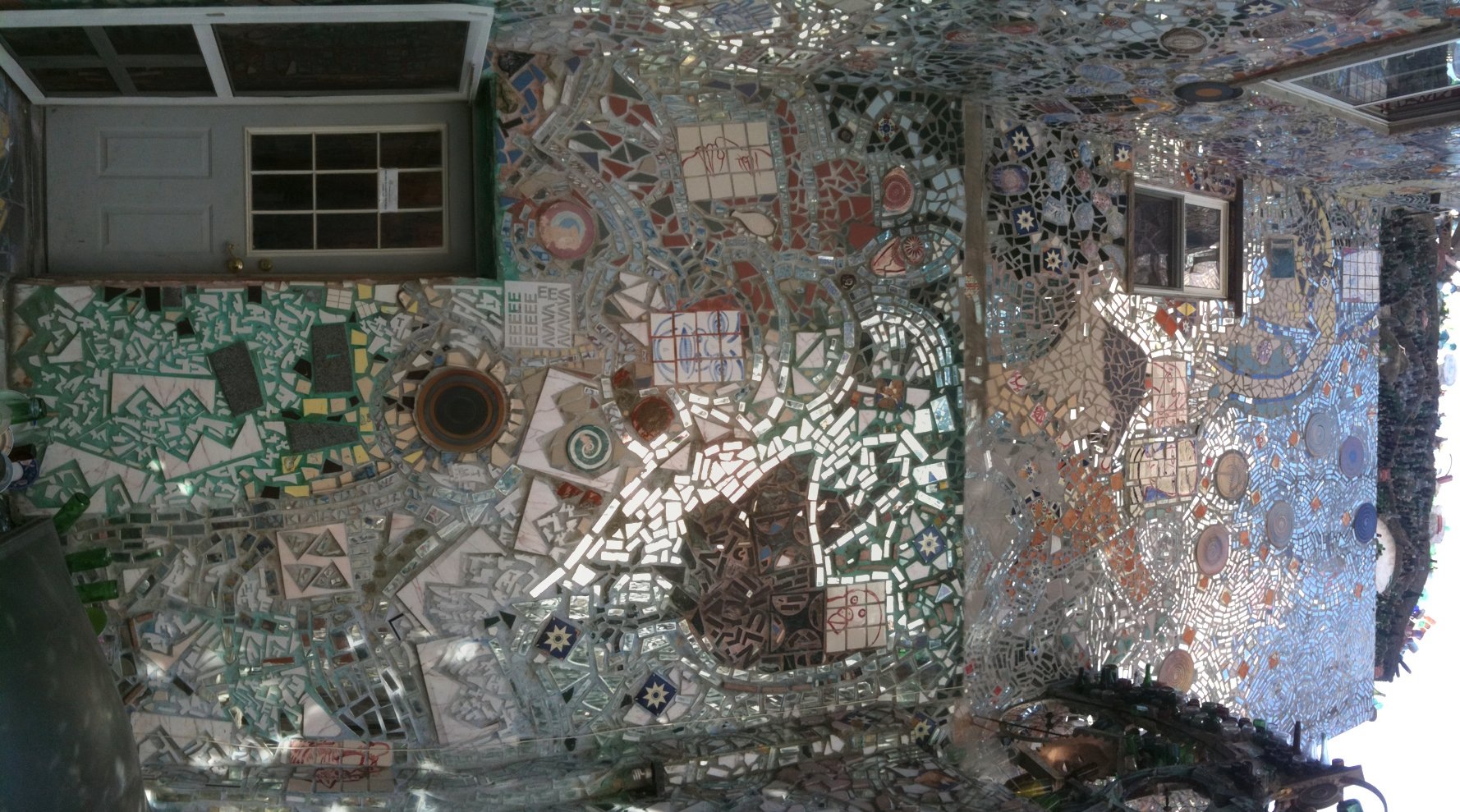
After we’d walked a few blocks, we began to see what they were talking about — storefronts, buildings and alleyways adorned with glittering mosaic murals: the unique and stunning work of Philadelphia folk artist, Isaiah Zagar. I was immediately reminded of Antoni Gaudí’s work in Barcelona – and Simon Rodia’s Watts Towers in Los Angeles. (I am ashamed to say I have yet to visit the Watts Towers. See Sally Nemeth’s blog for her visit to this incredible Los Angeles art treasure.)
The transcendent highlight of our South Street trek was our exploration of Isaiah Zagar’s masterwork, Philadelphia’s Magic Gardens – a work of art that must be seen and experienced to be appreciated. We were surrounded by it, engulfed in it, and astounded by it. Like the monuments of Gettysburg, these amazing artworks by Isaiah Zagar are timeless testaments to the better angels of our nature.
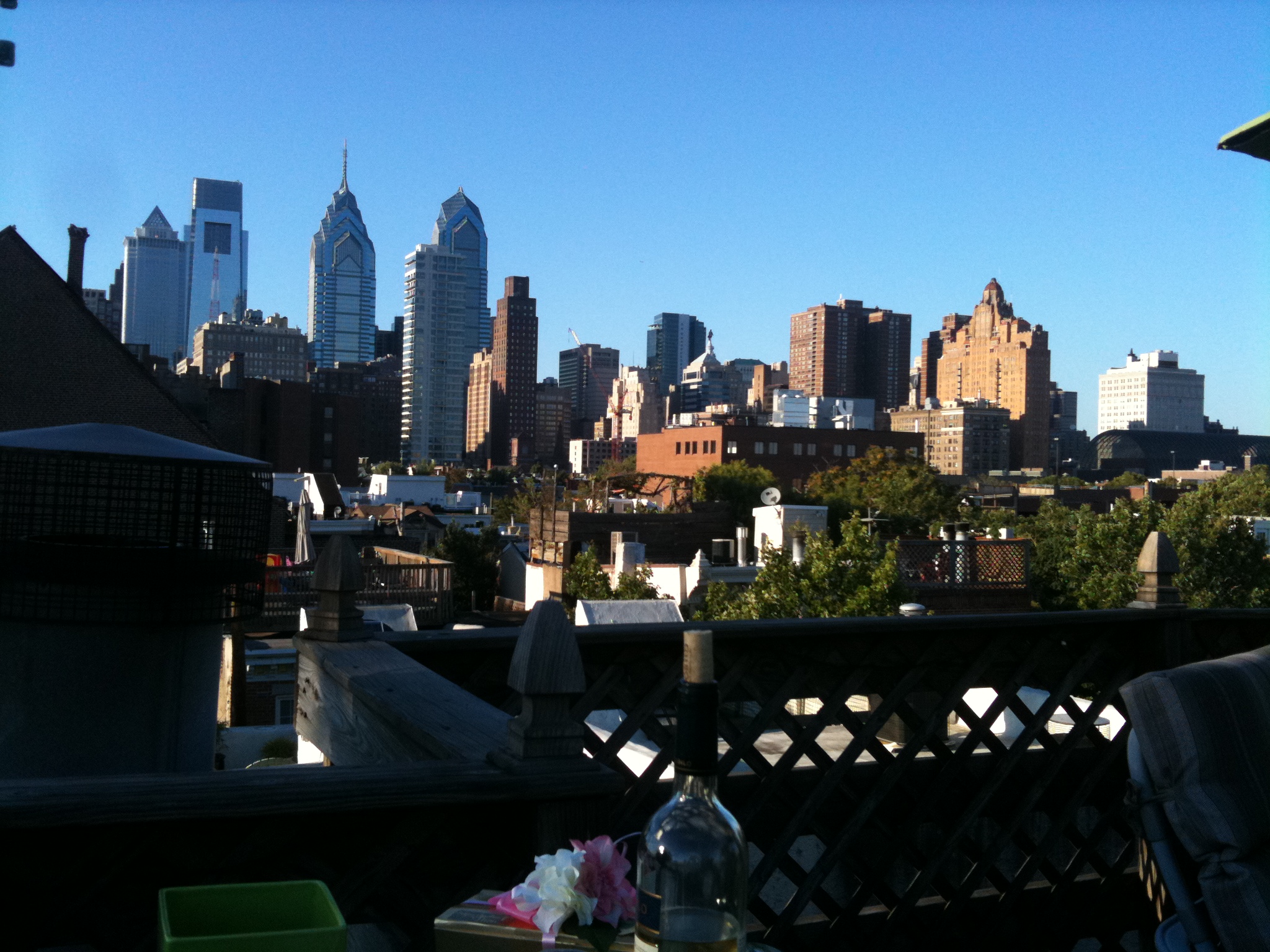
Later that night, we took in the July 4th fireworks from Mary and Roy’s townhouse rooftop. But I’ll let the brilliance and color of Zagar’s art stand in for the rocket’s red glare and bombs bursting in air.
I hope you’ve enjoyed this 4-part account of our honeymoon journey through history.(Zagar photos by Steve Rashid. Thanks, Steve!)

























![photo[2]](https://pab58.com/wp-content/uploads/2013/04/photo2.jpg)
![photo[1]](https://pab58.com/wp-content/uploads/2013/04/photo1.jpg)
![photo[8]](https://pab58.com/wp-content/uploads/2013/04/photo8.jpg)







































A Wild Winter Weekend in the Windy City!
These pictures don’t quite capture the wondrous sight we beheld – but they’ll have to do.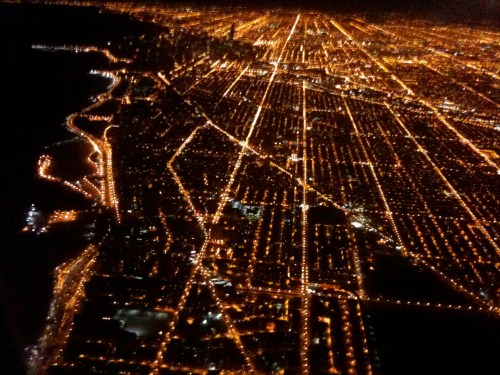
This video was taken at the corner of Central Street and Central Park.
And BTW – these are not rolling hills dusted with snow. This is a flat parking lot on which they just dumped these man-made mountains of snow. The Evanston kids were loving it! King of the hill!
Brad and I had been on campus for the great Blizzard of ’79, so this fabulous frosting brought back many snowed-under undergraduate memories.
We left Chicago on Monday, February 7th – and it was snowing again. Here’s Steve’s neighborhood on Hartzell, just before the flakes began to fall…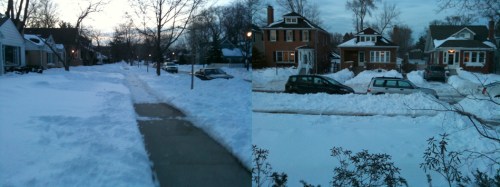
In this video, shot in front of Steve’s house, you can see the big flakes falling. It was time for Steve’s industrious neighbor to get his snow blower out again – and time for Brad and me to get out of town while we still could.
Getting back to the relative warmth of a February night in Los Angeles, I hurried to the Terminal 4 parking garage and found that my car battery was dead. As I waited for AAA to arrive, I was comforted by the thought that at least I wasn’t waiting while stuck in a three-foot drift on a slushy road in Chicago. And that I didn’t end up like one of those unfortunates snowbound on Lake Shore Drive.
Share this post:
Leave a comment
Filed under Adventure, Random Commentary
Tagged as Blizzard of '79, Brad Hall, Chicago, Emilia Barrosse, Evanston, Northwestern, O'Hare Airport, Paul Barrosse, Rock Me, snow, snow storm, Steve Rashid, thundersnow