Tag Archives: GOP

Mitt Romney, Florida & The Death of Democracy?

You didn’t have to scale Mount Parnassus and consult the Delphic Oracle to foretell that Mitt Romney was going to clobber Newt Gingrich in the Florida GOP Primary on Tuesday night.

The final tally gave Romney an overwhelming victory with 46.4% of the vote to 31.9% for Newt “46 more states to go” Gingrich.

But if there are Tea Party types, Libertarians, Social Conservatives and Fans of Philandering Politicians who are bummed by Romney’s easy victory over the likes of Gingrich, Santorum and Paul – then perhaps those conservatives may want to reconsider their embrace of Corporate Personhood and the Supreme Court’s democracy-destroying decision in the Citizen’s United case.

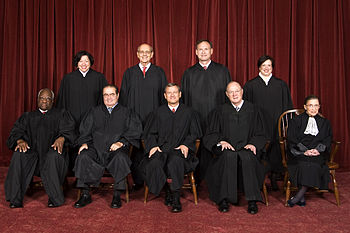
Mitt Romey is a wealthy candidate to begun with – but there’s no way for relatively cash poor candidates (no matter how principled and ideologically pure they may be) to compete against the flood of Super Pac money that a Wall Street crony like Romney can attract. Justice Alito may be shaking his head “no” for a very different reason tomorrow morning. If Chief Justice Roberts and Company didn’t see this onslaught coming when they decided that money = speech, then they are even more blind than justice is supposed to be.

So, cry in your beer, you blue collar Social Conservatives. Weep for poor Rick Santorum, your anti-choice, gay-baiting standard bearer, because he can’t compete with the money Mitt’s friends poured into Florida!

Call out in anguish, you Libertarian Ron Paul Revolutionists – because the no-rules, laissez faire, anti-regulatory religion you and you candidate adhere to has no answer for the rampaging anonymous money machine that chased the good doctor out of Florida!

And rend your garments, you Newtonians. Wail and gash your teeth because your brilliant historian’s erudition, high-minded philosophizing and vaunted forensic skill were no match for tens of million of dollars worth of negative campaign ads paid for by…

Oh, that’s right.

We don’t know who paid for them.

Classic Greek democracy developed in Athens around 508 BC, and stumbled along for about 186 years, before the conquering Macedonians suppressed the Athenian Democracy in 322 BC.

American democracy has lasted 50 years longer – but who needs the Macedonian hordes when you’ve got Roberts, Alito, Thomas, Scalia, and Kennedy working against you.

2 Comments

Filed under Politics

The State of Obama.

Okay, folks. Let’s just level with each other.

I know there are lots of my fellow lefties – whether we call ourselves liberals or progressives — who have been disappointed by President Obama since he took office under the promising banners of “Hope” and “Change”.

He didn’t go far enough on universal health care.

He didn’t prosecute the Bush Administration for its war crimes.

He hasn’t put any of the Wall Street banksters in jail.

And on and on and on…

But can you imagine a Republican President giving a State of the Union Address anything at all like the speech that President Obama just gave?

I’m no Pollyanna. I’m no easy dupe. But I am a clear-eyed political realist.

I am encouraged – even thrilled — that an intelligent, thoughtful and empathetic Democratic President has emerged from a three-year death-grip battle with the dark powers of the anti-intellectual, greedy, pro-feudal GOP with a resilient spirit, imagination and resolve strong enough to fashion the speech that President Obama gave tonight.

Newt Gingrich?

Mitt Romney?

Please.

Bring ‘em on.

6 Comments

Filed under Politics

Fantasy Politics & The Election of 2012

The Iowa Caucuses are over and the New Hampshire Primary is upon us. The Presidential election of 2012 is already well underway. Given that President Obama is unlikely to encounter any serious primary challenge on his open road to the Democratic Party’s nomination in Charlotte, North Carolina in the first week of September – the media focus has been squarely on the Republican contenders vying for the chance to deny Barak Obama re-election on the first Tuesday in November.

Of course, it’s a long, long time until November 6, 2012. We’ll know the winner of the Super Bowl, the NBA Championship, and the World Series before Election Day. And we’ll know the winner of American Idol, The Biggest Loser, Survivor, and who gets the guy on The Bachelor long before we know if any of the GOP field was able to take down Obama. A lot can happen between now and then. But looking at the Republican contenders arrayed against Obama (and each other) it’s hard not to feel the odds are in favor of the World’s Most Famous Former Community Organizer.

Much has been written (on the Right and Left) about the lackluster GOP hopefuls and the lack of party popularity enjoyed by the “inevitable” frontrunner Mitt Romney. You’d have to be living in a cave (which Osama bin Laden evidently wasn’t) not to have heard about how Mitt’s Mormonism, flip-flopping, and career as a multi-millionaire corporate raider make him a poor fit with this era’s angry, populist, anti Wall Street, Tea Party GOP electorate.

This schism between Main Street Republican voters and Wall Street has rank political opportunists like Newt Gingrich attacking Romney for his role as a profit-worshipping venture capitalist.

Strange days, indeed.

Each month (and sometimes each week) brings a new “anyone but Mitt” candidate surging into contention. As if to prove there’s no limit to the GOP’s anti-Romney anxiety, we’ve been treated to the entertaining rise and unsurprising fall of the scandalous blowhard Herman Cain, cute but crazy Michelle Bachmann, and rejected Republican re-treads like Newt Gingrich and Rick “Please don’t Google me” Santorum.

Trying to temper my disdain for these apparently preposterous Republican Presidential candidates, I remind myself that, back in 1980, we all thought Ronnie “Raygun” Reagan was an unelectable right wing nut job. Progressives cannot afford to gloat or get comfortable. However, if the GOP has any chance of winning the White House, the U.S. economy must go into free fall. But with the Dow Jones Average above 12,000 and unemployment falling steadily, the Republicans are forced into rooting for America to fail in order to win an election. Not a good bet.

So, in order to make the Presidential Election of 2012 interesting, I suggest participating in a game that keeps even lackluster NFL, NBA and MLB seasons interesting: a fantasy league.

Introducing FANTASY POLITICS…

FANTASY POLITICS

In fantasy politics, you are the campaign manager of your own team of two Republican Presidential candidates. You need to know how the daily news cycle, the primaries and caucuses affect the two candidates on your roster and how to minimize their gaffes, maximize their endorsements, and collect delegates through the long primary season on the road to the GOP nomination. Here’s how the candidates on your roster are impacted by the rules of fantasy politics.

FANTASY SCORING

Fantasy points are generated from the action on the campaign trail. When a GOP candidate on your team avoids a dangerously quotable gaffe during a debate, earns a newspaper endorsement, or wins a state primary, your fantasy team earns points for the week. The sum of your two candidates’ points combine to compete against the total for your opponent’s team for the week.

Sample Scoring:

Newspaper Endorsement +1

John McCain Endorsement -1

Debate Victory +1

Debate Gaffe -1

Positive News Story +1

Embarrassing YouTube Moment -1

Primary Delegates (1 point per delegate)

Really Good Concession Speech Upon Withdrawal (10 bonus points)

CANDIDATE ELIGIBILITY

Campaign managers can choose any two GOP candidates in the field as of Tuesday, January 10th, the day of the New Hampshire Primary. I’d say the Virginia Primary – but, of course, Newt Gingrich and Rick Perry failed to qualify for the ballot in Virginia – and our fantasy game would simply not be as much fun without them.

Candidates who are still in the race on Super Tuesday, March 6, 2012, earn 100 bonus points, in addition to any delegates they pick up that night in the collection of primaries and caucuses in Alaska, Georgia, Idaho, Massachusetts, North Dakota, Ohio, Oklahoma, Tennessee, Vermont, and Virginia. If neither of your candidates made it to Super Tuesday, you’re out of luck. And out of your misery.

DROP AND SWAP

On the day after Super Tuesday, campaign managers will have 24 hours to “drop and swap” candidates. This may not be fair – but it’s politically expedient: a chance for the rats to escape the sinking ships. However, if a candidate you dropped after Super Tuesday manages to make it to the Republican Convention in Tampa, Florida in late August with even a handful of delegates – you will be deducted one point for every delegate who votes in the Convention to nominate the candidate you dropped.

INJURY DESIGNATIONS

Sorry, unlike in the football, basketball, and baseball fantasy leagues, all of your GOP candidates must play hurt. Politics is not a game for sissies. There is no disabled list. If there was, a mentally disabled candidate like Rick “Frothy” Santorum, or an emotionally disabled candidate like Mitt “I like being able to fire people” Romney would not be on the roster. Instead, they’re leading GOP contenders. Suit up, shut up, and get up for the game.

SCORING CORRECTIONS

Occasionally the official elections returns from a particular state may be recounted and changed to accurately reflect what happened at the ballot box. In such circumstances, campaign managers may block a recount by making an appeal to the U.S. Supreme Court. (See “Bush v. Gore”)

THE WINNER

The winning campaign manager is the political genius that managed to back the two GOP candidates who got the furthest down the road on the way to winning their party’s nomination – and earned the right to lose to President Obama by a landslide on Election Day, Tuesday, November 6, 2012.

3 Comments

Filed under Politics, Sports

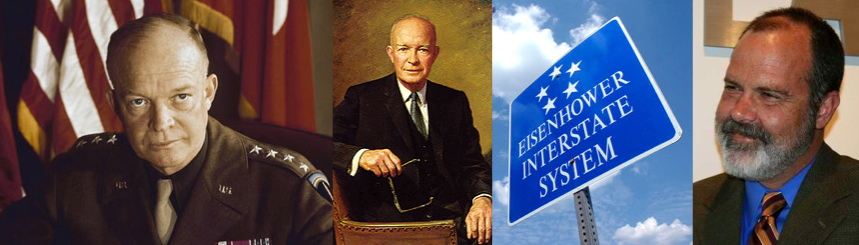
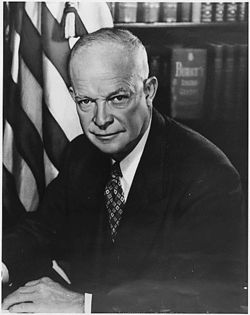
A New Presidential Biography Reminds Us Why We Should Like Ike.

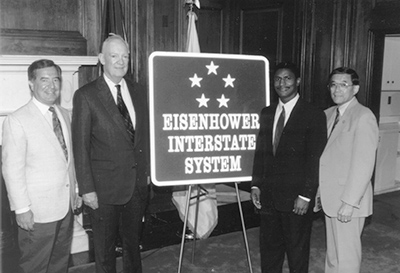
On October 4th, Jim Newton’s Presidential biography, Eisenhower: The White House Years arrives in bookstores.

This is exciting news. Not just because the author is a very dear friend of mine – but because I can’t think of a more apropos time since his Presidency ended in 1960 for us to look back on Ike’s two terms in the Oval Office.

My buddy Jim Newton is a veteran newspaperman who began his career at the New York Times. Since I’ve known him, he’s been an editor at the Los Angeles Times, where he’s now the editor-at-large. In 2006, Jim wrote a definitive biography of Chief Justice Earl Warren entitled, Justice for All.

Now, he’s focused his brilliance and talent on the man who put Earl Warren on the court.

Hold on. It was Republican who put the classic “activist judge” Earl Warren on the Supreme Court?

Indeed. And that’s just one of the reasons it’s a good time to revisit the Eisenhower Presidency.

More than a half-century after Dwight D. Eisenhower left office, his old campaign slogan “I like Ike” has become a cliché. But, in this era of Tea Party Republicans and Ronald Reagan worship, it’s nostalgic to recall a Republican President who would never have said, “The nine most terrifying words in the English language are, ‘I’m from the government and I’m here to help.’”

That kind of simplistic, anti-government demagoguery would not have appealed to the complex man who built our interstate highway system and sent Federal troops to Little Rock, Arkansas to enforce school desegregation.

In a move that would be anathema to today’s dogmatic GOP states’ rights defenders, Ike ordered units from the 101st Airborne Division to Little Rock on September 24, 1957. The next day, those soldiers escorted nine black students through the front door of Central High and into its formerly all-white classrooms. Of course, Ike had some previous experience with the paratroopers of the 101st. 13 years earlier in a little dustup called D-Day on June 6th, 1944. The Screaming Eagles followed Ike’s orders into their drop zones behind the beaches at Normandy – and into the hallways of a Little Rock high school.

But Jim’s book is not about General Dwight Eisenhower, the Supreme Allied Commander who led his forces to victory in World War Two. It’s about the Eisenhower, who, like George Washington and Ulysses S. Grant, went from the highest-ranking military leader in an epochal war to Commander in Chief as the thirty-fourth President of the United States.

I was born in 1958 during Ike’s second term, but John F. Kennedy was the first President that I was aware of – and my first clear memory of Kennedy was watching his funeral on TV.

During my boyhood, President Eisenhower was a distant figure: even more dimly remembered than General Eisenhower, the hero of D-Day and all those World War Two movies I loved and re-created in my backyard.

Comedians made jokes about Ike playing golf and how homely his wife Mamie was. After the glorious Jackie Kennedy enchanted The White House, dowdy Mamie didn’t have a chance.

By the time I was in high school, my sense was that Eisenhower’s Presidency, if I thought of it at all, didn’t amount to much. He was a dull President in a dull time. Thank goodness, 16-year old Paul didn’t write the book on Ike.

I certainly wasn’t alone in thinking of Eisenhower as little more than the Caretaker-in-Chief, hitting the links with Bob Hope and presiding over an easygoing, black & white, “Leave It To Beaver” American society. Long after I graduated from college in 1980 that was still the prevailing attitude about Ike’s time in the Oval Office. There was, however, residual gratitude on the Democratic Left for Eisenhower’s lukewarm endorsement of Vice President Dick Nixon in the 1960 race against Kennedy.

The laugh was on Dick. Dick got the last laugh.

Pressed by reporters to give an example of Nixon making a key contribution to his administration, Ike said, “Give me a week and I’ll think of one!” Priceless. Nixon went on to lose to Kennedy in one of the tightest Presidential races in American history. Nixon got the last laugh, though. Not only did Tricky Dick win the White House eight years later – that same year, 1968, Nixon’s daughter Julie won the hand of Ike’s grandson David in marriage.

But, looking back at Ike’s Presidency, it’s hard to imagine why, as a callow youth, I thought his time in office so inconsequential. Eisenhower was the second President to have an atomic bomb in his arsenal — and he refused to use it. He kept radical anti-Communist McCarthyism at arm’s length until it became, as he called it, “McCarthywasm.”

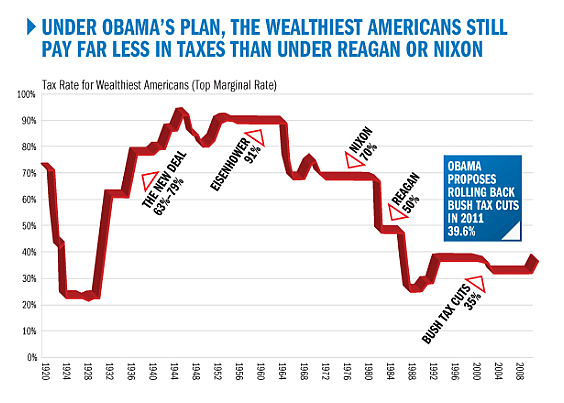
And, after lifting the nation out of its post World War Two debt, he was the last president until Democrat Bill Clinton to leave office with a budget surplus. The top marginal tax rate under Eisenhower was 91%. George W. Bush slashed that rate to 35%. Ike paid for WWII and built our highway system. George W. Bush built nothing and left us in debt to China.

For these, and many more reasons, this lifelong Democrat likes Ike. And I like Jim’s book. But you don’t have to depend upon my endorsement (which is so much more enthusiastic than Ike’s backing of Nixon) – you can just check out these amazing reviews…

“A truly great book, spirited, balanced, and not just the story of President Eisenhower but of an era.”
 Bob Woodward

Jim Newton does a masterful job illustrating the forces that confronted Dwight Eisenhower during his years in the White House, from nuclear politics to race relations to the federal debt and deficit. He paints a vivid portrait of a president struggling to find middle ground—sometimes successfully, sometimes not — but always with the good of the country in mind.” 
Dianne Feinstein, U.S. Senator

”

“Newton’s contribution is as cogent an inventory of Eisenhower’s White House years as I’ve ever read… This is a book for all who are interested in a better understanding of how America and the World were shaped post–WWII and for those who aspire to lead: Read Newton’s book first.”
 Chuck Hagel, U.S. Senator (1997–2009)

“Ike’s wisdom, born of experience and intellect, is on display in this important book, which heightens appreciation for his leadership. Newton reveals, for instance, that after the Korean War, only one American soldier was killed in combat during Eisenhower’s presidency. This volume contributes to our understanding of an outstanding human being.”
 George P. Shultz, 60th U.S. Secretary of State

“Jim Newton’s ‘Eisenhower, The White House Years’, simply and eloquently, delivers the man, his Presidency and, if America is paying attention, the life lessons that are his legacy.”
 Norman Lear

“Jim Newton’s brilliant reassessment of Eisenhower’s presidency is long overdue, and his book makes it clear that Ike was indeed a great president. Ike’s insistence on always doing the right thing for the country despite party pressure and personal predilection serves as a valuable model for politicians in all three branches of government.” Former FBI Director, William S. Sessions.

Buy my friend Jim Newton’s book today — and learn what a principled, heroic Republican used to be. And, alas, you’ll know why bipartisanship is a thing of the past.

I still like Ike.

Now more than ever.*

* With apologies to Nixon’s 1972 campaign.

3 Comments

Filed under History, Politics

Babes in Government-land…

I’ve had enough. I’m tired of dealing with babies.

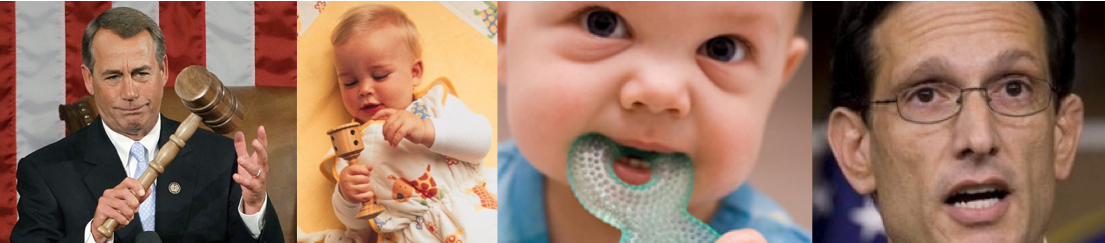
This whole Debt Ceiling “crisis” has made it clear to me that, with the Tea Party Caucus in the House of Representatives, we are dealing with political babies.

As a parent of three grown children, I know what a pain it is to deal with babies.

First of all, babies don’t know anything. All they know is what they want. And when they don’t get what they want, they cry.

Wahhhhh! Wahhhhh! Wahhhhh!

I will never understand why so many working class Midwestern Americans voted for these Tea Party-GOP babies in 2010 – but they did.

And now, political adults – both Democrats and Republicans – find they must contend with all these whiny, itty-bitty, small minded ultra-conservative babies in the U.S. House of Representatives who have no clue what it is to govern the greatest democracy in the western world.

As though they were simply playing with blocks in the safety of their padded playpens, these know-nothing GOP babies have no clear idea of the impact that their actions will have outside of their playpen.

I hope that the Government Adults – President Obama, Senate Majority Leader Harry Reid, Minority Leader Mitch McChinless, House Minority Leader Nancy Pelosi, and Speaker “Boo-Hoo” Boehner – are finally able to quiet the Tea Party babies and put them down for a long nap, just in time to raise the Debt Ceiling and move on with the grown-up business of government.

Ssssshhhh. Don’t wake the Tea Party-GOP babies.

Government is way to complex for infant children.

4 Comments

Filed under Politics

The (New) American Crisis.

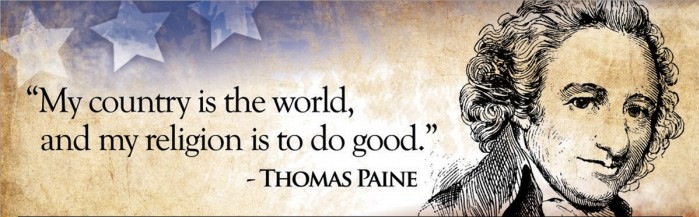
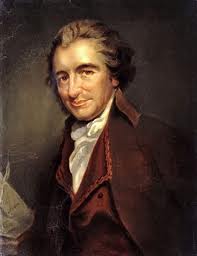
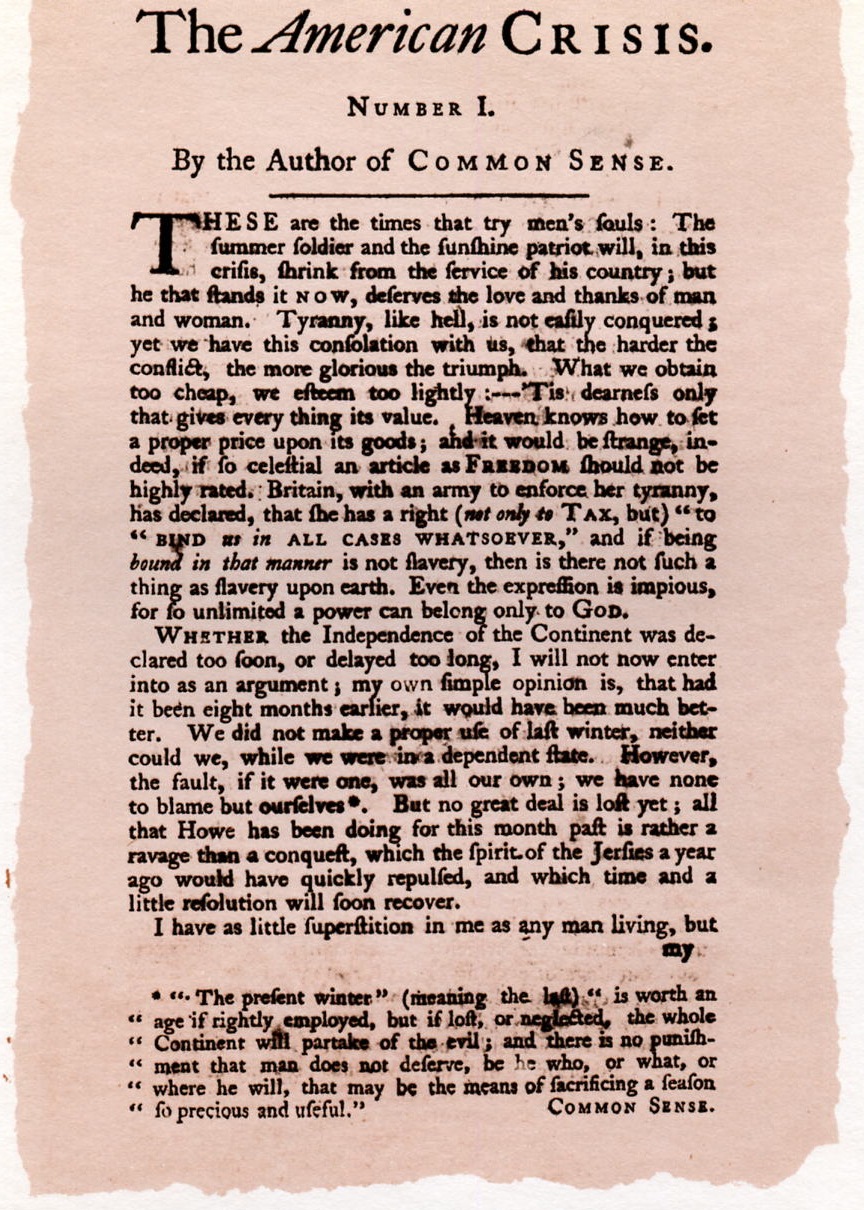
American patriot Thomas Paine served in George Washington’s army during the Revolutionary War as an aide-de-camp to General Nathanael Greene. In the desperate winter of ’76, the war was going badly — and Washington’s valiant, weary, and ill-equipped troops were in retreat.

The revolutionary cause was in dire jeopardy, when Paine took up his pen to rally his nascent nation’s flagging spirits.

Realizing that “it was necessary that the country should be strongly animated,” Paine wrote a series of popular pamphlets collectively titled The American Crisis. The first of these broadsides was published on December 23, 1776 – and General Washington found it so inspiring that he had it read to his soldiers at Valley Forge.

Today, as we suffer through this trumped-up Debt Ceiling crisis, it is once again “necessary that the country should be strongly animated.”

Therefore, with apologies to Thomas Paine…

These are the times that try Progressive’s souls. Some summer Liberals and sunshine Democrats will, in this crisis, shrink from their core values; but he that stands by Social Security, Medicare and Medicaid now, deserves the love and thanks of every working man and woman in America.

The GOP-Tea Party, like hell, is not easily conquered; yet we have this consolation with us, that the harder the conflict, the more glorious the triumph. The Grand Debt Ceiling Bargain we obtain too cheap, we esteem too lightly: it is Tax Fairness – with increases on the Wealthy, Big Business and Wall Street only — that gives Shared Sacrifice any real meaning.

Heaven knows how to put a proper price upon The Common Good; and it would be strange indeed if so celestial an article as The Full Faith and Credit of The United States should not be highly rated by Standard & Poor’s. (Though such a Downgrade looks increasingly possible.)

The GOP, with Fox News to enforce its Bullshit, has declared that they have a right (not only NOT to TAX) but “to BIND all working people in ALL CASES WHATSOEVER” to economic slavery, for so unlimited an economic power can belong only to George Bush’s God of Prosperity, the Koch Brothers, Republicans, Millionaires and Billionaires.

We have none to blame but ourselves, but no great deal is lost yet. All that Boehner, McConnell and Cantor have been doing for these past few months is rather a Ravage than a Conquest. They have over-reached and will be quickly repulsed by the voters. By 2012, with a little resolution on the part of working class Americans – resulting in a Democratic landslide — we will soon recover.

I have as little superstition in me as any man living, but my secret opinion has ever been, and still is, that God Almighty will not give up the American People to Economic Destruction by Tea Party Fools and GOP Corporatist Greed, or leave President Obama and the Democrats to perish who have so earnestly and so repeatedly sought to avoid the calamities of Default by every decent method which wisdom could invent.

Neither have I so much of the infidel in me, as to suppose that The Almighty has relinquished the Government of The United States, and given us up to the madness of small-minded religious zealots like Michele Bachmann and Jim DeMint; and as I do not, I cannot see on what grounds McConnell, Boehner and Cantor can hold Americans over an economic barrel.

‘Tis surprising to see how rapidly a panic (like this artificial Debt Ceiling Crisis) will sometimes run through a country. Yet panics, in some cases, have their uses; they produce as much good as hurt. Their peculiar advantage is that they are the touchstones of sincerity (Democrats) and hypocrisy (Republicans), and bring things and men to light, which might otherwise have lain forever undiscovered. They sift out the hidden thoughts of Conservatives, and hold them up in public to the world.

I shall not now attempt to give all the particulars of our negotiations with the GOP; suffice it for the present to say, that the Democratic Party and President Obama, though greatly harassed and fatigued, bore these Debt Limit negotiations with a manly and bipartisan spirit. All their wishes centered in one, which was, that the country would turn out and help them to drive the Republicans out come the Election of 2012.

I have been tender in raising the cry against the Tea Party radicals, and have used numberless arguments to show their danger, but it will not do to sacrifice our country either to their folly or their baseness. The Time of Decision is now arrived, in which either Tea Party Republicans or Democrats must change our sentiments, or one or both must fall.

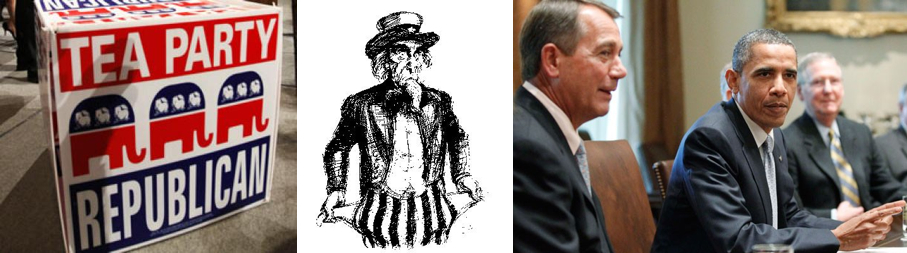
And what is a Tea Party Republican? Good God! What is he? I should not be afraid to stand with a hundred brave, steadfast Democratic Union Men against a thousand Tea Partiers. Every GOP-Tea Party member is a dupe or a coward; for servile, slavish, and corporate-interested fear is the foundation of Tea Partyism; and a man under such misguided influence, though he may be selfish and confused, can never be brave.

But, before the line of irrecoverable separation be drawn between American Liberals and Conservatives, let us reason the matter together: FOX News is as much rejected by reality as the American cause is injured by FOX News. Rupert “Phone Hacker” Murdoch and his Corporate Paymasters expect you to take up arms and flock to their standard. Your opinions are of no use to The Right, unless you support them without thinking, for ’tis Zombies, and not Thinking Men, that they want.

I once felt that kind of anger, which a man ought to feel, against the mean principles that are held by the Republicans. “If there must be trouble, let it be in my day, that my child may have prosperity.” But today, let every Progressive American awaken to his duty. For though the flame of liberty may sometimes cease to flare, the embers can never expire.

I call not upon a few, but upon all Progressives: not on this Blue State or that Purple State, but on every state: up and help us; lay your shoulders to the wheel; better have too much force than too little, when so great an object is at stake. Let it be told to the future world, that in the heat of the summer of 2011, when nothing but hope and virtue could survive, that the city and the country, alarmed at one common danger, came forth to meet and to repulse it.

If President Obama and the Congress cannot avoid the ignominy of National Default, it matters not where you live, or what rank of life you hold, the evil will reach you all. The far and the near, the rich and the poor, will suffer or rejoice alike.

The blood of Democratic children will curse their cowardice, who shrinks back at a time when a little might have saved the whole, and made them happy. I love the Liberal that can smile in trouble, that can gather strength from distress, and grow brave by reflection. ‘Tis the business of little GOP minds to shrink; but the Progressive whose heart is firm, and whose conscience approves his conduct, will pursue his principles unto Election Day.

Let them call me Liberal and welcome, I feel no concern from it; but I should suffer the misery of devils, were I to make a whore of my soul by swearing allegiance to GOP politicians who are stupid, stubborn, worthless and brutish — and fleeing with tax-cutting, budget-slashing terror from the orphan, the widow, and the unemployed of America.

There are cases that cannot be overdone by language, and there are persons who see not the full extent of the evil that threatens them. It is the madness of folly to expect statesmanship from Republicans who have refused to do political and social justice. The GOP’s first object is, partly by threats and partly by false promises, to fleece the American people before agreeing to pay their lawful debts.

I see no real cause for fear. I know our situation well, and can see the way out of it. The sign of fear has not been seen in our Liberal Camp. Our new Progressive Democratic Army is recruiting fast, and we shall be able to open the 2012 Campaign with tens of millions of voters, well educated and mobilized.

By perseverance and fortitude we have the prospect of a glorious issue; by cowardice and submission, the sad choice of a variety of evils — a ravaged country — crumbling cities — infrastructure without repair, and a shrinking Middle Class without hope — our homes turned into foreclosures, and our children to provide for, whose American Dream will be less than our own. Look on this picture and weep over it! And if there yet remains one thoughtless FOX viewer who believes it not, let him suffer the consequences unlamented.

Awake, Senate Democrats! Arise, President Obama! The GOP is mercifully inviting you to barbarous destruction (in a bipartisan fashion, of course), and men must be either rogues or fools that will not see it. I dwell not upon the vapors of imagination; I bring reason to your ears, and, in language as plain as A, B, C, hold up truth to your eyes.

Let the Bush Tax Cuts expire! Cut the Pentagon’s bloated budget! Let Medicare negotiate deals with the Drug Companies! Collect a fair share of taxes from Corporations and Wall Street Financiers that have reaped such an ungodly percentage of our National Treasure! Leave Social Security and our National Health alone! Do these things, and the blessings of Prosperity will be upon our Nation once again.

8 Comments

Filed under History, Politics

Pausing Amid the Political Hysteria…

As President Obama negotiates with Democratic and Republican Congressional leaders on the critical issues of raising the debt ceiling and reducing the Federal budget deficit, each breathless (and very sketchy) media report on the progress of those negotiations has been received in the Progressive Blogosphere with hand-wringing, whining, and melodramatic condemnations.

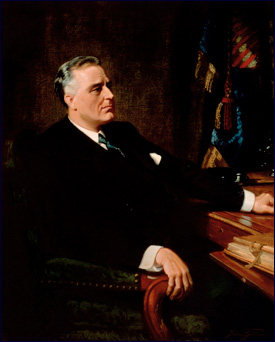
The President, it appears from all this premature carping, is ready to sell out Social Security, Medicare, Medicaid, your home mortgage interest deduction, the public schools, and FDR’s White House portrait to appease the all-powerful, Tea Party/GOP who are willing to sacrifice the full faith and credit of the U.S. Government on Grover Norquist’s anti-tax altar.

With the debt ceiling deadline approaching in less than a month, it’s more doom and gloom for Democrats. Obama, we hear from disenchanted liberals, is just GOP-lite. We need to mount a primary challenge. Or vote Green Party in 2012.  Or just stay home.

Because that worked so well for disappointed progressives in the 2010 mid-terms, right?

Because handing the House of Representatives over to Speaker John Boehner and the militant Tea Party jihadists sure showed those spineless Democrats a thing or two, didn’t it?

Aren’t you glad, you jaded bloggers on Daily Kos, TPM and The Huffington Post, that President Obama doesn’t have Nancy Pelosi to appease in these debt ceiling negotiations?

Oh, that’s right. If Nancy Pelosi were still the Speaker of the House – there wouldn’t even be negotiations over the debt ceiling.

It would be a pro forma vote of approval just like it’s always been.

Now, let’s get back to these White House negotiations over the debt limit. I’m pretty sure that, in order to avoid disaster, a Grand Bargain will be reached that will gore just about everyone’s ox to some degree.

But even if President Obama was not a man with liberal inclinations (and I think he’s shown that he is), he is a successful politician. He can see that an overwhelming majority of voters would rather see taxes raised on millionaires and billionaires than have their Social Security and Medicare benefits get cut.

And that’s true across party lines – especially among independents.

John Boehner can read those polls, too. But, even if Boehner wanted to strike a Bob Dole-like bargain with Obama to raise taxes on the rich (or what I like to call “restoring tax fairness”) in exchange for entitlement reforms that reduce waste and save money but don’t screw working people – he can’t do it. Because he’s got Michele Bachmann and the Tea Party Visigoths willing to wreak havoc on America’s credit rating in order to protect Exxon Mobil’s government subsidies and low tax rates on capital gains and other passive income for billionaires like the Koch Brothers.  (Euphemistically referred to as “the job creators.”)

The Visigoths are shown here doing to Rome what the GOP is doing to the U.S. MIddle Class.

So, the Republicans have their backs to wall in these negotiations, too. And President Obama knows it.

Of course, if scoring political points were all our President cared about, he’d be taking a much harder line in public – and that would win him praise from progressive bloggers and pundits yearning for a hard-knuckle approach. But that’s what you do in an election campaign – not when you’re trying to govern. (Remember how well the tough guy, no compromise, jam it down their throats approach served the country when that nasty little bully George W. Bush was in charge?)

President Obama is serious about bipartisanship. He always has been. And, in this case, bipartisanship may just mean giving the GOP enough rope to hang themselves in 2012.

So, let’s just see how this debt ceiling brinksmanship plays out. It’s the best drama of the summer. And I’m sure it won’t have an entirely happy ending for anyone.

But, if Obama has to make some concessions you don’t like, please remember this…

Would you rather President Romney – who made his millions buying US companies and out-sourcing the jobs overseas — were presiding over such critical White House  negotiations in the summer of 2013?

Would you like President Pawlenty choosing the next two Supreme Court justices?

Would you like President Bachmann…?

I’m sorry. I’ll just stop there. I don’t want to add any more crazy to this summer’s political hysteria.

6 Comments

Filed under Politics

President Obama: The 100th Post

Since this site was launched in January of 2010, I’ve posted 99 articles on this blog. This is the 100th post. And for the first time I’m devoting a post to the words of someone other than me: President Barack Obama.

President Obama’s speech on budgets, deficits and taxation yesterday went well beyond numbers crunching. He touched on truths that progressives have been shouting at their TV sets and arguing over water coolers ever since Reagan took office and began to dismantle The American Dream for workers and the middle class.  This was a President sounding like a Democrat and embracing the role of our government to do good things for the people it represents. This was a President rejecting voodoo economics and government of, by, and for the top one percent.

I’m sure there will be compromises in the battles that loom ahead with the GOP and its Teahadist , but this time the President we elected to bring Hope and Change stood tall and spoke the truth, calmly but forcefully. The right-wingers have been throwing fits ever since Obama finished making this speech. That’s how you know it’s the truth.

And now, for the 100th post in the history of this blog, I proudly present to you the 44th President of the United States, Barak Obama…

Remarks of President Barack Obama – As Prepared for Delivery

“The Country We Believe In”

The George Washington University

Washington, D.C.

April 13, 2011

As Prepared for Delivery—

Good afternoon.  It’s great to be back at GW.  I want you to know that one of the reasons I kept the government open was so I could be here today with all of you.  I wanted to make sure you had one more excuse to skip class.  You’re welcome.

Of course, what we’ve been debating here in Washington for the last few weeks will affect your lives in ways that are potentially profound.  This debate over budgets and deficits is about more than just numbers on a page, more than just cutting and spending.  It’s about the kind of future we want.  It’s about the kind of country we believe in.  And that’s what I want to talk about today.

From our first days as a nation, we have put our faith in free markets and free enterprise as the engine of America’s wealth and prosperity.  More than citizens of any other country, we are rugged individualists, a self-reliant people with a healthy skepticism of too much government.

But there has always been another thread running throughout our history – a belief that we are all connected; and that there are some things we can only do together, as a nation.  We believe, in the words of our first Republican president, Abraham Lincoln, that through government, we should do together what we cannot do as well for ourselves.  And so we’ve built a strong military to keep us secure, and public schools and universities to educate our citizens.  We’ve laid down railroads and highways to facilitate travel and commerce.  We’ve supported the work of scientists and researchers whose discoveries have saved lives, unleashed repeated technological revolutions, and led to countless new jobs and entire industries.  Each of us has benefitted from these investments, and we are a more prosperous country as a result.

Part of this American belief that we are all connected also expresses itself in a conviction that each one of us deserves some basic measure of security.  We recognize that no matter how responsibly we live our lives, hard times or bad luck, a crippling illness or a layoff, may strike any one of us.  “There but for the grace of God go I,” we say to ourselves, and so we contribute to programs like Medicare and Social Security, which guarantee us health care and a measure of basic income after a lifetime of hard work; unemployment insurance, which protects us against unexpected job loss; and Medicaid, which provides care for millions of seniors in nursing homes, poor children, and those with disabilities.  We are a better country because of these commitments.  I’ll go further – we would not be a great country without those commitments.

For much of the last century, our nation found a way to afford these investments and priorities with the taxes paid by its citizens.  As a country that values fairness, wealthier individuals have traditionally born a greater share of this burden than the middle class or those less fortunate.  This is not because we begrudge those who’ve done well – we rightly celebrate their success.  Rather, it is a basic reflection of our belief that those who have benefitted most from our way of life can afford to give a bit more back.  Moreover, this belief has not hindered the success of those at the top of the income scale, who continue to do better and better with each passing year.

Now, at certain times – particularly during periods of war or recession – our nation has had to borrow money to pay for some of our priorities.  And as most families understand, a little credit card debt isn’t going to hurt if it’s temporary.

But as far back as the 1980s, America started amassing debt at more alarming levels, and our leaders began to realize that a larger challenge was on the horizon.  They knew that eventually, the Baby Boom generation would retire, which meant a much bigger portion of our citizens would be relying on programs like Medicare, Social Security, and possibly Medicaid.  Like parents with young children who know they have to start saving for the college years, America had to start borrowing less and saving more to prepare for the retirement of an entire generation.

To meet this challenge, our leaders came together three times during the 1990s to reduce our nation’s deficit.  They forged historic agreements that required tough decisions made by the first President Bush and President Clinton; by Democratic Congresses and a Republican Congress.  All three agreements asked for shared responsibility and shared sacrifice, but they largely protected the middle class, our commitments to seniors, and key investments in our future.

As a result of these bipartisan efforts, America’s finances were in great shape by the year 2000. We went from deficit to surplus.  America was actually on track to becoming completely debt-free, and we were prepared for the retirement of the Baby Boomers.

But after Democrats and Republicans committed to fiscal discipline during the 1990s, we lost our way in the decade that followed.  We increased spending dramatically for two wars and an expensive prescription drug program – but we didn’t pay for any of this new spending.  Instead, we made the problem worse with trillions of dollars in unpaid-for tax cuts – tax cuts that went to every millionaire and billionaire in the country; tax cuts that will force us to borrow an average of $500 billion every year over the next decade.

To give you an idea of how much damage this caused to our national checkbook, consider this:  in the last decade, if we had simply found a way to pay for the tax cuts and the prescription drug benefit, our deficit would currently be at low historical levels in the coming years.

Of course, that’s not what happened.  And so, by the time I took office, we once again found ourselves deeply in debt and unprepared for a Baby Boom retirement that is now starting to take place.  When I took office, our projected deficit was more than $1 trillion.  On top of that, we faced a terrible financial crisis and a recession that, like most recessions, led us to temporarily borrow even more.  In this case, we took a series of emergency steps that saved millions of jobs, kept credit flowing, and provided working families extra money in their pockets.  It was the right thing to do, but these steps were expensive, and added to our deficits in the short term.

So that’s how our fiscal challenge was created.  This is how we got here.  And now that our economic recovery is gaining strength, Democrats and Republicans must come together and restore the fiscal responsibility that served us so well in the 1990s.  We have to live within our means, reduce our deficit, and get back on a path that will allow us to pay down our debt.  And we have to do it in a way that protects the recovery, and protects the investments we need to grow, create jobs, and win the future.

Now, before I get into how we can achieve this goal, some of you might be wondering, “Why is this so important?  Why does this matter to me?”

Here’s why.  Even after our economy recovers, our government will still be on track to spend more money than it takes in throughout this decade and beyond.  That means we’ll have to keep borrowing more from countries like China.  And that means more of your tax dollars will go toward paying off the interest on all the loans we keep taking out.  By the end of this decade, the interest we owe on our debt could rise to nearly $1 trillion.  Just the interest payments.

Then, as the Baby Boomers start to retire and health care costs continue to rise, the situation will get even worse.  By 2025, the amount of taxes we currently pay will only be enough to finance our health care programs, Social Security, and the interest we owe on our debt.  That’s it.  Every other national priority – education, transportation, even national security – will have to be paid for with borrowed money.

Ultimately, all this rising debt will cost us jobs and damage our economy.  It will prevent us from making the investments we need to win the future.  We won’t be able to afford good schools, new research, or the repair of roads and bridges – all the things that will create new jobs and businesses here in America.  Businesses will be less likely to invest and open up shop in a country that seems unwilling or unable to balance its books.  And if our creditors start worrying that we may be unable to pay back our debts, it could drive up interest rates for everyone who borrows money – making it harder for businesses to expand and hire, or families to take out a mortgage.

The good news is, this doesn’t have to be our future.  This doesn’t have to be the country we leave to our children.  We can solve this problem.  We came together as Democrats and Republicans to meet this challenge before, and we can do it again.

But that starts by being honest about what’s causing our deficit.  You see, most Americans tend to dislike government spending in the abstract, but they like the stuff it buys.  Most of us, regardless of party affiliation, believe that we should have a strong military and a strong defense.  Most Americans believe we should invest in education and medical research.  Most Americans think we should protect commitments like Social Security and Medicare.  And without even looking at a poll, my finely honed political skills tell me that almost no one believes they should be paying higher taxes.

Because all this spending is popular with both Republicans and Democrats alike, and because nobody wants to pay higher taxes, politicians are often eager to feed the impression that solving the problem is just a matter of eliminating waste and abuse –that tackling the deficit issue won’t require tough choices.  Or they suggest that we can somehow close our entire deficit by eliminating things like foreign aid, even though foreign aid makes up about 1% of our entire budget.

So here’s the truth.  Around two-thirds of our budget is spent on Medicare, Medicaid, Social Security, and national security.  Programs like unemployment insurance, student loans, veterans’ benefits, and tax credits for working families take up another 20%.  What’s left, after interest on the debt, is just 12 percent for everything else. That’s 12 percent for all of our other national priorities like education and clean energy; medical research and transportation; food safety and keeping our air and water clean.

Up until now, the cuts proposed by a lot of folks in Washington have focused almost exclusively on that 12%.  But cuts to that 12% alone won’t solve the problem.  So any serious plan to tackle our deficit will require us to put everything on the table, and take on excess spending wherever it exists in the budget.  A serious plan doesn’t require us to balance our budget overnight – in fact, economists think that with the economy just starting to grow again, we will need a phased-in approach – but it does require tough decisions and support from leaders in both parties.  And above all, it will require us to choose a vision of the America we want to see five and ten and twenty years down the road.

One vision has been championed by Republicans in the House of Representatives and embraced by several of their party’s presidential candidates.  It’s a plan that aims to reduce our deficit by $4 trillion over the next ten years, and one that addresses the challenge of Medicare and Medicaid in the years after that.

Those are both worthy goals for us to achieve.  But the way this plan achieves those goals would lead to a fundamentally different America than the one we’ve known throughout most of our history.

A 70% cut to clean energy.  A 25% cut in education.  A 30% cut in transportation.  Cuts in college Pell Grants that will grow to more than $1,000 per year.  That’s what they’re proposing.  These aren’t the kind of cuts you make when you’re trying to get rid of some waste or find extra savings in the budget.  These aren’t the kind of cuts that Republicans and Democrats on the Fiscal Commission proposed.  These are the kind of cuts that tell us we can’t afford the America we believe in.  And they paint a vision of our future that’s deeply pessimistic.

It’s a vision that says if our roads crumble and our bridges collapse, we can’t afford to fix them.  If there are bright young Americans who have the drive and the will but not the money to go to college, we can’t afford to send them.  Go to China and you’ll see businesses opening research labs and solar facilities.  South Korean children are outpacing our kids in math and science.  Brazil is investing billions in new infrastructure and can run half their cars not on high-priced gasoline, but biofuels.  And yet, we are presented with a vision that says the United States of America – the greatest nation on Earth – can’t afford any of this.

It’s a vision that says America can’t afford to keep the promise we’ve made to care for our seniors.  It says that ten years from now, if you’re a 65 year old who’s eligible for Medicare, you should have to pay nearly $6,400 more than you would today.  It says instead of guaranteed health care, you will get a voucher.  And if that voucher isn’t worth enough to buy insurance, tough luck – you’re on your own.  Put simply, it ends Medicare as we know it.

This is a vision that says up to 50 million Americans have to lose their health insurance in order for us to reduce the deficit.  And who are those 50 million Americans?  Many are someone’s grandparents who wouldn’t be able afford nursing home care without Medicaid.  Many are poor children.  Some are middle-class families who have children with autism or Down’s syndrome.  Some are kids with disabilities so severe that they require 24-hour care.  These are the Americans we’d be telling to fend for themselves.

Worst of all, this is a vision that says even though America can’t afford to invest in education or clean energy; even though we can’t afford to care for seniors and poor children, we can somehow afford more than $1 trillion in new tax breaks for the wealthy.  Think about it.  In the last decade, the average income of the bottom 90% of all working Americans actually declined.  The top 1% saw their income rise by an average of more than a quarter of a million dollars each.  And that’s who needs to pay less taxes?  They want to give people like me a two hundred thousand dollar tax cut that’s paid for by asking thirty three seniors to each pay six thousand dollars more in health costs?   That’s not right, and it’s not going to happen as long as I’m President.

The fact is, their vision is less about reducing the deficit than it is about changing the basic social compact in America.  As Ronald Reagan’s own budget director said, there’s nothing “serious” or “courageous” about this plan.  There’s nothing serious about a plan that claims to reduce the deficit by spending a trillion dollars on tax cuts for millionaires and billionaires.  There’s nothing courageous about asking for sacrifice from those who can least afford it and don’t have any clout on Capitol Hill.  And this is not a vision of the America I know.

The America I know is generous and compassionate; a land of opportunity and optimism.  We take responsibility for ourselves and each other; for the country we want and the future we share.  We are the nation that built a railroad across a continent and brought light to communities shrouded in darkness.  We sent a generation to college on the GI bill and saved millions of seniors from poverty with Social Security and Medicare.  We have led the world in scientific research and technological breakthroughs that have transformed millions of lives.

This is who we are.  This is the America I know.  We don’t have to choose between a future of spiraling debt and one where we forfeit investments in our people and our country.  To meet our fiscal challenge, we will need to make reforms.  We will all need to make sacrifices.  But we do not have to sacrifice the America we believe in.  And as long as I’m President, we won’t.

Today, I’m proposing a more balanced approach to achieve $4 trillion in deficit reduction over twelve years.  It’s an approach that borrows from the recommendations of the bipartisan Fiscal Commission I appointed last year, and builds on the roughly $1 trillion in deficit reduction I already proposed in my 2012 budget.  It’s an approach that puts every kind of spending on the table, but one that protects the middle-class, our promise to seniors, and our investments in the future.

The first step in our approach is to keep annual domestic spending low by building on the savings that both parties agreed to last week – a step that will save us about $750 billion over twelve years.  We will make the tough cuts necessary to achieve these savings, including in programs I care about, but I will not sacrifice the core investments we need to grow and create jobs.  We’ll invest in medical research and clean energy technology.  We’ll invest in new roads and airports and broadband access.  We will invest in education and job training.  We will do what we need to compete and we will win the future.

The second step in our approach is to find additional savings in our defense budget.  As Commander-in-Chief, I have no greater responsibility than protecting our national security, and I will never accept cuts that compromise our ability to defend our homeland or America’s interests around the world.  But as the Chairman of the Joint Chiefs, Admiral Mullen, has said, the greatest long-term threat to America’s national security is America’s debt.

Just as we must find more savings in domestic programs, we must do the same in defense.   Over the last two years, Secretary Gates has courageously taken on wasteful spending, saving $400 billion in current and future spending.  I believe we can do that again.  We need to not only eliminate waste and improve efficiency and effectiveness, but conduct a fundamental review of America’s missions, capabilities, and our role in a changing world.  I intend to work with Secretary Gates and the Joint Chiefs on this review, and I will make specific decisions about spending after it’s complete.

The third step in our approach is to further reduce health care spending in our budget.  Here, the difference with the House Republican plan could not be clearer:  their plan lowers the government’s health care bills by asking seniors and poor families to pay them instead.  Our approach lowers the government’s health care bills by reducing the cost of health care itself.

Already, the reforms we passed in the health care law will reduce our deficit by $1 trillion.  My approach would build on these reforms.  We will reduce wasteful subsidies and erroneous payments.  We will cut spending on prescription drugs by using Medicare’s purchasing power to drive greater efficiency and speed generic brands of medicine onto the market.  We will work with governors of both parties to demand more efficiency and accountability from Medicaid.  We will change the way we pay for health care – not by procedure or the number of days spent in a hospital, but with new incentives for doctors and hospitals to prevent injuries and improve results.  And we will slow the growth of Medicare costs by strengthening an independent commission of doctors, nurses, medical experts and consumers who will look at all the evidence and recommend the best ways to reduce unnecessary spending while protecting access to the services seniors need.

Now, we believe the reforms we’ve proposed to strengthen Medicare and Medicaid will enable us to keep these commitments to our citizens while saving us $500 billion by 2023, and an additional one trillion dollars in the decade after that.  And if we’re wrong, and Medicare costs rise faster than we expect, this approach will give the independent commission the authority to make additional savings by further improving Medicare.

But let me be absolutely clear:  I will preserve these health care programs as a promise we make to each other in this society.  I will not allow Medicare to become a voucher program that leaves seniors at the mercy of the insurance industry, with a shrinking benefit to pay for rising costs.  I will not tell families with children who have disabilities that they have to fend for themselves.  We will reform these programs, but we will not abandon the fundamental commitment this country has kept for generations.

That includes, by the way, our commitment to Social Security.  While Social Security is not the cause of our deficit, it faces real long-term challenges in a country that is growing older.  As I said in the State of the Union, both parties should work together now to strengthen Social Security for future generations.  But we must do it without putting at risk current retirees, the most vulnerable, or people with disabilities; without slashing benefits for future generations; and without subjecting Americans’ guaranteed retirement income to the whims of the stock market.

The fourth step in our approach is to reduce spending in the tax code.  In December, I agreed to extend the tax cuts for the wealthiest Americans because it was the only way I could prevent a tax hike on middle-class Americans.  But we cannot afford $1 trillion worth of tax cuts for every millionaire and billionaire in our society.  And I refuse to renew them again.

Beyond that, the tax code is also loaded up with spending on things like itemized deductions.  And while I agree with the goals of many of these deductions, like homeownership or charitable giving, we cannot ignore the fact that they provide millionaires an average tax break of $75,000 while doing nothing for the typical middle-class family that doesn’t itemize.

My budget calls for limiting itemized deductions for the wealthiest 2% of Americans – a reform that would reduce the deficit by $320 billion over ten years.  But to reduce the deficit, I believe we should go further.  That’s why I’m calling on Congress to reform our individual tax code so that it is fair and simple – so that the amount of taxes you pay isn’t determined by what kind of accountant you can afford.  I believe reform should protect the middle class, promote economic growth, and build on the Fiscal Commission’s model of reducing tax expenditures so that there is enough savings to both lower rates and lower the deficit.  And as I called for in the State of the Union, we should reform our corporate tax code as well, to make our businesses and our economy more competitive.

This is my approach to reduce the deficit by $4 trillion over the next twelve years.  It’s an approach that achieves about $2 trillion in spending cuts across the budget.  It will lower our interest payments on the debt by $1 trillion. It calls for tax reform to cut about $1 trillion in spending from the tax code.  And it achieves these goals while protecting the middle class, our commitment to seniors, and our investments in the future.

In the coming years, if the recovery speeds up and our economy grows faster than our current projections, we can make even greater progress than I have pledged here.  But just to hold Washington – and me – accountable and make sure that the debt burden continues to decline, my plan includes a debt failsafe.  If, by 2014, our debt is not projected to fall as a share of the economy – or if Congress has failed to act – my plan will require us to come together and make up the additional savings with more spending cuts and more spending reductions in the tax code.  That should be an incentive for us to act boldly now, instead of kicking our problems further down the road.

So this is our vision for America – a vision where we live within our means while still investing in our future; where everyone makes sacrifices but no one bears all the burden; where we provide a basic measure of security for our citizens and rising opportunity for our children.

Of course, there will be those who disagree with my approach.  Some will argue we shouldn’t even consider raising taxes, even if only on the wealthiest Americans.  It’s just an article of faith for them.  I say that at a time when the tax burden on the wealthy is at its lowest level in half a century, the most fortunate among us can afford to pay a little more.  I don’t need another tax cut.  Warren Buffett doesn’t need another tax cut.  Not if we have to pay for it by making seniors pay more for Medicare.  Or by cutting kids from Head Start.  Or by taking away college scholarships that I wouldn’t be here without.  That some of you wouldn’t be here without.  And I believe that most wealthy Americans would agree with me.  They want to give back to the country that’s done so much for them.  Washington just hasn’t asked them to.

Others will say that we shouldn’t even talk about cutting spending until the economy is fully recovered.  I’m sympathetic to this view, which is one of the reasons I supported the payroll tax cuts we passed in December.  It’s also why we have to use a scalpel and not a machete to reduce the deficit – so that we can keep making the investments that create jobs.  But doing nothing on the deficit is just not an option.  Our debt has grown so large that we could do real damage to the economy if we don’t begin a process now to get our fiscal house in order.

Finally, there are those who believe we shouldn’t make any reforms to Medicare, Medicaid, or Social Security out of a fear that any talk of change to these programs will usher in the sort of radical steps that House Republicans have proposed.  I understand these fears.  But I guarantee that if we don’t make any changes at all, we won’t be able to keep our commitments to a retiring generation that will live longer and face higher health care costs than those who came before.

Indeed, to those in my own party, I say that if we truly believe in a progressive vision of our society, we have the obligation to prove that we can afford our commitments.  If we believe that government can make a difference in people’s lives, we have the obligation to prove that it works – by making government smarter, leaner and more effective.

Of course, there are those who will simply say that there’s no way we can come together and agree on a solution to this challenge.  They’ll say the politics of this city are just too broken; that the choices are just too hard; that the parties are just too far apart.  And after a few years in this job, I certainly have some sympathy for this view.

But I also know that we’ve come together and met big challenges before.  Ronald Reagan and Tip O’Neill came together to save Social Security for future generations.  The first President Bush and a Democratic Congress came together to reduce the deficit.  President Clinton and a Republican Congress battled each other ferociously and still found a way to balance the budget.  In the last few months, both parties have come together to pass historic tax relief and spending cuts.  And I know there are Republicans and Democrats in Congress who want to see a balanced approach to deficit reduction.

I believe we can and must come together again.  This morning, I met with Democratic and Republican leaders in Congress to discuss the approach I laid out today.  And in early May, the Vice President will begin regular meetings with leaders in both parties with the aim of reaching a final agreement on a plan to reduce the deficit by the end of June.

I don’t expect the details in any final agreement to look exactly like the approach I laid out today.  I’m eager to hear other ideas from all ends of the political spectrum.  And though I’m sure the criticism of what I’ve said here today will be fierce in some quarters, and my critique of the House Republican approach has been strong, Americans deserve and will demand that we all bridge our differences, and find common ground.

This larger debate we’re having, about the size and role of government, has been with us since our founding days.  And during moments of great challenge and change, like the one we’re living through now, the debate gets sharper and more vigorous.  That’s a good thing.  As a country that prizes both our individual freedom and our obligations to one another, this is one of the most important debates we can have.

But no matter what we argue or where we stand, we’ve always held certain beliefs as Americans.  We believe that in order to preserve our own freedoms and pursue our own happiness, we can’t just think about ourselves.  We have to think about the country that made those liberties possible.  We have to think about our fellow citizens with whom we share a community.  And we have to think about what’s required to preserve the American Dream for future generations.

This sense of responsibility – to each other and to our country – this isn’t a partisan feeling.  It isn’t a Democratic or Republican idea.  It’s patriotism.

The other day I received a letter from a man in Florida.  He started off by telling me he didn’t vote for me and he hasn’t always agreed with me.  But even though he’s worried about our economy and the state of our politics, he said,

“I still believe.  I believe in that great country that my grandfather told me about.   I believe that somewhere lost in this quagmire of petty bickering on every news station, the ‘American Dream’ is still alive…

We need to use our dollars here rebuilding, refurbishing and restoring all that our ancestors struggled to create and maintain…We as a people must do this together, no matter the color of the state one comes from or the side of the aisle one might sit on.”

I still believe as well.  And I know that if we can come together, and uphold our responsibilities to one another and to this larger enterprise that is America, we will keep the dream of our founding alive in our time, and pass on to our children the country we believe in.  Thank you, God bless you, and may God bless the United States of America.

6 Comments

Filed under Politics

A Reply to My Conservative Friend…

I have a friend from childhood who grew up in the same blue-collar Westside Cleveland neighborhood that I did and was raised a Catholic, as I was. We both went to the same high school, played football and wrestled on the same team, and rocked in the same band.

Over the years, my buddy has evolved into a conservative – while I have remained a liberal. Those two generic political labels do not adequately sum up the total of our beliefs, but they do describe a basic divide in the way we approach solutions to social and political problems.

He bought into Ronald Reagan. I did not.

I believe that my friend and I would like to see the same kind of just, peaceful and loving world come to pass. He is more traditionally religious than I am, but we both share a reverence for the Gospel message of Jesus and its revolutionary humanity. He’s a good man, with a good heart — and a good and caring friend. He’s the kind of guy you want to have in your foxhole. He’s a great dad, too.

But we disagree on so many things.

Lately, he and I have exchanged a series of e-mails in which we’ve debated current events from Obama’s election to the Madison Uprising. In his most recent e-mail, he laid out what amounts to his personal political manifesto. Normally, I would fire off a direct reply. But in this case, I think a public reply might be helpful to those on both sides of our polarizing political divide who struggle to maintain a civilized and constructive dialogue despite their differences.

My friend’s words are in italics…

Ok, I have a few minutes before I head off to teach…

I am a conservative by learned behavior Paul.

I am a liberal from the cradle, raised by a union factory worker from the South and an elementary school teacher from Coal Country. Mom and dad came through the Depression under the Democratic leadership of FDR and watched progressive legislation like the New Deal and the G.I. Bill combine with a robust labor union movement to build a strong Middle Class in post-War America.

My dad told me when I was a small child that the difference between Republicans and Democrats is that “Republicans are for the rich – and Democrats are for the working man.” And while there are some notable Democratic corporate shills like Senators Joe Lieberman and Nebraska’s Ben Nelson, by and large what my dad told me has proven to be true. Right now, in my home state, Senator Sherrod Brown (D-OH) is among the strongest pro-labor votes in Congress.

As I have witnessed over the years, liberal policies that strive to seek justice for all, help the poor, feed the sick, and bring comfort to the least among us are far closer to the Gospel of Jesus than the “Greed is Good”, Ayn Rand-loving, Chamber of Commerce pro-corporate true-believers in the conservative movement who treat “trickle down economics” as gospel, despite that fact that it’s been discredited by the past 30 years of clearly observable history.

I believe the rich can keep what they make.

I, too, believe the rich can keep what they make. I just believe that they should keep a lot less of the excessive multi-millions and billions they stockpile through investments in businesses that make generous use of the public commons (roads, bridges, courts, public education, etc.) while paying taxes on a far smaller percentage of their income than the working people whose taxes actually pay for that essential infrastructure which makes an efficient and productive marketplace possible.

Yes, the rich can keep what they make. But they should keep a lot less of the billions they make by setting up offshore accounts in the Cayman Islands and elsewhere. Working people don’t have enough money to set up such legal tax-dodging schemes. (It’s not a level playing field, my brother. The very rich play by an entirely different set of rules.)

Let’s take a look at how much money the rich kept in their silk-lined pockets during the time period that conservatives often describe as the “good old days”…

When Republican President Eisenhower built the massive federal interstate highway system – the greatest boon to freedom of movement and economic development in this country in the 20th Century – he did so less than a decade after World War Two left the government deeper in debt than it is today (in inflation-adjusted dollars). At the time, the top marginal tax rate for multi-millionaires was 91 percent. And there were still plenty of mansions getting built and yachts being bought. But we were also investing in America.

Under Nixon, after the federal government paid off our World War Two debt, built the highways, brought electricity to rural America, sent millions of military veterans to college for next-to-nothing, and expanded public education — the top tax rate was 70 percent. Twice what it is today. And the American economy and the middle class were still growing. Heck, even under Ronald Reagan it was 50 percent.

Today, conservatives and Tea-baggers get all frothy at the mouth over President Obama’s desire to roll back the Bush tax cuts for the wealthiest Americans from 35 percent to 39.6 percent – even though the more than $40 billion in revenue that would generate in just one year would pay for nearly all the social and education investments the GOP wants to cut.
 (See the bottom of the big graphic, below.)

I believe in a flat tax with 0 exemptions.

Billionaire Steve Forbes has been pushing this canard for years. The flat tax is not a fair tax. Let’s remember that income tax is not the only tax Americans pay. There’s also sales tax, property tax, vehicle licenses, bridge and road tolls, fishing licenses, etc. A working family making $30-70,000 a year spends just about every dollar of their income just trying to make ends meet – and thus, the poor and middle class spend a far higher percentage of their annual income on the full range of taxes than multi-millionaires and billionaires do. This is called regressive taxation. Don’t be fooled by billionaires extolling the virtues of a flat tax. It’s a shell game.

I believe ALL religions should be taught in schools, they all have the same basic rules and it might change kids, for the better.

I agree with you here. It’s conservatives who generally attack comparative religion classes. Of course, it would be a challenge to survey the more than 300 religions and denominations in the United States, from those who believe in one god, to polytheists who believe in many gods, and those who believe in no god. (Not to mention Americans who believe in god as represented by an animal, a tree, or an alien being.) I’m not sure all these religions share the same basic rules – but it would be a fascinating field of study for all Americans, and society would doubtless benefit by children engaging such diversity from elementary school forward. I agree that it would change kids for the better.

But let’s also agree on two things:

1. Let’s keep science and religion separate. Kids who believe the Earth in only 6,000 years old will never compete in Science with kids in China and India. Kids can’t compete in Biology if they reject Evolution. And stem cell research (which Bush outlawed here) is already helping friends who are suffering from paralysis and cancer.

2. Our Constitution prohibits establishment of a national religion. So, though you and I – and a majority of Americans – profess to be Christians, that’s the law. Our Founders did not want the religious war of Old Europe to be re-fought in America. And they’d had enough of state-sponsored religion: where Kings claimed God gave them a Divine Right to dominion over the common people.

Gun control didn’t work in Chicago, we just changed the stats. Obvious gang killings became suicides because that’s what the mayor wanted.

You obviously know more about how “the stats” were changed in Chicago – but I don’t see why one big city mayor trying to game his town’s violent crime numbers has very much to do with intelligent, fair-minded efforts by local communities to regulate gun shows or to keep cheap handguns out of the hands of criminals, children, and the mentally unstable. Seems like a worthy goal to me.

Our Constitution states that, “A well regulated Militia, being necessary to the security of a free State, the right of the people to keep and bear Arms, shall not be infringed.” Other than National Guardsmen, how many people do you know who are members of a “well regulated Militia”? And I don’t count guys in camo gear running around the backwoods in Idaho preparing for whatever version of the apocalypse they’re into.

My family were all hillbillies. I learned to handle guns at a young age and they were kept and handled SAFELY. Though I don’t believe the common guy needs to be allowed to have an AK-47.

Who can argue with gun safety?  If you must have a gun in your house, by all means keep it safe. But all the statistics make it very clear that while people say they keep guns in their home for safety – it’s vastly more likely that their gun will wind up killing a loved one, a neighbor kid, an innocent victim, or the owner himself by accident than that gun will ever be used to kill an intruder in a fantasy scenario defense of home and hearth.

And yes, let’s keep the AK-47s in the hands of cops and soldiers. I totally agree with you — though those guys running around Idaho in their camouflage do not.

I have no right to not allow Gays their rights…

Great. I’m with you so far…

…but MY church should not be forced to perform marriages, nor should a PRIVATE school be forced to allow a behavior THEIR religion does not accept as normal.

First of all, I’m not aware of any proposal by progressives, liberals or Democrats to force churches to marry gay people. That’s not even on the table – nor would it ever be. The issue is what the state and federal authorities must recognize.

On the other hand, there are areas where the government can and must see that all churches abide by the law. Murder is against the law. A church can, therefore, cannot burn a woman at the stake, whether they think she’s a witch or not. Sounds reasonable, yes?

Likewise, private schools cannot disregard the law. Can a private school allow a 16-year old to drink beer on campus? Smoke pot? Grow his own in Horticulture class?

Private is private, public is public.

Again. As in the burning of witches, you can’t get away with illegal acts in a private setting. The Boy Scouts can’t keep black children and Asian kids out because of the color of their skin, despite the fact that they’re a private organization. Therefore, they can’t exclude gays, either. In American, we do not discriminate, either in the public square or behind closed doors. Do you want to go back to the days when black golfers couldn’t play in The Masters in Augusta, Georgia? Or when Little Richard couldn’t stay in the same hotel or eat at the same restaurant while on tour with Elvis and Jerry Lee Lewis? How about if no kids of Polish descent could be Boy Scouts?  Or no “Wops” could join the local country club or Chamber of Commerce?

Most of the CFD is republican, working folk.

Given how little GOP has ever done for working folk, that’s sad to hear. But, after Wisconsin, you’ll see that begin to change. The firemen and cops who backed Governor Walker are now standing in solidarity with the unions. They know they’ll also wind up on the GOP hit list. To break the labor unions is to accelerate working America’s race to the bottom.

Most of the people at my church are republican working folk.

Alas, I can see how conservative politicians and religious leaders who exploit issues like abortion and gay marriage have driven a wedge between religious working people and the liberals who are actually their natural allies. “God, guns and gays.” It’s a shame.

I think there is a big difference between TRUE poor and the leeches of the system. In Chicago, most of the ghetto areas are filled with gangs and system abusers, NOT true people who want or deserve help.

I’m sure you didn’t mean to say “true people”. I’m sure you meant “true poor people”.

Jesus, however, never differentiated between poor people. He never called them leeches. If he was here today, he would be ministering to the slums, the ghettos, and the gang-infested areas. He wouldn’t blame the victims.

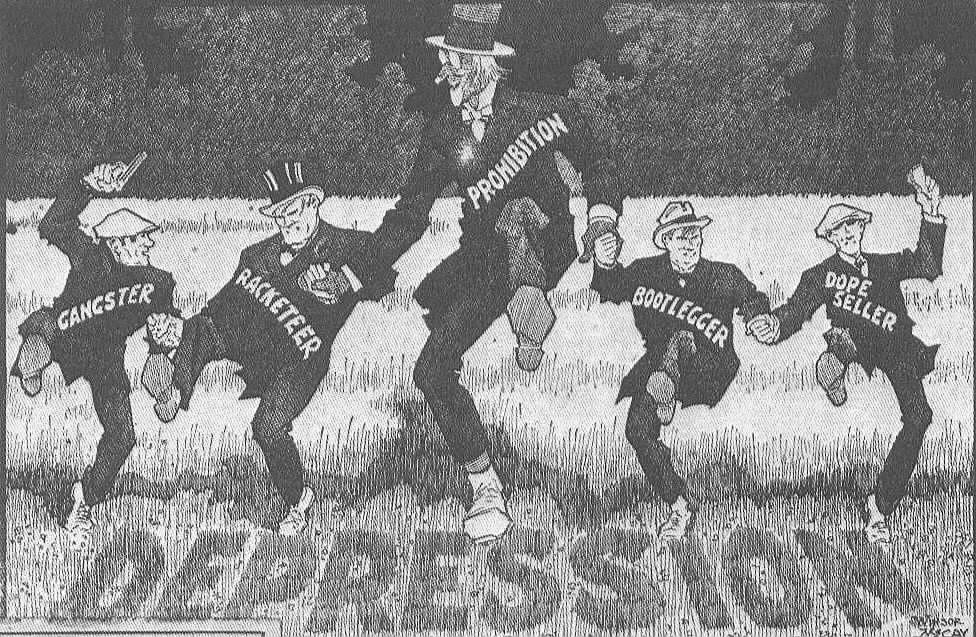
Gangs are bad. No doubt. Alcohol Prohibition in the 1920’s and 30’s led to a rise in street gangs and organized crime. Today, the War on Drugs has done the same. Then as now, gangsters are mythologized in the movies and feared in the streets. Then as now, selling contraband is often one of the few ways a poor young man with no social or economic advantages can make decent money. (Mickey D’s can’t employ everybody.) That doesn’t make it right. Legalize drugs. Treat the addicts and non-violent offenders, rather than ship them off to an increasingly for-profit prison system where money is made by filling jail cells. That would begin to help.

People who steal $500 from someone with a gun because they need a hit of crack go to jail. (The U.S. keeps a higher percentage of its population behind bars than the regimes in China and Russia.) But if you steal billions from working people by duping them into confusing adjustable rate mortgages – or rob them of their hard-eared pensions at the same time your top corporate execs make millions in bonuses – that’s just the American Way, right?

Ok, gotta go teach now…

Watch out for that tsunami.

Alas, my friend, not long after you sent your e-mail, that tsunami hit. It reminds us all how fragile life is, and how precious. So is friendship.

Let’s keep talking, buddy. And maybe we’ll find common ground.

What’s the alternative?

16 Comments

Filed under Politics, Truth

On, Wisconsin!

Hosni Mubarak, meet Scott Walker. Walker’s got a popular uprising on his hands, too.

A funny thing happened on the way to Wisconsin Governor Scott Walker’s goal of rolling back the hard-earned rights and benefits of his state’s public employee unions. Tens of thousands of citizens began marching in the streets of Madison.

A newly elected Republican, Governor Walker wants his GOP-controlled state legislature to pass a law that forces state workers to pay more for their pensions and health insurance coverage and takes away most of their collective bargaining rights. Ironically, Wisconsin was the first state in the nation to grant public employees collective bargaining rights.

An imperious Governor Walker says there will be no negotiations on his union-busting budget plan. If the legislature doesn’t pass his plan, Walker has threatened massive layoffs and cuts in state services that will cost thousands of jobs.

And in a move that would make Hosni proud, Walker put the National Guard on alert in case state workers strike or rise in protest. The Wisconsin Guard hasn’t been called out in a labor dispute since 1934. (And that situation was deadly.)

On Tuesday, February 15, approximately 15,000 people jammed inside the Capitol building and on the grounds to express their opposition to Walker. The next day, schools in Madison were closed as 40% of the teachers union’s 2,600 members called in sick and joined the growing throng of protestors at the Capitol.

Also on Tuesday, more than a thousand demonstrators gathered outside Governor Walker’s home. The line of protestors was ten blocks long.

Surely, this is all big national news, right?

In recent weeks, our national news media was awash with breathless coverage of the mass demonstrations in Egypt that brought down a dictatorship. That was as it should be. The defiant pro-democracy rallies in Cairo’s Tahrir Square were clearly and importantly newsworthy. So why isn’t it newsworthy when 10,000 Wisconsin citizens gather in the frigid streets of Madison chanting, “This is what Democracy looks like!”

In fact, many of the protesters in Madison recognize similarities between their struggle to maintain their rights and the Egyptians’ battle against an autocratic, oppressive regime. Some protest signs in Wisconsin say things like, “Hosni Walker,” “Don’t Dictate, Negotiate,” and “Dictators Will Fall.”

Our news media should be showing all Americans the sights and sounds of this popular uprising within our own borders. There should be up-close-and-personal feature stories about the local Madison businesses giving free food and coffee to the demonstrators — or police officers buying lunch for protesting state workers. Or the cheers that rose up when a column of hundreds of firefighters from across the state joined the protest, marching to the sound of their bagpipers.

Governor Walker had tried to keep the cops and firefighters out of this fight by exempting them from his regressive new anti-labor law – but Walker’s gambit to divide key groups of Wisconsin’s public employees against each other didn’t work. The President of Madison Fire Fighters Local 311 declared that even if supporting the protest leads to the cops and firemen getting their rights and benefits cut, too – organized labor sticks together.

“Oh you can’t scare me, I’m stickin’ to the union…”

According to all reports, the uniformed cops monitoring the protests are friendly and supportive — and off-duty officers are carrying “Cops for Labor” signs.

Of course, the struggle in Madison isn’t just about public workers’ rights in Wisconsin. It could be a pivotal event for the labor movement in America: a galvanizing moment when working people begin to push back against the 30-year conservative war on organized labor that began when Ronald Reagan broke the PATCO union during the air traffic controller’s strike.

President Obama appears to understand the larger implications of (what I’m calling) the Great Badger Labor Revolt…

“Some of what I’ve heard coming out of Wisconsin, where you’re just making it harder for public employees to collectively bargain generally seems like more of an assault on unions. And I think it’s very important for us to understand that public employees, they’re our neighbors, they’re our friends. These are folks who are teachers and they’re firefighters and they’re social workers and they’re police officers.

“They make a lot of sacrifices and make a big contribution. And I think it’s important not to vilify them or to suggest that somehow all these budget problems are due to public employees.”

But where Obama sees “neighbors” and “friends” who “make a lot of sacrifices and make a big contribution” – right wing gasbag Rush Limbaugh sees only enemies, calling teachers “parasites” and union workers part of an “anti-democracy” movement.”

It’s sad to think that Limbaugh’s ranting may carry farther on the media airwaves than President Obama’s pro-union message.

And why has Governor Walker launched his assault on middle-class jobs and collective bargaining? Walker claims his state is broke — but an independent analysis by the Wisconsin Fiscal Bureau projects a net positive balance of $56 million for the state budget at the end of 2011. And a report by the Institute for Wisconsin’s Future estimates the cuts in public employees’ pay will cost the state $1.1 billion in reduced economic activity annually – which will lead to the loss of some 9,000 private sector jobs.

Walker’s plan is not about what’s good for Wisconsin.

This trumped-up “budget crisis” is really an extension of the Republican war against workers’ rights that Walker’s fellow GOP governors, like Ohio’s John Kasich and Arizona’s Jan Brewer, are also waging.

But in Wisconsin, Walker is facing a revolt. And that revolt has spread to the legislature itself.

Today, on Thursday February 17, in the midst of heated debate as Walker pressed his GOP majority to hastily ram his budget plan through the legislature — all 14 members of the Senate Democratic caucus walked out — depriving the state Senate the three-fifths majority it needs for a quorum on budgetary issues. Soon afterward, the NBC affiliate in Madison reported that the Democrats left the state entirely.

“I know the whereabouts of not a single Democratic senator,” said Democratic Party communications director Graeme Zielinski Zielinski. “I do not know what latitude they’re on, or know what longitude they’re on. I assume they’re in this hemisphere, I’ll say that.”

GOP Senate Majority Leader Scott Fitzgerald said that at some point, if necessary, Republicans will call upon the State Patrol to round up the Democratic diaspora and return them to the Senate floor. (And how’s this for nepotism, cronyism, and conflict of interest? The state Senate leader and the Assembly Speaker are brothers — and the new head of the State Patrol is their dad. You just can’t make this stuff up.)

Working people in America are fighting for their survival. This uprising by unions members and citizens of Wisconsin should be a major news story.

We’ll see what kind of play it gets in the corporate-controlled (and thus, anti-union) national media — other than MSNBC.

Will we see Anderson Cooper live from the Capitol Grounds in Madison?

I hope so.

I doubt he’ll have to worry about any Cheese-heads hitting him in the head.

On, Wisconsin!

7 Comments

Filed under Politics