

 Let’s be honest. Book reports are one of the scourges of youth.
Even if you enjoyed reading the book that you were assigned in grade school, or that you read in some summer reading program, the book report was always hanging over you. You had to write them. Teachers had to grade them. Nobody was really happy about it.
Now that I’m out of school and read mostly for pleasure, I enjoy sharing my enthusiasm for books I’ve read. And since I’m in no longer in danger of being graded by Sister Philomena, it’s time to rehabilitate the book report.
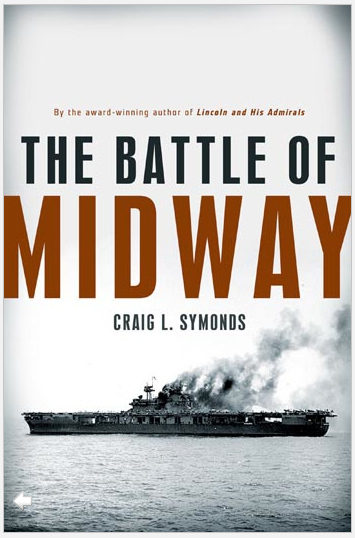
When I read a good book this year, I’ll post a book report on this blog — and The Battle of Midway by Craig L. Symonds is a very good book.
I confess that most of my recreational reading time is spent devouring history, especially military history: tales of Lord Nelson’s navy, the American Civil War, World War One aviation, and the great battles of World War Two. So, “The Battle of Midway” is right up my alley.
 Having read a lot of history books, I’m not easy to please. Too often, history is written in a dry and academic way. I dare you to hack your way through Thermopylae: The Battle That Changed the World by Paul Cartledge. The legendary last-stand heroism of King Leonidas and his 300 Spartans deserved more than a repetitive, impenetrable compendium of scholarly knowledge with no regard to dramatic storytelling.
Ever since I read the great Civil War histories of Bruce Catton and Shelby Foote, I’ve come to appreciate that the best, most readable history books address their subjects with a novelist’s gift for character and story. And that’s what Craig Symonds brings to his stirring account of the Battle of Midway: a game-changing confrontation that was essentially the Gettysburg of World War Two in the Pacific.
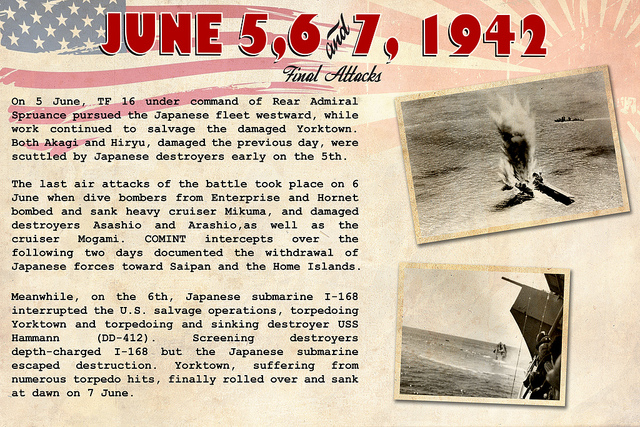
As the sun rose on June 4, 1942, six months after Pearl Harbor, the Japanese navy was supreme in the Pacific. Before the day was over, the U.S. Navy had turned the tide. Like the Confederacy after Gettysburg, the Japanese would continue to fight – and the bloodiest years of the war lay ahead – but the Japanese could no longer win the war.
 I’ve enjoyed Craig Symonds’ work before. A retired professor and chairman of the history department at the U.S. Naval Academy, Symonds wrote A Battlefield Atlas of the Civil War (1983) and Gettysburg: A Battlefield Atlas (1992), both of which I’m proud to have on my groaning history bookshelf. Those two books, with their easy-to-read maps and clear, concise copy make the great Civil War battles easy to comprehend. With no less clarity, Symonds goes deeper into the personalities and drama in The Battle of Midway.
Symonds begins by painting a bleak picture of American naval power after the disastrous surprise attack on Pearl Harbor. But, as dire as the situation was, with a seemingly unstoppable Japanese aircraft carrier force (the Kido Butai) imposing it’s will across the Pacific, the U.S. Navy’s own carriers had been absent from Pearl Harbor – and, within six months, would provide the platform for a counterstrike that would lay waste to the Kido Butai.
 Symonds draws all the main characters with the skill of a novelist: Admirals Nimitz, “Bull” Halsey and Spruance as well as the poker-loving gambler, Admiral Yamamoto. But Symonds doesn’t dwell solely on the brass – he also gives us a chance to meet the pantheon of heroes who flew the torpedo bombers, dive-bombers, and fighter planes, as well as the seamen who manned the guns on the ships, fought the fires on their decks, and patched up the holes to keep them afloat.
 By the time Symonds gets to the fateful, pivotal and incredible five-minute period in which American dive-bombers mortally wounded three of the four Japanese carriers in the Kido Butai – and thus changed the course of the war in 300 seconds — it’s clear how it happened, why it happened, and who was responsible.
“What I tried to do is put together the oral histories to recreate a moment” to make readers feel like they’re there, Symonds has said. “It allows us to put ourselves in their place.”
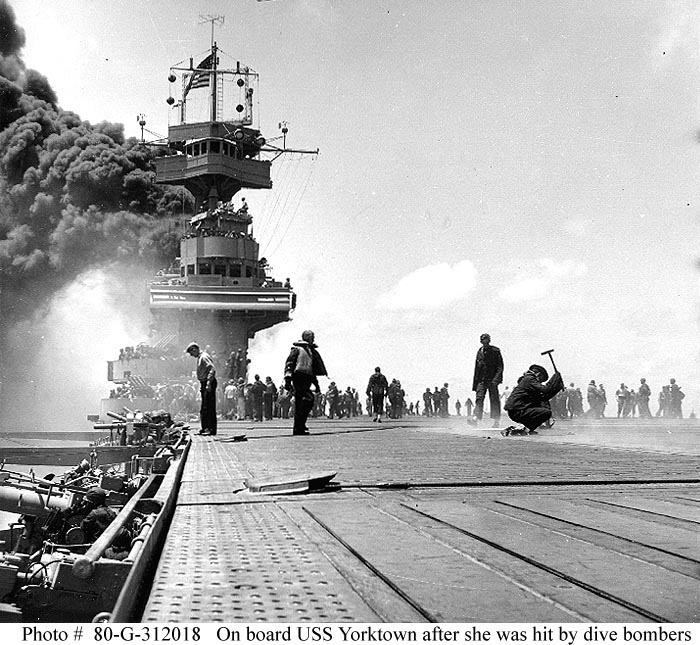 Particularly compelling in Symonds’ account is the story of the American carrier, USS Yorktown. The Yorktown had been badly damaged by a Japanese bomb on May 8, 1942 in The Battle of the Coral Sea. The crippled Yorktown limped into Pearl Harbor on May 27. It was expected that repairs would take three months. But Admiral Nimitz needed the Yorktown for his planned attack on the Kido Butai at Midway – so the repair crews at Pearl Harbor fixed her up and sent her back out to sea in just three days. Four days later, the Yorktown was fighting the Battle of Midway. Alas, the Yorktown did not survive Midway, but before she went down, her dive-bombers had sunk the Japanese carrier Soryu.
 The Battle of Midway is part of Oxford’s Pivotal Moments in American History series — and in the introduction to his book, Symonds writes: “there are few moments in American history in which the course of events tipped so suddenly and dramatically as it did on June 4, 1942. At ten o’clock that morning, the Axis powers were winning the Second World War… An hour later, the balance had shifted the other way. By 11:00 a.m., three Japanese aircraft carriers were on fire and sinking. A fourth was launching a counterstrike, yet before the day was over, it too would be located and mortally wounded. The Japanese thrust was turned back. Though the war had three more years to run, the Imperial Japanese Navy would never again initiate a strategic offensive…”
 The Battle of Midway is a great read. The resolute self-sacrifice of the doomed Navy torpedo bombers will bring you to tears. The courage, ingenuity and resourcefulness of the fire suppression and repair crews on the Yorktown will amaze you.
And, among other vastly interesting things, you’ll find out how Chicago’s O’Hare Airport got its name.
If you think you don’t like military history books, give this one a try.



 Paul's Voyage of Discovery & Etc.
A Wild Winter Weekend in the Windy City!
These pictures don’t quite capture the wondrous sight we beheld – but they’ll have to do.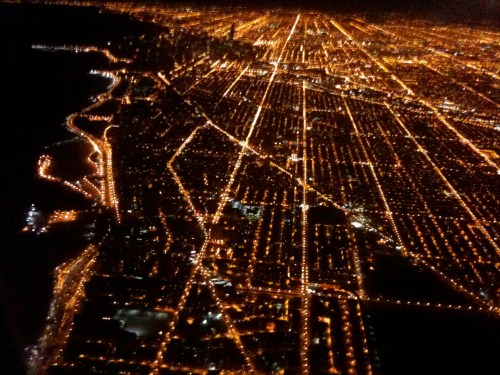
This video was taken at the corner of Central Street and Central Park.
And BTW – these are not rolling hills dusted with snow. This is a flat parking lot on which they just dumped these man-made mountains of snow. The Evanston kids were loving it! King of the hill!
Brad and I had been on campus for the great Blizzard of ’79, so this fabulous frosting brought back many snowed-under undergraduate memories.
We left Chicago on Monday, February 7th – and it was snowing again. Here’s Steve’s neighborhood on Hartzell, just before the flakes began to fall…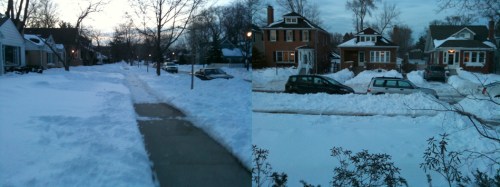
In this video, shot in front of Steve’s house, you can see the big flakes falling. It was time for Steve’s industrious neighbor to get his snow blower out again – and time for Brad and me to get out of town while we still could.
Getting back to the relative warmth of a February night in Los Angeles, I hurried to the Terminal 4 parking garage and found that my car battery was dead. As I waited for AAA to arrive, I was comforted by the thought that at least I wasn’t waiting while stuck in a three-foot drift on a slushy road in Chicago. And that I didn’t end up like one of those unfortunates snowbound on Lake Shore Drive.
Share this post:
Leave a comment
Filed under Adventure, Random Commentary
Tagged as Blizzard of '79, Brad Hall, Chicago, Emilia Barrosse, Evanston, Northwestern, O'Hare Airport, Paul Barrosse, Rock Me, snow, snow storm, Steve Rashid, thundersnow