Category Archives: Politics

Fantasy Politics & The Election of 2012

The Iowa Caucuses are over and the New Hampshire Primary is upon us. The Presidential election of 2012 is already well underway. Given that President Obama is unlikely to encounter any serious primary challenge on his open road to the Democratic Party’s nomination in Charlotte, North Carolina in the first week of September – the media focus has been squarely on the Republican contenders vying for the chance to deny Barak Obama re-election on the first Tuesday in November.
Of course, it’s a long, long time until November 6, 2012. We’ll know the winner of the Super Bowl, the NBA Championship, and the World Series before Election Day. And we’ll know the winner of American Idol, The Biggest Loser, Survivor, and who gets the guy on The Bachelor long before we know if any of the GOP field was able to take down Obama. A lot can happen between now and then. But looking at the Republican contenders arrayed against Obama (and each other) it’s hard not to feel the odds are in favor of the World’s Most Famous Former Community Organizer.

Much has been written (on the Right and Left) about the lackluster GOP hopefuls and the lack of party popularity enjoyed by the “inevitable” frontrunner Mitt Romney. You’d have to be living in a cave (which Osama bin Laden evidently wasn’t) not to have heard about how Mitt’s Mormonism, flip-flopping, and career as a multi-millionaire corporate raider make him a poor fit with this era’s angry, populist, anti Wall Street, Tea Party GOP electorate.

This schism between Main Street Republican voters and Wall Street has rank political opportunists like Newt Gingrich attacking Romney for his role as a profit-worshipping venture capitalist.

Strange days, indeed.
Each month (and sometimes each week) brings a new “anyone but Mitt” candidate surging into contention. As if to prove there’s no limit to the GOP’s anti-Romney anxiety, we’ve been treated to the entertaining rise and unsurprising fall of the scandalous blowhard Herman Cain, cute but crazy Michelle Bachmann, and rejected Republican re-treads like Newt Gingrich and Rick “Please don’t Google me” Santorum.
Trying to temper my disdain for these apparently preposterous Republican Presidential candidates, I remind myself that, back in 1980, we all thought Ronnie “Raygun” Reagan was an unelectable right wing nut job. Progressives cannot afford to gloat or get comfortable. However, if the GOP has any chance of winning the White House, the U.S. economy must go into free fall. But with the Dow Jones Average above 12,000 and unemployment falling steadily, the Republicans are forced into rooting for America to fail in order to win an election. Not a good bet.

So, in order to make the Presidential Election of 2012 interesting, I suggest participating in a game that keeps even lackluster NFL, NBA and MLB seasons interesting: a fantasy league.

Introducing FANTASY POLITICS…

FANTASY POLITICS

In fantasy politics, you are the campaign manager of your own team of two Republican Presidential candidates. You need to know how the daily news cycle, the primaries and caucuses affect the two candidates on your roster and how to minimize their gaffes, maximize their endorsements, and collect delegates through the long primary season on the road to the GOP nomination. Here’s how the candidates on your roster are impacted by the rules of fantasy politics.

FANTASY SCORING

Fantasy points are generated from the action on the campaign trail. When a GOP candidate on your team avoids a dangerously quotable gaffe during a debate, earns a newspaper endorsement, or wins a state primary, your fantasy team earns points for the week. The sum of your two candidates’ points combine to compete against the total for your opponent’s team for the week.

Sample Scoring:

Newspaper Endorsement +1

John McCain Endorsement -1

Debate Victory +1

Debate Gaffe -1

Positive News Story +1

Embarrassing YouTube Moment -1

Primary Delegates (1 point per delegate)

Really Good Concession Speech Upon Withdrawal (10 bonus points)

CANDIDATE ELIGIBILITY

Campaign managers can choose any two GOP candidates in the field as of Tuesday, January 10th, the day of the New Hampshire Primary. I’d say the Virginia Primary – but, of course, Newt Gingrich and Rick Perry failed to qualify for the ballot in Virginia – and our fantasy game would simply not be as much fun without them.

Candidates who are still in the race on Super Tuesday, March 6, 2012, earn 100 bonus points, in addition to any delegates they pick up that night in the collection of primaries and caucuses in Alaska, Georgia, Idaho, Massachusetts, North Dakota, Ohio, Oklahoma, Tennessee, Vermont, and Virginia. If neither of your candidates made it to Super Tuesday, you’re out of luck. And out of your misery.

DROP AND SWAP

On the day after Super Tuesday, campaign managers will have 24 hours to “drop and swap” candidates. This may not be fair – but it’s politically expedient: a chance for the rats to escape the sinking ships. However, if a candidate you dropped after Super Tuesday manages to make it to the Republican Convention in Tampa, Florida in late August with even a handful of delegates – you will be deducted one point for every delegate who votes in the Convention to nominate the candidate you dropped.

INJURY DESIGNATIONS

Sorry, unlike in the football, basketball, and baseball fantasy leagues, all of your GOP candidates must play hurt. Politics is not a game for sissies. There is no disabled list. If there was, a mentally disabled candidate like Rick “Frothy” Santorum, or an emotionally disabled candidate like Mitt “I like being able to fire people” Romney would not be on the roster. Instead, they’re leading GOP contenders. Suit up, shut up, and get up for the game.
SCORING CORRECTIONS

Occasionally the official elections returns from a particular state may be recounted and changed to accurately reflect what happened at the ballot box. In such circumstances, campaign managers may block a recount by making an appeal to the U.S. Supreme Court. (See “Bush v. Gore”)

THE WINNER

The winning campaign manager is the political genius that managed to back the two GOP candidates who got the furthest down the road on the way to winning their party’s nomination – and earned the right to lose to President Obama by a landslide on Election Day, Tuesday, November 6, 2012.
3 Comments

Filed under Politics, Sports

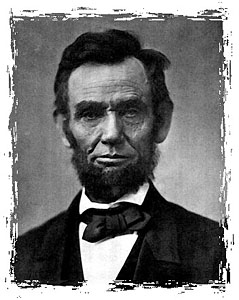
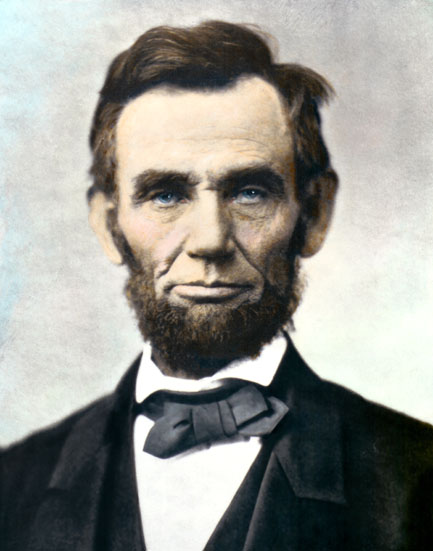
Lincoln’s Proclamation of Thanksgiving: Context, Conflict and Commemoration.

Abraham Lincoln issued the Presidential proclamation that set the precedent for our national day of Thanksgiving on October 3, 1863.

On that date, America was just past the halfway point in the Civil War. The great Union victories at Gettysburg and Vicksburg in July of ‘83 had raised hopes in the North that the Southern rebellion was doomed – but two months later, the Confederate victory at Chickamauga proved that the war was far from over.

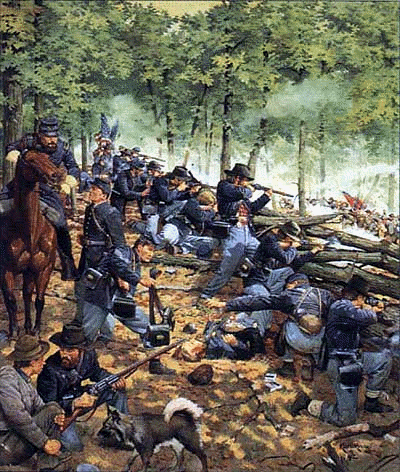
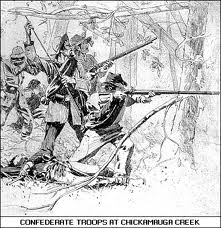
The Battle of Chickamauga, September 19 and 20, 1863, were the two bloodiest days in American history. Chickamauga claimed the lives of 1,657 Federal troops — with 9,756 soldiers wounded and 4,757 missing for a total of 16,170 casualties out of 58,000 troops.

Painting by Keith Rocco

Confederate losses were just as steep: 2,312 dead, 14,674 wounded and 1,468 missing for a total of 18,545 out of 66,000 troops.

It was only the courageous rear-guard stand of Union General George “Pap” Thomas – the legendary “Rock of Chickamauga” – that kept the Federal army from suffering a total rout in northern Georgia — and set the table for a Union victory at the Battle of Missionary Ridge two months later on November 25, 1863.

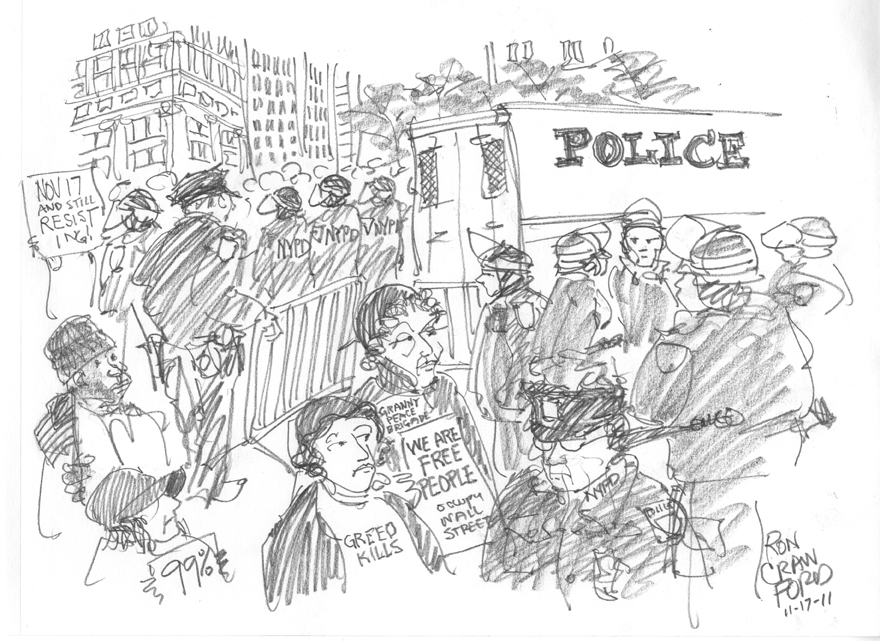
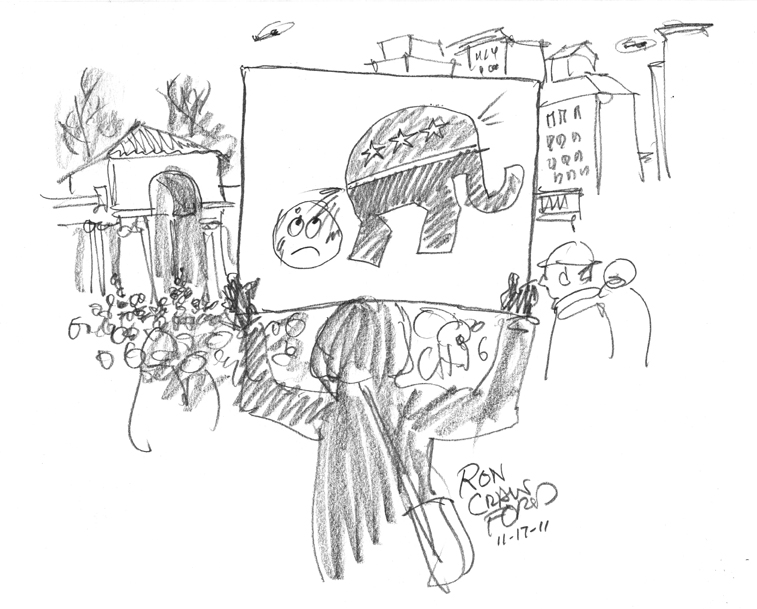
Drawing by Ron Crawford

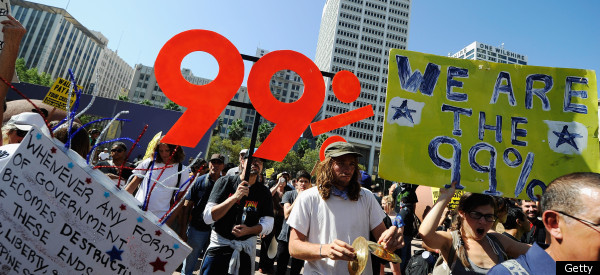
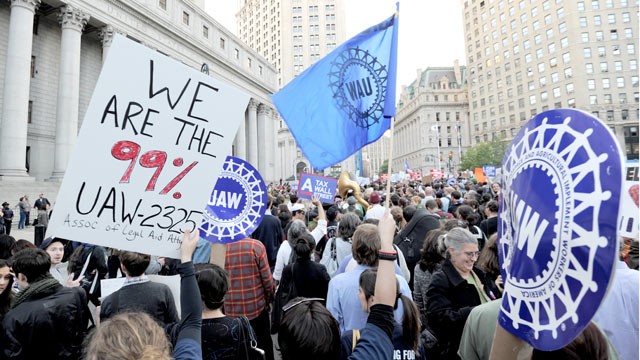
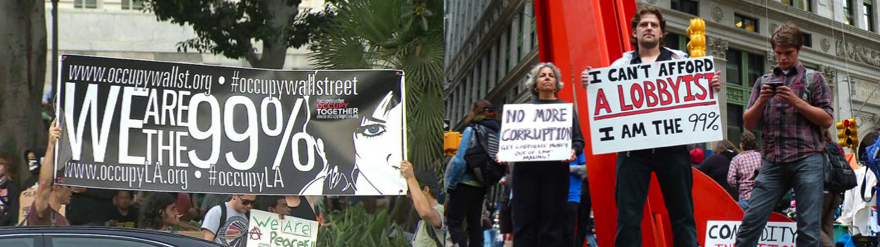
Today, though the Occupy Wall Street movement is provoking a healthy dialogue about the plight of the 99% versus the insane, unbalanced power, influence and affluence of the 1% — America is not embroiled in a civil war on the scale of the 19th Century War Between the States.

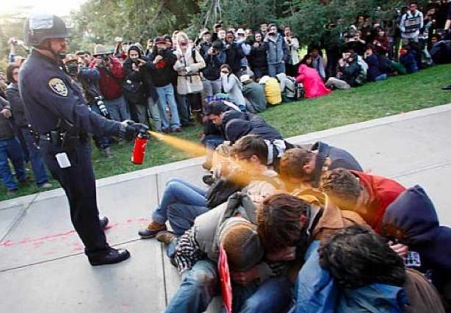
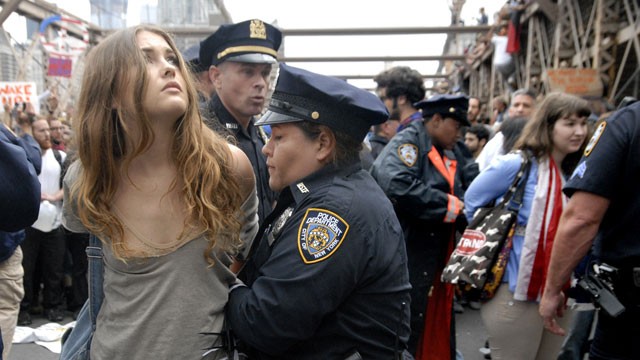
But, with pepper spray, police “batons”, riot gear, and other forms of authoritarian violence being directed against ordinary Americans seeking freedom and social and economic justice — it’s not entirely beyond the pale to suggest that this year’s Thanksgiving celebration falls on a date fraught with historic significance.

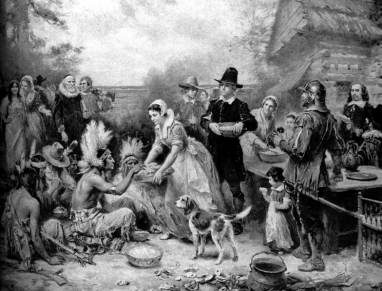
So today, November 24, 2011, let’s remember why Abe Lincoln established Thanksgiving as a national holiday in a much more desperate and pivotal moment in our national history. And let the Occupy Wall Street movement dine on turkey today — and draw strength for the battles ahead.

By the President of the United States of America.

A Proclamation.

The year that is drawing towards its close has been filled with the blessings of fruitful fields and healthful skies. To these bounties, which are so constantly enjoyed that we are prone to forget the source from which they come, others have been added, which are of so extraordinary a nature, that they cannot fail to penetrate and soften even the heart which is habitually insensible to the ever watchful providence of Almighty God.

In the midst of a civil war of unequaled magnitude and severity, which has sometimes seemed to foreign States to invite and to provoke their aggression, peace has been preserved with all nations, order has been maintained, the laws have been respected and obeyed, and harmony has prevailed everywhere except in the theatre of military conflict; while that theatre has been greatly contracted by the advancing armies and navies of the Union.

Needful diversions of wealth and of strength from the fields of peaceful industry to the national defense, have not arrested the plough, the shuttle or the ship; the axe has enlarged the borders of our settlements, and the mines, as well of iron and coal as of the precious metals, have yielded even more abundantly than heretofore.

Population has steadily increased, notwithstanding the waste that has been made in the camp, the siege and the battlefield; and the country, rejoicing in the consciousness of augmented strength and vigor, is permitted to expect continuance of years with large increase of freedom. No human counsel hath devised nor hath any mortal hand worked out these great things. They are the gracious gifts of the Most High God, who, while dealing with us in anger for our sins, hath nevertheless remembered mercy.

It has seemed to me fit and proper that they should be solemnly, reverently and gratefully acknowledged as with one heart and one voice by the whole American People.

I do therefore invite my fellow citizens in every part of the United States, and also those who are at sea and those who are sojourning in foreign lands, to set apart and observe the last Thursday of November next, as a day of Thanksgiving and Praise to our beneficent Father who dwelleth in the Heavens. And I recommend to them that while offering up the ascriptions justly due to Him for such singular deliverances and blessings, they do also, with humble penitence for our national perverseness and disobedience, commend to His tender care all those who have become widows, orphans, mourners or sufferers in the lamentable civil strife in which we are unavoidably engaged, and fervently implore the interposition of the Almighty Hand to heal the wounds of the nation and to restore it as soon as may be consistent with the Divine purposes to the full enjoyment of peace, harmony, tranquillity and Union.

In testimony whereof, I have hereunto set my hand and caused the Seal of the United States to be affixed.

Done at the City of Washington, this Third day of October, in the year of our Lord one thousand eight hundred and sixty-three, and of the Independence of the Unites States the Eighty-eighth.

By the President: Abraham Lincoln

Happy Thanksgiving, everybody!

And god bless the Occupy Wall Street Movement!

3 Comments

Filed under Art, History, Politics

“You Can’t Evict An Idea”

A billionaire autocrat orders his police force in riot gear to clear a public square of peaceful demonstrators in an early morning raid. This riot squad makes dozens of arrests and destroys the protestors’ personal property. The authorities also muzzle the press, confiscate cameras, order news helicopters out of the airspace above, and arrest journalists in an effort to keep news of this suppression of free speech and the right of assembly out of the morning papers.

This must be an old story out of Egypt or Libya, right?

Or did it happen yesterday in Syria or Yemen?

No, sadly. It happened here.

In New York City, Generalissimo Bloomberg sent his shock troops to evict Occupy Wall Street from the now legendary Zuccotti Park, which has become, according to one journalist, “the epicenter of the worldwide movement protesting corporate greed and economic inequality.”

At one o’clock in the morning on November 15, the NYPD announced that OWS protesters had to vacate Zuccotti Park with their belongings so that it could be cleaned. Following that announcement, hundreds of cops in riot gear raided the park.  About 200 people were arrested: 142 in the park, another 50 to 60 nearby – including many journalists, despite their press credentials.

The problem for El Presidente for Life Michael Bloomberg – who should be paying more attention to recent history — is that such authoritarian tactics cannot stop a truly popular movement. Even as cops and the sanitation works trashed the tents and occupied the park, the Occupy Wall Street media team was already issuing a statement saying, ”You can’t evict an idea whose time has come”.

The statement continued: “This burgeoning movement is more than a protest, more than an occupation, and more than any tactic. The ‘us’ in the movement is far broader than those who are able to participate in physical occupation. The movement is everyone who sends supplies, everyone who talks to their friends and families about the underlying issues, everyone who takes some form of action to get involved in this civic process.


“Such a movement cannot be evicted. Some politicians may physically remove us from public spaces – our spaces – and, physically, they may succeed. But we are engaged in a battle over ideas. Our idea is that our political structures should serve us, the people – all of us, not just those who have amassed great wealth and power. We believe that is a highly popular idea, and that is why so many people have come so quickly to identify with Occupy Wall Street and the 99 per cent movement.”

Well said, OWS.

Within hours of the raid, the National Lawyers Guild obtained a court order allowing OWS to return with their tents to the park. Emperor Don Pedro Magnifico Bloomberg has said he’ll challenge that court ruling.

So, the legal battle for Zuccotti park is not over. But, in many ways, the larger struggle for hearts and minds in America is already being won. The 99% have raised their voices and are being heard.

Big Brother may try to confiscate newsmen’s cameras and TV camera can be kept at bay – but the thousands of iPhones in the hands of Little Brother can capture the truth and post it for millions to see within minutes.

For instance, you can see a great photo timeline of the eviction at this link:

http://www.buzzfeed.com/mjs538/occupy-wall-street-evicted-from-zuccotti-park

As comedian Rick Overton has said, “Big Brother may be watching. But Little Brother is watching Big Brother.”

You can’t evict an idea whose time has come.

6 Comments

Filed under Politics, Truth

Capturing Occupy Wall Street: The Crawford Chronicles

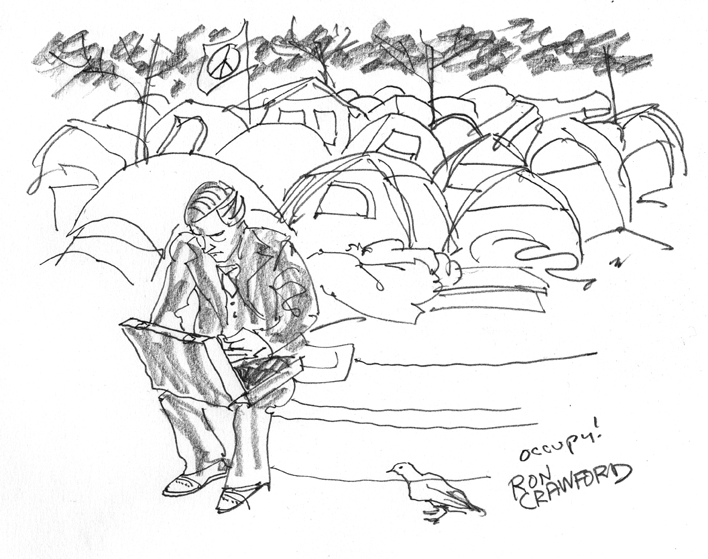
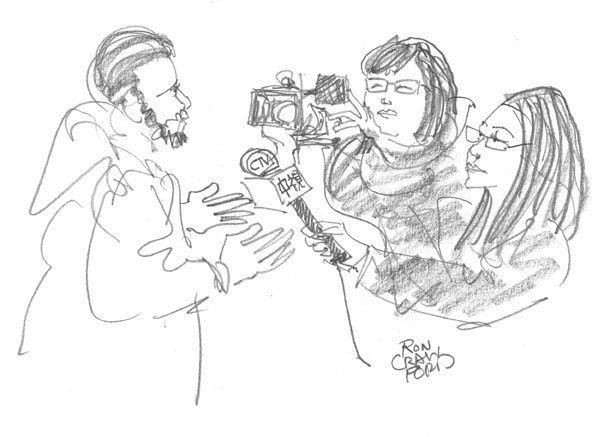
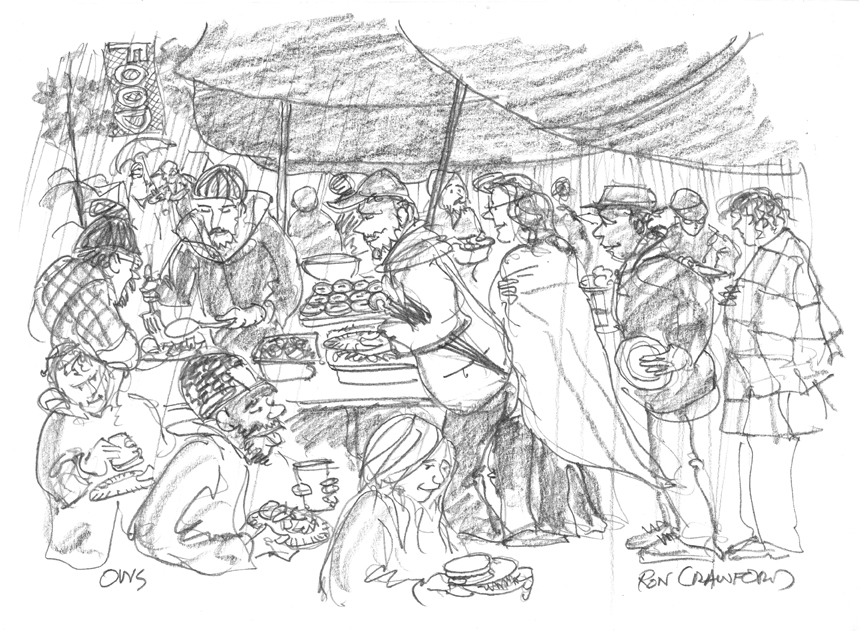
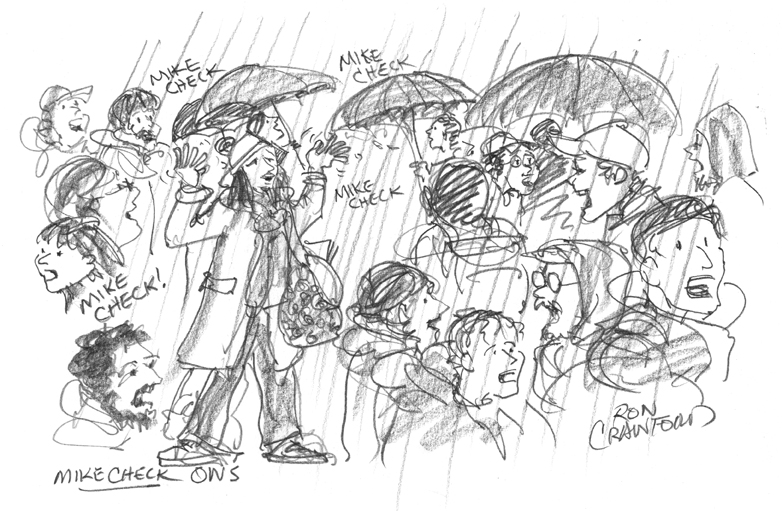
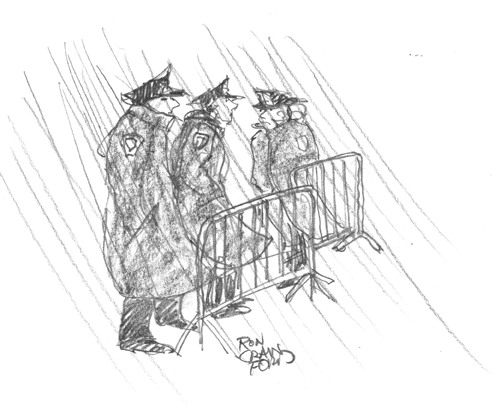
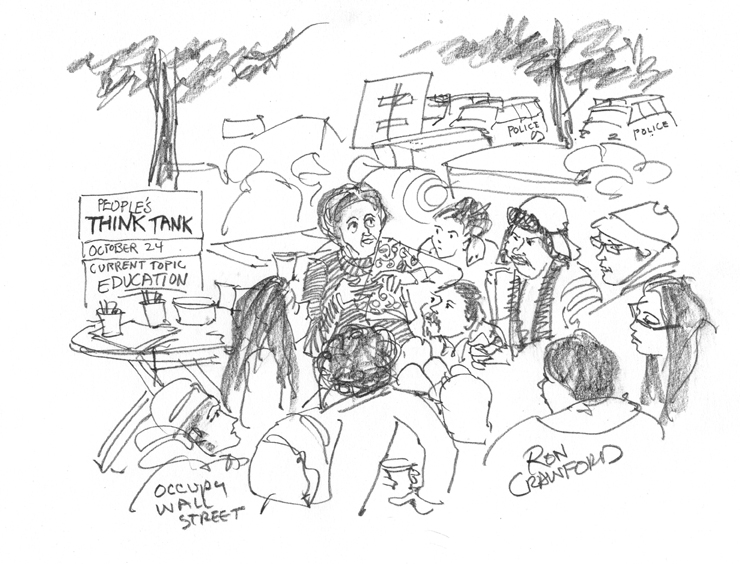
Our great friend, the outrageously talented artist, Ron Crawford, has been spending a lot of time at Occupy Wall Street in lower Manhattan. Here’s another gallery of images that Ron has captured with his keen eye and splendid pen.

Solidarity forever!

The commentary that follows is Ron’s own.

“Down this morning to OWS. Keeping the place neat and clean. We donated some thin metallic blankets for warmth.”

“Here is the brass statue made famous in the 9-11 photo.”

“The fire department took their bio-diesel generator away so they’re recharging cell phones and computers with bicycle generators. The rigs were brought in by Times Up. Note their logo on the computer guy’s cap.”

1 Comment

Filed under Art, History, Politics

The Occupy Wall Street Movement Doesn’t Need Black Bloc Buffoonery.

It’s obvious to readers of this blog that I am in wholehearted solidarity with Occupy Wall Street and the struggle for economic and social justice for the 99% of our citizens who have been increasingly denied their fair share of the American Dream.

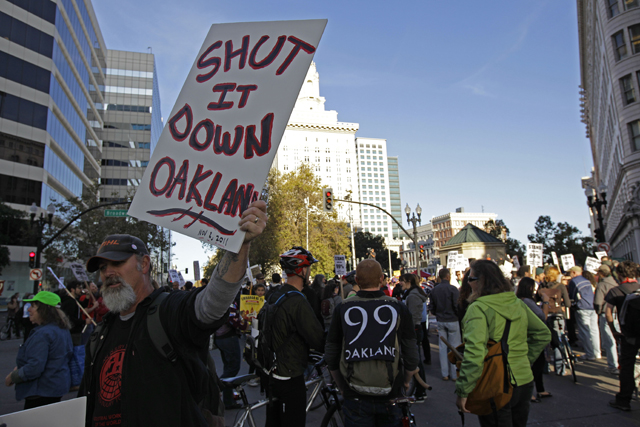
As the OWS movement has spread from lower Manhattan to big cities and small towns across the country, few of these protests have attracted more national headlines than Occupy Oakland, especially after last week’s spasm of police violence energized the Bay Area movement, leading to today’s General Strike and the effective closing of the Port of Oakland by thousands of patriots rallying to the cause of the 99%.

However, among the media reports on today’s General Strike in Oakland, I was disturbed to read this article by Ben Margot of the Associated Press.

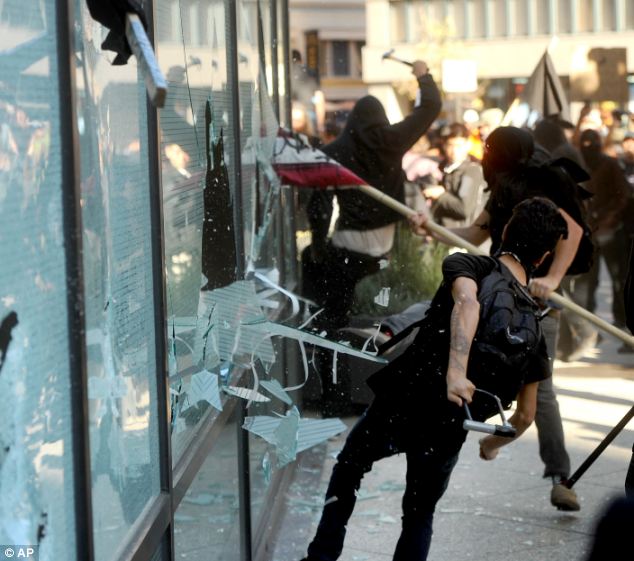
OAKLAND – Protesters supporting the Occupy Wall Street movement smashed the windows of a Wells Fargo bank branch in downtown Oakland on Wednesday during a day of demonstrations in protest of wealth inequalities.

 A group of about 300 men, many wearing black, some carrying wooden sticks, was part of a group of hundreds who set out to cause a general strike in the area around City Hall. The smaller group smashed several windows of the Wells Fargo branch while chanting, “Banks got bailed out; we got sold out.” They also spray-painted an expletive on the outer wall of the bank. Employees were inside while this took place, but it did not appear that anyone got hurt.

 Who were these 300 vandals “many wearing black, some carrying wooden sticks”? Were they right wing provocateurs infiltrating the OWS movement to discredit it?

The Raw Story blog shed more light on black bloc tactics in Oakland:

“The vast majority of the protesters remained peaceful, but a small group of black bloc protesters defaced ATMs and broke windows at Wells Fargo, Bank of America and Chase Bank branches as the protesters marched through downtown, according to the Oakland Tribune.

 A group of protesters also vandalized a Whole Foods store and someone spray-painted “fuck” on the side of the Christ the Light Cathedral.”

And who are “black block protestors”?

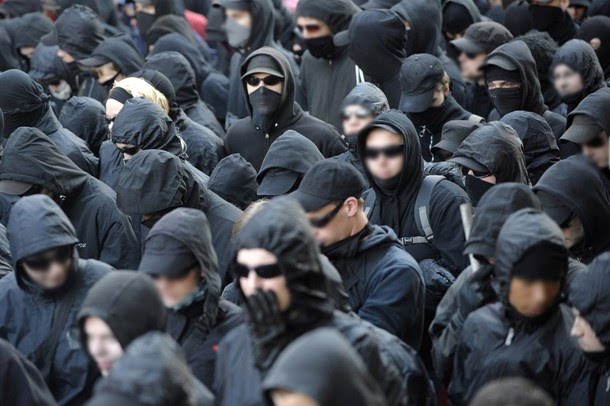
You can click on this link to get the full story – but basically, a black bloc is a tactic in which protestors wear black clothing, scarves, ski masks, and other concealing garb to avoid identification and promote solidarity. Black bloc tactics include vandalism, rioting and street fighting.

Black bloc? Let’s just say no to the black bloc.

The Occupy Wall Street movement is doing just fine, thank you, without black bloc tactics. OWS is attracting the old as well as the young, middle class teachers and union workers as well as students and unemployed youths. Dressing in black and hiding your face while engaging in violent acts will not win the hearts and minds of the 99% in America.

If the police attack non-violent protestors, OWS keeps the moral high ground. If the police crack down on provocateurs that smash windows and paint obscenities on bank buildings, grocery stores and churches – then that’s just the cops doing their job.

Scott Olsen, the Iraq War veteran who was shot in the head with a tear gas canister by the Oakland police during a courageous act of non-violent resistance did more to win average Americans to the cause of the 99% than any of these window-smashing anarchists ever will.

Remember the words of John Lennon, who knew a thing or two about street demonstrations and the struggle for social justice.

You say you want a revolution
Well, you know
We all want to change the world
You tell me that it’s evolution
Well, you know
We all want to change the world
But when you talk about destruction
Don’t you know that you can count me out

 You say you got a real solution

Well, you know
We’d all love to see the plan
You ask me for a contribution
Well, you know
We’re doing what we can
But when you want money
for people with minds that hate
All I can tell is brother you have to wait

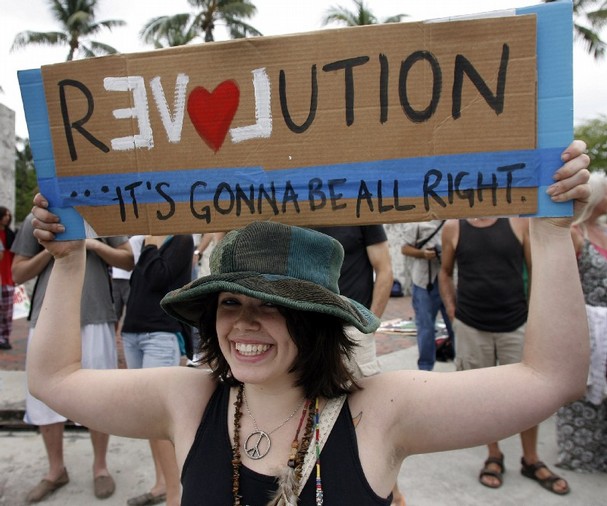
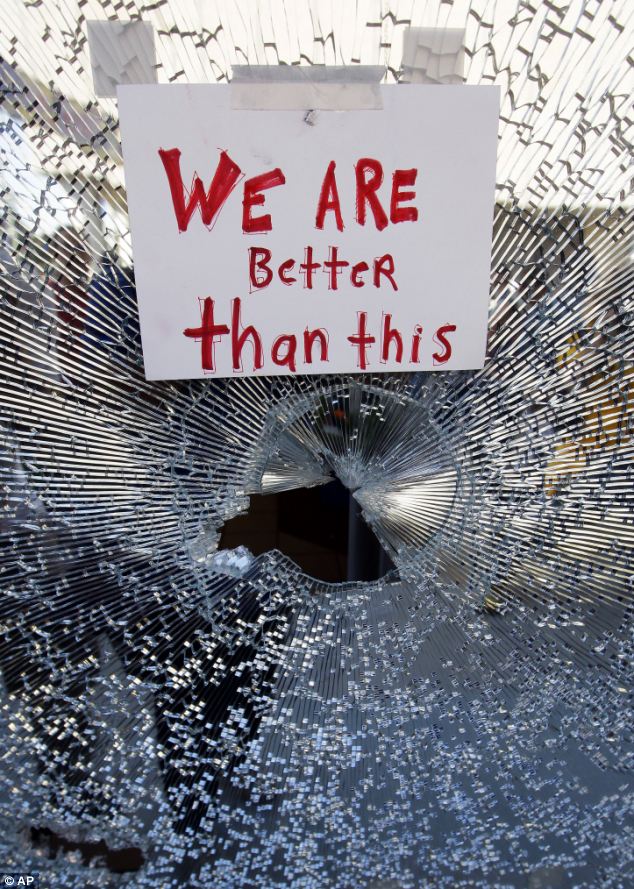
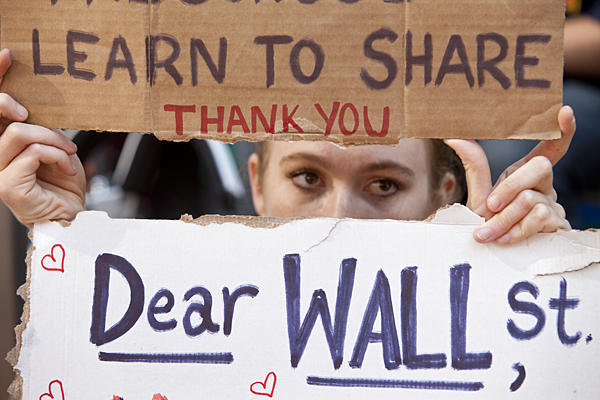
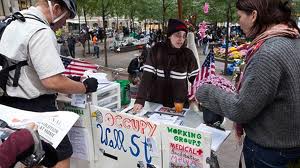
We win a lot more hearts and minds when our movement looks like this…

Rather than this…

Or this….

Rather than this…

OWS must stay non-violent. The movement has already changed the national conversation in a positive way. The politicians, pundits and media are talking more about OWS and the legitimate concerns of the 99% than yesterday’s national debt hysteria.

Martin Luther King won. Ghandi won. Dressing up is a black disguise and busting windows is only a way to lose. So, take off those black masks. Put down those clubs. Pick up a witty, pithy sign – and join the peaceful movement that’s on the verge of changing the status quo.

Let’s not snatch defeat from the jaws of victory.

3 Comments

Filed under Politics

Occupy Wall Street: Thomas Paine & Ron Crawford Capture the Moment

Words by Thomas Paine — Drawings by Ron Crawford..

“These are the times that try men’s souls…

“The summer soldier and the sunshine patriot will, in this crisis, shrink from the service of his country; but he that stands by it now, deserves the love and thanks of man and woman.”

“Tyranny, like hell, is not easily conquered; yet we have this consolation with us, that the harder the conflict, the more glorious the triumph.”

1 Comment

Filed under Art, History, Politics

An Artist Occupies Wall Street.

My good friend, the great artist Ron Crawford, went to Zuccotti Park on Friday October 21st and did what he does best: capture a scene in a few dynamic sweeps of his gifted pen.

Click on the drawing and blow it up.

I always love to see which details Ron chooses to focus on in his inspired sketches — like the word “Empathy” and the concerned fellow with a briefcase in the foreground.

Thanks, Ron – for giving those of us who can’t be there an eyewitness view of Occupy Wall Street that is, in many ways, more personal and revealing than a photo. (More drawings after the video.)

2 Comments

Filed under Art, History, Music, Politics

Wall Street Calling!

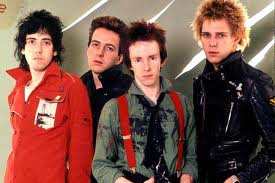
With apologies (and thanks) to Joe Strummer and Mick Jones, a marching song for the Occupy Wall Street movement.

To listen, click on Wall Street Calling.

WALL STREET CALLING

Wall Street calling to American towns
Resistance declared, and protest come down
Wall Street calling to the rest of the world
Come out of the cupboard, you boys and girls
Wall Street calling, the gamble’s gone bust,
Phony Reaganomics has bitten the dust
Wall Street calling, see the cops got no swing
‘Cept for the ring of that truncheon thing
 
Justice is coming,
karma’s coming ‘round
Payback expected,
the moguls goin’ down,
Too big to fail,
but I have no fear
‘Cause Wall Street is calling, and I…
I occupy Wall Street!!
 
Wall Street calling to the Tea Party clones
Forget it, brothers, they’ve stolen your bones
Wall Street calling to the Democratic left
Better start marching, and draw another breath
Wall Street calling, and I don’t wanna preach
But this is our moment, the goal’s within reach
Wall Street calling, there’s light after dark
When we stand together in Zuccotti Park
 
Justice is coming,
karma’s coming ‘round
Payback expected,
the moguls goin’ down,
Too big to fail,
but I have no fear
‘Cause Wall Street is calling, and I…
I occupy Wall Street!
 
Wall Street calling, yes, now is the time
To start standing up for the 99
Wall Street calling – We’re not goin’ away
City by city – we’re seizing the day
 
Wall Street calling
Occupy D.C.
Wall Street calling
Occupy Detroit
Wall Street calling
Occupy Cleveland
Wall Street calling
Occupy L.A.
Wall Street calling
Occupy Portland
Wall Street calling
Occupy Austin
Wall Street calling
Occupy ‘Frisco
Wall Street calling
Occupy Boston
Wall Street calling
Occupy Salt Lake

1 Comment

Filed under Music, Politics, Truth

Occupy Wall Street: 10 Suggestions for the 99% Manifesto

At long last, after three decades of Reaganomics and Wall Street sociopathology have hollowed out the US economy and shifted an ever-increasing percentage of our nation’s treasure to the coffers of the ruling class (in a redistribution of wealth that would make Robin Hood blush) – the youth who have been handed an empty burlap sack labeled “The American Dream” have taken to the streets to Occupy Wall Street.

And while the GOP and the corporate media pretend to be confused about what these demonstrations are all about, it’s clear to most of us: 99% of Americans are getting screwed by a economic/political system that is rigged in favor of the wealthy, the powerful, and their multinational corporations.

In recent days, the Occupy Wall Street movement has begun to articulate a message, if not a list of demands. Trying to remain inclusive, movement leaders (who spend a lot of time trying to reach small “d” democratic consensus) have largely been content to raise questions and provoke thought and discussion, rather than declare themselves for a specific agenda of legislative and legal solutions to the class warfare being waged against the 99%. The fact that the Occupy Wall Street movement is growing is a sign that their Socratic method is working – even if it confuses Fox & Friends.

Inspired by Occupy Wall Street, I’ve given thought to the questions raised by those young patriots in lower Manhattan’s Zuccotti Park – and have arrived at 10 suggestions for an as-yet-to-be-written Manifesto of the 99%.

1. Greed is not good

Sorry, Gordon Gekko, but you and your ilk have had 30 years to make your case – and you’ve failed. Your supply side rising tide did not lift all boats — only your mega-yachts. The Ayn Rand devotees in the GOP can push that everyone for his own interests, dog-eat-dog mantra all they want – but that dog won’t hunt. It’s time to relegate Greed to its ignominious place among the 7 Deadly Sins.

2. Corporations are not people
Sorry, Justice Scalia, Roberts, Alito, Thomas and Kennedy, but corporations are organizations licensed by the government (We, the People) to transact certain business under the law (again, We the People). In exchange for this license – which carries with it certain benefits and protections — We, the People can set legal limits to what corporations can and can’t do, and that includes making sure that big business can’t corrupt our electoral system by pouring anonymous billions into political advertising campaigns.
3. Fair trade not free trade

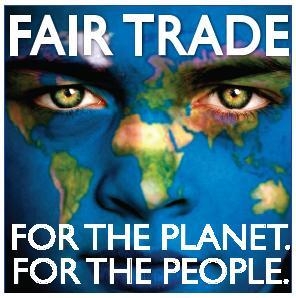
NAFTA, CAFTA, I don’t care which Free Trade treaty our government has signed, American workers have gotten the raw end of the deal. As long as Mexican, Chinese and other foreign workers can be paid a pittance compared to the American labor force, and the companies that hire them don’t have to operate under the same standards for worker safety and environmental protection that Americans have fought for a century to establish in this country – then THAT may, indeed, be free trade. But it is trade free of fairness to struggling American labor and the precious, endangered environment we all share. I’d rather see protective tariffs return than continue to see “free trade” agreements send us racing to the bottom.

4. Privatization is not a panacea

 I have one question for those who say the U.S. Post Office should be run like a business – or that the Post Office should be privatized. Is it profitable for the Post Office to pick up a few letters from farmers on remote farms in Iowa – or down in some isolated Appalachian valley? No, it’s not. A for-profit operation would soon decide that delivering a postcard to Granny down in the holler wasn’t worth their time and effort. That’s why the U.S. Post Office can’t be run like business: it’s an egalitarian service to all Americans.

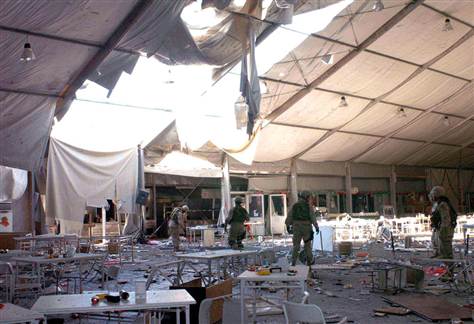
Consider this: Haliburton had a contract to feed our troops in Iraq (something the Army used to do for itself.) There’s an age-old military practice of staggering meal times for smaller groups of soldiers in a combat zone to avoid predictable concentrations of troops that the enemy can exploit. If the bad guys know all our soldiers eat regularly at a certain time – boom! That’s the time to hit us.  But Haliburton decided these staggered times and smaller groups were not cost-effective. It was more profitable to have fewer meal times for larger groups of troops. Thus, on December 21, 2004 — as hundreds of U.S. troops and other personnel crowded into a large mess tent in Mosul for their midday meal – a suicide bomber struck, killing 22 troops and contractors and injuring 69.  How many lives would have been saved if the Pentagon had not privatized the feeding of our troops?

5. The unions make us strong

The 8-hour workday. The 5-day work week. Overtime. The end of child labor. Occupational safety standards. Vacation pay. All of these things we take for granted are part of our nation’s fabric because of blood, sweat and tears shed by organized labor. That’s why the conservatives hate unions. That’s why the corporate elite supports GOP governors who run as moderates – then quickly pivot hard to the right to enact their anti-union agendas. We’ve seen it in Wisconsin, Michigan, Ohio and Maine, etc. The right wing may have been successful since the Reagan administration in portraying organized labor as corrupt (sometimes with good reason) and detrimental to free enterprise – but, all in all, the unions make us stronger.

6. Taxes pay for the commons

Rachel Maddow says it all in one of her television commercials. Standing in front of Hoover Dam, she makes the point that no person could have paid to build such a massive public works project, no town could have done it, and no state could have done it: it took a nation to build Hoover Dam. The same is true of the Interstate Highway System we all drive on, the water systems we all drink from, the public schools, the military, and that damned Post Office. Locally, our taxes pay for cops, firefighters and other first responders. Taxes make these institutions and services (collectively “the commons”) possible. Taxes are the cost of a civilized society. Ss Elizabeth Warren has so succinctly pointed out, the wealthy benefit more from the commons than the rest of us – and therefore, should pay a fair share of the taxes.

“There is nobody in this country who got rich on his own. Nobody. You built a factory out there — good for you.

 “But I want to be clear. You moved your goods to market on the roads the rest of us paid for. You hired workers the rest of us paid to educate. You were safe in your factory because of police forces and fire forces that the rest of us paid for. You don’t have to worry that marauding bands would come and seize everything at your factory and hire someone to protect against this because of the work the rest of us did.

 “Now look. You built a factory and turned into something terrific or a great idea — God bless! Keep a big hunk of it. But part of the underlying social contract is you take a hunk of that and pay forward for the next kid who comes along.”

7. Health care is a human right

Health care is not a commodity and does not work within the capitalist, for-profit, supply and demand economic model. Why not? It’s simple. If I want to buy a car, I have lots of options. I can buy an expensive new car, a low-cost used car, or a “previously owned” car (which is somewhere in the middle). I have lots of different makes and models and dealerships to choose from. And, if I don’t like the price – I can just walk away. Take the bus, carpool, or ride my bike if I need to.

But if your dad drops to the floor suffering a heart attack and the paramedics take him to the nearest emergency room – and he needs emergency bypass surgery – you don’t have a choice. You can’t check out the prices at other hospitals. You must do what’s possible at that moment to save your dad’s life. Likewise, if you have breast cancer, you’re not going to shop for the cheapest treatment — no matter what you’re financial situation is. You must have the most effective course of treatment your doctors recommend, whatever the cost. Capitalist rules don’t apply in health care – which is why all the other industrialized, civilized countries have national non-profit health care systems. Duh.

8. Fossil fuels are so 20th Century

Do I really need to point out that we can’t keep drinking oil? China is getting out front in the solar energy industry while the GOP grandstands on the Solyndra “scandal”. The real scandal for the GOP is that the Obama administration appears willing to act on a policy that generations of politicians on both sides of the aisle have only given lip service: end American dependence on foreign oil. Obama also talks a good game about making the U.S. a leader in Green technology and the solar, wind and geothermal energy sources of the future. Let’s hope it’s not just talk. So far, there are encouraging signs that the President means what he says. (We’ll see what happens with that Keystone XL shale oil pipeline.)

9. Voter ID laws = voter suppression

Voter fraud is not a problem in this country. The statistics make it clear that our democracy is not threatened by voter fraud. However, our democracy is threatened by the new Jim Crow: GOP-sponsored voter ID laws in an increasing number of Republican-controlled states. In order to defend against a non-existent threat, GOP lawmakers are making it harder for older and poorer folk to vote. Why? Because older and poorer folk (especially minorities) tend to vote for Democrats. When you hear the words “voter ID” – it’s all about voter suppression.

10. Jesus was a liberal

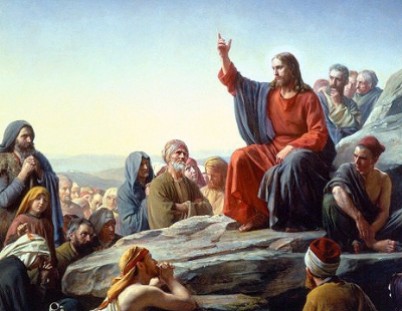
Sorry, all you conservative evangelicals at the Value Voters summit, but Jesus was a lefty. He was all for helping the poor and the sick. I don’t remember a single miracle in which Jesus restored a merchant’s business to profitability. In fact, He had some tough words for the rich.

Again I tell you, it is easier for a camel to go through the eye of a needle than for a rich man to enter the kingdom of God.” No ambiguity there. Now, Jesus wasn’t into class warfare. In fact, He wasn’t into war at all. “Blessed are the peacemakers.” I could go on and on. Jesus never uttered a word against homosexuals, He urged us to visit people in prison, and He wanted us to, above all, “Love each other as I have loved you.” Sounds like one of those freaking, bongo-playing hippies in Zuccotti Park. Bless them all.

9 Comments

Filed under Politics

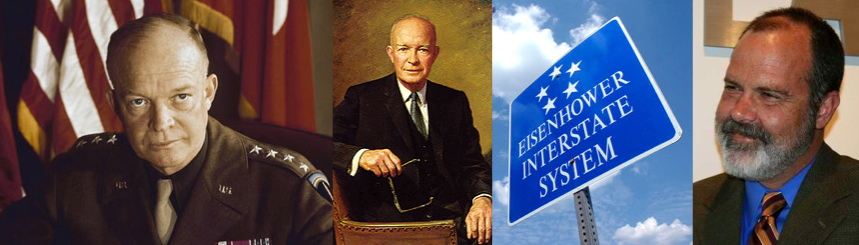
A New Presidential Biography Reminds Us Why We Should Like Ike.

On October 4th, Jim Newton’s Presidential biography, Eisenhower: The White House Years arrives in bookstores.

This is exciting news. Not just because the author is a very dear friend of mine – but because I can’t think of a more apropos time since his Presidency ended in 1960 for us to look back on Ike’s two terms in the Oval Office.

My buddy Jim Newton is a veteran newspaperman who began his career at the New York Times. Since I’ve known him, he’s been an editor at the Los Angeles Times, where he’s now the editor-at-large. In 2006, Jim wrote a definitive biography of Chief Justice Earl Warren entitled, Justice for All.

Now, he’s focused his brilliance and talent on the man who put Earl Warren on the court.

Hold on. It was Republican who put the classic “activist judge” Earl Warren on the Supreme Court?

Indeed. And that’s just one of the reasons it’s a good time to revisit the Eisenhower Presidency.

More than a half-century after Dwight D. Eisenhower left office, his old campaign slogan “I like Ike” has become a cliché. But, in this era of Tea Party Republicans and Ronald Reagan worship, it’s nostalgic to recall a Republican President who would never have said, “The nine most terrifying words in the English language are, ‘I’m from the government and I’m here to help.’”

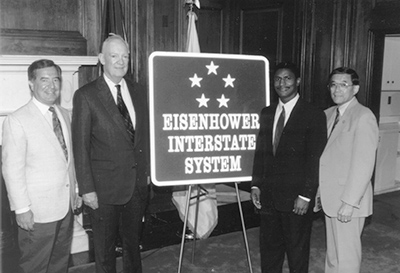
That kind of simplistic, anti-government demagoguery would not have appealed to the complex man who built our interstate highway system and sent Federal troops to Little Rock, Arkansas to enforce school desegregation.

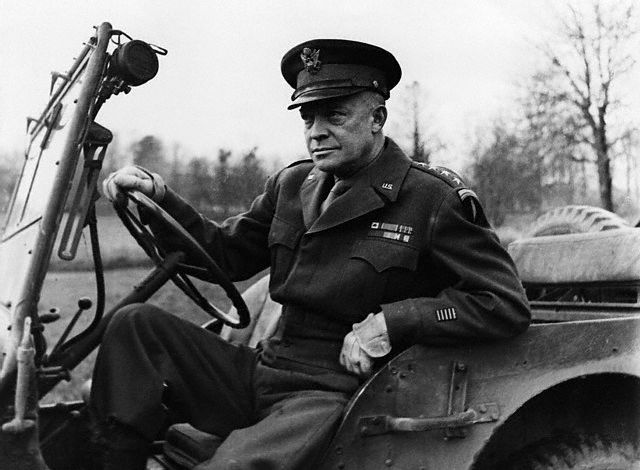
In a move that would be anathema to today’s dogmatic GOP states’ rights defenders, Ike ordered units from the 101st Airborne Division to Little Rock on September 24, 1957. The next day, those soldiers escorted nine black students through the front door of Central High and into its formerly all-white classrooms. Of course, Ike had some previous experience with the paratroopers of the 101st. 13 years earlier in a little dustup called D-Day on June 6th, 1944. The Screaming Eagles followed Ike’s orders into their drop zones behind the beaches at Normandy – and into the hallways of a Little Rock high school.

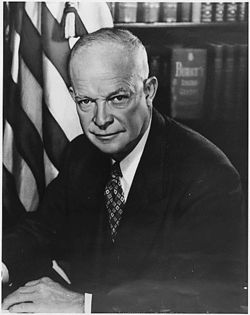
But Jim’s book is not about General Dwight Eisenhower, the Supreme Allied Commander who led his forces to victory in World War Two. It’s about the Eisenhower, who, like George Washington and Ulysses S. Grant, went from the highest-ranking military leader in an epochal war to Commander in Chief as the thirty-fourth President of the United States.

I was born in 1958 during Ike’s second term, but John F. Kennedy was the first President that I was aware of – and my first clear memory of Kennedy was watching his funeral on TV.

During my boyhood, President Eisenhower was a distant figure: even more dimly remembered than General Eisenhower, the hero of D-Day and all those World War Two movies I loved and re-created in my backyard.

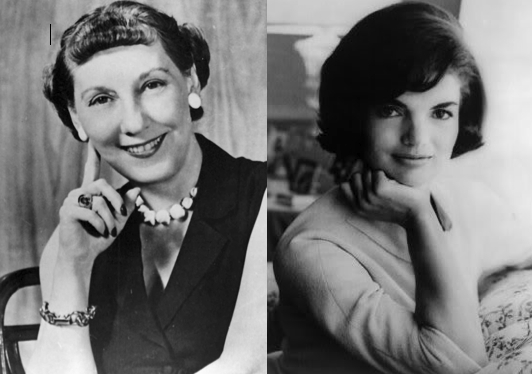
Comedians made jokes about Ike playing golf and how homely his wife Mamie was. After the glorious Jackie Kennedy enchanted The White House, dowdy Mamie didn’t have a chance.

By the time I was in high school, my sense was that Eisenhower’s Presidency, if I thought of it at all, didn’t amount to much. He was a dull President in a dull time. Thank goodness, 16-year old Paul didn’t write the book on Ike.

I certainly wasn’t alone in thinking of Eisenhower as little more than the Caretaker-in-Chief, hitting the links with Bob Hope and presiding over an easygoing, black & white, “Leave It To Beaver” American society. Long after I graduated from college in 1980 that was still the prevailing attitude about Ike’s time in the Oval Office. There was, however, residual gratitude on the Democratic Left for Eisenhower’s lukewarm endorsement of Vice President Dick Nixon in the 1960 race against Kennedy.

The laugh was on Dick. Dick got the last laugh.

Pressed by reporters to give an example of Nixon making a key contribution to his administration, Ike said, “Give me a week and I’ll think of one!” Priceless. Nixon went on to lose to Kennedy in one of the tightest Presidential races in American history. Nixon got the last laugh, though. Not only did Tricky Dick win the White House eight years later – that same year, 1968, Nixon’s daughter Julie won the hand of Ike’s grandson David in marriage.

But, looking back at Ike’s Presidency, it’s hard to imagine why, as a callow youth, I thought his time in office so inconsequential. Eisenhower was the second President to have an atomic bomb in his arsenal — and he refused to use it. He kept radical anti-Communist McCarthyism at arm’s length until it became, as he called it, “McCarthywasm.”

And, after lifting the nation out of its post World War Two debt, he was the last president until Democrat Bill Clinton to leave office with a budget surplus. The top marginal tax rate under Eisenhower was 91%. George W. Bush slashed that rate to 35%. Ike paid for WWII and built our highway system. George W. Bush built nothing and left us in debt to China.

For these, and many more reasons, this lifelong Democrat likes Ike. And I like Jim’s book. But you don’t have to depend upon my endorsement (which is so much more enthusiastic than Ike’s backing of Nixon) – you can just check out these amazing reviews…

“A truly great book, spirited, balanced, and not just the story of President Eisenhower but of an era.”
 Bob Woodward

Jim Newton does a masterful job illustrating the forces that confronted Dwight Eisenhower during his years in the White House, from nuclear politics to race relations to the federal debt and deficit. He paints a vivid portrait of a president struggling to find middle ground—sometimes successfully, sometimes not — but always with the good of the country in mind.” 
Dianne Feinstein, U.S. Senator

”

“Newton’s contribution is as cogent an inventory of Eisenhower’s White House years as I’ve ever read… This is a book for all who are interested in a better understanding of how America and the World were shaped post–WWII and for those who aspire to lead: Read Newton’s book first.”
 Chuck Hagel, U.S. Senator (1997–2009)

“Ike’s wisdom, born of experience and intellect, is on display in this important book, which heightens appreciation for his leadership. Newton reveals, for instance, that after the Korean War, only one American soldier was killed in combat during Eisenhower’s presidency. This volume contributes to our understanding of an outstanding human being.”
 George P. Shultz, 60th U.S. Secretary of State

“Jim Newton’s ‘Eisenhower, The White House Years’, simply and eloquently, delivers the man, his Presidency and, if America is paying attention, the life lessons that are his legacy.”
 Norman Lear

“Jim Newton’s brilliant reassessment of Eisenhower’s presidency is long overdue, and his book makes it clear that Ike was indeed a great president. Ike’s insistence on always doing the right thing for the country despite party pressure and personal predilection serves as a valuable model for politicians in all three branches of government.” Former FBI Director, William S. Sessions.

Buy my friend Jim Newton’s book today — and learn what a principled, heroic Republican used to be. And, alas, you’ll know why bipartisanship is a thing of the past.

I still like Ike.

Now more than ever.*

* With apologies to Nixon’s 1972 campaign.

3 Comments

Filed under History, Politics