Category Archives: History

Baseball Season Opens: Of Mud Hens & More…

Baseball is back. Which means that, for some of us, the suffering has just begun.

But despite the travails and triumphs of the teams we follow with such passion each season, the classic American game that legend has attributed to Abner Doubleday — played with a bat and ball — is fundamentally a profound and simple joy.

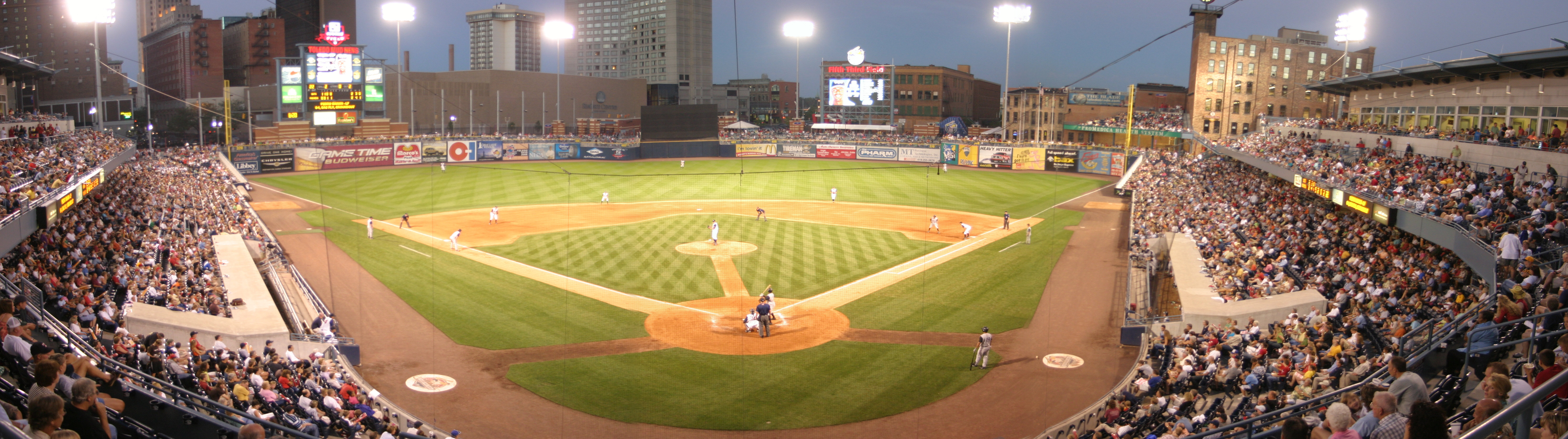
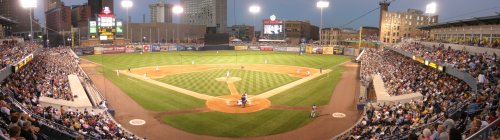
My hometown Cleveland Indians opened this 2010 baseball season on April 5th in Chicago by scratching out just four hits in a 6-0 loss to the White Sox. An ill omen, to be sure. Three days later, 250 miles east on Interstate 80, it will be Opening Day for the Toledo Mud Hens.

For some, the Toledo Mud Hens are a team of 16” softball players who played from the mid 1980’s to the early 90’s in the Chicago Theatre League, led by their manager and sweet-singing slugger, Coach Tom “Wolf” Larson. (More on these Mud Hens later.)
But for the vast majority of those who follow baseball, the Toledo Mud Hens are a minor league baseball team that plays in the International League. The current Mud Hens are the latest of a series of pro ballclubs that have called Toledo home since 1883.

For many years, "M*A*S*H" star, Jamie Farr, was the Toledo Mud Hens most high-profile fan -- other than Wolf Larson, of course.

The name “Mud Hens” was bestowed upon the team in 1896, as one of the two parks they played in that year was located near marshland inhabited by American Coots, also known as marsh hens or mud hens.

Today, the team mascot’s name is Muddy, and the female mascot is named Muddonna. (Which sounds a bit sacrilegious to this former altar boy’s ears – but I’m sure the reference is to the pop singer not the BVM. Which should not be confused with the MVP.)
I find it particularly interesting to note that The Mud Hens have a connection to my hometown, though only the most trivia-obsessed baseball fan living beyond Northeast Ohio will be intrigued to learn that The Mud Hens relocated temporarily to Cleveland from 1914-1915. The move was made to ensure that Cleveland’s League Park would have a game every day – and thus help the Cleveland Indians to counter territorial threats by the Federal League. (Damn that upstart Federal League!)
Another Cleveland connection to The Mud Hens is even more surprising. When the team was playing in Cleveland, it took on a new nickname: the “Iron Men”. The nickname of my high school alma mater, Cleveland Central Catholic, is “The Ironmen”. This is the kind of information baseball fans love to exchange in the long pauses between pitches, between innings, and between hot dogs and beer.

No, Alex Rodriguez was never a Mud hen -- but in 2007, they did (with beak in cheek) offer free agent A-Rod a contract that included a bonus for hitting 75 home runs in ‘08 and leading them to 10 straight International League titles. Hank Steinbrenner, son of the Yankees owner, asked The New York Times: "Does he want to go into the Hall of Fame as a Yankee, or a Toledo Mud Hen?”

The Mud Hens may be a minor league team, but they’ve had a lot of major league talent over the years – and some legendary ballplayers have worn Mud Hens gear, including Addie Joss, Travis Fryman, Kirby Puckett, Casey Stengel, Jim Thorpe (yes, that Jim Thorpe), Frank Viola, and the great, drunken Chicago Cub’s slugger, Hack Wilson, who knocked in 191 RBI’s for the Cubbies in 1930 – a major league record that still stands. Click here for a complete list of Toledo Mud Hens alumni enshrined in the Baseball Hall of Fame.

It should also be noted that Toledo is the site of a failed late 19th Century attempt to break pro baseball’s color line. The 1884 Toledo Blue Stockings of the American Association, was the only major league team with black players (Moses Fleetwood Walker and his brother, Welday Walker) before Jackie Robinson and the Brooklyn Dodgers made history in 1947. Sadly, Cap Anson, the racist star of the Chicago White Stockings (alas, the modern day Cubs) refused to play on the same field as a black man. Though Anson relented when told his team would lose its share of the gate for an exhibition game against Toledo – Anson’s steadfast resistance to interracial play helped to draw an ignominious color line in baseball for another 63 years.

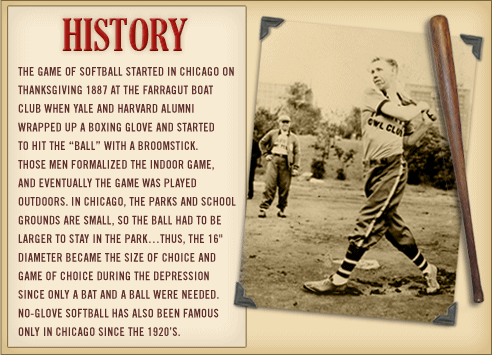
Now, back to 16” softball. Most of what you need to know about this wacky, egalitarian, and blessedly coed sport is encapsulated in this graphic from the website of the Chicago 16” Softball Hall of Fame.
Back in 1983, the Practical Theatre Company joined the fledgling Chicago Theatre Softball League, and someone — most likely Coach Wolf Larson himself — dubbed our team The Toledo Mud Hens. We played against teams from the Remains and Steppenwolf Theatres, among others. Bashing around the big 16” orb, a good time was had by all. And who can forget the time John Malkovich helped us to tackle Donny Moffat and give him a pink belly? But I digress…
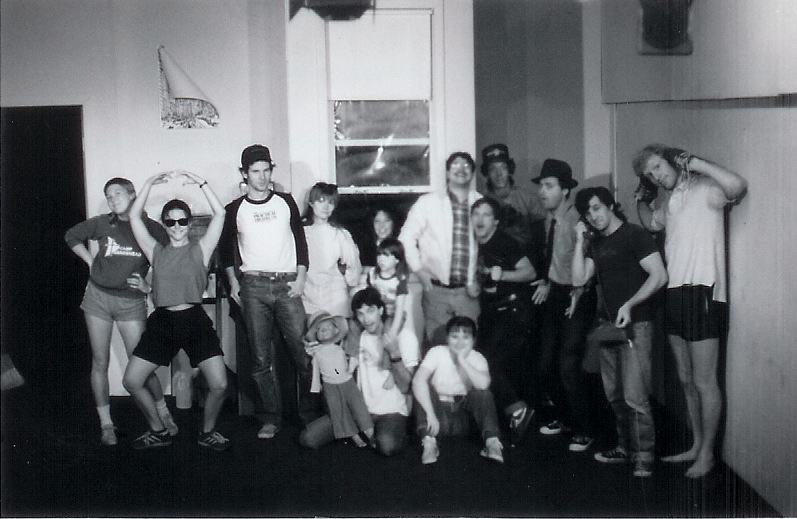
Toledo Mud Hens on the stage of the PTC's John Lennon Auditorium (1983).
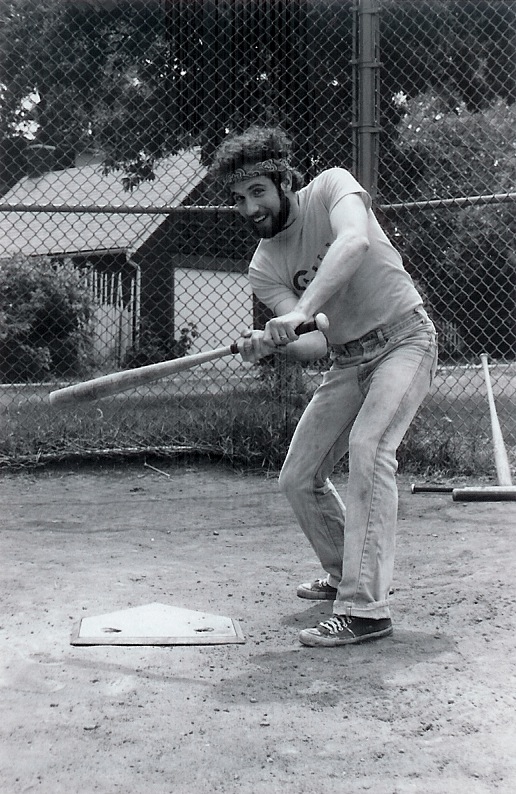
Jeff Lupetin. (Dig that crazy headband!)

These photos, taken in 1983, capture the distinctive batting stances of the early PTC Toledo Mud Hens. What we lacked in skill, we made up for in style. Of course, not all Mud Hens were without skill. Coach Wolf consistently crushed the ball at the plate and caught everything in centerfield within reach – and many that were far out of reach.

Terry Barron was a real honest-to-goodness shortstop that could field and throw with dexterity and flair. I witnessed Terry’s heroics many times from my post at third base. How good was I? Well, I still have a bent ring finger on my left hand from where I mishandled yet another bouncing, bounding 16” projectile.
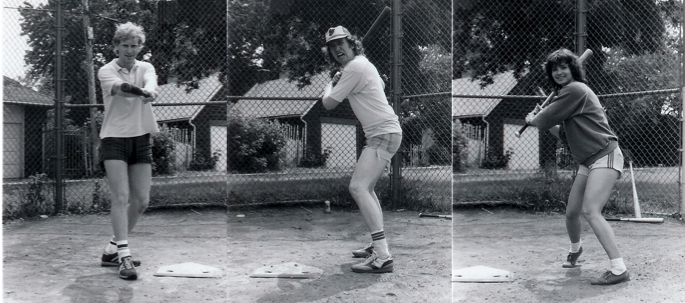
Brad Hall, Casey Fox at the Bat, Isabella Hoffman

Julia Crowe, Jim McCutchen, Sally Nemeth
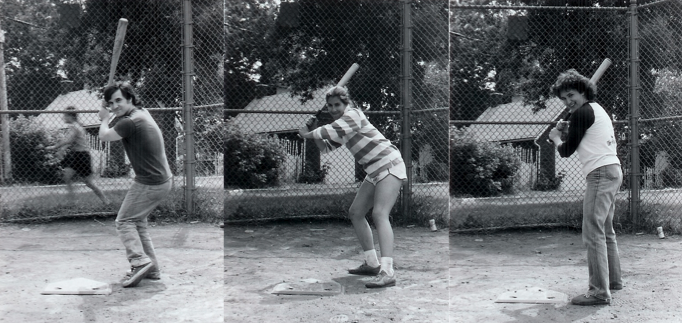
The Author, Stacy Upton, Shelly Goldstein
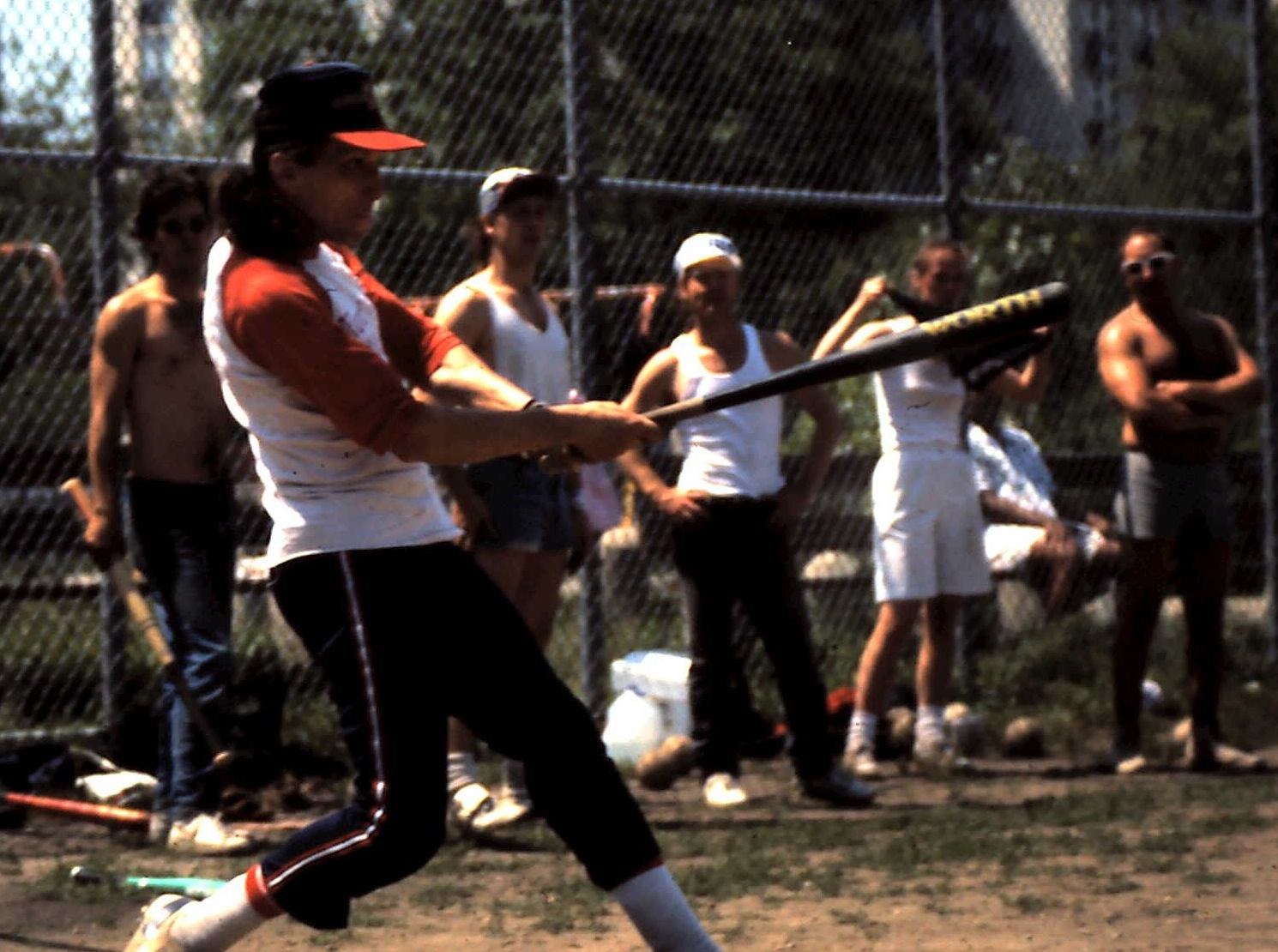
As Coach Wolf hits, note the all-star lineup of Hens on deck. (Photo by Jim McCutchen)

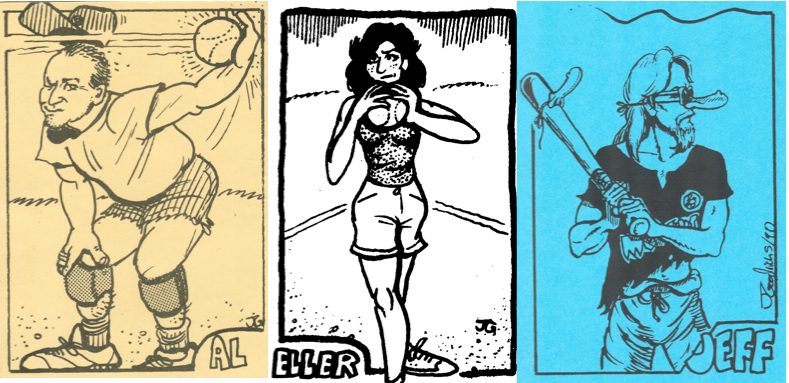
Over the years, players came and went – but Coach Wolf continued to hold the team together with the help of player-manager Ken Snedegar, and a new cast of Mud Hens clucked together into the early 1990’s. This edition of The Mud Hens was a winner. Heck! They even won league championships! And they had baseball cards, drawn by John Goodrich.

Here’s a select batch of some of Johnny B’s favorite Mud Hens cards from the six sets that he and Ken Snedegar produced. John tells me that many Mud Hen veterans have chosen the Paul Barrosse card from the first set (1985) as their favorite Mud Hen card portrayal of all time. It certainly captures my proficiency in the field.
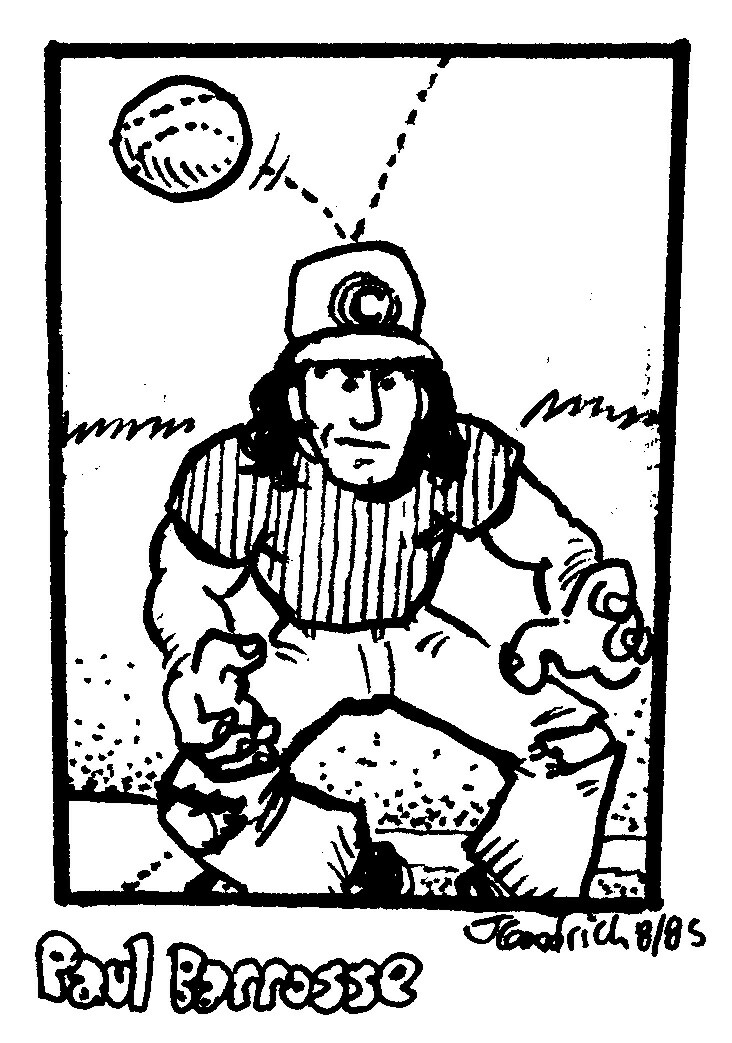
For John, half the fun of the cards was the meticulous stats and “fun facts” on the backs, supplied by Captain Snedegar. You can see by the reading the back of Barb Reeder’s card in ’90 how far John and Sned progressed in their card-making, stat-tabulating craft.

Today, Coach Wolf is living in faraway Madrid, Spain – where I presume they have no 16” softball. Yet I know that, even in Spain, Wolf Larson is well aware that it’s baseball’s opening week – and that The Toledo Mud Hens will take the field to start the 2010 season this Thursday.

As for the Chicago Theatre League’s Toledo Mud Hens – they played in the league championship final on August 31, 2009. Does anyone know who won? Do we still know any Mud Hens on that team? Let’s hear you cluck, Mud Hens!
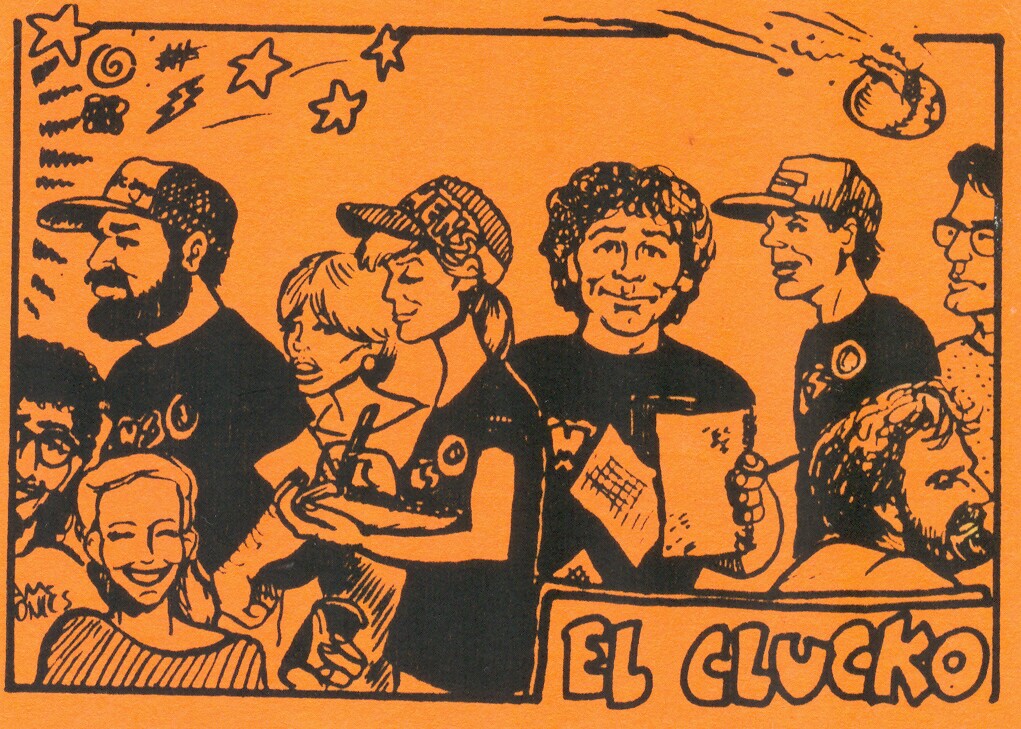
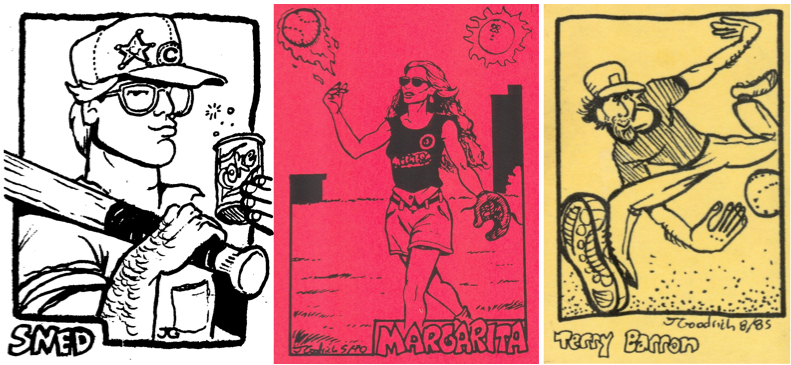
Now, here’s a gallery of classic Chicago Theatre League Toledo Mud Hens Cards, drawn by Johnny B. Goodrich.
16 Comments

Filed under Art, History, Sports

The Saints Come Marching In…

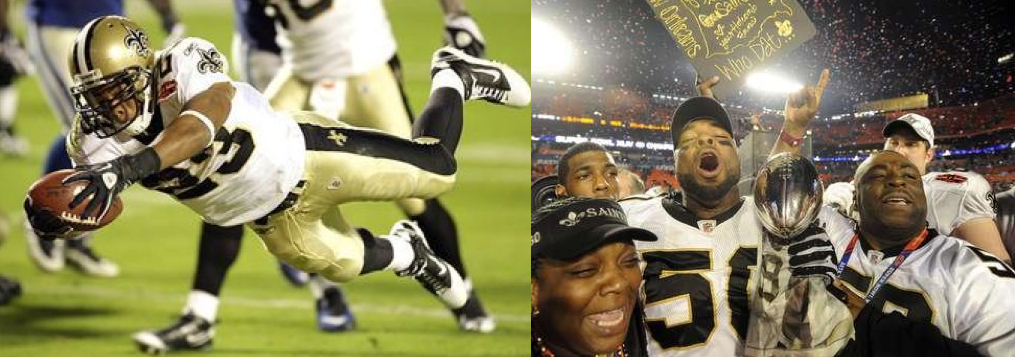
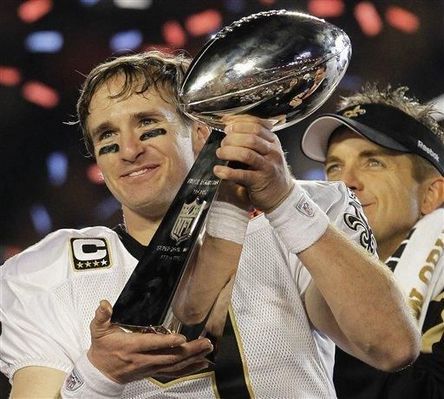
You don’t need to read this blog to know that the long-suffering New Orleans Saints won their first Super Bowl this weekend. Their emphatic 31-17 victory over the Indianapolis Colts touched off a party in the French Quarter that will ramble into the Mardi Gras festivities next week. Oh, how I long to be in that number, marching with the jazz bands stepping out down Bourbon Street, celebrating the Saints’ deliverance of the Crescent City from five years of neglect and misery after Hurricane Katrina nearly washed my father’s fabled hometown away.

For centuries, New Orleans has been the cradle of the Barrosse clan. It’s the only town in the United States where you can pick up a phonebook and find lots of people named Barrosse – and they’re all my kin. My father, Peter Adelmard Barrosse, was born there in 1927 (in the 9th Ward, near Jackson Barracks), and though he never again lived in the Big Easy after the Korean War, New Orleans loomed large in our family. We made a couple memorable visits to see my Grandma Barrosse and our many aunts, uncles and cousins – and I returned there several times in the 1980’s to work the Renaissance Faire in nearby Metairie. My grandmother, who lived to be 96, was still alive then – and the New Orleans Saints were still losers.

As if I didn’t suffer enough sports misery as a Cleveland Indians and Browns fan (and later a Cubs fan) – it was also my lot, through my father, to follow the Saints. The team was born at an NFL league meeting on November 1, 1966, which fell on All Saints Day. As New Orleans is just about the only Roman Catholic town in the south, the team’s ownership named them the Saints for the holiday on which they were born. For the next four decades, their heavenly name would be one of the few blessings this star-crossed franchise would receive.

The Saints played their first regular season game on September 17, 1967, in front of 80,879 fans at Tulane Stadium. The Saints returned the opening kickoff 94 yards for a touchdown – and for 43 seasons, it was mostly downhill from there. Naturally, they lost that first game to the Los Angeles Rams — and ended their first season with a 3-11 record.

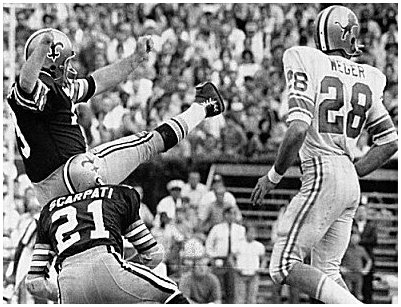
The only truly bright moment in Saints history, prior to their recent success, was the day in 1970 that their place-kicker, Tom Dempsey booted the longest field goal in NFL history.

On November 8, 1970, the Saints were, of course, trailing by one point in the final seconds of a game against the Detroit Lions. At that point, the only thing remarkable about the game was that the Saints actually had a chance to win it. However, it would take a miracle: a 63-yard field goal. Up to that point, nobody had kicked one longer than 56 yards. And that record was 17 years old.

Adding to the unlikely drama was the fact that the Saints kicker, Tom Dempsey, was born with no right hand and no toes on his right foot. Nonetheless, Dempsey electrified Saints fans – and stunned the football world – by drilling the ball 63 yards through the uprights and into the NFL history books. I was 12 years old at the time – and I thought it was the coolest thing in the world. There was finally something about the Saints I could brag about. But that was just a fleeting, fantastical moment. Grim reality soon returned.

Dempsey lives in Metairie now, and because it seems divinely ordained that Saints should suffer — his house was flooded in the Hurricane Katrina deluge.

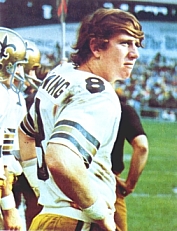
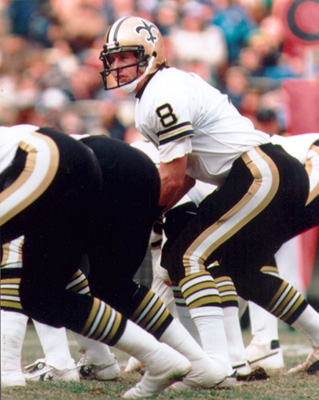
The year after Dempsey’s epic kick, the Saints drafted the Great Franchise Hope, Archie Manning. With the good-looking and talented Ole Miss star at quarterback, the Saints won the first game of the 1971 season, upsetting the Los Angeles Rams 24-20 at Tulane Stadium. But the Saints finished that year with a 4-8-2 record.

Despite Manning’s talent, and the adoration of his fans throughout Louisiana and Mississippi, Archie could not transform the Saints into a winner. The Manning family would have to wait another generation to put NFL championships in the family trophy case.

For too many years, too many seasons, too many games, and too many crushed hopes, New Orleans beloved Saints would become the ‘Aints. Fans wore bags over their heads, but they still came out to chant, “Who ‘dat? Who ‘dat? Who ‘dat say ‘dey gonna beat ‘dem Saints?”

Ironically, the Saints first Super Bowl victory, nearly 40 years after Archie Manning’s first season in New Orleans, came against Archie’s son, Peyton. Fate is always messing with ‘dem Saints.

Now, perhaps, the Saints curse has been lifted and a new period of hope, optimism and good luck will shine down from the heavens on the city of New Orleans. I sure hope so. My dad did not live to see what Katrina did to his city. It would have broken his heart. And he did not live to see this Super Bowl triumph, which would have thrilled him. But, if there was ever a football team being followed in heaven – wouldn’t it have to be the Saints?

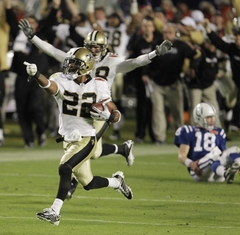
So, Dad, how did you feel when Tracy Porter picked off Peyton Manning late in the fourth quarter and took the rock to the house, giving the Saints’ the Lombardi Trophy?

I think I heard you celebrating with the joyous throng in the Quarter last night. “Who ‘dat? Who ‘dat? Who ‘dat say ‘dey gonna beat ‘dem Saints?”

4 Comments

Filed under History, Sports

Johnny B. Goodrich

A few years before I met the incredible Crawfords, I was already fortunate enough to have certain of my adventures enhanced and illustrated in cartoon form by John Goodrich, a schoolmate at Northwestern University in Evanston.

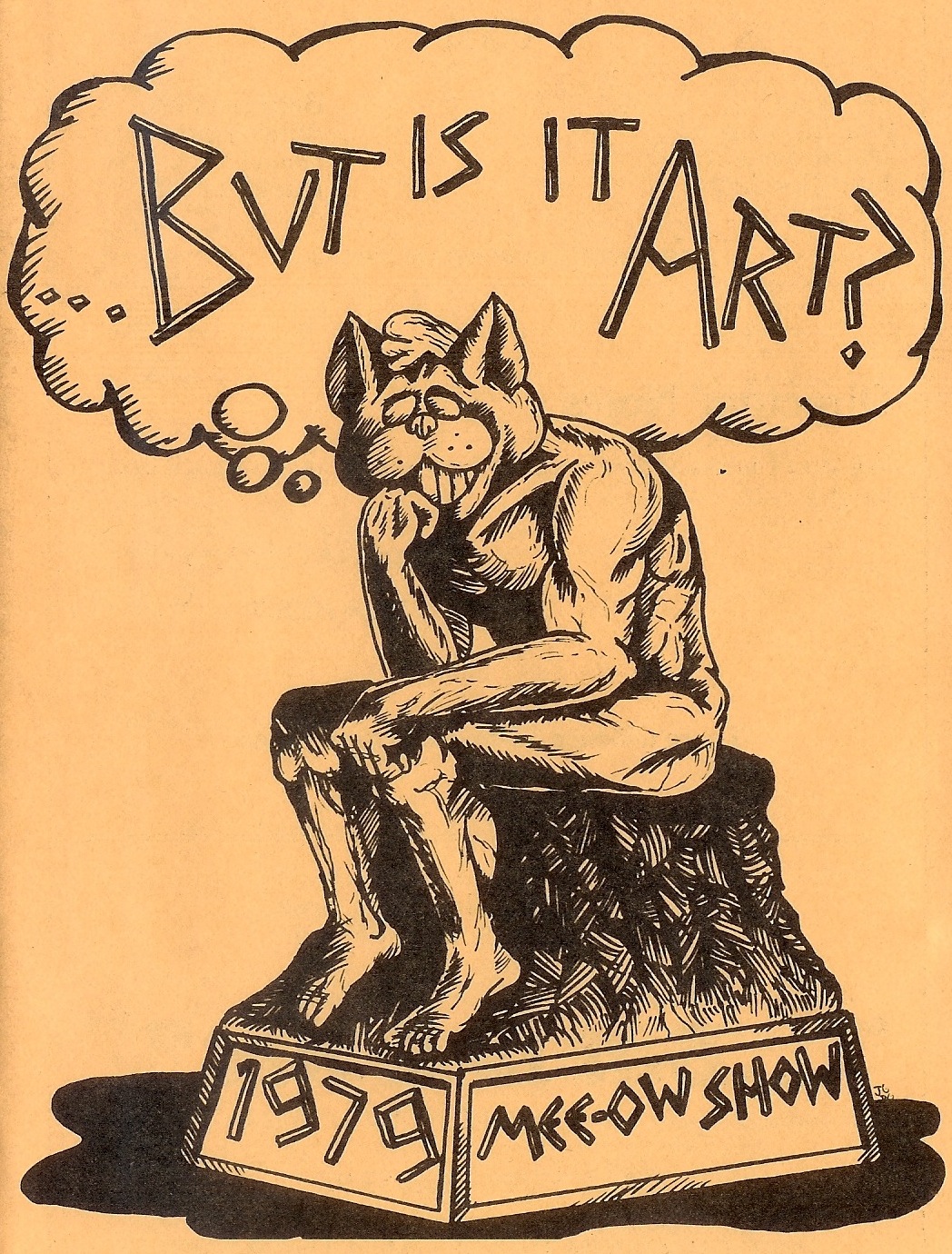
In the fall of 1978, John and I were cast in what would ultimately become …But is it Art?, the ’79 Mee-Show. John was a precocious, gangly, and quick-witted freshman, the youngest in a cast that included a senior, Winnie Freedman, my fellow juniors Rush Pearson, Dana Olsen and Bill Aiken, plus sophomores Barb Guarino, Althea Haropulos, and the incomparable Larry Shanker on the piano.

It was my second Mee-Ow show, and I was already behaving (insufferably, no doubt) like a sagacious old veteran, so a young newcomer like John was under my microscope. I liked John right away, but I’m sure I was tough on him.

C’mon! The kid was a freshman. He was two years younger than me.

Even now, it’s strange how, among the friends you meet in college, those who were a year or two ahead of you in school still appear far older and more experienced than you – and will for the rest of your life. Likewise, those who were a grade or two behind you always remain much younger in your mind. And somehow this applies even when we’re all in our early 50’s! I may be nearing 52, but that nearly 50-year old guy who was a freshman when I was a junior still seems much younger than me.

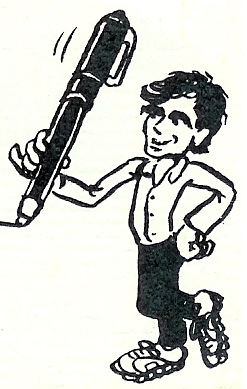
John made unique contributions to …But is it Art? In addition to his role as “The Incredible Dork” and his all-important portrayal of an unsuspecting young man who slips on a banana peel – John drew the poster for the show, created flyers and ads for us — and also began to turn his funny friends into cartoons. As a frustrated cartoonist myself, I was very impressed that John was the real deal.

Click on image to enlarge and read the jokes...

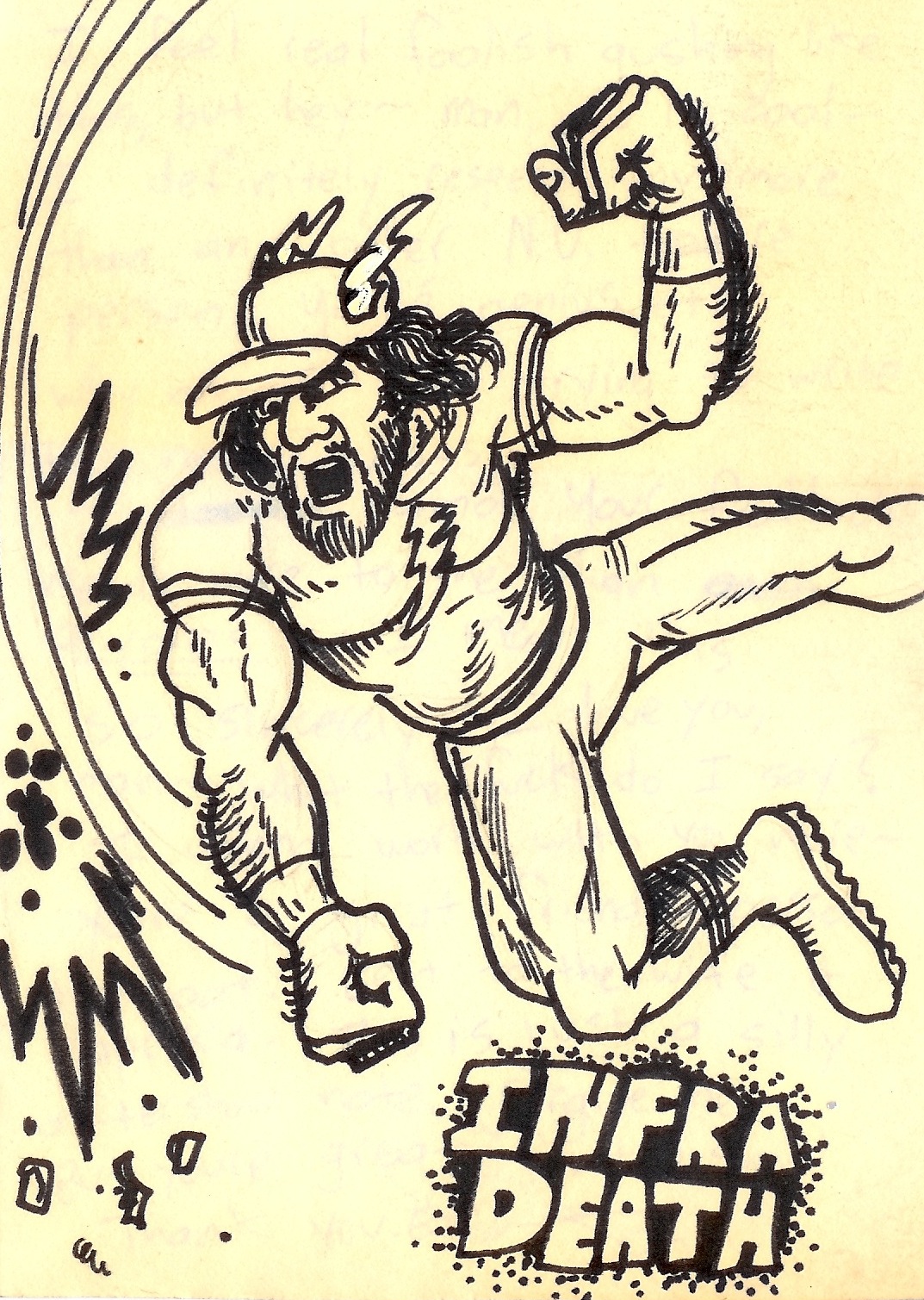
During my senior year in 1980, John and Dana Olsen got together and created a comic strip called “No Dumping” which appeared in The Daily Northwestern. The strip portrayed the adventures of four brain-addled 20-something slackers. Man, I thought that was cool. But then John did something even cooler: he turned us all into cartoon superheroes.

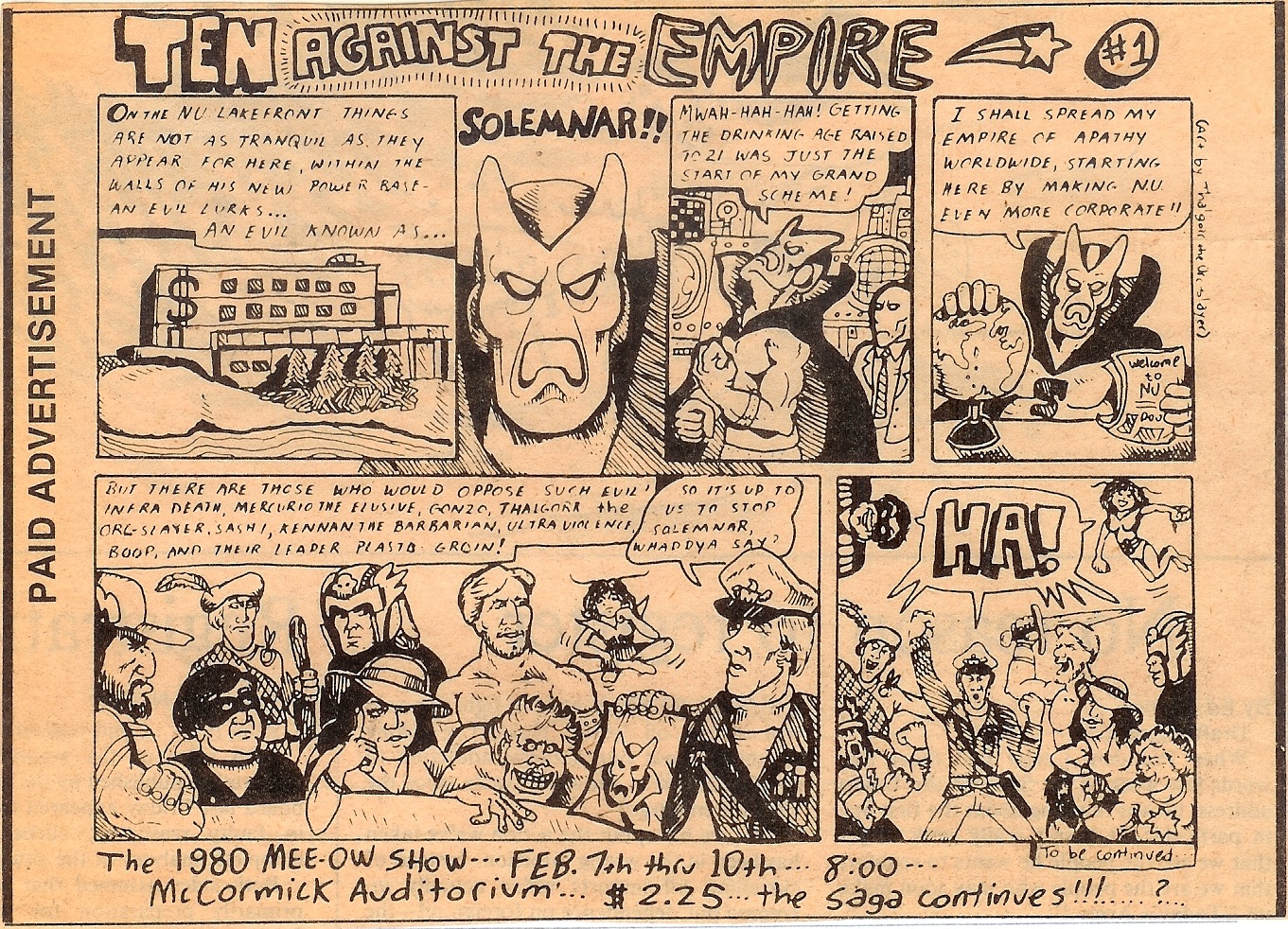
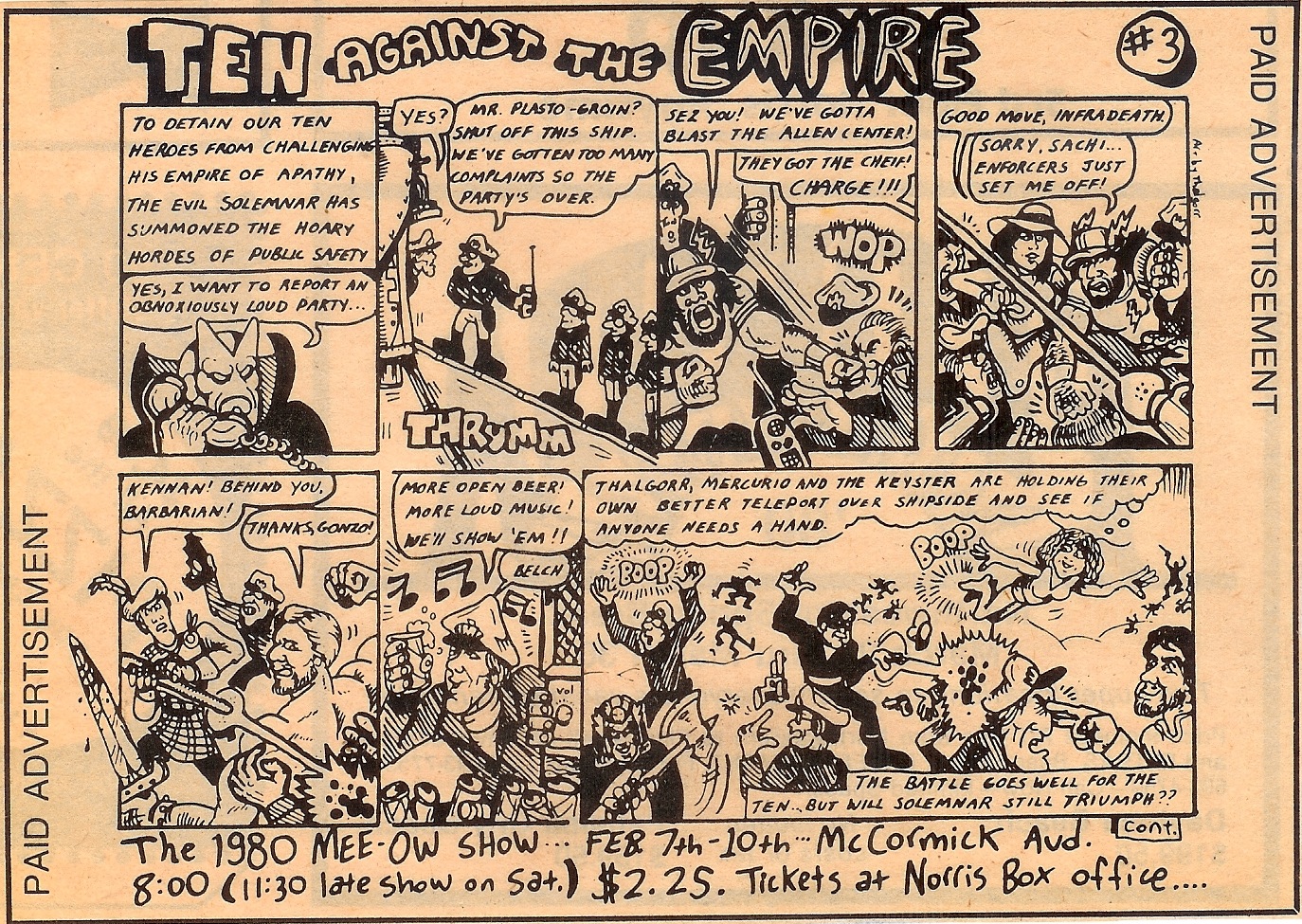
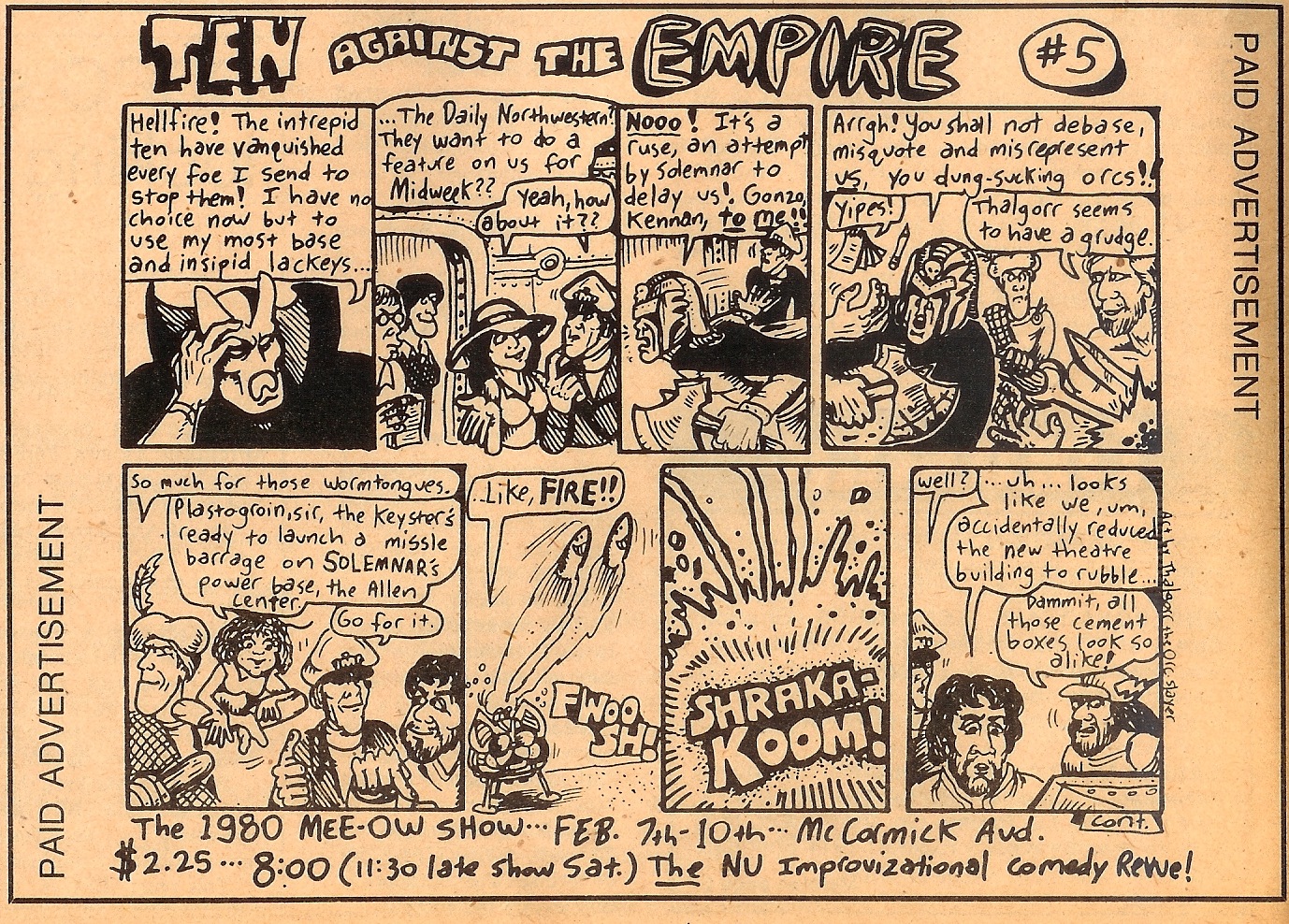
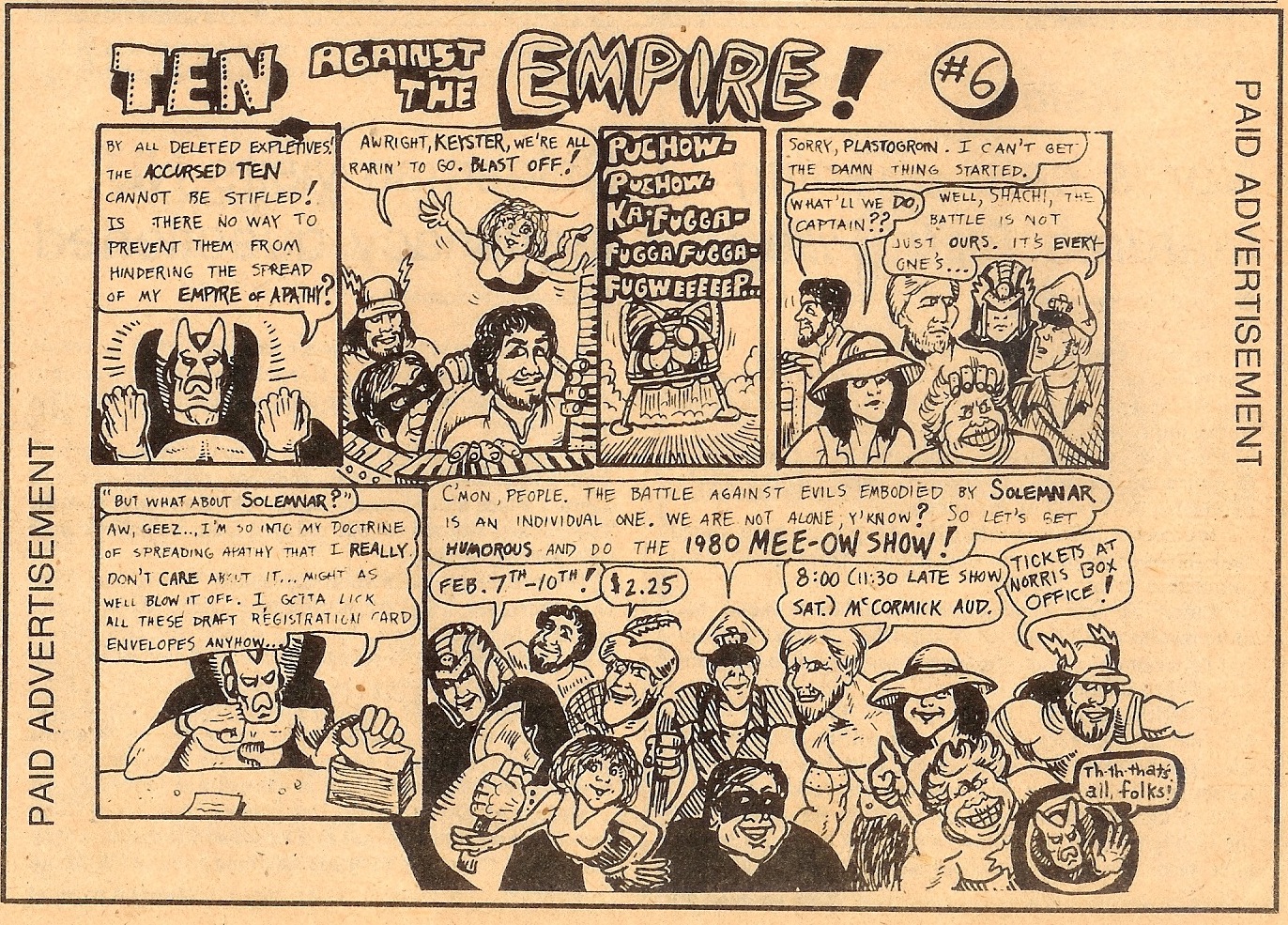
The title of the 1980 Mee-Ow Show was Ten Against The Empire. We were doubtless inspired by the second Stars Wars film, The Empire Strikes Back, which was being heavily promoted at the time, and set to be released in May, three months after our 3-week February run.

John launched our own promo efforts into a whole new galaxy by drawing a series of comic strip advertisements that ran in The Daily Northwestern during the week leading up to the show’s opening.

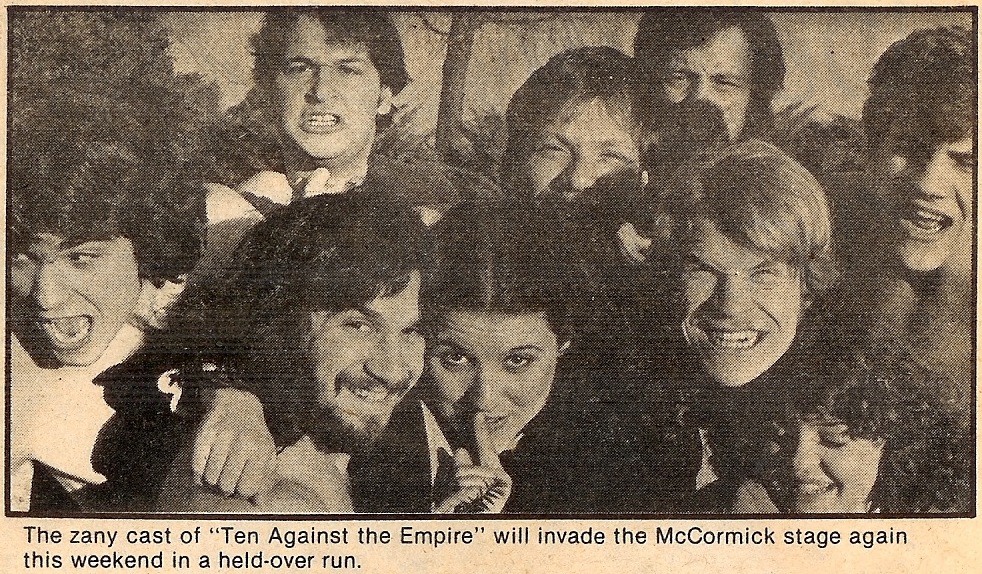
That's John on the far left, me with the beard, Julia, Rush & Judy. Back from from left: Mike, Kenny, Dana & Rod.

In the promotional strips, John transformed the cast of Ten Against the Empire — 
me, 
John, Julia Louis-Dreyfus, Rod McLachlan, Mike Markowitz, Kenny Marks, Dana Olsen, Rush Pearson, 
Judy Pruitt and 
piano virtuoso Larry Shanker – into a team of oddball heroes battling a humorless super-villain.

My own character’s name was Infra Death. You can tell how cool I thought all this was by the fact that I saved all 6 comics in the series. (The rest of them are posted at the end of this article.)

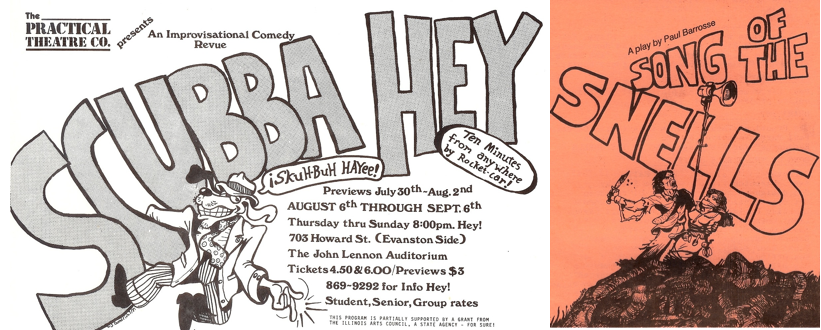
Even before he graduated from NU, John became very involved with the Practical Theatre Company as an actor and artist. He performed in our first production of Subnormal and our first improvisational comedy revue, Bag O’ Fun. He also did great graphic work for our third improv comedy show, Scubba Hey (’81) and a silly Shakespearean send-up I wrote called, Song of the Snells (’82).

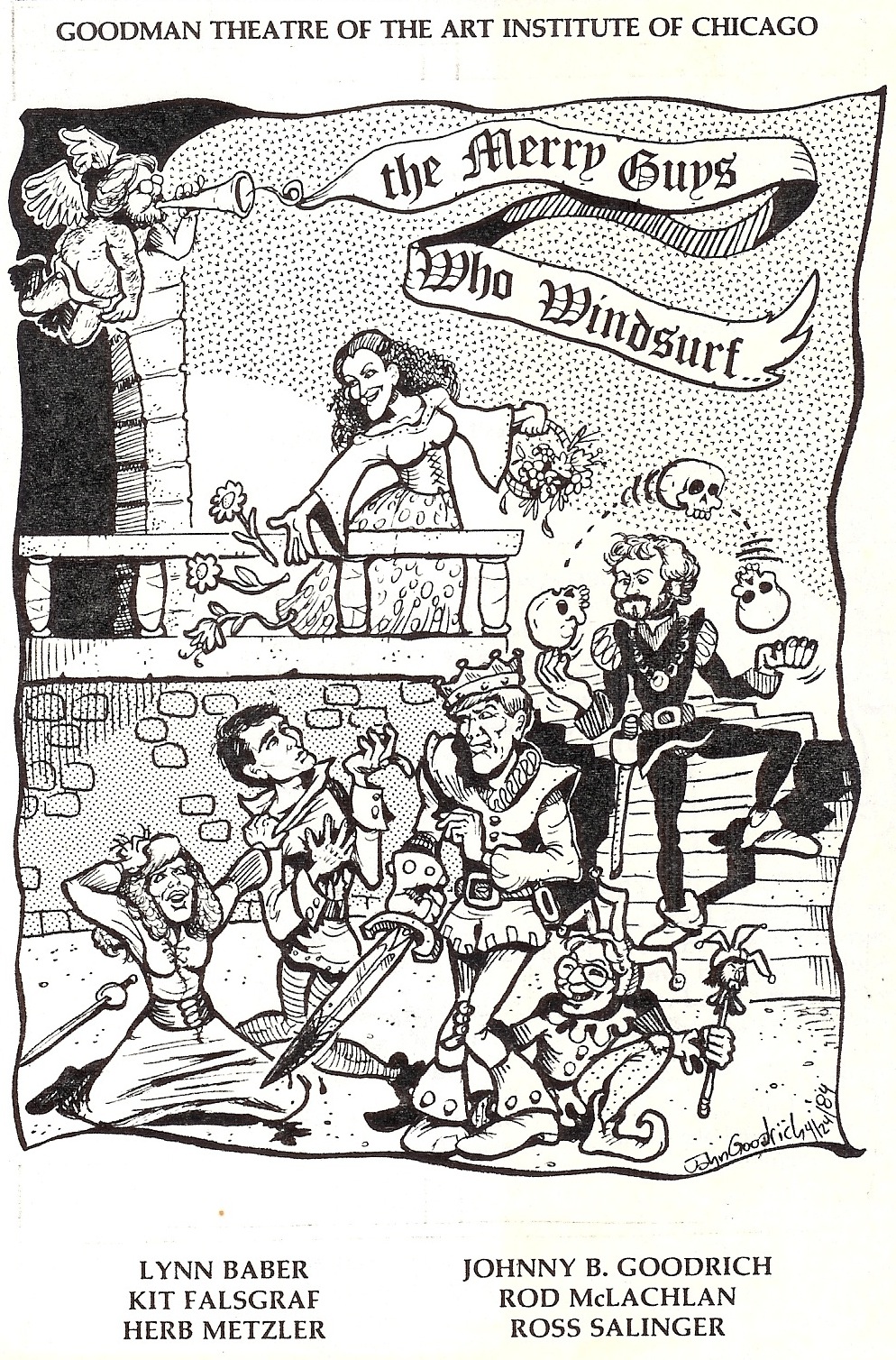
John would contribute to many more PTC projects between ’82 and ’84, both onstage and with his brilliant pencils in hand. I’ll save some of those details for the next two installments of my PTC history – but for The Merry Guys Who Windsurf, the comedy revue we staged at The Gooodman Theatre Studio in the summer of 1984, John not only performed – but he once again turned his fellow cast members into cartoons.

John’s still doing his cartoon thing, only now he’s a pro. He’s got his own company, which you can check out by clicking here. He specializes in custom cartoon graphics, graphic design and desktop publishing services.

Check out this funny blog post I found, written by one of John’s satisfied customers.

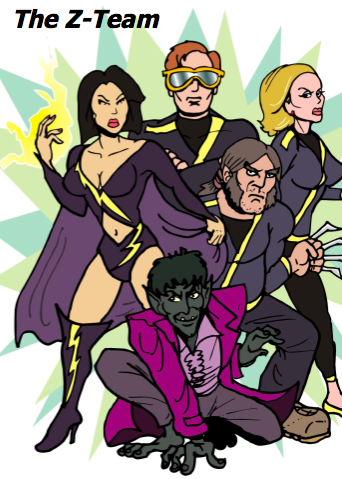
A few years ago, John and I teamed up on a cartoon series I was trying to sell to — where else – Cartoon Network. Superhero Haven was about a rehab center and halfway house for troubled superheroes.

We didn’t sell the show (Alas, Drawn Together beat us to the marketplace.) But it was great fun to work with John again – and he really brought a lot of great characters to life.

Since then, it’s always a pleasure to get John’s annual Groundhog Day card. For one thing, it’s fun to see how John’s going to work the cartoon groundhog into the photo. And, of course, it’s great to see his lovely family grow lovelier each year. It looks like John has done really, really well in the family business.

The last bit of art John drew for one of the PTC family was the announcement he did for Tom “Wolf” Larson’s big Twin Cities performing arts center opening last year. Of course, Wolf recently left the snowy tundra for the sunny climes of Spain. But before he left, Wolf got the chance to have John Goodrich turn him into a cartoon hero, too.

This is Infra Death, signing off!

9 Comments

Filed under Art, History

Le Salon de Crawford

After my graduation from Northwestern University in June of 1980, the birth of my daughter Maura that July, and our establishment of The Practical Theatre Company in the newly-built John Lennon Auditorium at the corner of Howard and Custer Streets – the most important thing that happened to me (and all of us at the PTC) was our serendipitous introduction to the remarkable Ron & Sydney Crawford and their fabulous children: Suzy, Jennifer and Ronny, who would soon come to be known as Rockin’ Ronny.

I can’t remember the exact moment I first met Ron & Syd Crawford in 1981 – but it was a moment that changed my life. It’s hard to catalogue the many ways in which the Crawfords contributed to my personal and artistic growth. They gave freely and generously of their love, their many talents, their warm hospitality – and their genuine enthusiasm for what these crazy kids were doing in their tiny storefront theatre on Evanston’s border with Chicago.

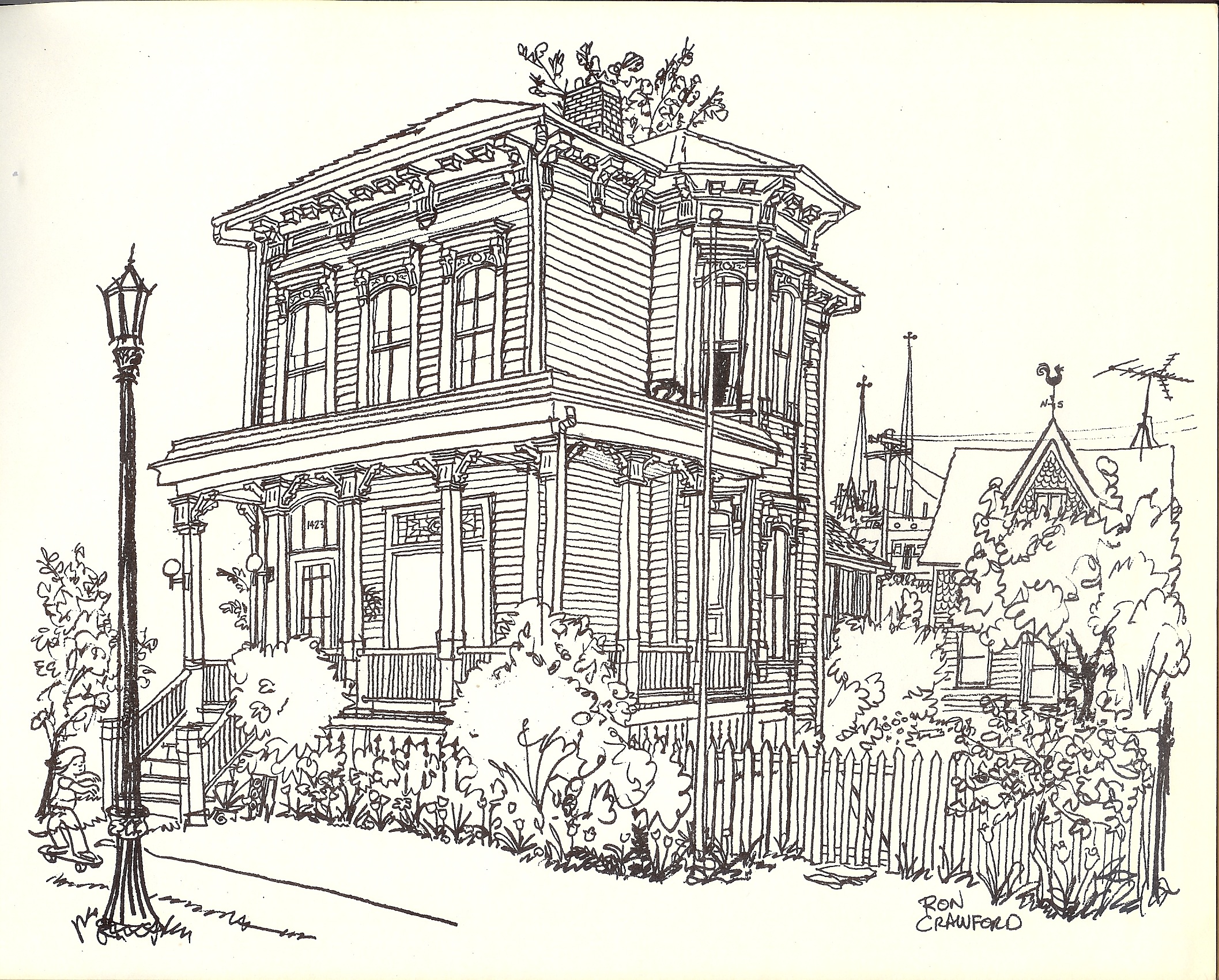
Ron and Syd Crawford were – and are – artists of the first rank. To me, they were – and are – a living, breathing cultural institution. In those days, their splendid Victorian “painted lady” on Elmwood Avenue in Evanston was home to the North Shore’s most vital and progressive salon — something I’ve only begun to fully appreciate in recent years. According to Wikipedia, a salon is a gathering of intellectual, social, political, and cultural elites under the roof of an inspiring hostess or host, partly to amuse one another and partly to refine their taste and increase their knowledge through conversation.”

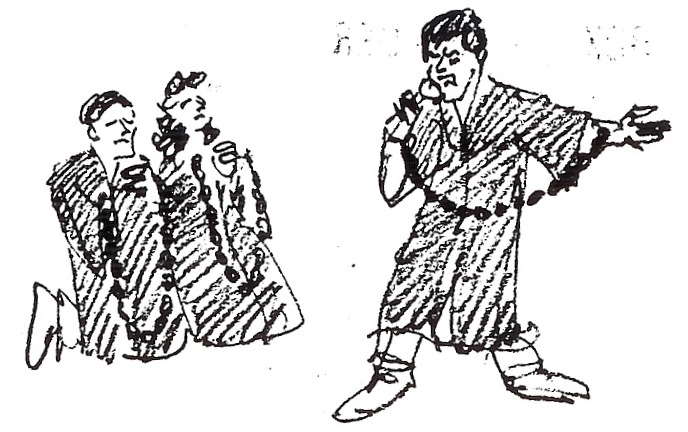
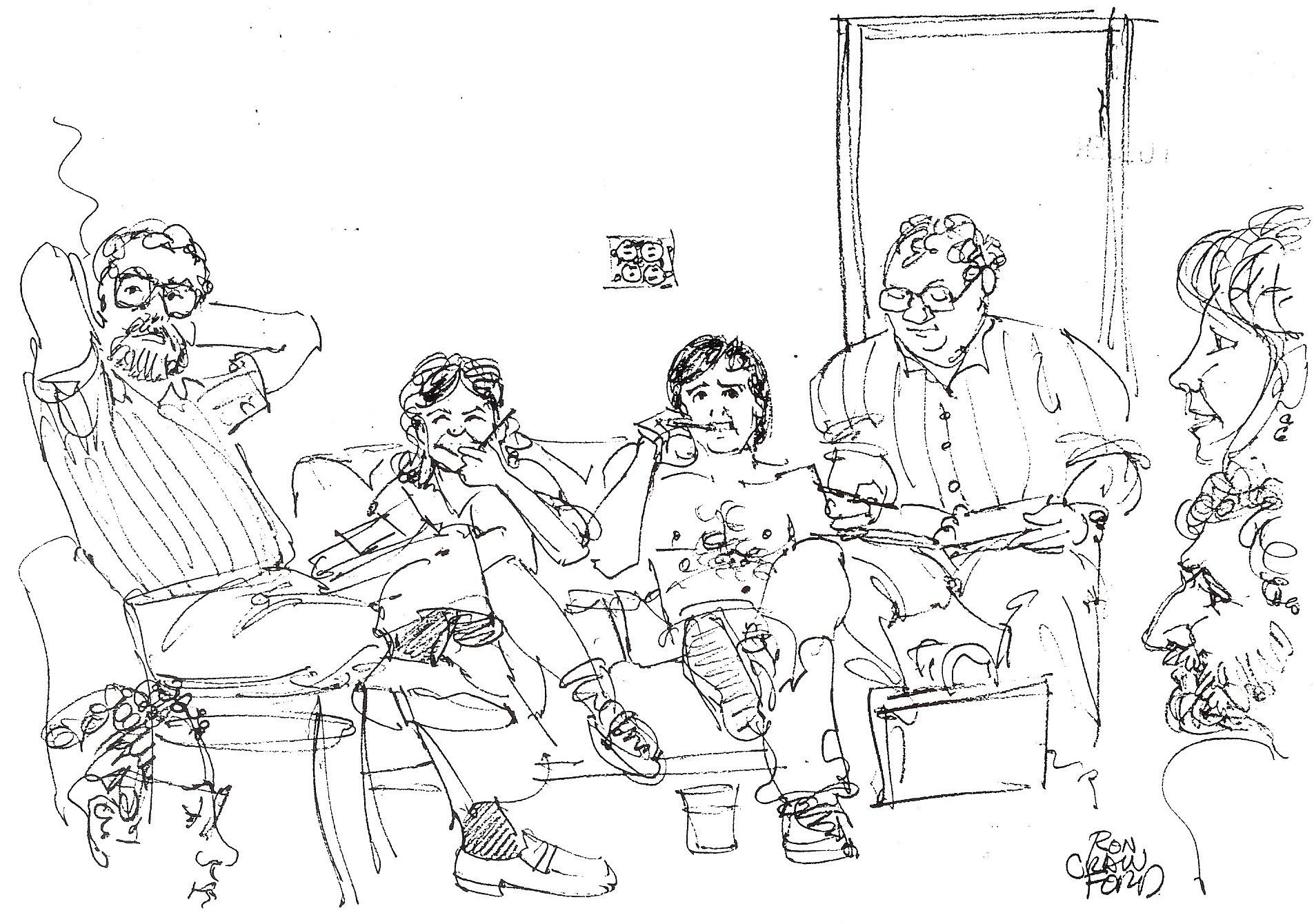
Rush & Paul, two of Evanston's avant-garde habitues of Le Salon de Crawford.

I didn’t realize it back then, but that was the scene at Ron and Syd’s house. Artists, writers, musicians, peaceniks, revolutionaries, madcap recent NU graduates, and assorted interesting members of the Evanston avant-garde – they all gathered at the Crawford’s home. Sydney and Ron were inspiring hosts, to be sure, and we all increased our knowledge through the passionate, party-driven conversation and camaraderie, as we dug the scene, hanging out with the groovy creative spirits, iconoclasts, and free thinkers at les Salon de Crawford!

Inside the Crawford house, you could still feel good vibrations lingering from the Summer of Love. The walls were covered with the evidence of an artistic and socially conscious life well lived – all arranged with impeccable taste: a poster from Eugene McCarthy’s campaign, neon artwork, and a museum’s-worth of paintings, photos and drawings. Oh, the drawings!

The Crawford's living room turned into an impromptu recording studio.

Yet another fabulous Ron Crawford poster for a PTC/Rockme event.

I’ll get back to the drawings in a moment. But for those who don’t know the Crawfords as well as I do, I should provide some basic biographical info…

They live in New York City now, but Ron & Sydney raised their children in Evanston and lived there for 30 years. (Ron’s dad was Captain Robert Crawford, the “Flying Baritone,” who wrote the Army Air Corps Song, “Off we go into the wild blue yonder…”) Ron did a lot of animation work in the 60’s and 70’s, creating educational films, corporate videos, TV commercials (Fiddle Faddle, anyone?) and television station graphics. When we met him, Ron still had an animation studio and film and video editing equipment in their coach house. (He often used his equipment and skills in the service of the PTC.)

Long before Sydney became the PTC’s beloved den mother, she helped Ron run their business (she even starred in some of their commercials), worked in a local frame store — and made the world turn for everyone in her salon.

Twenty years ago, Ron started working as an actor and, of course, he found success. He appeared in the Steppenwolf Theatre production of The Grapes of Wrath that went to Broadway, and his film career took him to Paris, where he starred in the movie Arthur and the Invisibles, as well as its two sequels. He also performs a one-man stage show, Travels with Mark Twain. You can fill in the gaps regarding Ron’s acting career here and here. Once Ron got to Broadway, Ron & Syd wound up staying in New York City — where they reside to this day. Lucky, NYC…

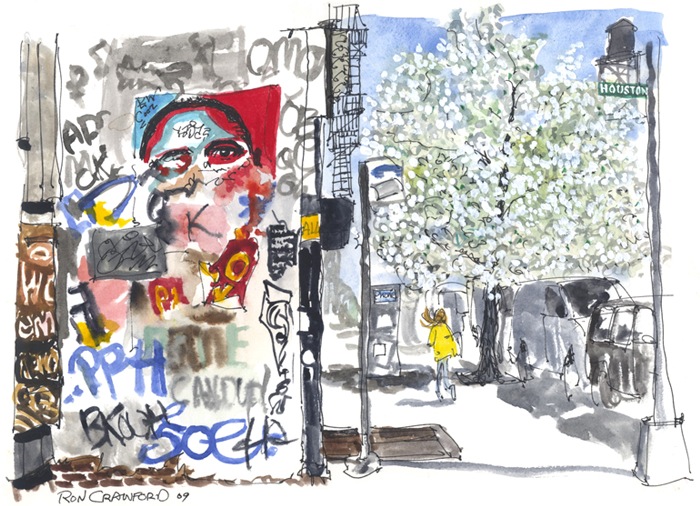
In recent years, Ron does for New York City what he did for Evanston, Illinois.

Today, Sydney is a talent agent representing fashion stylists, prop stylists, and photographers for print work: advertising, celebrity shots, and catalogs, etc. She started her agency, Sydney Represents, in 1994.  Of course, Syd’s still doing what she does best: creating an enthusiastic, encouraging and productive environment in which artists can flourish. She certainly helped one of the most talented artists I’ve ever met to thrive: her husband, Ron.

Willard Hall at Northwestern University

Which brings me back to those drawings.

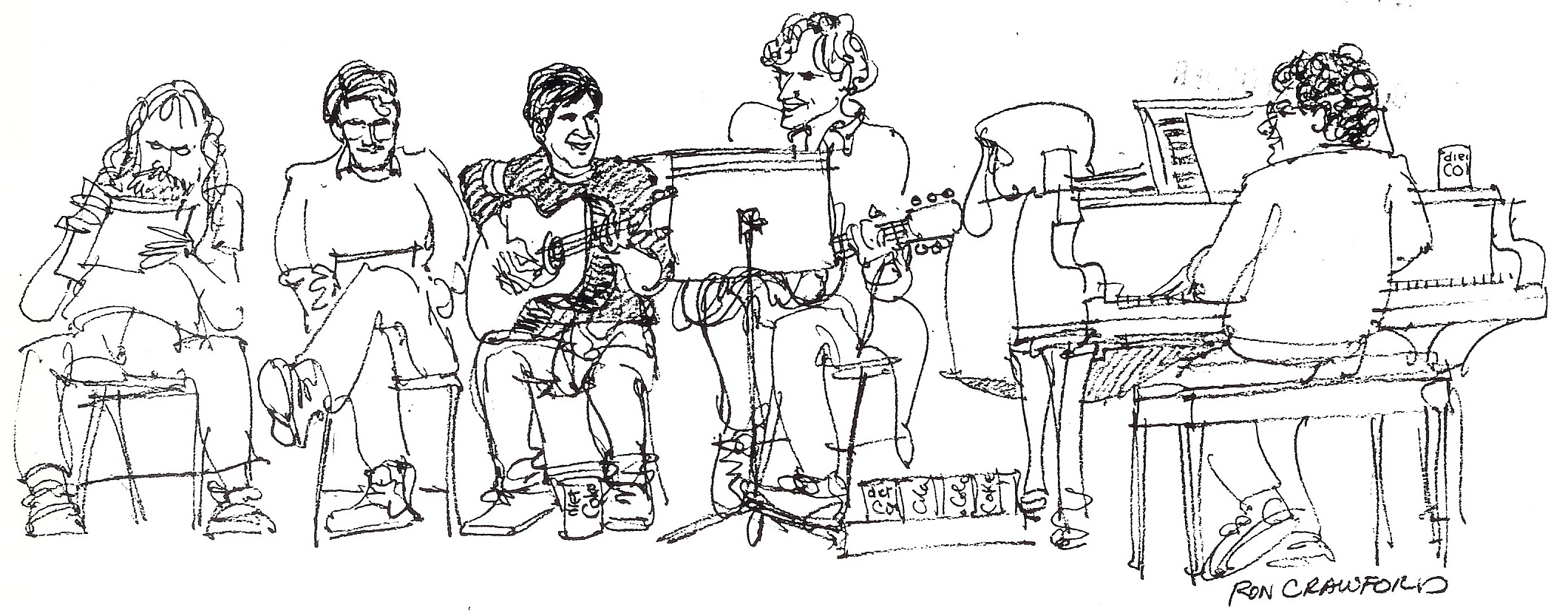
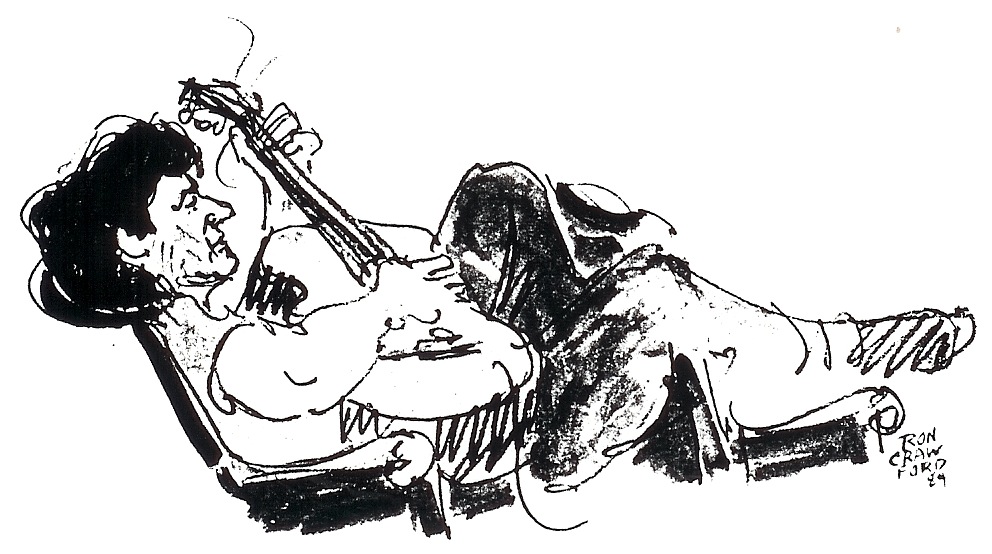
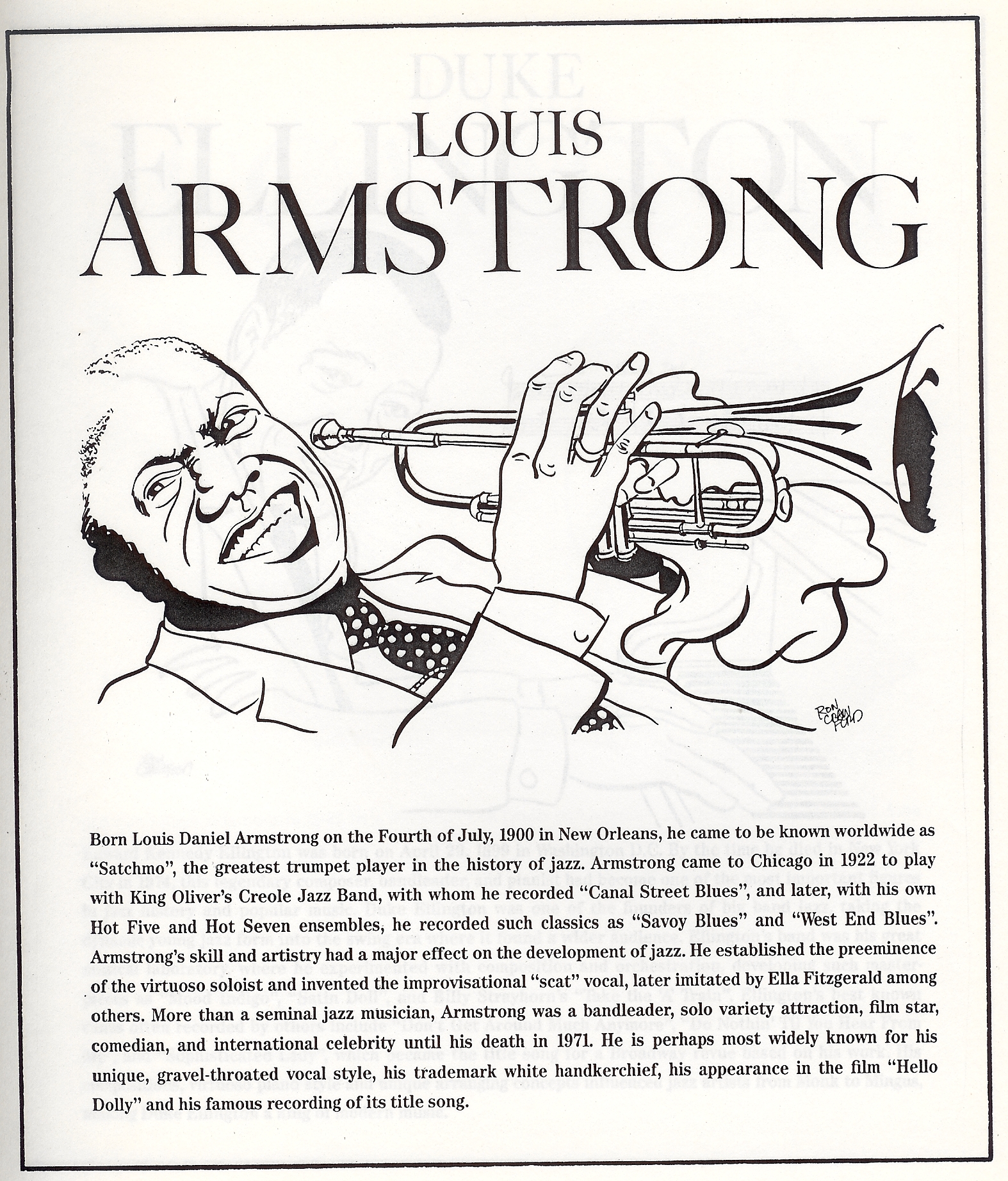
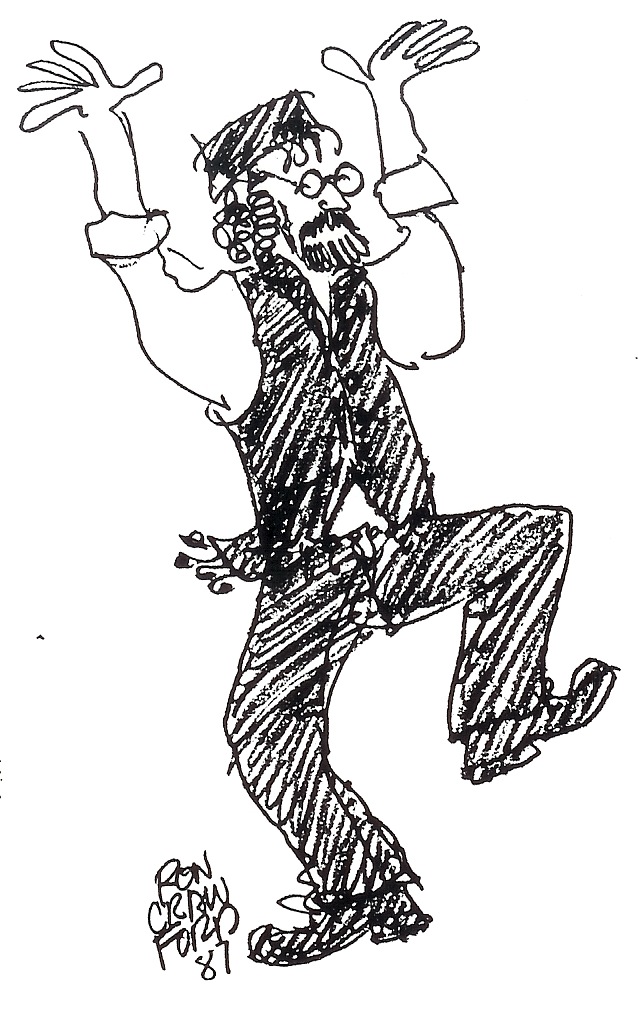
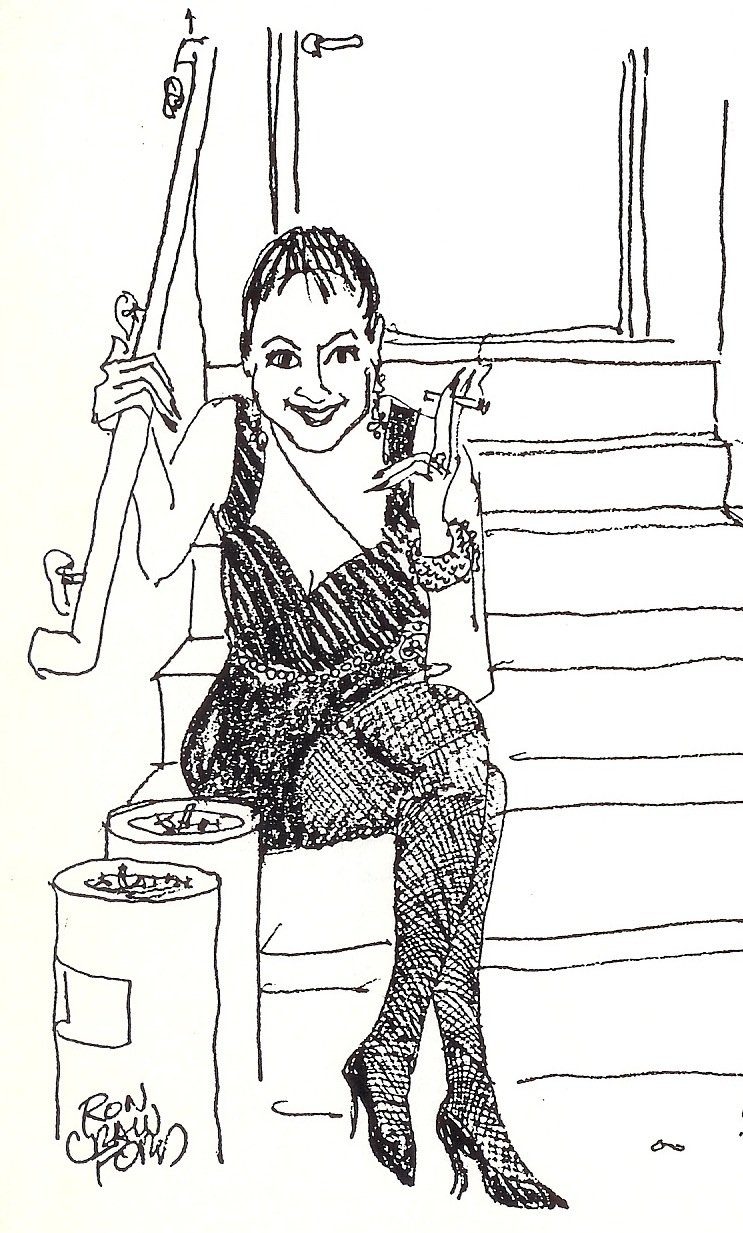
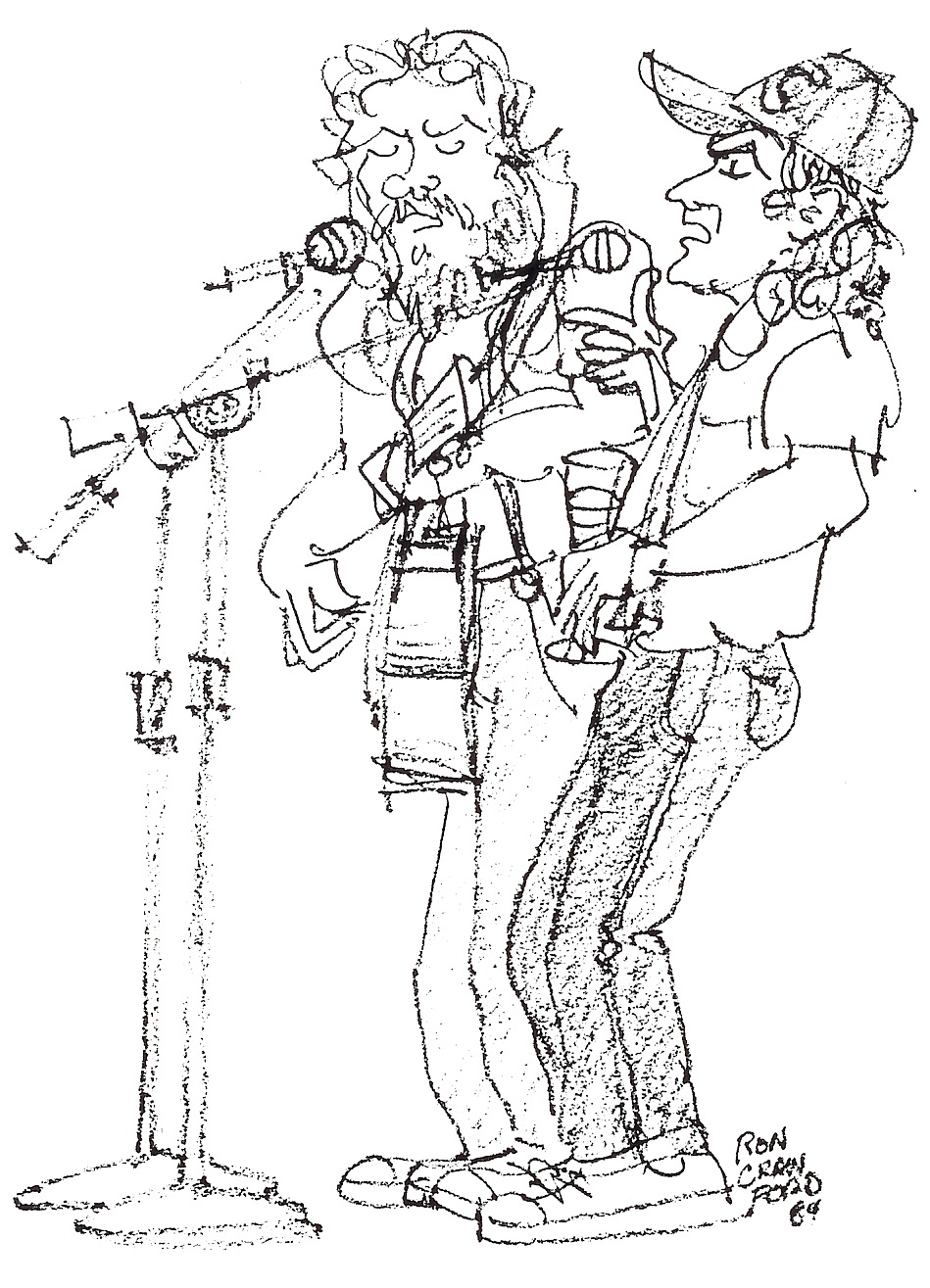
Ever since I’ve known him, Ron has always had a pencil and art pad in hand, rendering every scene, every gesture that draws his interest into a kinetic snapshot made of exquisite lines. He drew every important building in Evanston, and every Victorian home that captured his fancy. What Ansel Adams photos are to Yosemite – Ron’s drawings are to Evanston. Lucky for me — and everyone at the PTC — Ron has also illustrated just about every major event and many candid, everyday moments in the life of The Practical Theatre and its house band, Riffmaster & the Rockme Foundation (for whom his son, Rockin’ Ronny, bangs the drums with uncommon artistry).

You can check out the wide range of Ron Crawford’s truly awesome work at his website by clicking here.

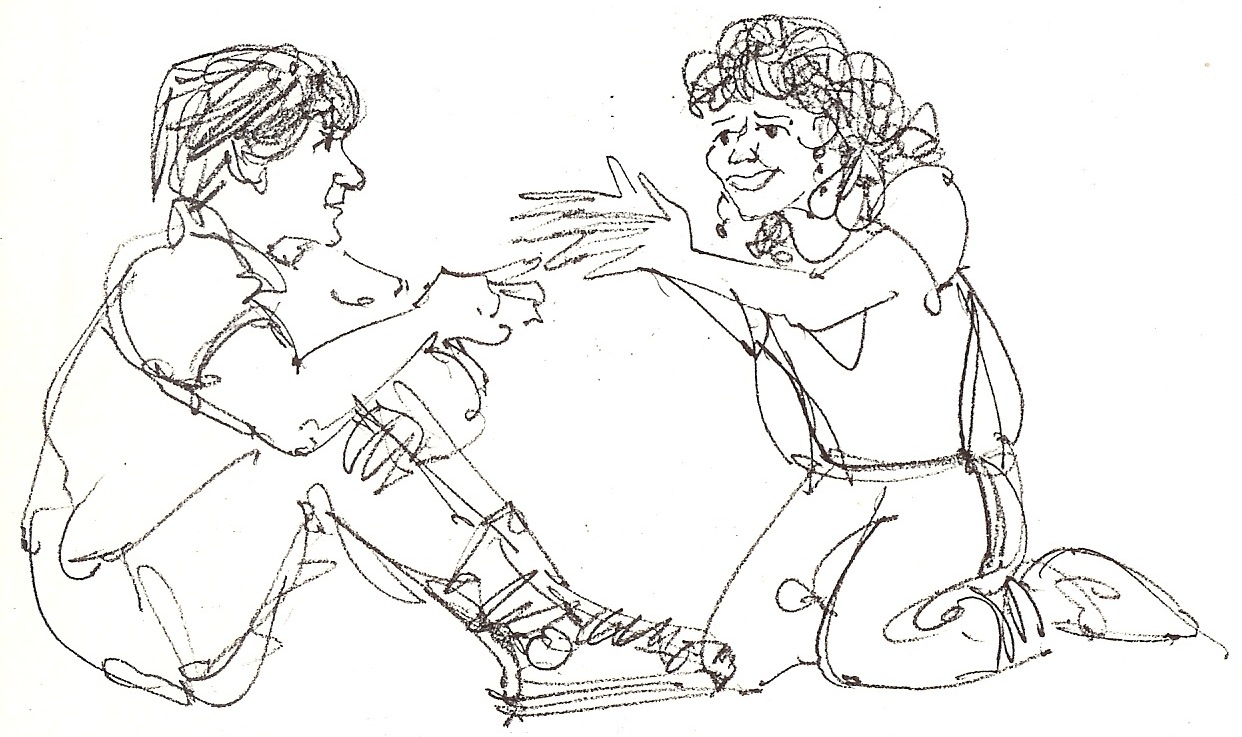
What follows is a gallery of drawings that Ron has blessed me with over the years, from the early 1980’s up through today, drawn from the hundreds of fabulous Ron Crawford sketches I’ve been saving ever since I met Ron & Syd — and was drawn into their happy, heavenly circle. Vive le Salon de Crawford!

Note: To see any of the Ron Crawford drawings in this post in glorious detail, simply click on the image. Presto!

Riffmaster & The Rockme Foundation performing at Tuts on Belmont Ave. in Chicago (1982).

"The Basic Food Groups Four" in "Babalooney" at the Piper's Alley Theater. (1983)

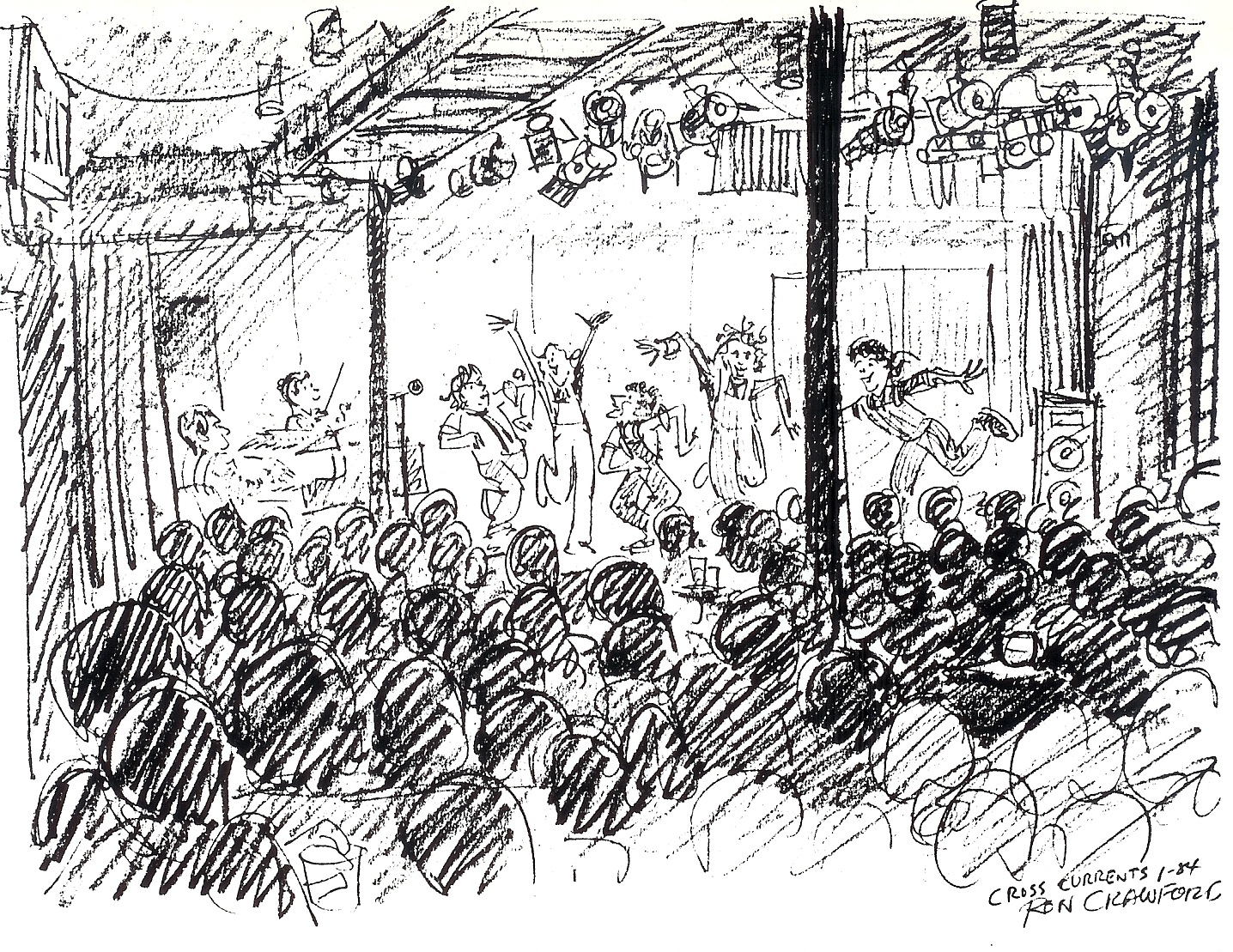
"Babalooney" pre-Off-Broadway preview at Crosscurrents. (1983)

Rockme Foundation "World Tour" at Biggies in Cleveland, Ohio. (1983)

Paul & daughter Maura at Q&R Studios, Evanston. (1983)

Paul as Ghost of Christmas Past, Goodman Theatre. (1984)

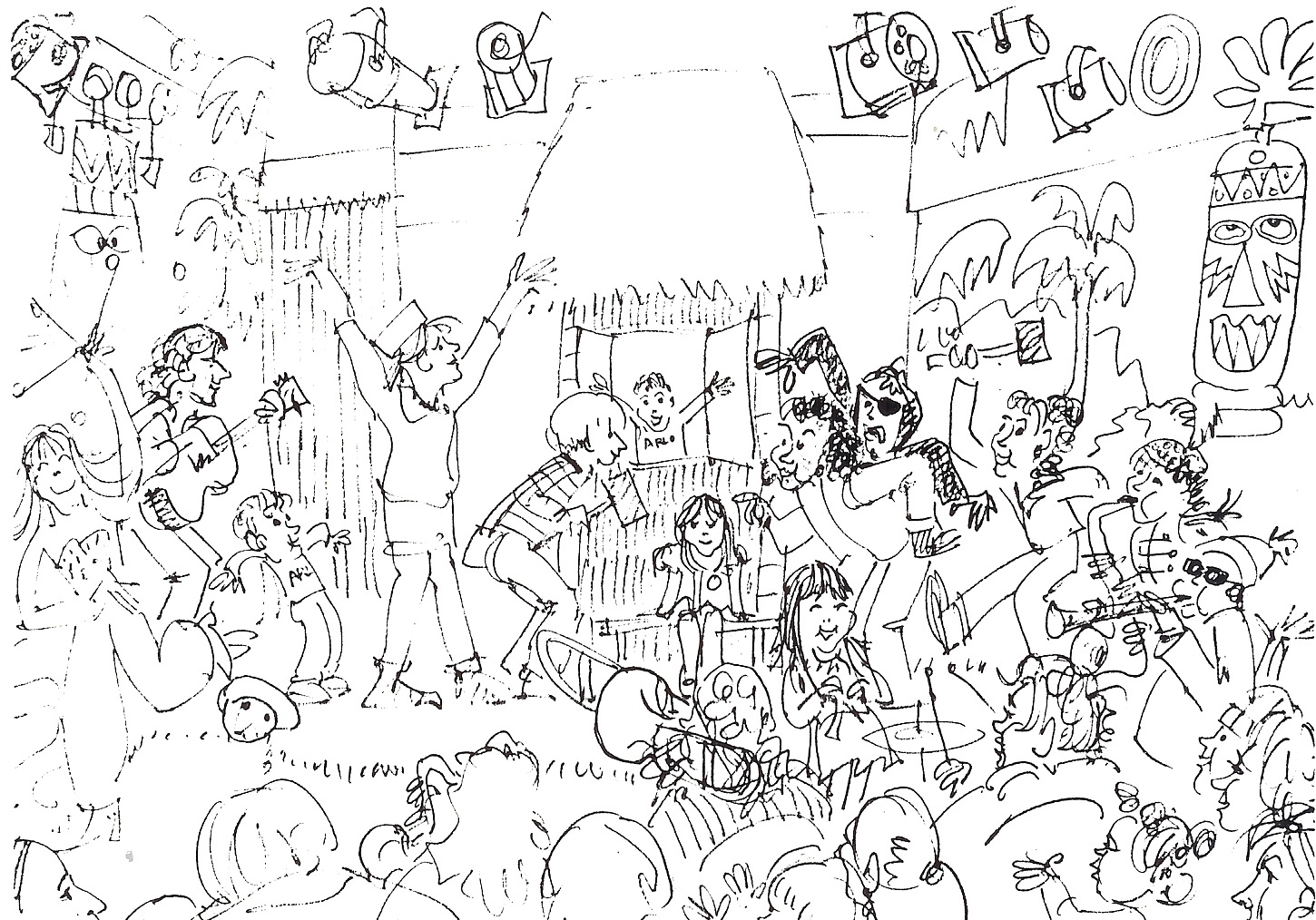
Rockme party after a performance of "Hula-Rama" at the John Lennon Auditorium. (1984)

Paul hanging out in the house at the Provincetown Playhouse in NYC. (1984)

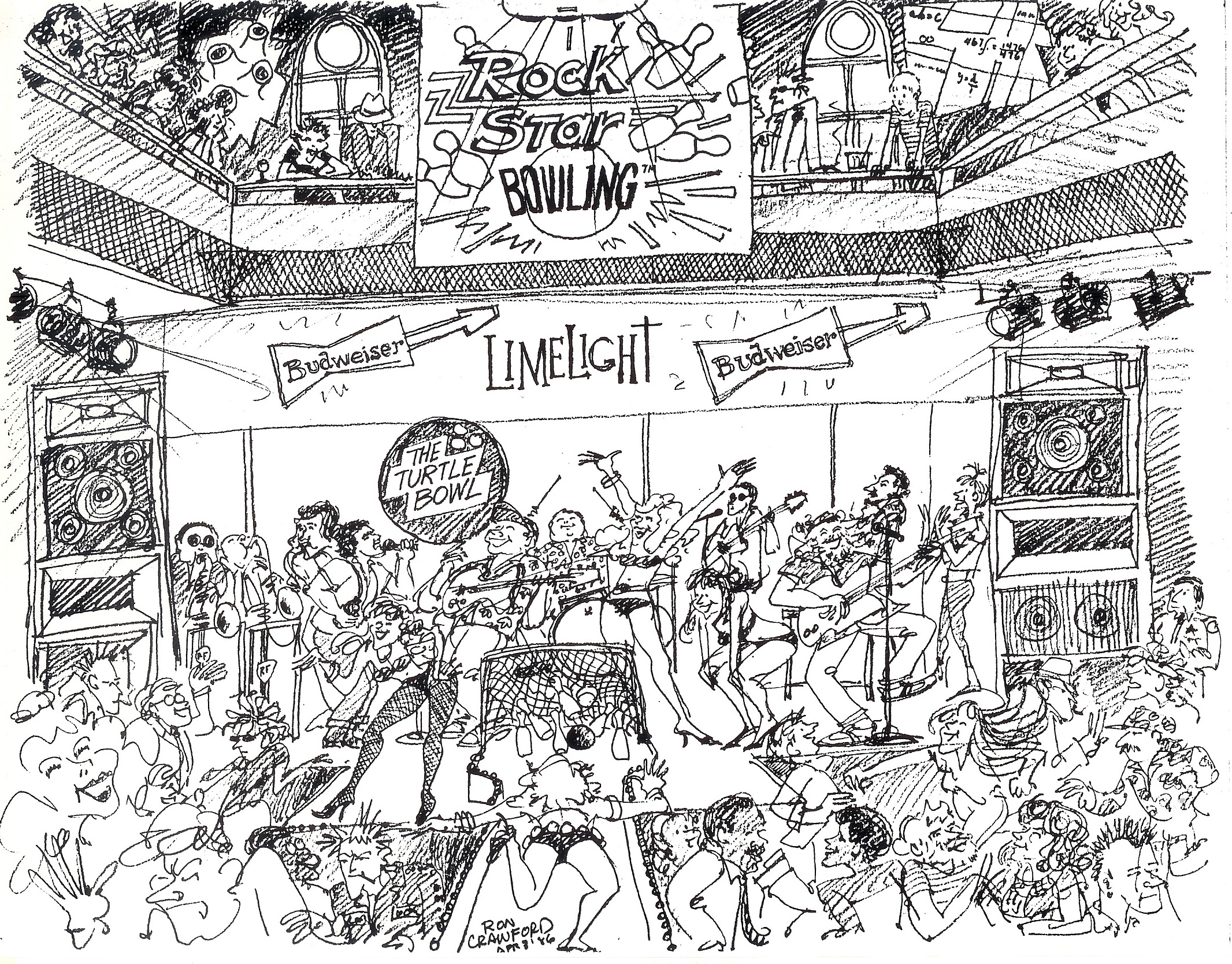
The Rockme Foundation playing at Limelight in Chicago, opening for Jimmy Sohns & the Cons. (1984)

A meeting of the John Lennon Athletic Club, trying to keep the 703 Howard space open. (1985)

SNL (1985)

SNL, Studio 8H at 30 Rock. (1985)

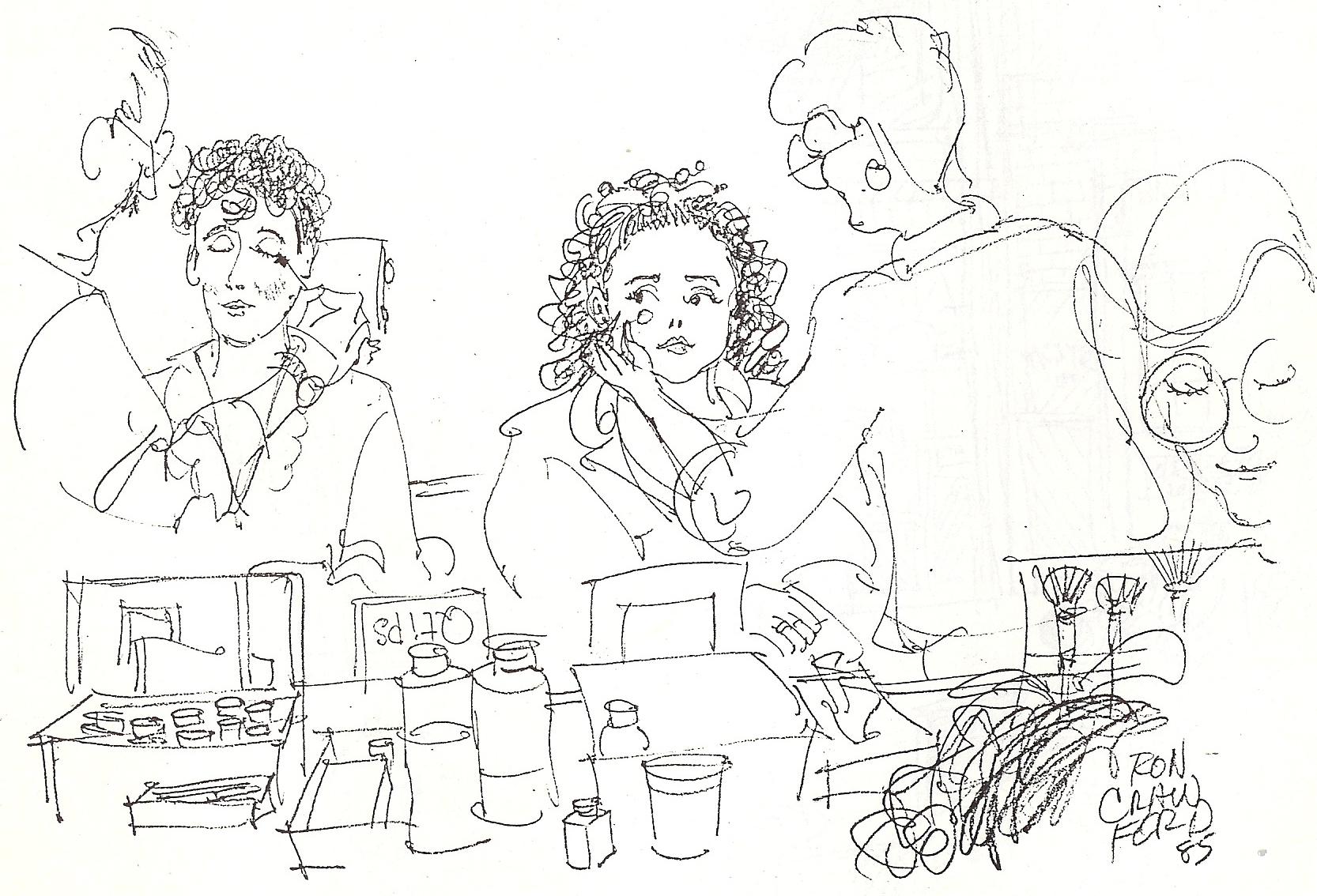
Julia Louis-Dreyfus and Mary Gross in make-up at SNL. (1985)

Ron's poster for "Art, Ruth & Trudy" (1986)

Paul as "All The King's Horses" in "Art, Ruth & Trudy" ('86)

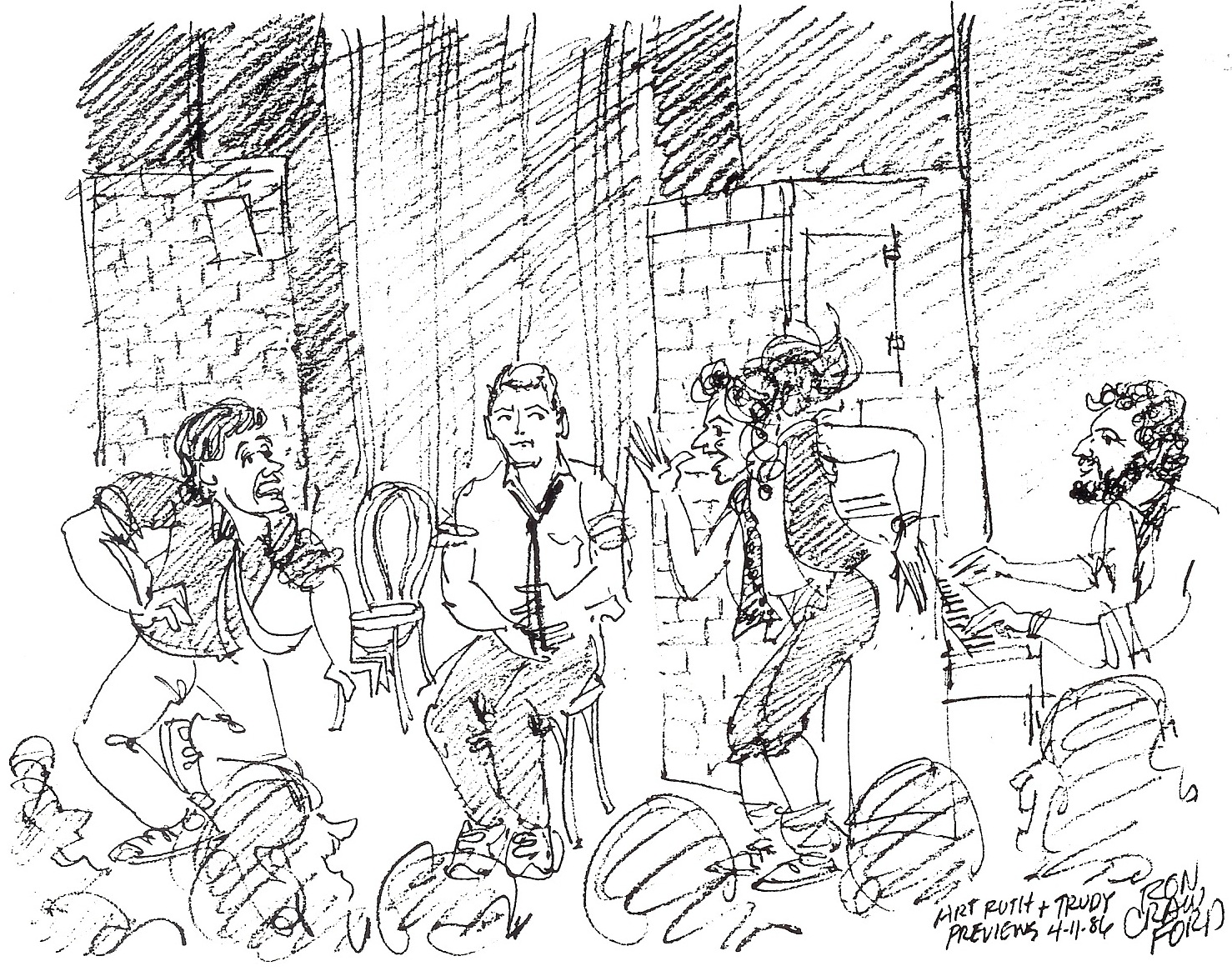
"Art Ruth & Trudy" preview at Club Victoria. (On the PTC's 7th birthday in 1986)

"Greylord have mercy on me!" ('86)

"Professional Pessimist" ('86)

Paul and Victoria in rehearsal for "Art, Ruth & Trudy". (1986)

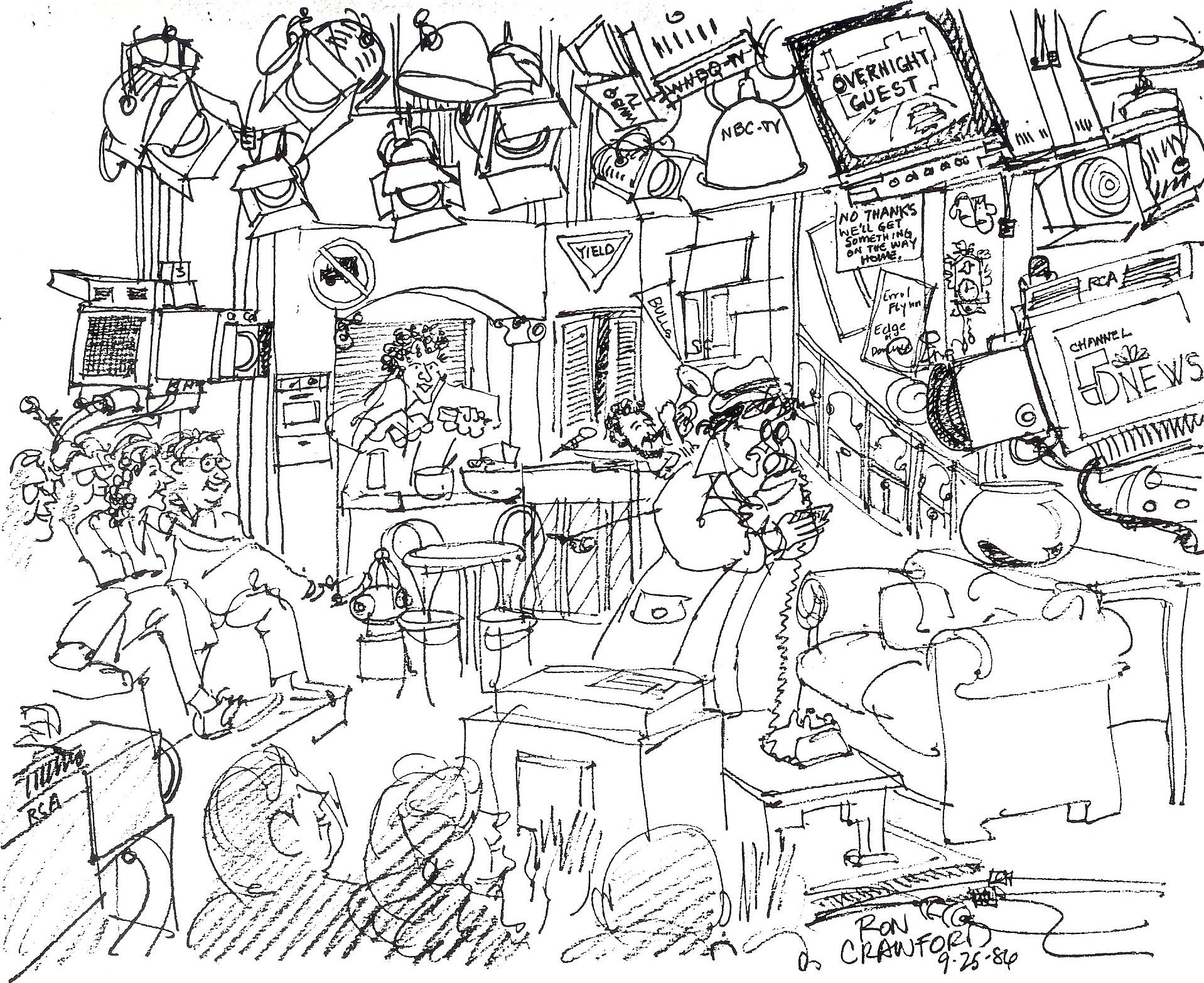
Paul, Brad Hall and Steve Rashid taping "Overnight Guest" at WMAQ-NBC. (1986)

Victoria and Paul at home in their apartment in Evanston. (1986)

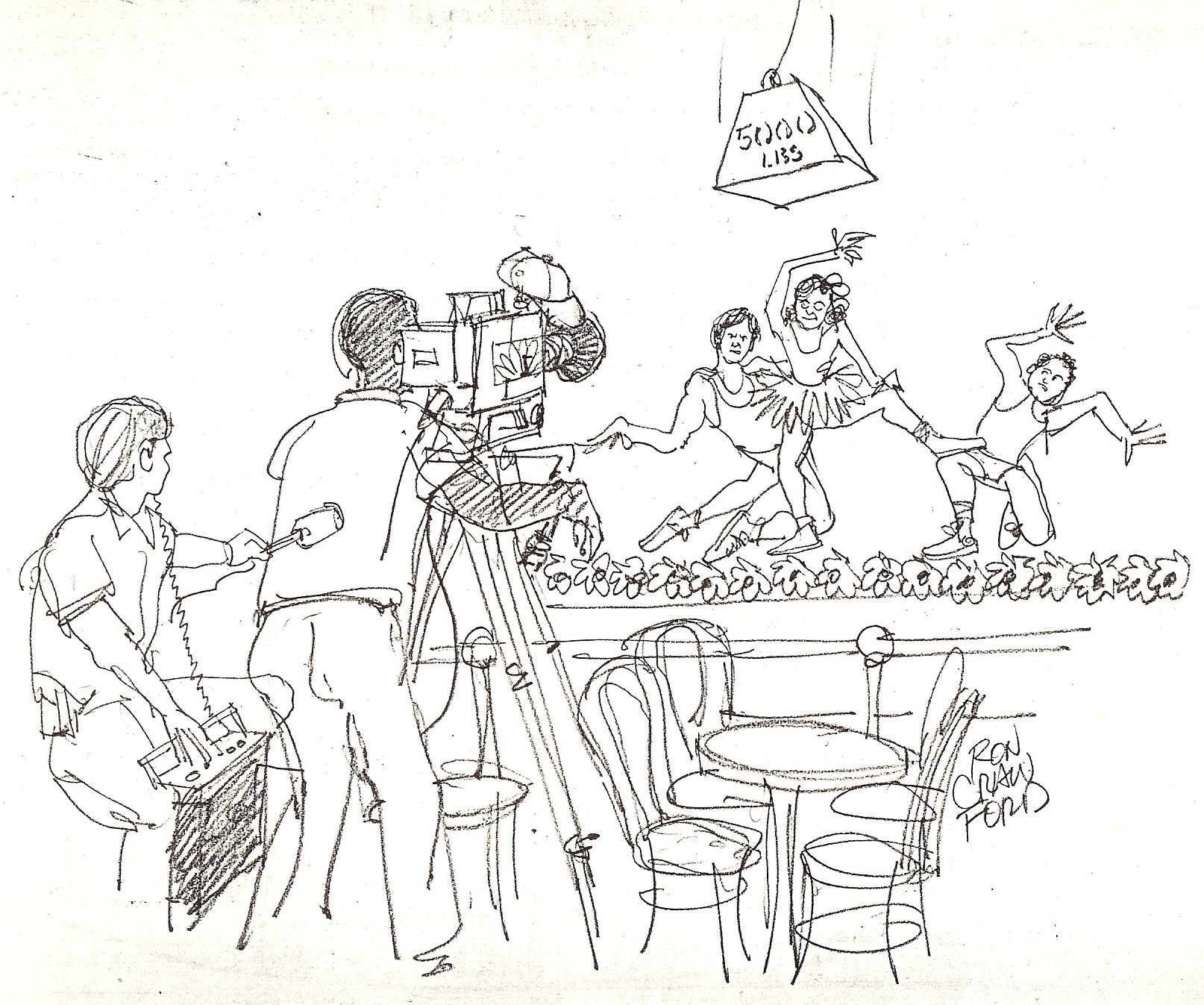
Taping "Swan Lake" in "Bozo the Town" at the Vic Theatre at Belmont & Sheffield in Chicago. ('87)

"Bozo the Town" notes with Sheldon Patinkin, Victoria, Paul, Louis DiCrescenzo, Bea & Steve Rashid.

I wrote the copy, Ron did the drawing. ('89)

Paul in "The Dybbuk" at the National Jewish Theatre. ('87)

Victoria and Linda Emond in "Serious Money" at The Court Theatre, directed by Terry McCabe. (1989)

Victoria as "Jacinta Condor" in "Serious Money" backstage at Court Theatre. (1989)

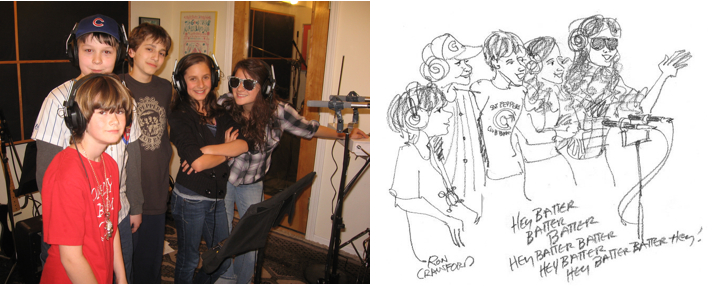
Real life & drawing at Rockme Foundation's "Woodshed @ Woodside" recording sessions. (2008)

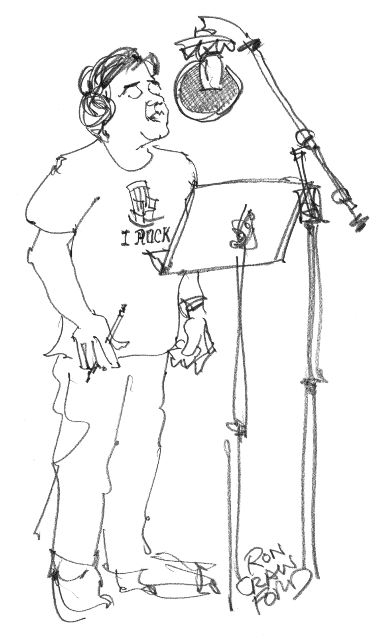
Paul at the mike. (2008)

Larry & The Rockmes at Woodside Sessions. (2008)

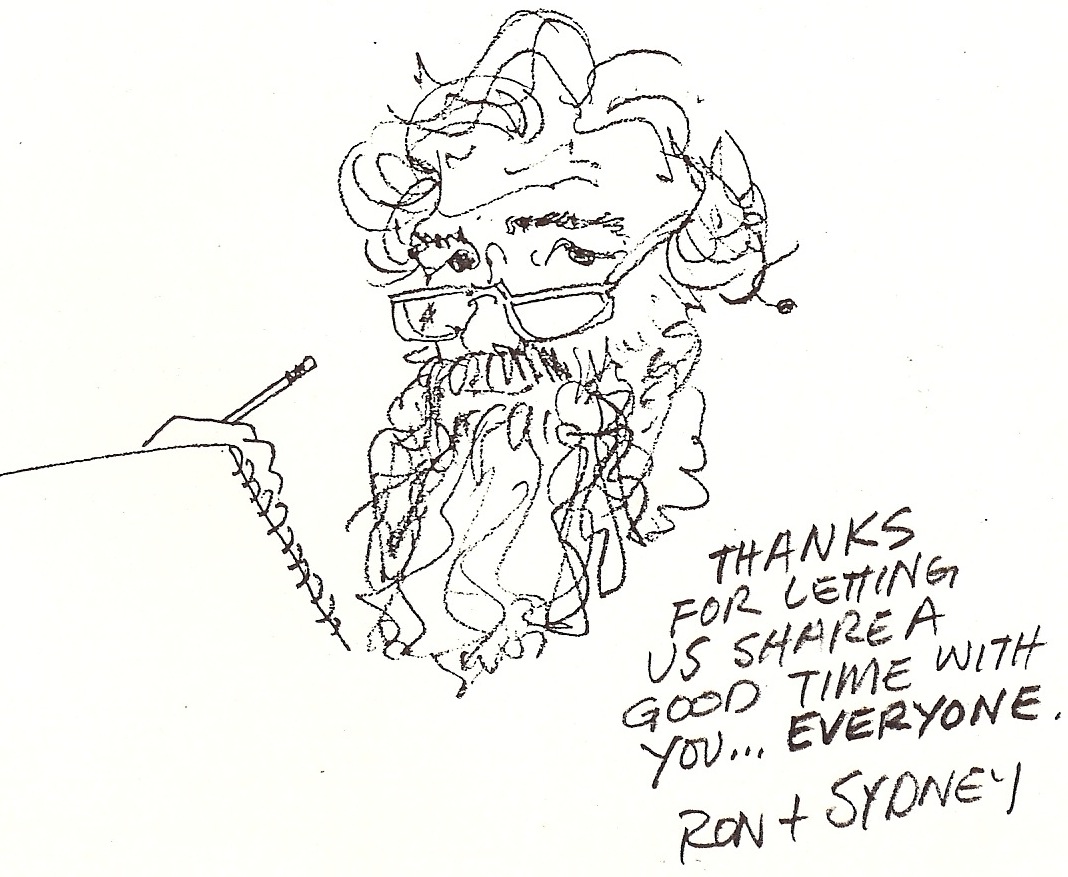
The best way to end this post is with the man himself, Ron Crawford. "Peace. Out!"

18 Comments

Filed under Art, History

“I have not yet begun to fight!”

Among all the depressing, defeatist, hand-wringing, and otherwise pathetic punditry on television and in print this morning in the wake of Martha Coakley’s upset loss in the Massachusetts election for Teddy Kennedy’s former seat in the U.S. Senate, The Christian Science Monitor had this headline (see above) in their online edition. I agree that there are lessons to be drawn from Coakley’s collapse, but not the lessons I’m hearing from all the usual talking heads.

It’s been nearly impossible to watch TV yesterday and today and listen to triumphant right-wingers crowing about the message that this election sends President Obama and the Democrats. Of course the GOP’s take on Coakley’s defeat is easy to dismiss. Today’s Republicans are a bunch of lock-step, talking-point spouting hacks whose analysis of everything in the last decade has been dead wrong. There are just two things the GOP knows how to do: keep their message focused and fight.

On the other hand, too many Democrats are already drawing the wrong conclusions from this debacle. And their messaging is all over the place. Conservative Democrats like Evan Bayh are using this moment as a call to centrism – which is code for a lack of political courage. And I shudder to think what a triangulating corporatist like Rahm Emmanuel is advising President Obama at this moment. I worry that Rahm, who was asleep at the switch in this critical Senate election (he’s supposed to be the White House inside politics genius), will also draw the wrong lessons from the loss of what should have been a safe Democratic seat in a very blue state.

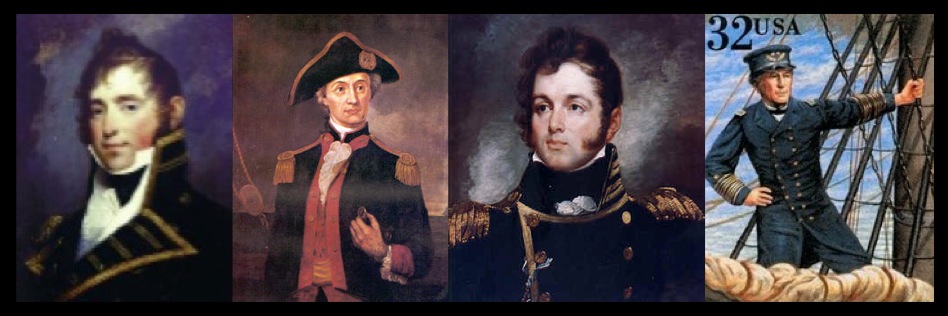
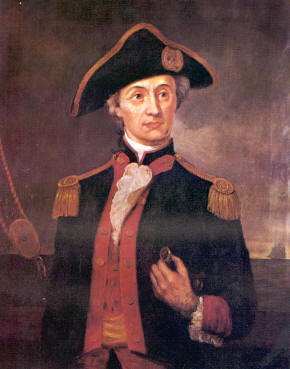
Let me, then, suggest to my fellow Democrats four lessons in courage, and some bold messaging, courtesy of – no! not a group of politicians and pundits – but a quartet of American Naval heroes.

1. John Paul Jones: “I have not yet begun to fight.”

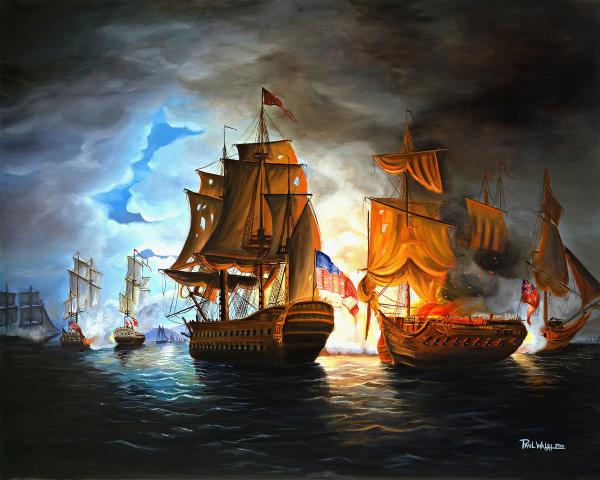
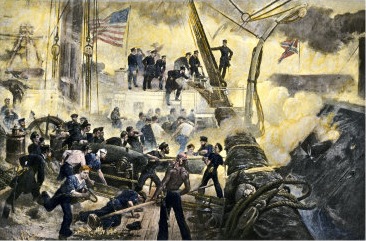
John Paul Jones is revered as the Father of the U.S. Navy, and his exploits in the War of Independence are legendary. But his greatest moment came when he snatched victory from the jaws of defeat on September 23, 1779.  In what has been called one of the bloodiest engagements in U.S. naval history. Jones, in command of the Bonhomme Richard, slugged it out with the 44-gun English frigate Serapis. The gun crews of the Bonhomme Richard and the Serapis traded thundering broadsides until Jones’ ship was burning and in danger of sinking.

Yet, when the Englishmen requested Jones strike his flag and surrender, he replied in defiance, “I have not yet begun to fight.” The battle raged on for more than three hours, ending when the tide of battle turned, the Serapis surrendered — and Jones took command of the defeated English ship.

Sure, the loss of a Senate seat is a terrible blow – but it would be great to hear Harry Reid say something very much like, “I have not yet begun to fight.”

2. Captain James Lawrence: “Don’t Give Up the Ship”

Sometimes a courageous example can turn a cruel defeat into an inspirational moment that transcends that loss – and helps to fuel an ultimate victory — as it did in a dramatic naval engagement early in the War of 1812.

In 1813, Captain James Lawrence was in command of the frigate Chesapeake when he dueled the English ship Shannon at the mouth of Boston Harbor, barely a cannon shot beyond the shore upon which, two centuries later, Martha Coakley’s Senatorial hopes were sunk.

In a brief and brutal exchange of volleys at close range, the Shannon outgunned Chesapeake – and the two ships became so entangled in each other’s fallen rigging that Chesapeake could no longer fire at the English ship. Captain Lawrence gave orders to board the Shannon, but he was hit by an enemy musket ball and had to be carried belowdecks, mortally wounded. Before he was taken below, Lawrence’s last words to his officers were: “Tell the men to fire faster and not give up the ship. Fight her till she sinks!”

Although Chesapeake was forced to surrender, Lawrence’s valiant words served as a rallying cry for generations of officers and men in the U.S. Navy: “Don’t give up the ship!”

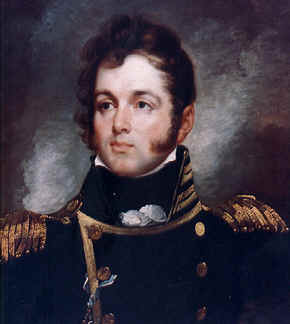
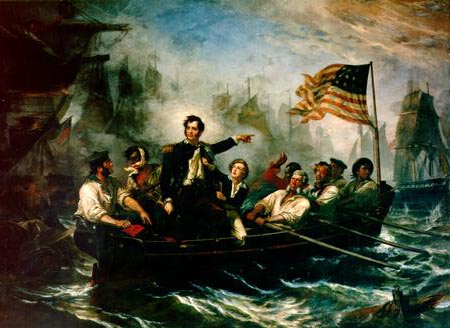
3. Oliver Hazard Perry: “We have met the enemy and they are ours…”

The immortal words of Captain Lawrence inspired his fellow officers. In fact, just months after the loss of the Chesapeake, Commodore Oliver Hazard Perry honored his late friend Lawrence by having the motto “Don’t give up the ship!” sewn onto his private battle flag – which he flew during the Battle of Lake Erie.

During the battle on September 10, 1813, Perry’s fleet engaged a fleet of British warships determined to put the Great Lakes in English control as a prelude to a possible invasion from the north. Perry’s flagship, the USS Lawrence (named in honor of the martyred Captain James Lawrence) was destroyed in the battle – but did Oliver Hazard Perry simply throw in the towel and seek compromise with his enemies? No, by god! He had himself rowed a half-mile through shot and shell to transfer his command to the USS Niagara – carrying his battle flag with his buddy’s final words of defiance emblazoned upon it: “Don’t give up the ship!”

Parry's personal battle flag at the Battle of Lake Erie.

Perry won the Battle of Lake Erie, ending the threat of English invasion via the Great Lakes, and sent his after-action report to General William Henry Harrison. Perry’s message contained few words and, like the words of his fallen friend, they became legendary: “We have met the enemy and they are ours; two ships, two brigs, one schooner and one sloop.”

I’d love to hear President Obama call out the obstructionist GOP Congress with a statement as blunt and bold as “We have met the enemy and they are ours…” The right wing may defeat us in Massachusetts, but like Commodore Perry in his rowboat, we must transfer our efforts to the next stage of the fight and press on until we win the battle.

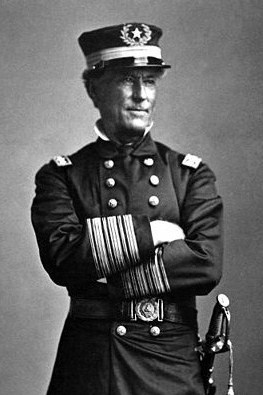
4. Admiral David Glasgow Farragut: “Damn the torpedoes! Full speed ahead!”

Stop worrying about the Coakley catastrophe, sagging poll numbers, what the GOP and right-wing pundits might say, or foot-dragging fears about your own re-election – just press on with a progressive agenda, keep trying to fix the stuff that Bush broke, fix the health care bill in reconciliation – and forget about bipartisanship. In other words,“Damn the torpedoes! Full speed ahead!”

Just about every American my age has heard – and used — this famous phrase many times, but few realize that it has nothing to do with torpedoes as we know them, and that it was actually coined during the Civil War. Of course, the phrase speaks of boldness, courage, and defiant resolution in the face of grave danger – and this time the words were uttered by Admiral David Glasgow Farragut.

Farragut was the highest-ranking U.S. naval officer when he fought the Battle of Mobile Bay on August 5, 1864. Farragut was hanging from the rigging of his flagship Hartford, as his invasion fleet approached the entrance to Mobile Bay, Alabama, intent on sailing past the Confederate defenses and conquering the forts that guarded the Bay.

As the guns of the Confederate forts came to bear on the ships in Farragut’s fleet, the leading ship, the ironclad monitor Tecumseh, was destroyed by a submerged mine. (BTW — we call it a “mine” now, but in Civil War parlance, a tethered underwater explosive device was called a “torpedo”.) With Tecumseh knocked out of action, Farragut’s fleet began to drift in confusion under the guns of the Confederate forts. With disaster in the offing, as Farragut hung from the shrouds aboard the Hartford, he gave the orders, “Damn the torpedoes! Four bells! Captain Crayton, go ahead! Joucett, full speed!”

Farragut sailed his own ship Hartford into the lead — and across the mines, which failed to detonate. The rest of his fleet followed the Commodore’s bold example, ran past the guns of the Confederate forts, and hammered them into submission from a safe anchorage.

Farragut’s fearlessness and resolve — when all might have been lost — saved the day and immortalized his words. If I was President Obama, in command of our mighty Ship of State, that’s the order I would give to Reid, Pelosi, and all my officers. “Damn the torpedoes! Full speed ahead!”

15 Comments

Filed under History, Politics, Truth

Getting Lucky with Gary Whitney

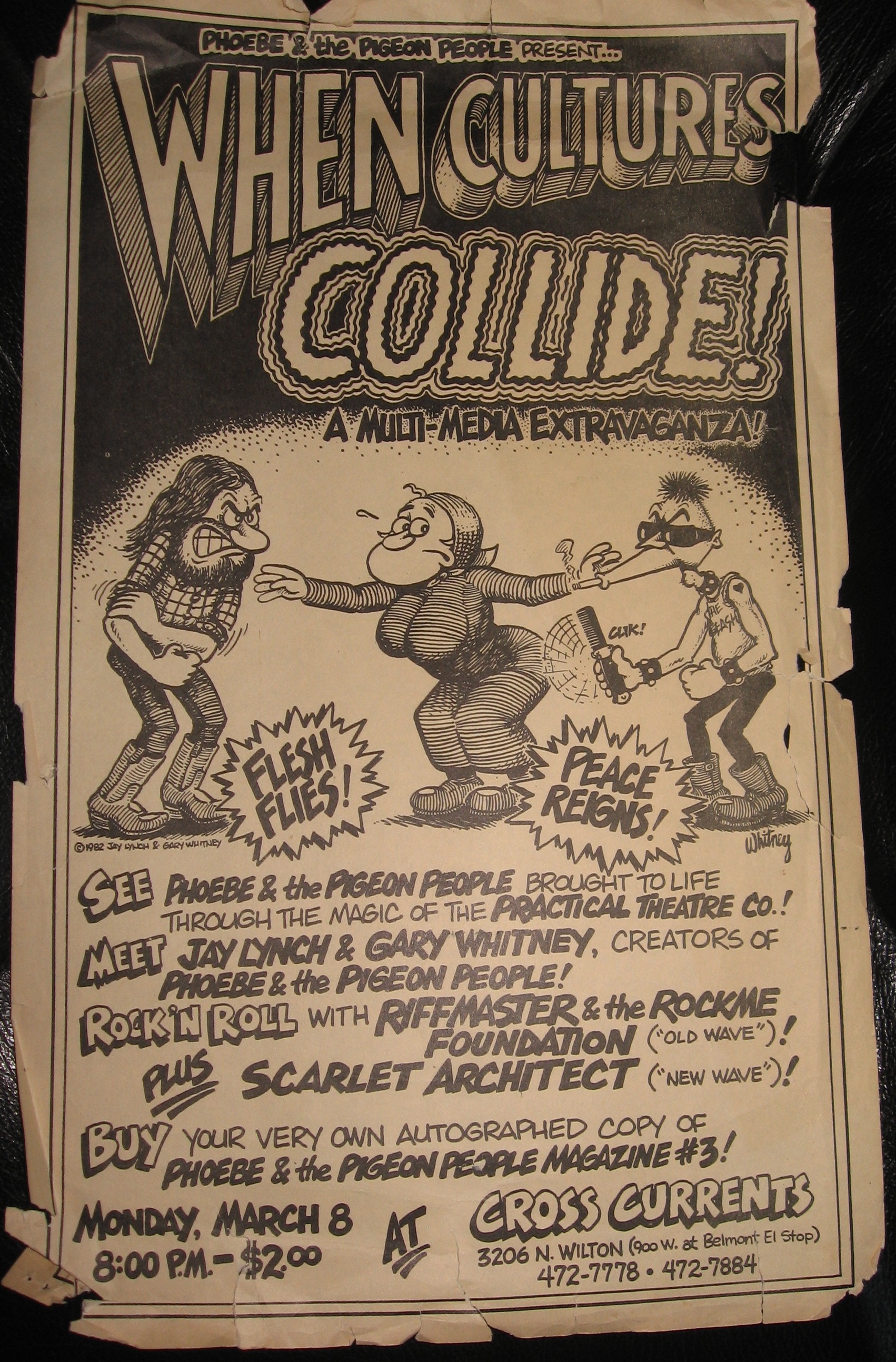
In the 1980’s, all of us at The Practical Theatre Company were very lucky to meet and work with an artist named Gary Whitney. At the time, Gary was partnering with Jay Lynch on the strip Phoebe & The Pigeon People which appeared in the pages of the Chicago Reader – and all of us recent Northwestern University grads had been fans of Gary’s artwork and Jay’s jokes for years before the incomparable Ron and Sydney Crawford introduced us to those two fascinating and talented artists.

Connecting us with Jay and Gary was yet another important social and artistic contribution made by the Crawfords to the PTC. Soon, I will undertake to express the full measure of our collective gratitude to Ron & Syd by blogging the story of their impact on my life, the history of the PTC, and the musical adventures of The Rockme Foundation. I’m pleased to say it’s an ongoing story.

From the moment I first met Gary, I liked him. We all did. Gary was a relatively quiet guy, but he was also very open and warm. He had a big beard and a big sense of humor. I can easily picture him at any number of gatherings at the Crawford’s house or at the John Lennon Auditorium laughing and enjoying the scene. Few of us knew who Gary Whitney really was (other than the guy who drew Phoebe) and Gary wasn’t the kind of guy to toot his own horn – but he, like Jay, was already a fixture in the wild, wild world of underground and alternative comix.

Gary had already been very active in the underground comic scene in the 1970s, contributing to many titles, including Bizarre Sex, Dope Comix, Kitchen Sink Press, Flying Fungus Funnies, and Windy City Comix, among many others. In the 1980’s, we at the Practical Theatre were blessed to have Gary lend his wit and talent to our efforts.

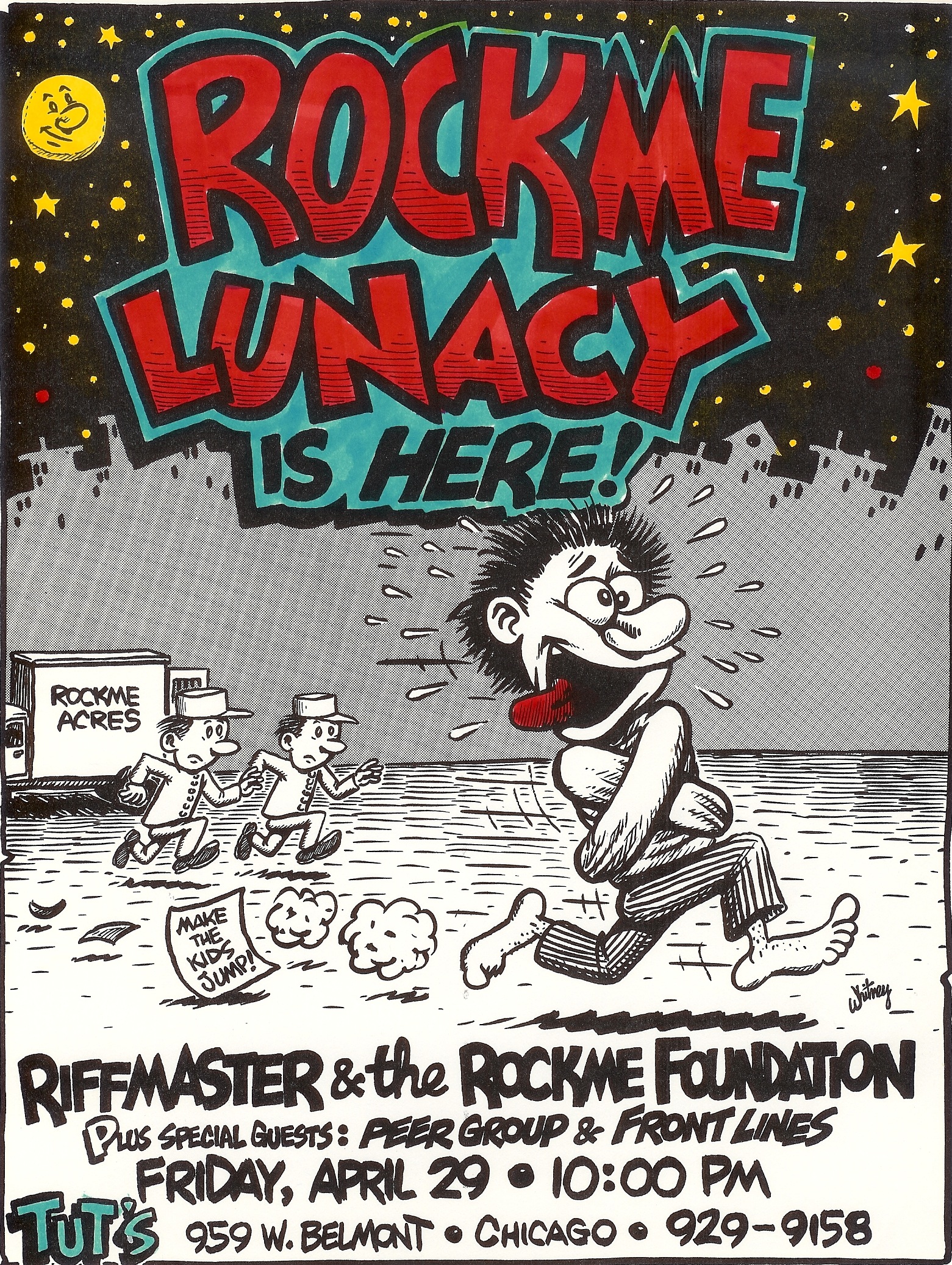
I can’t remember what the first event was for which Gary drew one of his great posters or flyers – but he drew a lot of them. He created a whole series of fabulous flyers to promote appearances by our house band, Riffmaster & The Rockme Foundation. Gary’s posters for the band’s gigs always created excitement, especially within the band. It was so cool to have the guy who drew Phoebe & The Pigeon People make our next gig look so exciting, offbeat and…cool. There’s no better word for it.

Gary also did the poster for The Practical Theatre’s production of Soapbox Sweepstakes, an ongoing satirical look at the 1984 Presidential election, which ran at the John Lennon Auditorium for 30 weeks, from May of ‘84 through election day.

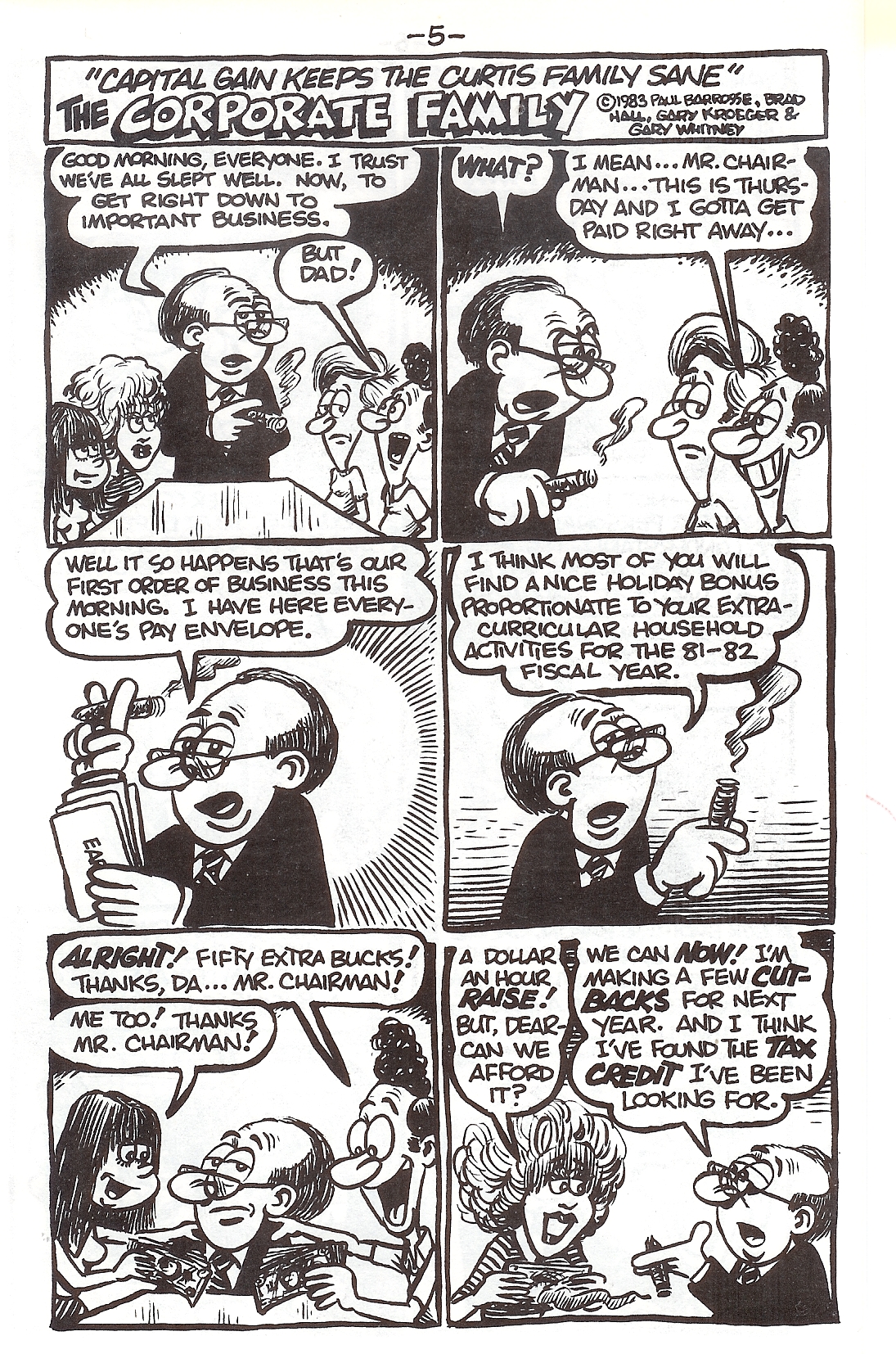
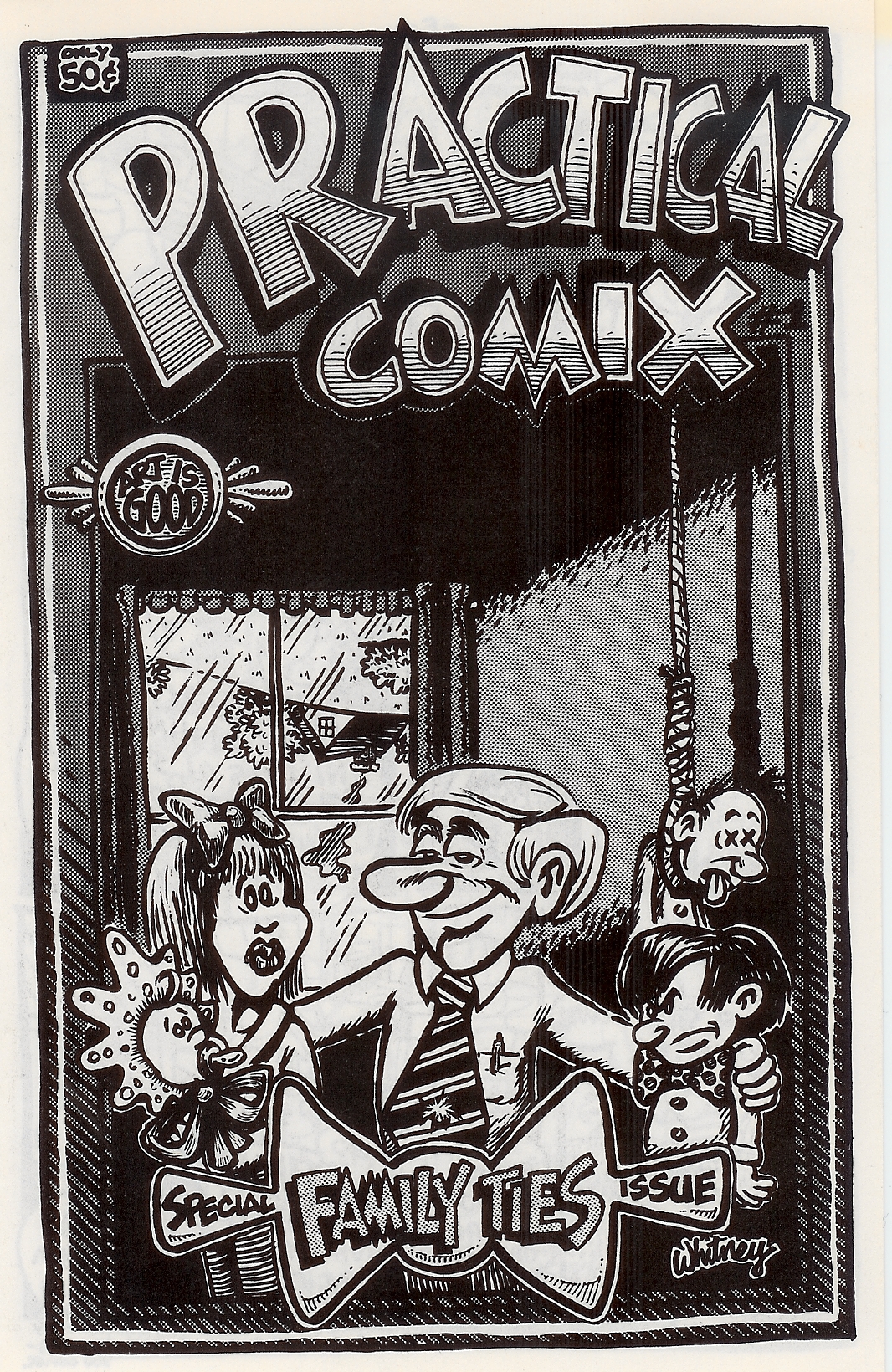
But the collaboration that I enjoyed most was working with Gary, Brad Hall, Gary Kroeger and Ron Crawford on the one and only issue of Practical Comix.

Practical Comix was a childhood dream come true. I’d been an avid reader of comic books since I was a small boy — and in high school during the groovy early 70’s, I became a big fan of underground comics. I even went to Cleveland’s Cooper School of Art one summer in a vain attempt to develop my artistic talents so that I could draw a comic book of my own. Alas, I never became more than a rudimentary cartoonist, but the dream of my own comic book never died. In 1983, Gary Whitney helped to make that dream come true.

What follows is an excerpt from Practical Comix: Special Family Ties Issue. The story is adapted from a sketch that Brad Hall, Gary Kroeger and I wrote for Saturday Night Live. The sketch didn’t make it to air on SNL – but Gary Whitney made it come alive in the pages of Practical Comix.

12 Comments

Filed under Art, History

Bazooka Joe, Jay Lynch & Me

It was 20 years ago that I was fortunate enough to cross paths with two pop culture legends.

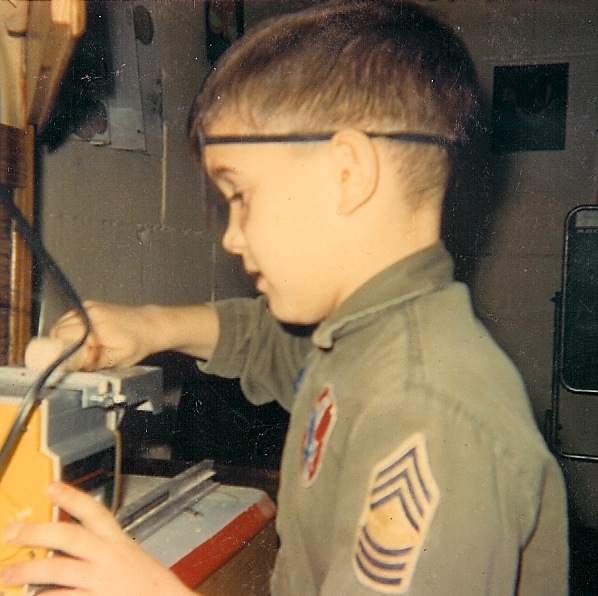
Here I am, circa about '64. Just the age for Bazooka Joe. In fact, is that an eyepatch strap wrapped around my crewcut head?

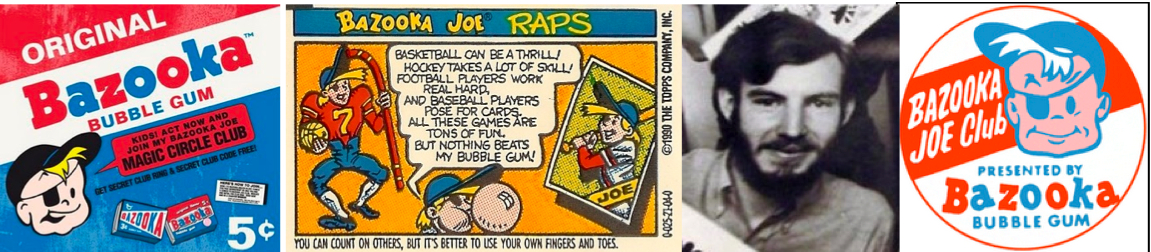
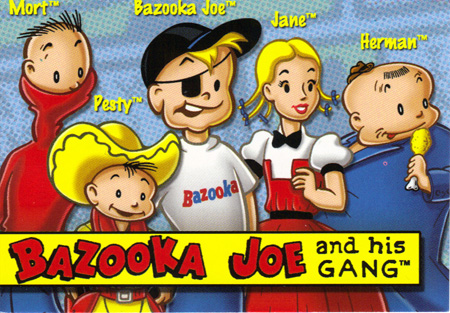
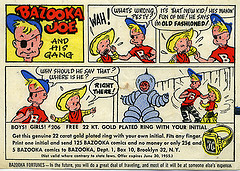
I’d actually known one of these legendary figures since I was a boy, riding my bike recklessly down to the corner store for a comic book, pop and some chewing gum. The gum of choice was Bazooka, a sugary square of latent tooth decay, swathed in a waxy wrapper. But I didn’t buy Bazooka for the taste of the gum – just as I didn’t buy baseball cards to get that stale, petrified pink stick that came along with all the photos, stats, and trivia. No, as my teeth worked their way through the first torturous chomps that would eventually soften that small rock-hard mass into something chewable, I was psyched to read the latest about a smart-aleck kid with an eye-patch: Bazooka Joe.

As far as I knew back then, Bazooka Joe And His Gang had always been and always would be. Iconic characters like Joe and Mort weren’t born and could never die. That’s how it is with great folk art. Did Woody Guthrie really write “This Land Is Your Land”, or was it always on the wind, just waiting to be given voice? Was some unknown drummer the first to hit a rim shot after a bad joke – or is that response simply wired into our DNA? Weren’t hamburgers and hot dogs available since the Garden of Eden? For millions of kids like me growing up in the early 1960’s, chewing Bazooka gum while reading Bazooka Joe comics was an essential cultural touchstone — albeit, one that made our jaws sore and our dentists rich.
It was inconceivable to me, as I sat in front of that corner store and chuckled at the antics of Joe and his pals printed on those little colored rectangles of waxed paper, that I would ever have anything to do personally with Bazooka Joe. Then, two decades later, I found myself in the orbit of a second cultural luminary: Jay Lynch.
This is Jay a few years before we met -- so he's not flipping me off.
I met Jay Lynch in the early 1980’s through our mutual friends, Ron and Sydney Crawford. (Someday, I will devote a lot of blog space to the amazing, artistic Crawfords.) At the time Jay was writing a comic strip called Phoebe & the Pigeon People with artist Gary Whitney. (I will soon be writing more about Gary, too.) Of course, like any fan of The Chicago Reader I knew Phoebe & the Pigeon People very well before I ever met Jay and Gary. In person, Jay was a relatively quiet guy. He was quick-witted and fun to be around, but you wouldn’t call him conversational. Jay gave up information about himself with more reluctance than a Gitmo detainee – so how was I to know he was an underground comics legend?
These links will give you a more complete picture of Jay Lynch:

http://www.mindspring.com/~jaylynch/

http://en.wikipedia.org/wiki/Jay_Lynch

http://jaylynchlist.ning.com/

Jay is a cultural superstar that has been operating on the minds of American youth (and older folk of youthful spirit) for decades. A contemporary of R. Crumb, Jay contributed to Bijou Funnies, one of the first underground comix, and his characters, Nard n’ Pat are icons in the world of subterranean funnies.

Besides his work with Gary Whitney on the long-running Phoebe & the Pigeon People strip, Jay contributed to Mad Magazine and worked for Topp’s on Bazooka Joe comics. He’s the guy all of us middle-aged kids have to thank for Topp’s Wacky Packagesin the early 1970’s: those satiric cartoon stickers we stuck all over everything, with titles like “Plastered Peanuts,” “Ultra Blight Toothpaste,” “Messquire Magazine,” and “Mrs. Blubberworth’s Whale Fat Syrup.” And then there’s Jay’s work on classics like Garbage Pail Kids and Meanie Babies. The list goes on…

In the fall of 1989, Victoria and I were planning our wedding for June of the following year, and I already had one foot in Los Angeles, when Jay approached us with an offer I could scarcely believe: would we like to work with him on a new edition of Bazooka Joe comics? I was busy and the holiday season was upon us – but how could we pass up a chance to have our work immortalized on one of those little waxy rectangles? A cosmic opportunity like that must be seized upon with joy and thanksgiving. We told Jay that we’d give it a shot.

According to Jay, Bazooka Joe was in a transitional, post-MTV period. Joe was in need of a makeover. For one thing, the notion of Bazooka Joe and his gang was problematic. The word “gang” no longer called to mind harmless Huntz Hall and The Bowery Boys. Now, courtesy of rap video imagery and real-world drug wars between outlaws like the Crips and Bloods, “gang” had taken on a far more negative connotation. “Bazooka Joe and His Gang” were gone, replaced by Bazooka Joe & Company.

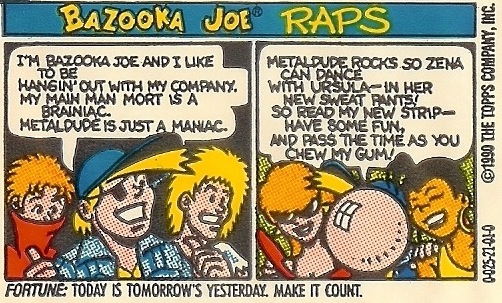
Now, Jay Lynch had dubbed himself Jayzey long before Jay-Z, so he knew that Topps had to embrace the MTV and Hip-Hop culture if it wanted to destroy the teeth of a new generation of kids, so Jay told us they were launching Bazooka Joe Raps. Run DMC meets Bazooka Joe.

Bazooka Joe himself would undergo a bit of a transformation: hipper, more handsome, and more of a jock. Joe’s hair and the bill of his ever-present baseball cap were both longer. And while his eye patch remained, Joe’s good eye was on the future.

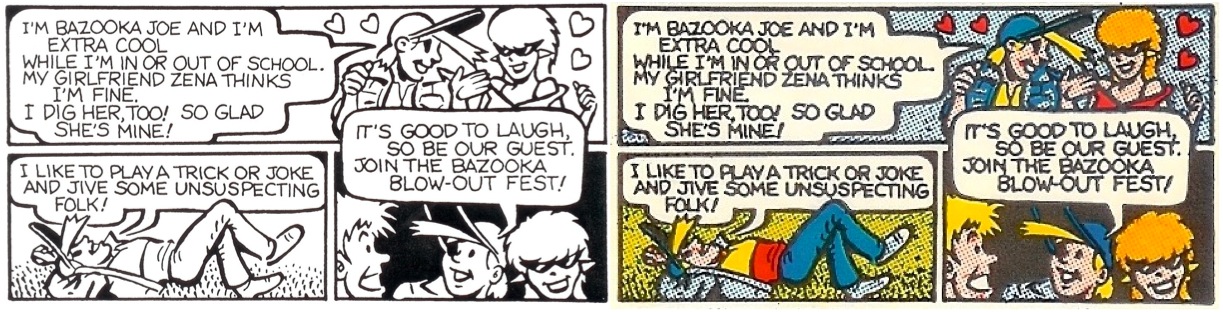
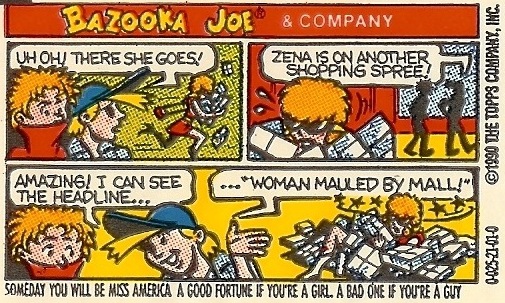
Topps was also introducing some new characters. Mort was still there, his nose sticking out of his ultra-long turtleneck, but Bazooka Joe’s new girlfriend was a sexy shopaholic named Zena.

In another nod to advances in youth culture, Metaldude made his debut. A hairy, hard-rocking misfit, Metaldude was designed to appeal to guys who wouldn’t be caught dead hanging with a relatively square guy like Bazooka Joe.

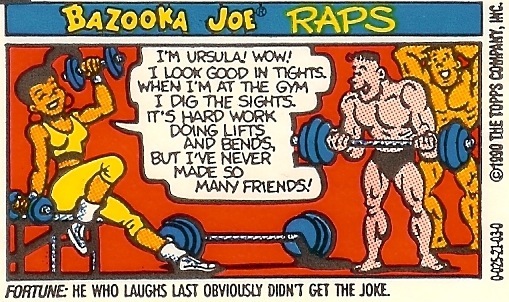
Then, there was Ursula – something totally new for Bazooka Joe: a black woman. And a sexy, confident and athletic black woman at that! Hard-bodied Ursula was drawn in an eye-popping fashion that even a guy with one good eye like Joe would have to appreciate.

From November of ’89 through February ’90, Victoria and I submitted scripts for the various new Bazooka Joe series, including Bazooka Joe Fantasies and Bazooka Joe Mystic Master of Space & Time. As it turned out, we did our best work on Bazooka Joe Raps.

However, my favorite strips are the ones we wrote for Bazooka Joe & Company. I’d always loved those classic three and four panel jokes as a kid – and to get a chance to do it myself was an honor. Victoria, having chewed more than her share of Bazooka Joe as a youth, was also thrilled to be part of a great American cultural institution.

The comics that illustrate this article are ones that we were privileged to add to Bazooka Joe’s jaw-aching legacy. And we’ve got Jay Lynch to thank for allowing us to share a very small part of childhood cultural history.

28 Comments

Filed under Art, History