
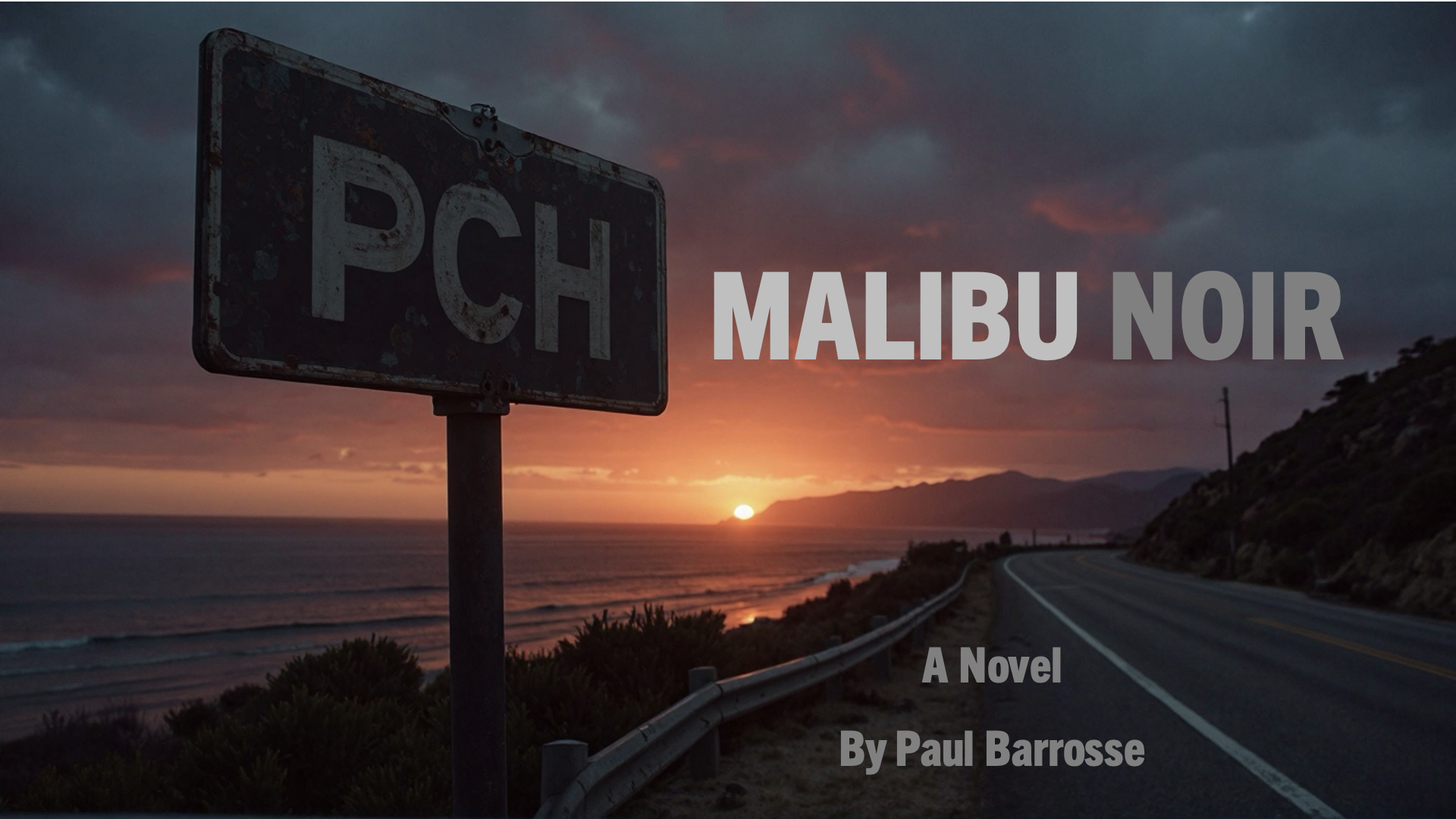
Okay. 15 likes is more than enough to trigger Chapter Two. Thank you all very much! I hope you enjoy it. It will take a total of 30 likes to release Chapter Three. This process is a bit like one of those old-time movie serials like “Buck Rogers” or “The Perils of Pauline.” You’ve gotta wait for that next installment.
Chapter Two
Cruising north through Malibu on his way home, Mike glanced to his left at the ocean. Through the rain, the moon was bright enough to see the white caps of the storm-driven surf as it surged toward the beach. This coastline was where he was born and raised. He’d conquered an early fear of the water to become a damn good surfer. His dad owned a small landscaping business: trimming, planting, and raking the lush yards of the high rollers who lived in the low hills to his right, overlooking the ocean. His parents didn’t want their only son pushing a wheelbarrow for a living – or worse, becoming a surf bum — so they saved up to send their golden boy to college.
Mike’s thoughts went back nine years to the months after Pearl Harbor. At the time, he was in his second year at UCLA. He remembered how his parents reacted when he enlisted in the Marines. They weren’t thrilled that he was delaying his education, but his dad had survived the trenches in The Great War and was proud to see his son do his bit. Hi mother could only cry and pray. Cry and pray. So, instead of getting his diploma and moving on to grad school, he got basic training at Camp Pendleton, dog tags, an M1 rifle, and the opportunity of a lifetime to go island hopping in the Pacific. The term “island hopping” always pissed him off. It was too cute. Like it was game.
Mike remembered “island hopping” all too well: that series of savage battles waged to capture strategic islands from the desperate, dug-in Japanese. Mike was lucky enough to escape the carnage on Tarawa with no more than a gunshot wound in his right arm. The bullet missed anything vital, so the medics patched him up and threw him back into the meat grinder. Mike figured he must have done something good on Tarawa before he got wounded because the Marines gave him a Bronze Star to go along with his Purple Heart.
He healed up in time to join the bloodbaths on the Marshall Islands: shell-torn strips of coral, sand, and jungle fever with crazy names like Kwajalein and Peleliu. He was always wet, always on edge, always exhausted — always a stroke of luck away from death. While managing to stay alive, he was promoted to sergeant and command of a rifle platoon. The lieutenant who had the job before him was blown to bits by a Jap artillery shell. That’s how advancement works on the battlefield: next man up.
He was leading his platoon on Iwo Jima when a Jap grenade ended his military career. He had no memory of what happened before and after that blast, but he evidently led his platoon well during the battle because the Marines sent him stateside with a Silver Star to go with his Bronze Star and two Purple Hearts. His parents were proud to see their son come home a decorated war hero. But Mike didn’t feel heroic. He was just glad to make it out alive.
After recovering from his wounds at a San Diego military hospital, 22-year-old Mike went back to Los Angeles. On his first day home in Malibu, he got the Marine Corps logo tattooed on his strong right forearm in honor of his lost comrades — and looked ahead to the peacetime future.
All the beers he’d just downed at Zack’s made Mike woozier than he expected. Gloria had cut him off just in time. He prided himself on holding his liquor, but he wasn’t great behind the wheel right now, especially on the wet road. He sure as hell didn’t want to get stopped by the cops. That’d be a real pain in his ass. So, he pulled off PCH, parked on a bluff overlooking one of his favorite surf breaks, and continued to think about the past.
For a while, he worked with his dad in the landscaping business, but his parents urged him to go back to school, finish his education, and become a doctor. Planting some movie star’s palm trees was no job for a war hero. Mike agreed with his parents, but he couldn’t wrap his head around going back to college. Not after Tarawa. Not after Iwo Jima. Plus, he’d seen enough doctors, hospitals, awful wounds, and deadly diseases to last a lifetime. Medical school was not for him. He needed to do something else. But what?
One night, Mike was drinking at Zack’s with a Marine pal he met while convalescing in San Diego. Eddie had been an MP in the service, policing the waterfronts on hellholes in the Solomon Islands. Eddie had lost some of his hearing when an enemy shell blew up a nearby ammo dump on Guadalcanal. But Eddie’s MP experience helped land him a job as a Los Angeles cop. Eddie assured him that, given Mike’s impressive war record and his time at UCLA, he was a shoo-in for the force.
Eddie was right. Mike made it through the police academy with the ease of a veteran who’d been through basic at Pendleton and commanded men under fire. Mike went at the job of being a policeman like he was hitting some Jap-held beach. Bold and fearless. Some would say reckless. Within a few years, he rose from beat cop to detective. Very few guys rose in rank that quickly. It ruffled some feathers — but promoting a bona fide war hero made for a nice article in all the papers. It was good press for the LAPD brass.
Some guys on the force thought Mike was too aggressive, too inclined to act on his own, blind to department politics, and quarrelsome with his superiors. Mike knew they were right. But the only guys on the force he truly respected were the ones who fought and bled in the war. Guys like Eddie. To Mike, everybody else was play-acting. Hollywood cops. It wasn’t fair, maybe, but that’s how he felt. At least most days he felt that way. Most nights he drank.
And on this night, he’d guzzled down a few too many beers. Mike stuck his head out the car window and took a deep breath. The chill air and rain on his face had the right effect. His head was beginning to clear, but not enough to drive home safely. Not yet.
Beer – and before that, bourbon — helped to dull the pain in his hip, but that’s not why he boozed so much. He started drinking hard during his first year as a cop. It helped him deal with the fact that he’d traded one war for another. He was just wearing a different uniform. But this time, the killing served no higher purpose, and the end of the war was never in sight. Fighting crime in L.A. was like trying to root out the last of the Japanese dead-enders still holding out in caves on those bloody islands. Mike took another deep breath of ocean air.
God, he loved the water. The surf. The peace.
When Mike was feeling particularly unsettled, angry, or weary of seeing the worst side of postwar Los Angeles, he would head to Malibu to visit his parents and surf. But after his dad dropped dead of a heart attack while lugging a bag of peat moss up to some rich asshole’s hillside garden, Mike checked in with his mom less frequently. Her sorrow bugged him. What could he say to her? He’d seen thousands of young men in the prime of their lives die miserably on blasted specks of jungle in the middle of nowhere. He’d seen far too many innocent young people murdered on the streets of L.A. His dad was a 65-year-old man who died doing the job he loved: an Irish immigrant running his own business in America. Where was the grief in that?
Feeling like he was now just two sheets to the wind, Mike started his car and drove back out onto Pacific Coast Highway. After a few uneasy minutes driving in what was now a pelting rain, he managed to make it safely into one of the parking spaces below his apartment. Not a cop in sight. He’d gotten away with it tonight, but the last thing he wanted was to give his old colleagues on the police force the pleasure of the putting the big hotshot war hero in the drunk tank.
The rain drummed on the car roof as Mike leaned back in the driver’s seat and closed his eyes, his head swimming with beer and memories.
He’d been a cop for only four years when, after far too many run-ins with the department brass, his standing as a rising star gave way to a well-earned reputation as a hard-headed know-it-all with a stubborn streak and an unhealthy disregard for danger. When he got demoted from detective back to beat cop, he read the writing on the wall. He saw that, like his dad, it was better for him to run his own business. So, he quit the force in ‘49 and hung out his shingle as a private investigator. He swore off the bourbon and switched to beer. It was time to clean up his act. At least a little.
Young as he was for a private eye, Mike’s chest full of wartime medals and his detective experience kept him in paying customers among the Hollywood elite. But he soon found that tracking down missing rich kids, staking out cheating spouses, and fixing indelicate problems for folks with scads of money was even more soul crushing than battling domestic battery in Encino, gang warfare in Boyle Heights, and unsolved murders in Burbank.
He started taking fewer cases, avoiding the ugliest ones. He spent more time riding waves.
Two years after leaving the police force, disillusioned 29-year-old Mike was living in Malibu, more surf bum than private investigator. When he wasn’t working the occasional case that didn’t offend his increasingly prickly sensibilities, he was sitting on a stool at Zack’s Oceanside Dive, knocking back beers and mooning over a barmaid named Gloria: the one shining, unsullied light in his life.


 Paul's Voyage of Discovery & Etc.
and then what happend?
Stuff. Lots of stuff.
yeah, but what kind of stuff?
MORE!!!