Tag Archives: World War Two

Victory at Pearl Harbor…

(This was orginally posted in 2010.)

The significance of December 7, 1941 is something that most of our parents do not need to be reminded about. It was a shocking, indelible moment for them, much like September 11, 2001 was for another generation of Americans. I don’t want to spend time here comparing those two disastrous attacks: one by a hostile state, the other by a handful of extremists. That’s for another time, another post.

This is a day of remembrance.
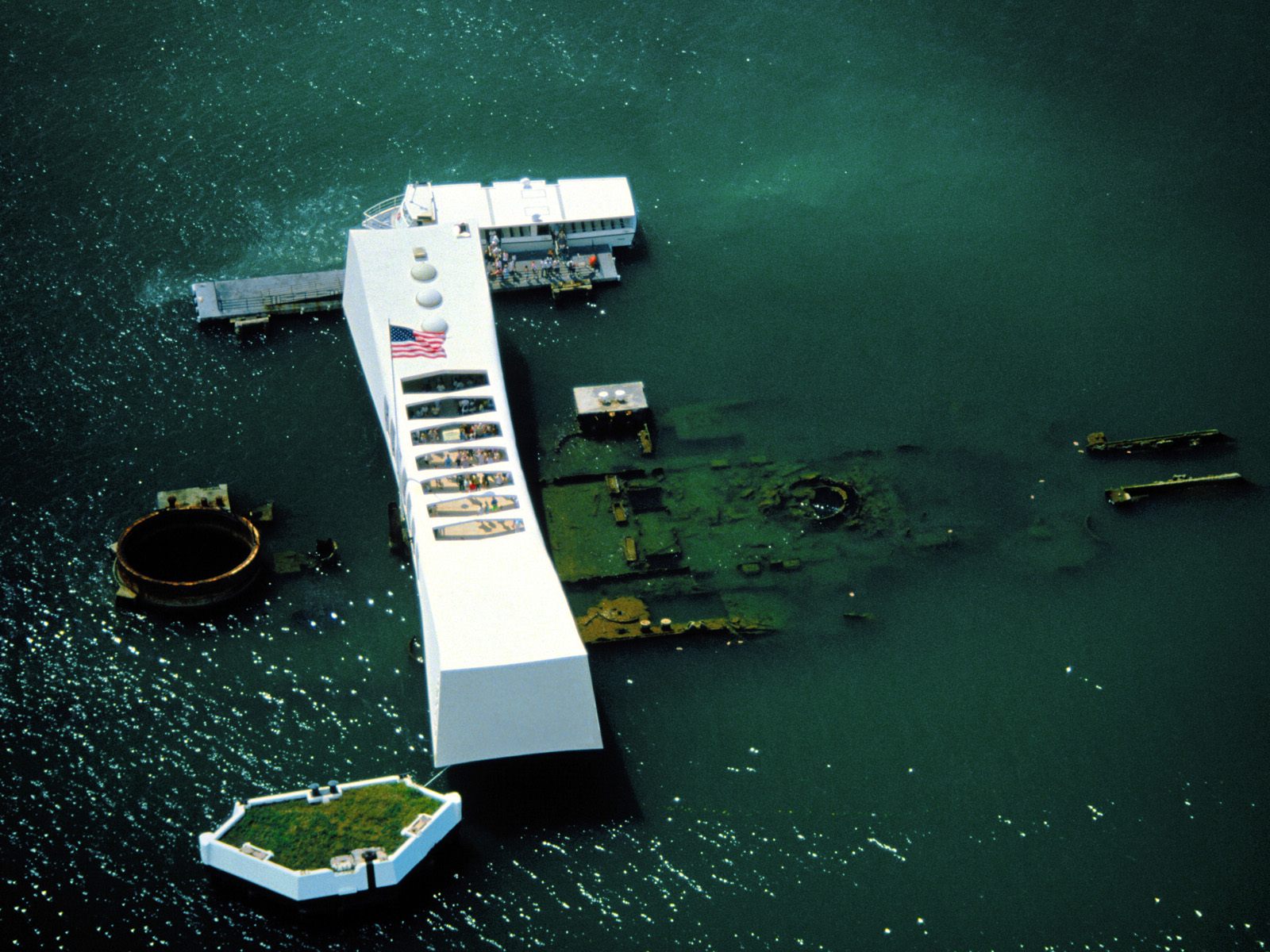
There are not many veterans of Pearl Harbor still with us. Not many left who saw the Japanese planes diving out of the sky, felt the concussions as great battleships shuddered, burned, and sank. Not many left who can stand on the observation deck of the USS Arizona Memorial, gaze at that sunken iron tomb and say, “I knew a guy who went down with that ship.”

On December 7th, we remember what was lost at Pearl Harbor: the lives, the ships, the planes – our national innocence.

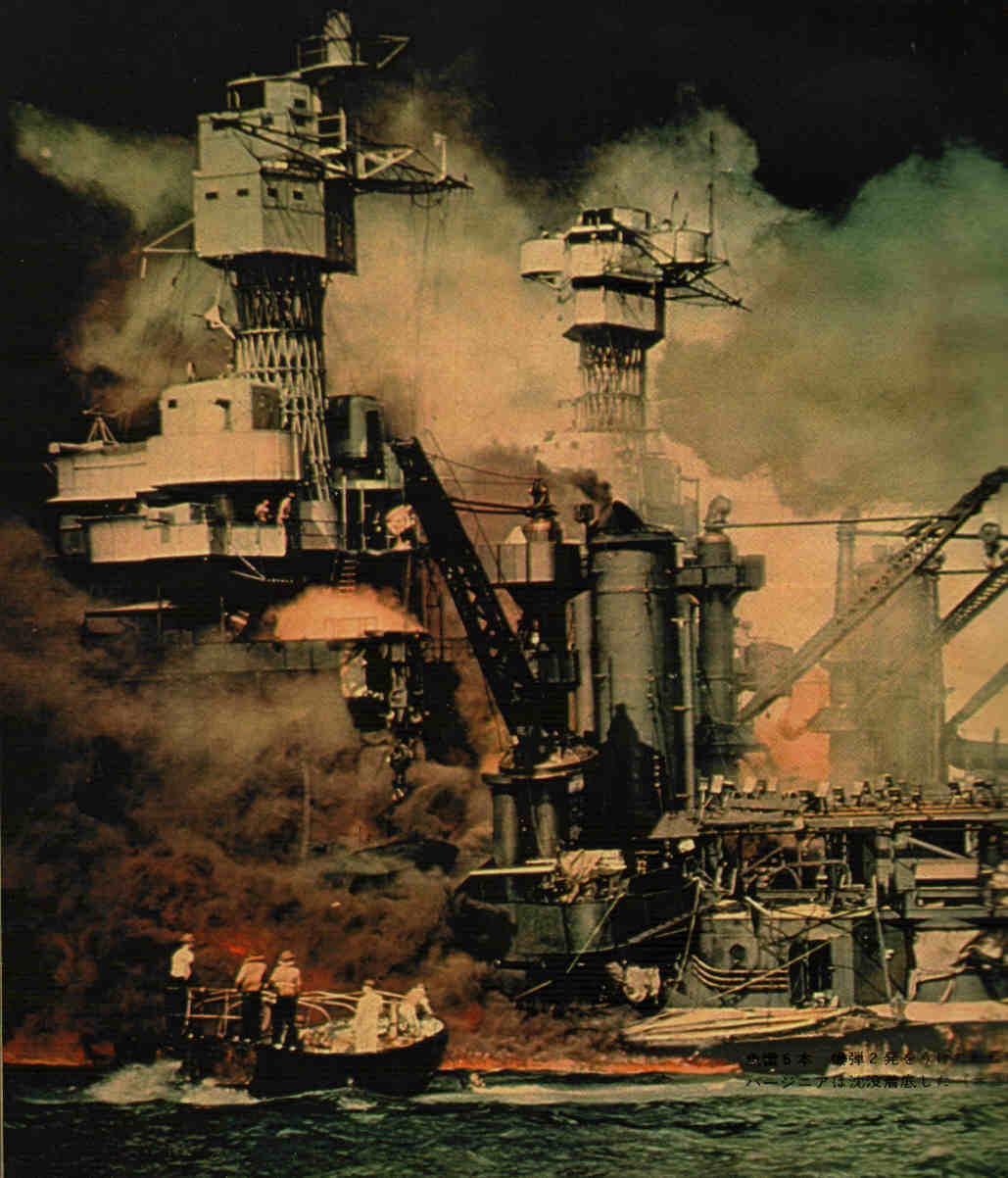
But on this day, we should also remember the miracle of Pearl Harbor: the incredible effort that raised so many of those ships from the bottom of the harbor, patched them up – and sent them back into the fight. Only three of the ships that were bombed in Pearl Harbor on that day of infamy were forever lost to the fleet.

And of the 30 ships in the Japanese fleet that attacked Pearl Harbor, only one survived the war without being sunk.

The dynamism, optimism and resolve displayed by those military crewmen and civilians who, within months, raised and repaired the devastated wreckage of Pearl Harbor are qualities that Americans must call on once again to overcome our national challenges. Would that our leaders would spend less time sowing the fear of future attacks – and more time appealing to the better angels of our national identity.

“Can do” was the unofficial motto of the Seabees, the legendary Navy outfit that led the reconstruction effort at Pearl Harbor.

Where’s that American “Can do” spirit now?

P.S. Click here for a WWII-era Pearl Harbor song I found online. It may seem a bit too upbeat at first, but in the context of our ultimate victory at Pearl Harbor, it’s not too bouncy after all. It’s got that confidence and “Can do” spirit.

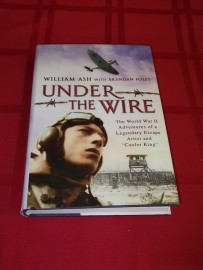
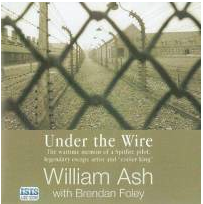
$(KGrHqNHJBcE-dPs9M,cBPn+++hkMg~~60_57P.S.S. On this day, let’s remember one of the great WWII POW escape artists. If you have any pals who love The Great Escape or Shawshank Redemption, please point them toward the story of William Ash: Texan, RAF pilot, POW — and a guy who escaped the Nazi prison camps 13 times!

He’s the guy that inspired Steve McQueen’s character in The Great Escape.

Amazon link: http://www.amazon.com/dp/1481088858/

Kindle ebook: (free to Prime members) http://amzn.com/B00AF4I0K8

Comments from authors on UNDER THE WIRE:

9780553817119What a splendid book! A young Texan brought up in the middle of the Depression who pulls himself up by his bootstraps, thereafter hikes to Canada to fly Spitfires for the Brits while America is still neutral. Just as the U. S. enters the war, he is shot down, and another exciting and terrible episode in his life begins. Living under terrible conditions he makes several attempts to escape until he finally succeeds in saving himself and many of his fellow POWs. This is a moving and heroic story of a young man who overcomes all obstacles with a sense of humor and succeeds in the end. Hollywood should snap this book up in a flash. Buy it, read it, enjoy it.

Charles Whiting, author of Hero: Life and Death of Audie Murphy
AshUNDER THE WIRE is a well-written and exciting memoir of wartime captivity that is packed with incident and vividly recreates the oft-neglected early days of Stalag Luft III and the now forgotten mass escape from Oflag XXIB, Schubin — a sort of dress rehearsal for the famous Great Escape. The author himself is one of the great unsung heroes of the Second World War, as are some of those whose adventures he records in this remarkable book. It also makes a refreshing change to read a memoir by someone who is politically literate and knew exactly what he was fighting against and what he was fighting for.’ There are passages in this book – particularly those concerning the political awakening of POWs and their determination to create a better post-war world – that make the reader want to stand up and cheer.

Charles Rollings, author of Wire and Walls, Wire and Worse

UNDER THE WIRE is everything I would expect from a memoir by Bill Ash — fast-paced, exciting and moving, but also colored by his mischievous sense of humor. He has a real gift as a storyteller — the characters and events come off the page as if we were meeting and experiencing them ourselves. Bill Ash was one of the great escape artists of the Second World War, and always managed to put himself in the centre of the action. He endured a lot, but never lost his essential humanity and zest for life, something that comes through very strongly in his book. That’s what makes UNDER THE WIRE such a joy to read — getting to know the irrepressible Ash and reliving his adventures with him.

Jonathan Vance, author of A Gallant Company: The Men of the Great Escape.
 

7 Comments

Filed under History

Bill Ash: A Real-Life Superhero

How’s this for a storybook hero?

060109h4A 21-year old kid from Texas leaves home in 1939 at the outbreak of World War Two to join the Royal Canadian Air Force. He gets sent to England, flies Spitfires — then gets shot down over occupied France in 1942. He becomes a POW, captured by the Gestapo and imprisoned in the notorious Stalag camps. And that’s where the William Ash story really begins.

Cocky young Bill Ash becomes one of the war’s greatest serial escape artists — attempting 13 daring escapes: cutting through barbed wire, climbing over it, or tunneling under it before finally escaping for good. His exploits inspired Steve McQueen’s character in The Great Escape.

But his adventures were far from over. Awarded an MBE for his wartime heroism, Ash worked as a BBC correspondent in India and as senior producer of BBC Radio Drama, and he wrote several books and plays.

Today, William Ash is 95 years young: one of America’s greatest unsung heroes of World War Two.

060108h3Our good friend, Brendan Foley, co-wrote Bill Ash’s wartime autobiography, UNDER THE WIRE. It’s what Bill’s messmates in the RAF would have called “a ripping good yarn.” It’s unbelievable, really. Except that it truly happened.

When Brendan and Bill’s book came out in the UK a few years ago, it became a bestseller, but somehow it’s been almost completely ignored in the U.S. media.

$(KGrHqNHJBcE-dPs9M,cBPn+++hkMg~~60_57According to Brendan, “The only thing we can do to get Bill and his book the recognition they deserve in the US and Canada is to turn to the Internet and people who care about WWII and the people who fought it for us. We’ve brought out North American paperback and kindle versions of UNDER THE WIRE to celebrate Bill Ash’s 95th birthday — an American Spitfire pilot and last of the great WWII POW escape artists. If you have any pals who love The Great Escape or Shawshank Redemption, please point them this way!”

Amazon link: http://www.amazon.com/dp/1481088858/

Kindle ebook: (free to Prime members) http://amzn.com/B00AF4I0K8

Comments from authors on UNDER THE WIRE:

9780553817119What a splendid book! A young Texan brought up in the middle of the Depression who pulls himself up by his bootstraps, thereafter hikes to Canada to fly Spitfires for the Brits while America is still neutral. Just as the U. S. enters the war, he is shot down, and another exciting and terrible episode in his life begins. Living under terrible conditions he makes several attempts to escape until he finally succeeds in saving himself and many of his fellow POWs. This is a moving and heroic story of a young man who overcomes all obstacles with a sense of humor and succeeds in the end. Hollywood should snap this book up in a flash. Buy it, read it, enjoy it.

Charles Whiting, author of Hero: Life and Death of Audie Murphy

AshUNDER THE WIRE is a well-written and exciting memoir of wartime captivity that is packed with incident and vividly recreates the oft-neglected early days of Stalag Luft III and the now forgotten mass escape from Oflag XXIB, Schubin — a sort of dress rehearsal for the famous Great Escape. The author himself is one of the great unsung heroes of the Second World War, as are some of those whose adventures he records in this remarkable book. It also makes a refreshing change to read a memoir by someone who is politically literate and knew exactly what he was fighting against and what he was fighting for.’ There are passages in this book – particularly those concerning the political awakening of POWs and their determination to create a better post-war world – that make the reader want to stand up and cheer.

Charles Rollings, author of Wire and Walls, Wire and Worse

UNDER THE WIRE is everything I would expect from a memoir by Bill Ash — fast-paced, exciting and moving, but also colored by his mischievous sense of humor. He has a real gift as a storyteller — the characters and events come off the page as if we were meeting and experiencing them ourselves. Bill Ash was one of the great escape artists of the Second World War, and always managed to put himself in the centre of the action. He endured a lot, but never lost his essential humanity and zest for life, something that comes through very strongly in his book. That’s what makes UNDER THE WIRE such a joy to read — getting to know the irrepressible Ash and reliving his adventures with him.

Jonathan Vance, author of A Gallant Company: The Men of the Great Escape.

From the Wikipedia article on Bill Ash:

William Franklin was born into a lower middle-class family in Dallas, Texas. He worked as a migrant worker during the U.S Great Depression and took a University course, doing privileged pupils’ essays in order to gain money and also for his personal development as an author.

It was around this time when the Spanish Civil War broke out, that the largely apolitical Ash, driven by a hatred of bullies and fascism, decided that if the war was still going when he was old enough to fight (aged 21), he would join the Abraham Lincoln Brigade.

In 1939, he left for Canada and joined the Royal Canadian Air Force, trained as a fighter pilot and reaching the UK shortly after the end of the Battle of Britain. He flew Spitfires on many missions, including an attack on the German battleships Scharnhorst and Gneisenau, culminating in “big wing” fighter sweeps over France. In March 1942, he was shot down and was caught by the Gestapo, twice being sentenced to death before being “rescued” by the German Luftwaffe, and shipped off to Stalag Luft III.

Ash was later moved to — and escaped from — Oflag XXI-B through the latrine tunnel with Harry Day and Peter Stevens. Escaping became his prime preoccupation for the rest of the war and he was subsequently awarded the MBE for his many escapes.

Back in England at war’s end, Ash became a naturalized British citizen and went to Balliol College, Oxford to earn degrees in Philosophy, Politics and Economics, before getting a job in the BBC‘s overseas service, posted as the Corporation’s official representative to the Indian sub-continent. Later, he was able to get work in the BBC’s radio drama department as a script editor.

1 Comment

Filed under History

My Book Report: “The Battle of Midway”

Let’s be honest. Book reports are one of the scourges of youth.

Even if you enjoyed reading the book that you were assigned in grade school, or that you read in some summer reading program, the book report was always hanging over you. You had to write them. Teachers had to grade them. Nobody was really happy about it.

Now that I’m out of school and read mostly for pleasure, I enjoy sharing my enthusiasm for books I’ve read. And since I’m in no longer in danger of being graded by Sister Philomena, it’s time to rehabilitate the book report.

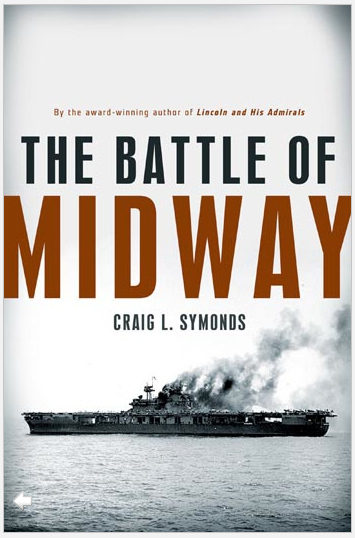
When I read a good book this year, I’ll post a book report on this blog — and The Battle of Midway by Craig L. Symonds is a very good book.

I confess that most of my recreational reading time is spent devouring history, especially military history: tales of Lord Nelson’s navy, the American Civil War, World War One aviation, and the great battles of World War Two. So, “The Battle of Midway” is right up my alley.

Having read a lot of history books, I’m not easy to please. Too often, history is written in a dry and academic way. I dare you to hack your way through Thermopylae: The Battle That Changed the World by Paul Cartledge. The legendary last-stand heroism of King Leonidas and his 300 Spartans deserved more than a repetitive, impenetrable compendium of scholarly knowledge with no regard to dramatic storytelling.

Ever since I read the great Civil War histories of Bruce Catton and Shelby Foote, I’ve come to appreciate that the best, most readable history books address their subjects with a novelist’s gift for character and story. And that’s what Craig Symonds brings to his stirring account of the Battle of Midway: a game-changing confrontation that was essentially the Gettysburg of World War Two in the Pacific.

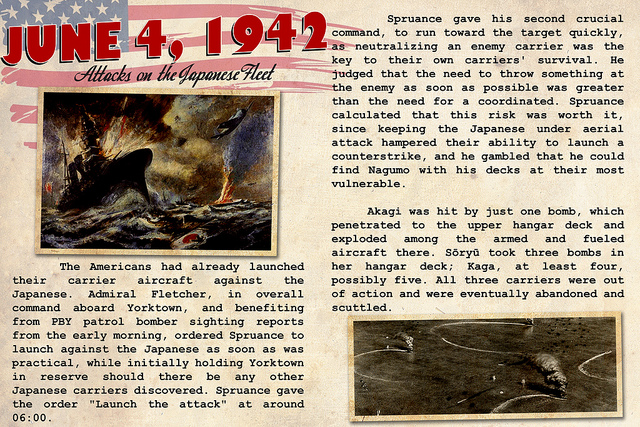
As the sun rose on June 4, 1942, six months after Pearl Harbor, the Japanese navy was supreme in the Pacific. Before the day was over, the U.S. Navy had turned the tide. Like the Confederacy after Gettysburg, the Japanese would continue to fight – and the bloodiest years of the war lay ahead – but the Japanese could no longer win the war.

I’ve enjoyed Craig Symonds’ work before. A retired professor and chairman of the history department at the U.S. Naval Academy, Symonds wrote A Battlefield Atlas of the Civil War (1983) and Gettysburg: A Battlefield Atlas (1992), both of which I’m proud to have on my groaning history bookshelf. Those two books, with their easy-to-read maps and clear, concise copy make the great Civil War battles easy to comprehend. With no less clarity, Symonds goes deeper into the personalities and drama in The Battle of Midway.

Symonds begins by painting a bleak picture of American naval power after the disastrous surprise attack on Pearl Harbor. But, as dire as the situation was, with a seemingly unstoppable Japanese aircraft carrier force (the Kido Butai) imposing it’s will across the Pacific, the U.S. Navy’s own carriers had been absent from Pearl Harbor – and, within six months, would provide the platform for a counterstrike that would lay waste to the Kido Butai.

Symonds draws all the main characters with the skill of a novelist: Admirals Nimitz, “Bull” Halsey and Spruance as well as the poker-loving gambler, Admiral Yamamoto. But Symonds doesn’t dwell solely on the brass – he also gives us a chance to meet the pantheon of heroes who flew the torpedo bombers, dive-bombers, and fighter planes, as well as the seamen who manned the guns on the ships, fought the fires on their decks, and patched up the holes to keep them afloat.

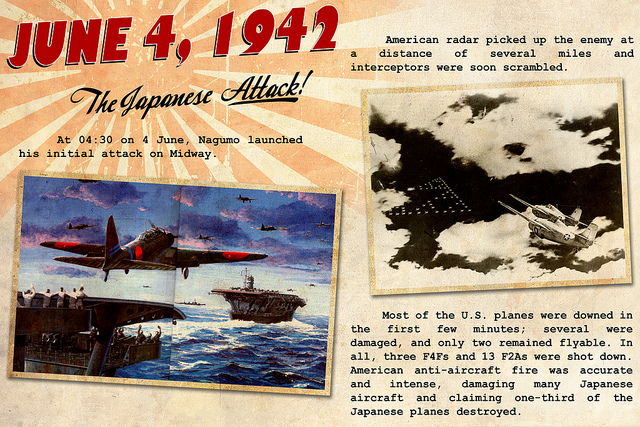
By the time Symonds gets to the fateful, pivotal and incredible five-minute period in which American dive-bombers mortally wounded three of the four Japanese carriers in the Kido Butai – and thus changed the course of the war in 300 seconds — it’s clear how it happened, why it happened, and who was responsible.

“What I tried to do is put together the oral histories to recreate a moment” to make readers feel like they’re there, Symonds has said. “It allows us to put ourselves in their place.”

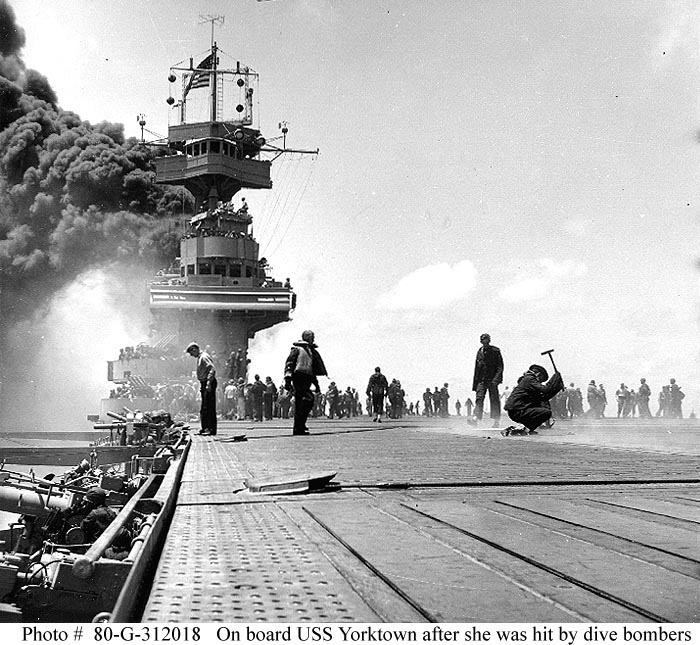
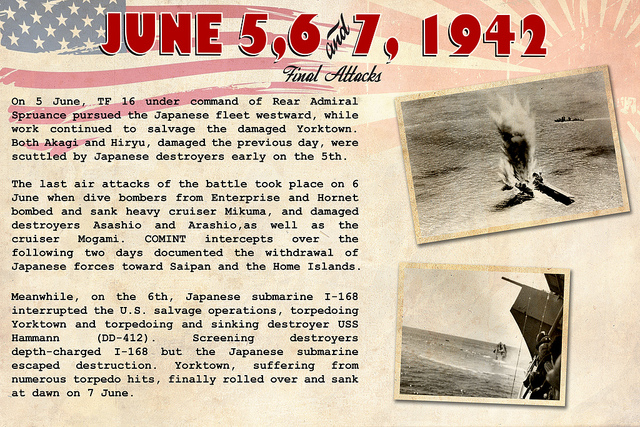
Particularly compelling in Symonds’ account is the story of the American carrier, USS Yorktown. The Yorktown had been badly damaged by a Japanese bomb on May 8, 1942 in The Battle of the Coral Sea. The crippled Yorktown limped into Pearl Harbor on May 27. It was expected that repairs would take three months. But Admiral Nimitz needed the Yorktown for his planned attack on the Kido Butai at Midway – so the repair crews at Pearl Harbor fixed her up and sent her back out to sea in just three days. Four days later, the Yorktown was fighting the Battle of Midway. Alas, the Yorktown did not survive Midway, but before she went down, her dive-bombers had sunk the Japanese carrier Soryu.

The Battle of Midway is part of Oxford’s Pivotal Moments in American History series — and in the introduction to his book, Symonds writes: “there are few moments in American history in which the course of events tipped so suddenly and dramatically as it did on June 4, 1942. At ten o’clock that morning, the Axis powers were winning the Second World War… An hour later, the balance had shifted the other way. By 11:00 a.m., three Japanese aircraft carriers were on fire and sinking. A fourth was launching a counterstrike, yet before the day was over, it too would be located and mortally wounded. The Japanese thrust was turned back. Though the war had three more years to run, the Imperial Japanese Navy would never again initiate a strategic offensive…”

The Battle of Midway is a great read. The resolute self-sacrifice of the doomed Navy torpedo bombers will bring you to tears. The courage, ingenuity and resourcefulness of the fire suppression and repair crews on the Yorktown will amaze you.

And, among other vastly interesting things, you’ll find out how Chicago’s O’Hare Airport got its name.

If you think you don’t like military history books, give this one a try.

3 Comments

Filed under History

Victory at Pearl Harbor…

(This was orginally posted last year.)

The significance of December 7, 1941 is something that most of our parents do not need to be reminded about. It was a shocking, indelible moment for them, much like September 11, 2001 was for another generation of Americans. I don’t want to spend time here comparing those two disastrous attacks: one by a hostile state, the other by a handful of extremists. That’s for another time, another post.

This is a day of remembrance.

There are not many veterans of Pearl Harbor still with us. Not many left who saw the Japanese planes diving out of the sky, felt the concussions as great battleships shuddered, burned, and sank. Not many left who can stand on the observation deck of the USS Arizona Memorial, gaze at that sunken iron tomb and say, “I knew a guy who went down with that ship.”

On December 7th, we remember what was lost at Pearl Harbor: the lives, the ships, the planes – our national innocence.

But on this day, we should also remember the miracle of Pearl Harbor: the incredible effort that raised so many of those ships from the bottom of the harbor, patched them up – and sent them back into the fight. Only three of the ships that were bombed in Pearl Harbor on that day of infamy were forever lost to the fleet.

And of the 30 ships in the Japanese fleet that attacked Pearl Harbor, only one survived the war without being sunk.

The dynamism, optimism and resolve displayed by those military crewmen and civilians who, within months, raised and repaired the devastated wreckage of Pearl Harbor are qualities that Americans must call on once again to overcome our national challenges. Would that our leaders would spend less time sowing the fear of future attacks – and more time appealing to the better angels of our national identity.

“Can do” was the unofficial motto of the Seabees, the legendary Navy outfit that led the reconstruction effort at Pearl Harbor.

Where’s that American “Can do” spirit now?

P.S. Click here for a WWII-era Pearl Harbor song I found online. It may seem a bit too upbeat at first, but in the context of our ultimate victory at Pearl Harbor, it’s not too bouncy after all. It’s got that confidence and “Can do” spirit.

4 Comments

Filed under History

Victory at Pearl Harbor…

The significance of December 7, 1941 is something that most of our parents do not need to be reminded about. It was a shocking, indelible moment for them, much like September 11, 2001 was for another generation of Americans. I don’t want to spend time here comparing those two disastrous attacks: one by a hostile state, the other by a handful of extremists. That’s for another time, another post.

This is a day of remembrance.

There are not many veterans of Pearl Harbor still with us. Not many left who saw the Japanese planes diving out of the sky, felt the concussions as great battleships shuddered, burned, and sank. Not many left who can stand on the observation deck of the USS Arizona Memorial, gaze at that sunken iron tomb and say, “I knew a guy who went down with that ship.”

On December 7th, we remember what was lost at Pearl Harbor: the lives, the ships, the planes – our national innocence.

But on this day, we should also remember the miracle of Pearl Harbor: the incredible effort that raised so many of those ships from the bottom of the harbor, patched them up – and sent them back into the fight. Only three of the ships that were bombed in Pearl Harbor on that day of infamy were forever lost to the fleet.

And of the 30 ships in the Japanese fleet that attacked Pearl Harbor, only one survived the war without being sunk.

The dynamism, optimism and resolve displayed by those military crewmen and civilians who, within months, raised and repaired the devastated wreckage of Pearl Harbor are qualities that Americans must call on once again to overcome our national challenges. Would that our leaders would spend less time sowing the fear of future attacks – and more time appealing to the better angels of our national identity.

“Can do” was the unofficial motto of the Seabees, the legendary Navy outfit that led the reconstruction effort at Pearl Harbor.

Where’s that American “Can do” spirit now?

P.S. Click here for a WWII-era Pearl Harbor song I found online. It may seem a bit too upbeat at first, but in the context of our ultimate victory at Pearl Harbor, it’s not too bouncy after all. It’s got that confidence and “Can do” spirit.

6 Comments

Filed under History