Tag Archives: Film noir

My First Novel: Chapter Five

Okay. We’ve reached 90 likes. So, here’s Chapter Five! Thanks for reading, folks. Keep those comments coming. Our boy Mike is getting deeper into the unknown. Of course, you can read the whole novel in sequence at right in “Landmarks” by clicking on “My Novel”. 100 “likes” and I’ll drop Chapter Six.

Chapter Five

The sun was setting as Mike drove slowly up Sullivan Ridge Road above Rustic Canyon. After a while, the road wasn’t paved. A half-mile in, it got bumpy, and he knew he was close to Murphy’s Ranch. The road wasn’t well travelled, but it wasn’t forgotten. For decades, Hollywood big shots had made their homes in the hills high above the hidden Nazi compound. It was dark when Mike parked his car, tucking it out of sight behind the roadside chaparral.

Mike had no reason to think anybody was following him, but he moved like he was being tracked. As on any dangerous case, he had his old Marine combat knife strapped to his right shin. He was also packing the 45-caliber automatic pistol he’d found on a shell-torn Pacific battlefield and smuggled stateside as a souvenir. Both had saved his life more than once. If things got as crazy as he imagined they might, he could need them tonight.

Mike had only walked about a few dozen yards when he managed to find the overgrown gate to Murphy’s Ranch. He climbed over the chained and locked gate and made his way down the five hundred vertigo-inducing concrete steps into what remained of the secret fascist enclave. He couldn’t see much in what little moonlight there was, but he didn’t dare use his flashlight. He advanced as if he was walking point on a night patrol. He had to find the meeting place, wherever it was, by 8:00. And he only had twenty minutes to get there.

Mike followed the shallow creek at the bottom of the canyon and with ten minutes to spare, he came upon a cinder block pillbox with lights ablaze in the one small window he could see. Voices could be heard inside.

The meeting was already underway.

Mike looked at his watch. 7:56. “Holy crap,” he whispered, it was really happening. He felt for the .45 under his jacket and crept up beside the window, careful to stay out of sight.

Keeping in the shadows, Mike peered through the window. It was a twenty-five-foot square chamber. Sophisticated machinery was in evidence everywhere: lots of wires and pipes and dials and buttons, but nothing Mike recognized. Two men were speaking what sounded like a mix of English and German. The young man didn’t seem to be as fluent in German as the older man, whose vocabulary and accent were superb. Mike listened for a moment. The younger man, who appeared to be in his early twenties, addressed the older man as “Doctor Huber.”

Mike understood the dynamics of rank and could tell that the younger guy was clearly subordinate to Huber, who looked more than thirty years older than his obvious assistant. Extremely agitated, Huber told the young man, whom he called “Horst,” that he was angry with himself for losing something. Some wondrous piece of advanced technology. At that moment, Mike wished his mom had spoken a lot more German around the house, and that he’d been more attentive in class at UCLA. But since Horst spoke less German than Huber, it wasn’t hard for Mike to get the gist of what they were saying. He was pleased with how well he was keeping up with their conversation — though what Dr. Huber said next made Mike wonder if he truly understood what they were saying at all.

If Mike heard him right, Dr. Huber was complaining to Horst that he’d intended to bring this incredible object “Zurück aus der Zukunft.” Mike took out his pocket notebook and wrote it down. “Zurück aus der Zukunft.” He had to make sure he remembered the words right – because they meant “back from the future.”

Did Huber really say, “back from the future”? What could that mean? Horst mentioned the word “future” several times. But Mike still couldn’t make out what exactly Dr. Huber had lost.

Huber told Horst that the device he’d just lost had far more computing power than anything current science had produced. Huber was adamant that he had to go back through the “Zeitportal” to find another such device. Mike jotted “Zeitportal” in his notebook. It wasn’t a difficult word to understand. “Ziet” meant “time”. And “portal” was the same word in English. Were these guys talking about a time portal?

Mike was listening very closely now, keen to understand every word of this crazy conversation. He took notes as the two scientists discussed how Huber’s lost piece of technology could advance their master plan. “Time portal?” “Master plan?” Mike didn’t like the sound of Germans talking about a master plan.

Mike couldn’t believe what he was hearing and seeing. This might turn out to be the wildest case he’d ever stumbled into.

And he was stone cold sober.

As Mike eavesdropped, he gathered that Horst was living in the hidden, forgotten compound, guarding the time portal that he and Dr. Huber had built. The portal was comprised of a large ring of wires and steel about thirty feet in circumference, with electronics and lights that meant nothing at all to Mike. Dr. Huber stepped toward that otherworldly contraption and declared he’d be back within the hour with another device like the one he lost. Mike watched in amazement as Horst fiddled with various controls and fired up the time portal, which hummed to life. Then, Dr. Huber entered the time portal and disappeared.

Mike was slack-jawed at what he was witnessing, but he steeled himself to calm down and focus. Did Huber really just disappear? This was when Mike was always at his best. When the crap was about to hit the fan, whether on Tarawa or in a dark alley in Long Beach, he knew how to shift into low gear and keep his mind on the mission.

With Huber gone, Mike turned his attention to Huber’s protégé, who was furiously writing up his notes. He couldn’t quite make out the situation between the two men. Dr. Huber was clearly in charge, but what organization were they working for? Was this a continuation of the Nazi fantasy embraced by Herr Schmidt and the founders of Murphy’s Ranch? Or was this something else?

Mike knew he had to stay put until Dr. Huber got back. That is if he got back.From the future?

It was all totally nuts.

The night was getting colder, and Mike regretted not wearing an overcoat. Of course, only in Los Angeles would forty degrees on a December night be considered cold. He’d been shivering in the dark for nearly an hour when Dr. Huber reappeared.

Mike watched as Huber emerged from the Zeitportal, triumphantly holding a small rectangular thing in his hand. Mike rubbed his eyes and stared at the object that Huber proudly showed to his protégé. It looked just like the same strange black device Mike had in his pants pocket!

Huber told Horst that the people of the future call it a “smart phone” or an “eye phone.” There was no mistaking those two names as Huber apparently didn’t know a German language equivalent. Mike took the device out of his pocket and looked at the writing on the back. “iPhone 3G.”

Mike realized his “iPhone” must be the very same “eye-phone” that Huber had lost, since the message on its screen led Mike directly to this meeting. He knew he had to hold on tightly to his mystery gizmo. There was no telling how it might help him as he tried to figure out just what the hell was going on.

In a commanding tone, Dr. Huber ordered Horst to make sure the portal’s systems were fully recharged by 7:00 pm tomorrow night. That’s when he’d go back to the future and start to put their plan into action. The two men ended their meeting with a crisp Nazi salute and a hearty “Heil Hitler!”

Mike could see that, just like those fanatic Japanese soldiers still hiding in caves, unwilling to surrender six years after the war, Horst and Huber were devoted dead-enders. Only they weren’t at a dead end. They’d apparently cooked up some wild, nefarious time-traveling plan. And that made them more dangerous than those Jap holdouts, hiding from their victorious enemies.

Then again, their whole time-traveling master plan might turn out to be a lot of kooky sci-fi bullshit, like that crazy flying-saucer flick he’d seen last month, The Day the Earth Stood Still. 

Mike followed Dr. Huber as the older man left his cinder block laboratory and labored up the long flight of concrete steps out of the canyon.

Huber was nimble for man his age. Mike drew on his stalking talents, which he credited to his time as a Boy Scout and improved upon as a Marine. He kept up with Huber undetected, tracking the old scientist until he got into his car and drove off. To where, Mike wondered? He didn’t try to follow. By the time he’d get to where his own car was parked, Huber would be long gone.

Besides, Mike knew exactly where Dr. Huber would be tomorrow – and when. He thought of going back down all those crazy stairs to see what young Horst was going to do next, but he was exhausted. He’d pulled off his surveillance mission so far and there was no good reason to take chances with a return visit to Murphy’s Ranch. He’s already gotten more information than he knew what to do with.

More than he could fathom.

It had been an incredible day. Did he really propose to Gloria and then watch a guy go back and forth through a time portal in the same evening? Mike had seen a lot in this world — an awful lot. But these last twenty-four hours had been like no other. He went back to his car, his thoughts swirling.

Did Dr. Huber really make a round trip to the future and back? Who was this Horst guy? What kind of plot were they cooking up? Should he alert any of his pals from the police force? And what the hell does an “iPhone” do?

At least he now had a couple of names to work with: Dr. Huber and Horst. Was Horst the guy’s first name or last?

Sleep didn’t come easy that night.

Early the next morning, as he often did, Mike went surfing at Paradise Cove before it got too crowded. As he paddled out, large swells were still being pushed onshore by yesterday’s storm. It wouldn’t be hard to catch a big wave in these conditions. Riding that wave would be the challenge.

From the time Mike was a teenager, surfing was a way to keep his body toned and his mind sharp. He surfed through high school, college, and right up to the war. Not long after his war wounds were healed, he got back on top of the waves. It was therapy. It was his religion. It was the closest thing to great sex. Conjuring the ecstasy of making love to Gloria, Mike missed his first big wave.

Despite the crazy scene Mike had witnessed at Murphy’s Ranch the night before, his proposal to Gloria was top of mind. Did he really just pop the question? Of course, he did. He was crazy about that girl. If she honored him with a “yes” he’d be the happiest jerk in the world. Lost in that thought, he missed another big wave. He wasn’t paying attention. It was Gloria. And the weird time travel thing. But it was mostly Gloria. Get your head in the game, he told himself.

These waves were too big to trifle with.

Before long Mike saw his buddy paddling out to meet him. Sergeant Andy Pafko was two years older than Mike, with over a decade of service in the LAPD. Andy tried to enlist in the Army right after the attack on Pearl, but since he was already a police officer, he was turned down by the draft board, which gave him a Class II-A deferment as he was deemed “essential.” Andy could never let that go. He wanted to be part of the big fight overseas. He hated spending his war years stateside, patrolling the seedy streets of L.A. So, of course, he drank a lot. The war took a toll even on the guys who couldn’t go.  

Andy and Mike were detectives and partners a few years ago, until they both got demoted for leaning on some crooks with connections in City Hall. Mike lost his detective rank and was busted back to walk a beat. Andy got reassigned to a shitty desk job. The police chief at the time, Clemence Brooks Horrall, wound up resigning from the department a year later in ’49, when a grand jury started investigating police corruption. But Mike had quit the force before that shit went down. Meanwhile, Andy stayed as his desk doing research: looking through case files for the hot shot detectives — kept out of the main action again.

Mike understood that, for a while, Andy was wary of association with his hot-headed, hard-charging ex-partner. He knew Andy blamed him for their demotion, though they both knew the jerks they busted were mobbed up, with city officials in their pockets. But ultimately, he and Andy remained friends. And they both loved to surf.  After riding a satisfying set of waves, Mike asked Andy to run down a name for him: some German-speaking guy named Dr. Huber.

Andy laughed. He didn’t have to work hard on that one.

“If we’re talking about the same Dr. Huber, then he’s on the FBI’s Most Wanted list. Dr. Otto Huber. Fifty-something years old. He’s a former Nazi physicist. Some kind of uber-genius. There’s a price on his head. We want him to work for our side. The Russians want him, too.”

Andy explained that in these six years after the war, Dr. Huber managed to elude the Soviet and American governments, both hungry for his technological expertise, as they ramped up production of atomic weapons and advanced their rocket programs. “If both sides can’t get Huber to come in from the cold and join them,” said Andy, “they’d all rather see him dead.”

Andy looked Mike straight in the eyes. He knew when his old partner’s wheels were turning. “Why the interest in Huber? You hear anything about his whereabouts?”

Mike played dumb. “Nothing solid, Andy. Just heard the name and was wondering who he was. I haven’t been to the post office lately, so I didn’t see his mug on the poster.”

“You’re full of shit,” said Andy. He knew Mike wasn’t asking about some random guy just because his name came up in conversation. Mike was a UCLA college boy, but Andy still couldn’t see his surf bum pal getting into a casual chat about nuclear physics.

As they lugged their longboards off the beach, Andy warned Mike. “If you know anything about this Huber fella, you should go to the Feds. Don’t try to bust him on your own, Mike. He’s a dangerous, fanatical bastard. A real Nazi dead-ender. Taking him down is a job for the G-men.”

Mike asked, “Is there a reward?”

“Yeah,” Andy replied, his concern growing evident. “There’s a big one. Ten grand. But you can’t spend it when you’re dead.”

“Thanks, buddy,” replied Mike with a grin. “I love you, too.”

Andy slugged him in the arm. “See you next week, my friend,” he said, walking away. “That is, if you’re still alive.”
3 Comments

Filed under Art, Classic Film, History, literature, Novel, Politics, Truth

My First Novel: Chapter Two

Okay. 15 likes is more than enough to trigger Chapter Two. Thank you all very much! I hope you enjoy it. It will take a total of 30 likes to release Chapter Three. This process is a bit like one of those old-time movie serials like “Buck Rogers” or “The Perils of Pauline.” You’ve gotta wait for that next installment.

Chapter Two

Cruising north through Malibu on his way home, Mike glanced to his left at the ocean. Through the rain, the moon was bright enough to see the white caps of the storm-driven surf as it surged toward the beach. This coastline was where he was born and raised. He’d conquered an early fear of the water to become a damn good surfer. His dad owned a small landscaping business: trimming, planting, and raking the lush yards of the high rollers who lived in the low hills to his right, overlooking the ocean. His parents didn’t want their only son pushing a wheelbarrow for a living – or worse, becoming a surf bum — so they saved up to send their golden boy to college.

Mike’s thoughts went back nine years to the months after Pearl Harbor. At the time, he was in his second year at UCLA. He remembered how his parents reacted when he enlisted in the Marines. They weren’t thrilled that he was delaying his education, but his dad had survived the trenches in The Great War and was proud to see his son do his bit. Hi mother could only cry and pray. Cry and pray. So, instead of getting his diploma and moving on to grad school, he got basic training at Camp Pendleton, dog tags, an M1 rifle, and the opportunity of a lifetime to go island hopping in the Pacific. The term “island hopping” always pissed him off. It was too cute. Like it was game.

Mike remembered “island hopping” all too well: that series of savage battles waged to capture strategic islands from the desperate, dug-in Japanese. Mike was lucky enough to escape the carnage on Tarawa with no more than a gunshot wound in his right arm. The bullet missed anything vital, so the medics patched him up and threw him back into the meat grinder. Mike figured he must have done something good on Tarawa before he got wounded because the Marines gave him a Bronze Star to go along with his Purple Heart.

He healed up in time to join the bloodbaths on the Marshall Islands: shell-torn strips of coral, sand, and jungle fever with crazy names like Kwajalein and Peleliu. He was always wet, always on edge, always exhausted — always a stroke of luck away from death. While managing to stay alive, he was promoted to sergeant and command of a rifle platoon. The lieutenant who had the job before him was blown to bits by a Jap artillery shell. That’s how advancement works on the battlefield: next man up.

He was leading his platoon on Iwo Jima when a Jap grenade ended his military career. He had no memory of what happened before and after that blast, but he evidently led his platoon well during the battle because the Marines sent him stateside with a Silver Star to go with his Bronze Star and two Purple Hearts. His parents were proud to see their son come home a decorated war hero. But Mike didn’t feel heroic. He was just glad to make it out alive.

After recovering from his wounds at a San Diego military hospital, 22-year-old Mike went back to Los Angeles. On his first day home in Malibu, he got the Marine Corps logo tattooed on his strong right forearm in honor of his lost comrades — and looked ahead to the peacetime future.

All the beers he’d just downed at Zack’s made Mike woozier than he expected. Gloria had cut him off just in time. He prided himself on holding his liquor, but he wasn’t great behind the wheel right now, especially on the wet road. He sure as hell didn’t want to get stopped by the cops. That’d be a real pain in his ass. So, he pulled off PCH, parked on a bluff overlooking one of his favorite surf breaks, and continued to think about the past. 

For a while, he worked with his dad in the landscaping business, but his parents urged him to go back to school, finish his education, and become a doctor. Planting some movie star’s palm trees was no job for a war hero. Mike agreed with his parents, but he couldn’t wrap his head around going back to college. Not after Tarawa. Not after Iwo Jima. Plus, he’d seen enough doctors, hospitals, awful wounds, and deadly diseases to last a lifetime. Medical school was not for him. He needed to do something else. But what?

One night, Mike was drinking at Zack’s with a Marine pal he met while convalescing in San Diego. Eddie had been an MP in the service, policing the waterfronts on hellholes in the Solomon Islands. Eddie had lost some of his hearing when an enemy shell blew up a nearby ammo dump on Guadalcanal. But Eddie’s MP experience helped land him a job as a Los Angeles cop. Eddie assured him that, given Mike’s impressive war record and his time at UCLA, he was a shoo-in for the force.

Eddie was right. Mike made it through the police academy with the ease of a veteran who’d been through basic at Pendleton and commanded men under fire. Mike went at the job of being a policeman like he was hitting some Jap-held beach. Bold and fearless. Some would say reckless. Within a few years, he rose from beat cop to detective. Very few guys rose in rank that quickly. It ruffled some feathers — but promoting a bona fide war hero made for a nice article in all the papers. It was good press for the LAPD brass.

Some guys on the force thought Mike was too aggressive, too inclined to act on his own, blind to department politics, and quarrelsome with his superiors. Mike knew they were right. But the only guys on the force he truly respected were the ones who fought and bled in the war. Guys like Eddie. To Mike, everybody else was play-acting. Hollywood cops. It wasn’t fair, maybe, but that’s how he felt. At least most days he felt that way. Most nights he drank.

And on this night, he’d guzzled down a few too many beers. Mike stuck his head out the car window and took a deep breath. The chill air and rain on his face had the right effect. His head was beginning to clear, but not enough to drive home safely. Not yet.

Beer – and before that, bourbon — helped to dull the pain in his hip, but that’s not why he boozed so much. He started drinking hard during his first year as a cop. It helped him deal with the fact that he’d traded one war for another. He was just wearing a different uniform. But this time, the killing served no higher purpose, and the end of the war was never in sight. Fighting crime in L.A. was like trying to root out the last of the Japanese dead-enders still holding out in caves on those bloody islands. Mike took another deep breath of ocean air.

God, he loved the water. The surf. The peace.

When Mike was feeling particularly unsettled, angry, or weary of seeing the worst side of postwar Los Angeles, he would head to Malibu to visit his parents and surf. But after his dad dropped dead of a heart attack while lugging a bag of peat moss up to some rich asshole’s hillside garden, Mike checked in with his mom less frequently. Her sorrow bugged him. What could he say to her? He’d seen thousands of young men in the prime of their lives die miserably on blasted specks of jungle in the middle of nowhere. He’d seen far too many innocent young people murdered on the streets of L.A. His dad was a 65-year-old man who died doing the job he loved: an Irish immigrant running his own business in America. Where was the grief in that?

Feeling like he was now just two sheets to the wind, Mike started his car and drove back out onto Pacific Coast Highway. After a few uneasy minutes driving in what was now a pelting rain, he managed to make it safely into one of the parking spaces below his apartment. Not a cop in sight. He’d gotten away with it tonight, but the last thing he wanted was to give his old colleagues on the police force the pleasure of the putting the big hotshot war hero in the drunk tank.

The rain drummed on the car roof as Mike leaned back in the driver’s seat and closed his eyes, his head swimming with beer and memories.

He’d been a cop for only four years when, after far too many run-ins with the department brass, his standing as a rising star gave way to a well-earned reputation as a hard-headed know-it-all with a stubborn streak and an unhealthy disregard for danger. When he got demoted from detective back to beat cop, he read the writing on the wall. He saw that, like his dad, it was better for him to run his own business. So, he quit the force in ‘49 and hung out his shingle as a private investigator. He swore off the bourbon and switched to beer. It was time to clean up his act. At least a little.

Young as he was for a private eye, Mike’s chest full of wartime medals and his detective experience kept him in paying customers among the Hollywood elite. But he soon found that tracking down missing rich kids, staking out cheating spouses, and fixing indelicate problems for folks with scads of money was even more soul crushing than battling domestic battery in Encino, gang warfare in Boyle Heights, and unsolved murders in Burbank.

He started taking fewer cases, avoiding the ugliest ones. He spent more time riding waves.

Two years after leaving the police force, disillusioned 29-year-old Mike was living in Malibu, more surf bum than private investigator. When he wasn’t working the occasional case that didn’t offend his increasingly prickly sensibilities, he was sitting on a stool at Zack’s Oceanside Dive, knocking back beers and mooning over a barmaid named Gloria: the one shining, unsullied light in his life.

4 Comments

Filed under Adventure, Art, Classic Film, History, literature, Novel, Truth

My First Novel

I’ve written in a variety of formats over the years: plays, comedy revues, poems, songs, sitcoms, documentaries, screenplays – even Bazooka Joe comics. But never a novel. Until now. I recently finished my first novel. It’s unlike anything I’ve written to date. I don’t intend to shop this novel. I’d just like folks to read it. So, I’m presenting the first chapter here. If, and when, ten people “like” this post – I’ll post Chapter Two. And so on. Enjoy.

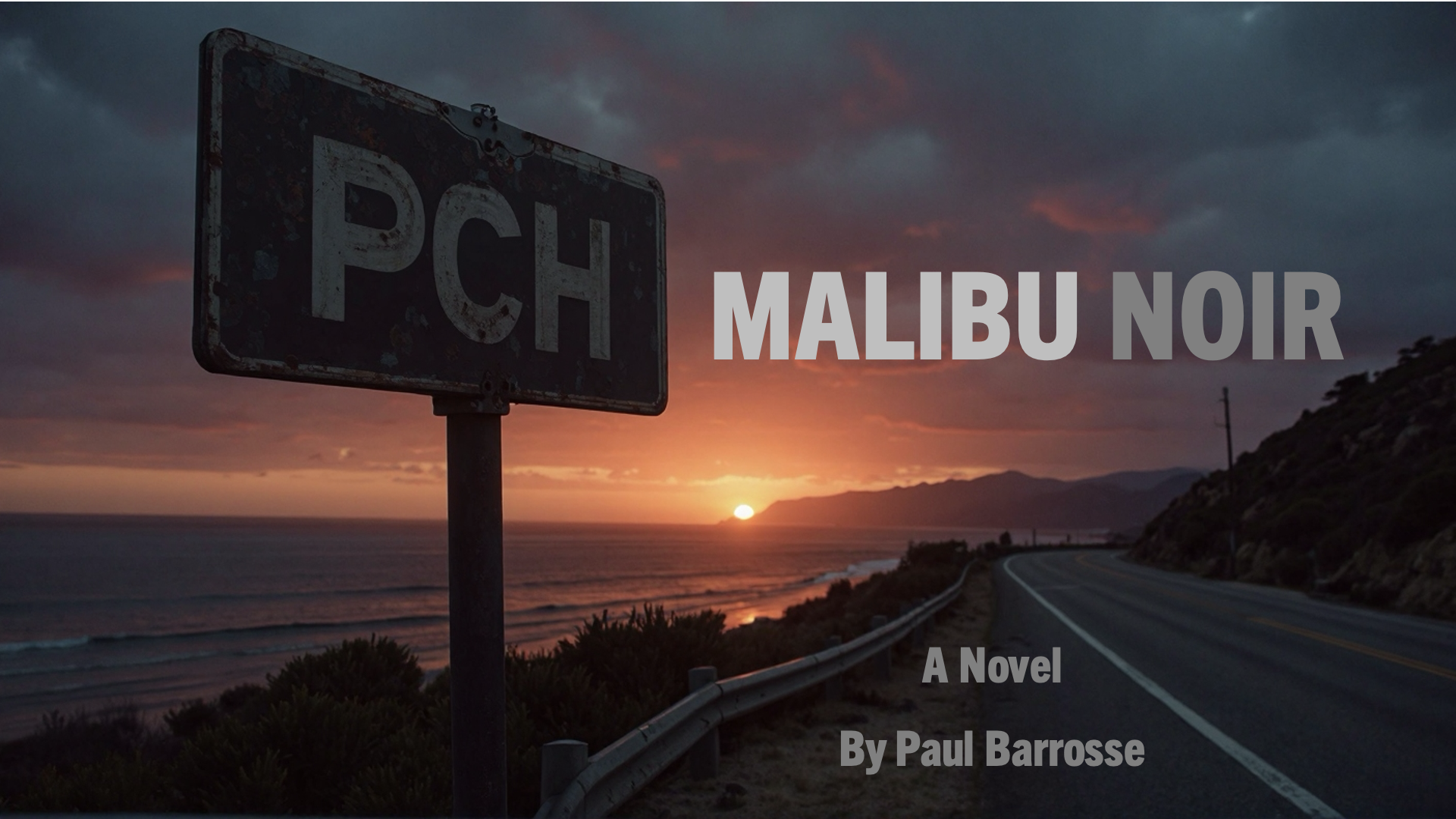
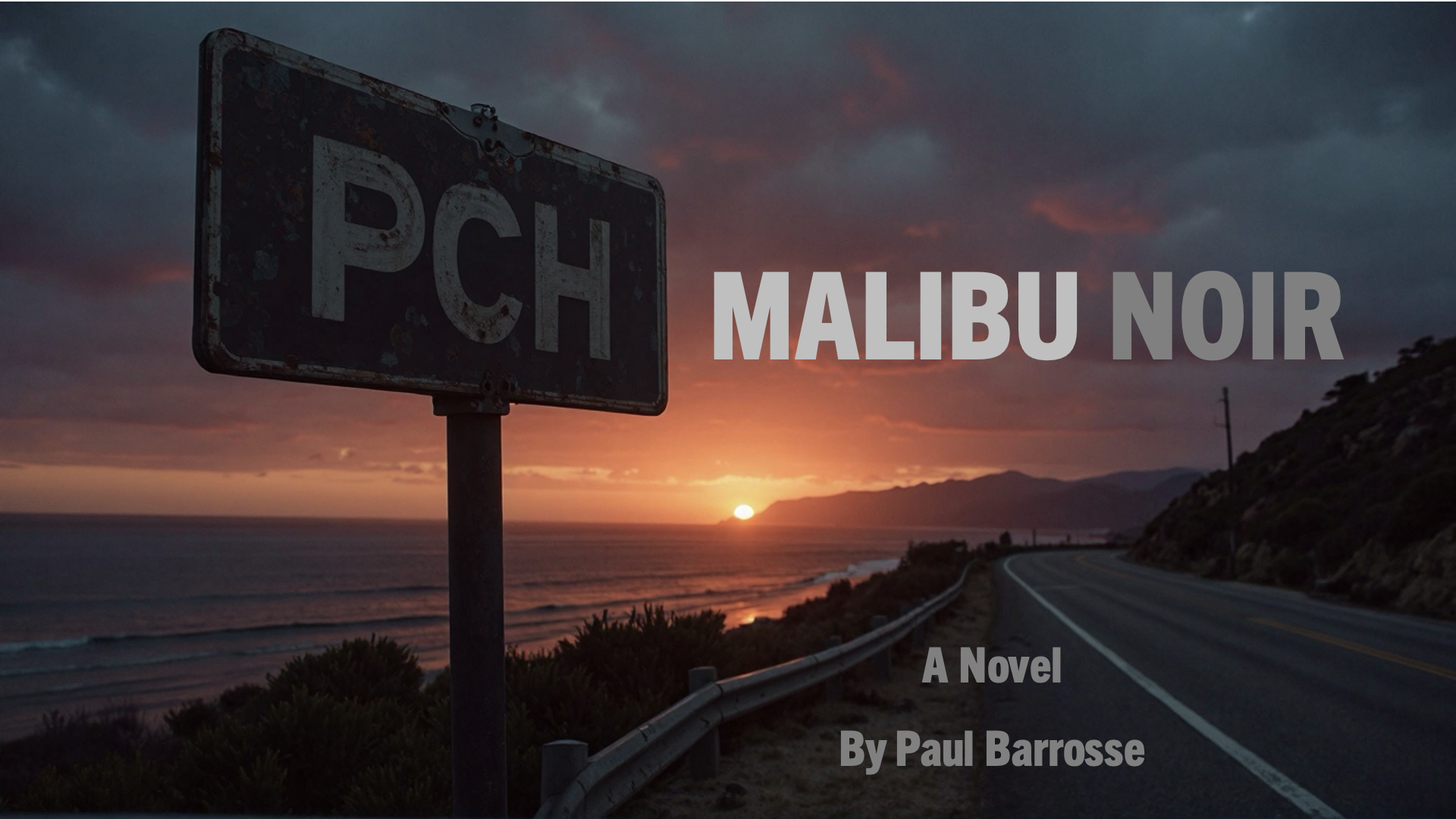
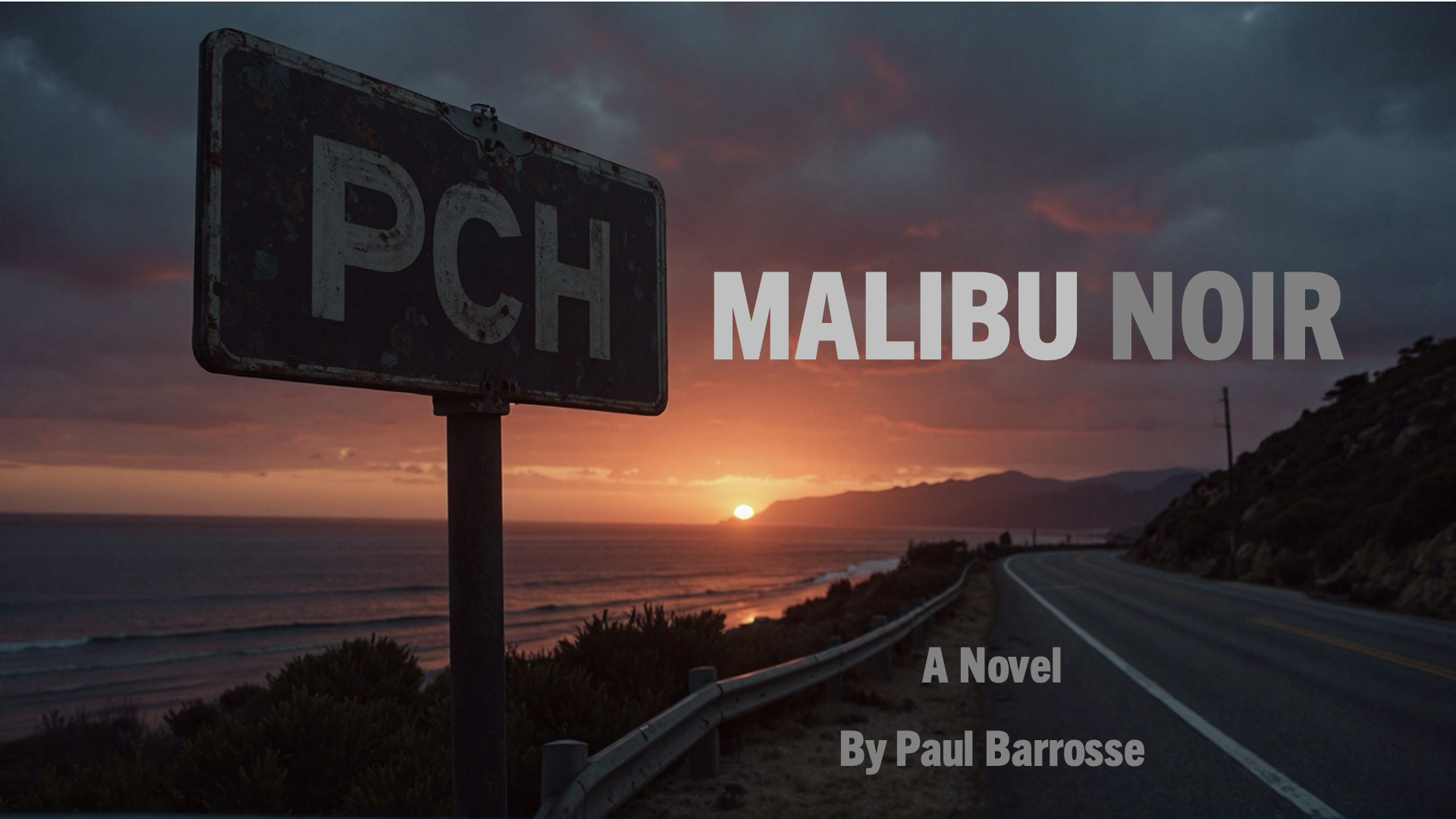
MALIBU NOIR

A Novel by Paul Barrosse

Dedicated to my darling Victoria

And to Peter Barrosse

My Dad & Veteran of the Korean War

Chapter One

From where Mike Delaney sat on his stool at Zack’s Oceanside Dive in Malibu, the Pacific Ocean looked anything but pacific. A storm was building, howling hard across the Santa Barbara Channel.

The surf slammed into the jagged rocks and wooden pilings below Zack’s waterfront deck, yet the gal working the bar wasn’t concerned. The crashing waves shivered Zack’s timbers, but 20-year-old Gloria polished her beer and shot glasses with no hint of concern. She was cool. And she was hot.

Gloria and Mike had been flirting for a few months now. At least Mike thought she was flirting with him. He normally did pretty well with girls. He was tall and good looking. Ever since The Asphalt Jungle came out the year before, he sometimes got compared to the movie star Sterling Hayden. Guys would call him “Dix” just to needle him. Yeah, he did okay with the ladies — but Gloria wasn’t just another chick he was looking to score.

Gloria was nice to Mike, but it was hard to tell how much she liked him because she was so damn nice to everybody. Still, he sensed she was extra nice to him. Gloria was the best thing Mike had found since he got back from the war six years ago. Since he survived the war. Swiveling on his bar stool to better track Gloria’s movements, a sharp, painful twinge in his hip reminded Mike how narrowly he survived.

Gloria’s mother, Barbara, owned the joint. Her late husband Zack was an abalone diver who cashed out, sold his boat, and bought the bar from the original owner who moved back East after a Malibu wildfire swept down the hillside and nearly torched the place. Gloria planned to go to college, but when her dad suddenly died of a brain aneurysm, she began helping her mom out at the bar.

Gloria was no typical barmaid. She was special. And Mike Delaney was falling hard for her. He wished he could tell her how crazy he was about her.

He wished he felt better about himself.

Johnnie Ray was crying on the jukebox as Mike tried to get his mind off Gloria by paging through a leftover Los Angeles Times. There wasn’t much news out of Korea lately. The war had ground to a stalemate after Heartbreak Ridge. That was the Army’s show. And a bloody show it was. Mike had found out just a week ago that he knew a couple guys who bought it in that useless battle. He knocked back the rest of his second beer, then waved to Gloria for another.He turned to the sports section to get his mind off war and death.

Mike was a baseball fan, and a pretty good player himself. He started in center field for his high school team and played some ball in the Marines before he was wounded. But a makeshift diamond on a shell-blasted island in the Marshalls was nothing like well-groomed Gilmore Field, where his favorite team played. The Hollywood Stars had ended the ‘51 Pacific Coast League season with a record of 93 wins and 74 losses, but they only finished in second place. Mike soon tossed the paper aside. Winter was the worst for baseball news. There was nothing new on the Stars.

By now, Mike was into his fourth beer — with more to come. Nothing specific drove him to drink. He came out of the war better than a lot of his buddies. He was alive after all. But he didn’t feel settled. He wasn’t over it. Any of it, really. Zack’s was the one place where, gazing at Gloria, he began to feel he was in the right place at the right time. He was dealing with a lot of stuff. It was about Gloria, sure. But it was about a lot more.

By the time Patti Page was singing “The Tennessee Waltz”, Mike was two more beers into his evening. It was his birthday, December 10, 1951. When you’re born between Thanksgiving and Christmas, you learn life doesn’t revolve around you. You get lost in the holiday hubbub. From as early as Mike could remember, he tried to let things roll off his back. He tried not to sweat the small stuff. He practiced being easygoing.

It wasn’t always easy. And he didn’t always succeed.

Most private dicks were anything but easygoing — but the hardboiled thing wasn’t Mike’s bag. Not that his 29 years of life experience didn’t justify cynicism. Hell, total nihilism was an appropriate reaction to what he’d seen and done. But Mike wasn’t wired that way.  He signaled Gloria for another beer. He wasn’t into the hard stuff anymore. Mike and strong booze didn’t get along.  

Not very long ago, they got along too well.

Gloria handed Mike a new bottle of beer. “That’s number five,” she noted with a smile, before whisking away his empty and moving on to her other customers. Mike felt she served him with an attention she didn’t pay to anyone else. She was even counting his drinks. That proved Gloria cared about him. The goddess Gloria.

For Mike, it was just he and Gloria at the bar that night. Everyone else was a bit player — like extras in the movies being shot all over town, like some rookie on the far end of the Hollywood Stars bench. When the right time came, Mike would be up to bat, he’d knock it out of the park, and Gloria would be his!

With these thoughts in mind, Mike fumbled in his pocket.  

It was still there.

He’d found a strange object earlier that day and didn’t know what to make of it.

Mike had been surfing the storm-driven swell off Point Dume and was walking back to his car when he saw something odd lying on the shoulder of Pacific Coast Highway. It was a black rectangular thing about five inches long, three inches wide, and maybe a half-inch thick — heavy for its size. One side of it was metal and the other side was glass. On the metal side it had an image that looked like an apple with a bite taken out of it and “iPhone 3G” written in small letters. On the right side was a button. There were smaller buttons on the left side. Mike tried pressing all the buttons – and must have hit the right one because the object suddenly lit up!

A message appeared on what looked like a tiny television screen. The message was written against a light blue background in German. “Murphy’s Ranch Donnerstagabend 20:00.”

Then the screen went dark.

Mike tried to turn it on again — but no luck. Maybe its battery died. Did the thing even have a battery? What the hell was it? Mike tucked the thing back into his pocket and with an instinct born of detective work, he took out his small reporter’s notebook and wrote, “Murphy’s Ranch Thursday night 8:00.”

Lucky for Mike, German was basically a second language to him. His mother’s family left Hanover just before the First World War, and growing up, German was spoken quite a bit in his home. At UCLA, he majored in chemistry, but took some German classes for an easy ‘A’. When he enlisted, he played down his fluency, afraid he’d be sent to the European front as a translator. A surfer boy from Southern California, he preferred to serve with the Marines in the Pacific. Not that he ever got a chance to surf on Tarawa.

As Mike sat at the bar, mooning at Gloria, he ran over in his mind whether he should show the strange object in his pocket to her – whatever the hell it was. Would she think he was nuts? It mattered a lot to Mike what Gloria thought of him, if she ever did think of him. He decided it was best to keep the damn thing to himself and not mention it. At least not yet.  

Mike was just getting to know Gloria. Weeks ago, he dared to ask how old she was — and was stunned to learn she was only nineteen. That she was so much younger than him, — and so innocent — made him nervous. She was just nine years old when the Japs hit Pearl Harbor! What could they possibly have in common? Was she too young for him? Are six bottles of beer too much? Was he too drunk to woo her? His vision of Gloria puttering behind the bar was getting blurry. It was time to go home.  

Mike got up, trying not to appear drunk. He didn’t want Gloria to think he was a lightweight. As he got up off his barstool, the old pain shot through his hip, sharp and searing: a too-frequent reminder that the Marine medics didn’t get all the shrapnel out. But six years after a Jap grenade almost cost him his leg, Mike wasn’t feeling sorry for himself. The shrapnel lodged in his hip was a pain in the ass – but it was also a reminder of the injury that punched his ticket off Iwo Jima. Lots of guys didn’t make it off those eight square miles of hell. Sometimes Mike wondered if maybe some vital part of him got left on that volcanic slagheap.

“Hey, Mike!”

He turned to see Gloria advancing with a pot of coffee. “How about a cup of Joe for the road, cowboy?” She was playfully implying he’d had too much to drink — but Mike was thrilled to think she even cared. He drained the cup his goddess offered. Was she sweet on him, too?

Mike set his cup down and Gloria picked it up saying, “Happy birthday.”

“How did you know?”

She smiled. “You told me after beer number one.”

Mike was hoping she didn’t see him blushing as she pirouetted with the coffee pot and put it back on the burner. She glanced back at him for a moment. “Drive safe, Mike. See you tomorrow?” 

Mike managed an unsteady, “For sure” and imagined himself blowing Gloria a gallant kiss as he floated out of the bar. The pain in his hip was dulled by the beer — and the pounding of his heart.

“Bobby Thompson got lucky!”

Abe and Iggy sat at the end of the bar, getting into it again. Abe Shatz was a Yankees fan. Ignatz Kalicky bled for the Giants. Ever since the World Series, they had the same argument at varying volumes. They were zealots. If Abe and Iggy weren’t arguing about baseball, they were arguing politics and the Korean War. Peace talks were underway in Panmunjom — but not at their end of the bar. Peace was impossible with those two. Mike was a big fan of peace. The brutal battles to liberate all those islands in the Pacific convinced him that peace was the only answer.

As he walked to his car, Mike could hear the ominous pounding of the surf.  His mind wandered to the day, coming soon, when he would summon the nerve and declare his love for Gloria. He’d ask her to marry him — crazy as that might seem. In fact, he’d buy an engagement ring the very next day. He’d do the whole thing first class. She was, after all, the classiest girl he’d ever known.

But should he talk to Gloria’s mother first? Or was that old fashioned? Was he being an idiot? Did Gloria even share his affection? Wasn’t she sending all the right signals? Or did she see him as just another barfly? Should he ask her out on a date before declaring his love? A clap of distant thunder punctuated that thought.

His reverie broken, the shooting pain in his hip returned.

By the time he reached his car, he’d almost forgotten about the odd black object in his pocket. He climbed in behind the wheel and took the thing out to examine it again. The screen was still dark, but he remembered: “Murphy’s Ranch Thursday night 8:00.”

He took a last look through Zack’s window and caught a glimpse of Gloria shutting the place down for the night. Tomorrow, he’d get that ring and find his courage.

Mike’s apartment was less than a mile north of Zack’s, one of three small units in a rundown beach house along Pacific Coast Highway. As he drove home in his beer-fogged state, he pondered how he’d gotten to his 29th birthday in such an unsettled state. He wasn’t always this way. He used to be more certain of himself: certain about what he wanted and how to get it.

He felt like he was at the beginning of a turning point in his life. It wasn’t just about whether he’d ever marry his glorious Gloria. It was the mysterious thing he’d stumbled on. The strange black brick in his pocket. It was “Murphy’s Ranch Thursday night 8:00.”

Drunk as he was, he was more excited about tomorrow than he’d been in years.

12 Comments

Filed under Adventure, Art, Classic Film, History, literature, Novel, Truth