Tag Archives: books

My First Novel: Chapter Two

Okay. 15 likes is more than enough to trigger Chapter Two. Thank you all very much! I hope you enjoy it. It will take a total of 30 likes to release Chapter Three. This process is a bit like one of those old-time movie serials like “Buck Rogers” or “The Perils of Pauline.” You’ve gotta wait for that next installment.

Chapter Two

Cruising north through Malibu on his way home, Mike glanced to his left at the ocean. Through the rain, the moon was bright enough to see the white caps of the storm-driven surf as it surged toward the beach. This coastline was where he was born and raised. He’d conquered an early fear of the water to become a damn good surfer. His dad owned a small landscaping business: trimming, planting, and raking the lush yards of the high rollers who lived in the low hills to his right, overlooking the ocean. His parents didn’t want their only son pushing a wheelbarrow for a living – or worse, becoming a surf bum — so they saved up to send their golden boy to college.

Mike’s thoughts went back nine years to the months after Pearl Harbor. At the time, he was in his second year at UCLA. He remembered how his parents reacted when he enlisted in the Marines. They weren’t thrilled that he was delaying his education, but his dad had survived the trenches in The Great War and was proud to see his son do his bit. Hi mother could only cry and pray. Cry and pray. So, instead of getting his diploma and moving on to grad school, he got basic training at Camp Pendleton, dog tags, an M1 rifle, and the opportunity of a lifetime to go island hopping in the Pacific. The term “island hopping” always pissed him off. It was too cute. Like it was game.

Mike remembered “island hopping” all too well: that series of savage battles waged to capture strategic islands from the desperate, dug-in Japanese. Mike was lucky enough to escape the carnage on Tarawa with no more than a gunshot wound in his right arm. The bullet missed anything vital, so the medics patched him up and threw him back into the meat grinder. Mike figured he must have done something good on Tarawa before he got wounded because the Marines gave him a Bronze Star to go along with his Purple Heart.

He healed up in time to join the bloodbaths on the Marshall Islands: shell-torn strips of coral, sand, and jungle fever with crazy names like Kwajalein and Peleliu. He was always wet, always on edge, always exhausted — always a stroke of luck away from death. While managing to stay alive, he was promoted to sergeant and command of a rifle platoon. The lieutenant who had the job before him was blown to bits by a Jap artillery shell. That’s how advancement works on the battlefield: next man up.

He was leading his platoon on Iwo Jima when a Jap grenade ended his military career. He had no memory of what happened before and after that blast, but he evidently led his platoon well during the battle because the Marines sent him stateside with a Silver Star to go with his Bronze Star and two Purple Hearts. His parents were proud to see their son come home a decorated war hero. But Mike didn’t feel heroic. He was just glad to make it out alive.

After recovering from his wounds at a San Diego military hospital, 22-year-old Mike went back to Los Angeles. On his first day home in Malibu, he got the Marine Corps logo tattooed on his strong right forearm in honor of his lost comrades — and looked ahead to the peacetime future.

All the beers he’d just downed at Zack’s made Mike woozier than he expected. Gloria had cut him off just in time. He prided himself on holding his liquor, but he wasn’t great behind the wheel right now, especially on the wet road. He sure as hell didn’t want to get stopped by the cops. That’d be a real pain in his ass. So, he pulled off PCH, parked on a bluff overlooking one of his favorite surf breaks, and continued to think about the past. 

For a while, he worked with his dad in the landscaping business, but his parents urged him to go back to school, finish his education, and become a doctor. Planting some movie star’s palm trees was no job for a war hero. Mike agreed with his parents, but he couldn’t wrap his head around going back to college. Not after Tarawa. Not after Iwo Jima. Plus, he’d seen enough doctors, hospitals, awful wounds, and deadly diseases to last a lifetime. Medical school was not for him. He needed to do something else. But what?

One night, Mike was drinking at Zack’s with a Marine pal he met while convalescing in San Diego. Eddie had been an MP in the service, policing the waterfronts on hellholes in the Solomon Islands. Eddie had lost some of his hearing when an enemy shell blew up a nearby ammo dump on Guadalcanal. But Eddie’s MP experience helped land him a job as a Los Angeles cop. Eddie assured him that, given Mike’s impressive war record and his time at UCLA, he was a shoo-in for the force.

Eddie was right. Mike made it through the police academy with the ease of a veteran who’d been through basic at Pendleton and commanded men under fire. Mike went at the job of being a policeman like he was hitting some Jap-held beach. Bold and fearless. Some would say reckless. Within a few years, he rose from beat cop to detective. Very few guys rose in rank that quickly. It ruffled some feathers — but promoting a bona fide war hero made for a nice article in all the papers. It was good press for the LAPD brass.

Some guys on the force thought Mike was too aggressive, too inclined to act on his own, blind to department politics, and quarrelsome with his superiors. Mike knew they were right. But the only guys on the force he truly respected were the ones who fought and bled in the war. Guys like Eddie. To Mike, everybody else was play-acting. Hollywood cops. It wasn’t fair, maybe, but that’s how he felt. At least most days he felt that way. Most nights he drank.

And on this night, he’d guzzled down a few too many beers. Mike stuck his head out the car window and took a deep breath. The chill air and rain on his face had the right effect. His head was beginning to clear, but not enough to drive home safely. Not yet.

Beer – and before that, bourbon — helped to dull the pain in his hip, but that’s not why he boozed so much. He started drinking hard during his first year as a cop. It helped him deal with the fact that he’d traded one war for another. He was just wearing a different uniform. But this time, the killing served no higher purpose, and the end of the war was never in sight. Fighting crime in L.A. was like trying to root out the last of the Japanese dead-enders still holding out in caves on those bloody islands. Mike took another deep breath of ocean air.

God, he loved the water. The surf. The peace.

When Mike was feeling particularly unsettled, angry, or weary of seeing the worst side of postwar Los Angeles, he would head to Malibu to visit his parents and surf. But after his dad dropped dead of a heart attack while lugging a bag of peat moss up to some rich asshole’s hillside garden, Mike checked in with his mom less frequently. Her sorrow bugged him. What could he say to her? He’d seen thousands of young men in the prime of their lives die miserably on blasted specks of jungle in the middle of nowhere. He’d seen far too many innocent young people murdered on the streets of L.A. His dad was a 65-year-old man who died doing the job he loved: an Irish immigrant running his own business in America. Where was the grief in that?

Feeling like he was now just two sheets to the wind, Mike started his car and drove back out onto Pacific Coast Highway. After a few uneasy minutes driving in what was now a pelting rain, he managed to make it safely into one of the parking spaces below his apartment. Not a cop in sight. He’d gotten away with it tonight, but the last thing he wanted was to give his old colleagues on the police force the pleasure of the putting the big hotshot war hero in the drunk tank.

The rain drummed on the car roof as Mike leaned back in the driver’s seat and closed his eyes, his head swimming with beer and memories.

He’d been a cop for only four years when, after far too many run-ins with the department brass, his standing as a rising star gave way to a well-earned reputation as a hard-headed know-it-all with a stubborn streak and an unhealthy disregard for danger. When he got demoted from detective back to beat cop, he read the writing on the wall. He saw that, like his dad, it was better for him to run his own business. So, he quit the force in ‘49 and hung out his shingle as a private investigator. He swore off the bourbon and switched to beer. It was time to clean up his act. At least a little.

Young as he was for a private eye, Mike’s chest full of wartime medals and his detective experience kept him in paying customers among the Hollywood elite. But he soon found that tracking down missing rich kids, staking out cheating spouses, and fixing indelicate problems for folks with scads of money was even more soul crushing than battling domestic battery in Encino, gang warfare in Boyle Heights, and unsolved murders in Burbank.

He started taking fewer cases, avoiding the ugliest ones. He spent more time riding waves.

Two years after leaving the police force, disillusioned 29-year-old Mike was living in Malibu, more surf bum than private investigator. When he wasn’t working the occasional case that didn’t offend his increasingly prickly sensibilities, he was sitting on a stool at Zack’s Oceanside Dive, knocking back beers and mooning over a barmaid named Gloria: the one shining, unsullied light in his life.

4 Comments

Filed under Adventure, Art, Classic Film, History, literature, Novel, Truth

My First Novel

I’ve written in a variety of formats over the years: plays, comedy revues, poems, songs, sitcoms, documentaries, screenplays – even Bazooka Joe comics. But never a novel. Until now. I recently finished my first novel. It’s unlike anything I’ve written to date. I don’t intend to shop this novel. I’d just like folks to read it. So, I’m presenting the first chapter here. If, and when, ten people “like” this post – I’ll post Chapter Two. And so on. Enjoy.

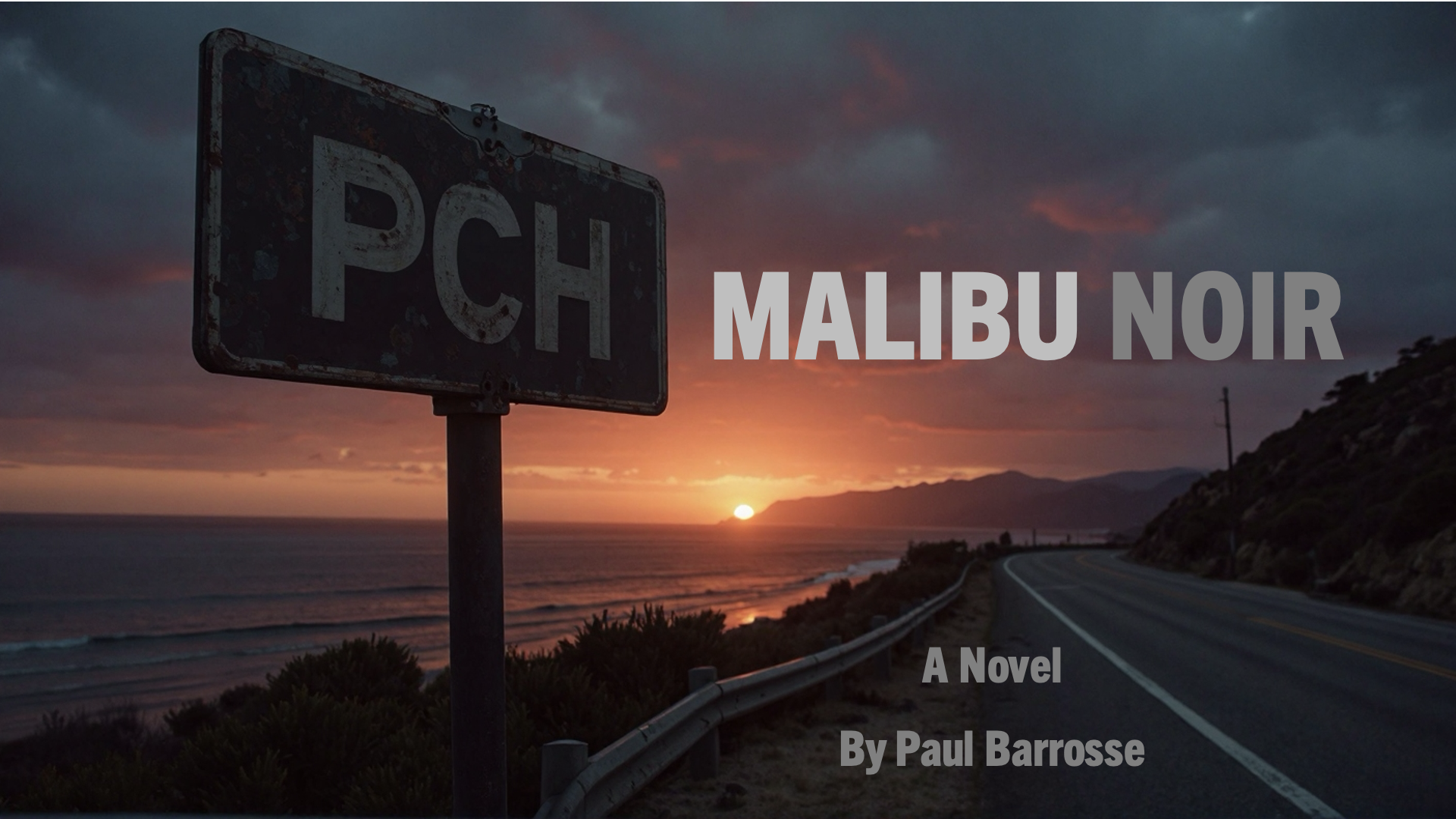
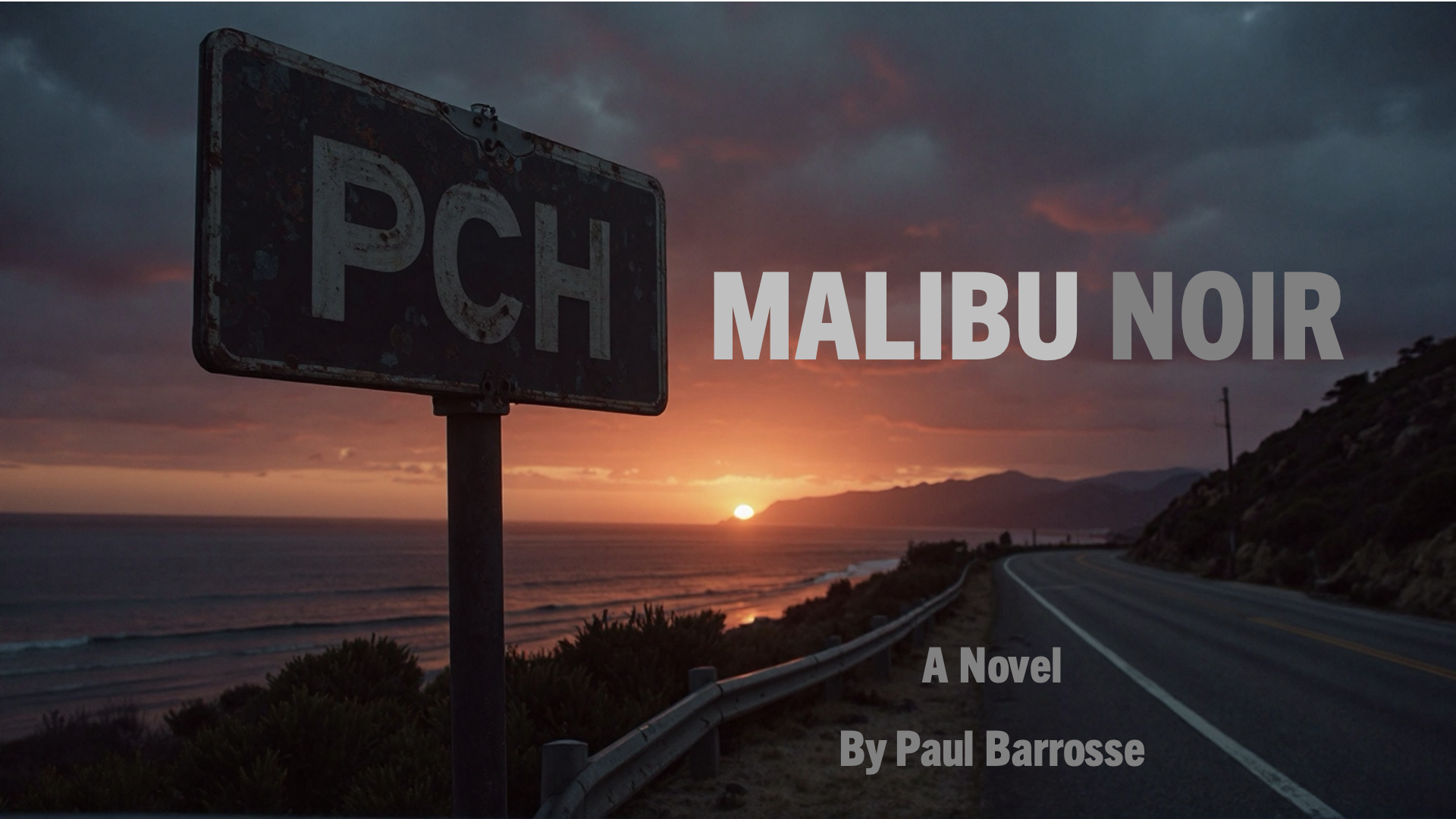
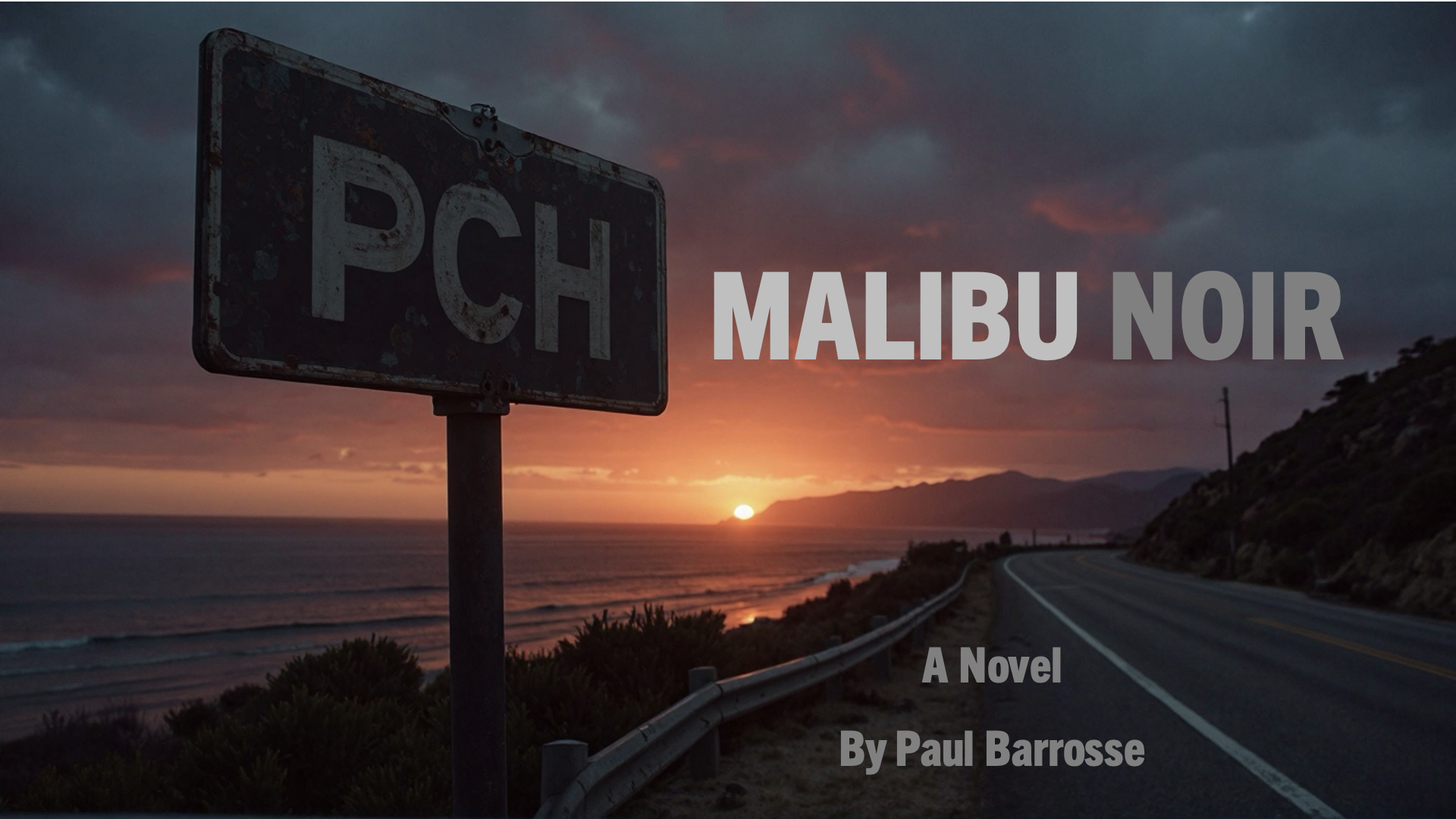
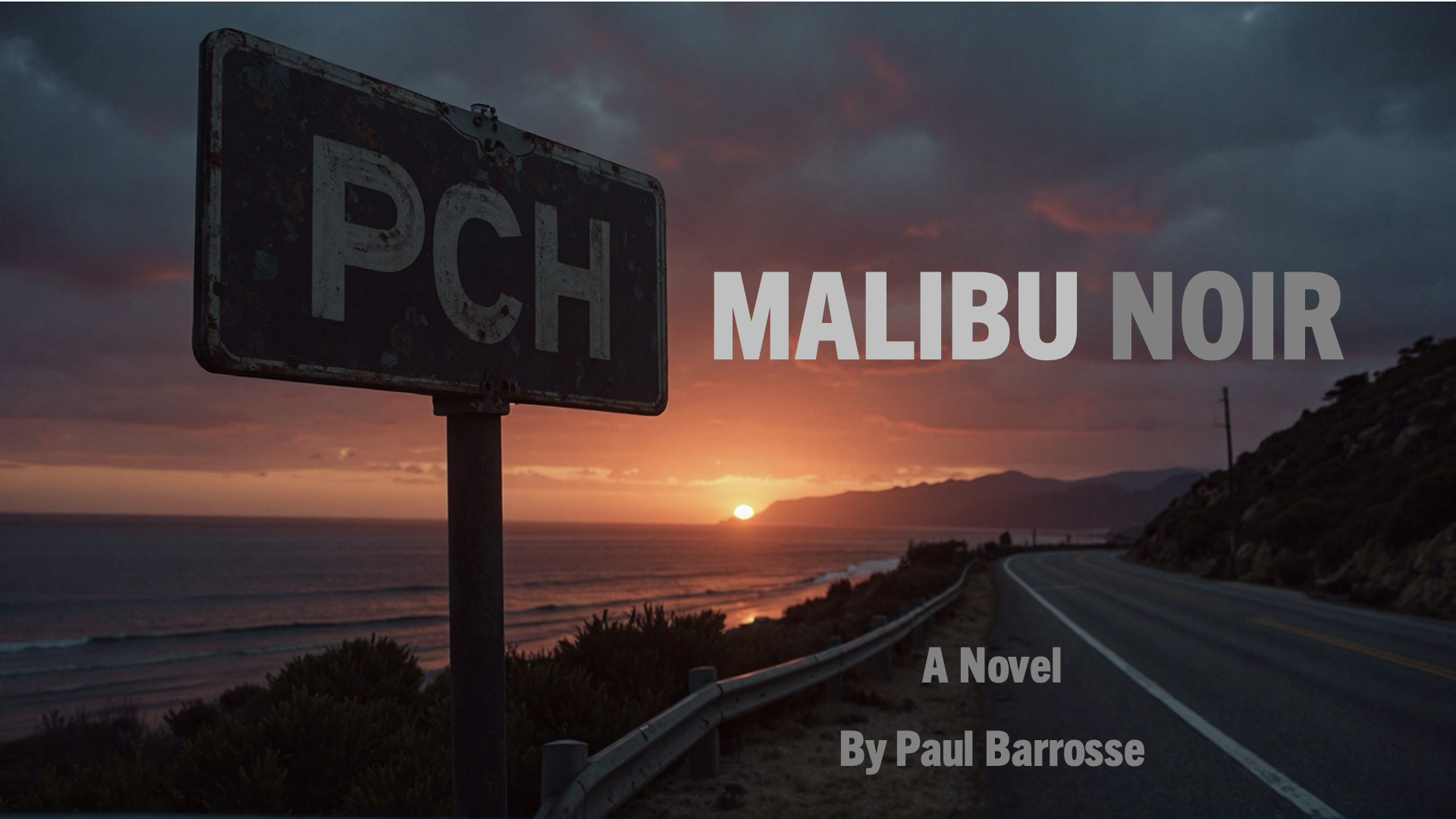
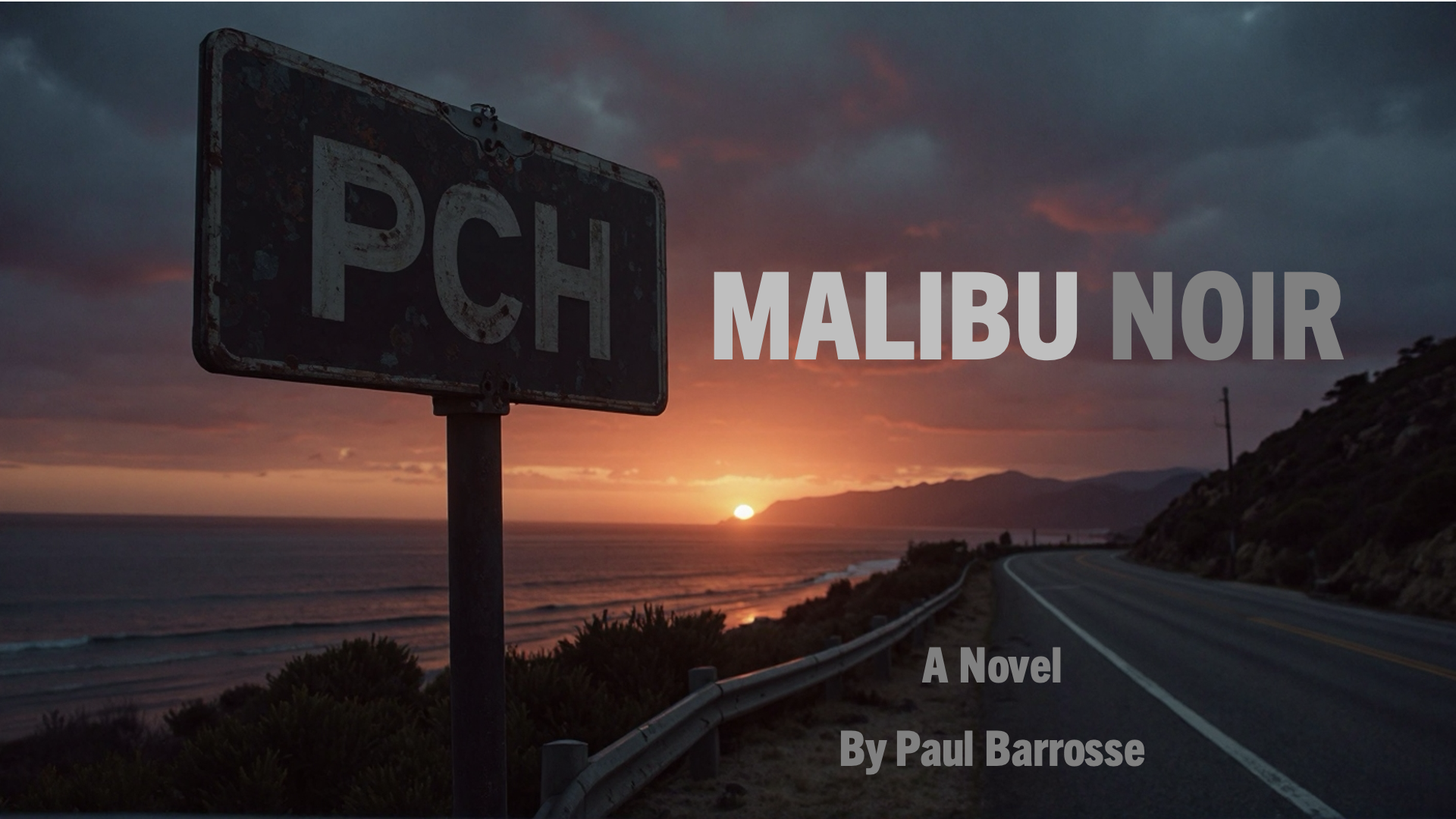
MALIBU NOIR

A Novel by Paul Barrosse

Dedicated to my darling Victoria

And to Peter Barrosse

My Dad & Veteran of the Korean War

Chapter One

From where Mike Delaney sat on his stool at Zack’s Oceanside Dive in Malibu, the Pacific Ocean looked anything but pacific. A storm was building, howling hard across the Santa Barbara Channel.

The surf slammed into the jagged rocks and wooden pilings below Zack’s waterfront deck, yet the gal working the bar wasn’t concerned. The crashing waves shivered Zack’s timbers, but 20-year-old Gloria polished her beer and shot glasses with no hint of concern. She was cool. And she was hot.

Gloria and Mike had been flirting for a few months now. At least Mike thought she was flirting with him. He normally did pretty well with girls. He was tall and good looking. Ever since The Asphalt Jungle came out the year before, he sometimes got compared to the movie star Sterling Hayden. Guys would call him “Dix” just to needle him. Yeah, he did okay with the ladies — but Gloria wasn’t just another chick he was looking to score.

Gloria was nice to Mike, but it was hard to tell how much she liked him because she was so damn nice to everybody. Still, he sensed she was extra nice to him. Gloria was the best thing Mike had found since he got back from the war six years ago. Since he survived the war. Swiveling on his bar stool to better track Gloria’s movements, a sharp, painful twinge in his hip reminded Mike how narrowly he survived.

Gloria’s mother, Barbara, owned the joint. Her late husband Zack was an abalone diver who cashed out, sold his boat, and bought the bar from the original owner who moved back East after a Malibu wildfire swept down the hillside and nearly torched the place. Gloria planned to go to college, but when her dad suddenly died of a brain aneurysm, she began helping her mom out at the bar.

Gloria was no typical barmaid. She was special. And Mike Delaney was falling hard for her. He wished he could tell her how crazy he was about her.

He wished he felt better about himself.

Johnnie Ray was crying on the jukebox as Mike tried to get his mind off Gloria by paging through a leftover Los Angeles Times. There wasn’t much news out of Korea lately. The war had ground to a stalemate after Heartbreak Ridge. That was the Army’s show. And a bloody show it was. Mike had found out just a week ago that he knew a couple guys who bought it in that useless battle. He knocked back the rest of his second beer, then waved to Gloria for another.He turned to the sports section to get his mind off war and death.

Mike was a baseball fan, and a pretty good player himself. He started in center field for his high school team and played some ball in the Marines before he was wounded. But a makeshift diamond on a shell-blasted island in the Marshalls was nothing like well-groomed Gilmore Field, where his favorite team played. The Hollywood Stars had ended the ‘51 Pacific Coast League season with a record of 93 wins and 74 losses, but they only finished in second place. Mike soon tossed the paper aside. Winter was the worst for baseball news. There was nothing new on the Stars.

By now, Mike was into his fourth beer — with more to come. Nothing specific drove him to drink. He came out of the war better than a lot of his buddies. He was alive after all. But he didn’t feel settled. He wasn’t over it. Any of it, really. Zack’s was the one place where, gazing at Gloria, he began to feel he was in the right place at the right time. He was dealing with a lot of stuff. It was about Gloria, sure. But it was about a lot more.

By the time Patti Page was singing “The Tennessee Waltz”, Mike was two more beers into his evening. It was his birthday, December 10, 1951. When you’re born between Thanksgiving and Christmas, you learn life doesn’t revolve around you. You get lost in the holiday hubbub. From as early as Mike could remember, he tried to let things roll off his back. He tried not to sweat the small stuff. He practiced being easygoing.

It wasn’t always easy. And he didn’t always succeed.

Most private dicks were anything but easygoing — but the hardboiled thing wasn’t Mike’s bag. Not that his 29 years of life experience didn’t justify cynicism. Hell, total nihilism was an appropriate reaction to what he’d seen and done. But Mike wasn’t wired that way.  He signaled Gloria for another beer. He wasn’t into the hard stuff anymore. Mike and strong booze didn’t get along.  

Not very long ago, they got along too well.

Gloria handed Mike a new bottle of beer. “That’s number five,” she noted with a smile, before whisking away his empty and moving on to her other customers. Mike felt she served him with an attention she didn’t pay to anyone else. She was even counting his drinks. That proved Gloria cared about him. The goddess Gloria.

For Mike, it was just he and Gloria at the bar that night. Everyone else was a bit player — like extras in the movies being shot all over town, like some rookie on the far end of the Hollywood Stars bench. When the right time came, Mike would be up to bat, he’d knock it out of the park, and Gloria would be his!

With these thoughts in mind, Mike fumbled in his pocket.  

It was still there.

He’d found a strange object earlier that day and didn’t know what to make of it.

Mike had been surfing the storm-driven swell off Point Dume and was walking back to his car when he saw something odd lying on the shoulder of Pacific Coast Highway. It was a black rectangular thing about five inches long, three inches wide, and maybe a half-inch thick — heavy for its size. One side of it was metal and the other side was glass. On the metal side it had an image that looked like an apple with a bite taken out of it and “iPhone 3G” written in small letters. On the right side was a button. There were smaller buttons on the left side. Mike tried pressing all the buttons – and must have hit the right one because the object suddenly lit up!

A message appeared on what looked like a tiny television screen. The message was written against a light blue background in German. “Murphy’s Ranch Donnerstagabend 20:00.”

Then the screen went dark.

Mike tried to turn it on again — but no luck. Maybe its battery died. Did the thing even have a battery? What the hell was it? Mike tucked the thing back into his pocket and with an instinct born of detective work, he took out his small reporter’s notebook and wrote, “Murphy’s Ranch Thursday night 8:00.”

Lucky for Mike, German was basically a second language to him. His mother’s family left Hanover just before the First World War, and growing up, German was spoken quite a bit in his home. At UCLA, he majored in chemistry, but took some German classes for an easy ‘A’. When he enlisted, he played down his fluency, afraid he’d be sent to the European front as a translator. A surfer boy from Southern California, he preferred to serve with the Marines in the Pacific. Not that he ever got a chance to surf on Tarawa.

As Mike sat at the bar, mooning at Gloria, he ran over in his mind whether he should show the strange object in his pocket to her – whatever the hell it was. Would she think he was nuts? It mattered a lot to Mike what Gloria thought of him, if she ever did think of him. He decided it was best to keep the damn thing to himself and not mention it. At least not yet.  

Mike was just getting to know Gloria. Weeks ago, he dared to ask how old she was — and was stunned to learn she was only nineteen. That she was so much younger than him, — and so innocent — made him nervous. She was just nine years old when the Japs hit Pearl Harbor! What could they possibly have in common? Was she too young for him? Are six bottles of beer too much? Was he too drunk to woo her? His vision of Gloria puttering behind the bar was getting blurry. It was time to go home.  

Mike got up, trying not to appear drunk. He didn’t want Gloria to think he was a lightweight. As he got up off his barstool, the old pain shot through his hip, sharp and searing: a too-frequent reminder that the Marine medics didn’t get all the shrapnel out. But six years after a Jap grenade almost cost him his leg, Mike wasn’t feeling sorry for himself. The shrapnel lodged in his hip was a pain in the ass – but it was also a reminder of the injury that punched his ticket off Iwo Jima. Lots of guys didn’t make it off those eight square miles of hell. Sometimes Mike wondered if maybe some vital part of him got left on that volcanic slagheap.

“Hey, Mike!”

He turned to see Gloria advancing with a pot of coffee. “How about a cup of Joe for the road, cowboy?” She was playfully implying he’d had too much to drink — but Mike was thrilled to think she even cared. He drained the cup his goddess offered. Was she sweet on him, too?

Mike set his cup down and Gloria picked it up saying, “Happy birthday.”

“How did you know?”

She smiled. “You told me after beer number one.”

Mike was hoping she didn’t see him blushing as she pirouetted with the coffee pot and put it back on the burner. She glanced back at him for a moment. “Drive safe, Mike. See you tomorrow?” 

Mike managed an unsteady, “For sure” and imagined himself blowing Gloria a gallant kiss as he floated out of the bar. The pain in his hip was dulled by the beer — and the pounding of his heart.

“Bobby Thompson got lucky!”

Abe and Iggy sat at the end of the bar, getting into it again. Abe Shatz was a Yankees fan. Ignatz Kalicky bled for the Giants. Ever since the World Series, they had the same argument at varying volumes. They were zealots. If Abe and Iggy weren’t arguing about baseball, they were arguing politics and the Korean War. Peace talks were underway in Panmunjom — but not at their end of the bar. Peace was impossible with those two. Mike was a big fan of peace. The brutal battles to liberate all those islands in the Pacific convinced him that peace was the only answer.

As he walked to his car, Mike could hear the ominous pounding of the surf.  His mind wandered to the day, coming soon, when he would summon the nerve and declare his love for Gloria. He’d ask her to marry him — crazy as that might seem. In fact, he’d buy an engagement ring the very next day. He’d do the whole thing first class. She was, after all, the classiest girl he’d ever known.

But should he talk to Gloria’s mother first? Or was that old fashioned? Was he being an idiot? Did Gloria even share his affection? Wasn’t she sending all the right signals? Or did she see him as just another barfly? Should he ask her out on a date before declaring his love? A clap of distant thunder punctuated that thought.

His reverie broken, the shooting pain in his hip returned.

By the time he reached his car, he’d almost forgotten about the odd black object in his pocket. He climbed in behind the wheel and took the thing out to examine it again. The screen was still dark, but he remembered: “Murphy’s Ranch Thursday night 8:00.”

He took a last look through Zack’s window and caught a glimpse of Gloria shutting the place down for the night. Tomorrow, he’d get that ring and find his courage.

Mike’s apartment was less than a mile north of Zack’s, one of three small units in a rundown beach house along Pacific Coast Highway. As he drove home in his beer-fogged state, he pondered how he’d gotten to his 29th birthday in such an unsettled state. He wasn’t always this way. He used to be more certain of himself: certain about what he wanted and how to get it.

He felt like he was at the beginning of a turning point in his life. It wasn’t just about whether he’d ever marry his glorious Gloria. It was the mysterious thing he’d stumbled on. The strange black brick in his pocket. It was “Murphy’s Ranch Thursday night 8:00.”

Drunk as he was, he was more excited about tomorrow than he’d been in years.

12 Comments

Filed under Adventure, Art, Classic Film, History, literature, Novel, Truth

The Practical Theatre Presents a 2025 Year-End Revue: Classic Comedy, Music & Cocktails

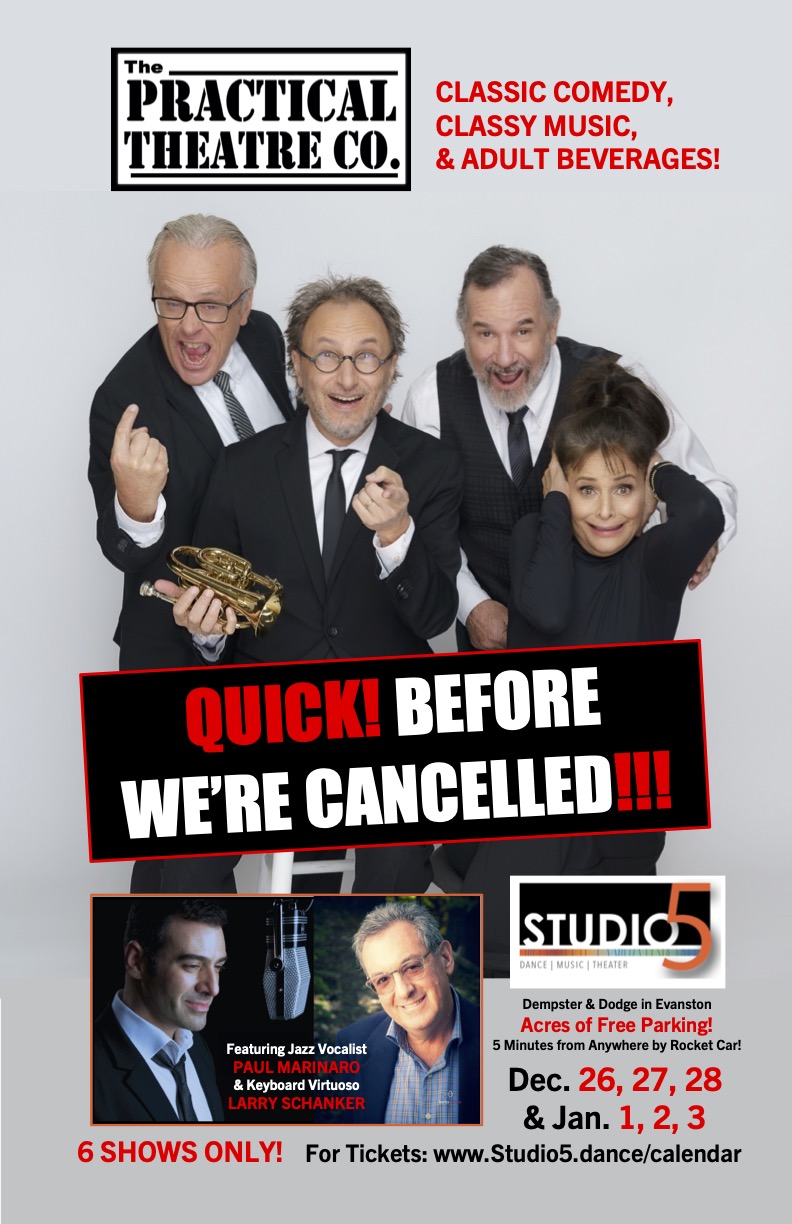
The Practical Theatre Company Presents its Annual Year-End Revue at Studio5 in Evanston, Shows December 26, 27, 28 and January 1, 2, 3

The Practical Theater, the Evanston-based sketch comedy group that launched the careers of “Saturday Night Live” veterans Julia Louis Dreyfus, Paul Barrosse, Brad Hall, and Gary Kroeger in the 1980’s, is still hard at work in the Chicago comedy vineyards. This holiday season, The PTC will be staging their latest comedy revue in their inimitable style at Studio5 for 6 shows only: Dec. 26, 27, 28 and January 1, 2, 3.

Their new revue, entitled “Quick! Before We’re Cancelled” satirizes a wild and volatile 2025 with razor-sharp sketch comedy ripped from today’s headlines, as well as a fun-filled, satiric look at various aspects of contemporary life, love, and the pursuit of happiness in an increasingly crazy world. Their new revue is infused with an improvisational spirit and backed by a stellar combo of talented musicians who support cast members Paul Barrosse, Victoria Zielinski, and Dana Olsen for a night of smart laughs — and a cocktail or two. (Did we mention there’s acres of free parking?) Tickets range from $40 to $55.

“Quick! Before We’re Cancelled” is a merry mix of sketches and original songs touching on everything from wacko conspiracy theories, the bittersweet romance of Don & Elon, artificial intelligence, Tarzan & Jane, the new Chicago-born Pope, ICE raiders, and a musical salute to the late, great Tom Lehrer.

Multi-instrumentalist Steve Rashid leads the Studio5 All-Stars, featuring guest keyboard virtuoso and PTC veteran Larry Schanker and the popular Chicago jazz vocalist Paul Marinaro, who will put his own soulful spin on some holiday classics while also serving as the show’s announcer.

“We’re all in need of some good laughs after this crazy, maddening year,” says PTC co-founder and Artistic Director Paul Barrosse. “Going through a year like this, we’ve got a lot to work with comedically. Reality itself feels like satire. It’s also great to have Paul Marinaro and Larry Schanker back onstage with us. They added so much last year. And Steve Rashid and the band make every revue we do as much a great jazz concert as a comedy show.”

The Studio5 All-Stars include the great Jim Cox on bass and passionate Robert Rashid on drums.

Alcoholic beverages are available for purchase at all shows.

The Practical Theatre Company was founded in 1979 while its founders were students at Northwestern University. Three years later, after producing a string of new plays and comedy revues in their 42-seat storefront theatre on Howard Street in Evanston, they joined with Second City owner Bernie Sahlins to open The Piper’s Alley Theatre (now The Second City E.T.C. space) — where the entire cast of their first comedy revue in that venue, “The Golden 50th Anniversary Jubilee” was hired by “Saturday Night Live.”

In the years that followed, The PTC followed up with the long-running “Megafun” at the Piper’s Alley Theatre and their longest-running show, “Art, Ruth & Trudy” at the Briar Street and Vic Theatres — which teamed Barrosse and Zielinski for the first time. Four years later, Paul and Victoria were married.

After a two-decade hiatus from the stage while Barrosse and Zielinski produced television, and a family, in Los Angeles, The PTC was revived in 2010 when Vic and Paul joined with fellow Northwestern alum Steve Rashid to stage comedy revues in Los Angeles, Cleveland, and Chicago. The trio then joined in 2015 with veteran PTC drummer Ronny Crawford and comedian Dana Olsen, a Northwestern pal, fellow Mee-Ow Show veteran, and screenwriter known for writing comedy films like “The Burbs,” “George of the Jungle,” and the current hit Nickelodeon series, “Henry Danger.”

EVENT DETAILS
Friday, Dec. 26 at 7:30 p.m.

Saturday, Dec. 27 at 7:30 p.m.

Sunday, Dec. 28 at 7:30 p.m.

Thursday, Jan. 1 at 7:30 p.m.

Friday, Jan. 2 at 7:30 p.m.

Saturday, Jan. 3 at 7:30 p.m.               

Where: Studio5, 1934 Dempster St., Evanston, IL 60202
Info: http://studio5.dance/calendar

Tickets: $40 for theatre seating, $55 for cabaret table seating

Leave a comment

Filed under Art, Comedy, History, Improvisation, Music, Politics, rock & roll, Truth, Uncategorized

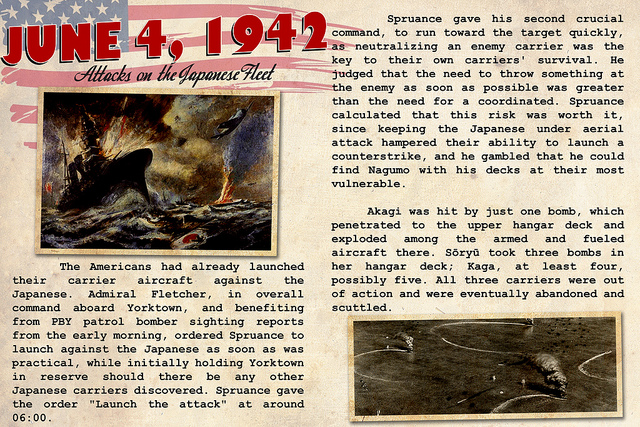
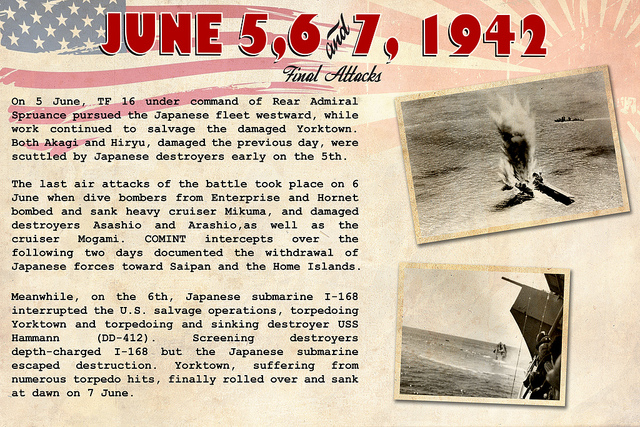
My Book Report: “The Battle of Midway”

Let’s be honest. Book reports are one of the scourges of youth.

Even if you enjoyed reading the book that you were assigned in grade school, or that you read in some summer reading program, the book report was always hanging over you. You had to write them. Teachers had to grade them. Nobody was really happy about it.

Now that I’m out of school and read mostly for pleasure, I enjoy sharing my enthusiasm for books I’ve read. And since I’m in no longer in danger of being graded by Sister Philomena, it’s time to rehabilitate the book report.

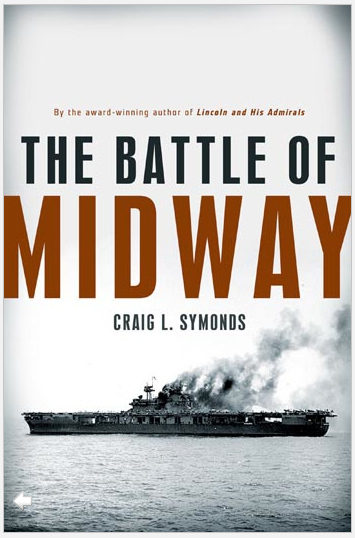
When I read a good book this year, I’ll post a book report on this blog — and The Battle of Midway by Craig L. Symonds is a very good book.

I confess that most of my recreational reading time is spent devouring history, especially military history: tales of Lord Nelson’s navy, the American Civil War, World War One aviation, and the great battles of World War Two. So, “The Battle of Midway” is right up my alley.

Having read a lot of history books, I’m not easy to please. Too often, history is written in a dry and academic way. I dare you to hack your way through Thermopylae: The Battle That Changed the World by Paul Cartledge. The legendary last-stand heroism of King Leonidas and his 300 Spartans deserved more than a repetitive, impenetrable compendium of scholarly knowledge with no regard to dramatic storytelling.

Ever since I read the great Civil War histories of Bruce Catton and Shelby Foote, I’ve come to appreciate that the best, most readable history books address their subjects with a novelist’s gift for character and story. And that’s what Craig Symonds brings to his stirring account of the Battle of Midway: a game-changing confrontation that was essentially the Gettysburg of World War Two in the Pacific.

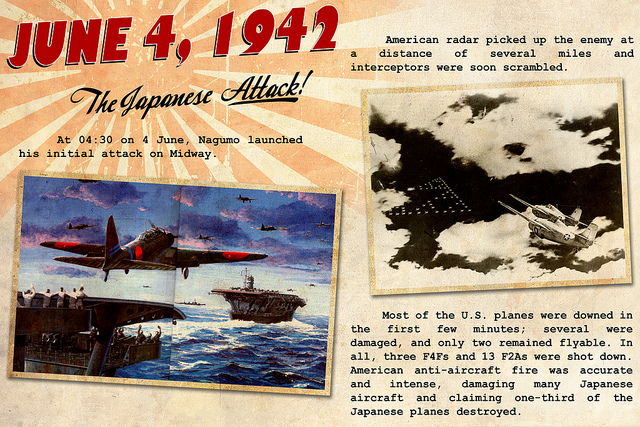
As the sun rose on June 4, 1942, six months after Pearl Harbor, the Japanese navy was supreme in the Pacific. Before the day was over, the U.S. Navy had turned the tide. Like the Confederacy after Gettysburg, the Japanese would continue to fight – and the bloodiest years of the war lay ahead – but the Japanese could no longer win the war.

I’ve enjoyed Craig Symonds’ work before. A retired professor and chairman of the history department at the U.S. Naval Academy, Symonds wrote A Battlefield Atlas of the Civil War (1983) and Gettysburg: A Battlefield Atlas (1992), both of which I’m proud to have on my groaning history bookshelf. Those two books, with their easy-to-read maps and clear, concise copy make the great Civil War battles easy to comprehend. With no less clarity, Symonds goes deeper into the personalities and drama in The Battle of Midway.

Symonds begins by painting a bleak picture of American naval power after the disastrous surprise attack on Pearl Harbor. But, as dire as the situation was, with a seemingly unstoppable Japanese aircraft carrier force (the Kido Butai) imposing it’s will across the Pacific, the U.S. Navy’s own carriers had been absent from Pearl Harbor – and, within six months, would provide the platform for a counterstrike that would lay waste to the Kido Butai.

Symonds draws all the main characters with the skill of a novelist: Admirals Nimitz, “Bull” Halsey and Spruance as well as the poker-loving gambler, Admiral Yamamoto. But Symonds doesn’t dwell solely on the brass – he also gives us a chance to meet the pantheon of heroes who flew the torpedo bombers, dive-bombers, and fighter planes, as well as the seamen who manned the guns on the ships, fought the fires on their decks, and patched up the holes to keep them afloat.

By the time Symonds gets to the fateful, pivotal and incredible five-minute period in which American dive-bombers mortally wounded three of the four Japanese carriers in the Kido Butai – and thus changed the course of the war in 300 seconds — it’s clear how it happened, why it happened, and who was responsible.

“What I tried to do is put together the oral histories to recreate a moment” to make readers feel like they’re there, Symonds has said. “It allows us to put ourselves in their place.”

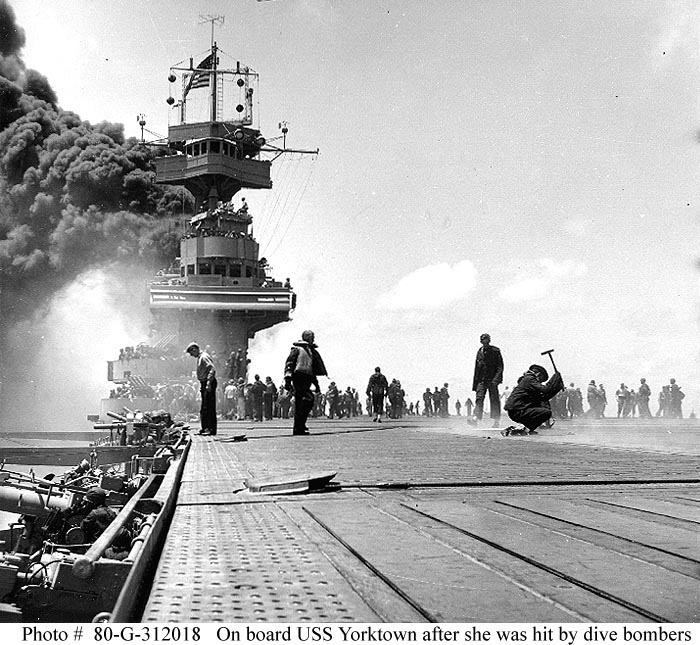
Particularly compelling in Symonds’ account is the story of the American carrier, USS Yorktown. The Yorktown had been badly damaged by a Japanese bomb on May 8, 1942 in The Battle of the Coral Sea. The crippled Yorktown limped into Pearl Harbor on May 27. It was expected that repairs would take three months. But Admiral Nimitz needed the Yorktown for his planned attack on the Kido Butai at Midway – so the repair crews at Pearl Harbor fixed her up and sent her back out to sea in just three days. Four days later, the Yorktown was fighting the Battle of Midway. Alas, the Yorktown did not survive Midway, but before she went down, her dive-bombers had sunk the Japanese carrier Soryu.

The Battle of Midway is part of Oxford’s Pivotal Moments in American History series — and in the introduction to his book, Symonds writes: “there are few moments in American history in which the course of events tipped so suddenly and dramatically as it did on June 4, 1942. At ten o’clock that morning, the Axis powers were winning the Second World War… An hour later, the balance had shifted the other way. By 11:00 a.m., three Japanese aircraft carriers were on fire and sinking. A fourth was launching a counterstrike, yet before the day was over, it too would be located and mortally wounded. The Japanese thrust was turned back. Though the war had three more years to run, the Imperial Japanese Navy would never again initiate a strategic offensive…”

The Battle of Midway is a great read. The resolute self-sacrifice of the doomed Navy torpedo bombers will bring you to tears. The courage, ingenuity and resourcefulness of the fire suppression and repair crews on the Yorktown will amaze you.

And, among other vastly interesting things, you’ll find out how Chicago’s O’Hare Airport got its name.

If you think you don’t like military history books, give this one a try.

3 Comments

Filed under History