
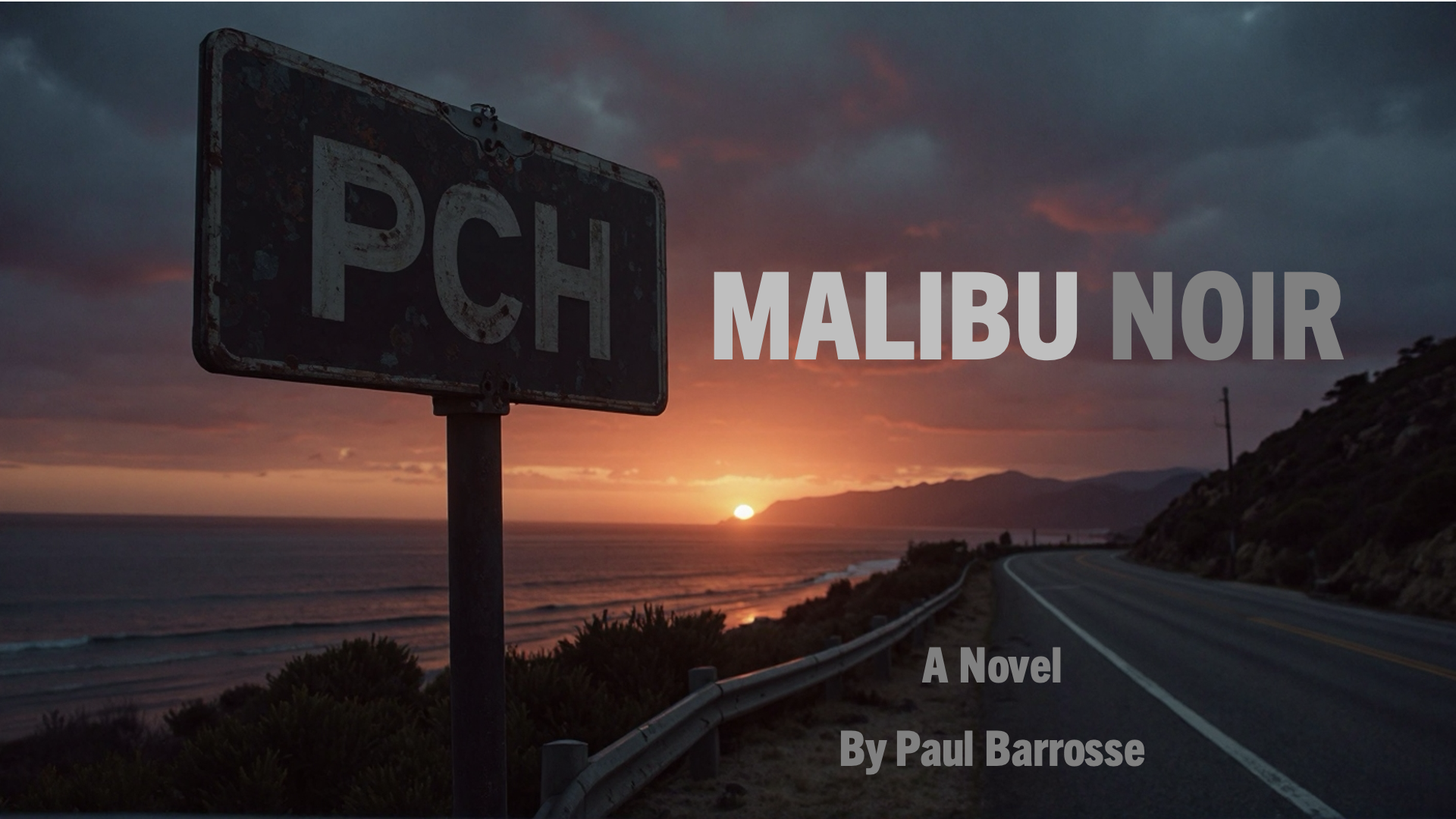
We’re over 120 “likes” now, so without further ado — here’s Chapter Seven. As always, all the acts can be read in sequence by clicking on “My Novel” in the “Landmarks” menu to your right. 150 “likes” will release Chapter Eight. Thanks for reading, folks!
Chapter Seven
Quietly and single-mindedly, Mike trailed Dr. Huber through the time portal with no clue what to expect. He might’ve thought about Gloria — about the ring he gave her and the proposal she’d pretty much accepted just a few hours ago.
But he didn’t.
Into the future he went.
He didn’t feel anything other than a slight bit of nausea as he advanced decades into the future. It was dark inside the portal. There wasn’t any Frankenstein’s laboratory-like zapping and pyrotechnics. It was a smooth transition, as if there was no discernable border between the present and future.
Seconds passed — or was it less? Dr. Huber was somewhere ahead of him, perhaps only a few feet away. Mike couldn’t tell. He walked forward slowly, deliberately, stalking Huber through the darkness of the portal, trying to keep pace with his unseen target. His adrenaline was flowing. He was on a mission — and he loved it.
Suddenly, Mike got whacked across the face! Where did all these crazy tree branches come from?
It was clear that Mike was no longer in the portal.
The moon lit his way as Mike struggled through the overgrown chaparral, feeling his way through burrs, thorns, and cobwebs with his .45 in hand. Hearing a rustling up ahead, he caught a glimpse of Dr. Huber, who didn’t appear to know he was being followed.
Mike tracked Huber for several hundred feet, from just outside the building housing the portal to the foot of the steps leading up and out of the compound. Dense foliage blocked the entire passage as he pursued the unsuspecting Huber into December 12, 2008.
Mike paused as Huber stopped at the bottom of the steps to catch his breath. The moonlight revealed a dilapidated building at the base of the steps. Mike remembered passing the same building on both of his trips to the compound, but now it appeared as though some mad artist had covered the derelict structure with bizarre, Picasso-like paintings. It was Mike’s first solid evidence that he’d travelled in time.
He was chasing Dr. Huber, but Mike was the one who was lost. Huber knew where he was going. The mad Nazi scientist was following a grand plan, more than five decades in the making. Mike was just a lone hunter trying to keep up with his prey.
Huber was surprisingly nimble for an older man. He moved briskly up the five hundred concrete steps and unlocked the compound’s now-ruined gate. He closed the gate and padlocked the chain before stepping out onto Sullivan Ridge Road, unaware that Mike was on his heels. Behind the gate, Mike watched from the bushes as a souped-up car of a make he’d never seen before skidded to a sudden stop along the shoulder of the road, picked Huber up, and raced off down the street.
Mike watched as Huber’s wild-looking hot rod sped down the road toward Pacific Coast Highway. He saw the situation clearly. Huber’s getaway was no coincidence. He’d planned it all perfectly. His next step would be to link up with Horst and check out their new and improved time portal. That could lead to a rebirth of Hitler’s Third Reich right here in America – and unimaginable horrors.
Mike had a hard time wrapping his head around the idea that he was now fifty-seven years in the future. He would have to get his mind right – and fast – to keep up with Dr. Huber. Mike had little of value in his pockets, other than fifty-six dollars in cash, his trusty .45, and the iPhone he’d found. He figured Huber would be meeting up with Horst at Cal Tech. He just didn’t know exactly when.
It was likely very soon.
Besides trying to save the future from the return of Nazism, Mike had another big reason to wrap up this case. It wasn’t patriotism, the thrill of the hunt, or the reward money. Mike had to track down Huber as soon as possible so he could get back to 1951 and Gloria. What’ll she think when the guy she just agreed to marry suddenly disappears? And, if he does manage to get back to her, how will he ever explain where he went? Mike tried hard to push such thoughts aside. He needed to focus on the here and now — whatever that meant anymore. He looked at his watch. It was 8:00 pm. Despite all he’d been through, the night was young.
Mike knew it was probably hopeless, but he looked for his car where he parked it on the side of Sullivan Ridge Road. Of course, it was no longer there. He was less than a mile from Pacific Coast Highway, so he could always walk down to PCH and thumb a ride north to Malibu. Back in his old neighborhood, he could get his bearings and maybe find someone who could help him figure out what to do with his iPhone. Maybe it had more secrets to reveal?
Mike jogged down to PCH, which was lit much brighter than back in his day, though the moonlight on the ocean looked just the same as it always did. Mike walked north, thumbing a ride along the way. The cars that passed him didn’t look like anything he’d ever seen. They were smaller and had a lot less chrome. No fins, big fenders or running boards to be seen. They looked like something out of Popular Mechanics. And the people in them weren’t dressed like he was. None of the guys wore hats. Self-consciously, Mike reached for his fedora. It wasn’t on his head. He must have lost it while trailing Huber through the overgrown brush on Murphy’s Ranch.
Mike looked for a pay phone to see if any of his old phone numbers still worked, but he couldn’t find one. There was a phone booth every other block back in ‘51. He finally found one at Will Rogers State Beach — but it had been vandalized. The phone cord was cut and there was no receiver. No phone book, either. Jerks, Mike muttered. Why mess with a damn phone book?
A couple of twenty-something surfers and their girls were looking for their car in the parking lot. Mike wondered what they’d think of a guy who looked like he might be from half a century in the past. He needn’t have worried. They passed him without a word. They were dressed different than beachgoers in his day, the girls were wearing a whole lot less, but to them Mike must have appeared to be just another black and white square.
Mike was in a whole new world. From now on, he’d have to tread carefully with every step he made. Right now, all he could do was keep moving northward and hope to find Zack’s — if it was still there. But why would it be? How could he be sure that anything from 1951 was still where it used to be?
Hitchhiking didn’t seem too popular anymore, so Mike walked the last few miles to Zack’s Oceanside Dive.
Fortunately, Zack’s was right where Mike hoped it would be. He picked up his step when he saw the newspaper racks on Zack’s front porch. He could finally confirm the date! The Los Angeles Times and The Daily News mastheads made it clear that both editions were published on Friday, December 12, 2008.
So, it was true. He’d just travelled fifty-seven years into the future.
Suddenly, a pang for Gloria stung him worse than the pain in his hip. How the hell was he going to get back to her? Mike’s mind swarmed with questions for which he had no answers. He reminded himself to focus. Take it moment to moment. Moment to moment.
Mike opened Zack’s familiar front door. A crude, monotonous, percussion-heavy music played on the jukebox, which was nothing like Zack’s old jukebox. Above the bar, there were three large television sets – all tuned to a different station. And in color! The sound was off on all the TVs. The pounding music dominated.
The joint was jumping. Mike was glad that Zack’s appeared to be doing a decent business after all these years. Taking in the patrons, he saw that none of the men were wearing suit jackets. Not a necktie in the place. Some of the ladies wore pants. Many of them stared into the same kind of iPhone he had in his pocket. These iPhones clearly weren’t a rare commodity.
Besides the clientele, the music, and the televisions, Zack’s hadn’t changed all that much. It looked like the same dowdy seaside dive Mike always knew, except that Gloria was no longer behind the bar. Then again, if the newspapers in the boxes out front were correct, Gloria would now be 77-years old.
Mike’s mind wandered for a moment. There was something oddly familiar about the gal behind the bar. Was he nuts? Damn, Mike thought, as he settled onto his usual stool at the bar. She looks just like Gloria.
The young woman took Mike’s drink order. Did her voice sound a bit like Gloria’s? He dismissed the thought and enjoyed his first bourbon. He’d catch up with crazy Dr. Huber tomorrow. All he had to do was track down Horst Mueller, who’d likely be found at Cal Tech. He’d get a car in the morning and drive out to Pasadena. Right now, he needed to relax and get a grip on his bizarre situation. He called for another shot. Then another. No beer tonight for Mike. The stress of time travel had him back on the hard stuff.
There was a Daily News sports section sitting on the bar and Mike paged through it. An article on the pro baseball offseason made no mention of his beloved Hollywood Stars. Mike read that there were now two major league teams in town, the Angels and the Dodgers. Were these the same Dodgers that played in Brooklyn? Did the Stars still exist? Was Gilmore Field still standing? Mike shoved the sports page down the bar. He was in deep shit. If he didn’t stay focused, madness could be just around the corner.
Several rounds later, Mike had focused enough to learn the barmaid’s name was Gina but little else. He told her his name was Mike, feeling slightly more comfortable — and more than a little guilty. After all, he was engaged to Gloria. But the all-too-familiar-looking Gina was a pleasure to talk to – and as long as she set up the drinks, Mike would knock ‘em down.
By now, Gloria would have started pouring him coffee.
Way too many bourbons later, Mike was still looking for the right moment to confess to Gina that he was a traveler from the distant past. Of course, that would be stupid — but he had lots of questions that needed answers. First, he wanted to know more about his iPhone. So, he took a chance. Pulling it out of his pocket, he complained to Gina that it didn’t work. Gina knew what it was right away.
“Cool. An iPhone! Wish I had one. How much did it cost?”
Mike had no idea what it cost. He assumed it was probably expensive. “Way too much,” he said with a feeble smile. Gina laughed. “I know,” she said, “but they’re worth it.”
Mike handed the iPhone to her. “Looks like your battery’s dead. You just need to re-charge it,” she said, handing it back to him. She was sorry she didn’t have a charger. “You must be a high roller, Mike. You’re on the cutting edge of technology.” Mike smiled. If she thinks an iPhone is cutting edge, he mused to himself, how about a damn time portal? His head was swimming. There was something about Gina. Something familiar. She told Mike he could get an iPhone charger just about anywhere.
While Gina served her other customers, Mike listened to the conversations at the bar. He couldn’t keep up. The sports scores and current events were beyond him. He was fifty-seven years behind the times. He knocked back his last shot, bid Gina a too-flirtatious goodbye, and made his stumbling exit.
Weaving his way out of Zack’s, Mike made his way to a secluded spot on the beach that he knew well: a surfer’s cove where he’d camped overnight many times. There was a small cave at low tide, carved out by decades of pounding surf. He’d crash there. In the morning he’d get a car, charge up his iPhone and track down Horst – and Huber.
It was bizarre being stuck in the future, but he was determined to stop this mad Nazi plot and get back to Gloria, marry her, baby her up, and live happily ever after. That is, if he could make it back to 1951.
He was very drunk. And tired. So very, very tired. Soon, the crashing waves lulled him to a blessed, boozy sleep.

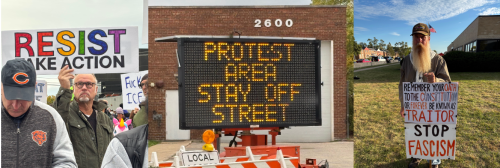
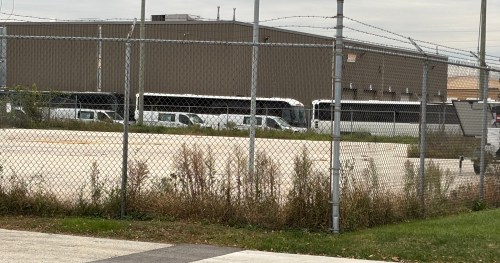

 When we got to the Broadview ICE facility, the protest location had been changed. The last time we were there, protestors lined one side of the driveway where the masked ICE thugs drove their unmarked cars into the detention center. We were able to confront the ICE goons as they came and went.
 another facility entrance. We could see the ICE vehicles enter and leave – but they didn’t have to drive past us. They didn’t have to look at us. They didn’t have to hear us. They didn’t have to feel our rage. But we expressed ourselves anyway.
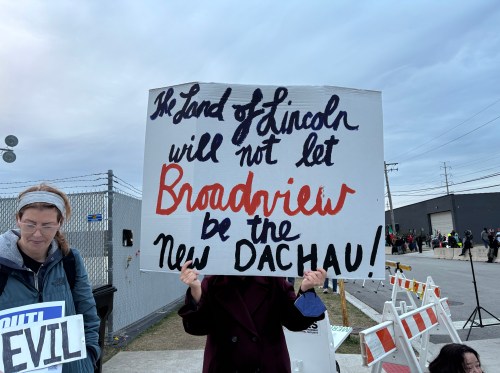
 Some of our fellow protestors expressed themselves in creative ways. There was the guy with the bald eagle head who wore only his red-white-and-blue underwear and a pair of boots on this cold, autumn day. Three handmaidens stood silent witness. There were lots of funny costumes. How threatening could a man in a pink conical cap riding a unicorn be?
 The folks in the middle were the County sheriffs and the Broadview cops. They were there to maintain order – especially the Broadview mayor’s 6:00 pm protest curfew. We tried to remind them that our First Amendment rights to assemble and engage in free speech do not have an expiration date – or hour. We asked them why they don’t wear masks, but the ICE goons do. We asked them if they knew what was going on in the detention center. We asked them, as professional policemen, if they were comfortable protecting guys who were arresting people without a warrant and affording them no due process.
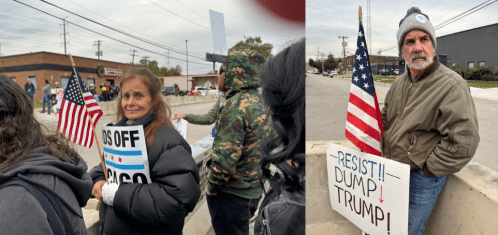
 It was well past 6:00 pm when Victoria and I left the protest and went home. I’m not sure how long the stalemate lasted. There were still hundreds of protestors in no mood to leave quietly. Next time, we’ll stay to the bitter end.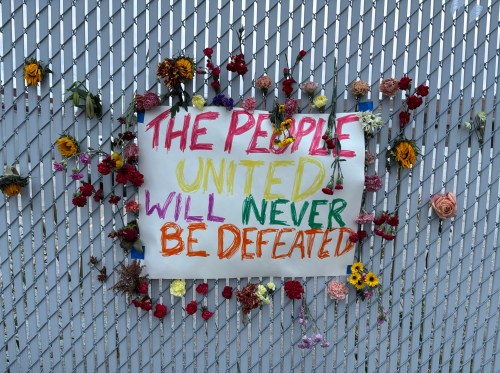


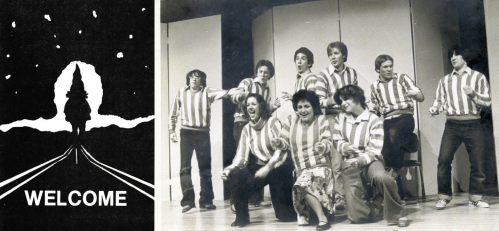
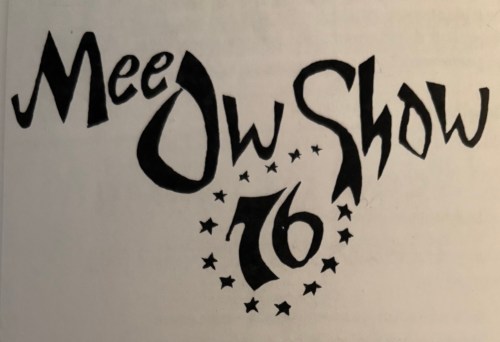 Produced, written, and performed by students,
  Ass and North by Northwestern. Among the cast were Stew Figa, Jeff Lupetin, Betsy Fink, Suzie Plakson, Tom Virtue, Kyle Hefner, and Dana Olsen. It was the coolest, funniest live performance I’d seen since I hit campus.
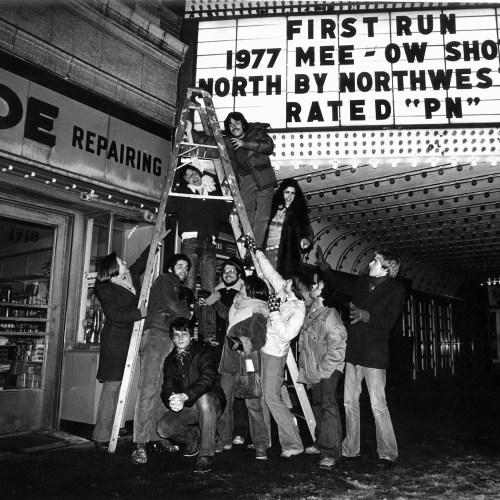 enthusiastic. Mee-Ow was the hippest scene on campus – fast-eclipsing the popularity of
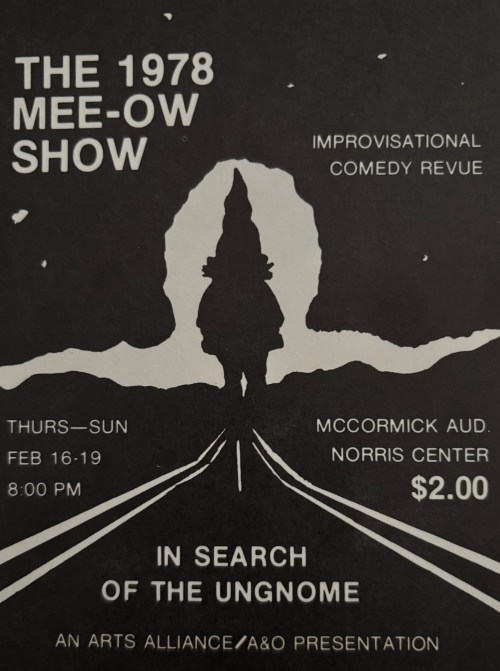 out of hand. Then, Kyle would send us out of the room in groups for a few minutes to work out a rudimentary idea of how to structure a scene from one of these premises.
 If a sketch doesn’t end well, then the next sketch starts from a deficit. It must win back the audience after an awkward moment — and that can kill a running order. That’s why, from those days forward, The Practical Theatre Company has never rested until we’ve done our best to satisfactorily “button” a sketch. (Alas, we don’t always succeed.)
 opportunity for a moment of unexpected, improvised fun with the audience. Confident in the through-line of the sketch and the final button, we could have some improvisational fun when the moment called for it.
 Rush and I shocked the crowd with a sketch called “Biafran Restaurant”. It was a moment in time. We were clad in our underwear, performing a sketch that juxtaposed a terrible African famine with a middle class American dining experience: balancing precariously on the comedic edge as we reminded the audience of an ongoing tragedy. These weren’t easy laughs. And it was glorious. We felt like we were pushing the envelope. And maybe we were. We were college sophomores – just starting to explore our comedic horizons.
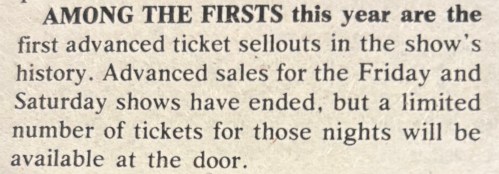 I loved everything about the Mee-Ow Show process: the music, the comedy, the late nights scripting sketches at Rush or Dana’s apartments after rehearsals. And when we performed the shows and the packed crowds laughed every night, I was hooked. I was home.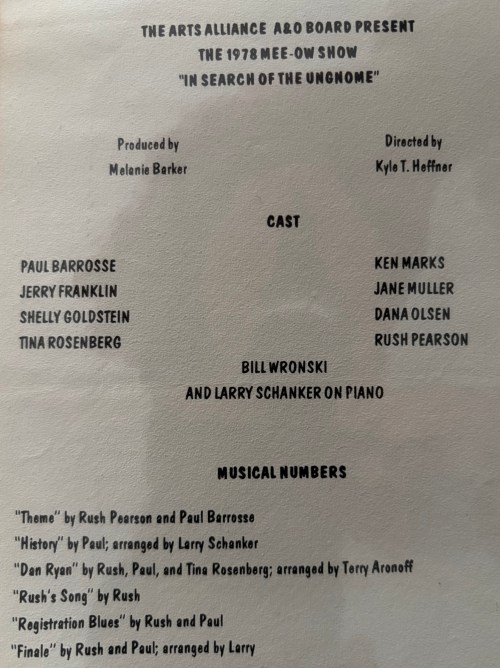




 Paul's Voyage of Discovery & Etc.