Category Archives: History

Louis D — RIP

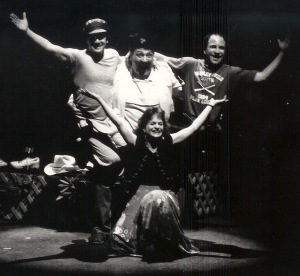
Louis DiCrescenzo (right) and Terry Shaughnessey backstage at "Bozo the Town".

The one and only Louis DiCrescenzo, the gifted artist who designed and built both The John Lennon Auditorium at 703 Howard Street and The Piper’s Alley Theatre at North & Wells, passed away last week.

Brad Hall, his cast-mate in the original production of “Do Black Patent Leather Shoes Really Reflect Up?”, introduced Louis to The Practical Theatre Company in 1981. Louis’ imprint on the PTC was much, much larger than the big man himself.

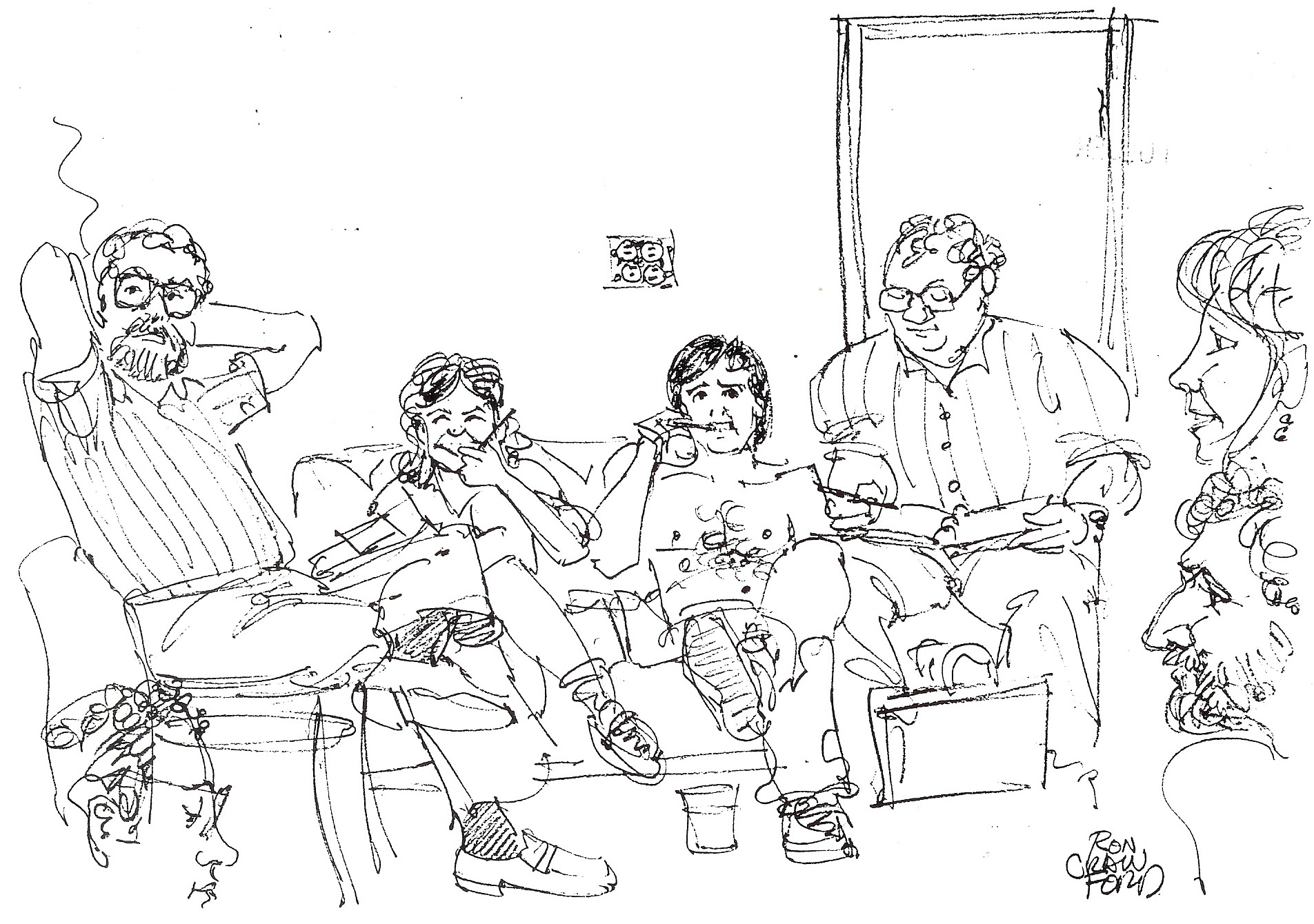
The big man in a note session backstage with us during "Bozo the Town". (From right) Sheldon Patinkin, Vic, Paul, Louis D., Bea and Steve Rashid. (Kyle Hefner, below left)

Big, affable, talented Louis D will be remembered by members, friends and fans of The Practical Theatre Company not only for his visionary theatre designs – but also for his scene-stealing performances as stage manager in “Art, Ruth & Trudy” and “Bozo the Town”, as well as his wonderful turns on the PTC/WMAQ-TV projects, “Overnight Guest” (as landlord, Nick Nickolopopolous) and the Emmy-winning live broadcast of “Deer Season.”

Paul, Louis, Kyle and Vic in "Bozo the Town". (1987)

Louis D was larger than life.

And we were glad to have worked, rehearsed, performed – and laughed – with him.

RIP Louis.

We love you.

Here’s Louis’ obituary in The Chicago Tribune…

13 Comments

Filed under Art, Comedy, History

Capturing Occupy Wall Street: The Crawford Chronicles

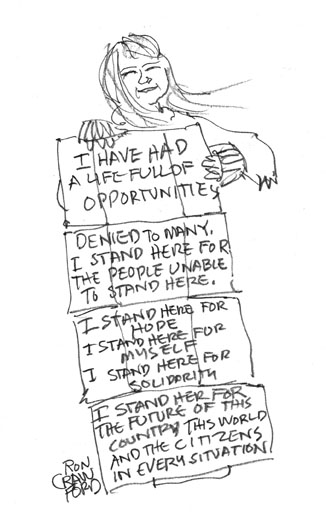
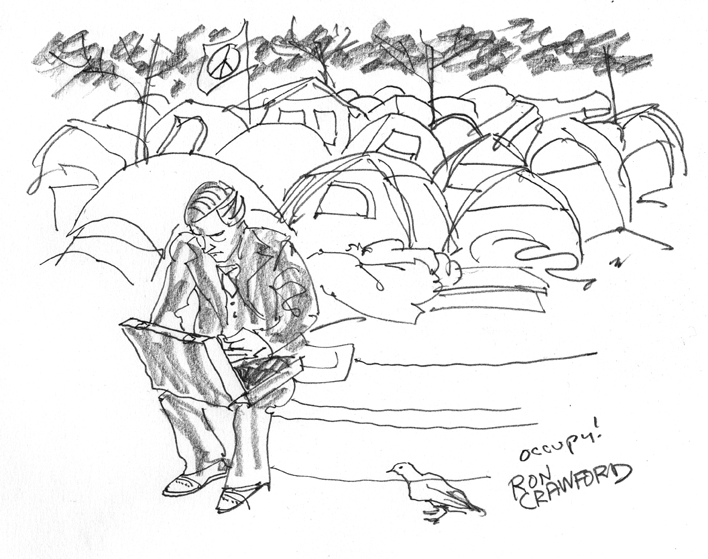
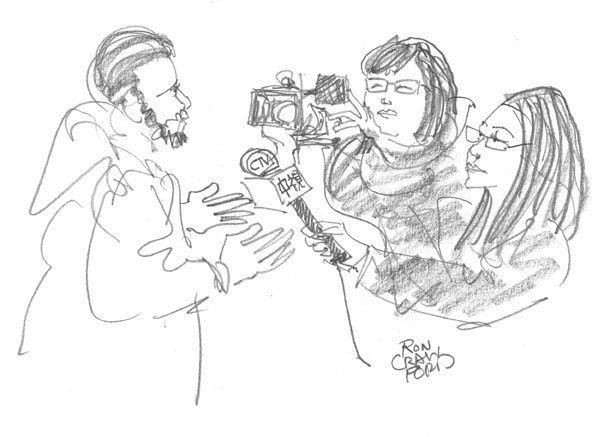
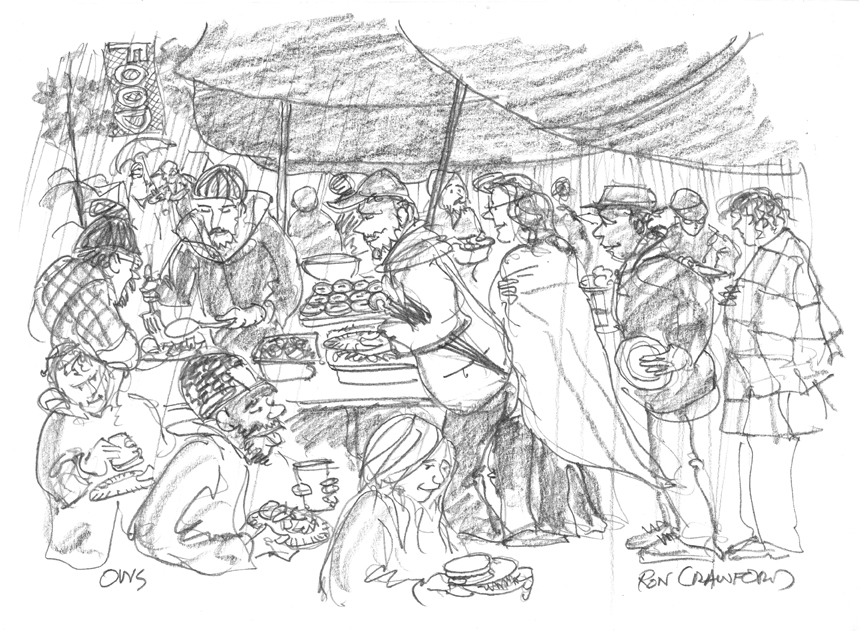
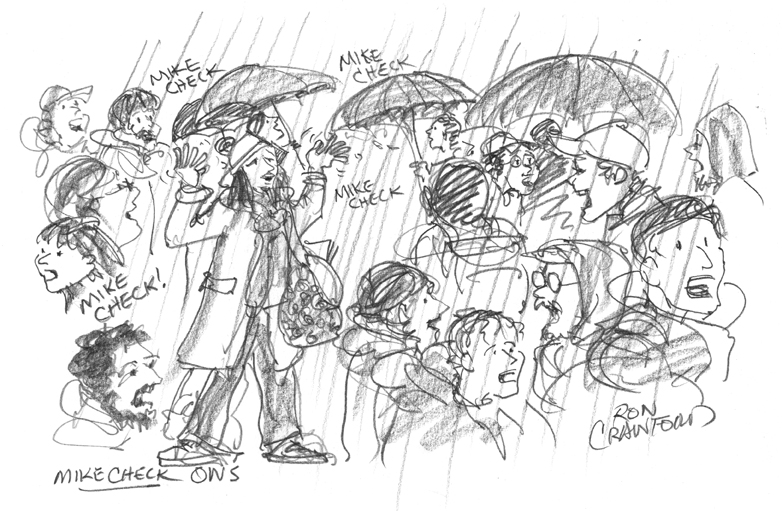
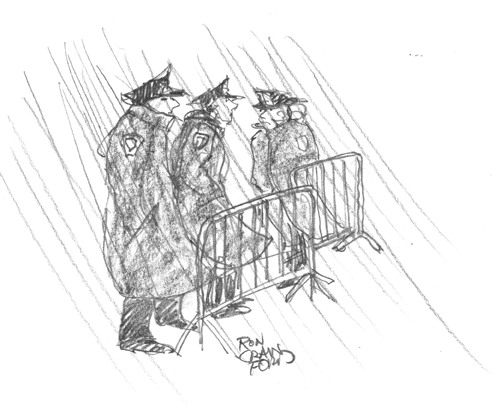
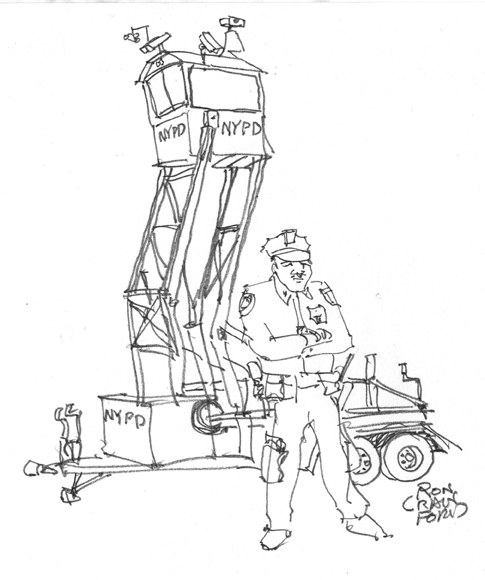
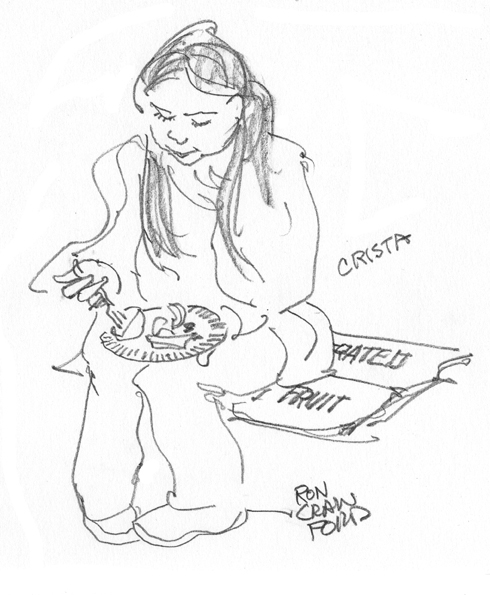
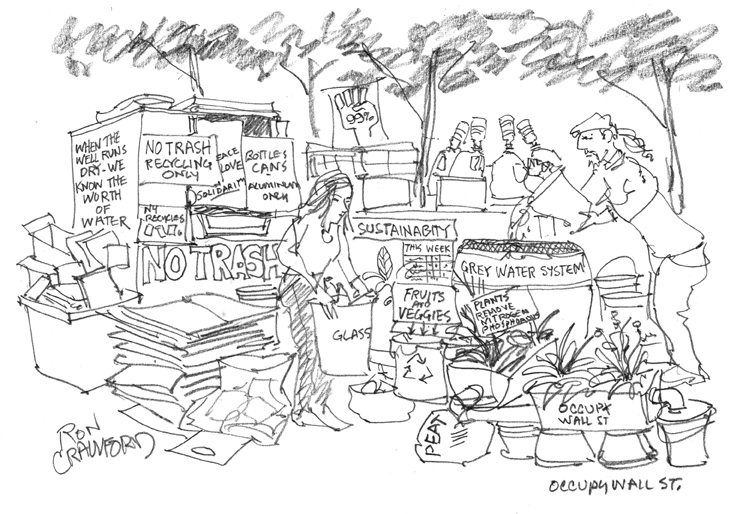
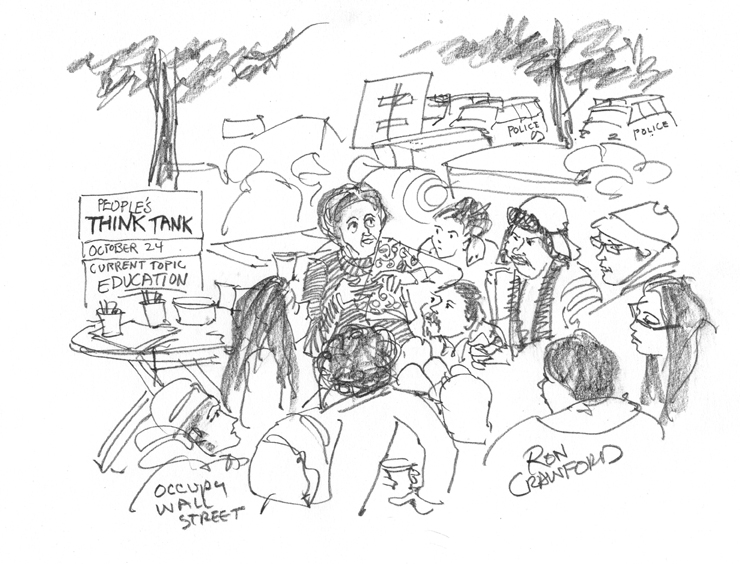
Our great friend, the outrageously talented artist, Ron Crawford, has been spending a lot of time at Occupy Wall Street in lower Manhattan. Here’s another gallery of images that Ron has captured with his keen eye and splendid pen.

Solidarity forever!

The commentary that follows is Ron’s own.

“Down this morning to OWS. Keeping the place neat and clean. We donated some thin metallic blankets for warmth.”

“Here is the brass statue made famous in the 9-11 photo.”

“The fire department took their bio-diesel generator away so they’re recharging cell phones and computers with bicycle generators. The rigs were brought in by Times Up. Note their logo on the computer guy’s cap.”

1 Comment

Filed under Art, History, Politics

Occupy Wall Street: Thomas Paine & Ron Crawford Capture the Moment

Words by Thomas Paine — Drawings by Ron Crawford..

“These are the times that try men’s souls…

“The summer soldier and the sunshine patriot will, in this crisis, shrink from the service of his country; but he that stands by it now, deserves the love and thanks of man and woman.”

“Tyranny, like hell, is not easily conquered; yet we have this consolation with us, that the harder the conflict, the more glorious the triumph.”

1 Comment

Filed under Art, History, Politics

An Artist Occupies Wall Street.

My good friend, the great artist Ron Crawford, went to Zuccotti Park on Friday October 21st and did what he does best: capture a scene in a few dynamic sweeps of his gifted pen.

Click on the drawing and blow it up.

I always love to see which details Ron chooses to focus on in his inspired sketches — like the word “Empathy” and the concerned fellow with a briefcase in the foreground.

Thanks, Ron – for giving those of us who can’t be there an eyewitness view of Occupy Wall Street that is, in many ways, more personal and revealing than a photo. (More drawings after the video.)

2 Comments

Filed under Art, History, Music, Politics

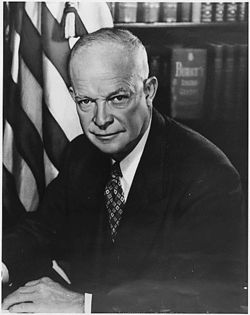
A New Presidential Biography Reminds Us Why We Should Like Ike.

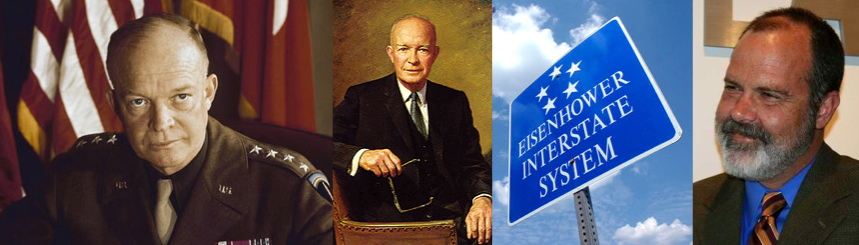
On October 4th, Jim Newton’s Presidential biography, Eisenhower: The White House Years arrives in bookstores.

This is exciting news. Not just because the author is a very dear friend of mine – but because I can’t think of a more apropos time since his Presidency ended in 1960 for us to look back on Ike’s two terms in the Oval Office.

My buddy Jim Newton is a veteran newspaperman who began his career at the New York Times. Since I’ve known him, he’s been an editor at the Los Angeles Times, where he’s now the editor-at-large. In 2006, Jim wrote a definitive biography of Chief Justice Earl Warren entitled, Justice for All.

Now, he’s focused his brilliance and talent on the man who put Earl Warren on the court.

Hold on. It was Republican who put the classic “activist judge” Earl Warren on the Supreme Court?

Indeed. And that’s just one of the reasons it’s a good time to revisit the Eisenhower Presidency.

More than a half-century after Dwight D. Eisenhower left office, his old campaign slogan “I like Ike” has become a cliché. But, in this era of Tea Party Republicans and Ronald Reagan worship, it’s nostalgic to recall a Republican President who would never have said, “The nine most terrifying words in the English language are, ‘I’m from the government and I’m here to help.’”

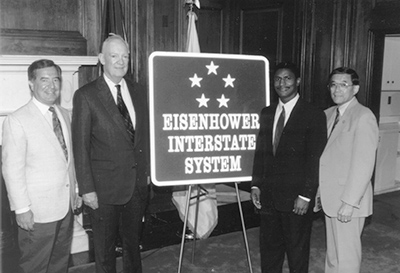
That kind of simplistic, anti-government demagoguery would not have appealed to the complex man who built our interstate highway system and sent Federal troops to Little Rock, Arkansas to enforce school desegregation.

In a move that would be anathema to today’s dogmatic GOP states’ rights defenders, Ike ordered units from the 101st Airborne Division to Little Rock on September 24, 1957. The next day, those soldiers escorted nine black students through the front door of Central High and into its formerly all-white classrooms. Of course, Ike had some previous experience with the paratroopers of the 101st. 13 years earlier in a little dustup called D-Day on June 6th, 1944. The Screaming Eagles followed Ike’s orders into their drop zones behind the beaches at Normandy – and into the hallways of a Little Rock high school.

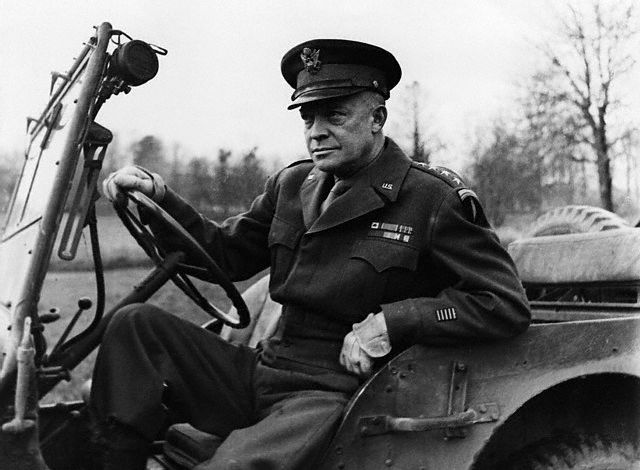
But Jim’s book is not about General Dwight Eisenhower, the Supreme Allied Commander who led his forces to victory in World War Two. It’s about the Eisenhower, who, like George Washington and Ulysses S. Grant, went from the highest-ranking military leader in an epochal war to Commander in Chief as the thirty-fourth President of the United States.

I was born in 1958 during Ike’s second term, but John F. Kennedy was the first President that I was aware of – and my first clear memory of Kennedy was watching his funeral on TV.

During my boyhood, President Eisenhower was a distant figure: even more dimly remembered than General Eisenhower, the hero of D-Day and all those World War Two movies I loved and re-created in my backyard.

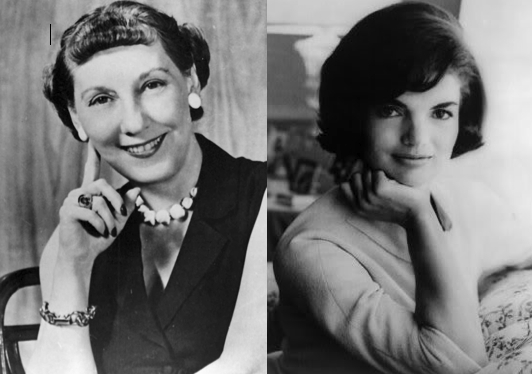
Comedians made jokes about Ike playing golf and how homely his wife Mamie was. After the glorious Jackie Kennedy enchanted The White House, dowdy Mamie didn’t have a chance.

By the time I was in high school, my sense was that Eisenhower’s Presidency, if I thought of it at all, didn’t amount to much. He was a dull President in a dull time. Thank goodness, 16-year old Paul didn’t write the book on Ike.

I certainly wasn’t alone in thinking of Eisenhower as little more than the Caretaker-in-Chief, hitting the links with Bob Hope and presiding over an easygoing, black & white, “Leave It To Beaver” American society. Long after I graduated from college in 1980 that was still the prevailing attitude about Ike’s time in the Oval Office. There was, however, residual gratitude on the Democratic Left for Eisenhower’s lukewarm endorsement of Vice President Dick Nixon in the 1960 race against Kennedy.

The laugh was on Dick. Dick got the last laugh.

Pressed by reporters to give an example of Nixon making a key contribution to his administration, Ike said, “Give me a week and I’ll think of one!” Priceless. Nixon went on to lose to Kennedy in one of the tightest Presidential races in American history. Nixon got the last laugh, though. Not only did Tricky Dick win the White House eight years later – that same year, 1968, Nixon’s daughter Julie won the hand of Ike’s grandson David in marriage.

But, looking back at Ike’s Presidency, it’s hard to imagine why, as a callow youth, I thought his time in office so inconsequential. Eisenhower was the second President to have an atomic bomb in his arsenal — and he refused to use it. He kept radical anti-Communist McCarthyism at arm’s length until it became, as he called it, “McCarthywasm.”

And, after lifting the nation out of its post World War Two debt, he was the last president until Democrat Bill Clinton to leave office with a budget surplus. The top marginal tax rate under Eisenhower was 91%. George W. Bush slashed that rate to 35%. Ike paid for WWII and built our highway system. George W. Bush built nothing and left us in debt to China.

For these, and many more reasons, this lifelong Democrat likes Ike. And I like Jim’s book. But you don’t have to depend upon my endorsement (which is so much more enthusiastic than Ike’s backing of Nixon) – you can just check out these amazing reviews…

“A truly great book, spirited, balanced, and not just the story of President Eisenhower but of an era.”
 Bob Woodward

Jim Newton does a masterful job illustrating the forces that confronted Dwight Eisenhower during his years in the White House, from nuclear politics to race relations to the federal debt and deficit. He paints a vivid portrait of a president struggling to find middle ground—sometimes successfully, sometimes not — but always with the good of the country in mind.” 
Dianne Feinstein, U.S. Senator

”

“Newton’s contribution is as cogent an inventory of Eisenhower’s White House years as I’ve ever read… This is a book for all who are interested in a better understanding of how America and the World were shaped post–WWII and for those who aspire to lead: Read Newton’s book first.”
 Chuck Hagel, U.S. Senator (1997–2009)

“Ike’s wisdom, born of experience and intellect, is on display in this important book, which heightens appreciation for his leadership. Newton reveals, for instance, that after the Korean War, only one American soldier was killed in combat during Eisenhower’s presidency. This volume contributes to our understanding of an outstanding human being.”
 George P. Shultz, 60th U.S. Secretary of State

“Jim Newton’s ‘Eisenhower, The White House Years’, simply and eloquently, delivers the man, his Presidency and, if America is paying attention, the life lessons that are his legacy.”
 Norman Lear

“Jim Newton’s brilliant reassessment of Eisenhower’s presidency is long overdue, and his book makes it clear that Ike was indeed a great president. Ike’s insistence on always doing the right thing for the country despite party pressure and personal predilection serves as a valuable model for politicians in all three branches of government.” Former FBI Director, William S. Sessions.

Buy my friend Jim Newton’s book today — and learn what a principled, heroic Republican used to be. And, alas, you’ll know why bipartisanship is a thing of the past.

I still like Ike.

Now more than ever.*

* With apologies to Nixon’s 1972 campaign.

3 Comments

Filed under History, Politics

A Hilarious History Goes Home.

What do Leopold & Loeb’s original 1924 ransom note, Patricia Neal’s 1972 Golden Globe, one of former Illinois Governor Rod Blagojevich’s 1978 college blue books, and Practical Theatre Company memorabilia, circa 1979-1989, have in common?

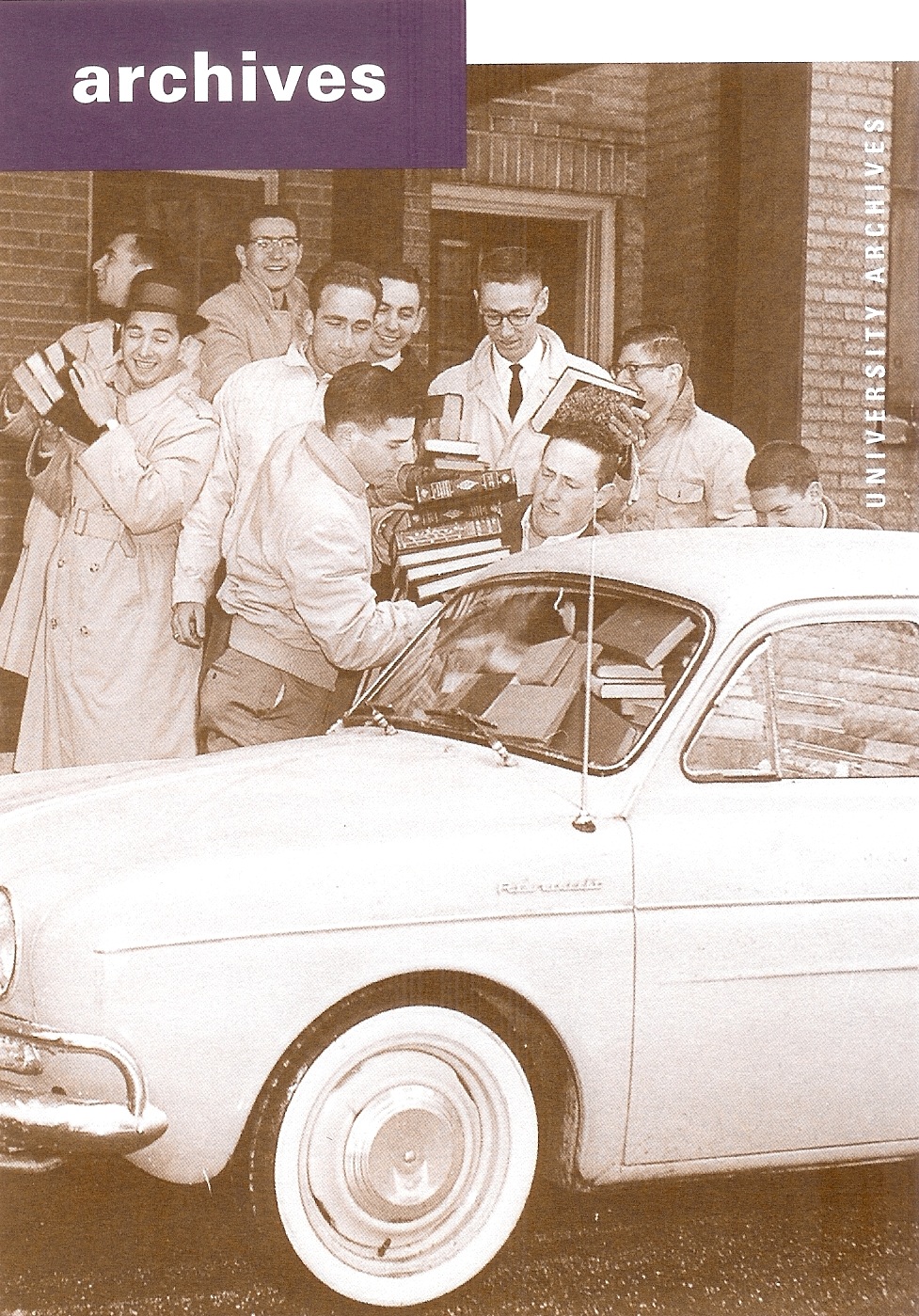
This year, everyone who ever worked at The Practical Theatre Company has been accorded a great honor by Northwestern University. For generations to come, a decade’s worth of our adventures (and some misadventures) — from “Clowns” to the musical “Rockme” — are now enshrined among the Special Collections in the Northwestern University Archives.

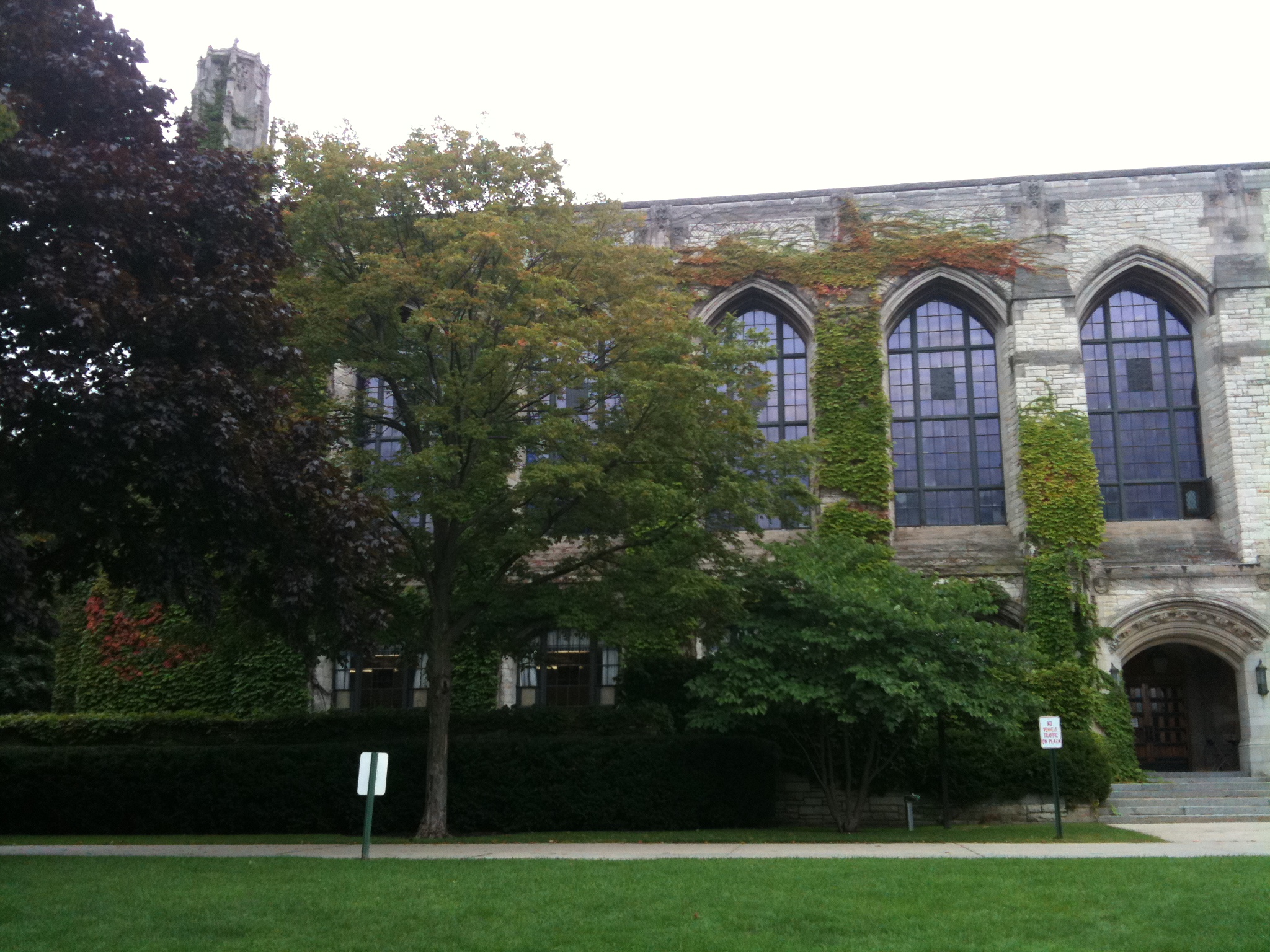
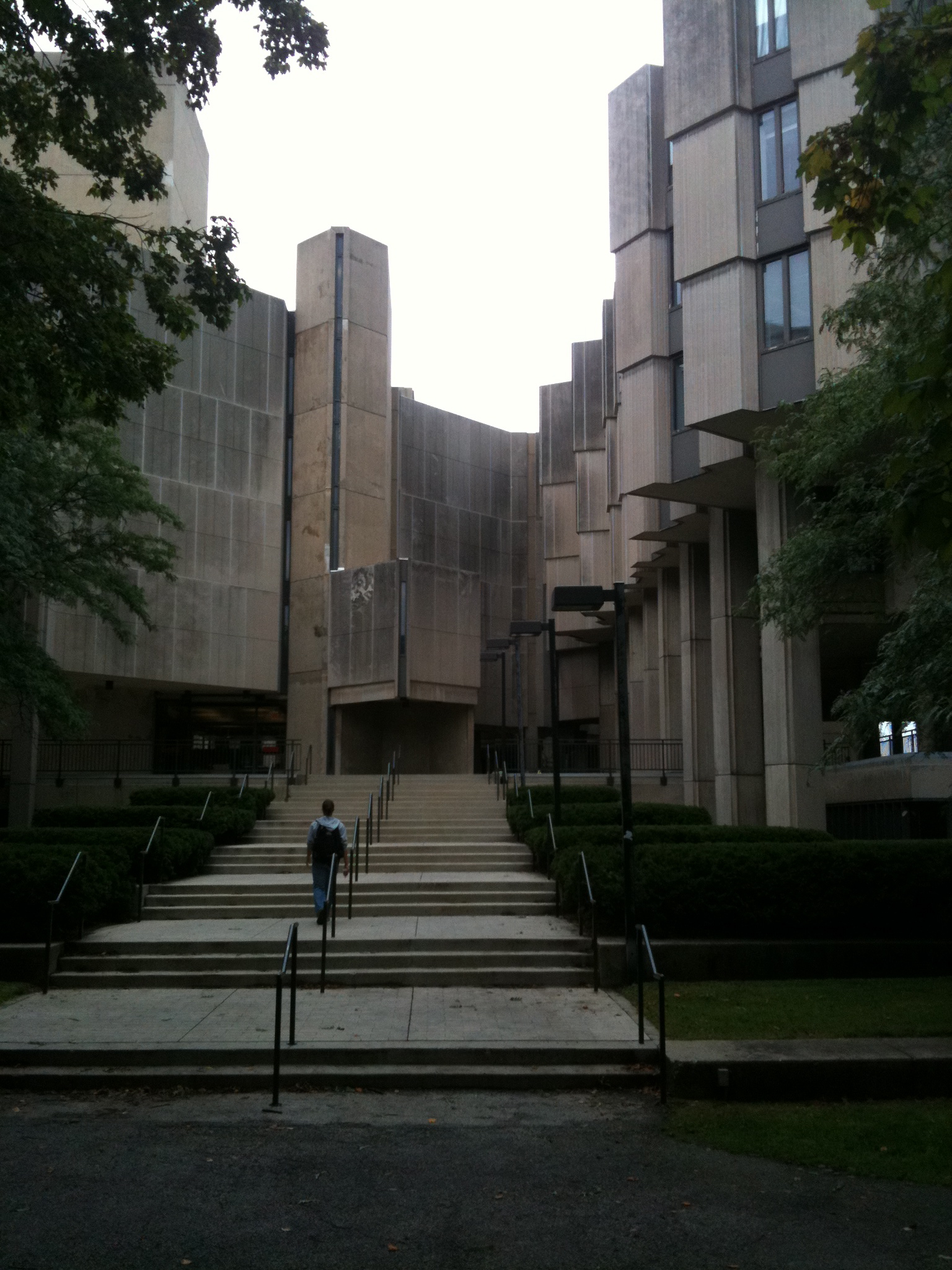
The written and videotaped record of that brilliant, madcap, kinetic and creative period — from Shanley Hall to the John Lennon Auditorium, from Piper’s Alley to Briar Street – have been lovingly placed upon the venerable shelves of the Old Deering Library. (Not the concrete monstrosity built in 1970 – but the grand cathedral-like edifice, built between 1931 and 1933 and, perhaps apocryphally, derided as an “upside down pig” by Frank Lloyd Wright.)

This vulgarity is not the PTC archive's home. We're in the magnificent old library building. Yeah!

How did this come to pass?

The 4-part PTC history I penned for this blog got the attention of University Archivist, Kevin B. Leonard, who made me an offer I couldn’t refuse: a chance to place the tangible history of the PTC in safekeeping at Northwestern Library, where it can be studied by students, researchers, writers, and anyone with an interest in the exploits of the Practical Theatre, Chicago theatre in the 1980’s, improvisational theatre, and the legend of Tomaloochie Falls.

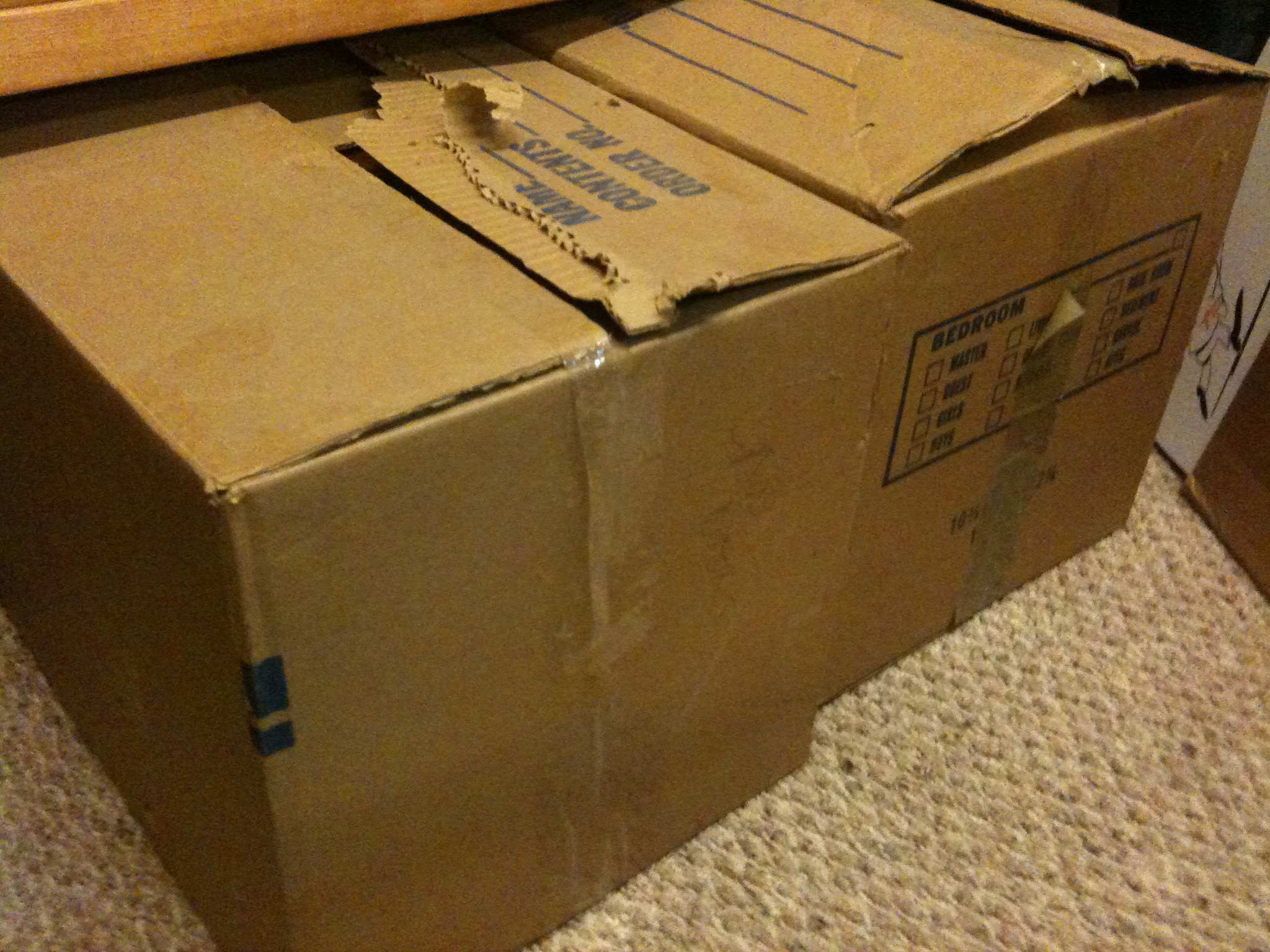
I’ve been hauling the PTC’s history around in as many as twenty battered cardboard boxes, from house to house, and state to state for over two decades. And it’s a very heavy history.

A couple of years ago, my wise and wonderful wife, Victoria, urged me to clean up our cluttered garage and turn it into a room that our teenage daughters could use for music and recreation.

A key part of that effort involved opening all those dusty, damaged boxes of PTC files, photos, artwork, oddities and rarities and putting them into file cabinets where they’d be out of the way – and protected.

Some of this stuff had not been seen by anyone since it was packed up when we left The John Lennon Auditorium in 1985.

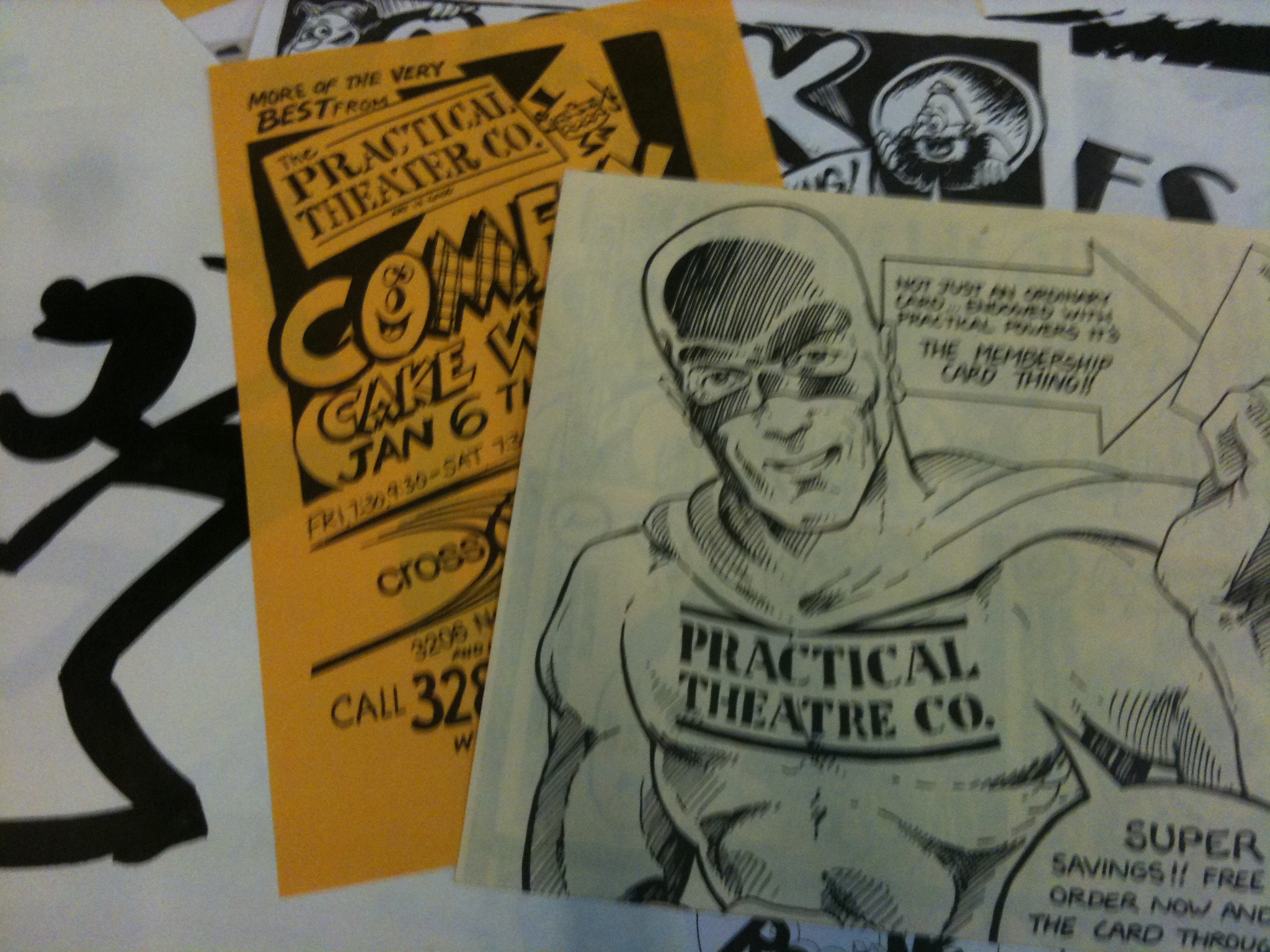
Now that this jumbled mass of an archive was stuffed into file drawers, it was easy to get lost for hours poring over ancient documents, from “Bag O’ Fun” scripts, to PTC Board meeting minutes, and other goodies, including season brochures and posters illustrated by a grand gallery of great artists: Ron Crawford, John Goodrich, Paul Guinan and Gary Whitney, among others. These rediscoveries inspired my blog series on the PTC’s history – and provided the graphic material that brought those articles to life.

But as I transferred those precious pieces of history from cardboard boxes to metal file cabinets, an alarming number of water-damaged documents reminded me of how a flash flood in the basement of my first home in Woodland Hills came dangerously close to destroying this accumulated treasure of legendary theatrical lore. So, when the NU Archives offered to provide a safe home for the documentary history of the PTC, I was happy to get this trove off my hands and into the grasp of professional archivists.

Over the course of six months, working some weekends and grabbing a few hours here and there, I dove into the process of sorting and arranging all those bulging file cabinets full of raw, confused files into something the NU Archives could work with upon receipt. I suppose I could’ve just sent Kevin Leonard the whole, unadulterated pile of Practical – but Mama Barrosse raised me better than that.

Finally, the PTC archives were ready for delivery, along with four boxes of my personal papers, covering my post-PTC adventures and TV shows like Totally Hidden Video, Strange Universe and Behind the Music. I was relieved to know that, after all these years, this archive was headed home to Northwestern, where the whole adventure began.

From: Paul Barrosse
Sent: Thursday, September 15, 2011
To: Kevin B Leonard
Subject: Practical Archives
 
Hi, Kevin!
 
I dropped the boxes off at UPS on Monday night — so they probably got shipped to you on Tuesday.
 
One note: Each box has files arranged alphabetically — but each box goes A-Z.
 For instance, you may find files for “Art, Ruth & Trudy”, “Babalooney” and “Scubba Hey” in several boxes. Generally, this is not the same material, but additional material I discovered as I filled each box.

See you soon, Paul

In mid-September, I flew to Chicago with my daughter Emilia, a junior at Northwestern. I had three good reasons for the trip.

I had to help Emilia move into an off-campus house.

My daughter Emilia on move-in day with an armload of important staples.

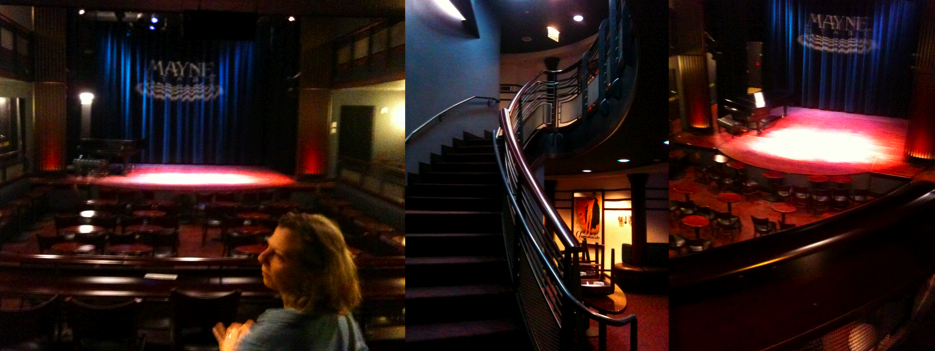
I wanted to check out the fabulous Mayne Stage in Rogers Park, where The Vic & Paul Show will run this December 20th through 30th. (Have you gotten your tickets yet?)

Bea Rashid joined us for our visit to the exquisite Mayne Stage cabaret in Rogers Park.

And I wanted to meet with Kevin Leonard and confirm that my boxes had arrived at the NU Archives.

The boxes had arrived. And here they are — in Kevin Leonard’s really cool office in the basement of Deering Library..

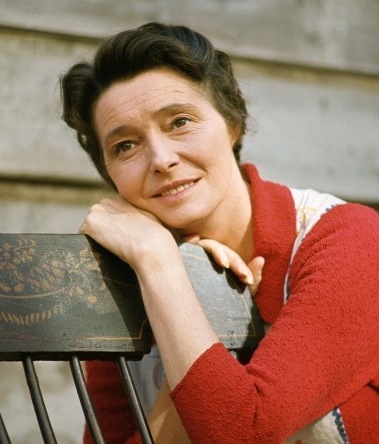
Now, the history that so many of us – NU alums and non-alums alike – made together in the 1980’s is now home alongside the papers of such notables at Patricia Neal, Frank Galati and Viola Spolin, the Queen Mother of improvisation.

BTW – Viola’s son, Paul Sills, founded the Story Theatre in the Piper’s Alley space behind Second City: the very same space that became the PTC’s Piper’s Alley Theatre – home of The Golden 50th Anniversary Jubilee, Megafun, and Babalooney. (There are a lot of cool connections to be made at the NU Archives.)

Soon, the list of everything that’s available for study in the PTC archives will be accessible online through a searchable database.

I encourage you to drop by Old Deering Library and pay a visit to the Northwestern Archives. Check out the Special Collections — and get your hands on the history of The Practical Theatre Company. Especially those of you who helped to make that history.

Kevin Leonard might have some really cool things to show you.

16 Comments

Filed under Art, History

You CAN Go Home Again.

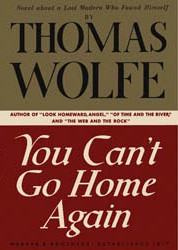
In his 1940 novel, You Can’t Go Home Again, Thomas Wolfe’s protagonist, George Webber, is an author who writes a book about his hometown – and winds up pissing off his old hometown peeps to the point where he gets death threats. In the novel, Webber comes to the realization that, “You can’t go back home to your family, back home to your childhood … back home to a young man’s dreams of glory and of fame … back home to the old forms and systems of things which once seemed everlasting but which are changing all the time — back home to the escapes of Time and Memory.”

Over the years, the phrase “You can’t go home again” has entered the popular vernacular, representing the notion that once you move away from the place of your birth – especially to a bigger city — it’s impossible to return to your old stomping grounds and find satisfaction. Your fond, gauzy memories of the past will be disappointed by what you find upon your return.

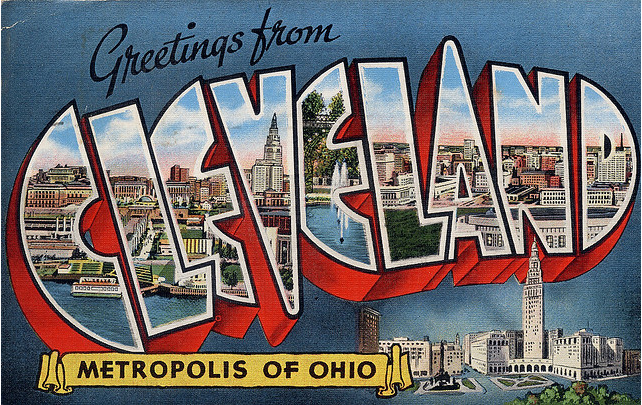
Well, if Thomas Wolfe had come along with me on my trip back to Cleveland, Ohio this summer, he might have re-written his famous novel. You can go home again. At least you can go home to Cleveland.

I had two good reasons to return to Cleveland this past August. First, it was time to spend some quality time with my mother and sister – who still live in the same West Side neighborhood that I grew up in. Second, my high school, Cleveland Central Catholic, was hosting an alumni event, culminating in a football game on our brand new football field. (We never had our own home field when I toiled on the gridiron for CCC.) It was a happy confluence of events: a chance to see old friends and family.

The first impression I got as I drove my rental car into my old neighborhood on Cleveland’s West Side was that the ‘hood had seen better days.

In my youth “Old Brooklyn” was always a working class neighborhood – but that was at a time in the early 60’s to mid 70’s when the working class was more upwardly mobile. The sons and daughters of increasingly unionized factory employees, union steel workers and public school teachers were going to college in record numbers. And I was one of them.

I’ll spare us all the rest of my socio-economic rant. Suffice to say that, like all the big, brawny Rust Belt manufacturing cities that flourished for a hundred years on the Great Lakes, Cleveland has struggled economically in the post Free Trade economy.

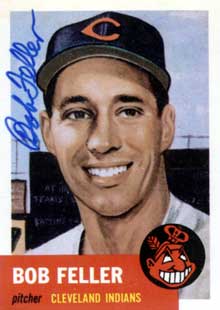
But while it may no longer claim to be “The Best Location in the Nation” – or the largest city in Ohio (the former state capitol backwater, Columbus, now holds that title) — my hometown is a proud old metropolis with strong cultural institutions, from the Cleveland Orchestra to The Cleveland Playhouse, The Cleveland Clinic and it’s beloved Browns and Indians, long-suffering sports franchises with storied histories of heartbreak and glory. It’s the city of Bob Feller and Jim Brown.

‘Nuff said.

The neighborhood I grew up in from first grade until I went away to college is on the West Side near the Cleveland Zoo. My mom’s house is just a block away from the intersection of Pearl Road and State, near the bus barns. (When I was a kid, on a hot day in late summer, the old streetcar tracks could still be seen peeking through the receding asphalt, fanning out from the bus barns.)

A while ago, folks in my old neighborhood were given the choice of keeping their red brick streets or having them paved with asphalt. My mom’s block voted to keep their bricks. It was good call. Cleveland winters are hell on blacktop. Plus, the brick street gives my mom’s block character. Those bricks were unforgiving when you wiped out on your bike or during games of street hockey and “kick the can” – but they sure look good. Still do.

I took a walk around the neighborhood, down my own Spokane Avenue and along my old paper route on adjacent Henritze Ave. (Oh yeah, remember when ambitious kids could earn some cash and gain experience as young entrepreneurs by delivering the daily newspapers? Don’t get me started.)

My solitary ramble through this familiar landscape was revelatory. All along my street, and on my old paper route, I saw tidy, well-maintained, middle class homes interspersed with properties that had clearly seen better days. Yet, throughout the neighborhood, I saw people painting their houses and working on their landscaping. I also saw something you don’t see much of in my suburban neighborhood in Woodland Hills, California: porch life. People sitting on their porches and front steps, chatting with neighbors and watching the world go by. And, in this case, one strange, expatriate wanderer.

But at the corner of Henritze and West 41st St., I came face to face with a clear and undeniable sign of my neighborhood’s decline: a grassy empty lot that was once Memphis Elementary School. In my day, Memphis School was a vital center of activity in the neighborhood. I never went to school there, but I swung on its swing sets, took advantage of its summer youth programs, and played “strikeouts” against boxes drawn on its walls. And yes, I also learned to avoid the unsavory elements of “The Memphis Gang”. Now, all those childhood memories have been reduced to a patch of lawn.

When we first moved to Spokane Avenue in the early 60’s, huge, majestic elm trees on each “tree lawn” dominated the far end of our block – their branches reaching across the street to embrace each other. Riding down the street to Scott Tyndall’s house was like entering the forest primeval. Our end of the block had no trees. I remember when the city planted a little maple tree sapling in front of our house.

By the time I began high school, the ravages of Dutch Elm Disease had claimed the big trees down the block – and today, more than three decades later, our little Maple trees now dominate Spokane Avenue. And the tree in front of my house is one of the biggest on the street.

Ah, my house. I love this house. My family moved here in 1964 (or was it ’65?). I thought we’d moved into a mansion. Built in 1910, as was much of the housing stock in the neighborhood, it’s a 3-story, 1,366 square foot modest Victorian masterpiece – and it served our family of five very, very well. My mom still lives in this house, and she’s done a great job of fixing it up. Adding a bathroom downstairs was brilliant! Renovating the bathroom upstairs was also a great idea.

And leaving my old second floor bedroom untouched is all right with me.

Seeing it now, it’s hard to imagine all the things we did in my backyard.

It looks so small now – but, back in the day, my pals and I found plenty of room to play football (complete with NFL Films-style dramatic self-narration), recreate scenes from “Combat” and “Lost in Space”, play games like “Red Rover” and “Kick the Can” – and compete in our version of “Home Run Derby.”

“Home Run Derby” was played with a Wiffle ball. Teams were usually 2 versus 2 — or 3 against 3. The batter stood at home plate facing the back of the house. The pitcher threw the plastic ball – and the batter did his best to loft it onto the second floor porch (a home run) – or onto the roof (also a home run). However, if the ball was hit onto the roof, the fielders had a chance to catch the ball as it rolled off the roof. If they did, the batter was out. Batted balls that hit the house below the second floor were singles. Balls that hit the second floor were doubles. Balls that smacked against the third floor were triples. In every case, if the fielders managed to catch the ball as it rebounded off the wall – the batter was out.

We played “Home Run Derby” for hours. We broke a lot of windows, too.

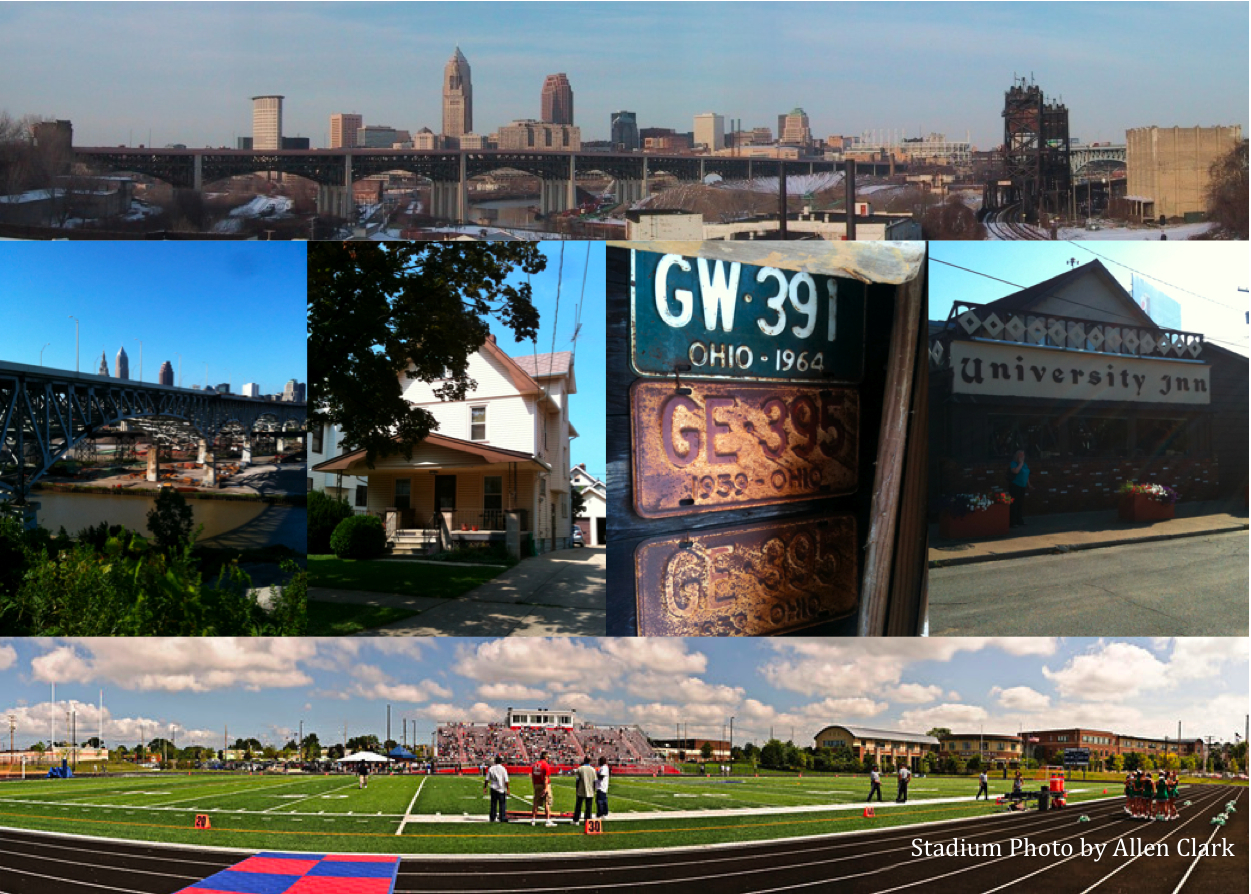
That evening, I drove my rental car north to meet some of my high school teachers and friends at Sokolowski’s University Inn, a Tremont area institution that sits on the western rim of The Flats – the industrial flatland through which the Cuyahoga River winds to Lake Erie.

Across The Flats, in downtown Cleveland, The Jake was hosting a Cleveland Indians game.

Now, I know that a big insurance company purchased the “naming rights” to Jacobs Field — but I’ll start calling that great ballpark “Progressive Field” about the same time I refer to Sears Tower in Chicago as “Willis Tower”.  Which is never.

And speaking of “You can’t go home again” – tell that to former Cleveland Indians star and future Hall of Famer Jim Thome, one of eight Major League ballplayers to hit more than 600 career home runs. On the same weekend that I was returning to my hometown, Jim Thome was at The Jake playing his first game in a Cleveland uniform since the dark day in 2002 when he accepted a six-year $85 million offer from the Philadelphia Phillies.

The CCC welcoming committee in front of Sokolowski's. (Photo by Allen Clark)

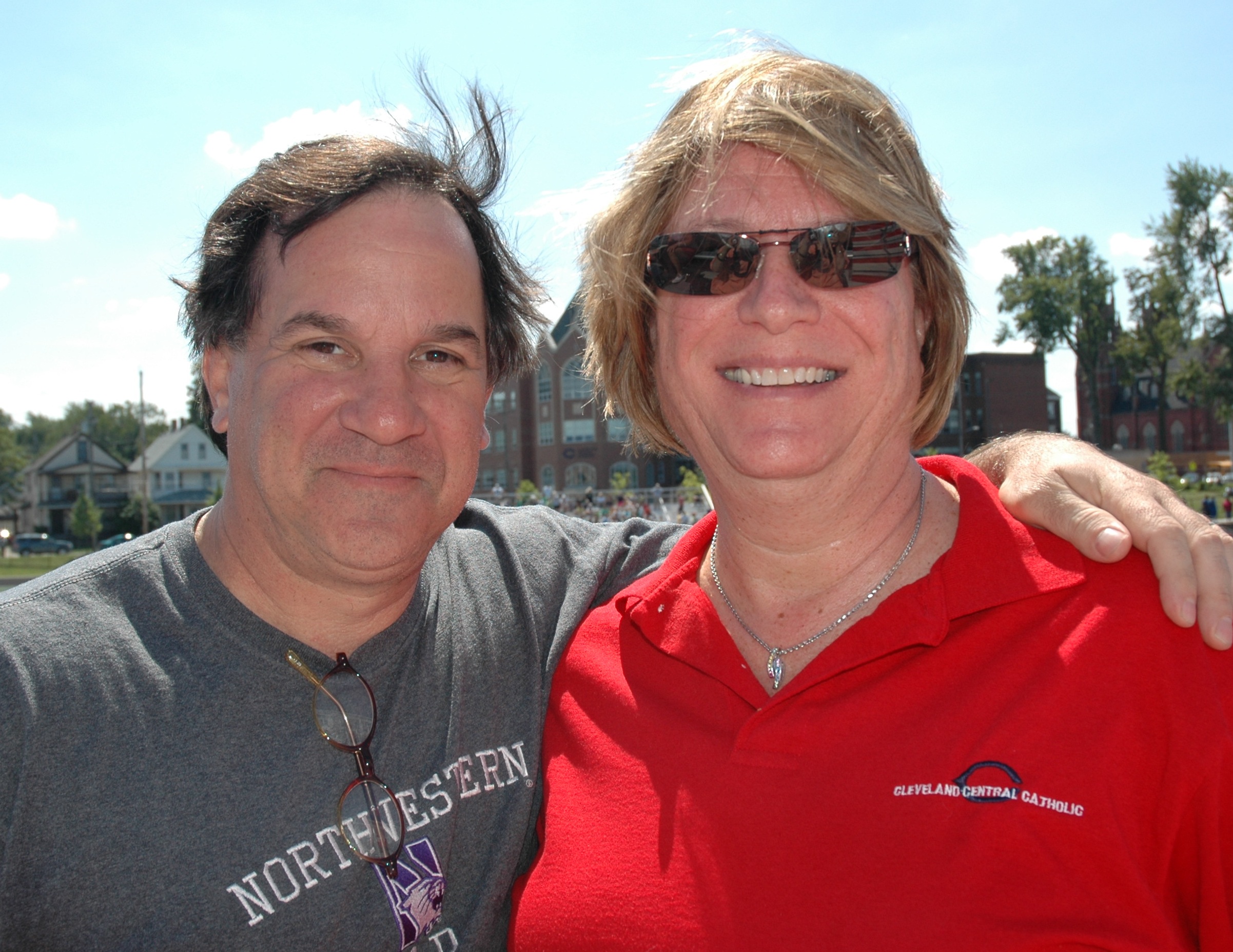
As Cleveland’s baseball fans warmly welcomed Thome back to town, so too did the Cleveland Central Catholic community gathered at Sokolowski’s welcome the prodigal son who left in 1976 to go to Chicago and attend Northwestern University.

Among the hometown heroes I reconnected with that night were my former Social Studies teacher, the ageless Elda Borroni, my former Art teacher and beloved mentor, Ellen Howard (Ellen Fasko in those days), and my classmate and quirky, creative buddy, Dancin’ Dave Wicinski.

Me and Dancin' Dave, one of my best CCC buddies & a classic character. (Photo by Ellen Howard)

With Elda Borroni, a teacher who challenged me politically and intellectually -- and still does. (Photo by Allen Clark)

With Ellen Howard: my Art teacher, Yearbook advisor, mentor and lifelong friend. If you only have a few teachers like Ellen in your high school years -- you're damn lucky. (Photo by Allen Clark)

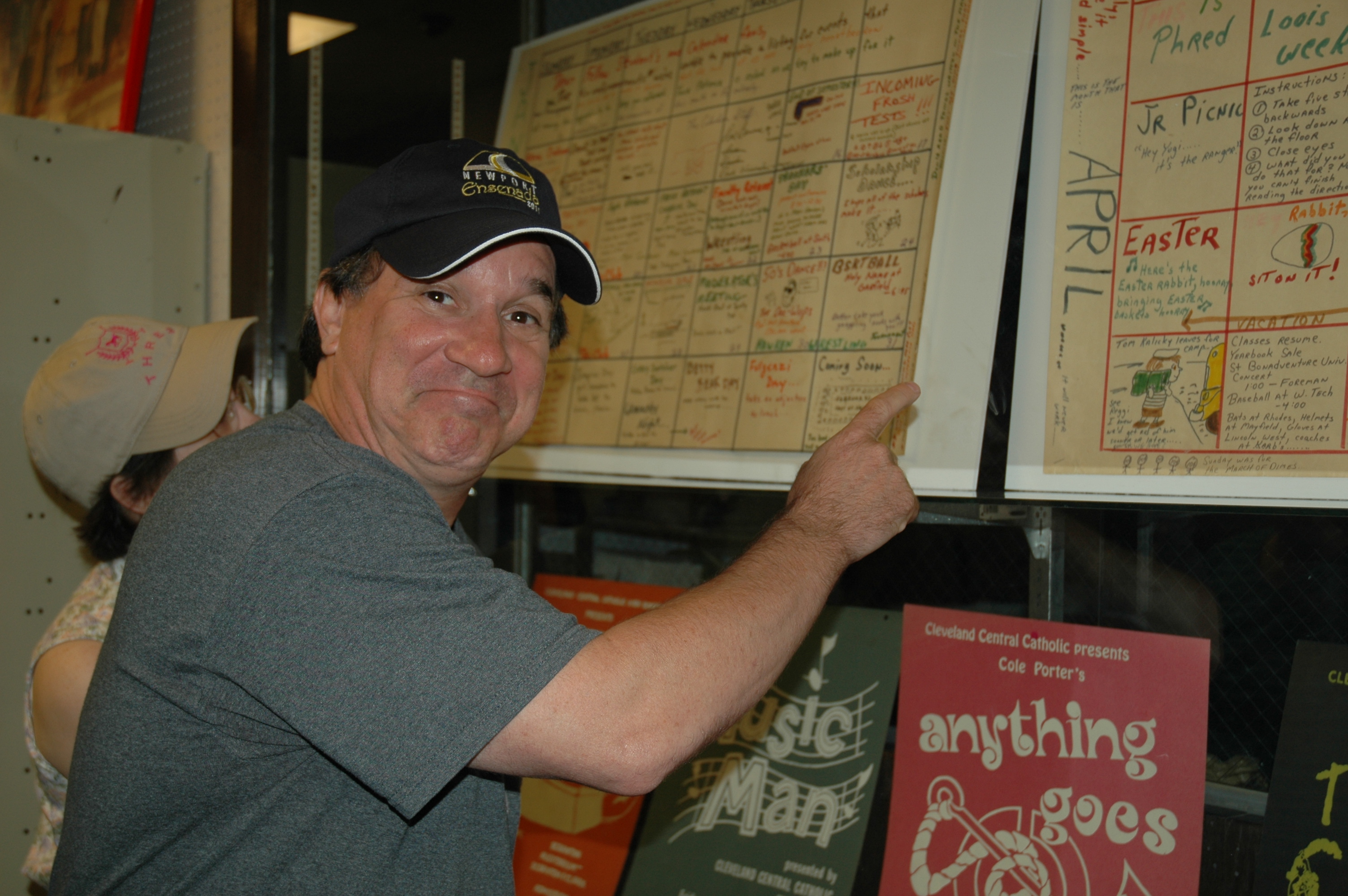
The next day, I brought my mother Mary and sister Nancy to the East Side campus of Cleveland Central Catholic for a back-to-school event for alumni – and a football game at my alma mater’s brand new football field. Before the game, we took a tour of the Forman campus (the former St. Stan’s High School) where I’d spent so much time during my high school years, especially at football practice and in the basement where the Art Department was housed.

I was thrilled to see some of the school calendars I helped create have been preserved and installed in the Art Department hallway. (Note the "Music Man" poster. I was Prof. Harold Hill in that production.)

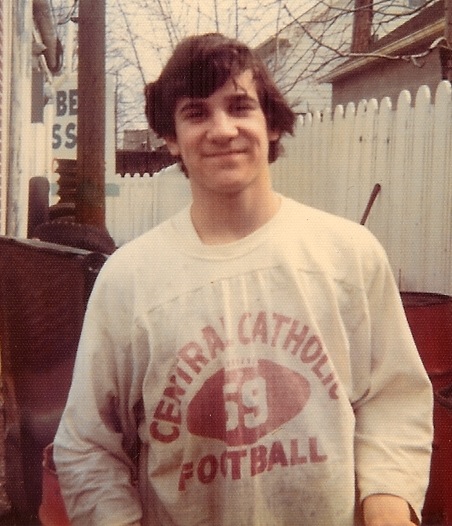
I played football at CCC for four years as an enthusiastic but seriously undersized defensive back and running back. By senior year I was a starting cornerback – and the smallest player on the field in every game I played. And in all those years, we never had our own football field. Our varsity home games were played at Garfield High.

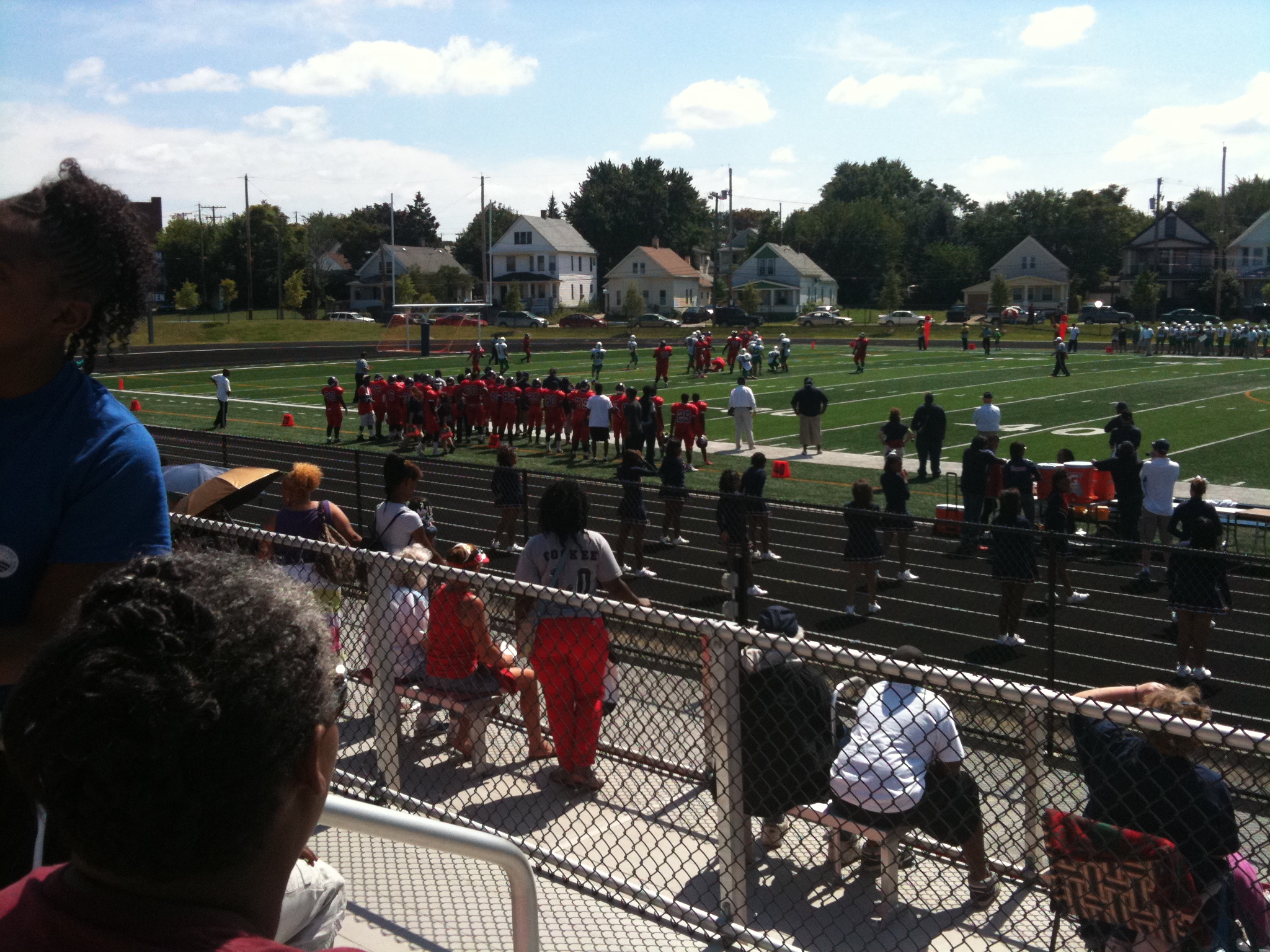
Now, thanks to the generosity and community-minded spirit of the Stefanski family and other CCC alumni donors, we have a splendid new stadium that has helped to rejuvenate a downtrodden, once-proud neighborhood. It’s truly amazing. It’s clear to see that Friday Night lights will be a big deal at CCC.

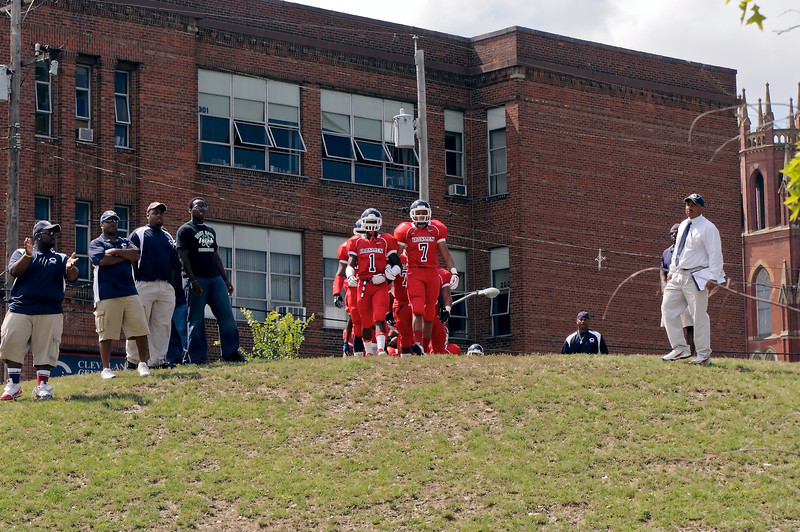
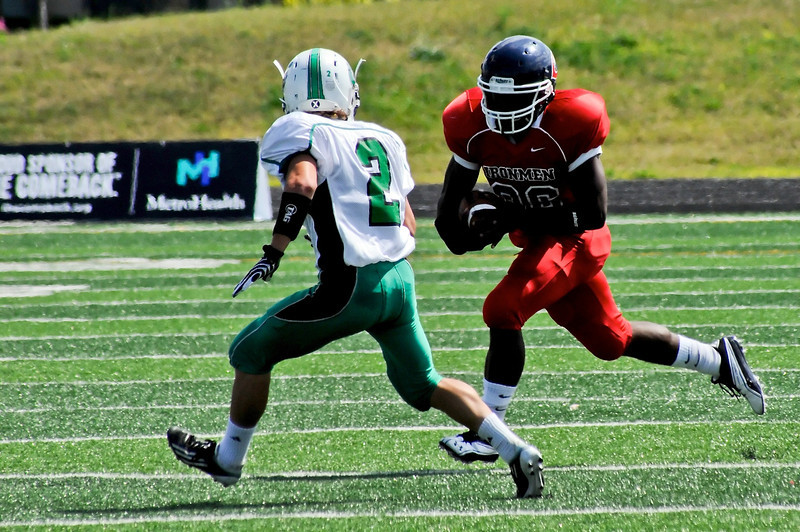
Check out the following game photos by Central Catholic’s talented official photographer, Allen Clark.

The Cleveland Central Catholic Ironmen won the game, too!

The new football field has truly transformed the whole neighborhood. (Photo by Allen Clark)

Over the course of the weekend I got to reconnect with my wrestling coach and all-time inspirational hero, Joel Solomon, his younger brother (and my football and wrestling teammate) John Solomon — and Martha Benek, the girl who played Marian the Librarian opposite my fast-talking charlatan, Harold Hill in “The Music Man”. Amazingly enough, Martha is now the librarian at CCC! (I have not, however, been selling marching band instruments from town to town.)

Harold Hill (Paul) and Marian the Librarian (Martha). She's really a librarian!

On Sunday, I drove out to Twinsburg, Ohio to spend a delightful afternoon with my former Scranton campus principal, George Costa — and his wonderful and witty wife, my high-spirited high school theatre director, Mary Ann Zampino.

George was the coolest principal you can possibly imagine – and “Zamp” cast me as Marryin’ Sam in “Li’l Abner” and honored me with the title role in “The Music Man”.  She was also the person with whom I performed in my first comedy revue.

How can you ever say “thank you” to such people? The only way is to see them more often — and share more than just memories.

It was an awesome three days in August spent with wonderful people in the Best Location in the Nation.

You can go home again.

And you should.

11 Comments

Filed under Beauty, History

Daring to Say the F Word…

President Obama & Vice President Biden share a moment of relief after the Debt Ceiling was lifted.

Now that the debt ceiling fight is over, the newspaper scribes in the Washington press corps and the pundits on television (“the dunderpates”, as my wife calls them) prattle on about the winners and losers in this sorry showdown.

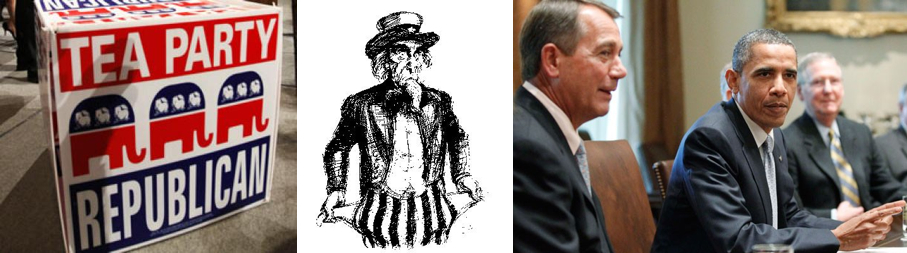
President Obama is the loser because he caved to the Tea Party minority. Obama’s the winner because he showed Americans that the GOP is ruled by its radical Tea Party minority. Senate Minority Leader Mitch McConnell is the winner because he sidestepped Senate Majority Leader Harry Reid in the final negotiations with The White House. Speaker John Boehner is the loser because he couldn’t control his caucus in the House. Etc. Etc. Etc.

Lost in all this claptrap is the biggest loser: the American people. It’s a sad commentary on our news media that the reporters and talking heads who dominate the public discourse are so insulated from normal working lives, so infatuated with politics-as-sport, that they cannot see outside their own sandbox.

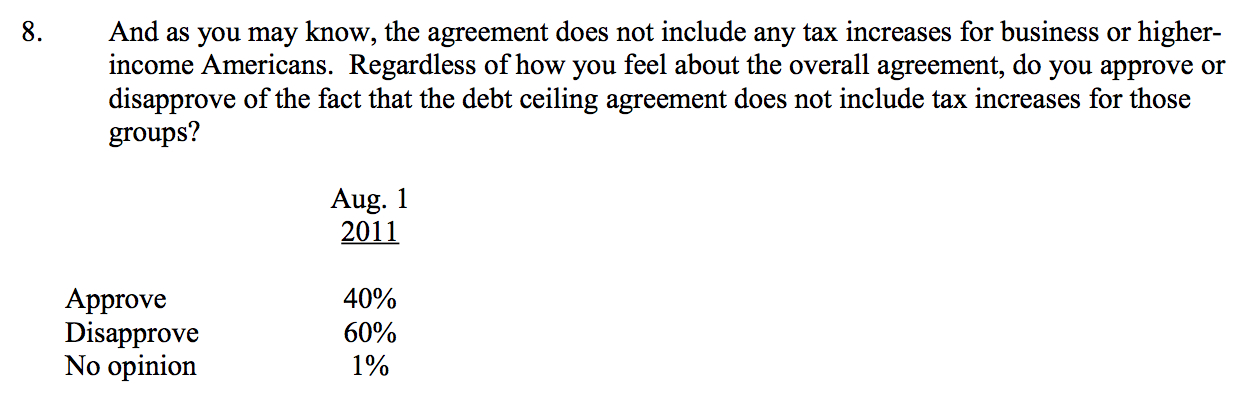
However, if the media ever managed to crane their craven heads above the Beltway, they might be forced to tell a story too complicated and nuanced for front-page headlines and television sound bites. The American people, it appears, can actually sort through GOP bullshit – even if smug, self-satisfied hacks like David Gregory (Meet the Press) and paid flacks like Chris Wallace (Fox News Sunday) can’t or won’t. According to the latest CNN poll, a large plurality of the American electorate were not swayed by the GOP-Tea Party’s no-taxes, cuts-only Siren song.

Yet, somehow, despite the fact that 60% of Americans agree with President Obama about his oft-stated “balanced approach” to deficit reduction, the bullhorns in the mainstream media keep blaring the Big Story of Tea Party success. (We’ll keep FOX out of the discussion. It’s not a news organization: it’s a propaganda arm of the GOP.)

GOP Congressman Walsh was a big cheerleader for default. Turns out, he had already defaulted on his own kids.

The more nuanced story is that, while the Tea Party fanatics may have won a political victory by moving the debt ceiling deal far off to the right – it looks like they’ve lost the larger battle for American hearts and minds. And that could cost them dearly in the 2012 elections. Not to mention the wrench these Tea Party bomb-throwers and their enablers in the Republican Congressional leadership just threw into the works of the GOP’s normally cozy relationship with Wall Street and the Chamber of Commerce. Something tells me you won’t see too many Tea Partiers backed by the Chamber in 2012.

Looking ahead to 2012, the Conventional Wisdom is that President Obama has been grievously wounded in the debt ceiling fight. And it’s clear that he took a hit to his approval rating and his reputation for political cool. Yet, according to the latest CNN poll, the American people have judged that Obama came out of the debt ceiling debacle well ahead of Congress – and far ahead of GOP Congressional leaders. In fact, nearly 70% of those polled disapprove of how GOP leaders behaved during the rancorous debt ceiling negotiations — a scathing indictment of Sen. McConnell, whom the Beltway intelligentsia has declared the winner in this fight.

Now, if you (like me) are a regular reader of left wing-Democratic-progressive websites like Daily Kos, Talking Points Memo and The Huffington Post (which isn’t all that progressive anymore) – you’d think that every Liberal is frustrated and angry — and that all Democrats are up in arms, feeling betrayed by Obama’s capitulation to Tea Party brinkmanship. Calls for a Democratic primary challenge to the President have gone out – and a general alarum has been sounded. However, the latest Gallup poll provides a very different perspective on how left-of-center folks feel about the debt ceiling agreement.

Shocking, huh? A plurality of Democrats and Liberals approve of the debt ceiling agreement — and Republicans and Conservatives (those the mainstream media claim were the victors in this battle royal) don’t like the deal at all.

Of course, this poll reflects something most of us already know: liberals and Democrats have a more positive and realistic attitude toward American government. (At least we don’t hate it.) But these poll results also signal peril for the Tea Baggers. Usually, when political leaders make a big deal their constituents don’t like, it’s a bad sign for them in the next election cycle.

We don’t hear much in the media about how this debt ceiling debacle has damaged the right-wingers. The Beltway Wise Men say it’s all doom and gloom for Obama and the Democrats. But at least at this moment, the American people aren’t buying that bullshit narrative.

Now, please forgive me. I’m going to use the F-word.

I suggest that there’s a larger political narrative in America that we (and the national media) should be focused on right now — something that David Gregory and Chris Wallace wouldn’t touch with a 10-foot pole. I know it’s not nice to use the F-word in polite political discourse — but since Ronald Reagan’s Presidency, The United States has been creeping towards fascism. The post-9-11 environment and the cynical exploitation of misguided Tea Party populism has accelerated our fascist drift.

I know that intelligent, dignified and reasonable people shouldn’t throw the term “fascist” around lightly — and the “fascist” label has been seriously misused, mischaracterized and misunderstood.

After all, the Tea Party-GOP crowd has alternately lambasted President Obama as both a left-wing Socialist and a right-wing Fascist: mutually exclusive condemnations.

But, I ask you to consider the definition of “fascism” found in The Concise Encyclopedia of Economics, and written by Sheldon Richman.

“As an economic system, fascism is socialism with a capitalist veneer.

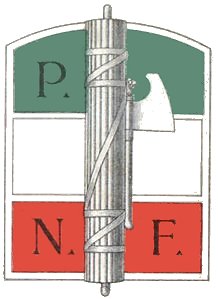
The word derives from fasces, the Roman symbol of collectivism and power: a tied bundle of rods with a protruding ax. In its day (the 1920s and 1930s), fascism was seen as the happy medium between boom-and-bust-prone liberal capitalism, with its alleged class conflict, wasteful competition, and profit-oriented egoism, and revolutionary Marxism, with its violent and socially divisive persecution of the bourgeoisie.”

“Under fascism, the state, through official cartels, controlled all aspects of manufacturing, commerce, finance, and agriculture…The consequent burdening of manufacturers gave advantages to foreign firms wishing to export.”

“Fascism embodied corporatism, in which political representation was based on trade and industry rather than on geography…Corporatism was intended to avert unsettling divisions within the nation, such as lockouts and union strikes. The price of such forced “harmony” was the loss of the ability to bargain and move about freely.”

Here’s a simpler definition…

Fascism: “The merging of state and corporate interests.”

Modern American Fascism is more subtle than the Mussolini version in the mid 20th Century. Corporate interests exert their control over the U.S. government in less overt ways than they did in Italy in the 30’s and 40’s. In today’s American strain of fascism, it’s not the U.S. Government that’s in charge. Instead, through campaign donations, lobbying and revolving door cronyism, Corporate Oligarchs exert their control over a Government that increasingly serves corporate interests.

The problem is bad and getting worse. Since the Scalia-Roberts-Thomas-Alito axis on the U.S. Supreme Court established corporate personhood and opened the sluice gates for billions of corrupting corporate dollars to flow anonymously into our electoral system, the slide toward oligarchy by U.S. CEOs and their Congressional minions has advanced with scant resistance by what passes for an American left. (Though we saw vigorous resistance to the fascist agenda in Wisconsin earlier this year.)

And what of this union-bashing, union-busting agenda that a cabal of GOP governors are pushing? What about all these bipartisan “Free Trade” deals that have benefitted the bottom lines of multi-national corporations while hollowing out our U.S. manufacturing base and driving our wages lower? This agenda is clearly not in the best interest of the American People, so who does it serve? Corporate fat cats. That’s who.

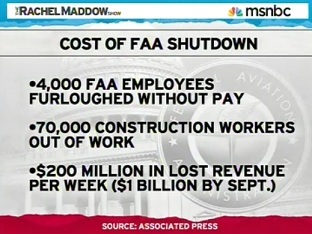
Just this week, the paychecks of thousands of airline employees, FAA employees, and construction workers on airport improvement projects were held hostage when the GOP-led House, at the behest of Delta Airlines, tried to attach an anti-union provision in the bill authorizing funding for the FAA. Delta wants to bust their employees’ labor unions and Delta’s toadies in the GOP House stood ready to do their bidding — even at the risk of thousands of American jobs in an already-bad economy: not to mention threatening the safety of the traveling public. Again. Who are John Boehner and Eric Cantor serving with this dangerous game of political chicken? Corporate Big Money. That’s who.

Maybe it’s time to call these guys what their actions reveal them to be: American Fascists.

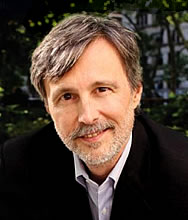
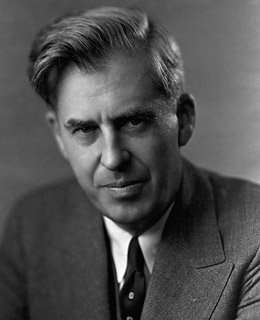
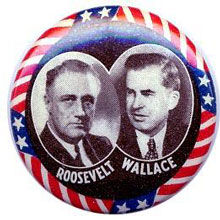
Author and radio host Thom Hartmann has been concerned about creeping American Fascism for quite a while. In his article, The Ghost of Vice President Wallace Warns: “It Can Happen Here”, Hartmann writes about the warnings of Vice President Henry Wallace, who served with President Franklin Delano Roosevelt in the early years of World War Two.

Here are some enlightening passages from Hartmann’s article. I urge you to read the whole thing:

In early 1944, the New York Times asked Vice President Henry Wallace to, as Wallace noted, “write a piece answering the following questions: What is a fascist? How many fascists have we? How dangerous are they?” 

Vice President Wallace’s answer to those questions was published in The New York Times on April 9, 1944, at the height of the war against the Axis powers of Germany and Japan. 

”The really dangerous American fascists,” Wallace wrote, “are not those who are hooked up directly or indirectly with the Axis. The FBI has its finger on those. The dangerous American fascist is the man who wants to do in the United States in an American way what Hitler did in Germany in a Prussian way. The American fascist would prefer not to use violence. His method is to poison the channels of public information. With a fascist the problem is never how best to present the truth to the public but how best to use the news to deceive the public into giving the fascist and his group more money or more power.”

In this, Wallace was using the classic definition of the word “fascist” – the definition Mussolini had in mind when he claimed to have invented the word. (It was actually Italian philosopher Giovanni Gentile who wrote the entry in the Encyclopedia Italiana that said: “Fascism should more appropriately be called corporatism because it is a merger of state and corporate power.” Mussolini, however, affixed his name to the entry, and claimed credit for it.) 

As the 1983 American Heritage Dictionary noted, fascism is: “A system of government that exercises a dictatorship of the extreme right, typically through the merging of state and business leadership, together with belligerent nationalism.” 

Mussolini was quite straightforward about all this.

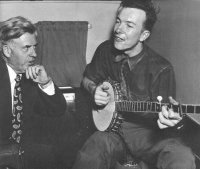
V.P. Wallace and the great Pete Seeger.

“If we define an American fascist as one who in case of conflict puts money and power ahead of human beings,” Vice President Wallace wrote in his 1944 Times article, “then there are undoubtedly several million fascists in the United States. There are probably several hundred thousand if we narrow the definition to include only those who in their search for money and power are ruthless and deceitful. … They are patriotic in time of war because it is to their interest to be so, but in time of peace they follow power and the dollar wherever they may lead.”

“American fascism will not be really dangerous,” Wallace added in the next paragraph, “until there is a purposeful coalition among the cartelists, the deliberate poisoners of public information…”

“Still another danger,” Wallace continued, “is represented by those who, paying lip service to democracy and the common welfare, in their insatiable greed for money and the power which money gives, do not hesitate surreptitiously to evade the laws designed to safeguard the public from monopolistic extortion.”

As Wallace wrote, some in big business “are willing to jeopardize the structure of American liberty to gain some temporary advantage.” He added, “Monopolists who fear competition and who distrust democracy because it stands for equal opportunity would like to secure their position against small and energetic enterprise [companies]. In an effort to eliminate the possibility of any rival growing up, some monopolists would sacrifice democracy itself.”

Wallace continued: 

”The symptoms of fascist thinking are colored by environment and adapted to immediate circumstances. But always and everywhere they can be identified by their appeal to prejudice and by the desire to play upon the fears and vanities of different groups in order to gain power. It is no coincidence that the growth of modern tyrants has in every case been heralded by the growth of prejudice.”

“The American fascists are most easily recognized by their deliberate perversion of truth and fact,” Wallace wrote. “Their newspapers and propaganda carefully cultivate every fissure of disunity, every crack in the common front against fascism. They use every opportunity to impugn democracy.”

In his strongest indictment of the tide of fascism the Vice President of the United States saw rising in America, he added, “They claim to be super-patriots, but they would destroy every liberty guaranteed by the Constitution. They demand free enterprise, but are the spokesmen for monopoly and vested interest. Their final objective toward which all their deceit is directed is to capture political power so that, using the power of the state and the power of the market simultaneously, they may keep the common man in eternal subjection.”

For another view of Vice President Wallace, you can check out this link and draw your own conclusion.

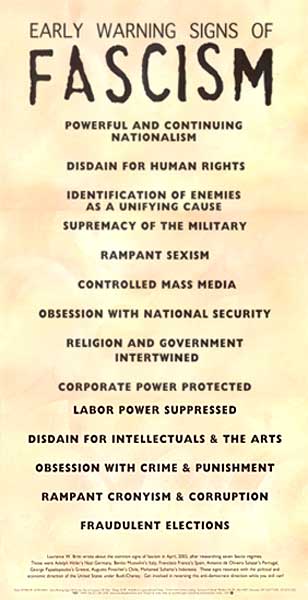
When you pause to consider it, the Fascist agenda that Wallace warned about — as championed by most of the Republican Party (and too many conservative Blue Dog Democrats) — is making frightening progress. Let’s evaluate where we stand today against these clear warning signs…

Heck, this looks like the Unofficial Republican Party platform!

Are the Tea Party extremists fascists? Are today’s Congressional Republicans fascists? Are “Free Trade”-supporting Democrats fascists? Is President Obama a fascist? Do you think I’m completely off-the-wall for even raising the possibility of American Fascism? Can it really happen here? You decide. But, before you dismiss this article as the ravings of a Liberal loon – please do some research. You might be surprised by what you’ll learn.

We don't want these guys to get reinforcements, do we?

One thing to consider: the President elected in 2012 will probably have the opportunity to appoint two justices to the U.S. Supreme Court — and it’s likely they’re be replacing old liberals who have stood as a bulwark against the Fascist Faction on the court. Whatever else you want to say about him, President Obama’s two picks (Sotomayor and Kagan) have been reliable votes in opposition to Scalia and his gang of black-robed corporate shills.

I hate to use the F word again — but if we don’t turn out the progressive vote for President Obama and the Democratic Party in 2012 — our democracy will be in F-ing trouble.

Pete Seeger's buddy Woody Guthrie knew who America's enemy was. (Check out the sticker on his guitar.)

12 Comments

Filed under History, Politics

The (New) American Crisis.

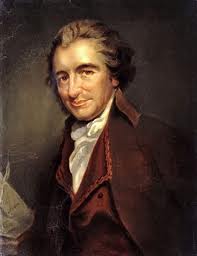
American patriot Thomas Paine served in George Washington’s army during the Revolutionary War as an aide-de-camp to General Nathanael Greene. In the desperate winter of ’76, the war was going badly — and Washington’s valiant, weary, and ill-equipped troops were in retreat.

The revolutionary cause was in dire jeopardy, when Paine took up his pen to rally his nascent nation’s flagging spirits.

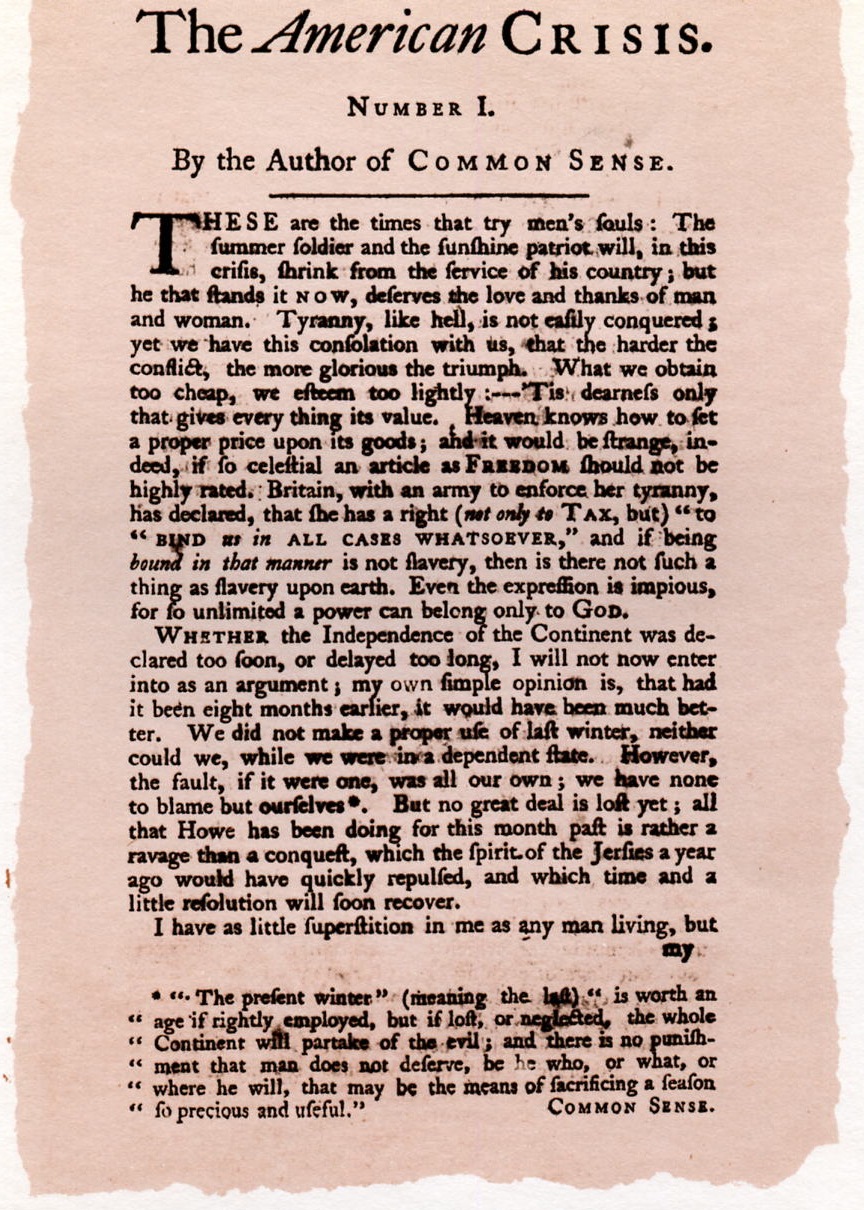
Realizing that “it was necessary that the country should be strongly animated,” Paine wrote a series of popular pamphlets collectively titled The American Crisis. The first of these broadsides was published on December 23, 1776 – and General Washington found it so inspiring that he had it read to his soldiers at Valley Forge.

Today, as we suffer through this trumped-up Debt Ceiling crisis, it is once again “necessary that the country should be strongly animated.”

Therefore, with apologies to Thomas Paine…

These are the times that try Progressive’s souls. Some summer Liberals and sunshine Democrats will, in this crisis, shrink from their core values; but he that stands by Social Security, Medicare and Medicaid now, deserves the love and thanks of every working man and woman in America.

The GOP-Tea Party, like hell, is not easily conquered; yet we have this consolation with us, that the harder the conflict, the more glorious the triumph. The Grand Debt Ceiling Bargain we obtain too cheap, we esteem too lightly: it is Tax Fairness – with increases on the Wealthy, Big Business and Wall Street only — that gives Shared Sacrifice any real meaning.

Heaven knows how to put a proper price upon The Common Good; and it would be strange indeed if so celestial an article as The Full Faith and Credit of The United States should not be highly rated by Standard & Poor’s. (Though such a Downgrade looks increasingly possible.)

The GOP, with Fox News to enforce its Bullshit, has declared that they have a right (not only NOT to TAX) but “to BIND all working people in ALL CASES WHATSOEVER” to economic slavery, for so unlimited an economic power can belong only to George Bush’s God of Prosperity, the Koch Brothers, Republicans, Millionaires and Billionaires.

We have none to blame but ourselves, but no great deal is lost yet. All that Boehner, McConnell and Cantor have been doing for these past few months is rather a Ravage than a Conquest. They have over-reached and will be quickly repulsed by the voters. By 2012, with a little resolution on the part of working class Americans – resulting in a Democratic landslide — we will soon recover.

I have as little superstition in me as any man living, but my secret opinion has ever been, and still is, that God Almighty will not give up the American People to Economic Destruction by Tea Party Fools and GOP Corporatist Greed, or leave President Obama and the Democrats to perish who have so earnestly and so repeatedly sought to avoid the calamities of Default by every decent method which wisdom could invent.

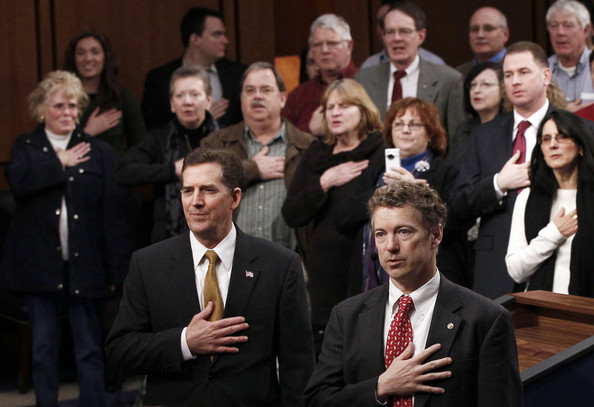
Neither have I so much of the infidel in me, as to suppose that The Almighty has relinquished the Government of The United States, and given us up to the madness of small-minded religious zealots like Michele Bachmann and Jim DeMint; and as I do not, I cannot see on what grounds McConnell, Boehner and Cantor can hold Americans over an economic barrel.

‘Tis surprising to see how rapidly a panic (like this artificial Debt Ceiling Crisis) will sometimes run through a country. Yet panics, in some cases, have their uses; they produce as much good as hurt. Their peculiar advantage is that they are the touchstones of sincerity (Democrats) and hypocrisy (Republicans), and bring things and men to light, which might otherwise have lain forever undiscovered. They sift out the hidden thoughts of Conservatives, and hold them up in public to the world.

I shall not now attempt to give all the particulars of our negotiations with the GOP; suffice it for the present to say, that the Democratic Party and President Obama, though greatly harassed and fatigued, bore these Debt Limit negotiations with a manly and bipartisan spirit. All their wishes centered in one, which was, that the country would turn out and help them to drive the Republicans out come the Election of 2012.

I have been tender in raising the cry against the Tea Party radicals, and have used numberless arguments to show their danger, but it will not do to sacrifice our country either to their folly or their baseness. The Time of Decision is now arrived, in which either Tea Party Republicans or Democrats must change our sentiments, or one or both must fall.

And what is a Tea Party Republican? Good God! What is he? I should not be afraid to stand with a hundred brave, steadfast Democratic Union Men against a thousand Tea Partiers. Every GOP-Tea Party member is a dupe or a coward; for servile, slavish, and corporate-interested fear is the foundation of Tea Partyism; and a man under such misguided influence, though he may be selfish and confused, can never be brave.

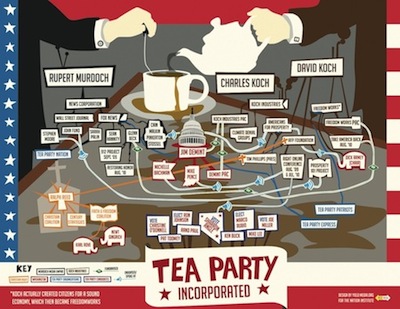
But, before the line of irrecoverable separation be drawn between American Liberals and Conservatives, let us reason the matter together: FOX News is as much rejected by reality as the American cause is injured by FOX News. Rupert “Phone Hacker” Murdoch and his Corporate Paymasters expect you to take up arms and flock to their standard. Your opinions are of no use to The Right, unless you support them without thinking, for ’tis Zombies, and not Thinking Men, that they want.

I once felt that kind of anger, which a man ought to feel, against the mean principles that are held by the Republicans. “If there must be trouble, let it be in my day, that my child may have prosperity.” But today, let every Progressive American awaken to his duty. For though the flame of liberty may sometimes cease to flare, the embers can never expire.

I call not upon a few, but upon all Progressives: not on this Blue State or that Purple State, but on every state: up and help us; lay your shoulders to the wheel; better have too much force than too little, when so great an object is at stake. Let it be told to the future world, that in the heat of the summer of 2011, when nothing but hope and virtue could survive, that the city and the country, alarmed at one common danger, came forth to meet and to repulse it.

If President Obama and the Congress cannot avoid the ignominy of National Default, it matters not where you live, or what rank of life you hold, the evil will reach you all. The far and the near, the rich and the poor, will suffer or rejoice alike.

The blood of Democratic children will curse their cowardice, who shrinks back at a time when a little might have saved the whole, and made them happy. I love the Liberal that can smile in trouble, that can gather strength from distress, and grow brave by reflection. ‘Tis the business of little GOP minds to shrink; but the Progressive whose heart is firm, and whose conscience approves his conduct, will pursue his principles unto Election Day.

Let them call me Liberal and welcome, I feel no concern from it; but I should suffer the misery of devils, were I to make a whore of my soul by swearing allegiance to GOP politicians who are stupid, stubborn, worthless and brutish — and fleeing with tax-cutting, budget-slashing terror from the orphan, the widow, and the unemployed of America.

There are cases that cannot be overdone by language, and there are persons who see not the full extent of the evil that threatens them. It is the madness of folly to expect statesmanship from Republicans who have refused to do political and social justice. The GOP’s first object is, partly by threats and partly by false promises, to fleece the American people before agreeing to pay their lawful debts.

I see no real cause for fear. I know our situation well, and can see the way out of it. The sign of fear has not been seen in our Liberal Camp. Our new Progressive Democratic Army is recruiting fast, and we shall be able to open the 2012 Campaign with tens of millions of voters, well educated and mobilized.

By perseverance and fortitude we have the prospect of a glorious issue; by cowardice and submission, the sad choice of a variety of evils — a ravaged country — crumbling cities — infrastructure without repair, and a shrinking Middle Class without hope — our homes turned into foreclosures, and our children to provide for, whose American Dream will be less than our own. Look on this picture and weep over it! And if there yet remains one thoughtless FOX viewer who believes it not, let him suffer the consequences unlamented.

Awake, Senate Democrats! Arise, President Obama! The GOP is mercifully inviting you to barbarous destruction (in a bipartisan fashion, of course), and men must be either rogues or fools that will not see it. I dwell not upon the vapors of imagination; I bring reason to your ears, and, in language as plain as A, B, C, hold up truth to your eyes.

Let the Bush Tax Cuts expire! Cut the Pentagon’s bloated budget! Let Medicare negotiate deals with the Drug Companies! Collect a fair share of taxes from Corporations and Wall Street Financiers that have reaped such an ungodly percentage of our National Treasure! Leave Social Security and our National Health alone! Do these things, and the blessings of Prosperity will be upon our Nation once again.

8 Comments

Filed under History, Politics

Growing Up in the Space Age

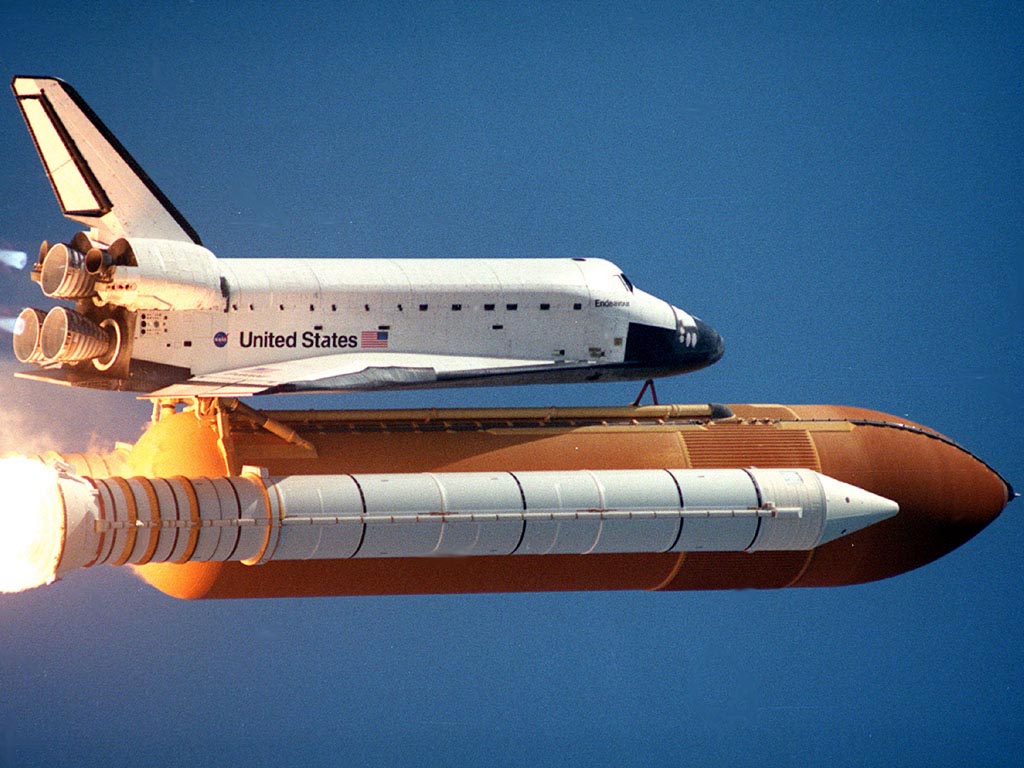
The Space Shuttle Atlantis took off from the Kennedy Space Center on Friday morning, July 8, 2011 – and as I write this, it’s still out there, flying through space on NASA’s final shuttle flight. The last voyage of Atlantis marks the end of three decades of the U.S. Space Shuttle program – and 54 years since the dawn of the Space Age.

At 53 years of age, I am a true child of the Space Age.

So, why didn’t I feel a greater tug at my heart when I witnessed this last Space Shuttle launch? For the first time in my lifetime, there will be no manned space program – and few people seem to care. New York Yankee captain Derek Jeter’s 3,000th hit (a home run, no less) and the World Cup dramatics of the U.S. Women’s Soccer team have gotten more airplay and headlines than the end of a momentous era in American history.

Why hasn’t NASA’s Space Shuttle program captured the American imagination the way the Mercury, Gemini and Apollo programs did? Maybe it’s because we stopped our manned explorations at the Moon – and didn’t put our footprints on another planet. Maybe it’s because we don’t really understand what the International Space Station is all about. Maybe it’s because we got bored with 130 Space Shuttle flights. Or it might be because the amazing Hubble Space Telescope has shown us that the universe is so vast that man has no hope of conquering it.

As seen by The Hubble Space Telescope: Those aren't stars, folks. They're galaxies.

All I know is that there was a time when American astronauts getting launched into space was the coolest thing ever. Long before we ever heard of “The Right Stuff”, guys like John Glenn, Ed White, and Jim Lovell were even bigger stars than Major League baseball players.

From take-off to splashdown, the manned space flights of my boyhood were always the biggest events of the year.

We were on our way to the Moon. And it was glorious.

My wife Victoria was seven months old when the Space Age began on October 4, 1957 with the Soviet Union’s launch of its Sputnik 1 satellite. The Russians beating us into space freaked Americans out so much that we actually invested heavily in education – especially in science and math – for fear of falling behind. (Fortunately, Eisenhower’s Republican Party was in the White House, not John Boehner’s cynical GOP.)

Just four months after Sputnik, the U.S. put its first satellite, Explorer 1, into space – and the Space Race between America and the Soviet Union was underway.

Explorer 1 was launched on January 31, 1958 and two and a half months later, I was born. That same April week, the Russians sent a dog into space.
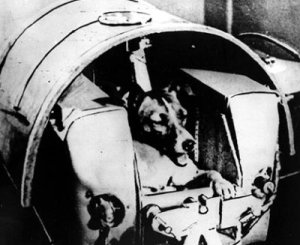
Laika, a 3-year old Siberian Husky — nicknamed “Muttnik” by the American press — was rocketed into orbit atop a modified intercontinental ballistic missile. It’s clear that PETA was not operating in the Soviet Union at the time, because Muttnik’s capsule was not designed for recovery. Laika had already passed away in space by the time her capsule burned up on re-entry into the Earth’s atmosphere.

The Russian and American space programs were racing to be the first to put a man in space. But first, lower primates were used as guinea pigs. I was eight months old and still in diapers when the first space monkey was shot into the heavens. On December 13, 1958 the U.S. Army launched a squirrel monkey named Gordo on a suborbital flight. Gordo went up and down safely — but he died during recovery due to equipment failure.

A year later, on December 4, 1959, a rhesus monkey named Sam rode a Mercury capsule 55 miles into space. Unlike the unlucky Gordo, Sam was recovered alive in the Atlantic Ocean.

The next month, Miss Sam took her turn in space, successfully testing the Mercury capsule’s escape system on a 58-minute test flight.

Go, Space Monkeys, go!

I was approaching my 3rd birthday by the time the U.S. Space Program worked its way up the Evolutionary ladder to a chimpanzee named Ham. The 4-year old chimp blasted off from Cape Canaveral, Florida, on January 31, 1961. Ham’s job was to show that live animals aboard a spacecraft could carry out their jobs during launch, weightlessness and re-entry. Ham passed the test with flying colors, survived the mission, and retired to the National Zoological Park in Washington, D.C.
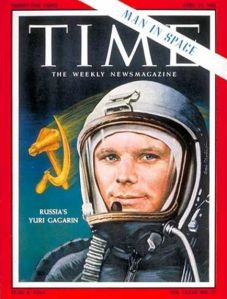
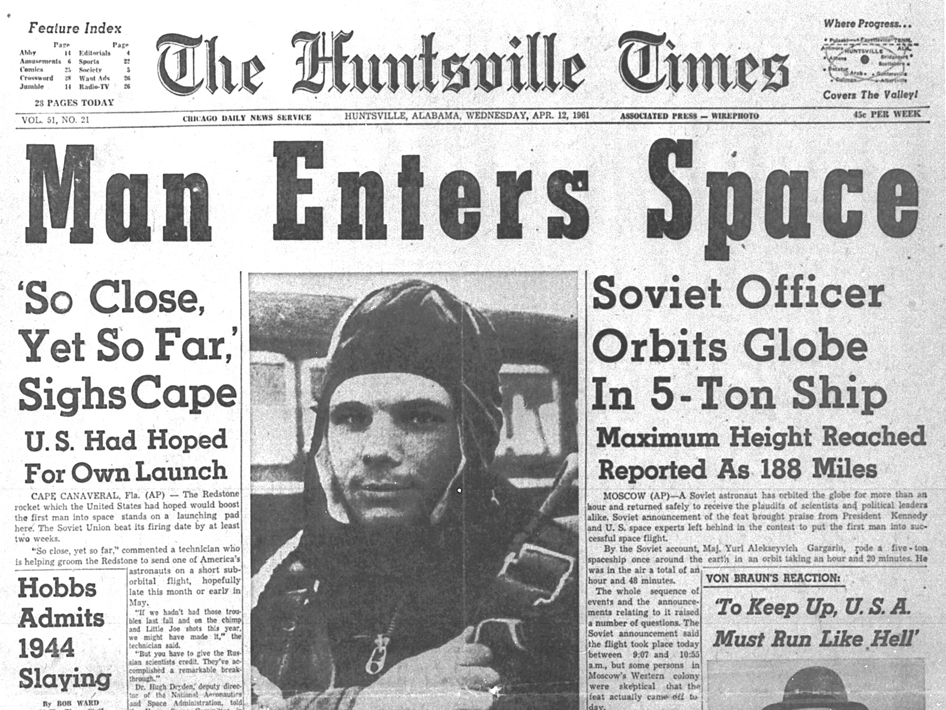
A little more than two months after we put a chimp in space – the Russians launched a human being.

Four days before my third birthday, on April 12 1961, cosmonaut (“sailor of the universe”) Yuri Gagarin orbited the Earth aboard his spacecraft Vostok 1.

The Soviet Union had won the race to put a man in space — but The United States of America wasn’t far behind.

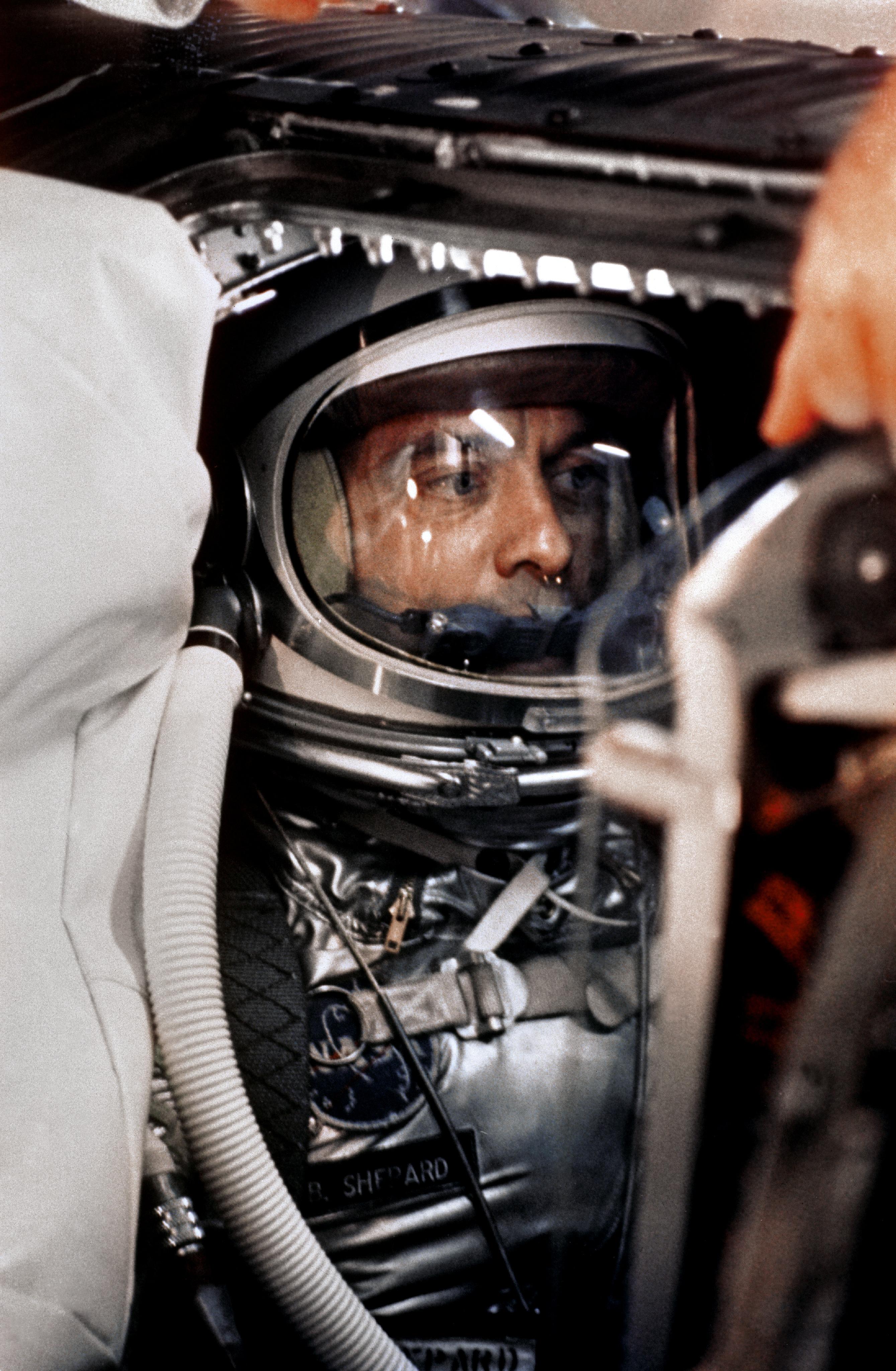
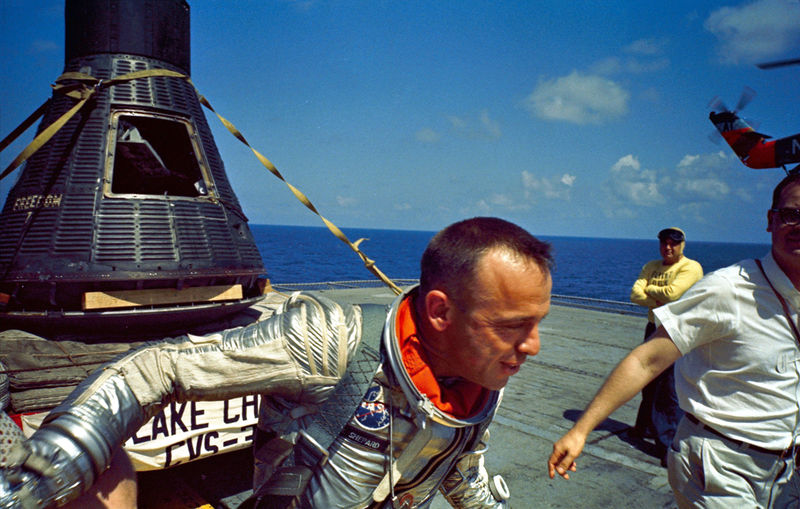
Three weeks after Gagarin’s flight, on May 5 1961, astronaut (“sailor of the stars”) Alan Shepard made a suborbital spaceflight in the Mercury capsule Freedom 7. The first American in space was a Big Deal.

Three weeks after Shepard’s voyage, President John F. Kennedy redefined the ultimate goal of the Space Race, declaring, “I believe that this nation should commit itself to achieving the goal, before this decade is out, of landing a man on the moon and returning him safely to the earth.”
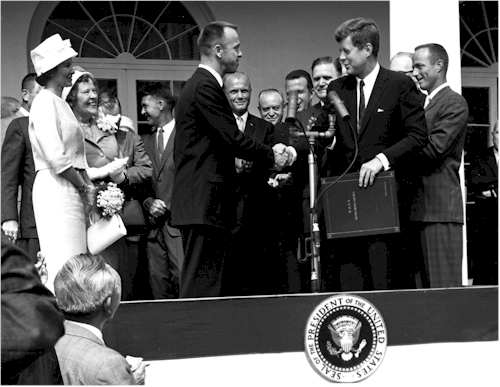
President Kennedy congratulates astronaut Alan Shepard, the First American in Space.

That was some pretty exciting stuff. That was Big Thinking. Kennedy’s ambitious and optimistic vision would ultimately light the way to an era of American dominance in science, math, and computer technology as we raced the Soviets to the Moon. (Tea Party nihilists? Are you listening?)
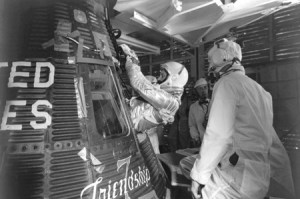
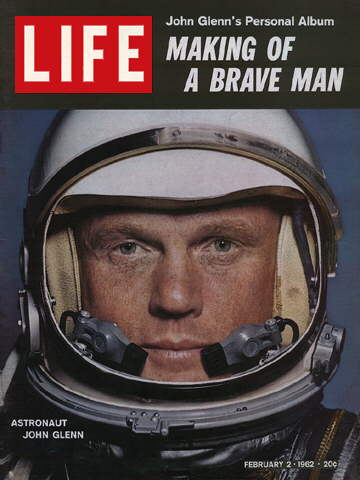
Almost a year after the Soviets put a human into orbit, astronaut John Glenn became the first American to orbit the Earth on February 20, 1962. Glenn’s achievement was the first I actually remember being aware of as a child, though I was not yet four years old.

A pilot in the Marines, John Glenn was from my home state of Ohio (and would later become a long-serving Senator) – and my fellow Clevelanders were all abuzz with the thrill of our favorite son’s achievement.

A little more than 7 years later, the entire world would be transfixed by the words and actions of another astronaut from Ohio.

The same year that Glenn orbited the Earth, the U.S. introduced Project Gemini to the world.

Gemini was a two-man spacecraft designed so that American astronauts and NASA technicians could develop and practice all the technologies, maneuvers and skills needed to get to the Moon, including the docking of two spacecraft and voyages that were long enough to simulate flying to the Moon and back. Later in ’62, President Kennedy Speech made a speech at Rice University in Houston, summing up the rationale for putting a man on the Moon.

“We choose to go to the Moon in this decade and do the other things, not because they are easy, but because they are hard, because that goal will serve to organize and measure the best of our energies and skills, because that challenge is one that we are willing to accept, one we are unwilling to postpone, and one which we intend to win…”

As kids in the mid-1960’s, we could not get enough of the Gemini program.

Each new launch, each new astronaut and each new spaceflight broke new ground.

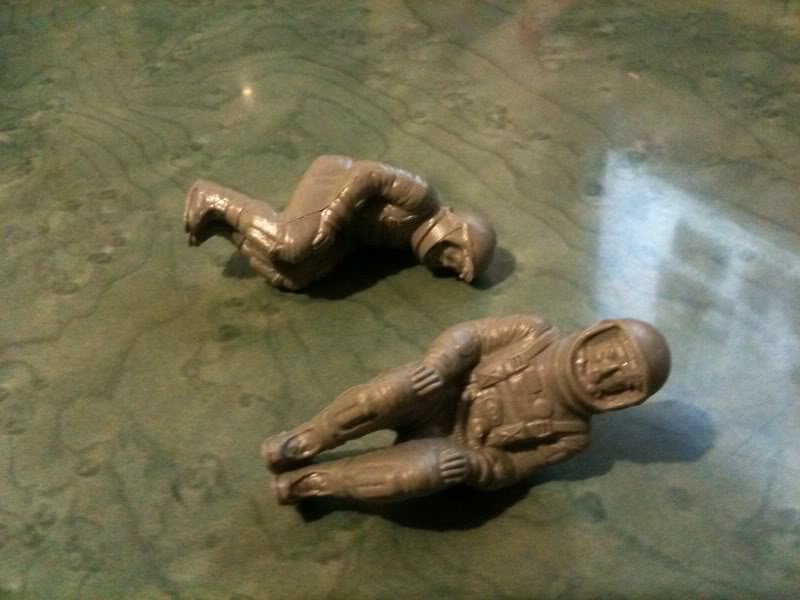
Each daring Gemini mission gave us another marvelous achievement, a new source of profound and positive wonder, two new spaceman heroes — and, of course, a cool new plastic model kit to buy and build.

With two tiny astronauts to glue into their seats in that 2-man Gemini capsule.

In March of ’65, astronauts Virgil “Gus” Grissom and John W. Young aboard Gemini 3 became the first to change their spacecraft’s orbit.

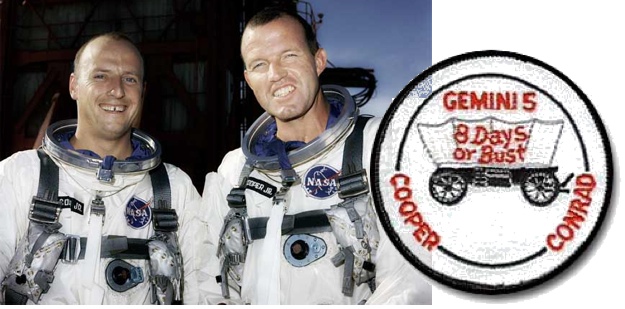
In August of ’65, the crew of Gemini 5, Gordon Cooper and Charles “Pete” Conrad, spent 8 days flying in space, long enough for a lunar mission.
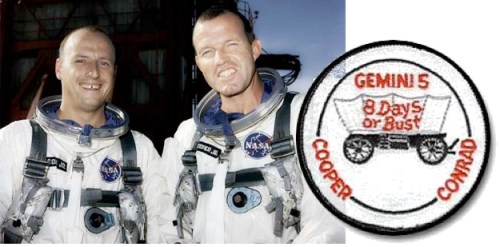
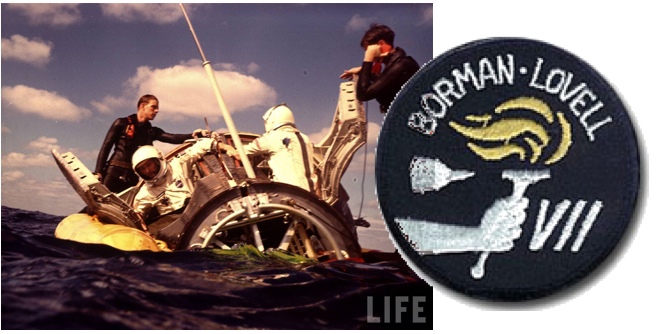
By December of that same year, Frank Borman and James A. Lovell had extended that record to 14 days aboard Gemini 7.

Grissom, Cooper, Conrad, Borman and Lovell became household names — and Americans swelled with pride as each Gemini mission brought new accomplishments, and took us another tangible step closer to our national goal of beating the Soviets to the Moon.
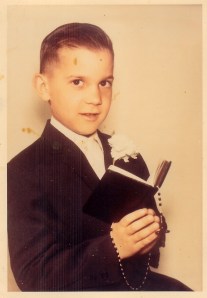
In 1966, I was a second grader making my First Holy Communion at St. Rocco’s Church — and Gemini was in its last year, with five missions to close out the program.

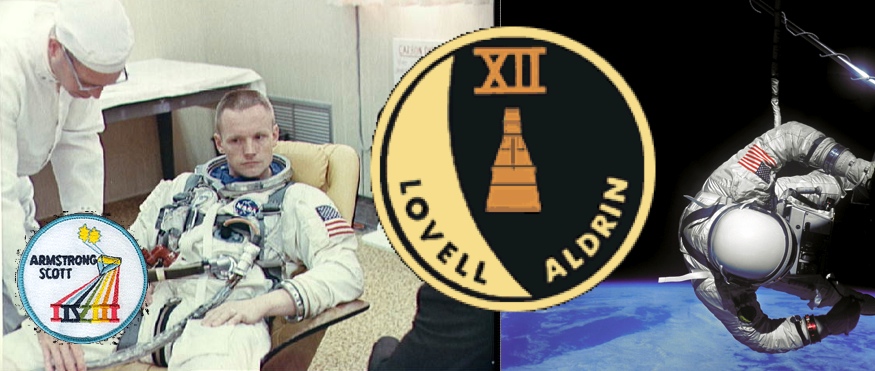
Two Gemini astronauts who made spaceflights that year — Neil Armstrong (Gemini 8) and Edwin E. “Buzz” Aldrin (Gemini 12) — would play even larger roles in the next phase of NASA’s drive to make good on JFK’s lofty lunar pledge: the Apollo Program.

Neil Armstrong prepares for his Gemini 8 flight & Buzz Aldrin's Gemini 12 spacewalk.

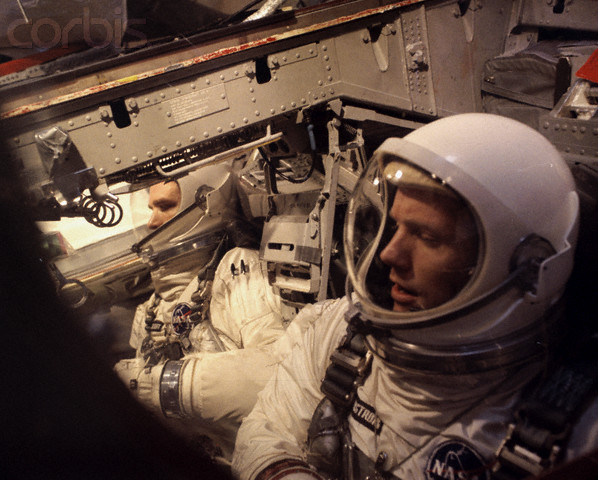
Astronauts David Scott and Neil Armstrong during tests prior to their Gemini 8 space flight.

To us kids, Apollo was even cooler than Gemini because the space capsule was bigger – and there were now three astronauts to glue onto their seats in our models. But our excitement would come a bit later.

Because the first news we kids heard about the Apollo program was not good. In fact, it was the first bad news we’d ever heard out of NASA since the race to the Moon began.

And it was reallybad news.
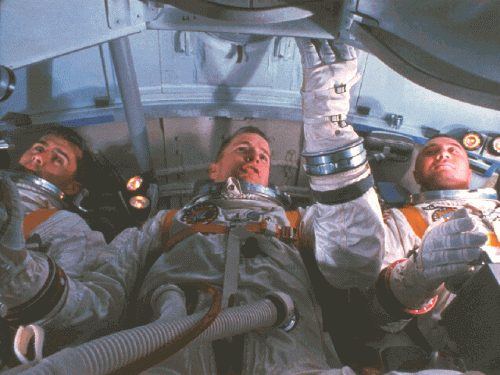
The doomed Apollo 1 astronauts testing equipment in their capsule. Gus Grissom is at right.

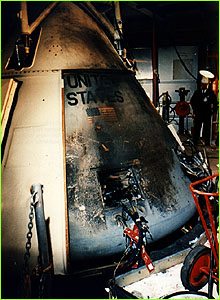
I was almost 9-years old on January 27, 1967 when the first Apollo crew died in a fire that swept through their capsule during a dress rehearsal for their upcoming mission. The loss of three American astronauts was shocking. We kids had heard that lots of Russian cosmonauts had been killed over the years – their deaths whitewashed by the censored Soviet press — but “Gus” Grissom, Ed White and Roger Chaffee were the first casualties in the omnipotent U.S. Space program that we knew about.

Seeing the grim pictures of the charred Apollo 1 capsule in the newspapers that I delivered changed the way I (and all my buddies) viewed the space program. We were reminded that spaceflight was a dangerous, deadly business — and that no team, not even NASA, wins every time.

It was a lesson we would re-learn two decades later.

Following a series of unmanned Apollo launches that tested every aspect of the program’s equipment and technology, Apollo 7 was the first manned Apollo mission after the tragedy that claimed the lives of Grissom, Chaffee and White.

From October 11 to 22, 1968, Apollo 7 astronauts Wallly Schirra, Donn F. Eisele, and Walt Cunningham orbited the Earth for 11-days — testing Apollo’s life-support, propulsion, and control systems.

After the Apollo 1 tragedy, Apollo 7’s technical success gave NASA the confidence it needed to send Apollo 8 around the Moon two months later.
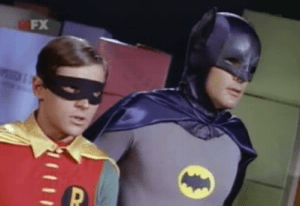
1968 was an exciting year to be a fourth grader. The assassinations of Martin Luther King and Bobby Kennedy shook my liberal parents to the core (I can still recall my confused father waking me to announce that “Rosey Greer just killed Robert Kennedy”) — but Detroit Tigers pitcher Denny McClain won 31 games during the “Year of the Pitcher” and Batman was in its final season on TV. Plus — America finally got within reach of the Moon.
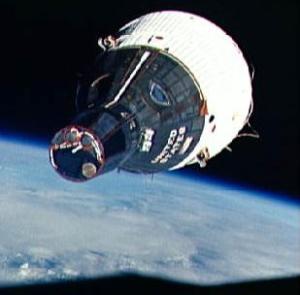
Apollo 8 took off on 21 December 1968, and became the first manned spacecraft to orbit another heavenly body when crew members Frank Borman, Jim Lovell and Bill Anders flew around the Moon ten times. I’ll never forget that epochal Christmas Eve broadcast, beamed from Apollo 8 in lunar orbit, in which the crew read passages from the King James Bible’s Book of Genesis. It was the first time we ever saw an Earthrise – and it was one of the most-watched television broadcasts worldwide.
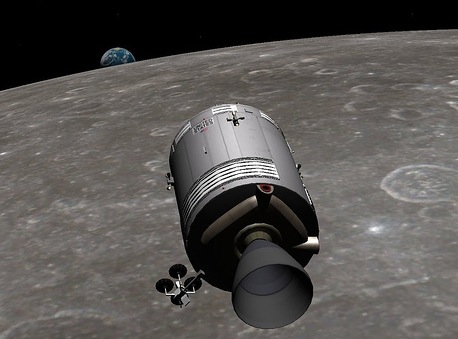
But, half a year later, even more people around the globe would be glued to the progress – and triumph — of another Apollo mission.

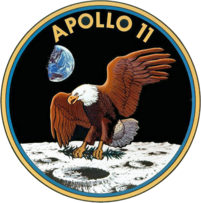
In the days leading up to the Apollo 11 mission to the Moon, you could get a cardboard model of the Apollo capsule and the Lunar Module at Union 76 gas stations. Of course, I got mine.

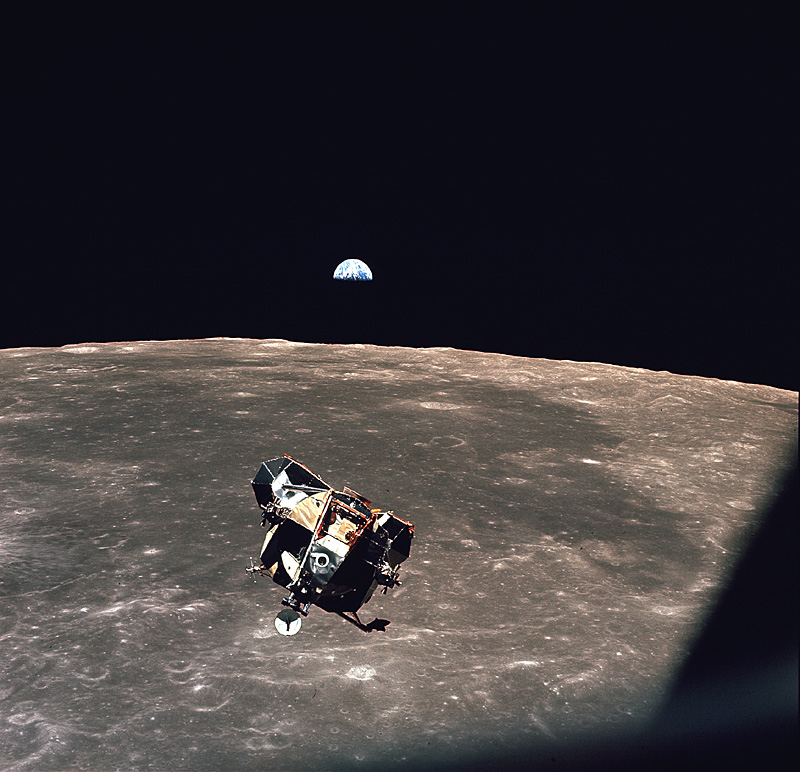
The Revell model kit was even cooler because it also included the Lunar Lander: the strange, spider-legged craft that two of the Apollo 11 astronauts would ride down to the lunar surface and park in an area called the Sea of Tranquility.

For an 11-year old 5th grader, this was the Greatest Adventure You Could Possibly Imagine. And what made it even greater is that the mission’s commander was a fellow Ohioan, Neil Armstrong – and Armstrong was tapped to be the first man to set foot on the Moon!

Armstrong would be joined on the Moon by Buzz Aldrin – and Apollo 11’s third crew member, Michael Collins, would cruise around the Moon in the command module like a cosmic getaway driver waiting to pick the Moonwalkers up, their pockets stuffed with Moon rocks after the Big Lunar Heist.
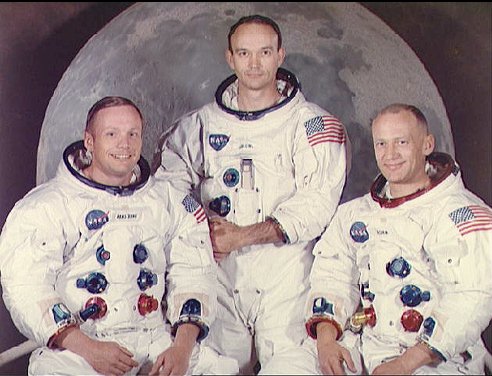
Armstrong, Collins & Aldrin: The Apollo 11 Crew.

The lunar lander, Eagle, is landing...

It was the greatest TV show ever – and my Uncle Archie and his family came to our house on Cleveland’s west side to watch the Big Event on July 20, 1969.

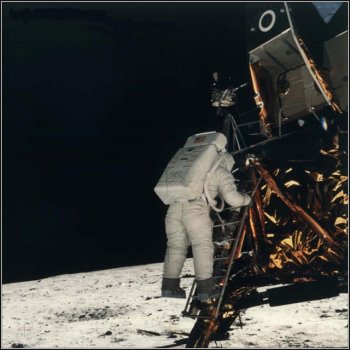
At least 500 million television viewers around the world watched as citizen-astronaut Neil Armstrong became the first human to step onto the Moon.

And, while I hate to call out a fellow Ohioan, Armstrong clearly flubbed his big, history-making line!

Armstrong meant to say, “That’s one small step for a man, one giant leap for mankind.” But our hero didn’t say “one small step for a man” as he put his historic footprint on the Moon — he just said, “one small step for man”.

Pedants would say that rendered Armstrong’s great quote redundant – but at the time, nobody cared.

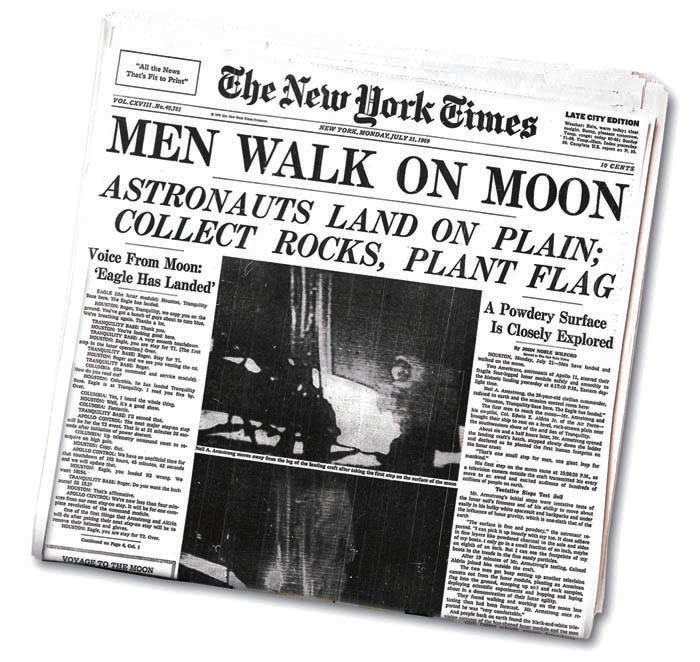
I still remember the pride I felt delivering The Cleveland Plain Dealer on my paper route early the next morning – trumpeting one of those very rare headlines that took up the entire front page.

(The New York Post does it everyday — but Rupert Murdoch doesn’t run any real newspapers.)
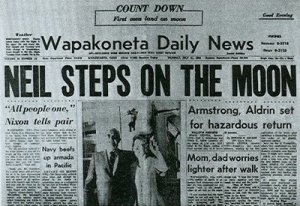
Downstate, in Neil Armstrong’s hometown of Wapakoneta, Ohio, my fellow paperboys were delivering the same triumphant news.

Apollo 11 made good on President Kennedy’s pledge to put a man on the moon within the decade.

Americans had won the race to the Moon.

We didn’t know it yet – but Apollo 11 was the high water mark of the U.S. space program.
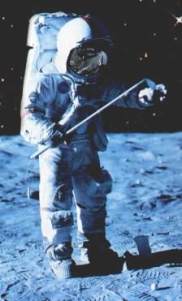
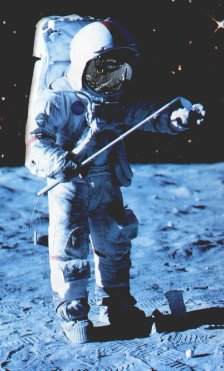
Later Apollo missions also had their highlights. In February 1971, Apollo 14 Commander, Alan Shepard (the first American in space) became the fifth man to walk on the Moon – and the first to play golf on the lunar surface.

Shepard took out a modified 6-iron and after a few Moon Mulligans, he hit one good shot.

Now that astronauts were playing golf on the moon, I guess we needed a golf cart up there, too.

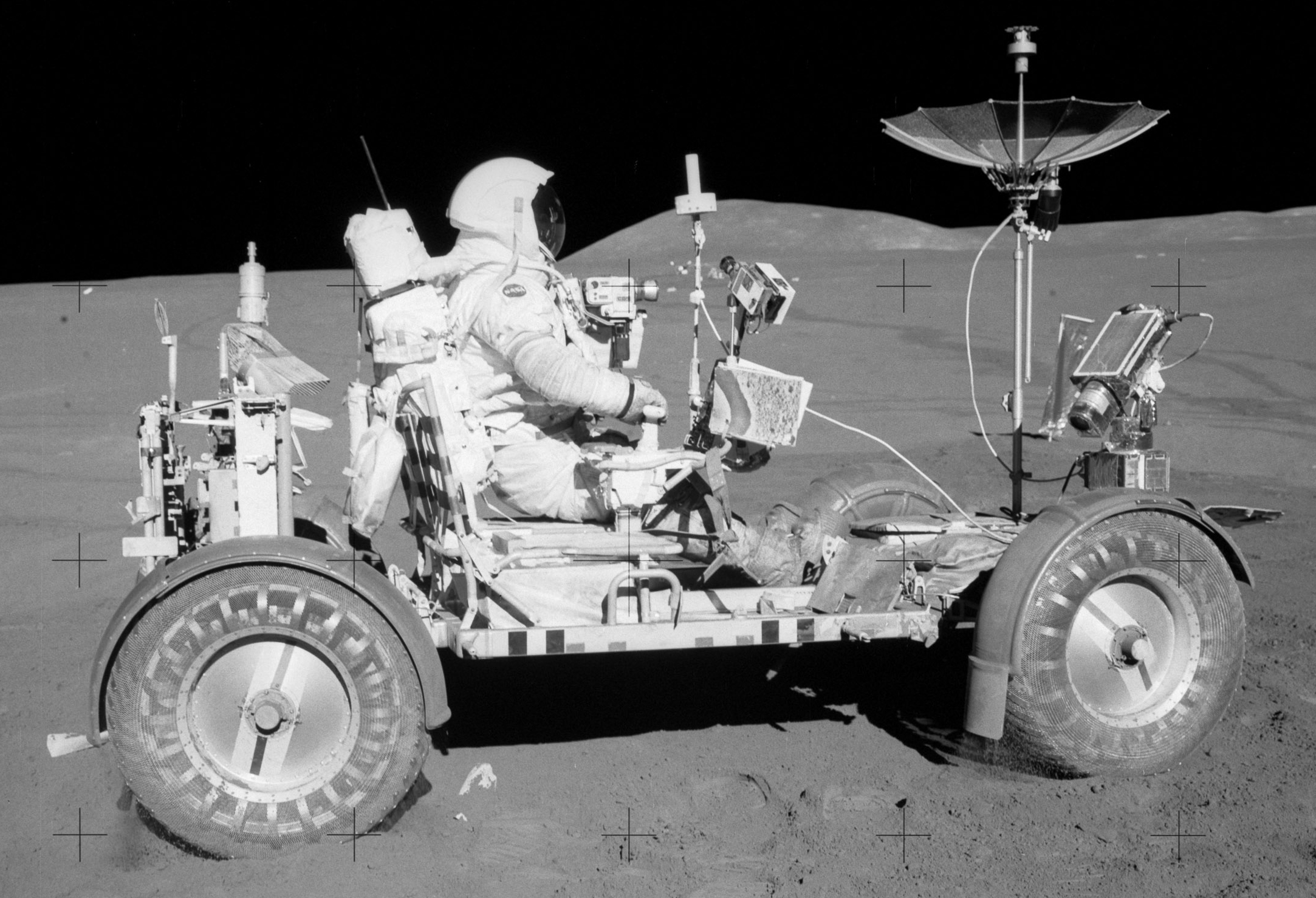
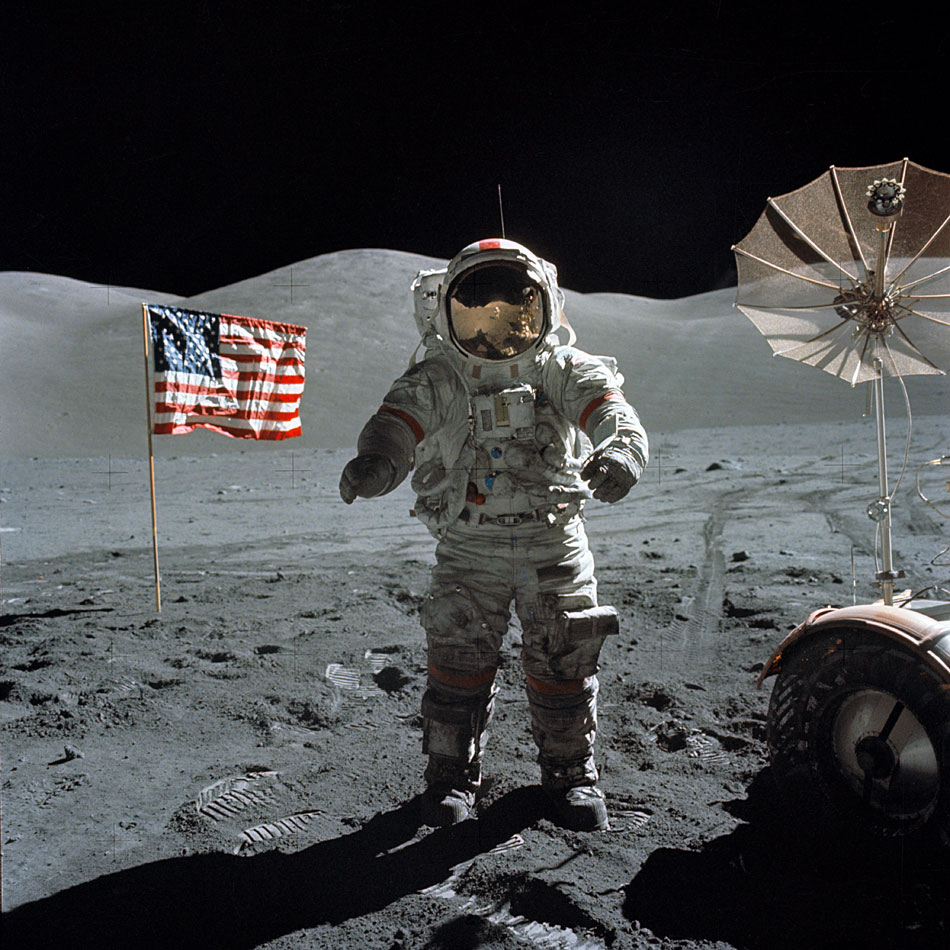
In July of ’71, Apollo 15 became the fourth mission to put men on the Moon – and the first to break out the lunar rover! To kids like me, it looked like the ultimate dune buggy. Astronauts David Scott and James Irwin tooled around in the rover, traveling 17 miles across the lunar landscape. The lunar rover was another Space Age innovation – and another cool model to build.

The end of the Apollo Program meant no more moonwalks, moon rocks, lunar rovers…

And a lot less public passion for NASA — and our national space exploration program.

I graduated from St. Rocco’s grade school in 1972 – and I was a freshman at Cleveland Central Catholic High School when Apollo 17 made the sixth and final lunar landing in December of that year.
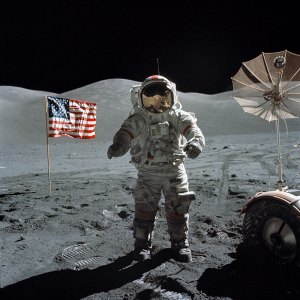
There would be four long years of high school and four years at Northwestern University before Americans finally got back into space.
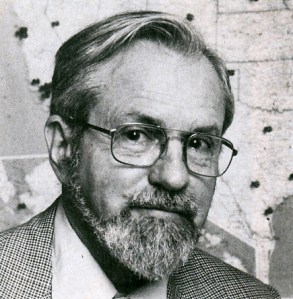
During my college years, I might not have thought about space travel at all if it weren’t for Professor J. Allen Hynek’s Astronomy course. Hynek had a passion for space exploration and believed it was foolish to assume that humans were the only intelligent life in the universe. Founder of the Center for UFO Studies, it was Hynek who coined the term “close encounters of the third kind.” (He even got a cameo in the Steven Spielberg’s movie.)

Professor Hynek impressed me with the vastness of space – and while I nearly failed Astronomy, I somehow managed to talk my way into his Honors Astronomy class.

It was a small class of about twenty students, dominated by discussion and Hynek’s wonderful, enlightening stories. My final grade rested on the strength of my final presentation – and I chose my subject wisely: the Space Race.
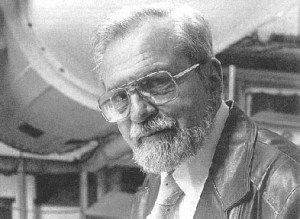
Professor Hynek had worked with the Air Force and NASA since the days of project Blue Book. He knew nearly every NASA administrator and astronaut personally – and he took my final presentation as a series of cues to launch into anecdotes about his personal experiences during those thrilling years when Americans strove to conquer the Moon – and succeeded. Basically, I co-hosted my presentation with Dr. Hynek. And I got an A in the class.
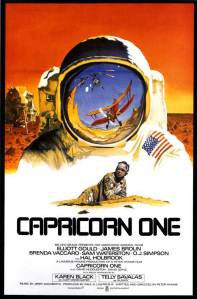
But by the time I graduated from NU in 1980, the excitement of the Apollo missions seemed like ancient history. NASA wasn’t pushing on to Mars. That was disappointing. So were Watergate, the Iranian Hostage Crisis and the Arab Oil Embargo. And some paranoid cynics were even claiming the lunar landings were faked!

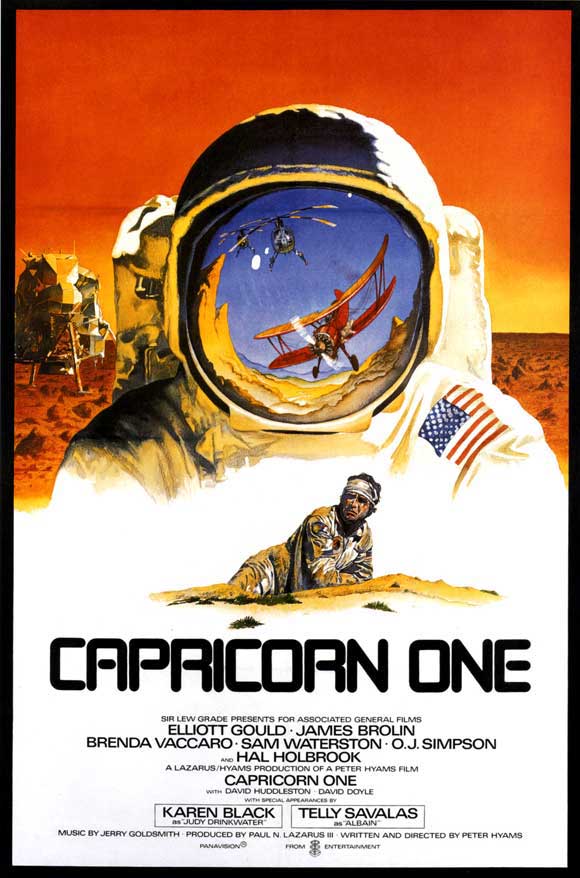
The disillusioned mood was captured in Capricorn One, a 1978 movie in which the U.S. government stages a Mars landing hoax.

Americans needed a morale boost in 1981. Frustrated voters gave us President Ronald Reagan and NASA gave us the Space Shuttle program.

The Space Shuttle was kinda cool at first. I mean, come on – a reusable space vehicle that could land on a runway like a plane? That was really neat.

But by the time the first shuttle, dubbed Columbia, was launched on April 12, 1981, it had been exactly 20 years since cosmonaut Yuri Gagarin became the first man in space — and no American had been in space in more than 8 years.

NASA’s second space shuttle, Challenger, made its maiden flight on April 4, 1983. Nearly three years later, on January 28, 1986, Challenger was on the launch pad, ready to go on her tenth mission.

By then, the Shuttle Program was taken for granted by many Americans, including me.

Without a sexy, inspirational objective like taking a man to the Moon to fire our imaginations, the astronauts on the space shuttle missions seemed more like lab technicians in space, performing experiments, testing equipment, and building a space station whose purpose was ill-defined and unappreciated by the general public.

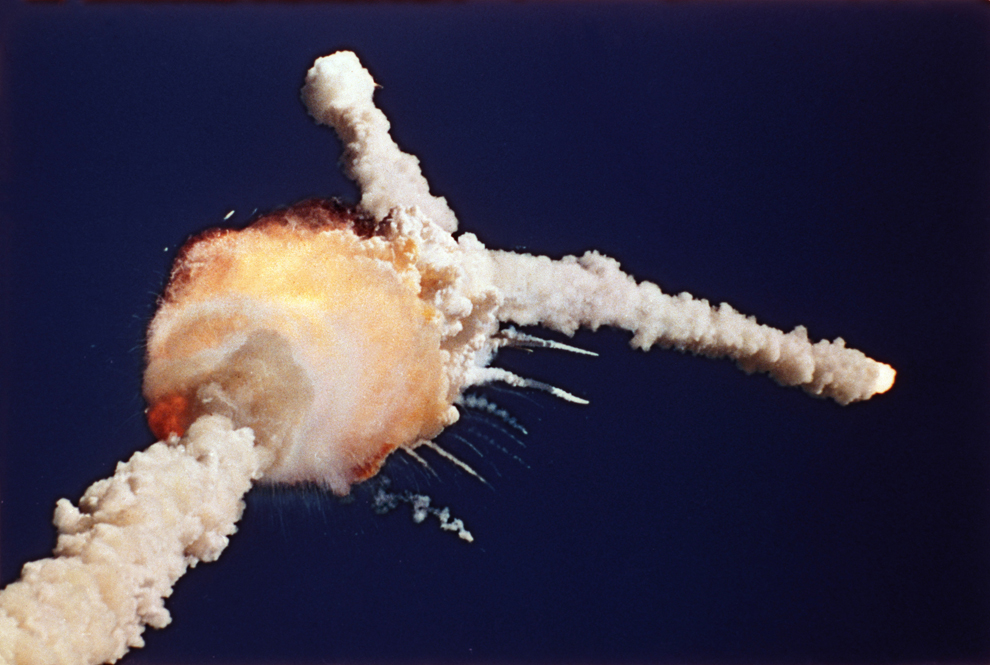
Then, just 73 seconds after lift-off – Challenger’s tenth mission turned into a spectacular reminder of the grave dangers of manned space flight.

Challenger exploded during its ascent, killing all seven astronauts on board, including Christa McAuliffe, a 37-year old elementary school teacher. Christa’s starring role as the first teacher in space attracted more attention to this launch than most of the previous shuttle missions.

Largely because of space pioneer teacher Christa McAuliffe, school kids across the country were watching the launch in their classrooms (just as we’d done at St. Rocco’s two decades earlier.)

In a few shocking, fiery moments, the Challenger Disaster became the most indelible image of the Space Program since Armstrong took that first step on the Moon.

And we all learned about “O-rings.”

Seventeen years after Challenger blew up, the Space Shuttle Columbia came to ruin on the opposite end of its journey: Columbia broke up on re-entry into the atmosphere on February 1, 2003, killing all seven crew members.

In a way, Challenger and Columbia were tragic bookends to a Space Shuttle Program that has been largely unsung in the course of 130 missions. This week’s final voyage of the Space Shuttle Atlantis closes the Shuttle Program’s page in the epic Space Age adventure series that has been so much a part of my generation.

Bon Voyage, Atlantis. Prayers for your safe return.

A Parochial Coda:

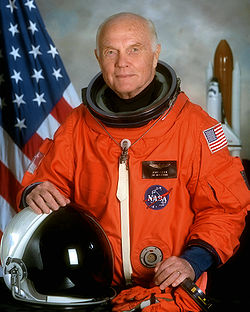
After serving 24 years as a Senator from Ohio, my boyhood hero, John Glenn – the fist American to orbit the Earth – became the oldest person to go into space.

Glenn was 77-years old on October 29, 1998, when he took his second record-breaking spaceflight, this time aboard the Space Shuttle Discovery.

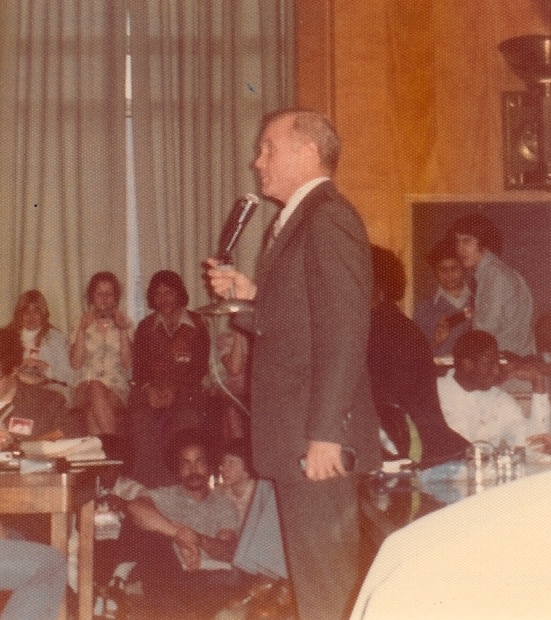
I had the privilege of meeting Senator John Glenn 23 years before his space shuttle flight when I was a high school junior visiting Washington D.C. as part of a Close Up Program trip.

The year was 1975, and it had only been 13 years since Glenn had flown his Mercury capsule in orbit around the Earth.

He seemed larger than life as he spoke to us in that Congressional committee meeting room. He was a real hero — a guy with The Right Stuff.
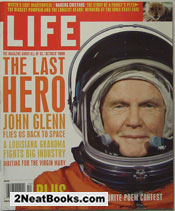
John Glenn was born on July 18, 1921 – and next week he’ll celebrate his 90th birthday.

Happy birthday, John!

Thanks for the memories.

10 Comments

Filed under History